
A new twinge when you sip coffee. A dark spot you don't remember seeing last month. A tooth that feels “off” when you chew. That's usually the moment people start searching for a dentist near me in Chattanooga, TN or an emergency dentist in Cleveland, TN and hoping the answer isn't going to be stressful, painful, or complicated.
Most cavities are treatable. Many are easier to manage than patients expect, especially when we catch them early. Modern dentistry gives us several cavity treatment options, from simple fluoride care to fillings, crowns, root canals, and, when needed, tooth extraction and tooth replacement. The right treatment depends on how deep the decay goes, how much healthy tooth is left, and what will keep you comfortable now while protecting your long-term oral health.
This guide walks through those options in plain language, with a focus on what patients usually want to know first: What's happening, what will it feel like, and what comes next?
Finding a Dentist for Your Toothache in Chattanooga TN
You wake up with a toothache, tell yourself it might go away, then notice that cold water makes that same tooth zing. By lunchtime, you're checking the mirror for a crack or dark spot. By evening, you're searching for a dentist in Chattanooga, TN because not knowing feels worse than the problem itself.
That uncertainty is common. Some patients worry they'll hear they need a root canal. Others haven't been to the dentist in a while and feel embarrassed. Many want someone to explain what's wrong without making the visit feel rushed or overwhelming.

What most patients are feeling before they call
A toothache doesn't always mean the same thing. It could be early decay, a cracked filling, a deeper infection, or irritation from clenching and grinding. That's why a proper exam matters. The goal isn't to guess. It's to find the cause and match it to the least invasive treatment that makes sense.
Patients in Chattanooga and Cleveland also tend to ask practical questions right away:
- Will it hurt: Patients want relief, not a lecture.
- Can this be fixed today: Sometimes yes, especially for simpler restorative care.
- Do I have options if I'm anxious: Yes. Comfort measures and sedation can make treatment much easier.
A cavity visit should feel clear and manageable. Patients do better when they know what the dentist sees, why treatment is recommended, and what the appointment will actually feel like.
If you're interested in how local practices make it easier for patients to find the right office, this guide to mastering local SEO for multiple branches gives useful context on why location-specific information matters when you're comparing care in Chattanooga and Cleveland.
What Is a Cavity and Why Does It Need Treatment
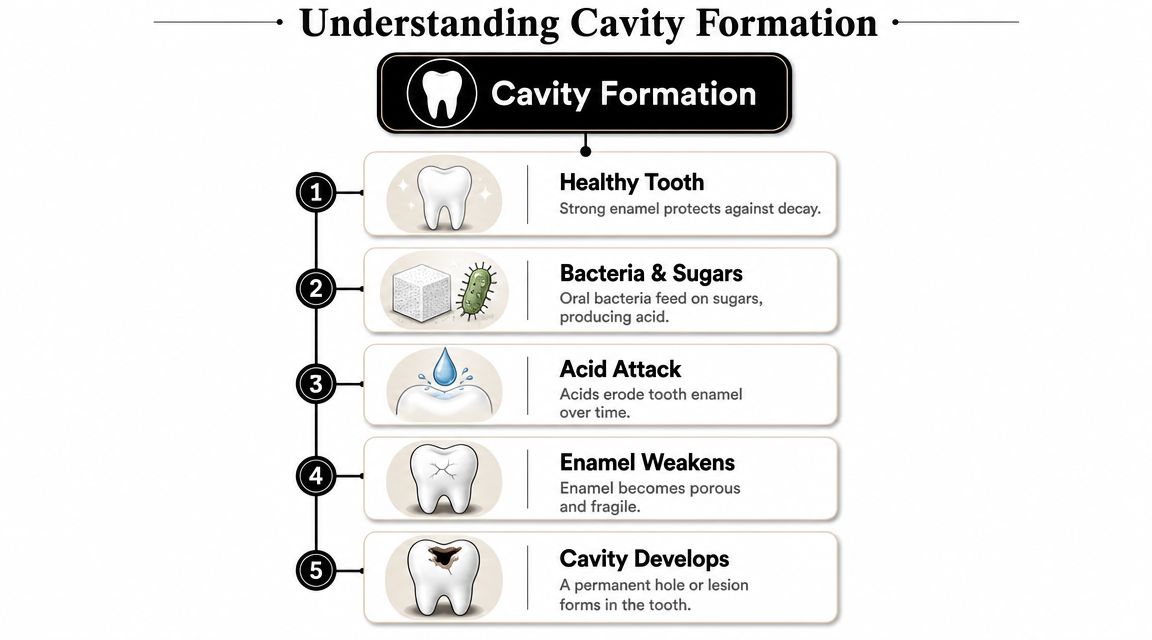
A cavity is a damaged area in a tooth caused by decay. In simple terms, bacteria in the mouth feed on sugars and produce acid. That acid weakens the outer layer of the tooth, then works deeper if it isn't stopped.
A small cavity can develop unnoticed. You may not feel anything at first. That's one reason people get caught off guard when a dentist points out decay on an exam or X-ray.
To make this easier to picture, think of a pothole in a road. The first weak spot looks minor. Cars still pass over it. But if no one repairs it, water, pressure, and time make the hole larger. Teeth work the same way. A tiny weak area can turn into a deeper structural problem.
How decay moves through a tooth
A tooth has layers. The outer layer, enamel, is strong. Under that is dentin, which is softer and lets decay spread more quickly. Deeper still is the pulp, where the nerve and blood supply live.
Once decay reaches each new layer, treatment usually becomes more involved.
- Early weakening in enamel can sometimes be managed without drilling.
- A true hole in the tooth usually needs a filling to remove decay and rebuild the tooth.
- Deep decay near the nerve may require a crown or root canal treatment.
- A badly damaged, unsalvageable tooth may need extraction.
The reason dentists take cavities seriously isn't just comfort. It's preservation. The earlier we act, the more natural tooth structure we can keep.
For a closer look at common causes in adults, this article on what causes tooth decay in adults is a helpful companion read.
Why treating a cavity matters early
The problem is common enough that you shouldn't feel singled out by it. The World Health Organization reports that untreated dental caries in permanent teeth is the most common health condition worldwide, and in the United States, nearly 90% of adults ages 20 to 64 have had tooth decay, while 1 in 4 have untreated decay according to the World Health Organization oral health fact sheet.
Here's a short visual overview that helps many patients understand the progression before they come in for care.
Practical rule: If a tooth is newly sensitive, catches food, or has a visible dark spot, don't wait for severe pain before booking an exam. Cavities rarely become simpler with time.
Early Cavity Treatment Fluoride and Dental Sealants
Not every cavity concern means you need a drill. When decay is still in its earliest stage, the goal is often to strengthen the tooth and stop the damage from progressing.
That's where fluoride and sealants come in. These are preventive and minimally invasive options that can be especially useful when a dentist sees early enamel changes, vulnerable grooves on back teeth, or spots that are at higher risk but not yet structurally broken down.
When fluoride makes sense
Fluoride helps remineralize weak enamel. In a dental office, that often means a professional fluoride varnish applied directly to the teeth. Patients usually find it quick and easy. There's no drilling, no shot, and no recovery period beyond following the after-care instructions you're given.
For adults, fluoride is often part of an early intervention plan when a dentist sees a non-cavitated area that may still be reversible. It can also help people who deal with dry mouth, frequent sensitivity, or a history of recurrent decay.
StatPearls notes that initial lesions should be managed with remineralization, biofilm control, and sealing rather than immediate tissue removal, supporting a conservative approach when a lesion is still early enough for that kind of care, as explained in this StatPearls overview of dental caries.
Where sealants help most
Sealants are thin protective coatings placed on the chewing surfaces of back teeth. Molars have tiny grooves and pits that can be hard to keep clean, even for people who brush well. A sealant helps block bacteria and food from settling into those areas.
Patients usually ask if sealants are only for kids. They're most commonly discussed for children and teens, but adults with deep grooves and cavity-prone molars may also be candidates depending on the tooth and its condition.
The CDC notes that fluoride varnish can reduce cavities in primary teeth by about one-third, and dental sealants can prevent 80% of cavities on the chewing surfaces of back teeth. You can read that directly on the CDC cavities and tooth decay page.
What early treatment feels like
This is often the most reassuring part for nervous patients. Early cavity treatment usually feels simple.
- Fluoride varnish: Fast, topical, and noninvasive.
- Sealants: Smooth application with little to no discomfort.
- Monitoring with home care: Sometimes the best next step is better brushing, fluoride toothpaste, and a shorter recall interval.
If a tooth is early enough for these options, preserving natural structure is the priority. That's good for comfort today, and it's also good for your long-term restorative health because every bit of healthy tooth matters.
Restoring Your Smile Dental Fillings Inlays Onlays and Crowns
Once a cavity has formed a true hole, the question changes from “Can we reverse this?” to “What's the best way to rebuild the tooth?” The answer depends on how large the damaged area is and how much support the remaining tooth can provide.
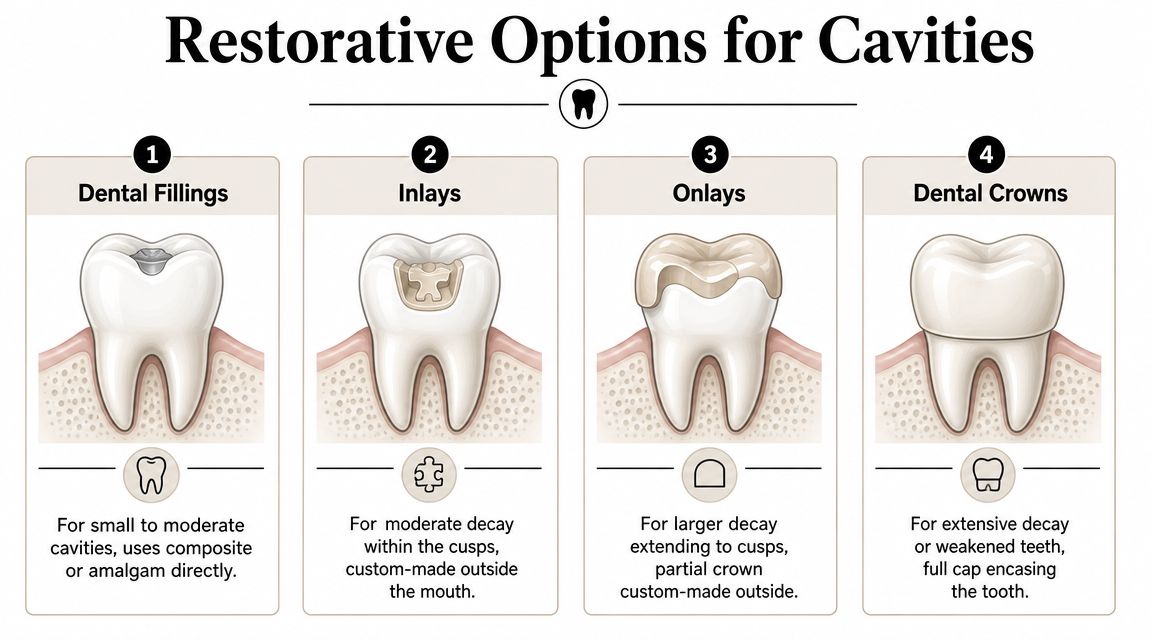
Many patients get confused, because several treatments can sound similar. A filling, inlay, onlay, and crown all restore a tooth, but they do it at different levels of coverage and strength.
How to think about each option
A simple comparison helps.
| Treatment | Best for | How much of the tooth it covers | What patients often notice |
|---|---|---|---|
| Filling | Small to moderate cavity | The damaged area only | Usually the simplest and most familiar repair |
| Inlay | Damage inside the cusps | More than a filling, less than an onlay | Custom fit for added precision |
| Onlay | Larger damage involving one or more cusps | Partial coverage of the chewing surface | More strength when a filling isn't enough |
| Crown | Extensive decay or weakened tooth | Covers the whole visible tooth | Full protection and support |
Fillings for smaller cavities
A filling is usually the right choice when decay is limited enough that the tooth still has strong surrounding walls. The dentist removes the decayed area, cleans the space, and places filling material to restore shape and function.
The FDA explains that composite resin is the most common filling material, and the same source notes that indirect restorations are among the more durable options for larger defects. The Mayo Clinic notes that crowns are used when decay is extensive because they cover the entire tooth, while ceramic onlays are durable, long-lasting options. Those treatment details are summarized on the FDA page about treatment options for dental caries.
For patients, the big question is usually comfort. Most fillings feel easier than expected. You're numb during the procedure, and after the appointment the tooth may feel a little different for a short time as your bite settles.
Inlays and onlays for the middle ground
Sometimes a tooth is too damaged for a simple filling but doesn't need a full crown. That's where inlays and onlays help. These restorations are made to fit more precisely and support a tooth that needs more strength.
You can think of them as custom restorations for the gray zone between a basic filling and a full cap. They're often chosen when preserving more natural tooth is still realistic but the cavity is too large for direct filling material alone.
If you've ever been told, “This tooth is too big for a filling but not broken enough for a crown,” an inlay or onlay may be the reason.
Crowns for heavily damaged teeth
A crown covers the full visible portion of the tooth above the gumline. Dentists recommend crowns when the remaining tooth is too weakened to hold up well with a filling alone, or when a tooth has had extensive decay and needs better structural protection.
Crowns often sound intimidating, but many patients like the feeling of having a compromised tooth fully reinforced. Chewing can feel more secure. Temperature sensitivity may improve once the tooth is properly restored and sealed.
For patients who are busy or anxious, convenience matters too. Same-day crown technology can reduce the drawn-out feeling of restorative care because it avoids the usual sequence of temporary crown, outside lab wait, and return visit. At Winn Smiles, same-day crowns are one restorative option used when a tooth needs full-coverage protection in a more efficient format.
Advanced Care for Deep Decay Root Canals and Extractions
The treatments people fear most are often the ones that bring the most relief. If decay has reached the pulp, the inside of the tooth can become inflamed or infected. That's when pain can shift from occasional sensitivity to lingering ache, throbbing, or pain with pressure.
At that stage, the goal is no longer just repairing a hole. The goal is stopping infection, removing the source of pain, and saving function if possible.
What a root canal actually does
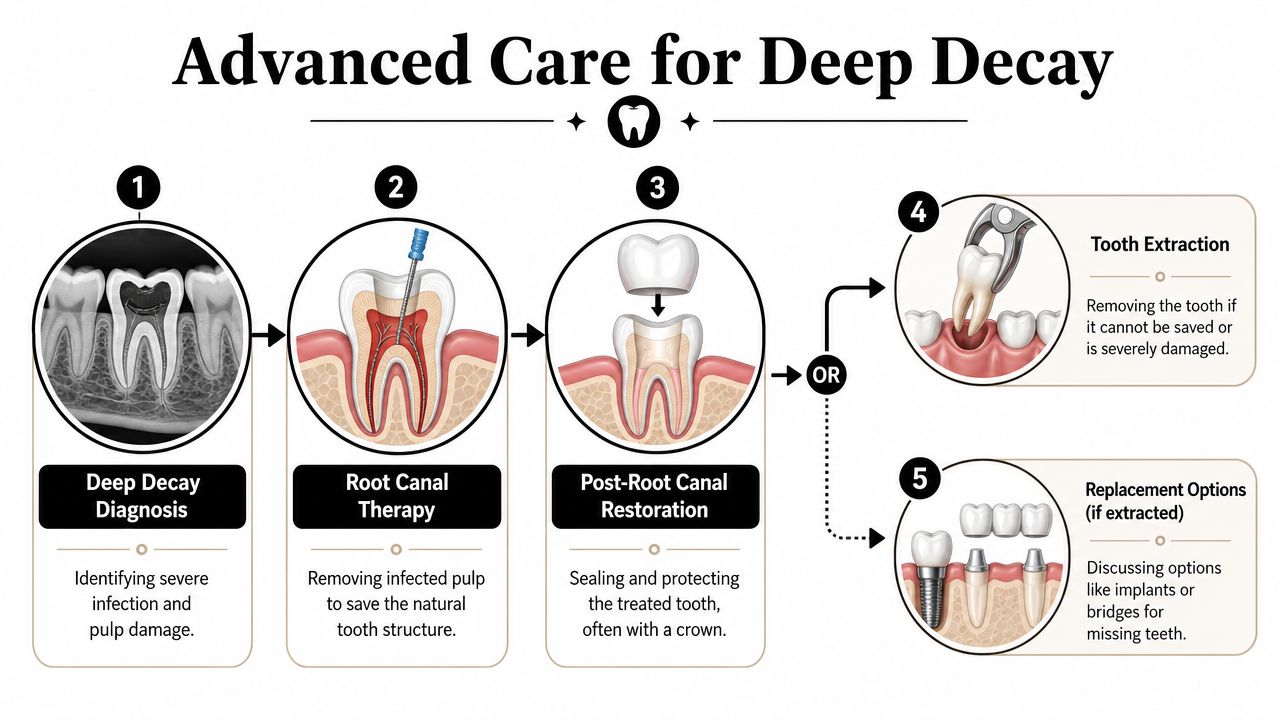
A root canal treats the inside of a tooth. The dentist removes damaged or infected pulp tissue, cleans the internal canals, and seals the space. In many cases, the tooth is then restored with a crown for protection.
Patients often assume a root canal is what causes pain. In reality, the infection or inflammation is what hurts. The procedure is done to remove that source of pain and preserve the natural tooth.
If you'd like a service-specific overview, this page on root canal treatment explains the basics in straightforward language.
What it feels like for most patients
The anxiety around root canals usually comes from stories, not current experience. Modern treatment is focused on numbness, efficiency, and keeping you comfortable throughout the appointment.
Here's how many patients describe it:
- During treatment: Pressure more than pain, similar to having a filling while numb.
- After treatment: Soreness is possible, but many people feel relief because the deep internal irritation has been addressed.
- After final restoration: The tooth often feels stable again once it's protected.
Root canal therapy is a tooth-saving procedure. If a tooth can be preserved predictably, saving it is usually preferable to losing it.
Expert guidance from StatPearls emphasizes a minimally invasive philosophy, managing early lesions conservatively and extending that same tooth-preserving principle to advanced care, where root canals are chosen to preserve the natural tooth whenever possible, with extraction only when necessary.
When extraction is the better choice
Sometimes a tooth can't be saved. The decay may be too extensive, the remaining structure too weak, or the infection too severe. In that situation, tooth extraction can be the healthiest option.
This is where careful communication matters. An extraction should never feel like “giving up.” It should feel like a clear medical decision made to remove pain, eliminate disease, and create a path toward a better long-term result.
Common reasons extraction may be recommended include:
- Too little healthy tooth remains: There isn't enough structure to support a lasting restoration.
- The tooth is fractured beyond repair: Even if decay were removed, the tooth wouldn't function predictably.
- Infection control requires removal: The tooth is no longer a good candidate for preservation.
Replacing a tooth after extraction
If a tooth does need to come out, replacement matters. Leaving a gap can affect chewing, appearance, and how neighboring teeth move over time.
Patients searching for dental implants near me are usually looking for a stable, long-term option. Dental implants are commonly considered the strongest replacement approach because they replace the missing tooth root and support a restoration above it. Depending on the situation, a bridge or other restorative plan may also make sense.
The important thing is this. Extraction isn't the end of the conversation. It's one step in a larger plan to restore comfort, function, and confidence.
Your Comfort-First Dental Visit in Chattanooga and Cleveland
For many adults, the hardest part of cavity treatment isn't the procedure. It's the anticipation. They worry about shots, drilling sounds, bad past experiences, or not knowing what the dentist will find. A comfort-focused visit changes that experience before treatment even begins.
The environment matters. So does the pace of communication. Patients tend to feel calmer when the office feels welcoming, the team explains things clearly, and the treatment plan isn't delivered in rushed technical language.

What helps anxious patients most
Comfort in dentistry is usually a combination of small details and clinical tools working together. At a practical level, patients often do best when they know they'll be listened to and not pushed through a one-size-fits-all process.
That may include:
- A calm consultation: Time to describe what you're feeling, what worries you, and what outcome you want.
- Sedation options when appropriate: Especially helpful for patients with high anxiety or complex treatment needs.
- Laser dentistry in selected cases: A gentler, more precise option for certain procedures.
- Clear financial conversations: Understanding treatment choices and costs before care begins.
What the appointment typically feels like
A new patient exam for suspected decay often starts with photos, dental X-rays, and a close clinical exam. From there, the dentist explains what's early, what's active, and what can wait versus what should be treated soon.
Patients usually respond well to this kind of side-by-side explanation:
| What you may hear | What it means in plain language |
|---|---|
| “We can monitor this area” | It doesn't need drilling now, but it needs follow-up |
| “This needs a filling” | There's a true cavity that should be cleaned and restored |
| “This tooth may need a crown” | Too much structure is weakened for a simple filling |
| “The nerve is involved” | The decay is deep enough that root canal care may be needed |
A good dental visit leaves you with fewer unknowns. You should know what the problem is, what the treatment choices are, and what the next step will feel like.
For patients in Chattanooga and Cleveland, that kind of visit often matters as much as the treatment itself. If you've delayed care because you hate feeling rushed or judged, a comfort-first approach can make it much easier to move forward.
Your Next Steps and Common Cavity Questions
Patients often wait to schedule because they're stuck on one practical question. Usually it isn't “What is a cavity?” It's “Do I really need treatment yet?” or “Can I avoid a filling?”
Can drill-free treatment replace a filling
Sometimes, but only very early. The Mayo Clinic notes that while fluoride can reverse very early decay, once a physical cavity, meaning a hole, has formed, a filling is typically necessary to remove the decay and restore the tooth. That's the key line many people need, and it's explained on the Mayo Clinic cavity diagnosis and treatment page.
How do I know if my cavity is early or deep
You usually can't tell with confidence at home. Sensitivity can happen with both early and deeper problems. Some deep cavities barely hurt until they become urgent. A dentist uses an exam and imaging to tell whether the enamel is just weakening, whether there's a true hole, or whether the decay is already near the nerve.
If I'm nervous, should I still come in now
Yes. In fact, anxious patients often benefit the most from earlier care because smaller problems usually mean simpler treatment. That often translates to shorter visits, fewer surprises, and more options for conservative treatment.
The simplest next step is to book an exam while the problem still feels manageable. If you need a dentist in Chattanooga, TN, a dentist near me, help with restorative dentistry, or guidance on whether a tooth may need a filling, crown, root canal, or tooth extraction, getting answers early protects both comfort and long-term oral health.
If you're dealing with tooth sensitivity, a dark spot, or a toothache that won't settle down, Winn Smiles offers dental care in Chattanooga and Cleveland with a focus on clear explanations, patient comfort, and treatment options that fit your needs. Schedule a visit to find out whether your tooth can be treated with early care, a filling, a same-day crown, or another restorative solution before the problem gets more complicated.