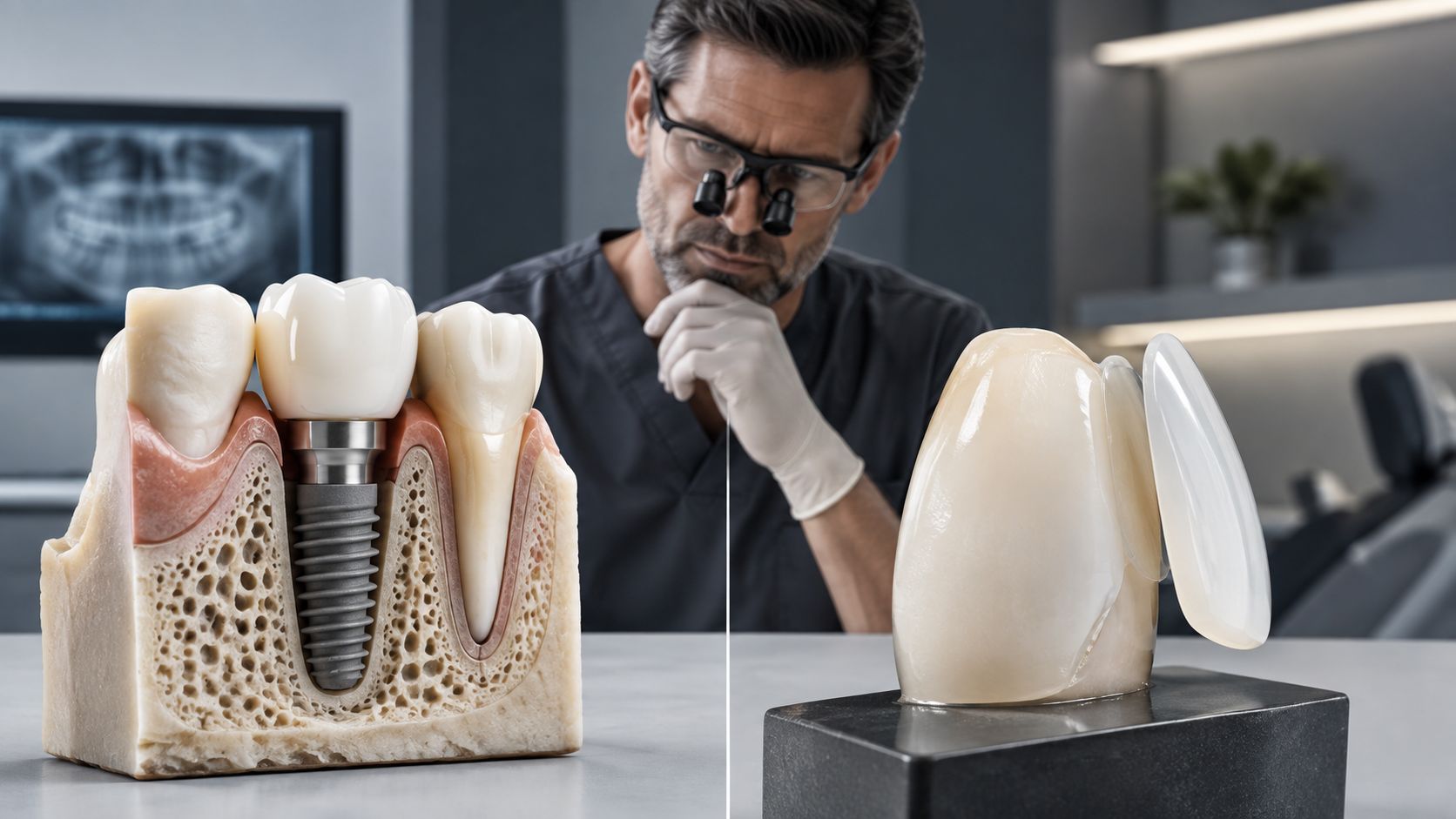
A single dental implant usually costs about $3,000 to $6,000, while a single porcelain veneer usually costs about $900 to $2,500. In plain terms, implants usually cost about 2 to 4 times more upfront, but the right choice depends less on price and more on whether your tooth is missing or cosmetically flawed.
If you're in Cleveland, TN or Chattanooga, TN, you're probably not comparing these because you're shopping for a random cosmetic upgrade. You're comparing them because something is bothering you right now. Maybe you had a tooth extraction and now you hate the gap. Maybe a front tooth is chipped, dark, or worn down. Maybe you're typing “dentist near me,” “dental implants near me,” or “cosmetic dentist near me” because you want a clear answer before you book.
That answer starts with one simple rule. Implants replace missing teeth. Veneers improve the look of teeth that are still there. If you keep that straight, the money conversation gets much easier.
Why Cleveland and Chattanooga Patients Are Comparing Implants and Veneers
Online dental searches blur two very different treatments together. A patient in Ooltewah loses a back tooth after a difficult root canal and starts looking into tooth replacement. A Chattanooga teacher with a worn front tooth from grinding sees beautiful veneer photos online and wonders if that applies to her. A Cleveland patient getting ready for a wedding wants to fix old bonding that never looked quite right. All three may end up reading the same “dental implants vs veneers cost” article, even though they need different treatment paths.
Start with tooth status, not price
The biggest mistake I see is people asking, “Which one is cheaper?” before asking, “What problem am I treating?”
If the tooth is gone, a veneer isn't an option. It needs enamel to bond to. If the tooth is present and healthy enough, an implant would be unnecessary and far more invasive than needed.
Practical rule: If the tooth is missing, think implant. If the tooth is present but stained, chipped, uneven, or worn, think veneer first.
That matters for local patients searching for a dentist in Cleveland, TN or dentist in Chattanooga, TN because the best treatment isn't the cheapest line item. It's the one that fits the condition in your mouth.
Three common local scenarios
- After a tooth extraction: If you're missing a molar and want stable chewing again, you're in restorative dentistry territory. This often overlaps with emergency dentist care, tooth extraction follow-up, dental x-rays, and implant planning.
- For a damaged front tooth: If the tooth is still structurally sound but looks rough, cosmetic dentistry may solve it faster and for less money.
- For a smile refresh: If you dislike old bonding, uneven color, or small chips across several visible teeth, veneers usually make more sense than replacing healthy teeth with implants.
Patients also compare these options because they want one office that can handle the full picture. That may include cleaning and exams, new patient exams, cosmetic dentistry, restorative dentistry, and emergency dental services under one roof. That's the practical way to make a decision. Match the treatment to the tooth, then judge the cost.
What Each Treatment Actually Does to Your Tooth
A lot of confusion disappears once you understand what each treatment physically does.
Implant means replacement
A dental implant is a full tooth-replacement system. It replaces the part under the gums and the visible part above the gums. The implant post is placed into the jawbone, then an abutment connects the post to a custom crown. The result is a replacement tooth that stands on its own.
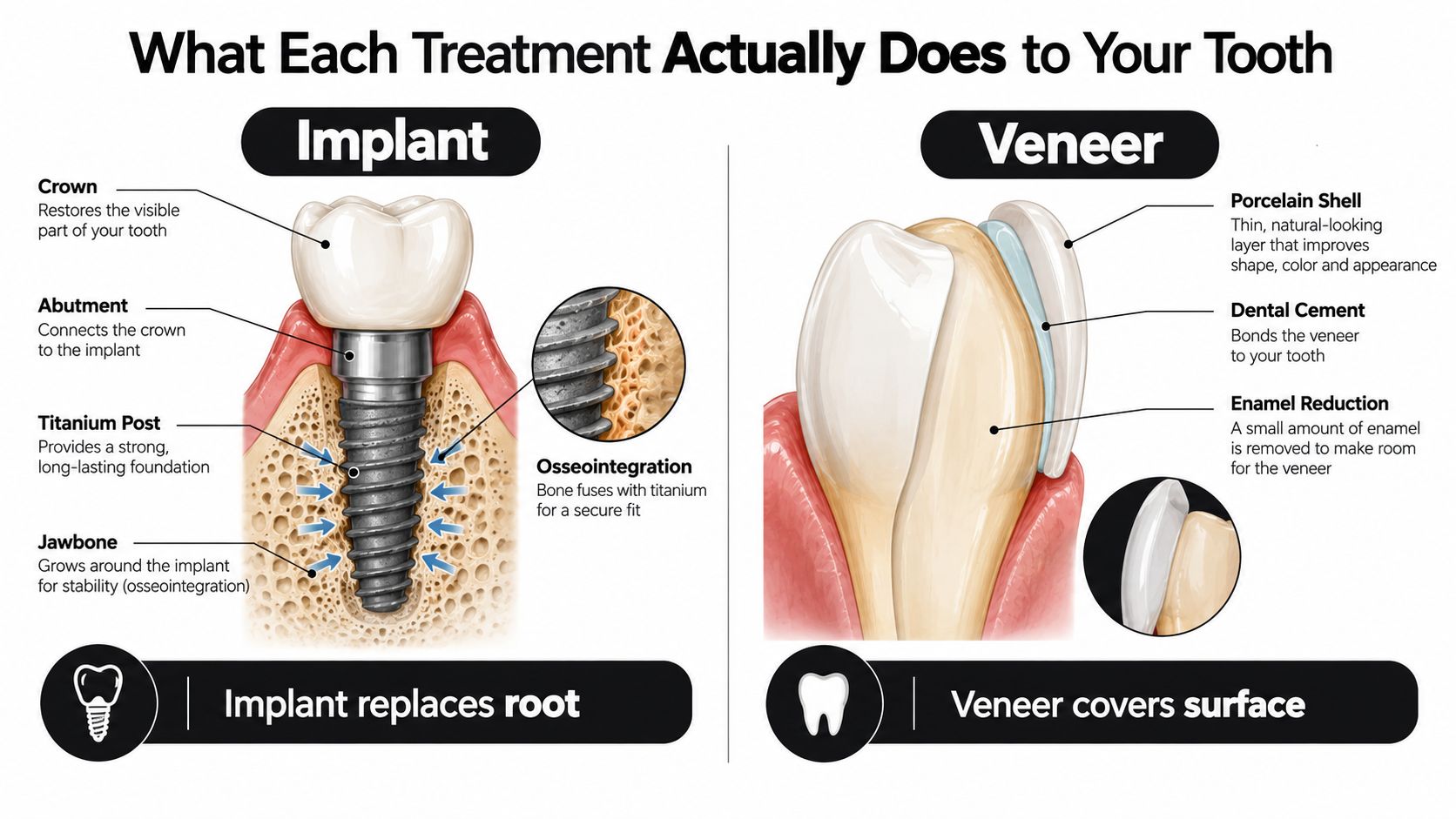
This is the option for a missing front tooth after an accident, a failed root canal that led to extraction, or a tooth that's beyond saving. It's restorative treatment, not a cosmetic cover-up.
Veneer means coverage
A veneer is a thin shell, usually porcelain, bonded to the front of an existing tooth. It changes the color, shape, width, and surface appearance of that tooth. It doesn't replace the root. It doesn't replace a missing tooth. It improves what you already have when the tooth itself is still present.
This is why veneers work well for deep discoloration, old bonding, small gaps, mild shape issues, and chipped enamel on visible teeth. If someone has a tetracycline-stained smile or several front teeth that look uneven, veneers can create a major cosmetic improvement without replacing the teeth.
An implant replaces a missing tooth. A veneer covers a visible flaw on a tooth that still has enough healthy structure to keep.
Why this matters to your mouth, not just your smile
These treatments solve different biological problems.
- Implants support a missing tooth space and are part of restorative dentistry.
- Veneers depend on healthy enamel and belong to cosmetic dentistry.
- Implants are surgical care.
- Veneers are surface-level smile design.
That difference matters long before you discuss fees, financing, or whether you're booking with a cosmetic dentist near me. If you self-sort correctly at the start, your consultation becomes much more efficient.
Upfront Cost Compared by the Numbers
Let's get to the numbers people want.
Current U.S. pricing guides place a single porcelain veneer at about $900 to $2,500 per tooth and a single dental implant with crown at about $3,000 to $6,000 per tooth, so implants are usually the higher upfront investment and are often about 2 to 4 times more expensive at the start according to this current veneers vs implants cost breakdown.
Early in your search, this is the cleanest side-by-side view.
| Upfront Cost: Implants vs Veneers in Cleveland and Chattanooga | National Range | Cleveland / Chattanooga Range | What's Included |
|---|---|---|---|
| Porcelain Veneer | $900 to $2,500 per tooth | Varies by case complexity, materials, lab work, and cosmetic goals | Cosmetic planning, tooth preparation, lab fabrication, bonding |
| Single Dental Implant | $3,000 to $6,000 per tooth | Varies by bone support, surgical needs, and whether add-ons are needed | Implant, abutment, and crown, with possible additional surgical costs |
What the sticker price usually hides
Implant pricing is often misunderstood because people see one number in an ad and assume that covers everything. It often doesn't. A complete implant case may involve the implant post, the abutment, the final crown, imaging, and sometimes additional surgical needs. A veneer fee can also vary based on cosmetic planning, temporary restorations, lab ceramics, and how many teeth are being treated together.
Another useful benchmark comes from current U.S. pricing datasets showing that a single dental implant averages about $4,507, while a porcelain veneer averages about $1,759 per tooth, putting the implant at roughly 2.6 times the cost on average in one national dataset from Real Dental Costs.
Multi-tooth cases change the conversation fast
The treatment scope matters just as much as the per-tooth fee. A pricing overview for 2026 places a 6 to 8 veneer smile makeover at about $15,486, while full-mouth implant solutions are commonly cited at $40,000+ for both arches or $20,000 to $30,000 per arch for All-on-4 style treatment in this cosmetic dental financing guide.
If you're comparing smile makeover options, that scale difference matters more than any headline ad. For patients wanting a more detailed veneer fee discussion before booking, this local resource on how much veneers cost is a useful next step.
Lifespan, Replacement Cycles, and Long-Term Value
A Cleveland or Chattanooga patient with one missing tooth and a patient with four worn front teeth should not judge value the same way. If the tooth is missing, the question is how long the replacement will stay functional. If the tooth is still there but looks chipped, stained, or uneven, the question is how often you are willing to remake cosmetic work.
That difference matters more than the starting fee.
Independent pricing guides commonly place porcelain veneers at about 10 to 15 years of service life, while dental implants are often described as lasting 20 to 30 years or longer with maintenance, according to this implant vs veneer cost and lifespan guide. The implant usually wins on durability. Veneers can still be a smart buy, but only when the tooth is present and healthy enough to support them.
Lifetime cost comparison
| Lifetime Cost Comparison: Implant vs Veneer | Dental Implant | Porcelain Veneer |
|---|---|---|
| Primary role | Replaces a missing tooth | Covers an existing tooth |
| Typical service life | Often 20 to 30 years or longer with maintenance | Roughly 10 to 15 years in many pricing guides |
| Replacement pattern | The implant itself may stay in place while the crown may need future maintenance | Veneers are more likely to need full replacement |
| Effect on nearby teeth | Doesn't rely on adjacent teeth | Stays on the treated tooth but depends on healthy enamel |
| Value over time | Higher upfront cost, stronger long-term durability case | Lower upfront cost, but replacement cycles matter |
Here is the plain advice I give. Do not pick veneers to avoid implant cost if the tooth is already failing or missing. That usually leads to more treatment later, not less. An implant costs more up front, but it is built for replacement. A veneer is built for refinement.
Veneers get expensive in a different way. One veneer replacement may feel manageable. Replacing several front veneers years later can turn into another large cosmetic case, especially if you want the shade and shape to match across the smile. The Cleveland Clinic veneer overview also notes that veneers are not permanent and may need replacement over time.
Composite veneers can reduce the initial bill, but they usually wear faster than porcelain. Porcelain lasts longer, costs more, and still may need to be replaced at some point. For patients comparing long-term tooth replacement with cosmetic covering, this guide on how long dental implants last gives a more practical picture of durability.
If you are replacing a missing tooth, implants usually give the better long-term value. If you are improving a healthy but cosmetically flawed front tooth, veneers often make more sense even though they may need to be redone later.
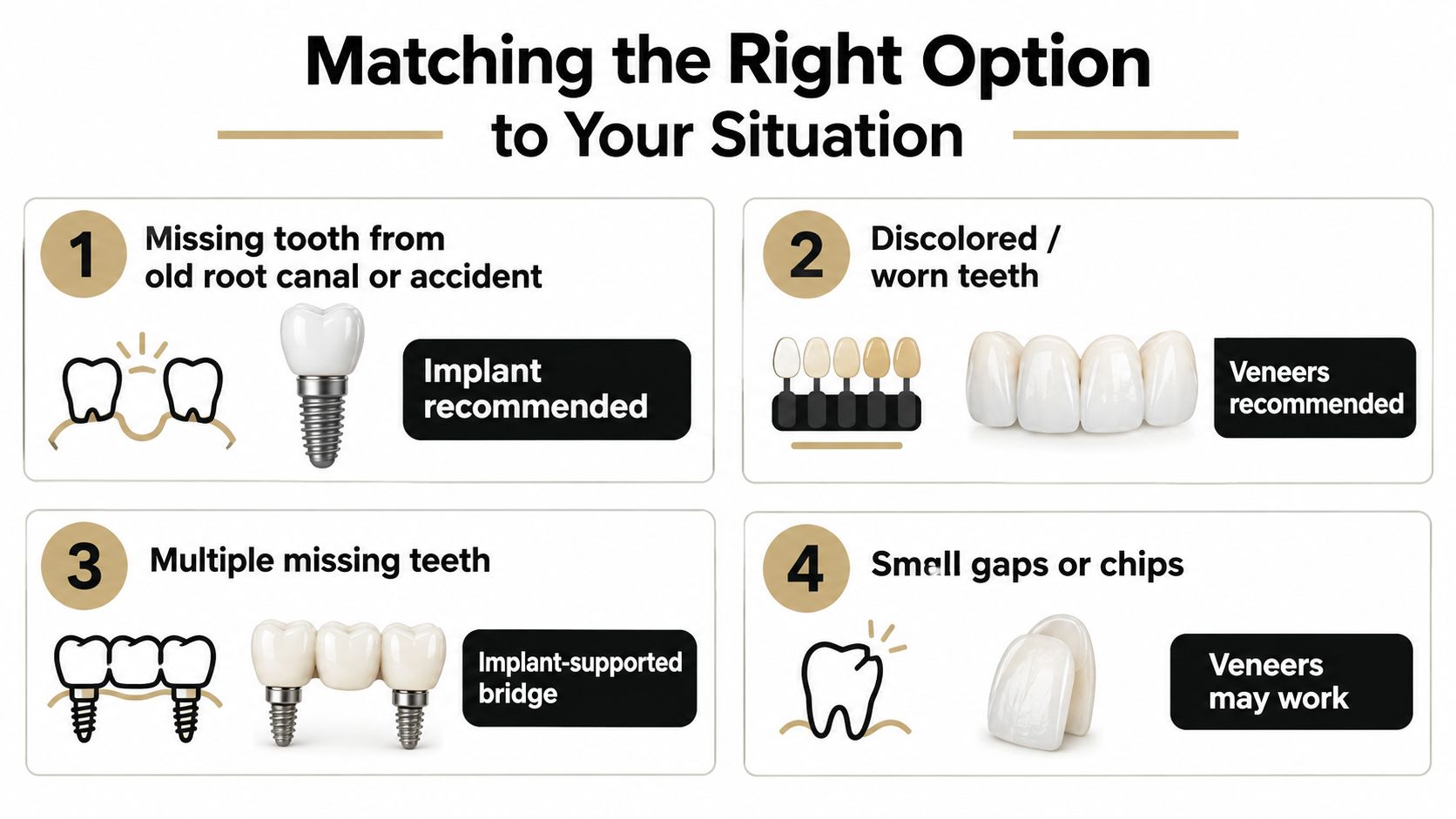
Matching the Right Option to Your Situation
Patients deciding between these options get clarity by matching treatment to tooth status. Start with one question. Is the tooth missing, failing, or unattractive?
In Cleveland and Chattanooga, I see the same mistake over and over. Patients compare veneer and implant prices before confirming whether the tooth can even be kept. That leads to the wrong shortlist fast.
Missing tooth
If the tooth is already gone, or it needs to come out, an implant is the right comparison. A veneer cannot replace a missing tooth. It only covers the front of a tooth that is still there.
That applies whether the space came from an old extraction, sports trauma, or a tooth that failed after a root canal. If you are calling offices around Cleveland or Chattanooga for quotes and the tooth is missing, stop shopping veneers. You need implant planning.
Structurally damaged tooth
This group needs an exam before a price decision. A tooth that is cracked, heavily filled, breaking down, or painful may still be saveable, or it may be one fracture away from extraction.
If the tooth has healthy root support and enough structure left, a veneer might be part of the cosmetic fix. If the tooth is failing below the gumline or cannot hold a restoration predictably, an implant becomes the better long-term move. The question is not cosmetic versus implant. It is save versus replace.
Worn, chipped, stained, or uneven front teeth
Veneers usually make more sense. If the teeth are healthy and stable, veneers can correct color, shape, length, and symmetry in a way an implant is not designed to do.
This is the common Chattanooga and Cleveland cosmetic case. The teeth are present. The patient dislikes how they look in photos, on video calls, or in bright light. That is veneer territory, not implant territory.
Full smile makeover without missing teeth
If no teeth are missing and your concern is appearance, choose veneers or another cosmetic option first. Placing implants just to improve the look of healthy natural teeth is the wrong treatment plan.
A good dentist should say that plainly.
At this stage, patients often benefit from seeing both restorative and cosmetic options in one office. Winn Smiles offers consultations for both, which can be useful when the answer depends on whether a problem tooth can be preserved or should be replaced.
- Choose implant first if the tooth is missing or failing beyond repair.
- Choose veneer first if the tooth is healthy enough and the problem is mainly visual.
- Ask about combining treatments if you are replacing a missing tooth in one area and improving visible front teeth in another.
Timelines, Candidacy, and What the Visit Looks Like
A lot of treatment regret comes from bad expectations, not bad dentistry. The timeline for veneers is very different from the timeline for implants.
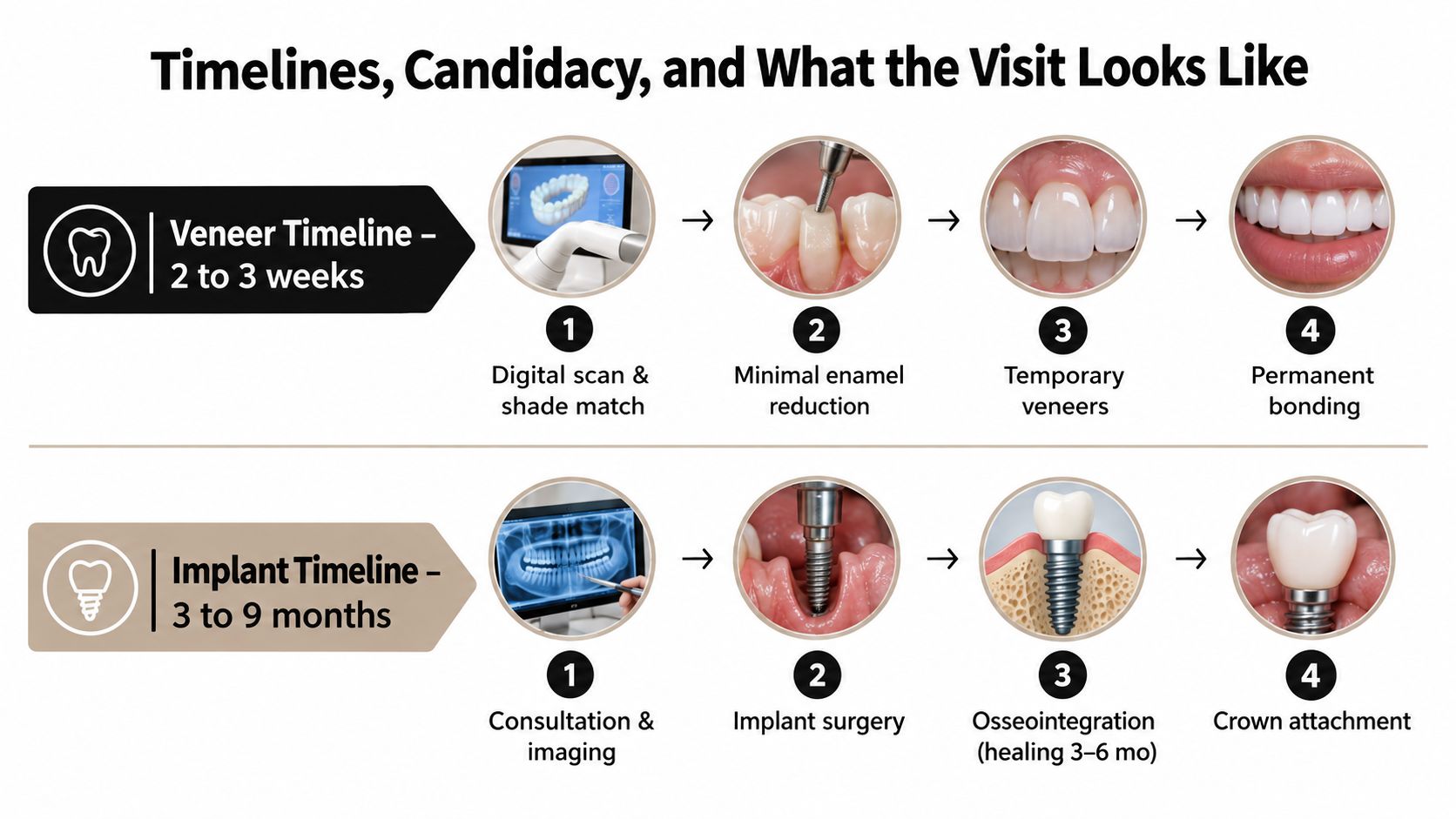
Veneers move faster
Veneers are usually a shorter cosmetic process. The early visit focuses on exam findings, smile goals, shade, and whether the teeth and gums are healthy enough to proceed. Then the teeth are prepared, impressions or digital scans are taken, and the final restorations are bonded at a later visit.
For a cosmetic dentist near me because you want a visible change soon, veneers often fit that urgency better than implants.
Implants take longer but solve a different problem
Implants involve surgery and healing. That means your care plan may include imaging, extraction planning if the tooth is still present, healing time, and then the final restoration phase after integration. It's a more involved path because it's replacing a lost tooth, not dressing up an existing one.
Good implant treatment takes patience. If a tooth is missing, patience is worth it.
What to expect in a local dental office
In Cleveland and Chattanooga, most patients comparing these treatments also need routine dental care wrapped around the bigger decision. A proper consultation often includes:
- Clinical evaluation: A dentist checks whether the tooth is missing, restorable, or only cosmetically compromised.
- Dental x-rays or imaging: This matters for bone support, root condition, and treatment planning.
- Gum health review: Active gum issues can affect both veneer and implant candidacy.
- Written treatment options: You should leave knowing the practical choices, not just hearing a sales pitch.
If you're also overdue for cleaning and exams, that visit may be the right time to catch other issues before investing in cosmetic or restorative work.
Honest Pros and Cons With a Clear Recommendation
Here's the direct version.
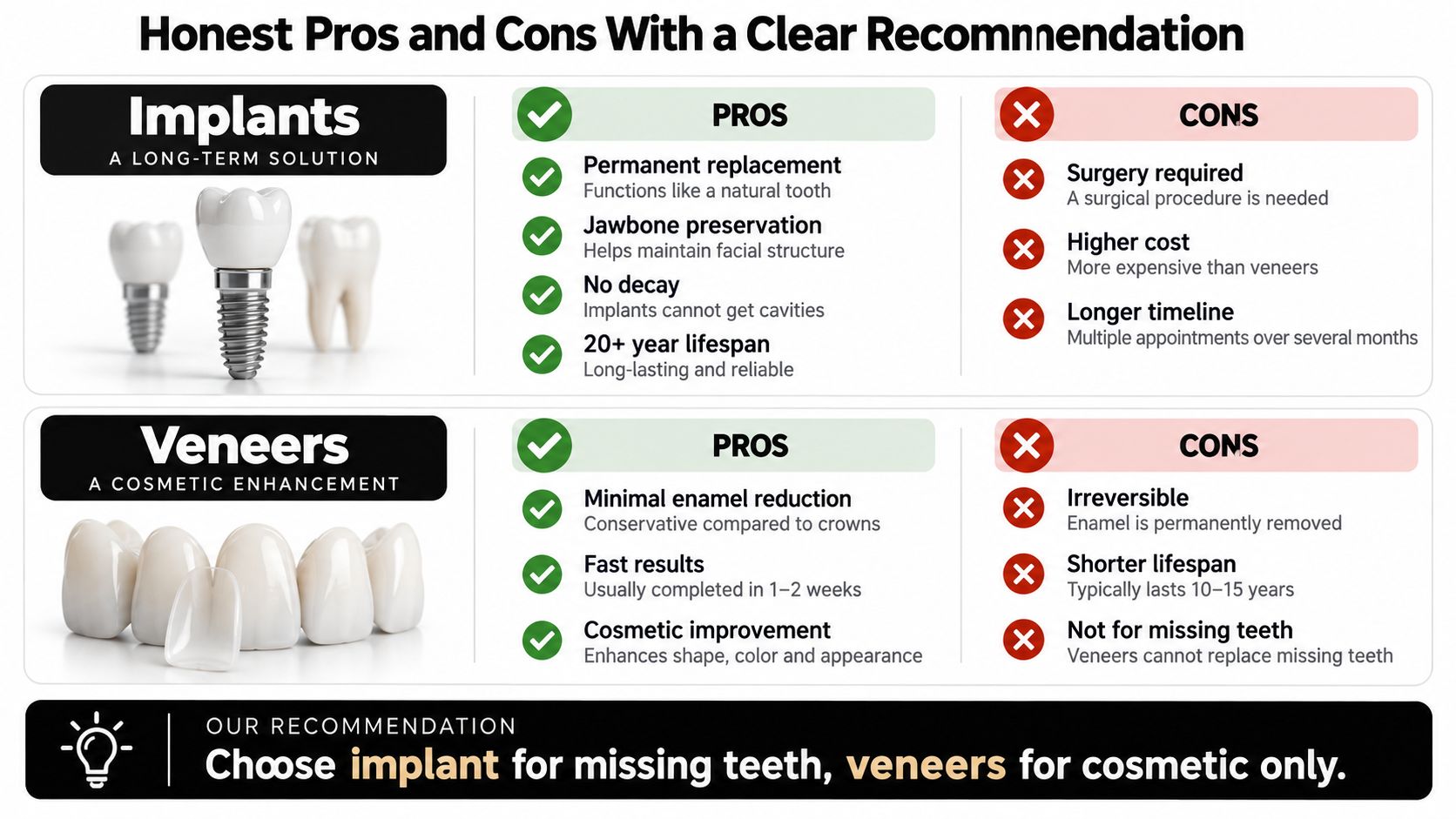
Dental implants
Pros
- Replace a missing tooth instead of hiding the problem
- Stand on their own without depending on neighboring teeth
- Support long-term function and chewing
- Usually offer stronger long-range value for true tooth loss
Cons
- Cost more upfront
- Require surgery
- Take longer to complete
- Aren't the right choice for teeth that are still healthy and present
Porcelain veneers
Pros
- Lower upfront cost than implants in most single-tooth comparisons
- Fast cosmetic change for front teeth
- Excellent for chips, discoloration, old bonding, and shape problems
- Useful when you want a coordinated smile makeover
Cons
- Don't replace missing teeth
- Depend on existing tooth structure
- Need replacement over time
- Aren't a fix for deep structural failure
My recommendation
If you're missing a tooth, stop comparing veneers. Get evaluated for an implant. That's the durable category match.
If your tooth is still there and your complaint is cosmetic, don't jump to surgery. Look at veneers first. That's usually the cleaner, faster, and less invasive path.
If you're unsure whether the tooth can be saved, book an exam with a dentist who does both restorative dentistry and cosmetic dentistry. That way you get an actual diagnosis instead of guessing from photos online.
Financing, Insurance, and Booking Your Consultation
This is the part people often avoid, but it matters. Even the right treatment can feel out of reach if the payment plan isn't clear.
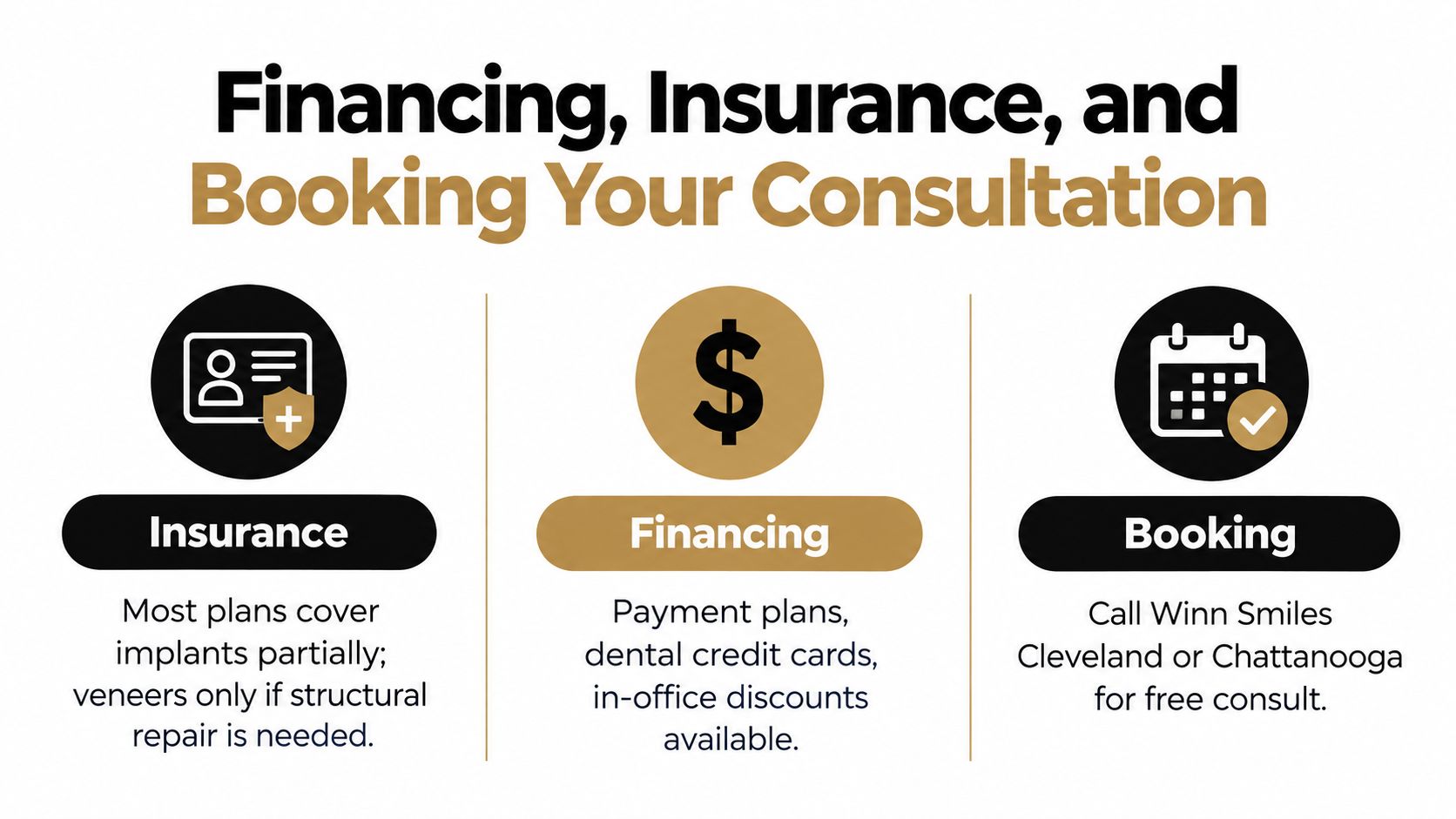
What insurance usually does and doesn't do
Coverage varies widely. In general, cosmetic procedures are harder to get covered than restorative procedures. That's one reason implants and veneers create so much confusion in treatment planning.
For patients reading from the UK, routine public coverage is even more restrictive. NHS guidance states that dental implants are not included in routine NHS dental treatment bands and are generally paid for privately, as explained in this summary of NHS implant coverage. In Tennessee, private dental benefit plans differ by employer and policy, so the only useful answer is a real benefits check tied to your treatment plan.
Smarter ways to pay without rushing into a bad decision
If you need financing, compare terms carefully before signing anything. A practical resource on borrowing basics is this installment vs payday loan guide, especially for patients trying to avoid high-cost short-term debt while managing healthcare expenses.
A good consultation should give you itemized pricing before you commit, not vague ranges and pressure. Ask for the treatment total, what's included, and which parts are optional versus necessary.
The cheapest payment option isn't the safest one. Clear terms matter just as much as the monthly number.
For a dentist near me in Cleveland or Chattanooga, choose an office that can evaluate the tooth, explain the diagnosis, and show you cosmetic and restorative options in writing. That's the kind of visit that helps you make a calm decision instead of a rushed one.
If you're deciding between veneers and implants, Winn Smiles can evaluate whether your tooth is missing, failing, or cosmetic and give you a clear treatment plan for that specific situation. The team provides cosmetic, restorative, and implant care for patients in Cleveland and Chattanooga, so you don't have to guess which category you fit. If you're ready for a straightforward consultation, visit Winn Smiles.