
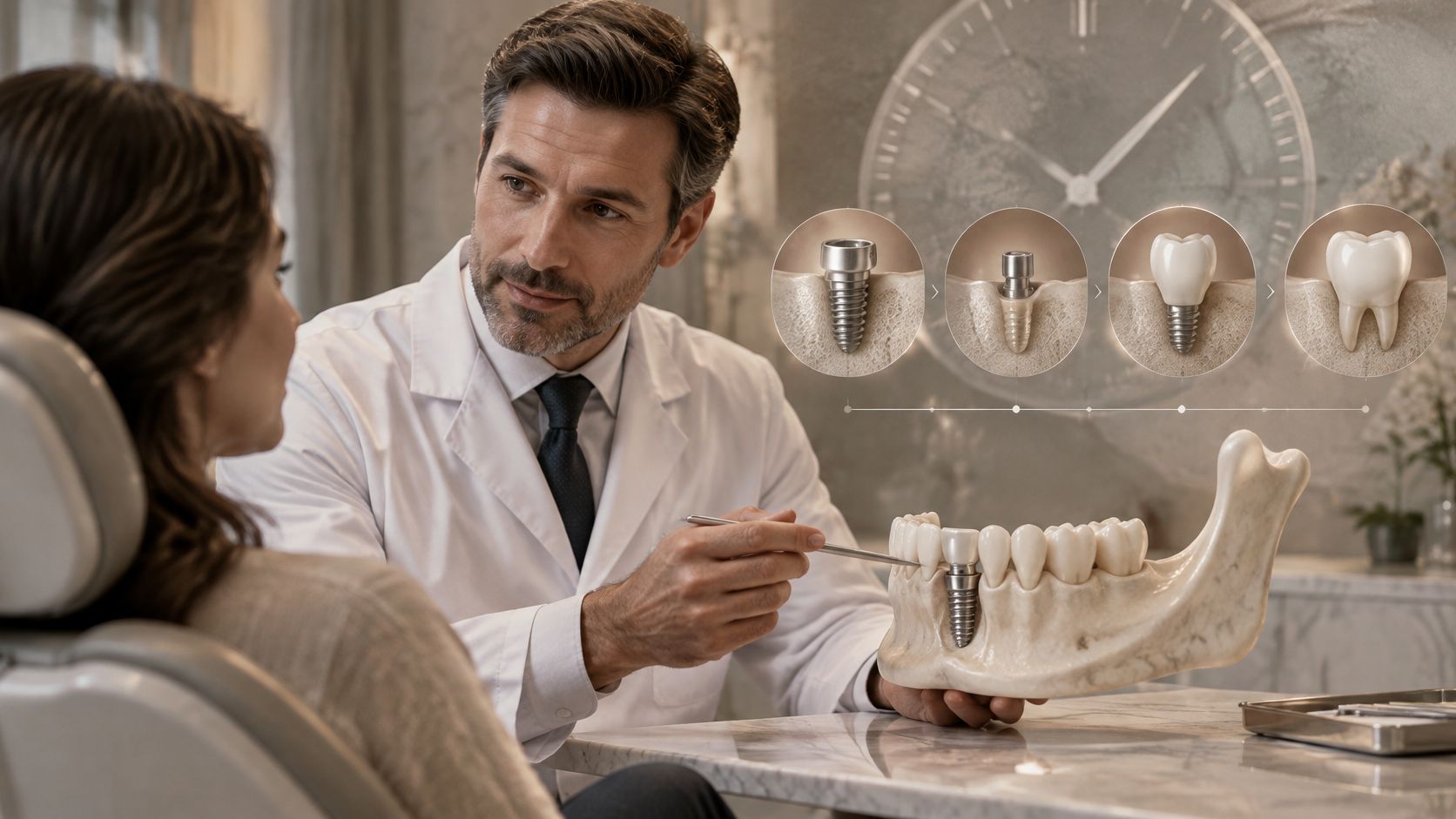
A typical dental implant takes about 6 to 12 months from your first visit to your final crown, and the 3 to 6 month period when bone bonds to the implant is the main reason for that range. When some patients leave with a tooth the same day, it's important to understand the timing involved. That visible tooth, your final crown, and a fully healed implant follow three different clocks, and a good consultation in Cleveland or Chattanooga, TN should separate them clearly.
Dental Implant Stages and Timelines in Cleveland and Chattanooga, TN
Most patients searching for a dentist near me or dental implants near me expect one surgery date. In practice, treatment moves through planning, preparation, placement, healing, and restoration. Guy's and St Thomas' NHS Foundation Trust identifies three or four stages, a pre-operative assessment, possible bone grafting, implant placement, and restorative treatment to fit a crown, bridge, or denture, and notes the overall process commonly takes 6 to 12 months because each stage can involve multiple visits.
Your individual length depends on the number of implants, jawbone condition, healing progress, and the type of replacement tooth you choose. The surgery itself is usually the shortest part. The waiting between steps is what fills the calendar.
Stage by Stage Lookup
| Stage | Typical duration | Visits | What can extend it |
|---|---|---|---|
| Consultation, X-rays and 3D imaging | 1-4 weeks to schedule and plan | 1-2 | Scheduling and imaging review |
| Tooth extraction and socket healing (if needed) | 1-2 weeks for the gum to close | 1-2 | Bone quality after removal |
| Bone graft (if needed) | About 3-6 months before implant placement | 1-2 | Graft maturing before surgery |
| Implant placement surgery | Single appointment, about 1-2 hours | 1 | Number of implants and anesthesia |
| Gum healing | 1-2 weeks | 1-2 check visits | Stitch removal and soft-tissue care |
| Osseointegration (bone bonds to implant) | About 3-6 months | 1-2 monitoring visits | Bone density and jaw location |
| Abutment placement | Short procedure once the implant is stable | 1 | Gum tissue readiness |
| Crown, bridge or denture fabrication | About 2-4 weeks of lab time | 2-3 | Custom lab work and bite adjustment |
| Full process, first visit to final crown | About 6-12 months overall | 6-10 across all stages | Grafting, number of implants and healing |
What Happens at Each Step
Consultation and planning comes first. Our first implant visit includes a thorough examination with 3D imaging of the jaw, a discussion of your goals and options, and a personalized treatment plan. Bring your medical history, medication list, and any recent dental x-rays so we don't repeat work you've already done.
Preparation is next, and not everyone needs it. A damaged tooth may need tooth extraction, or thin bone may need grafting before an implant can be placed safely. Follow socket care closely after an extraction and call if swelling gets worse instead of better, since that site has to heal before surgery.
Implant placement is a single surgical visit, typically done under local anesthesia. Sedation is available if you want it, which helps if dental visits make you anxious. Many patients who start by researching options to find dental implant treatment are surprised that this appointment is measured in hours, while healing is measured in months.
Healing, Abutment, and Your Final Tooth
During healing, your gum closes fairly quickly while bone bonds to the implant surface underneath. Keep every check-in visit, even when you feel fine. Those short appointments let us confirm healing is on track before we load the implant with biting force.
Once the implant is stable, we place the abutment, a small connector that sits above the gum. Then impressions or digital scans go to a lab for your custom restoration. We place that crown, bridge, or denture once the implant has fully integrated, then check your bite and make small adjustments so it feels natural.
Ask for three dates, not one: when you can leave with a temporary tooth, when your final crown should be ready, and when the implant should be fully bonded to bone.
That distinction matters for planning work, photos, travel, and meals. A dentist in Cleveland, TN or a dentist in Chattanooga, TN who gives you all three timelines is giving you a plan you can use. Patients who need related care, such as cleaning and exams, teeth whitening, or other restorative dentistry, can often sequence that care around these healing windows rather than adding extra months.
Recovery Week by Week After Implant Surgery
Recovery from implant placement usually takes a few days to a week for most patients. Placement is typically done under local anesthesia, with sedation available if desired. Post-procedure discomfort is typically minimal and can be managed with over-the-counter pain medication.
This visual summary shows how the first week usually unfolds.

Days 1 to 7
Days 1 to 3 are for rest. Use cold packs in short intervals, stick to soft foods, and expect swelling to peak around day two before it starts to ease. Our guide on what to eat after dental implant surgery can help you stock the kitchen before your appointment.
Days 3 to 7 usually feel much more normal. Swelling and soreness fade, and most patients return to desk work and light routines. Keep cleaning gently around the area and avoid poking the site with your tongue or fingers.
Weeks 2 Through Month 6
During weeks 1 to 2, your gum heals and stitches are removed if they haven't dissolved. Feeling better at this point is normal, but it doesn't mean you can chew hard foods on the implant yet.
From months 1 to 3, we monitor bone healing at check-ins while you protect the implant from hard chewing. From months 3 to 6, we confirm integration and begin planning your abutment and crown.
Call us promptly, or contact an emergency dentist if we're closed, for any of these signs:
- Bleeding that doesn't stop: steady bleeding after the first day needs attention.
- Pain that grows after day three: pain should trend down, not up.
- Fever or worsening swelling: either can signal infection.
- Numbness that doesn't fade: lingering numbness should be checked.
- An implant that feels loose: any movement needs an exam right away.
Keeping every follow-up appointment is how we confirm bone bonding is on track, rather than guessing from how the gum looks.
Why Bone Healing Sets the Pace
An implant can feel firm as soon as it is placed, because it is seated in the jawbone. The lasting bond takes longer. Like an anchor that needs time for concrete to set around it, an implant needs time for bone to grow onto its surface before it can support full biting force.
This illustration shows how bone gradually grows onto the implant surface.

Gum Healing Is Not Bone Healing
Your gum and jawbone recover on different timelines. The gum usually heals within 1 to 2 weeks, while bone bonding, called osseointegration, generally takes about 3 to 6 months. The implant integrates with the jawbone over the next few months, and the team monitors healing during that time.
In plain language, bone grows onto the implant surface and helps hold it in place. Once the implant has fully integrated, the custom-made crown, bridge, or denture can be placed. This is why a temporary tooth, a final restoration, and a fully bonded implant are separate milestones, even if one happens before the others.
At a two-week visit, the gum may look closed and feel comfortable. That visible healing is reassuring, but it does not show whether the deeper bone has finished bonding. The implant may still need months of healing before it is ready for its final restoration.
This short video walks through the integration process.
How You Support Healing
You cannot speed up bone growth, but you can avoid disrupting it. Brush carefully, clean around the implant as directed, and follow your post-operative instructions even after soreness fades. Avoid smoking and keep diabetes well controlled, since both can affect how predictably bone heals.
When the gum looks healed, the bone is still working.
The timeline can vary with bone quality and the implant's location in the jaw. A same-day tooth may help fill the gap while healing continues, but it does not mean the implant is fully bonded or ready for full biting force. Waiting for osseointegration gives the final crown, bridge, or denture a stable foundation. That gradual process is part of careful dental care.
Immediate, Early and Conventional Loading Compared
Three phrases cause most of the confusion here. Immediate placement means putting the implant in, often right after an extraction. Immediate loading means attaching a tooth to it soon after. Delivering your final crown is a separate milestone again, and it can come months later.
A same-day tooth is usually a temporary restoration, shaped for appearance and kept light in your bite. It doesn't mean biological healing is finished. Soft tissue still matures, your bite still needs adjustment, and your permanent crown still has to be made.
Loading Protocols Side by Side
| Protocol | When a tooth is attached | Time to final crown | Best suited to |
|---|---|---|---|
| Immediate loading | Temporary tooth within about 48 hours to 1 week | Often 3-6 months after placement | Strong primary stability and controlled bite |
| Early loading | Prosthesis attached 1 week to 2 months after placement | Often 2-6 months after placement | Good bone and stable implant |
| Conventional loading | About 3 months in the lower jaw, about 6 months in the upper jaw | After integration, often 3-6 months | Most single-implant cases and upper-jaw sites |
Conventional, or delayed, loading is the most conservative path. A 2025 academic review reports that delayed implant protocols generally require an additional 3–6 months of osseointegration before the implant can receive functional loading.
Faster isn't automatically better. A systematic review of 10 randomized trials involving 423 patients found no significant long-term difference between immediate and non-immediate loading for implant failure or marginal bone loss.
Who May Qualify for a Faster Tooth
You may be a candidate for immediate or early loading if you have dense, healthy bone, the implant seats with strong stability at placement, your gums are healthy, and biting forces on that tooth can be controlled. Front teeth with light bite contact sometimes qualify. Back molars under heavy chewing load often don't.
At your consultation, request those same three timelines in writing. If a cosmetic dentist near me search brought you here because a front tooth is visible when you smile, ask specifically whether a temporary can protect your appearance while bone heals underneath.
Factors That Add Months to Your Implant Timeline
The standard estimate assumes a healthy, ready site. Many mouths aren't ready on day one, and that's where extra months come from. The useful question isn't just how many months, it's which checkpoint could add time for you.
Checkpoints That Change the Plan
| Factor | Typical added time | Why it changes the timeline |
|---|---|---|
| Bone grafting | About 3-6 months before placement | Graft must mature before the implant can be placed |
| Sinus lift for upper back teeth | Often several months, around 4-6 | Extra healing before the implant |
| Upper jaw placement | About 6 months to integrate | Softer bone needs longer to bond |
| Smoking | May delay placement until habits change | Slows bone healing and raises complication risk |
| Poorly controlled diabetes | May delay placement until control improves | Slower healing and higher infection risk |
| Gum disease or infection | Weeks to months, treated before surgery | Must be cleared before placement |
| Extraction socket healing | Several weeks to months before implant | Bone must fill in before implant placement |
| Full-arch treatment | Adds planning for several implants and temporary teeth | Bite and prosthesis are coordinated across implants |
Bone grafting is the most common reason timelines stretch. Cleveland Clinic guidance on dental bone grafts states that after a dental bone graft has healed, implant placement is generally best completed within 6–12 months, and graft healing before placement averages about 4.53 months in the clinical review it draws on. If bone loss is part of your picture, our overview of dental implants with bone loss and their cost considerations explains how grafting can rebuild a site that looks hopeless at first glance.
Most adults with missing teeth are candidates for dental implants, though overall health, smoking habits, and bone density can affect suitability. Gum disease or an active infection needs treatment first, because placing an implant into an infected site invites failure. Full-arch treatment follows its own path, since several implants, temporary teeth, splinting, and bite control are coordinated together.
Speed also carries trade-offs. Research comparing immediate versus delayed placement found similar implant survival overall, but immediate placement was associated with threefold more early complications and twice as many delayed complications in the analyzed studies.
A slower route is sometimes the safer one, especially with infection, thin bone, or weak initial stability.
Before accepting any timeline, ask which of these factors apply to you. A new patient exam with imaging turns a generic average into your actual sequence, including fallback options if stability at surgery isn't strong enough for a temporary tooth.
Book Your Dental Implant Consultation in Cleveland or Chattanooga, TN
How soon can you get a temporary tooth, when might the final crown be placed, and how long until the implant bonds with your jawbone? These are three different milestones. Your consultation helps clarify which timeline fits your needs.
At the first implant visit, the team examines your mouth, takes 3D imaging of your jaw, discusses your goals and options, and creates a personalized treatment plan. For full-mouth dental implants, Winn Smiles recommends a visit to check your mouth and provide a clear estimate based on your needs. The team serves Cleveland and Chattanooga, TN, and can discuss sedation options if anxiety is a concern.
What to Bring and What to Ask
Bring a few details that can help the dentist understand your health and goals:
- Current medications: Include supplements and blood thinners.
- Medical history: Note diabetes, heart conditions, and past surgeries.
- Smoking habits: Share them so the team can consider them when planning treatment.
- Dental history: Bring information about previous extractions and any recent X-rays.
- Timing questions: Mention weddings, travel, or work deadlines that may affect your plans.
Before you leave, ask about the three timelines separately: when a temporary tooth may be possible, when the custom-made final crown or other restoration could be placed, and when the implant may be fully integrated with the jawbone. The implant itself needs time to bond with bone; a tooth on top does not mean that healing is complete. You can also ask about the $199 new patient special when booking.
To discuss implant care, emergency dental services, or cosmetic dentistry, schedule a consultation with a dentist in Cleveland, TN or a dentist in Chattanooga, TN through the website or by phone. You can also use our live chat that books appointments to choose a time.
Winn Smiles provides dental implants, full-arch implant solutions, and restorative care in Cleveland and Chattanooga, TN. To discuss replacing a missing tooth and get a treatment timeline based on your needs, schedule an implant consultation through Winn Smiles.

