You may be searching for “dental implants with bone loss cost” after losing a tooth, discovering that chewing has become uncomfortable, or feeling hesitant to smile in photographs. You may also have been told that a standard implant isn't possible without first rebuilding the jawbone. That news can feel discouraging, but bone loss is usually a treatment-planning variable, not a dead end.
For patients looking for a dentist near me in Chattanooga or Cleveland, TN, the most useful first step is a careful evaluation. The right plan should explain how much bone remains, which procedures are necessary, what can be avoided, and how each stage affects your overall investment. At Winn Smiles, patients can explore dental implants, tooth extraction, restorative dentistry, cosmetic dentistry, and emergency dental services with a local team focused on clear communication and comfortable care.
Why Bone Loss Changes the Implant Conversation
A missing tooth often affects more than appearance. You may avoid certain foods, cover your mouth when laughing, or feel self-conscious when speaking with customers, friends, or family. Many people initially think the solution is simple: remove the damaged tooth, place a dental implant, and restore the smile.
The conversation changes when the jawbone has shrunk.
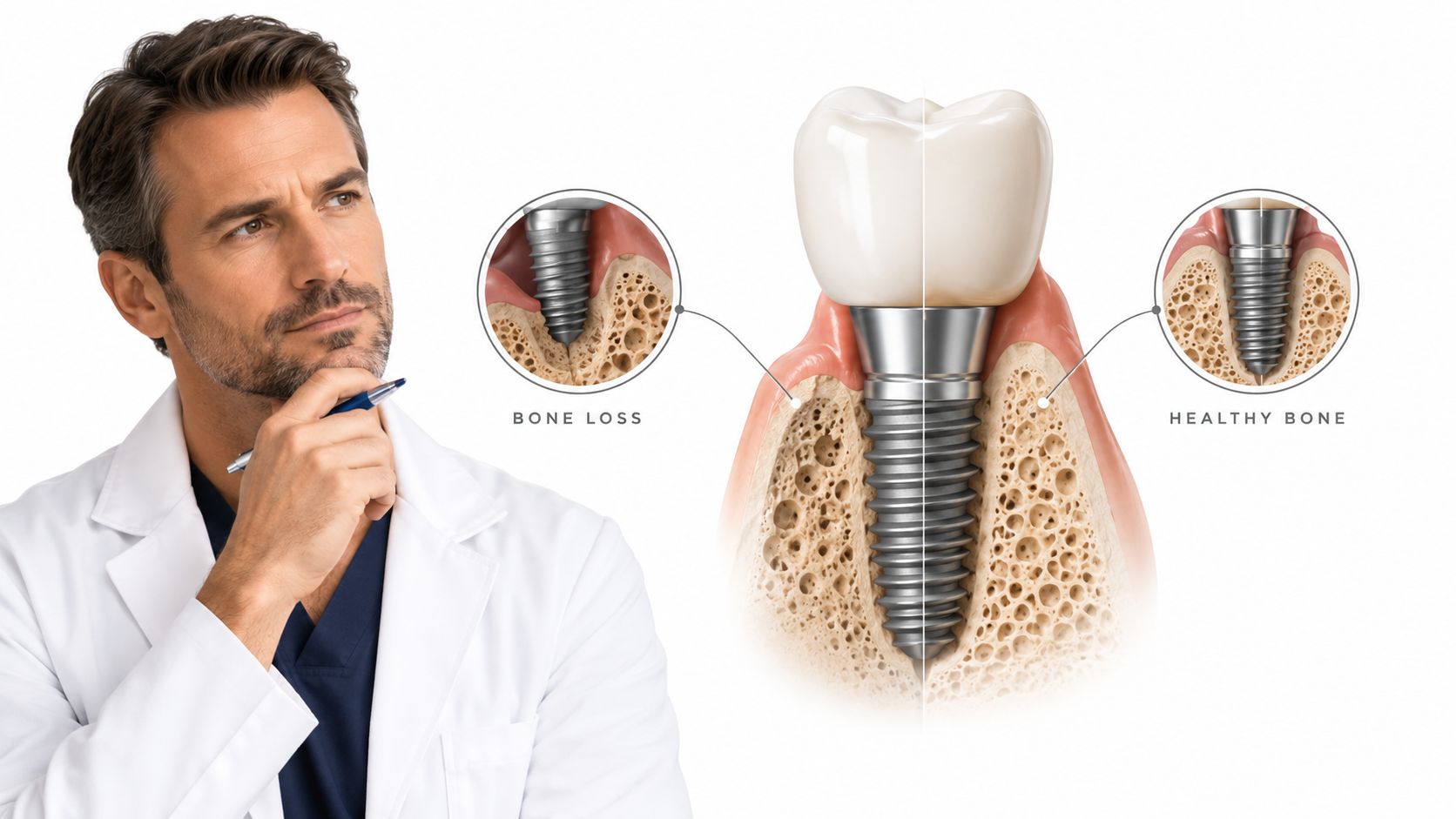
A tooth root gives the surrounding bone daily stimulation. After extraction or tooth loss, that stimulation disappears, and the bone can gradually resorb. The ridge may become too narrow or too short to provide the stable foundation an implant requires. You might not feel this process happening, which is why a missing tooth can seem unchanged on the surface while the treatment options underneath become more involved.
Practical rule: Bone loss doesn't decide whether you can receive an implant. It helps determine which route will make the implant stable.
A common patient experience
Consider a patient from Cleveland who has lived with a missing molar for several years. The patient can still smile comfortably because the gap isn't visible, but chewing has shifted to the opposite side. During an examination, the dental team finds that the ridge under the missing tooth has narrowed. The patient may still be a good implant candidate, but the plan could include bone augmentation before implant placement.
That isn't a failed outcome. It's a more accurate diagnosis.
For Chattanooga and Cleveland patients, the important distinction is between a standard implant pathway and an implant pathway that includes foundation work. A standard pathway may involve the implant post, connecting component, and crown. A more complex pathway can involve tooth extraction, socket preservation, grafting, a sinus lift, additional healing, or a different implant design.
The cost question becomes easier to understand once each part has a purpose. You aren't paying for an unexplained add-on. You're investing in the conditions needed for the replacement tooth to function properly and remain maintainable.
Why a local consultation matters
A search for Dental implants near me should lead to more than a price displayed online. Implant treatment depends on the location of the missing tooth, the condition of the gums, the relationship between the jaw and nearby structures, and the amount of usable bone. A new patient exam, dental x-rays, and a discussion of your medical and dental history help turn a general estimate into a personalized plan.
Bone loss is manageable when it's identified early and explained clearly. The right consultation replaces an overwhelming question with a sequence of decisions, beginning with diagnosis and ending with a restoration that supports eating, speaking, and smiling with greater confidence.
Understanding How Jawbone Health Affects Your Options
Think of the jawbone as the foundation of a house. A natural tooth root acts like a support post set into that foundation. It helps maintain the shape and strength of the surrounding bone through normal chewing.
When the tooth is extracted, the support post is gone. The foundation doesn't disappear all at once, but the ridge can gradually shrink and lose the dimensions needed for implant stability. The change can affect bone width, height, and density. If the ridge becomes too thin or too short, placing an implant without preparation may compromise its position or support.
You can read a plain-language explanation of this process in what bone loss in teeth means.
How clinicians evaluate the foundation
A responsible implant consultation answers three questions:
- How much bone is available? Dental x-rays and 3D imaging help show the shape of the ridge and the position of important structures.
- Where is the safest implant position? The plan must account for nearby roots, nerves, and the sinus area.
- Can the existing bone support an implant now? If not, the evaluation identifies the procedure needed to rebuild support.
This diagnostic process matters because an implant isn't placed wherever a tooth is missing. The implant must be positioned to support the final crown, fit the available anatomy, and remain accessible for daily cleaning.
What the scan changes
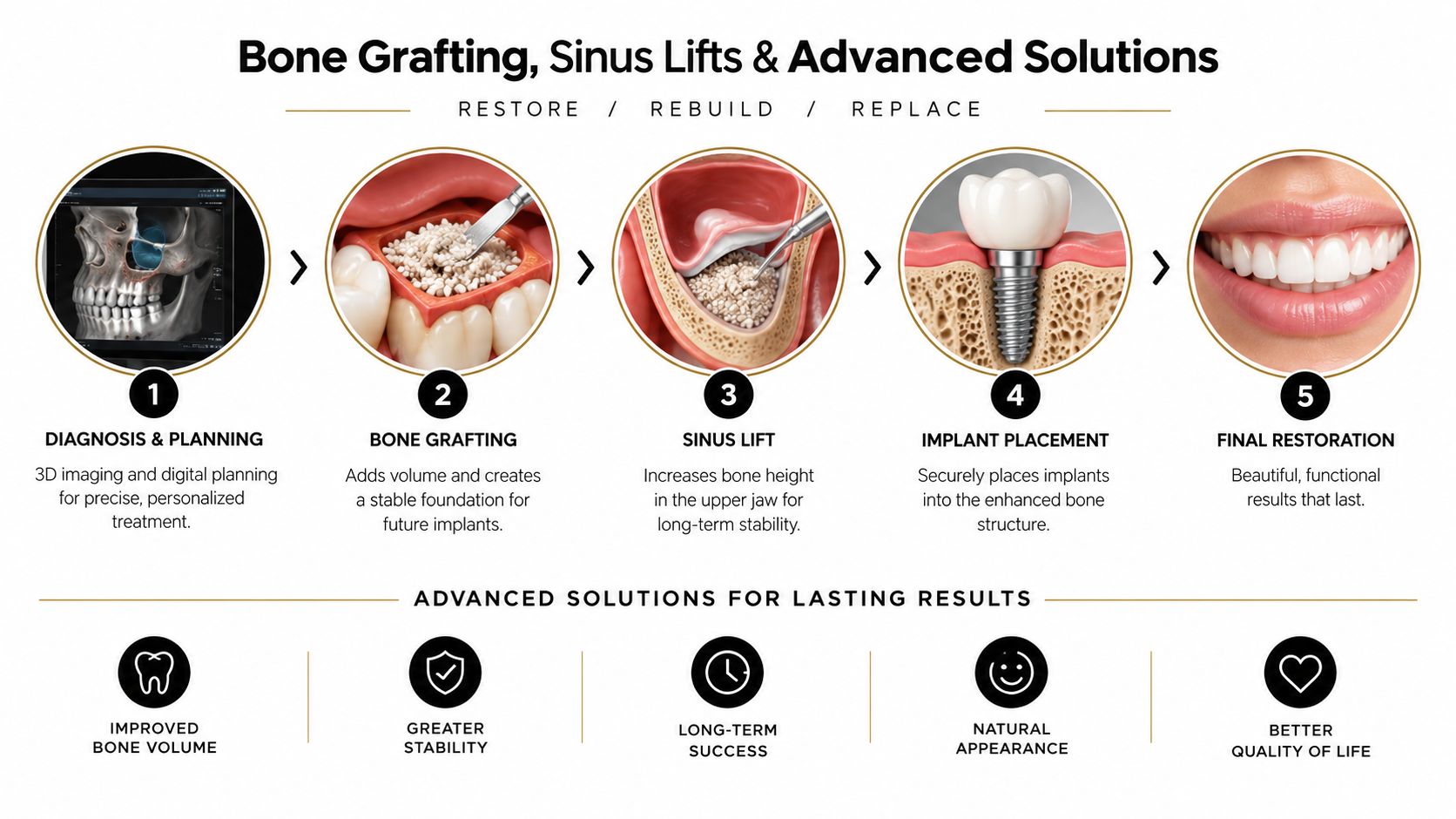
Without detailed imaging, bone loss can feel like an unknown problem. With a clear map, it becomes a treatment decision. Some patients have enough bone for implant placement with limited preparation. Others may need a graft to widen the ridge, a sinus lift to create space in the upper back jaw, or a more advanced approach for severe loss.
The scan also helps identify factors that may need attention first, such as active gum disease, an infection, or a neighboring tooth that has shifted into the space. Treating those concerns supports a healthier environment for restorative dentistry.
For someone searching for a dentist in Chattanooga, TN or a dentist in Cleveland, TN, this is why diagnostics should come before a firm cost promise. A trustworthy estimate is based on your anatomy, not on a generic implant advertisement.
Bone Grafting, Sinus Lifts, and Advanced Solutions
Bone rebuilding isn't one procedure for every patient. The appropriate option depends on where bone has been lost, how much support remains, and whether the upper jaw, lower jaw, front teeth, or back teeth are involved.
Standard bone grafting is often considered when the ridge lacks enough width or height for an implant. The clinician places graft material in the deficient area, allowing the body to develop a stronger foundation during healing. This approach can be suitable for a localized defect, especially when the missing tooth has left a limited area of bone loss.
A sinus lift addresses a different problem. The sinus sits above the back teeth in the upper jaw. When the bone beneath it becomes too thin, the sinus membrane may need to be gently raised so graft material can create room for an implant. This is not the same as a routine ridge graft, and it requires careful evaluation of the upper-jaw anatomy.
Comparing the main approaches
| Approach | When it may be considered | Main trade-off |
|---|---|---|
| Ridge or socket grafting | The implant site needs more width or height | Adds surgery and healing before or around implant placement |
| Sinus lift | The upper back jaw has limited bone beneath the sinus | Requires specialized planning in a sensitive anatomical area |
| Tilted implants | The available bone allows an angled implant strategy | Implant position and final restoration require careful design |
| Zygomatic implants | Severe upper-jaw bone loss makes conventional anchorage difficult | Uses cheekbone support and demands advanced clinical expertise |
For severe maxillary bone loss, zygomatic implants may anchor into the cheekbone rather than rely on the weakened jaw ridge. Tilted implants may also help use existing bone in a way that avoids or reduces traditional augmentation in selected cases. These options aren't automatically better. They are alternatives for specific anatomy, and the benefits must be weighed against surgical complexity, maintenance, and the experience required.
A cosmetic dentist near me search may focus on the visible result, but implant planning is fundamentally restorative. The goal is to restore appearance while creating a stable, cleanable, and functional replacement.
Breaking Down the Dental Implants with Bone Loss Cost
The cost of dental implants with bone loss usually reflects several connected components: diagnosis, tooth extraction when needed, bone preparation, implant placement, the abutment or connector, and the final crown or full-arch restoration. Bone augmentation adds surgery, graft materials, and healing time, so a patient with a narrow ridge may have a different investment from someone who has adequate bone for direct implant placement.
The history of implant dentistry helps explain why treatment has become more extensive. A review of bone grafting costs and implant treatment history notes that early implant-like attempts date to the Mayan civilization around 600 AD. It identifies 1965 as the year Per-Ingvar Brånemark first placed his implants in patients and 1978 as the year he presented a two-stage threaded titanium root-form implant system. By the 1990s, guided bone regeneration and bone grafting had become standard extended applications. As these procedures became part of implant care, the financial structure expanded beyond the implant hardware itself.
What changes the financial picture
A relatively contained defect may need socket preservation or a localized graft. More advanced vertical ridge augmentation can require block grafts, membranes, titanium meshes, or an extraoral donor site. A multicenter study found that iliac crest grafting carried the highest biological and general financial costs, while less invasive scaffold-based approaches had the lowest financial cost and shorter surgical times, as reported in this clinical comparison of vertical ridge augmentation approaches.
Material choice also matters. An evidence review found that socket-preservation materials ranged from US$46.2 to US$140, while socket-sealing materials ranged from US$12 to US$189. The same review found that xenogeneic grafts tended to be the most expensive, with allografts and alloplasts progressively cheaper. It also cautioned that higher expenditure didn't reliably produce greater effectiveness across all graft materials, so a more expensive material isn't automatically the best choice for every patient. These findings are detailed in this evidence review of grafting materials and ridge preservation.
Ask for an itemized plan that separates imaging, surgery, grafting, healing visits, implant components, and the final restoration. If insurance or medical documentation may be relevant, a resource on medically necessary dental billing can help explain how dental and medical billing questions may be organized. Your dental office should still confirm what applies to your plan and your diagnosis.
Timeline and What to Expect During Treatment
Bone loss often changes the sequence more than the destination. A patient with sufficient bone may move from evaluation to implant placement more directly. A patient who needs grafting must allow the site to heal and mature before the implant can be placed safely.
The stages of care
Your plan may include the following stages:
- Evaluation: The dentist reviews your health history, examines your gums and teeth, takes dental x-rays or 3D images, and discusses your goals.
- Site preparation: If needed, the team performs a tooth extraction, graft, socket preservation procedure, or sinus lift.
- Healing: The grafted area must integrate with the existing bone. The exact healing period depends on the procedure and your response.
- Implant placement: The titanium implant post is positioned once the foundation is ready.
- Restoration: After the implant and surrounding tissues have healed sufficiently, the abutment and crown or full-arch restoration are fitted.
The process can feel slow because each stage protects the next one. Placing an implant into insufficiently prepared bone may create more risk than allowing the site to heal properly first.
A longer plan isn't necessarily a worse plan. In bone-loss cases, controlled healing is part of the treatment, not wasted time.
Planning your daily life
You should know what to expect after each appointment, including dietary instructions, cleaning guidance, medications, and follow-up visits. Patients with dental anxiety may also want to ask about comfort measures and sedation options before treatment begins.
The final restoration should be planned from the beginning. The position of the implant, the shape of the crown, and the way your teeth meet all need to work together. That coordination is what turns bone reconstruction into practical restorative dentistry rather than an isolated surgical procedure.
Financing Your New Smile in East Tennessee
The financial question is reasonable. Dental implant treatment with bone loss can involve more appointments and more components than a straightforward filling, crown, or tooth extraction. Avoiding the subject doesn't make the cost easier to manage. A written plan makes it possible to understand what is necessary now, what can be staged, and which options may fit your health and budget.
During a consultation, ask for more than a single total. Request an explanation of the diagnostic fee, preparatory procedures, implant surgery, temporary teeth if needed, final crown or prosthesis, and follow-up care. You should also ask whether the quoted amount changes if the clinician discovers a different bone condition during treatment.
Questions that support a clear decision
- What is essential? Ask which procedures are needed for safety and stability, rather than optional upgrades.
- What can be staged? Some patients may prefer to complete treatment in planned phases.
- What alternatives exist? A bridge, partial denture, or implant-supported solution may have different clinical and financial implications.
- What happens after placement? Clarify maintenance, hygiene visits, adjustments, and possible replacement of restorative components.
- Which payment arrangements are available? Ask about financing, deposits, and the timing of payments before scheduling surgery.
Patients seeking implant payment plans can use that information as a starting point for discussing ways to organize treatment expenses. Financing doesn't make an unsuitable procedure appropriate, but it can make a clinically appropriate plan easier to pursue.
For people comparing a cosmetic dentist near me with a restorative provider, look for an office that connects appearance, function, gum health, and long-term maintenance. The most affordable-looking quote may not include every stage. Transparent planning helps you compare complete treatment plans rather than isolated surgical fees.
Schedule Your Consultation with Winn Smiles
If you're missing teeth and have been told you have bone loss, don't assume that implants are no longer available. A consultation can show whether you need a localized graft, a sinus lift, a different implant approach, or a non-implant restoration.
At the appointment, expect a detailed examination, dental x-rays or 3D imaging when appropriate, and a discussion of your goals. The clinician should explain your bone structure in plain language and give you a personalized estimate that reflects the procedures your case requires.
Patients in Cleveland and Chattanooga can also discuss related needs, including tooth extraction, cleanings and exams, periodontal care, same-day crowns, teeth whitening, cosmetic dentistry, and emergency dental services. Addressing active infection, gum concerns, or damaged neighboring teeth may be an important part of creating a healthy environment for implant treatment.
A consultation is also the right time to discuss comfort. Tell the team if you've delayed care because of dental anxiety, difficulty chewing, or concern about surgery. With a clear sequence and realistic expectations, the path from bone loss to a restored smile becomes easier to understand and plan.
Winn Smiles offers dental implant consultations, 3D imaging, bone grafting and sinus lift planning for patients in Cleveland and Chattanooga who are concerned about bone loss and cost. Visit Winn Smiles to request a consultation and receive a personalized roadmap for restoring your smile.