You're at dinner in Chattanooga, cutting your food into small pieces and chewing on one side because the other side has a gap. Or you're covering your mouth when you laugh, or a denture shifts when you talk. That's the everyday reality behind most searches for dental implants near me or a dentist near me.
Dental implants for missing teeth can restore chewing and confidence, but the implant itself is only the start. Your gum health, bone support, overall health, treatment planning, and long-term maintenance decide how well the result holds up. This guide explains your options in plain language for patients in Chattanooga, TN and Cleveland, TN, including what to expect at a consultation, what healing looks like, and what care looks like years later.
Dental Implant Options at a Glance
You rarely choose an implant in isolation. You're weighing a fixed tooth against a bridge or a removable denture, and the right fit depends on how many teeth are missing and what support is available. This comparison puts the main options for dental implants for missing teeth side by side.
| Option | What It Replaces | What Holds It in Place | Best Suited For |
|---|---|---|---|
| Single-tooth implant | One missing tooth | Implant in the jawbone with a crown on top | One gap with healthy teeth left untouched |
| Full-arch implants | All teeth in one arch | Implants in the jawbone that support a custom restoration | Most or all teeth in one arch missing or failing |
| Traditional bridge | One or more teeth | Crowns on the neighboring natural teeth | Gaps with healthy neighbors able to carry the crowns |
| Conventional denture | Teeth in one or both arches | Adhesives and suction on the gums | Removable replacement that does not require surgery |
A single-tooth implant replaces one root and one visible tooth. It doesn't rely on the teeth beside the gap, so those teeth don't need to be shaped for crowns. That's often its biggest advantage.
Full-arch implants replace every tooth in the upper or lower arch with a restoration anchored to implants in the jawbone. A traditional bridge fills a smaller gap by using crowns on neighboring natural teeth for support. Our guide to comparing dental implants and bridges walks through that trade-off in more detail.
A conventional denture sits on the gums and relies on adhesives and suction. It avoids surgery, but it can move during eating and speaking and usually needs adjustments over time.
Three Questions to Answer Before Your Visit
- How many teeth are missing? Count gaps in each arch, including teeth that are badly broken or loose.
- Are the neighboring teeth healthy? A bridge needs strong support teeth that can carry extra chewing load.
- Do you want fixed or removable? Fixed options stay in place, while removable dentures come out for cleaning.
A table can narrow your options. It can't confirm bone, gum health, or bite forces.
Your dentist in Chattanooga, TN should confirm the choice with an exam and dental X-rays or three-dimensional imaging. That visit turns a general preference into a plan that's specific to your mouth.
How a Dental Implant Works, From Root to Crown
Think of a fence post set firmly in the ground. The post doesn't do the visible work, but everything attached to it stays stable because the base is solid.
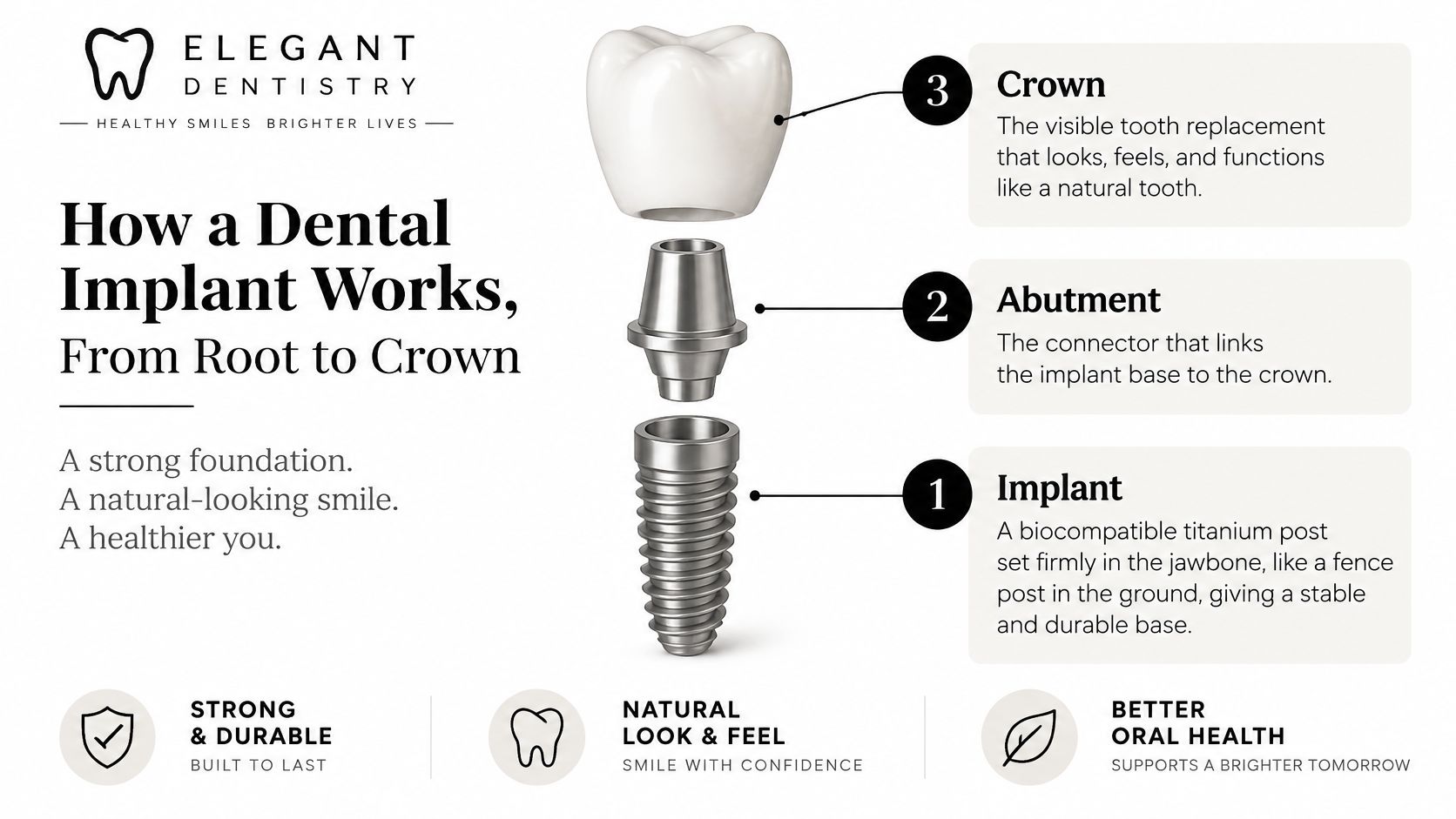
A dental implant has three parts, from the bottom up.
- The implant is a small titanium post placed in the jawbone. It acts as an artificial tooth root.
- The abutment is a connector at the gum line. It links the implant to the restoration above it.
- The crown, bridge, or denture is the custom-made visible part. We place it once the implant has fully integrated.
After placement, bone grows directly onto the titanium surface over the next few months in a process called osseointegration, and we monitor healing during that time. A Springer history of osseointegration notes that Swedish orthopedic surgeon Per-Ingvar Brånemark observed titanium becoming firmly anchored in bone in the 1950s, and his team placed the first documented permanent osseointegrated dental implants in a human volunteer in 1965.
At your consultation, ask us to walk you through each stage, what happens at each visit, and roughly how long each stage will take. You shouldn't have to guess where you are in the process.
Who Qualifies for Dental Implants
The reassuring starting point is simple. Most adults with missing teeth are candidates for dental implants, and overall health, smoking habits, and bone density can affect suitability. Needing preparation first doesn't automatically rule you out.
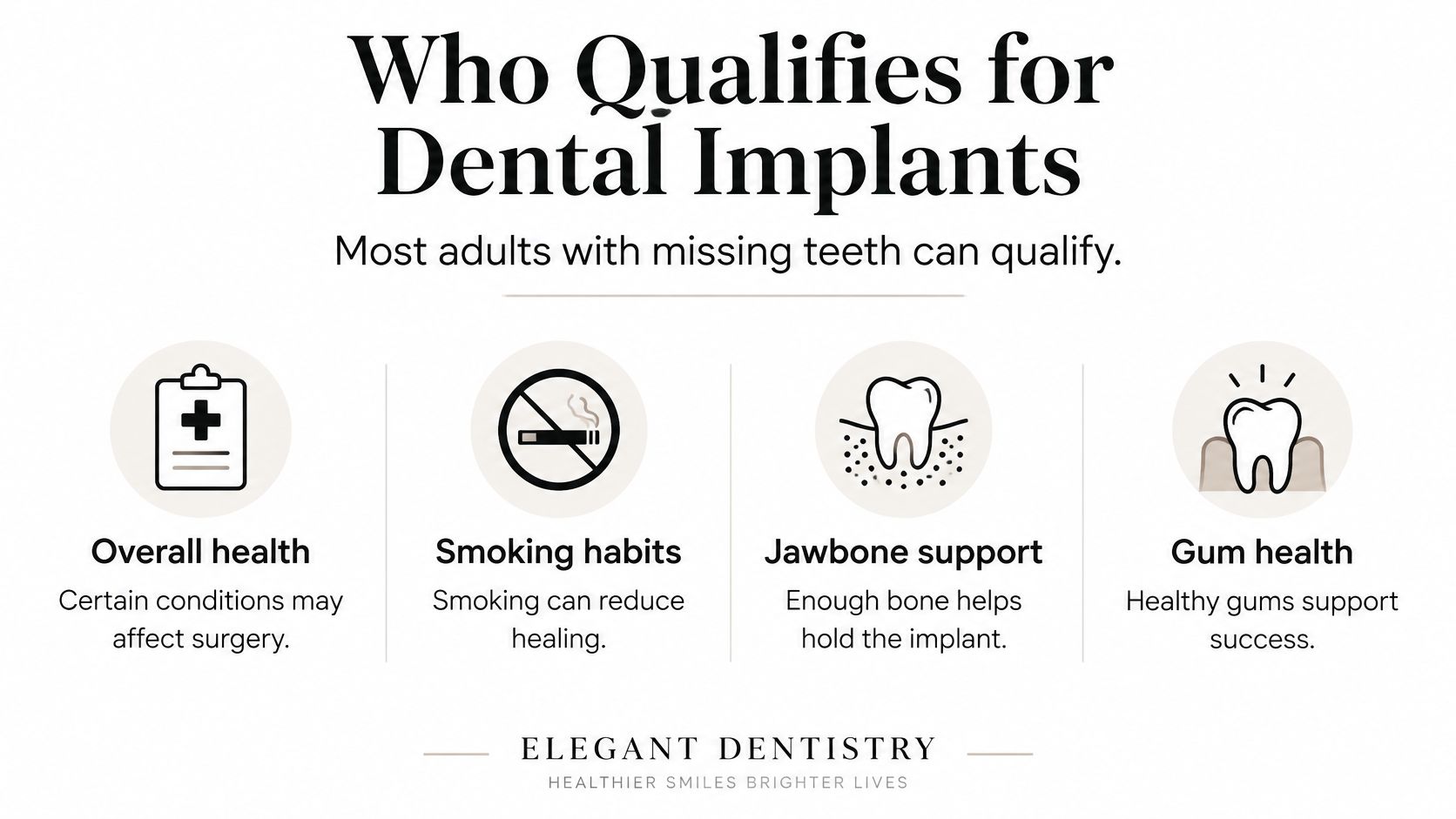
A common misunderstanding is that enough bone means you're automatically a good candidate. Bone volume matters, but it's only one part of the picture. Gum disease history, three-dimensional implant position, spacing, bite forces, and whether the final restoration can be cleaned well all affect the plan.
The 2024 AO/AAP consensus summarized in 2025 found that implant malposition is consistently associated with peri-implant disease, with some investigations reporting an odds ratio as high as 48.2, and inadequate spacing and placement that is too buccal or too apical were specifically identified as risks. In plain language, where the implant sits matters as much as what it's made of.
What Might Need Treatment First
Active gum disease usually needs treatment before placement because inflamed gums don't provide a healthy foundation. If you'd like background before you visit, our overview of gum disease and implants explains why we sequence care this way. When bone is thin, grafting or another preparatory step may be discussed so the implant has support.
Smoking can slow healing, and conditions that affect healing need to be part of the conversation. None of these factors should be judged from an advertisement or a quick look in the mirror. They need an exam, health history, and imaging.
Your Pre-Consultation Checklist
- Gums at your last checkup: Were you told you had gum disease, deep pockets, or bleeding?
- Smoking or vaping: Do you currently smoke or vape, even occasionally?
- Health conditions: Do you have diabetes or another condition that affects healing?
- Bone confirmation: Has imaging confirmed enough bone where the tooth is missing?
- Daily commitment: Can you clean around the implant daily and keep professional maintenance visits?
Good candidacy is a plan, not a yes or no label. Sometimes the answer is yes after gum treatment, grafting, or a change in restoration design.
Bring a written list of your health history, current medications, and questions. Ask whether gum disease must be treated first, whether grafting is justified, how you'll clean the proposed restoration, and what alternatives exist if an implant isn't the safest choice.
Immediate or Staged Implant Timing
You don't always have to wait months for a tooth, but you shouldn't assume a same-day tooth is safe just because it's faster. Timing depends on stability at placement, bone quality, and how bite forces can be controlled while healing happens.
| Pathway | When It Fits | Stability Needed | Typical Timing |
|---|---|---|---|
| Staged placement | Most cases, especially when bone or gums need time to heal | Standard healing with no early load on the implant | Several months before the crown is attached |
| Early loading | Implant is stable but full healing is still needed | Stability builds during the first weeks of healing | Shorter wait than staged placement, set by stability checks |
| Immediate loading (same day) | Strong primary stability, most often dense lower-jaw bone | Insertion torque of at least 35 N·cm and an ISQ of at least 70 | Temporary tooth the same day, final restoration later |
A contemporary clinical review of implant loading reports implant survival of approximately 95 to 100% for immediate or early loading when insertion torque reaches at least 35 N·cm, and an implant stability quotient of at least 70 is also cited as a practical threshold for immediate loading. Those numbers are measurements your clinician records, not things you can judge by feel.
They matter because very limited movement during early healing lets bone form on the implant surface. Excessive movement can lead to fibrous tissue around the implant instead of firm integration, which means the base never locks in properly.
Bone location changes the decision too. Dense lower-jaw bone generally tolerates immediate loading better, while low-density bone in the back of the upper jaw often favors staged or progressive loading. Immediate loading can achieve survival comparable with early loading, but results are less consistently comparable with conventional delayed loading.
Expect us to document insertion torque or stability readings, evaluate bone density with three-dimensional imaging when indicated, and control bite forces through the temporary design. If a tooth extraction comes first, we provide aftercare instructions and can discuss replacement options such as a dental implant or bridge.
Ask one direct question before you commit. Which pathway fits my bone and healing, and what will my timeline be from placement to final tooth?
Recovery After Implant Surgery and Extractions
Healing starts with protecting the site, not testing it. These steps apply after a tooth extraction and help you understand the early discipline that also supports implant care.
The First Days in Order
- First 24 hours: Don't rinse or gargle during that initial 24-hour period, eat soft foods for 24 to 48 hours, and avoid smoking or vaping for at least 72 hours, as University Hospitals Dorset aftercare guidance advises.
- After day one: Gently rinse with warm salt water made from one-half teaspoon of salt in 250 milliliters of water, three to four times daily for up to 10 days.
- While you're numb: Avoid hot food and drinks so you don't burn yourself or bite your cheek or lip.
Soreness and swelling typically ease over several days. Eat soft foods, keep your head raised when resting if instructed, and follow the written directions you're given rather than advice from friends.
If bleeding continues, Whittington Health guidance on post-extraction bleeding recommends maintaining pressure for at least 20 minutes before removing the swab. Use firm, continuous pressure with rolled gauze or a clean cloth, then call if bleeding doesn't stop.
Call promptly for facial swelling, uncontrolled bleeding, severe toothache, injury, or a lost crown. Sudden pain that increases several days after an extraction may signal dry socket and requires evaluation, not waiting. When contacting an emergency dentist, describe the specific problem clearly so the team can triage you correctly.
How Long Dental Implants Last
A chipped crown a decade later can feel like the whole implant failed, even when the post in the jaw is still firm. The implant and the tooth on top don't wear out together. The implant replaces the root and bonds to bone. The crown, bridge, or denture takes the chewing, so it ages faster.
A systematic review of long-term implant outcomes reported a pooled 10-year implant-level survival estimate of 96.4%, with a 95% confidence interval of 95.2% to 97.5%, and a broader prediction interval of 91.5% to 99.4%. That spread is the practical point. Comparable patients and clinics do not all land on one figure.
In these studies, survival means the implant was still present at follow-up. Long-term research also reports high implant retention alongside biological complications and bone loss, so a retained implant can still need repairs around it. Gum health, smoking, bite forces, bone density, and the plan made before placement decide how closely one mouth matches the average.
The crown or restoration on top of a dental implant may need replacement after 10 to 15 years due to normal wear and tear. With proper care, dental implants can last a lifetime, and the implant itself rarely needs to be replaced.
Those percentages describe groups of patients. Your result follows the bone you start with, your overall health, and the maintenance you keep up afterward.
Before treatment, ask which survival window fits a single tooth or a full arch, and which factors in your mouth could shift it.
Keeping Implants Healthy Over the Long Term
This is the part many patients don't hear clearly enough. Dental implants can't get cavities, but they can be affected by gum disease, and implants need lifelong care.
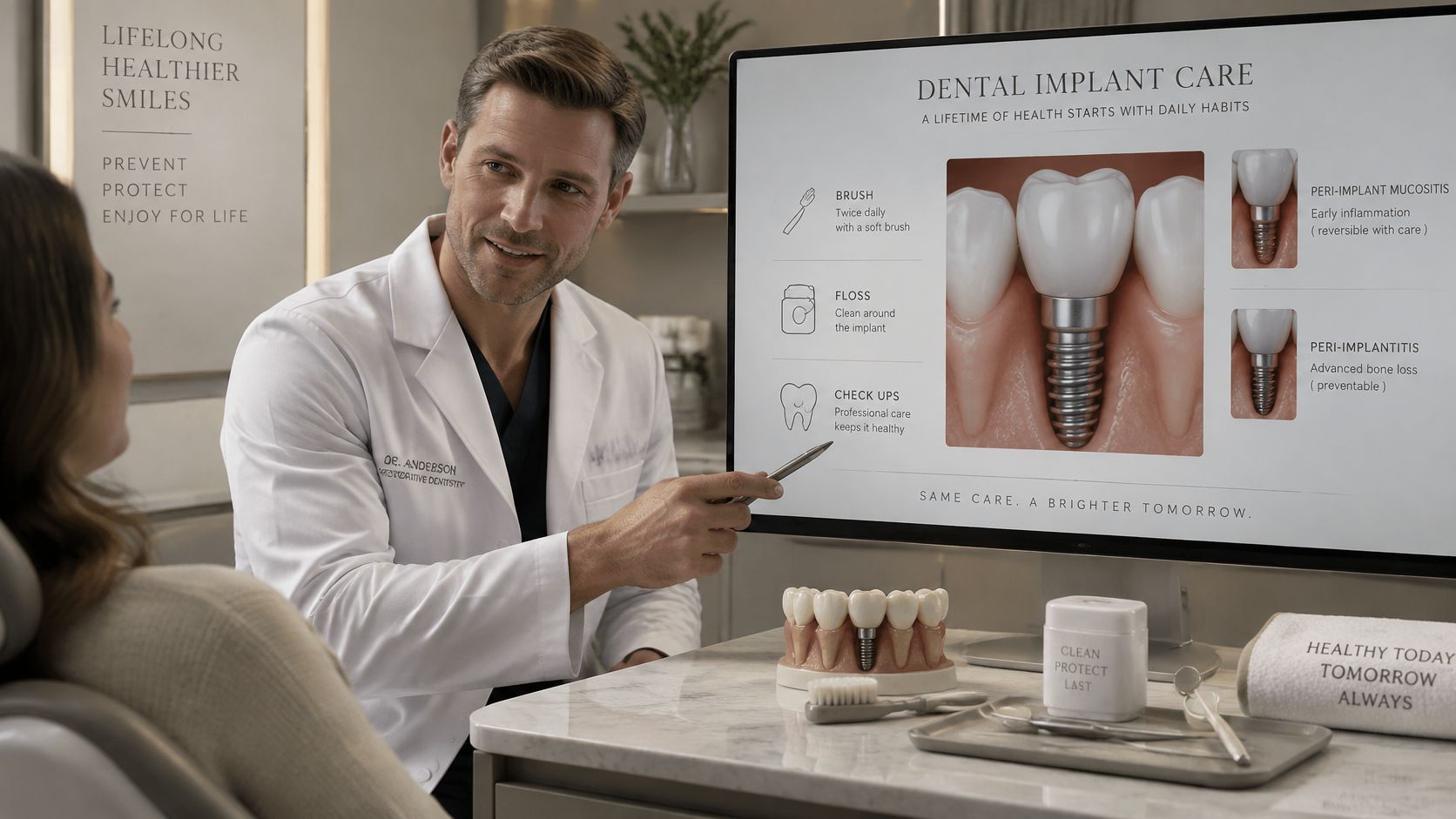
Two terms are worth knowing. Peri-implant mucositis is inflammation of the gum around an implant and is reversible when caught early. Peri-implantitis is more serious because plaque-driven inflammation can cause progressive loss of supporting bone.
A large systematic review of peri-implant disease found patient-level peri-implant mucositis prevalence of 46% and peri-implantitis prevalence of 21%. One 25-year cohort in that review reported 95% implant survival but peri-implantitis incidence of 30%, which shows that an implant can remain present while the tissue around it becomes unhealthy.
Time matters as well. A 2025 evidence review of peri-implantitis incidence reported a weighted mean patient-level incidence of approximately 12% within 5 years, 14% within 10 years, and 22% within 20 years.
| Time After Placement | Estimated Peri-Implantitis | What It Signals |
|---|---|---|
| 5 years | About 12% | Inflammation can progress quietly, so routine checks matter |
| 10 years | About 14% | Risk rises with previous gum disease and irregular visits |
| 20 years | About 22% | Population estimate, not a personal prediction |
Risk was higher among people with previous periodontitis, fully edentulous patients, and those who attended maintenance irregularly. These are population-level estimates, not predictions for you. Your personal risk depends on hygiene, restoration design, implant position, medical history, and whether you keep follow-up visits.
The short video below is a useful visual introduction before we outline your home routine.
Your Long-Term Maintenance Plan
- Clean between and around implants daily: Use the interdental brushes, floss, or water flossing approach we recommend for your restoration shape.
- Choose gentle tools if you're sensitive: If brushing feels harsh, maxijournal's sensitive teeth toothbrush guide can help you compare softer options to discuss with us.
- Keep professional maintenance: Attend cleaning and exam visits on the schedule set for your risk level, not only when something hurts.
- Ask for a baseline: A baseline X-ray and probing record let us compare bone and gum measurements over time.
- Control whole-body risks: Stop smoking and manage conditions such as diabetes with your medical team.
Contact our office promptly for bleeding around an implant, pus, tenderness, a bad taste, increasing depth when we probe, or any feeling of looseness. Don't wait for the next routine cleaning and exam if those signs appear. Early inflammation is usually easier to reverse than established bone loss.
What Affects the Cost of Dental Implants
You can't get an accurate implant cost from an ad because the work behind the visible tooth changes from person to person. A clear estimate comes after an exam, not before it.
Main Cost Drivers
- Number of teeth: One implant costs less in total work than several implants or a full arch.
- Preparation needed: Tooth extraction, bone grafting, gum treatment, or other preparation adds stages.
- Final restoration: A single crown, an implant-supported bridge, and a full-arch restoration involve different materials and lab work.
- Imaging and follow-up: Three-dimensional imaging, surgery visits, temporary teeth, and maintenance visits should be listed clearly.
Your first implant visit includes a thorough examination with 3D imaging of the jaw, a discussion of goals and options, and a personalized treatment plan. That visit lets us confirm whether you need extraction or grafting, which restoration fits, and how many appointments to expect.
Be cautious with offers that sound too simple. Ads offering free dental implants are not from our business and are a scam, so verify any offer directly with the dental office before you share personal or payment information.
Compare written estimates on the same basis. Does each estimate include imaging, surgery, the abutment connector, the final crown or restoration, follow-up visits, and maintenance? Are stages itemized separately, and how do any dental plan benefits apply?
Request a written, itemized estimate before agreeing to treatment. If a quote can't explain what's included, it isn't ready for a fair comparison.
Book Your Implant Consultation in Chattanooga
If you're looking for dental implants near me in Chattanooga, TN, or you're a Cleveland, TN patient who wants a clear plan, start with a consultation rather than a guess. We'll confirm your options, evaluate bone and gum health with imaging, and give you a personalized plan with a clear estimate.
We offer dental implants for a single tooth as well as full-arch implant solutions, so you can ask about both restorative dentistry paths in one visit. We also offer a free 3D scan to assess whether a patient is a candidate for full-arch implants, and a $199 new patient special for patients who want to get started.
Comfort belongs in the plan from the beginning. Ask about sedation options for surgery and how we support anxious patients, alongside related dental care you may need such as cleanings and exams, teeth whitening, or cosmetic dentistry after tooth replacement is complete.
What to Bring
- Medication list: Include prescriptions, over-the-counter medicines, and supplements.
- Health history: Note diabetes, heart conditions, allergies, and past surgeries.
- Previous records: Bring extraction records or recent dental X-rays if you have them.
- Written questions: Include timing, maintenance, cost, and alternatives.
Call our office or request an appointment online to schedule your consultation. Bring your questions, tell us what outcome matters most to you, and leave with a timeline you understand.
Ready to replace a missing tooth with a plan built around your bone, gums, and long-term maintenance, not just a quick quote? Winn Smiles offers dental implants for missing teeth, including single-tooth and full-arch solutions for Chattanooga and Cleveland patients, with imaging, clear estimates, and comfort-focused care. Visit Winn Smiles to request your implant consultation today.