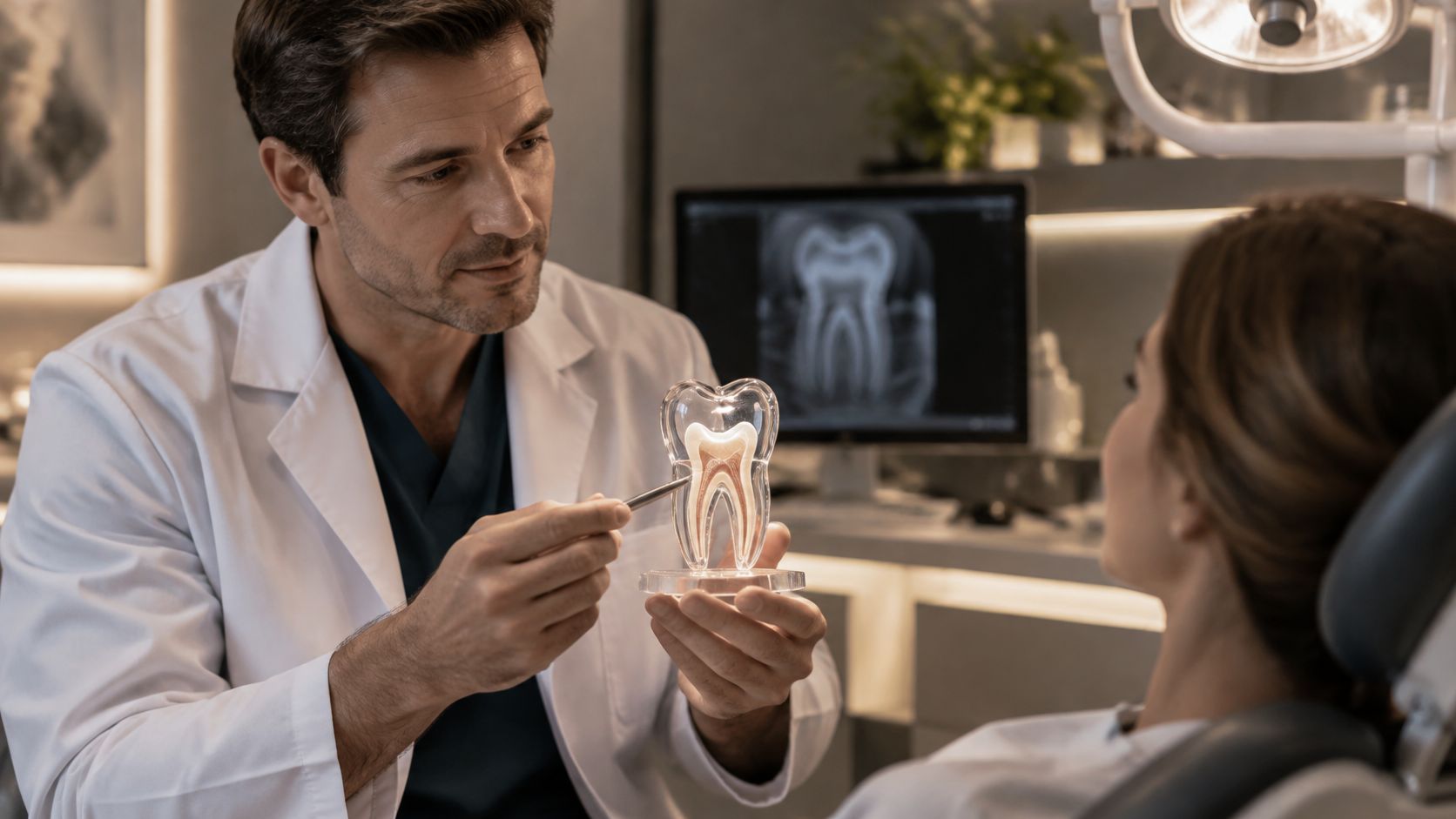
An estimated 70% of U.S. adults over age 65 have periodontal disease, according to the National Institute of Dental and Craniofacial Research. That makes bleeding or receding gums a reason to get checked, not something to dismiss as an inevitable part of aging. If you're searching for gum disease treatment near me in Chattanooga, TN, the most useful first step is an examination that matches treatment to what's happening beneath your gumline.
At Winn Smiles, we serve Chattanooga and Cleveland, Tennessee, with periodontal evaluations and personalized care. You don't need to know whether you need a regular cleaning, deep cleaning, or specialist before booking. Finding that out is part of the visit.
Why Bleeding Gums Deserve a Real Evaluation
You finish brushing and notice pink in the sink. Your gums don't hurt much, so you switch to a gentler brush and decide to see whether it happens again. Or perhaps your teeth look longer, but you're unsure whether your gums have changed.
These are reasonable things to notice, but they aren't reliable ways to judge disease severity. Periodontitis can affect the tissues supporting your teeth without causing severe pain. The World Health Organization's oral-health fact sheet identifies severe periodontal disease as a major oral-health problem and an important cause of tooth loss.
Changes you can see at home are a starting point for an examination, not a diagnosis.

Signs worth bringing to your dentist
Tell us about changes even if they come and go:
- Bleeding or tenderness: Gums bleed during brushing or flossing, feel sore, or look swollen.
- Recession or odor: Teeth appear longer, or bad breath persists despite cleaning.
- Drainage or movement: You notice pus, a loose tooth, shifting teeth, or a bite that feels different.
Bleeding can have more than one explanation. Your medications, brushing technique, plaque buildup, and underlying health all belong in the conversation. Don't stop a prescribed medication because your gums bleed. Bring your medication list so we can assess the situation properly.
Gum health is more than appearance
Managing gum disease supports overall health, including reducing risks related to diabetes complications and respiratory problems. Gum disease is also associated with cardiovascular disease, although treating your gums shouldn't be presented as a guarantee that you'll prevent heart disease.
Practical rule: Don't use the absence of pain as proof that your gums are healthy.
Our guide to preventing gum disease can help you strengthen your daily routine. But persistent symptoms need an examination, not just a different toothpaste.
An evaluation can distinguish early gingivitis, established periodontitis, and other causes of irritation. That's why finding a dentist near you should begin with a diagnosis rather than choosing a treatment from a service menu.
Gum Disease Stages and the Treatment Each One Needs
Gingivitis affects the gums without destroying supporting bone. Periodontitis involves damage to the tissues and bone that hold teeth in place. That distinction changes both the treatment and what recovery means.
As the Cleveland Clinic's gum disease treatment guide explains, early gum inflammation can generally be reversed, while more advanced disease may require deeper cleaning, medication, or surgery. Periodontitis can be effectively managed, but it can't be completely reversed.
Why pocket depth matters
A gum pocket is the space between a tooth and the surrounding gum. When that space becomes deeper, you can't reliably reach all the bacterial buildup with a toothbrush or floss.
Depth isn't the only finding that matters. Your dentist also considers bleeding, loss of attachment around the tooth, bone levels, and whether disease is progressing. A tooth that looks fairly normal above the gumline may still need treatment below it.
Gum disease stages, usual treatment and reversibility
| Stage | What it looks like | Usual treatment | Reversible? |
|---|---|---|---|
| Gingivitis | Red, swollen or bleeding gums; no bone loss | Professional cleaning plus daily brushing and flossing | Yes, generally reversible |
| Mild periodontitis | Bleeding gums with shallow pockets | Scaling and root planing with improved home care | Not reversed, but controlled |
| Moderate periodontitis | Deeper pockets, some bone loss, possible bad breath | Deep cleaning, with antimicrobial medication when indicated | Not reversed; managed over time |
| Severe periodontitis | Significant bone loss, loose teeth, gum recession | Deep cleaning plus periodontal surgery or specialist referral when needed | Not reversed; tooth loss is a real risk without care |
This table is a guide to treatment patterns, not a way to diagnose yourself. Appearance alone doesn't establish a stage, and medication or surgery isn't automatic just because a case falls into a particular category.
What to do at home while arranging care
Brush twice daily with a soft-bristled brush, using gentle pressure along the gumline. Clean between teeth daily with floss or appropriately sized interdental brushes, which reach spaces a toothbrush misses.
Improved home care can reverse gingivitis when combined with appropriate professional cleaning. It can't remove hardened deposits from deep periodontal pockets. If bleeding continues despite consistent, careful cleaning, arrange an evaluation rather than brushing harder.
Call promptly for heavy bleeding, gum or facial swelling, pus, or a noticeably mobile tooth. If swelling affects breathing or swallowing, seek emergency medical care.
Whether you're comparing a family dentist or searching for a cosmetic dentist near me, active gum symptoms deserve attention before teeth whitening or other appearance-focused treatment.
How a Dentist Confirms Gum Disease at Your Visit
A periodontal evaluation should give you something more useful than “your gums need work.” It should identify where disease is present, how much support has been affected, and which findings justify treatment.
This overview shows the main parts of a gum evaluation.

What we measure and why
Medical and dental history comes first. We review medications, diabetes, tobacco use, symptoms, and previous gum treatment. These details help explain risk and influence treatment choices.
We examine the gums for redness, swelling, bleeding, and tenderness. The location and pattern help distinguish a localized problem from more widespread inflammation.
Pocket measurements are recorded around the teeth. A slender periodontal probe measures the spaces beside each tooth. Tell us if an area is sensitive so we can adjust our approach.
Recession and tooth mobility are assessed alongside the pocket chart. These findings help us understand how much support has been lost, rather than judging inflammation alone.
Dental X-rays show supporting bone that isn't visible during a surface examination. Our periodontal evaluation uses advanced imaging alongside clinical measurements to assess bone loss, recession, and inflammation.
We explain the diagnosis and develop a treatment plan. You should understand which areas need care, what treatment is intended to accomplish, and how we'll judge the response.
The CDC's explanation of periodontal disease describes why examining the gums and assessing supporting structures matter. A cleaning removes buildup; the examination establishes the diagnosis. Pocket measurements can accompany a cleaning appointment, but cleaning itself doesn't replace them.
For another look at the clinical examination, watch the following video.
Questions that make your findings understandable
You're welcome to ask:
- Show me the chart: Which sites have deeper pockets or bleeding?
- Explain the images: Where do the X-rays show bone loss?
- Connect findings to care: What stage is this, and what would change the plan?
For example, persistent bleeding in a deep pocket after treatment deserves a different conversation from inflammation that resolves after plaque removal. Your response to care matters as much as the starting measurements.
Deep Cleaning, Lasers and Other Non-Surgical Options
A newer device doesn't automatically mean you need a more advanced treatment. Scaling and root planing is the core nonsurgical treatment for established periodontitis, while add-ons should have a specific reason.
The National Institute of Dental and Craniofacial Research's gum disease guide describes scaling as removing plaque and tartar above and below the gumline. Root planing smooths affected root surfaces so bacteria have fewer irregular places to remain.
What deep cleaning actually involves
We begin periodontal treatment with scaling and root planing under local anesthesia to keep you comfortable. The team works beneath the gumline where routine home cleaning can't remove hardened deposits.
Treatment may be organized by side or quadrant so the clinician can clean thoroughly and keep the appointment manageable. We use gentle ultrasonic tools and advanced laser treatments, which can be less invasive than traditional methods, to help minimize discomfort.
The goal isn't just to complete a procedure. It's to create conditions in which inflammation can settle and the affected areas become easier to maintain.
When an add-on has a purpose
An antimicrobial rinse or medication placed beneath the gums may be appropriate for selected sites. Before recommending it, the clinician should explain whether it addresses persistent inflammation, a difficult pocket, or another specific concern.
A British Society of Periodontology statement on periodontal testing and treatment discourages antibiotics for most periodontal conditions, says salivary or microbiological testing generally doesn't change treatment, and finds insufficient support for routinely recommending lasers. Antibiotics may be reserved for particular situations, such as rapidly progressing disease under specialist supervision.
Our laser dentistry services include gum disease treatment, gum reshaping, and selected sleep apnea procedures. Having laser technology available doesn't make it necessary for every gum pocket. Your treatment recommendation should explain what it adds in your case.
The most important question isn't which machine is newest. It's which finding makes an additional treatment worthwhile.
Evidence for adjunctive photodynamic therapy is uncertain, so it shouldn't be presented as an established replacement for mechanical cleaning. Likewise, completing full-mouth treatment within 24 hours hasn't shown clear superiority over conventional staged treatment. Speed alone isn't a reason to choose a protocol.
Before agreeing to additional treatment
Ask questions that connect the recommendation to a measurable problem:
- Identify the target: Which pocket or symptom needs this treatment?
- Explain the benefit: What improvement is expected beyond deep cleaning?
- Describe alternatives: Could reassessment or further mechanical cleaning be reasonable?
- Set the review point: How will we decide whether it worked?
At reassessment, pocket depths, bleeding, and remaining disease activity should guide the next decision. A good response may mean no add-on is needed at all.
When Surgery or a Periodontist Makes Sense
Surgery becomes a consideration when nonsurgical care can't adequately control disease or make affected areas maintainable. The decision shouldn't rest on the word “severe” alone.
Findings that justify a closer specialist discussion include:
- Persistent deep pockets: Areas remain difficult to clean after thorough treatment.
- Continuing inflammation: Bleeding or drainage persists at reassessment.
- Lost support: Imaging shows advanced bone loss, or teeth become loose.
- Exposed roots: Recession creates a problem that may benefit from tissue repair.
Which provider treats which gum problem
| Provider | Best for | Typical role |
|---|---|---|
| General dentist | Exams, cleanings, mild to moderate gum disease | Diagnosis, scaling and root planing, maintenance |
| Periodontist | Deep pockets, bone loss, gum surgery, complex or recurring cases | Surgical and advanced periodontal care |
| Emergency dentist | Severe pain, bleeding, swelling or infection | Urgent stabilization, then ongoing or specialist care |
| Dental hygienist | Routine cleanings and periodontal maintenance visits | Cleaning, progress checks and home-care coaching |
What surgery is intended to accomplish
Pocket-reduction surgery gives the clinician access to root surfaces that are difficult to clean through a deep pocket. The gum tissue is repositioned so the area can be cleaned more effectively and maintained afterward.
Gum grafting addresses selected areas of recession by adding tissue to protect exposed roots or improve the gum tissue around a tooth. Other regenerative procedures may help rebuild support in suitable defects, but they don't guarantee restoration of everything that has been lost.
A periodontist is a dentist with advanced training in gums, supporting bone, and dental implants. Referral is appropriate when pockets remain deep after reassessment, bone loss is advanced, or surgery is being considered.
Urgent care and long-term care have different jobs
An emergency dentist addresses immediate pain, swelling, bleeding, or infection. That appointment may stabilize the problem without completing the longer periodontal treatment plan.
At Winn Smiles, we offer periodontal care, root canals, and same-day emergency dental solutions for knocked-out teeth, severe persistent pain, bleeding, or infection. We can begin the evaluation and explain when specialist care is appropriate; your general dental team can continue coordinated maintenance afterward.
Treatment goal: Preserve teeth when they can be maintained predictably, and explain clearly when they can't.
Periodontal treatment helps preserve the gums supporting your teeth and reduces the risk of tooth loss and extensive future dental work. Tooth extraction isn't an automatic consequence of a gum disease diagnosis. If replacement becomes necessary, restorative dentistry and dental implants require planning around gum health, not just the missing tooth.
What Treatment Visits and Costs Look Like
Typical visits in a gum treatment plan
| Visit | What happens | Timing |
|---|---|---|
| Initial evaluation | Exam, pocket measurements, indicated X-rays and a written treatment plan | One initial visit before treatment, with further assessment if needed |
| Scaling and root planing | Deep cleaning under local anesthesia, one side or quadrant at a time | Usually spread over more than one visit; the treatment plan sets the count |
| Recovery after deep cleaning or laser | Temporary tenderness; recovery instructions reflect the procedure | After our laser gum treatment, mild soreness lasts 24–48 hours, with full healing within 1–2 weeks; deep-cleaning recovery is individualized |
| Periodontal maintenance | Cleaning, progress check and home-care review | Typically every 3–4 months for patients with a history of periodontal disease |
Planning around comfort and recovery
Arrange your schedule around the areas being treated and the instructions you receive. After local anesthesia, avoid chewing until numbness has resolved so you don't accidentally bite your cheek or tongue.
Don't assume every laser procedure has the same recovery. Minor procedures such as gum reshaping may need little or no downtime, while periodontal treatment can involve more tissue healing. Contact us if symptoms worsen rather than gradually improve.
During maintenance, we remove new plaque and tartar, check progress, and reassess your home-care routine. Our explanation of periodontal maintenance versus regular cleaning can help clarify why these visits aren't interchangeable.
Understanding the full cost before starting
Financial concerns are common and deserve a direct conversation. The CareQuest Institute's 2025 oral-health survey found that 26% of U.S. adults had no dental coverage, while only 52% of adults earning $30,000 or less reported a dental visit during the prior year.
We offer transparent cost discussions so you can understand the proposed care before deciding. There isn't a useful universal price for gum treatment because the extent of disease, treatment areas, and additional procedures differ.
Use these questions to clarify your estimate:
- Total treatment cost: Does the estimate include the examination, X-rays, all deep-cleaning visits, and reassessment?
- Ongoing care: What maintenance costs should I plan for?
- Optional additions: Which charges cover recommended add-ons, and why are they needed?
- Coverage and payment: What does my plan cover, what remains my responsibility, and are payment arrangements available?
Staging treatment by quadrant may help organize visits and expenses, but it shouldn't create unsafe delays. Discuss a clinically appropriate schedule rather than spacing appointments as far apart as possible.
If the diagnosis or reason for surgery remains unclear, a second opinion can help you make an informed decision. You should be able to explain the purpose of your treatment plan in your own words before committing to it.
Book Your Gum Evaluation in Chattanooga, TN
The right local appointment should make your next decision clearer. You should leave knowing what was measured, what needs attention, and whether treatment can begin with straightforward nonsurgical care.
When choosing a dentist in Chattanooga, TN, focus on communication as well as convenience. A nearby office is helpful, but understandable recommendations and a workable follow-up plan matter just as much.
What you should expect from your care team
Look for practical answers rather than promises that every case needs the same technology:
- A complete estimate: Treatment and maintenance costs are explained, not limited to the first appointment.
- A reason for referral: You understand what a specialist would add.
- Honest treatment choices: Necessary care is distinguished from optional additions.
- Clear access arrangements: You know how to reach the team if symptoms become urgent.
We create personalized plans that consider your oral health, lifestyle, and budget. Our Chattanooga and Cleveland locations offer periodontal care alongside general, cosmetic, and restorative services, with comfort-focused care and sedation options to discuss if you're anxious.
We also offer same-day appointments for dental emergencies. If you're calling about active bleeding, swelling, or persistent pain, describe those symptoms when requesting the appointment so the team can assess urgency.
Make your appointment request specific
Ask for a periodontal evaluation, especially if you've noticed recurrent bleeding, recession, odor, or movement. Bring your current medication list, previous dental records if available, and a short note describing when symptoms began and what makes them noticeable.
Good telephone communication helps patients reach the right next step. For readers interested in how dental offices organize appointment messages and urgent inquiries, Dial Milo dental answering tools provide background on that process; they aren't a substitute for clinical assessment.
You don't have to arrive ready to approve deep cleaning, laser treatment, or surgery. Your examination, pocket chart, and indicated dental X-rays help establish what's needed.
If you've been postponing care because you fear a complicated plan, start with the evaluation. The first visit is about understanding your gums, not committing to every possible treatment.
Winn Smiles offers periodontal evaluations, scaling and root planing, and personalized follow-up care for patients in Chattanooga and Cleveland, Tennessee. Visit Winn Smiles to request a gum evaluation, and tell our team about any bleeding, swelling, recession, or dental anxiety when you book. We'll help you understand the findings and choose a practical next step.