
Whitening is generally enamel-safe for healthy teeth when strength, time and frequency follow professional or product directions, with mild temporary sensitivity as the most common effect and risk rising with strength, frequency and existing damage. If that's true, why do some people end up with rough, sore, or more yellow-looking teeth after trying to whiten them?
The gap is usually in the method, not the goal. A product can lighten stain molecules without removing enamel, or it can scrub and soften the surface you're trying to protect. Those are very different approaches, and they don't carry the same risk. If you want a dentist near me in Cleveland or Chattanooga, TN because you want a brighter smile without trading away healthy enamel, start by ranking your options by dose, exposure time, and the condition of your teeth before you begin.
Whitening Options Compared for Enamel Safety
Is teeth whitening enamel safe enough for routine use? For healthy teeth, yes, when you use the strength, contact time, and frequency your dentist or the manufacturer directs. The American Dental Association whitening guidance identifies hydrogen peroxide and carbamide peroxide as the principal bleaching agents, and both can penetrate dental hard tissues. That reach is why the product and how you use it matter more than the word whitening on the label.
Home systems commonly use approximately 3% to 6% hydrogen peroxide or about 10% to 20% carbamide peroxide. Carbamide peroxide releases roughly one-third of its concentration as hydrogen peroxide, so 18% carbamide peroxide is approximately equivalent to 6% hydrogen peroxide. In-office systems may use 15% to 43% hydrogen peroxide, which shortens treatment time but increases the need for professional isolation and monitoring.
Whitening Options and Their Enamel Risk as Directed
| Option | Typical strength | Enamel risk when used as directed | Best fit |
|---|---|---|---|
| In-office professional whitening | 15% to 43% hydrogen peroxide | Temporary sensitivity; isolated and monitored by the dentist | Healthy teeth and gums, supervised visit |
| Dentist-supervised take-home trays | Custom trays, gel strength set by the dentist | Low to moderate; time and strength controlled | Gradual whitening with ongoing oversight |
| Over-the-counter strips and gels | About 3% to 6% hydrogen peroxide or 10% to 20% carbamide peroxide | Low to moderate; sensitivity most common | Healthy enamel, short courses as labeled |
| Whitening toothpaste | About 2.8% hydrogen peroxide in some products | Low; risk grows with continuous exposure | Maintenance between professional treatments |
| Peroxide-free color-correcting products | No peroxide | Low; no significant enamel erosion in reviewed evidence | Mild staining, sensitive teeth, modest results |
The strongest option isn't automatically the least safe, because in-office care includes gum protection and monitoring. The weakest option isn't risk-free either, since daily, open-ended use adds up. What shifts the balance is your starting point, including sensitivity, recession, decay, cracks, exposed dentin, or defective restorations.
Practical rule: Check enamel and gums before starting, choose the lowest strength that meets your goal, and don't stack products.
Use those three rules today if you're comparing care from a cosmetic dentist near me with a box from the store. A check first prevents you from bleaching over a problem. The lowest effective strength limits unnecessary exposure. Skipping extra strips, gels, and whitening toothpaste at the same time keeps a modest plan from becoming a high-dose one.
How Peroxide Affects Enamel and How Dose Sets the Risk
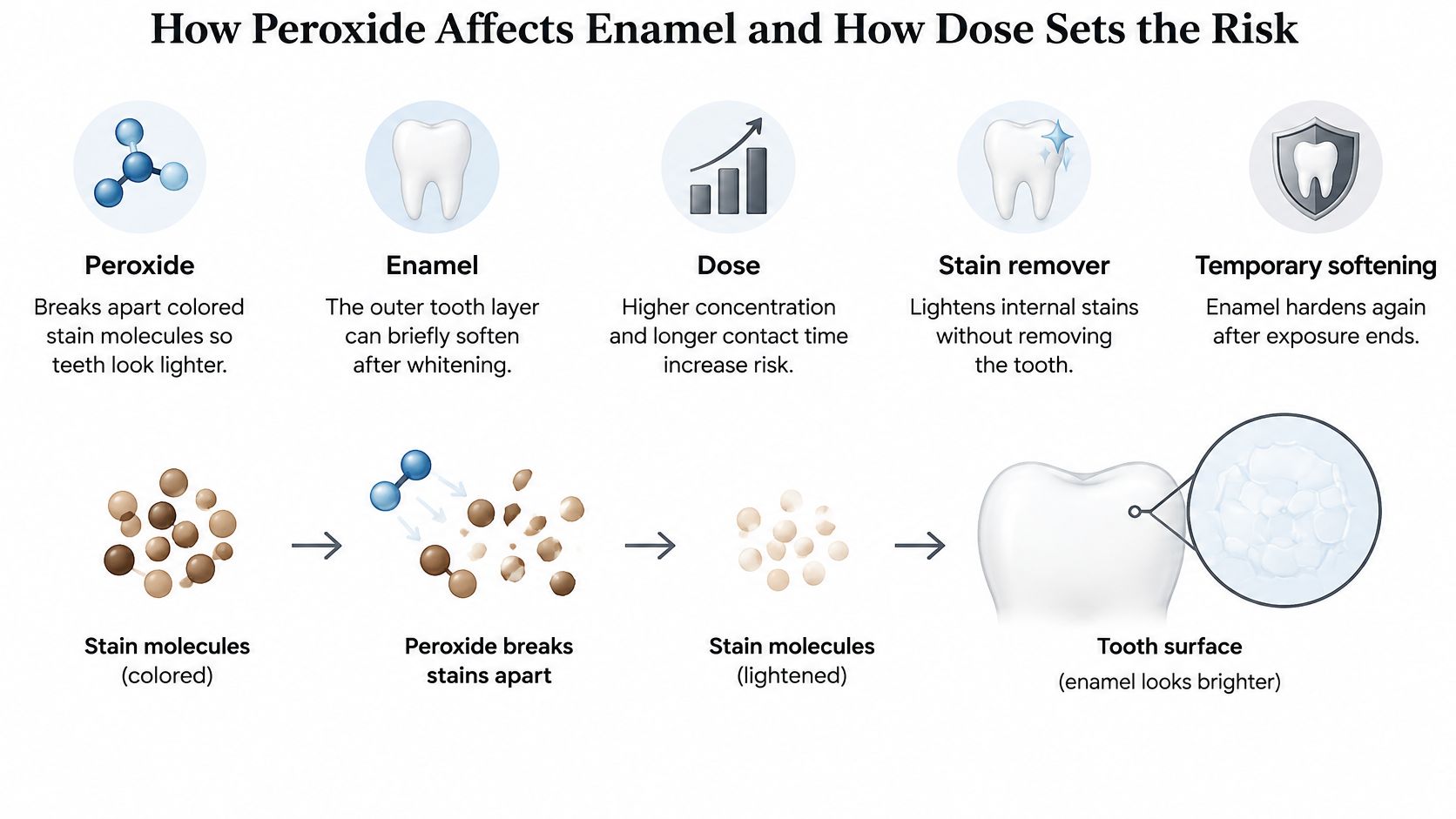
How can peroxide lighten teeth without stripping away enamel? It breaks apart colored stain molecules, changing how light reflects from the tooth. The same process can temporarily soften enamel, so the amount used and the time it stays on matter.
Peroxide works a little like a stain remover on fabric: strength and contact time both affect the result. Teeth are different from fabric, though. Saliva and breaks between treatments help the mouth recover, while repeated or prolonged exposure can increase the chance of sensitivity and changes in enamel hardness.
What the Hardness Numbers Actually Mean
A systematic review and meta-analysis in a PubMed-indexed enamel microhardness review reported a pooled relative measure of 0.89, with a 95% confidence interval of 0.84 to 0.94, indicating a modest reduction in measured hardness. Exposure time was a significant moderator, and a tenfold increase in exposure corresponded to a 6.8% decrease in Knoop hardness. The review characterized the evidence as largely laboratory-based and found no clear evidence of clinically meaningful enamel harm.
A measurable change in a lab test does not mean enamel is crumbling in your mouth. Laboratory conditions can involve uniform exposure without the saliva, breaks, and follow-up care that accompany real treatment. The findings support controlled use, rather than avoiding whitening altogether when teeth are healthy.
A controlled chairside comparison described in a PMC chairside whitening comparison evaluated approximately 15% hydrogen peroxide equivalent from 45% carbamide peroxide, 40% hydrogen peroxide, and 35% hydrogen peroxide with LED activation. Protocols producing color change above approximately Delta E 6 showed the steepest microhardness declines and the largest calcium and phosphate changes. The investigators proposed a qualitative performance ceiling near Delta E 6 when balancing visible whitening with enamel integrity.
The Three Dose Levers You Control
Total exposure depends on three things: peroxide strength, minutes per session, and sessions per week. Increasing any one can raise risk, even if the other two stay the same.
- Strength: Choose the lowest concentration that can reach your shade goal in a reasonable time.
- Minutes per session: Set a timer and remove trays or strips as directed.
- Sessions per week: Leave recovery time between treatments rather than whitening daily to speed up results.
High-strength peroxide needs recovery intervals, too. Fluoride and saliva support remineralization, the process that helps restore minerals to enamel after temporary softening. If sensitivity builds rather than settles, pause whitening and get your teeth checked before continuing.
For example, finishing one strip course and immediately starting another for an upcoming event adds exposure without guaranteeing a brighter result. A custom-fit tray or carefully isolated in-office treatment gives you a defined dose instead of guesswork.
Mild tingling or cold sensitivity for a day or two can be a normal response. Pain that lingers, keeps building, or comes with bleeding or sore gums is a reason to stop and call.
One Limit Peroxide Can't Cross
Peroxide changes natural tooth color, but it does not whiten existing crowns, veneers, fillings, or sealants. A front filling that matched before treatment may look darker afterward because the surrounding teeth have lightened. Consider that shade difference before whitening to avoid an unexpected mismatch.
DIY Trends That Wear Enamel Down
Natural doesn't mean gentle, and gritty doesn't mean cleaner. That's the assumption behind many social media whitening trends, and it's where enamel can get into real trouble. Chemical bleaching changes stain molecules, while physical wear removes or softens the surface itself.
This comparison shows the difference between a measured gel and abrasive household ingredients.
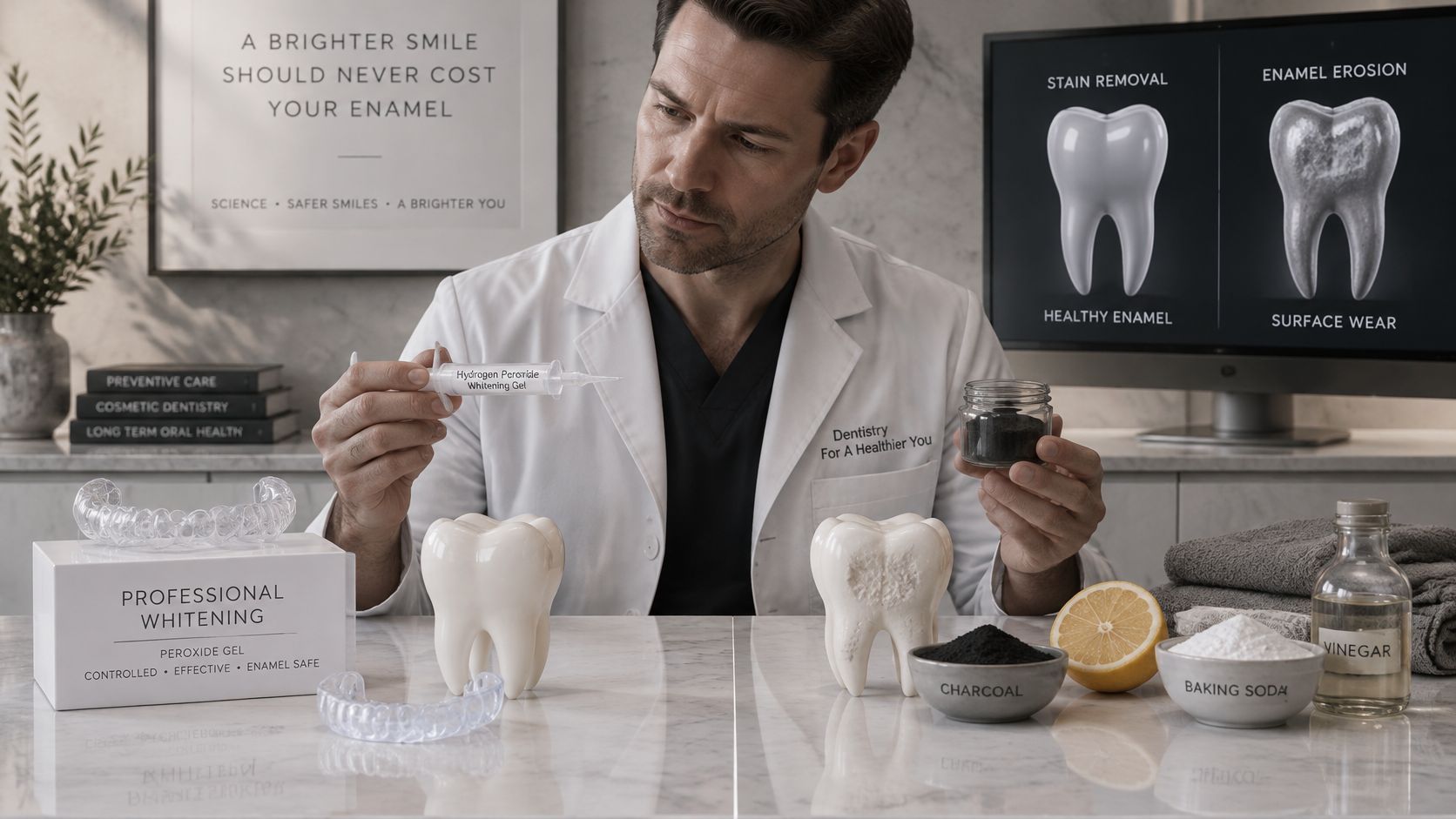
Charcoal powders, gritty whitening pastes, baking-soda and lemon-juice scrubs, and citrus soaks all rely on abrasion, acid, or both. The American Dental Association article debunking dental trends describes highly abrasive trends as capable of wearing enamel down faster than normal. That makes them a risk, not just an ineffective shortcut.
Hard brushing right after acidic drinks creates the same problem in a quieter way. Acid softens the surface first, then stiff bristles and pressure scrub it while it's vulnerable. Wait about 30 minutes after acidic food or drink before brushing, rinse with water in the meantime, and use a soft brush with light pressure.
This short video walks through why those trends can backfire.
Small exposures add up over months. A gritty powder twice a day, citrus on weekends, and whitening strips on top can leave edges thin and teeth more sensitive, and thinner enamel can let the darker layer underneath show through. If a product leaves your teeth feeling rough, cupped, or increasingly sore, pause it and book an exam instead of switching to another trend.
Signs Your Enamel Needs a Check Before Whitening
A tooth that already stings in the cold, looks glassy at the edges, or hurts when you bite is not a blank surface for bleach. The gel only sits on what is already there. Thin enamel, open dentin, a crack, or a sore gum changes how much dose that tooth can take, and for how long.
Symptoms to Check Before Whitening
| Symptom | Possible cause | Next step |
|---|---|---|
| Cold sensitivity that lasts after a whitening course | Exposed dentin, recession or enamel loss | Book an exam before the next session |
| Sharp pain when biting | Cracks, decay or a failing filling | Stop whitening and get evaluated |
| Thin, translucent or notched edges | Enamel wear or erosion | Stop and ask about erosion treatment |
| Cupping or notches near the gumline | Abrasion or gum recession | Have the area checked before any further whitening |
| White or sore gum patches | Gum irritation from trays or strong gel | Pause tray use and ask the dentist |
| Old crowns, veneers or fillings | Restorations do not whiten | Plan shade matching before whitening |
Cold that lingers after a whitening course often means dentin is no longer fully covered. Enamel has thinned, or the gum has pulled back and left the root exposed. A sharp jab on biting is a different signal. It can mean a crack, decay, or a filling that is giving way under pressure. Stop the gel and have that tooth examined before another session.
Translucent edges, notches, and small cups near the gumline are wear you can see. You can read how that loss happens in our guide to what enamel erosion does to teeth. On a tooth that already looks thin, a longer tray time or a stronger gel raises the chance of more soreness, even when the shade goal is modest. The same product for a shorter time on intact enamel is a lower risk than that longer exposure on worn edges.
White or sore gum patches usually mean gel reached tissue it should not. A tray that gaps, or too much product in the reservoir, is the usual reason. Pause tray wear until the tissue settles and the fit is checked.
A pre-whitening visit is clearer when symptoms, shade goals, and product history sit in one record. Tools for transcribing patient visits in dental clinics can help teams keep those details together. Bring your own list as well: what you used, and the week the symptoms started.
The NHS teeth whitening guidance states that professional whitening should not be performed in people aged 17 or younger or in patients with unhealthy teeth or gums. It also identifies cold- or sweet-triggered sensitivity, sore gums or throat, and white gum patches as possible side effects. An exam looks for decay, gum disease, and restorations that would make whitening uncomfortable or uneven.
An older crown on a front tooth will not lighten with the teeth around it. Whiten first, and the mismatch can force a later replacement just to blend the shade. Crowns, veneers, and fillings need a shade plan before the gel goes on.
Gentler Whitening Choices for Sensitive Teeth
Cold zings after ice water can still leave room for whitening. Sensitivity changes the product, the strength, and the schedule. It is not the same signal as enamel that has already worn thin. A safer choice depends on three things: how strong the gel is, how long it stays on the teeth, and what condition those teeth are in before you start.
Peroxide acts a bit like a strong cleaner on a polished counter. A short, measured pass can lift surface color. Leaving a stronger cleaner in place longer raises the chance of roughness and pain, especially where the surface is already chipped or thin. The brand name matters less than dose, minutes of contact, and the enamel you bring to the appointment.
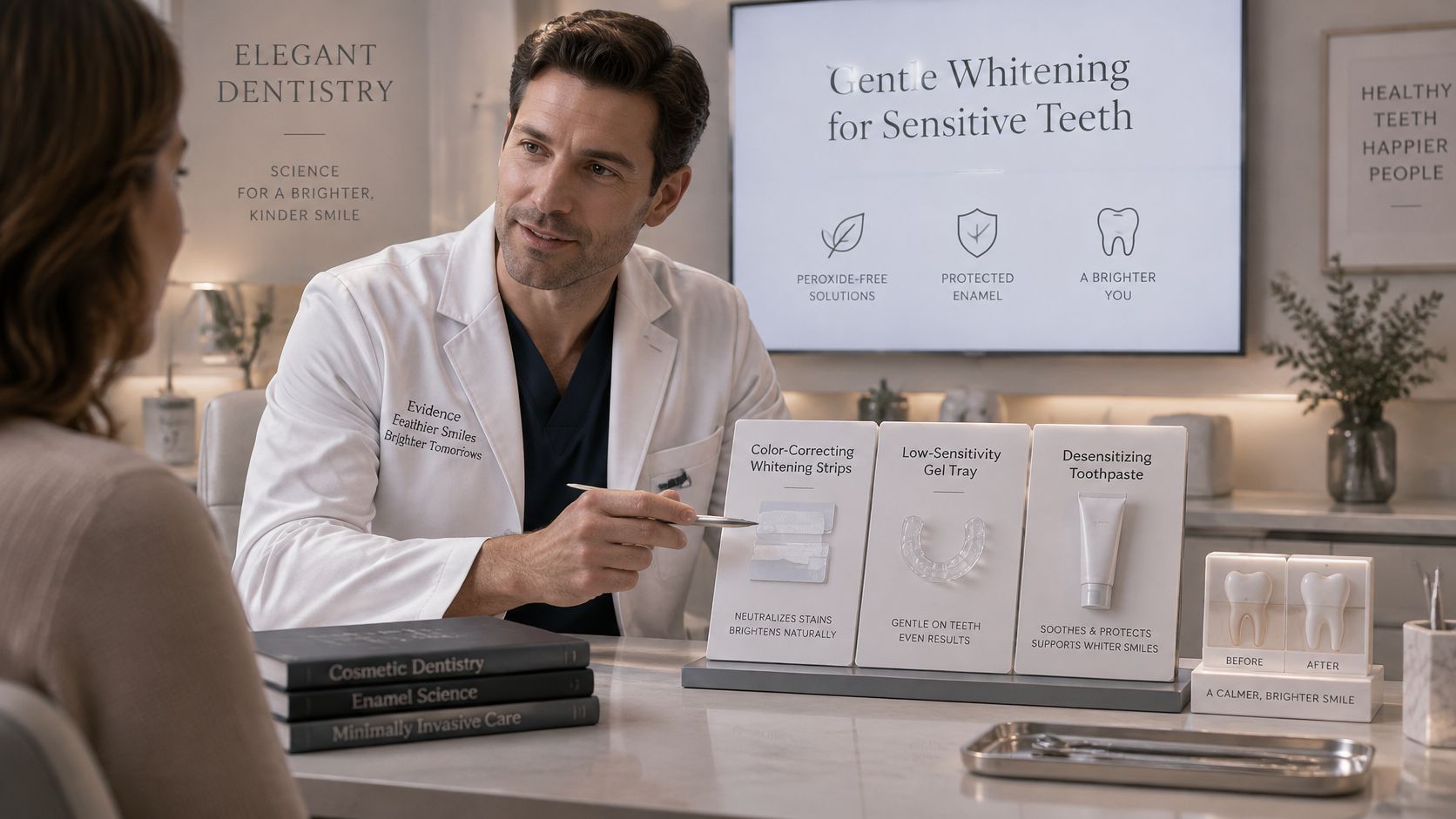
A 2025 systematic review, summarized in a PubMed review of peroxide-free color-correcting products, found perceptible whitening with no significant enamel erosion or dentin-roughness changes in the reviewed evidence, while reported sensitivity remained below 3%. The color change was generally more modest than with carbamide peroxide. Lower-strength at-home regimens tend to cause only mild sensitivity, which is why a slower plan often fits tender teeth better than chasing the biggest shade jump.
Rank Your Choice by Goal
- Fastest results: Supervised in-office whitening is a yes when the exam shows healthy teeth and gums. The dose is higher, but contact time is short and someone is watching.
- Lowest sensitivity: A lower-strength take-home gel is usually the safer yes. Shorter sessions and rest days cut total exposure.
- Peroxide-free color correction: A reasonable yes for mild staining if you expect a smaller change, in line with the review above.
- Recession, cracks, decay concerns, or restorations: A not-yet. Damaged or restored teeth raise risk even at a modest dose, so the exam comes before any gel.
A patient in Chattanooga, TN, with cold sensitivity and gum recession, and with family photos coming up, does better starting with an exam and desensitizing care. Guidance on tooth sensitivity relief can sit alongside a lower-strength gel used for shorter nights, then a pause to reassess. Ask a dentist or pharmacist which desensitizing toothpaste fits. Some people also look at European Sensodyne toothpaste shipped internationally when a preferred formula is hard to find nearby. Pain that lingers after a session is a stop sign, not a reason to add another night of gel.
Book Your Whitening Check in Cleveland or Chattanooga
Book the whitening evaluation before you choose the product. That order protects you from spending money on a kit your enamel, gums, or existing dental work can't support comfortably. It also gives you a clear answer on whether whitening, treatment first, or a different cosmetic option fits best.
At Winn Smiles, serving Cleveland and Chattanooga, TN, your visit starts with a conversation about your shade goals, sensitivity history, and timeline. We then examine your enamel, gums, and existing restorations, and we build a personalized treatment plan that considers your oral health, lifestyle, and budget. If we find decay, gum inflammation, recession, or a failing restoration, we'll explain what to treat first and why waiting can improve both comfort and results.
What the Two Paths Look Like
Winn Smiles offers teeth whitening with in-office treatments that can whiten teeth in one session, and take-home options for gradual, customized whitening. Professional whitening is available at our Cleveland office. In-office care suits you if you want supervised speed, while custom trays suit you if you'd rather whiten gradually at home with a set strength and schedule.
During an in-office visit, we protect your gums, apply a gel strength chosen for your enamel, and watch for sensitivity throughout. We use LED activation only when your plan calls for it. Afterward, we'll recommend remineralization support and a recovery interval before any touch-up, so you don't stack exposure while your teeth settle.
Bring a list of every whitening product you're using, how often you use it, and any symptoms you've noticed. That list helps us calculate your real exposure, not just the dose from one box.
We can also plan shade matching for crowns, veneers, and fillings, so your final smile looks even instead of two-toned. If you're looking for a dentist in Cleveland, TN or a dentist in Chattanooga, TN who'll check first and whiten second, request an appointment or call us. Tell us what you've tried, and we'll tell you which option fits your enamel.
A brighter smile shouldn't come with guesswork about your enamel. At Winn Smiles, we check your teeth and gums first, explain your in-office and take-home whitening options in plain language, and build a plan around your sensitivity, restorations, and goals. Visit Winn Smiles to request your whitening check in Cleveland or Chattanooga and get a clear, enamel-safe next step.

