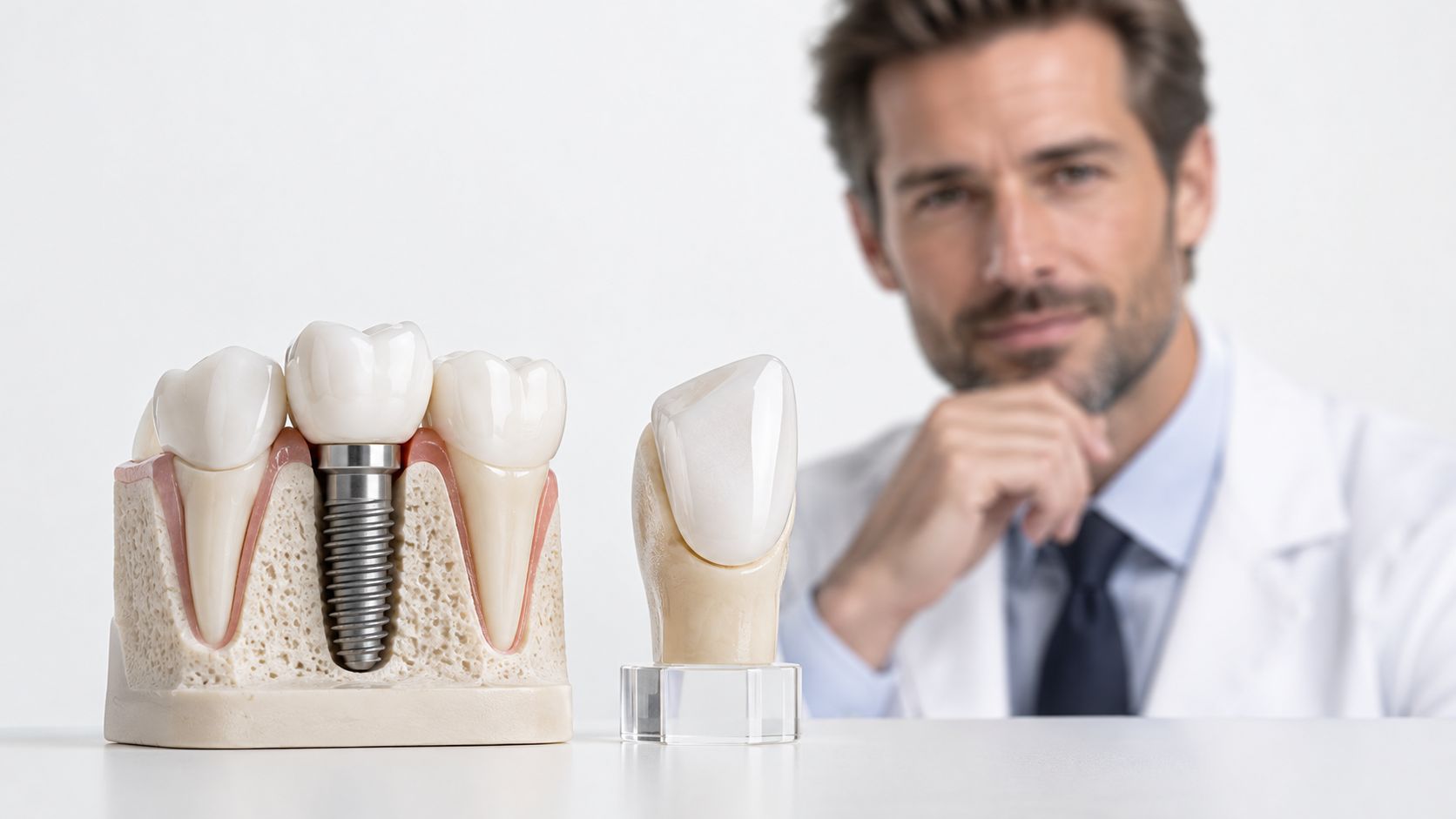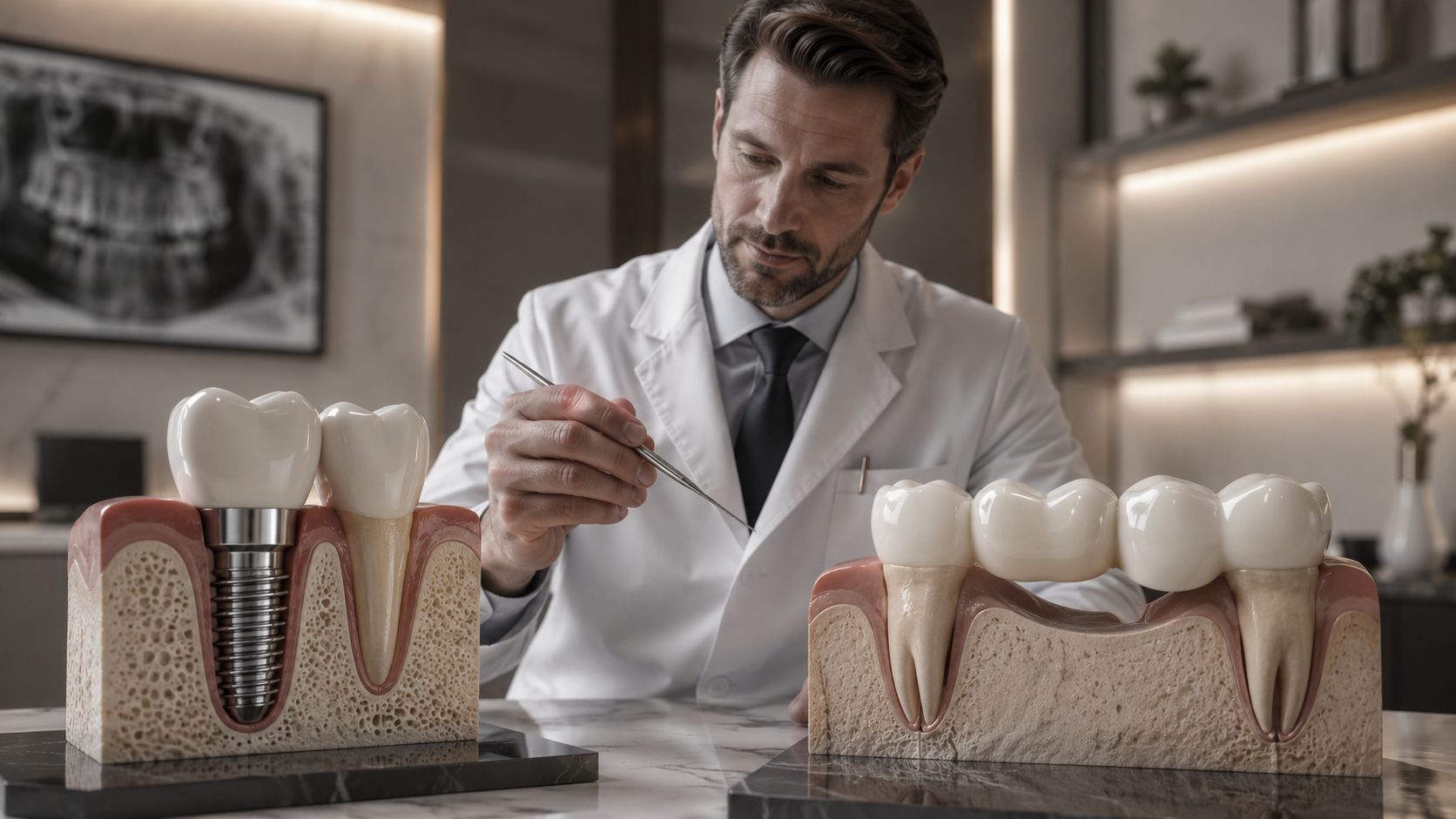
Dental implants have a 10-year success rate above 97%, and bridges usually last 5 to 15 years before replacement. The smarter choice depends on your bone health, your budget timeline, and how many teeth you're replacing.
If you're sitting with a gap in your smile and trying to decide between dental implants or bridges, you're not just choosing a restoration. You're choosing how you want to chew, clean, and maintain that space for years, maybe decades, and that can feel like a lot when you're already anxious about treatment.
| Criteria | Dental Implants | Dental Bridges |
|---|---|---|
| What it replaces | Tooth root and crown | Missing tooth or teeth across the gap |
| Tooth impact | Preserves nearby teeth | Relies on neighboring teeth for support |
| Timeline | Surgical and longer | Usually faster and less invasive |
| Longevity | Built for long-term durability | Commonly needs replacement sooner |
| Maintenance | Clean like a natural tooth | Cleaning under and around the bridge takes more care |
Deciding Between Dental Implants or Bridges
A patient in Chattanooga can hear two options in one visit and still leave unsure which one fits real life. One choice sounds more permanent, the other sounds simpler, and both can be right depending on what's happening in the mouth. That's where a trusted local dentist matters, because this isn't just about filling a gap, it's about making sure the fix fits your body, your timeline, and your comfort level.
At Winn Smiles, patients in Chattanooga and Cleveland get the kind of conversation that lowers stress instead of adding to it. Free consultations and second opinions give people room to ask the questions they've been carrying around, including whether surgery makes sense, whether the surrounding teeth should stay untouched, and how much healing time they can realistically manage.
Why the decision feels so personal
Tooth loss affects more than appearance. It can change how you bite, how you clean your teeth, and how confident you feel when you talk or smile. A missing back tooth might not seem urgent at first, but once chewing becomes uneven, the problem starts to spill into everyday life.
That's why the question isn't only “What looks better?” It's also “What will still make sense next year, and after that?”
Practical rule: if you want the least guesswork, compare the treatment that solves today's gap with the treatment that fits your future maintenance routine.
For many patients, the first good step is a new patient exam with dental x-rays, a careful look at the bite, and an honest discussion about whether the mouth is better suited for an implant, a bridge, or another restorative dentistry option such as tooth extraction followed by replacement planning. In some cases, cosmetic dentistry goals matter too, especially when the missing tooth sits in the smile line. In other cases, the fastest path back to function matters more.
The right answer often comes from an exam, not a search engine. A local office that handles dental implants near me, dentist near me, and emergency dentistry concerns can help separate fear from facts before you commit.
Understanding Dental Implants and Dental Bridges
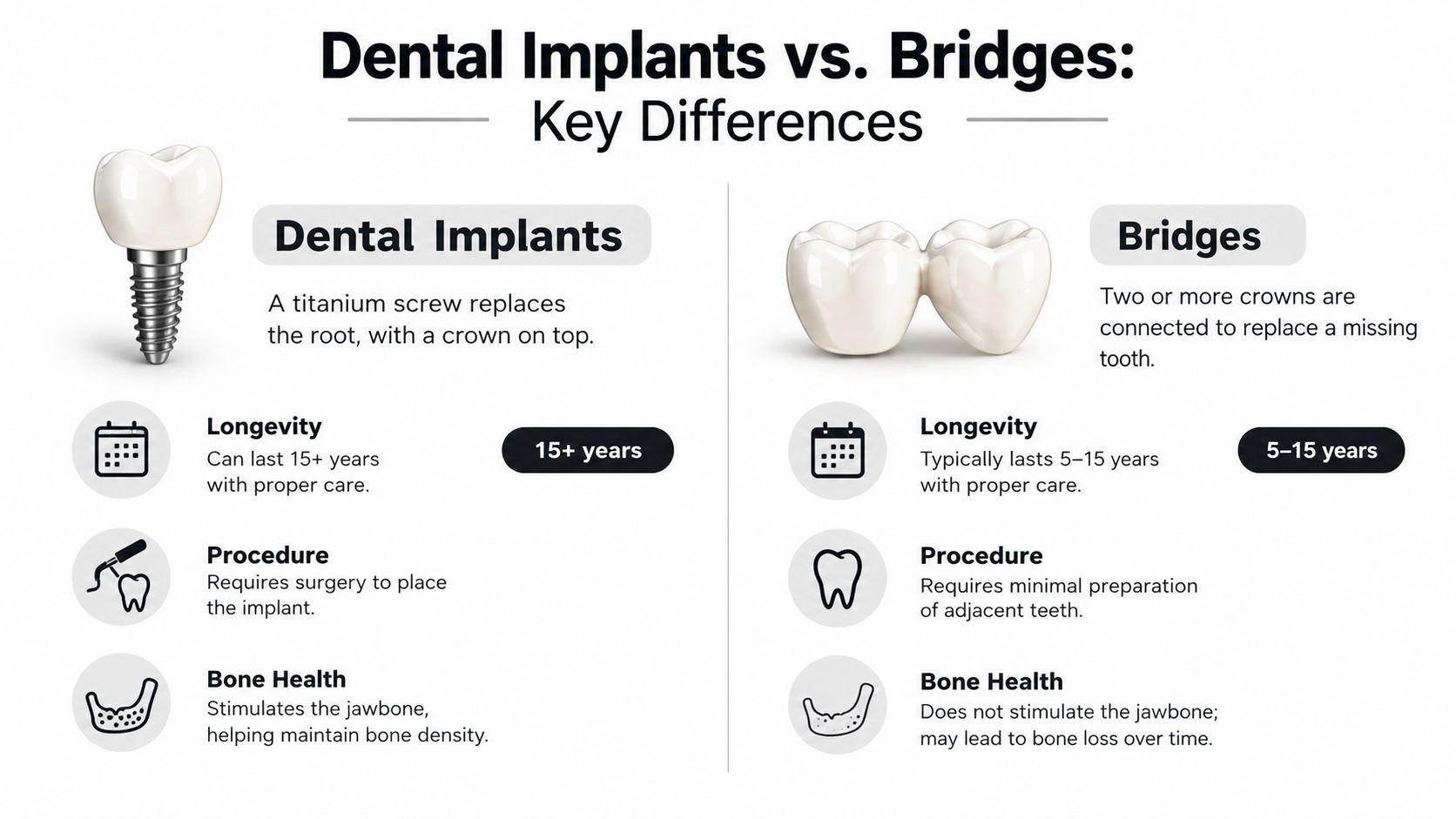
A dental implant is a small post placed into the jaw, then restored with a crown on top. It acts like an artificial root, which is why implants feel like a more complete replacement than a simple visible cap. The key idea is osseointegration, the process where bone grows around the implant so it becomes part of the mouth's support system, not just a tooth sitting on top of the gums.
A bridge works differently. It fills the empty space by attaching a false tooth to the natural teeth on either side of the gap. Those supporting teeth carry the load, which makes the bridge faster in many cases, but it also means the teeth next to the gap become part of the restoration.
What patients actually receive
A traditional bridge usually involves crowns on the anchor teeth with a replacement tooth in between. A Maryland bridge uses a lighter bonding approach, and a cantilever bridge attaches from one side when only one neighboring tooth is available. Those details matter because the design changes how much force the restoration can handle and how much preparation is needed.
The difference in durability also matters. A large NCBI review found dental bridges have an estimated survival rate of about 94% at 3 years, 89% to 91% at 5 years, and 79% to 82% at 10 years (NCBI bridge survival review). That doesn't make bridges a bad option. It just means they work on a different timeline than implants.
If you're trying to compare the two, think of an implant as rebuilding the root and crown, while a bridge replaces the visible tooth across the gap.
For patients and staff who need to sort out coverage questions, procedure coding, and paperwork, resources on dental medical billing services can also help explain why treatment estimates sometimes look different from one option to the other. That kind of administrative clarity can reduce a lot of stress before treatment begins.
Dental Implants vs Bridges Head to Head
The comparison comes down to how each choice performs over time, not just what it looks like on day one. A 2012 systematic review found implant-supported single crowns had a 97.2% five-year survival rate and a 95.2% ten-year survival rate, while also reporting measurable complication risks such as soft-tissue complications at 7.1%, bone loss greater than 2 mm at 5.2%, and screw loosening at 8.8% at 5 years (systematic review and meta-analysis). High survival doesn't mean zero maintenance.
Longevity and survival
Implants have the advantage when the goal is long-term durability. Clinical benchmarks from StatPearls describe a 10-year success rate above 97% for implants, which gives patients a useful reference point when they're making a durable tooth-replacement decision (StatPearls implant benchmark). Bridges can still perform well, but the survival curve is different, and replacement is more likely over time.
Effect on neighboring teeth
Bridges and implants diverge in a very practical way. An implant stands on its own, so the adjacent teeth stay untouched. A bridge depends on those teeth for support, which can be a good trade-off in the right case, but it does mean healthy teeth become part of the restoration.
Maintenance and complication profile
A bridge asks for more attention around the margins and underneath the replacement tooth. An implant asks for careful hygiene too, but it doesn't require the same kind of support from nearby teeth. In plain terms, a bridge can be easier to place, while an implant can be easier to live with long term.
The decision in one line
Best fit matters more than raw survival. If your neighboring teeth are already heavily restored, a bridge may make sense. If they're healthy and you want to preserve them, an implant often has the cleaner biological logic.
| Criteria | Dental Implants | Dental Bridges |
|---|---|---|
| Longevity | Strong long-term durability, with high 10-year success benchmarks | Good medium-term survival, but replacement is more common over time |
| Procedure | Surgical, with healing time | Less invasive, usually faster |
| Nearby teeth | Leaves them alone | Uses them as anchors |
| Maintenance | Similar to caring for a natural tooth | Requires extra care around the bridge |
| Risk profile | Maintenance issues still happen | Support teeth can be affected over time |
When Implants Are the Better Choice

An implant usually makes sense when the missing tooth sits in a healthy area and the neighboring teeth are worth protecting. That's especially true if you want a solution that doesn't ask the surrounding teeth to do extra work. For many adults, that feels like the quieter, cleaner long-term choice.
Long-term data support that logic. A study of 10,871 implants reported cumulative survival at the implant level of 98.9% at 3 years, 98.5% at 5 years, 96.8% at 10 years, and 94.0% at 15 years (large implant survival study). Those numbers don't promise perfection, but they do show why implants have become a standard option in modern dentistry.
Good implant candidates often share a few traits
- Enough bone to support the post. Without stable bone, the foundation may not be strong enough.
- A desire to preserve neighboring teeth. If the teeth next to the gap are healthy, keeping them untouched is a real advantage.
- Comfort with a longer process. Implants usually involve surgery and healing before the final crown is placed.
- A long-term mindset. Patients who want to reduce replacement cycles often lean this way.
This is also where case-specific guidance matters. A person missing a single back tooth may care more about keeping the adjacent teeth intact than about finishing as fast as possible. Another person may want the most durable path after years of avoiding treatment.
If you want a deeper look at who qualifies for this approach, Winn Smiles has a helpful resource on dental implant candidacy. That kind of planning can save a lot of uncertainty before you start.
When Bridges Make More Sense
Bridges deserve more respect than they often get in implant-first marketing. If you need a faster restoration, want to avoid surgery, or don't have enough bone for an implant without extra procedures, a bridge can be the more practical choice.
That practical reality is backed by market behavior too. Recent journal data reports that bridges account for 51.7% of treatment distribution in crown-and-bridge work (treatment distribution source). In other words, bridges are not an old-fashioned fallback. They're still a major part of real-world care because anatomy, budget, and timing often make them the right answer.
The bridge advantage shows up when timing matters
A bridge usually gets you back to function faster. It also avoids the surgical step that makes some patients nervous or disqualifies them medically. If the surrounding teeth already need crowns, a bridge can sometimes solve more than one problem at once.
The trade-off is that you're asking those support teeth to carry extra responsibility. That can be perfectly reasonable in the right mouth, especially when the plan is built around existing dental work rather than idealized textbook conditions.
A bridge is often the smarter choice when the goal is quick restoration without surgery and the teeth on either side already need attention.
For patients who are comparing costs, the difference is often not “cheap versus expensive.” It's “lower upfront cost versus potentially fewer replacement cycles later.” That's a more honest frame, especially if you're budgeting for treatment in Chattanooga or Cleveland and trying to protect your next few years of dental expenses.
The Full Cost of Tooth Replacement Over Time
A bridge can look cheaper on day one. That first estimate matters, but it does not tell the whole story. If the bridge later needs replacement, or if the anchor teeth need more treatment, the total bill can climb in ways that are easy to miss during the first visit.
The hidden cost is replacement timing. Bridges can wear down, the supporting teeth can change, and treatment may need to be repeated. Dental implants usually ask for a higher upfront investment, but they stand on their own and may reduce repeated replacement cycles later.
The hidden costs behind the first estimate
A first quote only covers the starting point. It often leaves out maintenance, possible work on neighboring teeth, and the way a longer-lasting restoration can spread its cost across more years. The better money question is simple, if a restoration is still in place years later, or needs to be replaced, what does that really mean for your budget?
That long-view approach matters because both treatments remain widely used for real patients. Analysts tracking the single-tooth implant-and-bridge segment project growth from USD 6.58 billion in 2025 to USD 9.81 billion by 2031 (market projection). The projection does not pick a winner. It shows that implants and bridges both continue to solve real problems, but in different ways and on different timelines.
For a patient-friendly breakdown of how treatment costs can add up, Winn Smiles also explains tooth replacement options and cost. That kind of clear conversation can reduce surprises and make the decision feel less pressured.
Your Next Step at Winn Smiles
The right answer depends on your mouth, not a generic rule. If your bone support is strong and you want a long-term solution that leaves neighboring teeth alone, an implant may fit best. If you need a faster, less invasive option, or your anatomy points away from surgery, a bridge may be the more sensible choice.
That's why a consultation matters. At Winn Smiles in Chattanooga and Cleveland, patients can talk through dental implants, bridges, tooth extraction, emergency dentistry, and restorative dentistry in a calm setting with modern technology, including same-day crowns and laser dentistry. For anxious patients, comfort-focused care and sedation options can make the process feel much more manageable.
The most useful visit is the one where you leave with clarity. You should know what each option does, how long it may last, what it asks of the teeth around it, and what the financial picture really looks like before you commit.
If you're searching for a dentist near me or dental implants near me in Chattanooga or Cleveland, schedule a free consultation and ask for a second opinion if you need one. A good plan should feel clear, honest, and designed for your smile, not rushed.
If you're ready to compare dental implants or bridges with guidance that fits your mouth and your budget, visit Winn Smiles to schedule a free consultation. The team can walk you through your options, answer questions about healing and cost, and help you choose the path that makes the most sense for your long-term oral health.