Single dental implants typically run $3,000 to $6,000 per tooth, while full-arch solutions usually land around $15,000 to $30,000 per arch. Lower-cost options like partial dentures and bridges still exist, but the right choice depends on your mouth, your timeline, and how long you want the result to last.
| Option | Typical Cost | Average Lifespan | Best Fit | Watch Out For |
|---|---|---|---|---|
| Single dental implant with crown | $3,000 to $6,000 per tooth | Long-term, with the crown more likely to need replacement than the implant post | One missing tooth with healthy surrounding bone | Higher upfront cost, healing time |
| Traditional bridge | $1,000 to $5,000 per tooth | Moderate, depends on supporting teeth | A short span where nearby teeth already need crowns | It relies on neighboring teeth |
| Removable partial denture | $300 to $5,000 | Varies by material and fit | Budget-conscious replacement for several teeth | Less stable, may need adjustments |
| Full denture | Varies by case | Varies by case | Multiple missing teeth or full-arch tooth loss | Retention and comfort can be an issue |
| Implant-supported bridge | $5,195 on average for an implant-supported bridge, with full-arch treatment often far higher | Long-term fixed solution | Several missing teeth or a fuller reconstruction | More complex planning and higher total cost |
| Full-arch implant solution | $15,000 to $30,000 per arch | Long-term fixed solution | Extensive tooth loss or failing dentures | Highest upfront investment |
If you're searching for a dentist near me in Cleveland, TN or Chattanooga, TN, you're probably not just trying to find the cheapest fix. You want something that won't hurt every time you chew, won't embarrass you in conversation, and won't turn into a new problem six months later. That's the essential conversation behind tooth replacement options cost, and it's the one worth having before you spend a dollar.
Why the Right Replacement Matters Beyond the Price Tag
A lot of people sit in the car after a Google search for tooth replacement options cost and feel more confused than when they started. One missing molar can lead to one recommendation, while another patient with the same missing tooth might need a completely different plan. That's not a sales tactic, it's dentistry.
The reason is simple. Teeth don't exist in isolation. When one is gone, the neighboring teeth can drift, the bite can shift, and the jawbone in that area can start losing support over time. A replacement that looks cheap on paper can be the wrong move if it ignores those bigger problems.
The question isn't only what it costs today
A young professional with one broken front tooth usually cares about appearance, speed, and comfort. A retiree with several missing back teeth may care more about chewing and keeping the bill manageable. Those are very different priorities, even if both patients say the same thing at check-in.
That's why dentists don't start with the fee sheet. We start with the mouth in front of us. A treatment that preserves bone and keeps the bite stable may be worth more than a lower-priced option that solves only part of the problem.
Practical rule: If a replacement saves money now but creates bigger treatment later, it's not actually the cheaper choice.
For patients comparing a dentist in Chattanooga, TN or Cleveland, the smart move is to ask what kind of result they're buying. A bridge, partial, implant, or full-arch restoration can all fill a gap, but they don't do it in the same way. The best value comes from matching the solution to the biology, not just the budget.
How Dentists Decide Which Option Fits Your Mouth
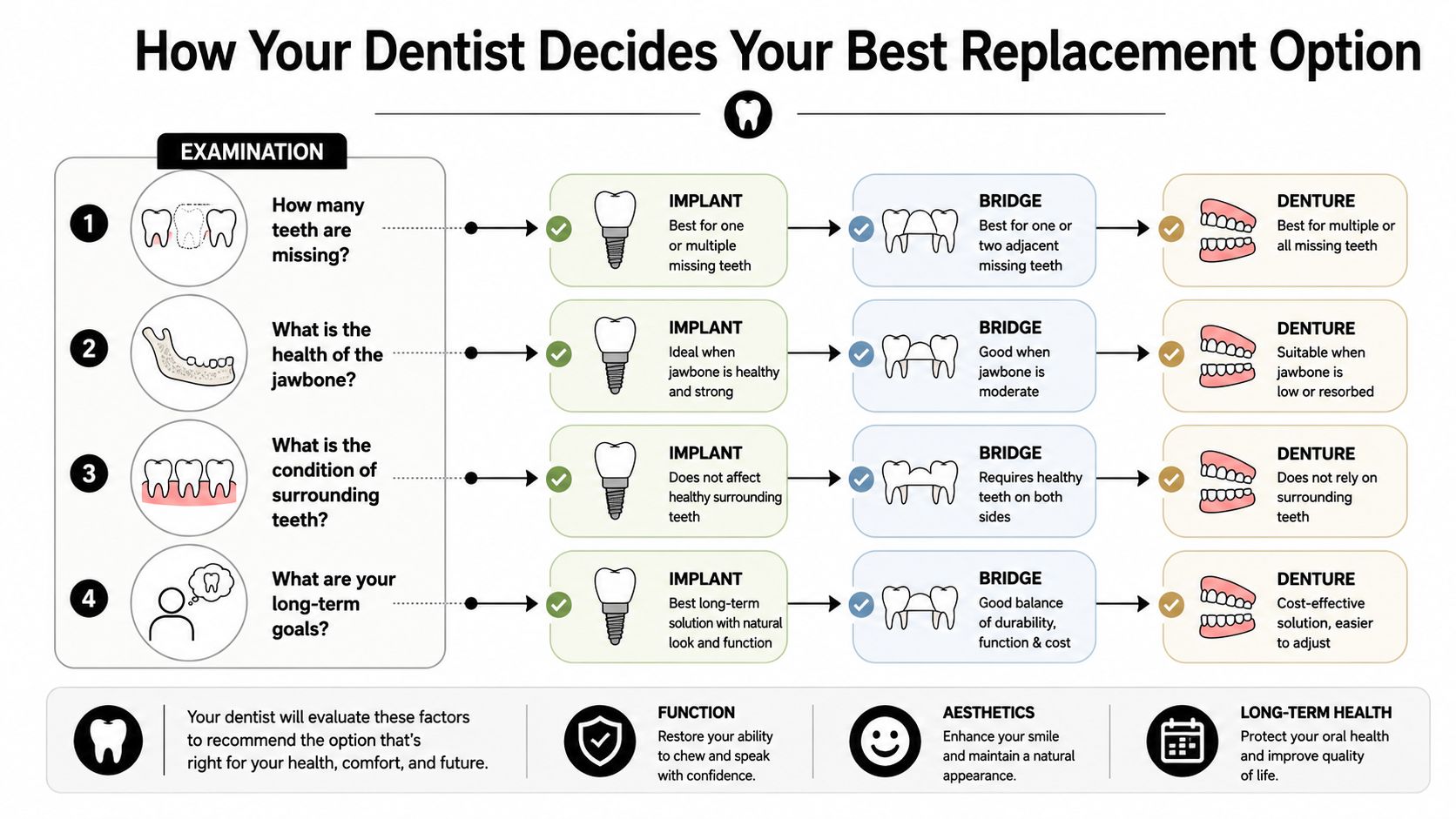
Before anyone talks about a quote, the exam has to answer four plain questions. How many teeth are missing, what does the bone look like, are the neighboring teeth healthy, and what do you want the result to do for you over time. That's the decision tree, and it's a lot more useful than comparing ad headlines.
What changes the recommendation
If there's one missing tooth and the nearby teeth are healthy, an implant is often the cleanest answer because it doesn't depend on the teeth beside it. If several teeth are missing in a row, an implant-supported bridge may make more sense because it can cover more space without needing a separate implant for every single tooth. If the mouth has widespread tooth loss, the discussion usually shifts toward a full-arch fixed solution or an implant-retained denture.
Bone matters too. If the jawbone has thinned after years without a tooth, grafting may be needed before an implant can work well. That isn't an upsell, it's foundation work. A strong base matters more than a fast shortcut.
Why health history changes the plan
Smoking, uncontrolled diabetes, and long-term denture wear can all affect healing and how predictable a restoration will be. Those factors don't automatically rule out treatment, but they do change the timing and the sequence. A careful dentist in Cleveland or Chattanooga should explain that plainly instead of pretending every mouth has the same starting point.
The most useful consult feels less like a pitch and more like a map. If the dentist explains why one option fits your mouth better than another, you're getting real guidance. That's the point where cosmetic dentist near me searches should turn into an actual treatment plan, not a guess.
Comparing Every Tooth Replacement Option Side by Side
The comparison people need is not “what's cheapest.” It's “what do I get, how long will it last, and what will I regret later.” A clean side-by-side view makes that easier to answer, especially for patients trying to balance dental implants near me against lower-cost temporary options.
| Option | Typical Cost | Average Lifespan | Best Fit | Watch Out For |
|---|---|---|---|---|
| Single dental implant with crown | $3,000 to $6,000 per tooth | Long-term | One missing tooth, healthy bone, strong interest in permanence | Upfront cost, healing time |
| Traditional bridge | $2,000 to $5,000 per unit | Moderate | Short gaps with healthy neighboring teeth | Nearby teeth have to be prepared |
| Removable partial denture | $300 to $5,000 | Varies by material and fit | Lower-budget replacement for multiple teeth | Less stability, more maintenance |
| Full conventional denture | Varies by case | Varies by case | Widespread tooth loss when fixed options aren't practical | Fit can change over time |
| Implant-supported bridge | $5,195 on average for an implant-supported bridge | Long-term | Several missing teeth in one area | More planning and higher cost |
| Full-arch implant solution | $15,000 to $30,000 per arch | Long-term | Failing teeth or an unstable denture situation | Highest investment and more complex treatment |
A single implant with a crown is usually the cleanest fixed answer for one tooth. CareCredit notes that the national average cost for a single implant is $2,143 for the implant procedure alone, and the crown can add $488 to $3,254 depending on material, which is why final pricing is usually discussed as a full treatment rather than a fixture alone. CareCredit's implant cost breakdown makes that distinction clear.
A traditional bridge can be a good fit when the teeth next to the gap already need crowns. It's faster, and it stays fixed in place. The trade-off is that healthy adjacent teeth have to be shaped to support it.
A removable partial denture is the budget entry point, especially for patients who need something practical now. A flipper tooth averages $605, which shows how low the starting price can go when the goal is temporary replacement rather than long-term stability. This 2026 cost guide also places removable partial dentures in a broader $1,738 to $2,229 average range, depending on design.
An implant-supported bridge and full-arch implant work are different categories entirely. They're for patients who want a more stable, fixed result and are willing to invest accordingly. If you want a more detailed implant pricing breakdown, this Winn Smiles guide on implant costs is a useful follow-up.
Bottom line: If you're only weighing the first bill, you'll miss the real difference between a temporary fix and a long-term restoration.
The Hidden Math Most Cost Comparisons Skip
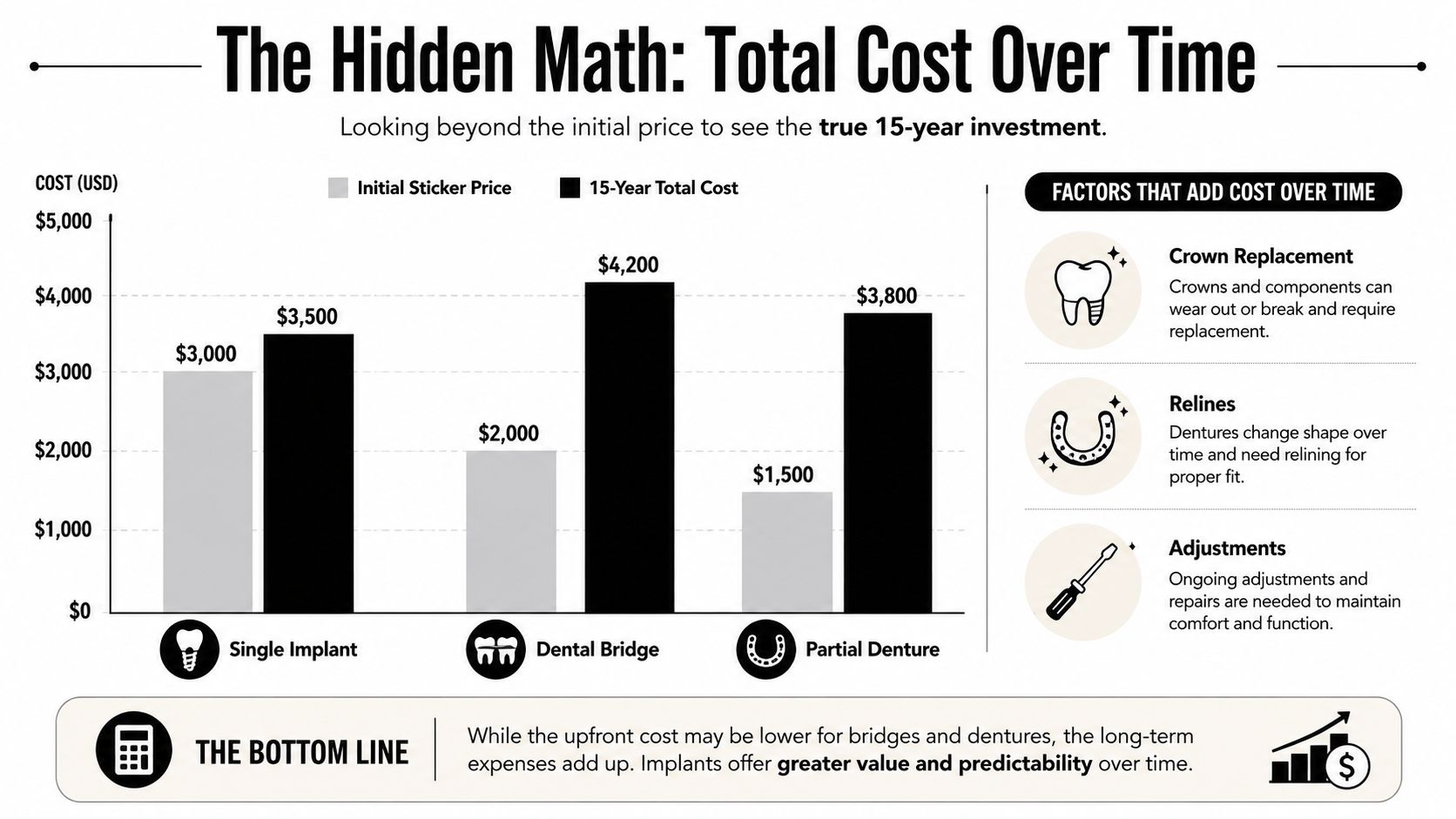
Sticker price is the part people see first, but it's not the part that matters most. A dental restoration can look affordable today and still cost more over time if it needs repeated repairs, relines, replacements, or extra visits. That's why the smartest question is not “what's the cheapest option,” it's “what's the total cost over years, not months.”
The annualized view is revealing. One independent comparison estimates a bridge at £1,500 lasting 12 years, which works out to about £125 per year, while dentures at £800 lasting six years come out to about £133 per year and may need multiple sets across 20 years. That lifecycle-cost comparison is useful because it shows why the cheapest starting number doesn't always stay cheapest.
What adds to the bill later
Crowns wear. Dentures loosen. Bridges can need repair if the supporting teeth change. Implant crowns may need replacement even when the implant post itself remains stable for a very long time. That split between the fixed foundation and the visible restoration is one reason implant pricing is often misunderstood.
Skipping replacement altogether can be even more expensive. Teeth drift into the gap, chewing patterns change, and the bone in the empty area can continue to shrink. Once that happens, the later fix is usually more complex than the original one would have been.
Ask for the total lifecycle cost, not just the first invoice.
That question usually earns respect in the operatory because it shows you're thinking like a long-term patient, not a one-time shopper. It also helps you compare a bridge, partial, or implant on the same terms. For a dentist near me search, that's the kind of clarity you want before you commit.
Insurance, Financing, and Local Cost Relief in Tennessee
The published price is rarely the final price. Insurance, financing, and local care access can change the number a lot, especially for patients in Cleveland and Chattanooga who are trying to replace teeth without draining savings. That's why this part of the conversation deserves its own attention.
Many patients assume dental insurance will either cover everything or cover nothing. In reality, coverage depends on the plan, the procedure, and the benefit cap. A crown may be covered differently than the implant post, and a bridge may be treated differently than a full-arch restoration. The only way to know is to get a pre-treatment estimate before anything starts.
For patients who need a second opinion on affordability, this guide to the best dental insurance plans for 2026 can help you compare broader coverage strategies before you make a decision. If you want to break the bill into smaller pieces, Winn Smiles' implant payment plans are worth asking about during a consult.
Where local relief can come from
AARP notes that HRSA community health centers operate nationwide and that 90% provide additional dental services, including bridges, implants, and dentures depending on income levels. AARP's discussion of replacing missing teeth makes the point clearly, and it matters because community access is often very different from private-office pricing. That can be a real path for patients who need care but can't absorb full private-market fees.
Tennessee adults also need to check how limited Medicaid dental coverage applies to their situation. It's not a blanket answer, and it's not something to guess on. Ask the office to verify benefits before treatment is scheduled.
A good office should also explain financing in plain English. Monthly payment options, third-party financing, and free consults for select services can make a major difference when the treatment is clinically straightforward but financially tight.
Most useful tip: ask for a written pre-treatment estimate with procedure codes before you agree to any replacement plan.
Questions Worth Bringing to Your Implant or Denture Consult
A good consult should leave you with a written plan, not a fuzzy memory. If you're comparing a dental implant against a bridge or denture, go in with questions that force clarity on the total fee and the timeline. That's how you avoid surprise charges and rushed decisions.
The questions that matter
- What's included in this quote? Ask whether the implant post, abutment, crown, sedation, and follow-up visits are all part of the price.
- Will extra procedures change the total? Bone grafting, tooth extraction, and sinus-related work can add to the bill.
- How long will the process take? Some cases move in stages, and others are more straightforward.
- What happens if an implant fails? You want to know the office's plan before anything starts.
- Do you offer emergency care if something hurts or breaks? That matters for anxious patients and busy families alike.
Ask for the treatment plan in writing, ideally with the procedure codes listed. That makes insurance review easier and keeps everyone aligned on what's being done. If same-day crowns are available, ask whether that can reduce the number of visits. If you deal with dental anxiety, ask about sedation options before the day of treatment.
A clear photo record helps too. Before-and-after examples show the office's style, the esthetic result, and how they manage different cases. That's especially useful if you're deciding between a cosmetic fix and a more durable restorative option.

How Winn Smiles Makes Tooth Replacement Easier Locally
Winn Smiles sees tooth replacement as a planning conversation, not a one-size-fits-all sale. With offices in Cleveland and Chattanooga, the team can walk patients through implants, full-arch options, same-day crowns, and comfort-focused care in a setting that feels less clinical and more personal. That matters when you're already stressed about cost.
Patients who are nervous about treatment should ask about the comfort menu and personalized sedation options. Those details don't change the clinical logic, but they do change how manageable the visit feels. The practice also offers free consultations and second opinions for select services, which gives you a cleaner read on the numbers before you commit.
If you're trying to compare a bridge, partial, or implant without pressure, ask for the full treatment picture first.
The local experience should feel straightforward. You come in, get examined, talk through the options, and leave with a clear plan for what the mouth needs and what it will cost. If that sounds like the kind of care you want, schedule a visit and ask the office to review your replacement options in plain language.
Common Questions Patients Ask Before Committing
How long does a single implant take? It depends on the mouth, the bone, and whether extra steps like extraction or grafting are needed. The important part is that the price you're quoted should match the full treatment, not just the implant piece.
Do you handle emergency tooth loss? Yes, and that matters if a tooth breaks, falls out, or becomes painful without warning. A true dental emergency is anything that causes severe pain, swelling, bleeding that won't stop, or a broken tooth that can't wait for a routine visit.
Are implants safe if I've had dentures for years? Often yes, but long-term denture wear can change the bone and gum conditions, so the exam has to drive the plan. The same goes for patients with diabetes, because healing and treatment timing need to be reviewed carefully before surgery.
Can I afford to wait on treatment? Sometimes patients can, but delaying replacement often makes the long-term work more complicated. That's why it's better to get a written estimate now than to guess later.
If you're comparing tooth replacement options cost in Cleveland or Chattanooga, Winn Smiles can help you sort out the true price, the timeline, and the option that best suits your mouth. Visit Winn Smiles to schedule a consultation and get a clear plan before you make a decision.