You've been told you may need an implant, and now you're searching for dental implants near me in Chattanooga, TN, or Cleveland, TN. Then you see the phrase “dental implants without screws” and wonder whether it means less drilling, less discomfort, or a tooth without a visible hole. Before choosing a treatment, you deserve a clear explanation of what's different, what isn't, and what you may need to maintain later.
Why Patients Search for Dental Implants Without Screws
Hearing “screwless implant” can be reassuring until you try to picture how the tooth stays in place. Does it snap in? Is it glued on? Is there still an implant underneath?
Those are reasonable questions, especially if you're already nervous about replacing a tooth. You don't need to learn an entire dental vocabulary to understand your options.
The concerns behind the search
For someone replacing a front tooth, appearance may come first. You might worry that a screw hole will show whenever you smile. Someone replacing a back tooth may be more concerned about a screw loosening or whether a future repair means drilling through the crown.
Another patient may want something that feels like part of their mouth rather than a collection of hardware. These concerns deserve separate answers because appearance, repairability, and comfort aren't interchangeable outcomes.
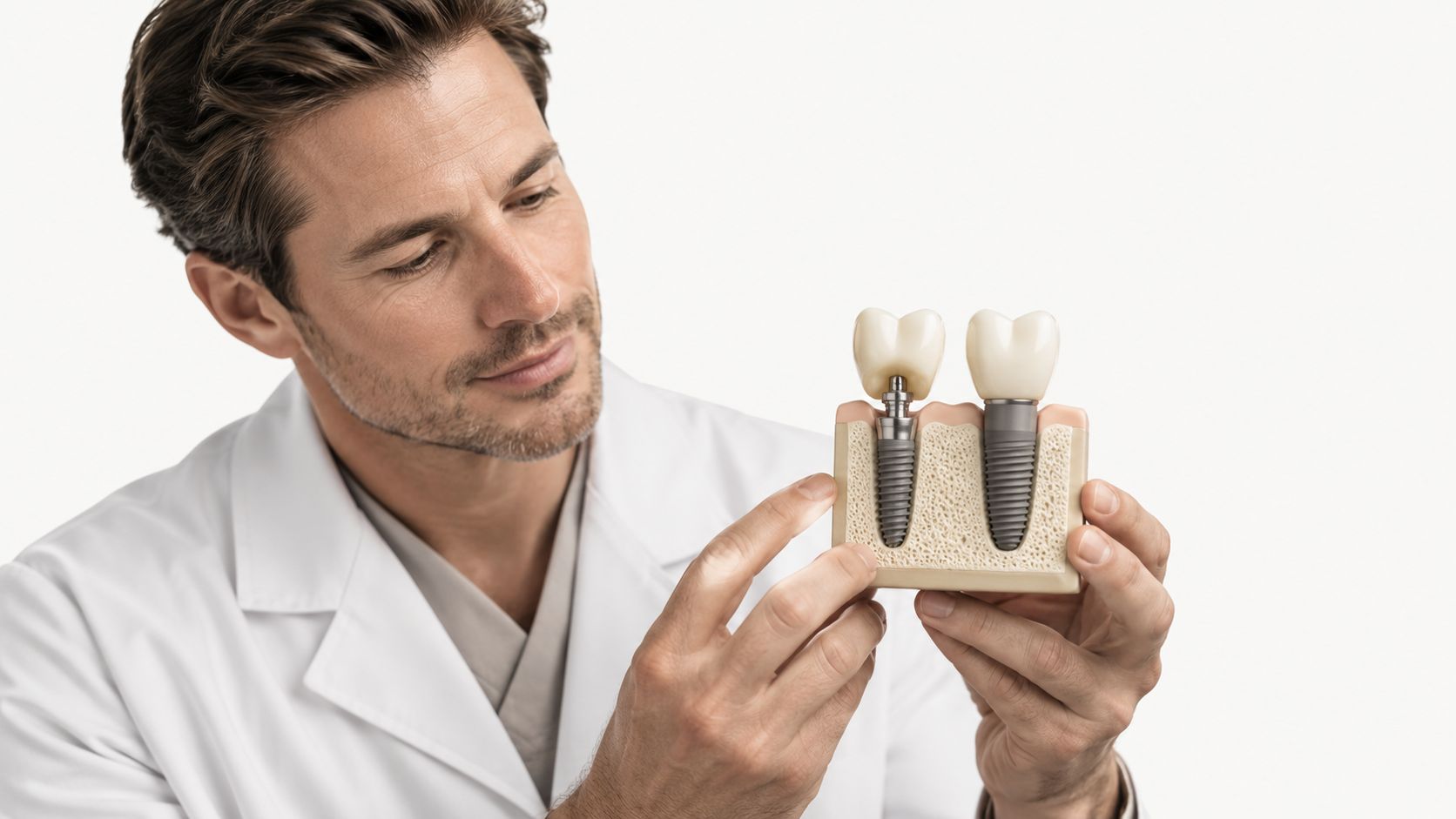
A model can make the conversation easier by showing which part sits in bone and which part becomes your visible tooth.
Start with the attachment, not the advertisement
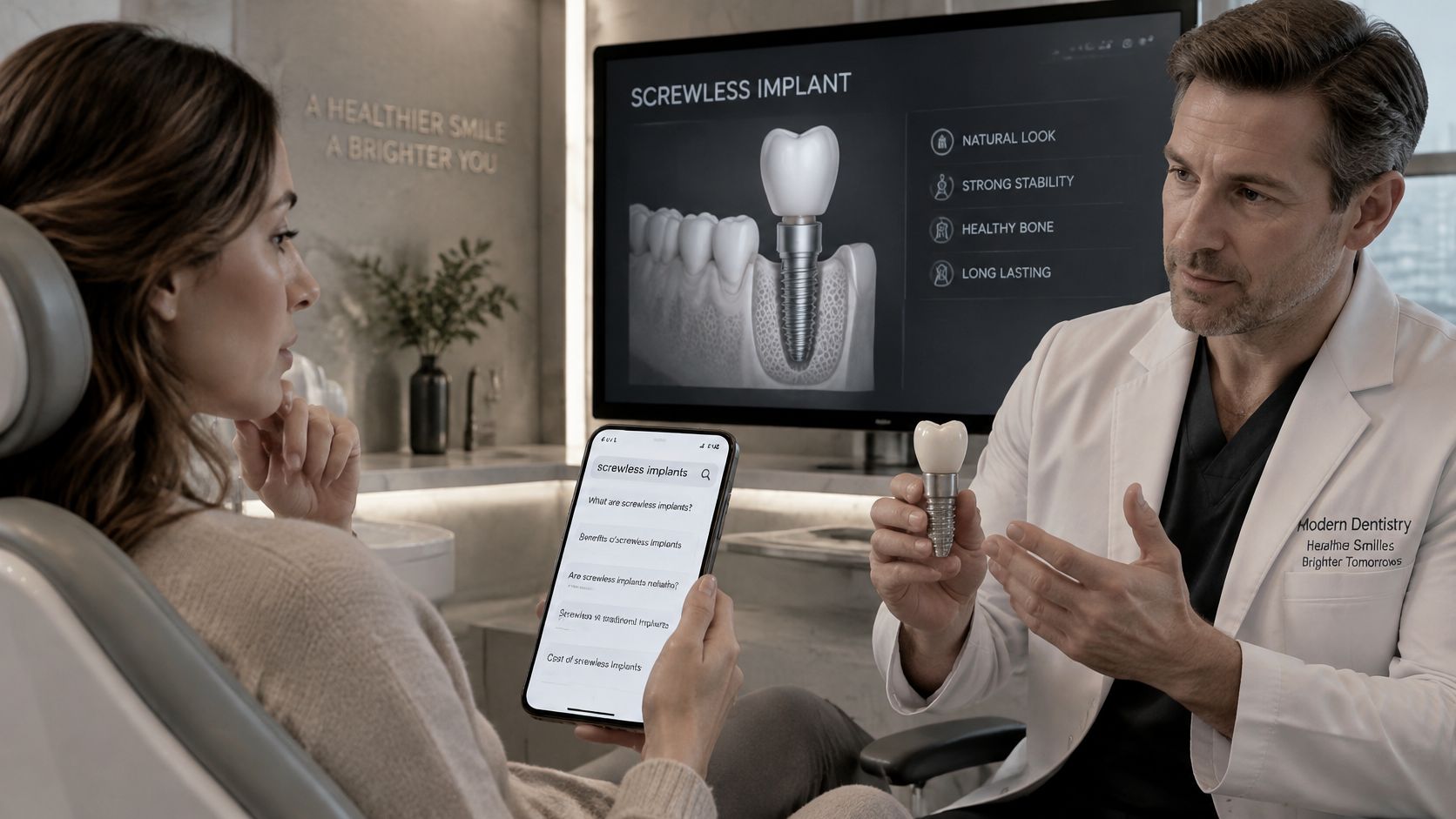
The useful question isn't whether a treatment sounds modern. It's how the replacement tooth attaches and what that means for your care.
The documented Integrated Abutment Crown approach, for example, combines the crown and connector into a mechanically retained unit without cement or a prosthetic screw. That describes the restoration's attachment, not a different bone-healing process, as explained in the clinical study of Integrated Abutment Crown restorations.
Practical rule: Ask the dentist to name the attachment method, rather than relying on the word “screwless.”
You may be asking about a cemented crown, a screw-free mechanical connection, or a screw-retained tooth whose access opening is concealed. Knowing which one is being proposed makes the rest of the decision much less confusing.
What Without Screws Actually Means in Implant Dentistry
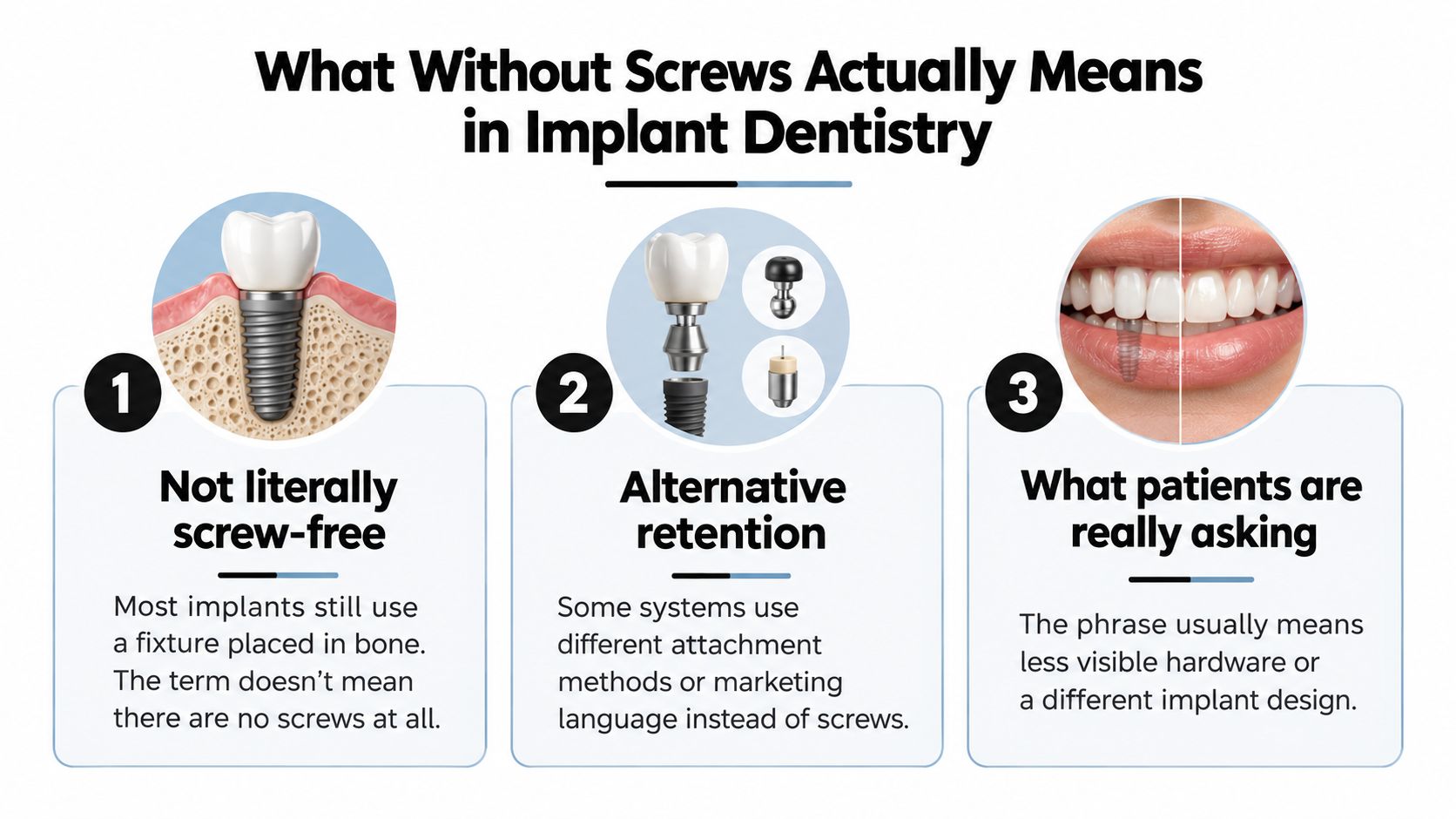
An implant restoration has distinct jobs to perform. The implant provides support in bone, a connector called an abutment joins the parts, and the crown supplies the tooth-shaped surface you see.
Changing the crown's attachment doesn't automatically change the implant underneath. It also doesn't establish that surgery will be gentler or healing will be faster.
This visual separates the hardware question from the appearance question.
Cemented crowns and genuinely screw-free connections
With a cement-retained crown, dental cement holds the crown onto an abutment. There's no crown access channel for a retaining screw, but that doesn't necessarily mean the entire assembly contains no screw. A separate abutment screw may remain underneath.
A locking-taper or Morse-taper restoration is different. In the screwless, cementless approach described in a clinical report on an integrated abutment-crown connection, the combined unit engages directly with the implant through a precisely fitted taper. Friction and mechanical engagement provide retention instead of crown cement or a prosthetic screw.
The distinction matters at maintenance visits. A cemented crown and a locking-taper crown may look similar to you, but the dentist needs different information and techniques to manage them.
Hidden screws are still screws
A conventionally screw-retained restoration can have its access channel covered with tooth-colored material. You may not see metal, yet the tooth remains screw-retained.
Likewise, digitally fabricated describes how a restoration is planned or made. It doesn't tell you whether the final attachment uses cement, a screw, or a locking connection.
- Attachment design: Ask what physically holds the restoration in place.
- Implant material and construction: Treat these as separate questions from crown retention.
- Bone healing: Don't assume a different attachment removes the need for integration with bone.
If your questions also involve ceramic implant construction, the resource to compare one-piece and two-piece zirconia implants can help you prepare a separate design discussion. It shouldn't be treated as evidence that a particular retention method is right for your mouth.
Comparing Cement-Retained, Screw-Retained, and Press-Fit Options
The options are easier to compare when you focus on what happens after treatment: how the tooth looks, how it can be repaired, and what you'll need to keep clean. “No visible screw” answers only part of that conversation.
Screwless and Screw-Retained Implant Restorations Compared
| Restoration type | How it attaches | Esthetic profile | Retrievability | Main maintenance concern |
|---|---|---|---|---|
| Cement-retained crown or bridge | Cement holds the restoration to an abutment | No crown screw-access channel | Removal can be more involved | Cement control and loss of cement retention |
| Conventionally screw-retained restoration | A prosthetic screw secures the restoration | Access channel can be concealed | Provides planned screw access for removal | Screw loosening and ceramic damage |
| Screwless locking-taper restoration | Precision mechanical engagement retains the unit | No prosthetic screw-access channel in the described design | Depends on the connection and removal technique | Loss of retention and system-specific servicing |
| Snap-on overdenture or implant-retained full-arch restoration | Attachment depends on the particular removable or fixed design | Appearance depends on the complete prosthesis | Patient-removable and dentist-removable designs differ | Attachment retention, cleaning access, and repair planning |
A digitally fabricated cementless restoration may belong in the screw-retained row. Digital manufacturing isn't a separate promise of screw-free attachment.
For a patient, the main benefit of a cemented crown may be an uninterrupted tooth surface, particularly when implant angulation makes access-channel placement awkward. The compromise is less straightforward removal if the restoration needs attention. The systematic review comparing cement- and screw-retained restorations discusses these practical considerations alongside its clinical findings.
A single tooth isn't a full arch
“Press-fit” and “snap-on” need clarification before they're useful treatment descriptions. Ask whether the dentist means a locking connection within an individual restoration, an overdenture you remove, or a fixed bridge the dental team removes.
These aren't equivalent experiences. Your cleaning instructions, repair arrangements, and expectations about removing the teeth depend on the actual design.
- For a visible tooth: Discuss where an access channel would emerge, not just whether one exists.
- For a repairable restoration: Ask how the dentist would reach the connection without unnecessarily replacing other parts.
- For a full arch: Request a demonstration of cleaning access and who removes the prosthesis.
Neither “screwless” nor “digital” tells you how easily you'll clean around a full-arch restoration. Have the proposed design explained on a model before agreeing to treatment.
Clinical Pros and Cons Backed by Implant Research
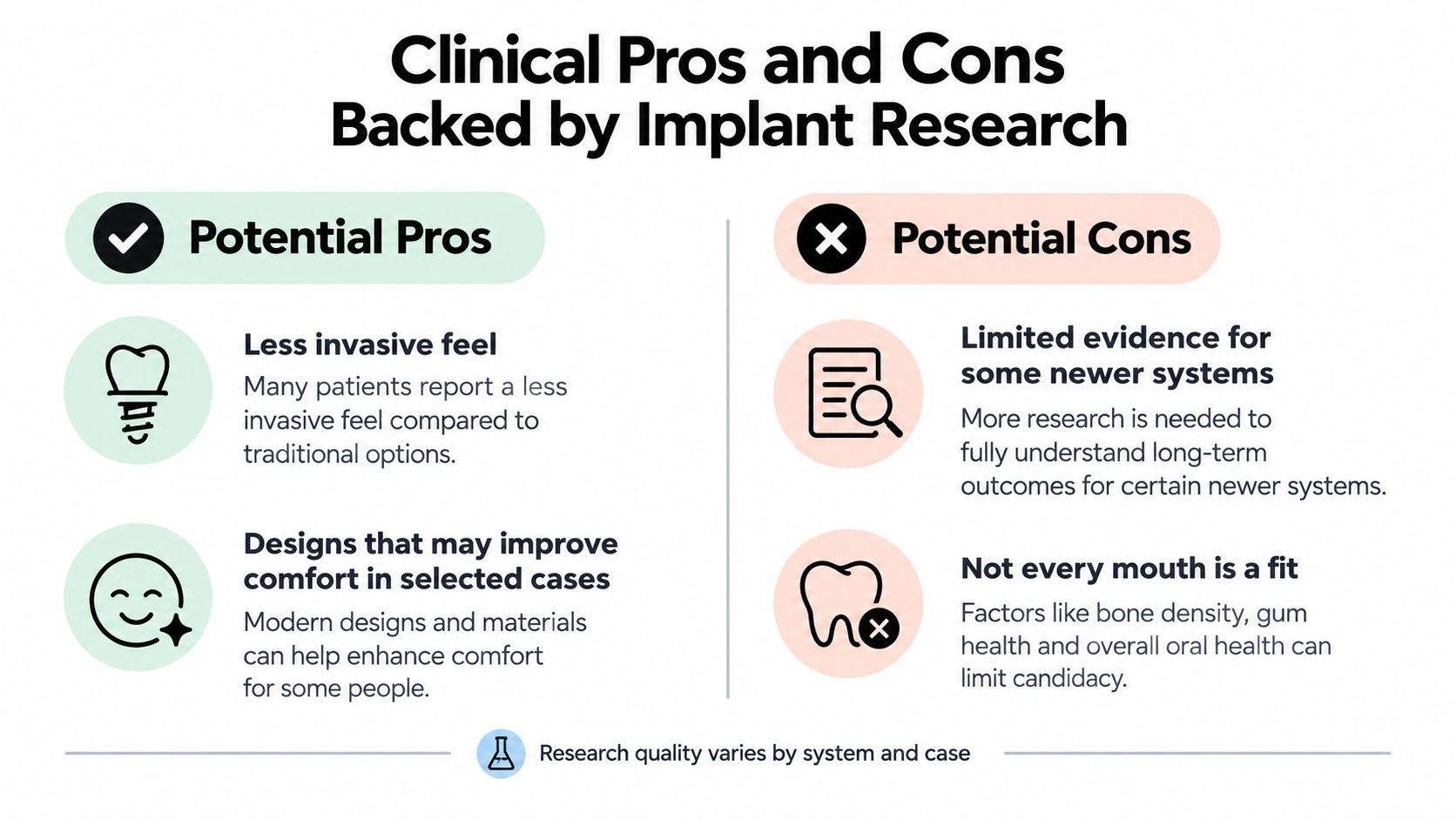
Research doesn't establish a universal winner. It supports comparing specific restorations in specific clinical circumstances, with attention to what researchers counted as survival, failure, or a repairable complication.
The systematic review cited earlier included 20 studies, 2,139 patients, and 8,989 implants, followed for 12 to 180 months. It found slightly less marginal bone loss and higher implant survival with cement-retained restorations, but the authors cautioned that the bone-loss difference might not be clinically meaningful.
Read beyond the headline result
That review's finding doesn't mean every patient should receive a cemented crown. A small average difference in a study doesn't settle whether a crown margin placed below the gumline can be cleaned effectively or whether you'll need convenient access for future repairs.
Locking-taper evidence needs the same care. A review discussing conical locking-taper restorations reported a 16.9% failure rate for screwless restorations versus 36.3% for screw-connected restorations in one comparison, but differing designs, observation periods, and definitions prevent treating that result as a universal advantage.
Screwless does not mean complication-free. The useful question is which complications a design may introduce, and how your dentist plans to prevent or manage them.
The balance includes biological concerns, such as tissue problems associated with residual cement, and mechanical concerns, such as loosening or damaged ceramic. These categories matter more to your daily experience than a broad claim that one attachment is “better.”
What laboratory findings can and can't tell you
Laboratory research helps explain how connections behave under controlled conditions. In mechanical research comparing screw-retained and screwless Morse-taper abutments, tested survival was similar, while adding a prosthetic screw changed where stress concentrated within the assembly.
That's useful engineering information, not a guarantee about how a crown will perform in your mouth. Your bite, restoration design, implant connection, hygiene, and follow-up still require individual consideration.
For a nervous patient, the reassuring conclusion is practical: you don't have to identify the strongest-sounding technology yourself. You need a dentist who can explain why the proposed design fits your circumstances and what happens if it needs service.
How to Choose the Right Option for Your Mouth
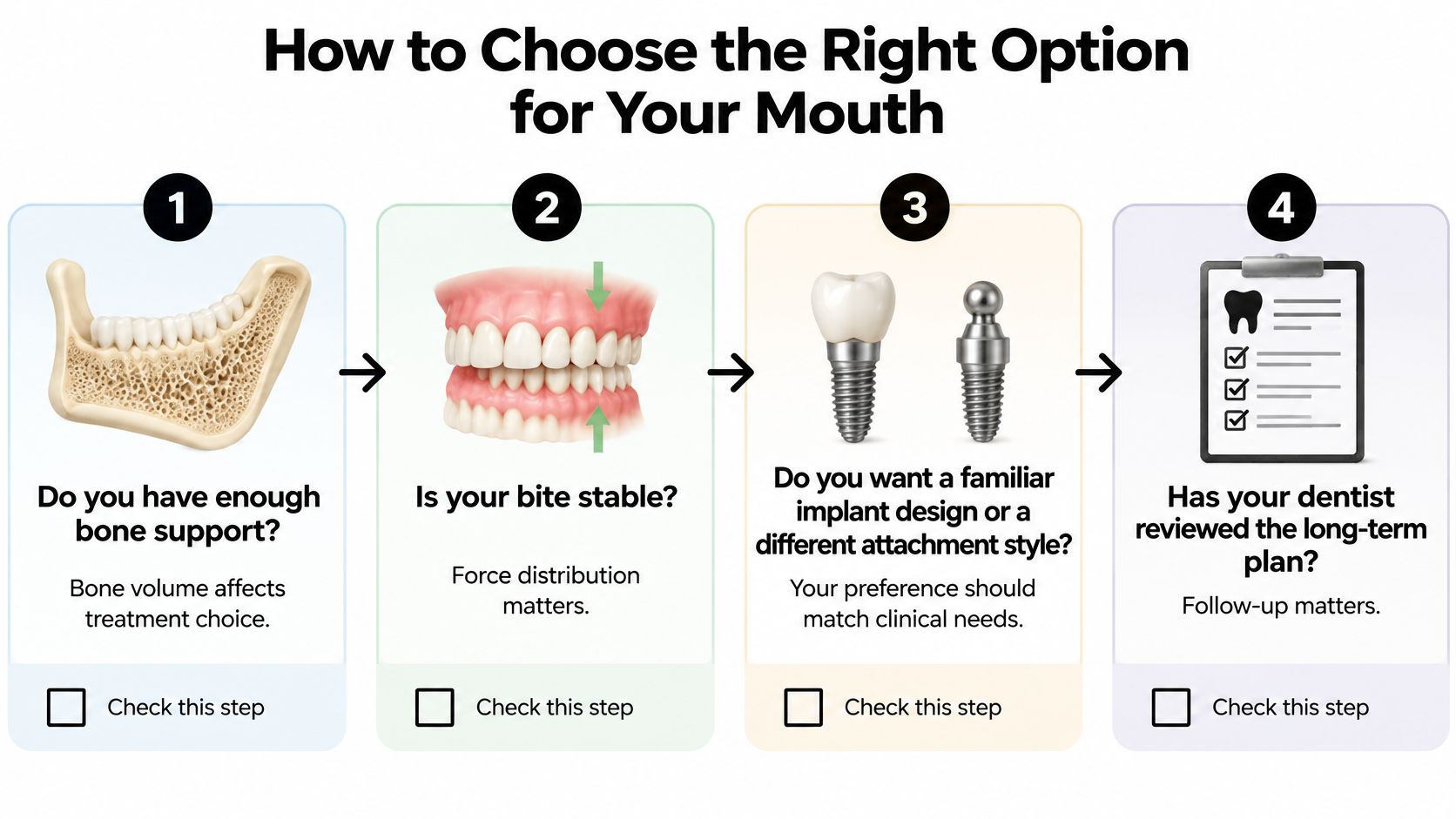
Begin with your mouth, not a preferred attachment. Implant angle, tissue depth, access for repairs, and maintenance risk help determine whether a particular restoration is sensible.
Use the decision path below to prepare for that discussion.
Match the choice to the situation
For a front tooth, ask where the screw-access channel would be positioned. A cement-retained approach may address an unfavorable emergence position, but the dentist must also consider whether the cement margin would remain accessible.
For a molar, convenient retrieval may deserve more weight than eliminating an access channel. If you grind heavily, have limited bone, or need a full arch, ask for a case-specific explanation rather than assuming a single-tooth result applies.
The guide to dental implant candidacy offers a starting point for discussing whether implant treatment itself is appropriate before settling on retention.
Separate established options from emerging workflows
A 2025 randomized clinical trial of single posterior implants compared a fully digital cementless, screw-retained workflow with a conventional combined screw-and-cement approach. It reported comparable early prosthetic outcomes, reduced impression and placement time, accurate fit, shorter chair time, and favorable early bone findings, while explicitly acknowledging limited long-term comparative evidence in the digital cementless workflow trial.
That's encouraging for the treatment studied. It doesn't establish the same outcomes for front teeth, full arches, grinding, or complex bites, and it doesn't settle long-term repairability or cost.
Bring these questions to the consultation:
- Suitability: Why does this attachment fit my implant position and bite?
- Serviceability: How would you remove or repair it?
- Evidence: What's established for this system, and what remains uncertain?
- Cost: What does the proposed fee include, and what future maintenance could involve a separate charge?
If you prefer another way to review the topic before your visit, this video can serve as a conversation starter.
Maintenance, Failure Modes, and Warning Signs to Watch
Your maintenance plan should address both the tissues around the implant and the parts supporting the tooth. A restoration can remain present while still needing treatment for inflammation, looseness, or ceramic damage.
A systematic review of implant restoration complications reported estimated failure rates of 0.87 for cement-retained versus 0.71 for screw-retained restorations per 100 prosthesis-years. The associated consensus evidence describes technical complications reaching approximately 10% annually and biological complications approximately 7% annually, figures that shouldn't be interpreted as your personal forecast.
Biological problems and mechanical problems need different attention
For cemented restorations, prevention includes a cleansable crown margin, appropriate cement space and volume, and visual and radiographic checks for excess cement. Cemented designs show more fistula formation and suppuration, meaning a drainage pathway or pus around affected tissues, while screw-retained designs show more ceramic chipping in the cited evidence.
Mechanical problems include loss of cement retention, screw loosening, and ceramic fracture. These aren't all equivalent to losing the implant, but they do call for assessment rather than an attempt to tighten or glue the tooth yourself.
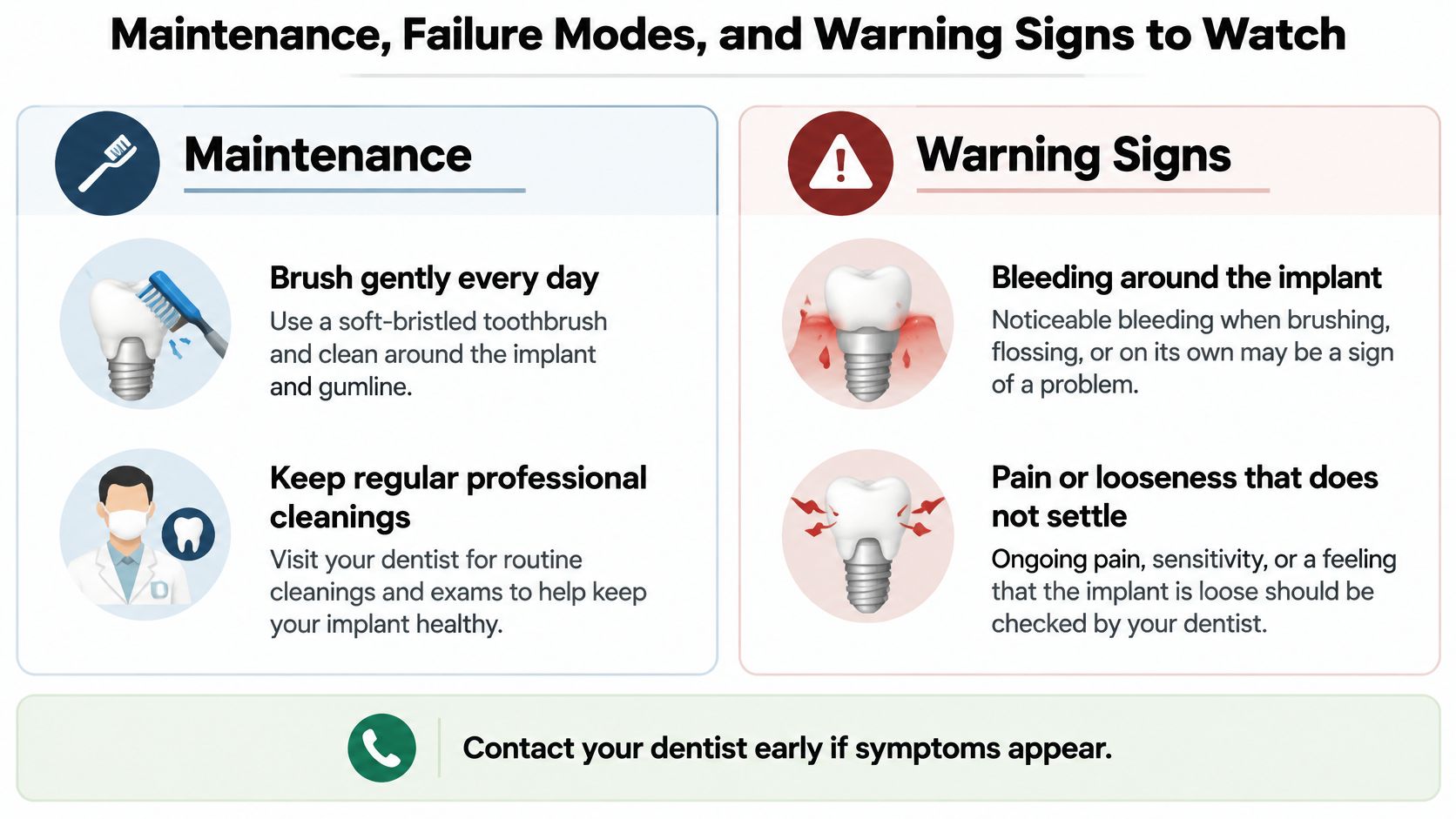
Keep the care instructions visible while you establish your routine.
Know when to call
Ask your dental team to demonstrate daily cleaning around your particular crown or bridge. Professional cleaning and exams should include a maintenance schedule suited to the restoration and your clinical needs.
- Movement: Report a crown or bridge that feels loose.
- Tissue changes: Contact the office about persistent swelling, bleeding, drainage, or an unpleasant taste near the implant.
- Bite changes: Arrange an assessment if the teeth meet differently or ceramic chips.
- Pain: Seek advice rather than assuming persistent discomfort is part of having an implant.
For background before an appointment, the discussion of common causes of dental implant failure and the guide to dental implant complications can help you organize your questions. Neither replaces an examination.
Report a change early. You don't need to know whether the problem involves the crown, connection, or implant before calling.
How Winn Smiles Evaluates Screwless and Full-Arch Implant Options
A useful implant evaluation should end with an explanation, not just a treatment name. In Cleveland and Chattanooga, Tennessee, patients considering care at Winn Smiles can bring their concerns about visible hardware, anxiety, and future repairs into the same conversation.
The clinical starting points are implant position, bone support, bite forces, and the intended implant system. Retention should follow those findings rather than being selected because “screwless” sounds preferable.
What to expect from the discussion
A new patient evaluation is an opportunity to review your dental history, discuss the area needing treatment, and ask which examination findings or dental x-rays are needed for planning. If tooth extraction is part of the conversation, ask how it fits into the overall replacement plan.
The practice provides dental implants and full-arch implant solutions. For someone missing most or all teeth, the consultation should distinguish a full-arch plan from a single crown, including cleaning access, removal arrangements, and repair responsibilities.
- Comfort planning: Discuss dental anxiety and the practice's sedation options.
- Related care: Ask whether periodontal care or other restorative dentistry needs attention alongside tooth replacement.
- Costs: Request a clear explanation of the proposed treatment and what is included before committing.
Keep related services in perspective
The practice also offers same-day crowns and laser dentistry, but these services don't automatically determine implant eligibility or promise a same-day implant result. Ask which technologies are relevant to your treatment rather than assuming every available service belongs in your plan.
If your search began with “cosmetic dentist near me,” it's reasonable to discuss appearance alongside function. Teeth whitening or other cosmetic dentistry questions can be considered separately without distracting from the implant's maintenance requirements.
With locations serving Cleveland and Chattanooga, TN, and free consultations and second opinions available for select services, the practice offers a way to explore options before making a commitment. Confirm whether your proposed implant consultation qualifies when you contact the office.
Your Next Step Toward Implants Without Visible Screws
You don't have to arrive knowing which attachment you want. Bring the concern that started your search, whether that's a visible opening, worry about repairs, or uncertainty about replacing a missing tooth.
The important distinction is now clearer: dental implants without screws describes a retention choice, not a universal upgrade. A recommendation should connect the proposed restoration to your implant position, tissue access, maintenance needs, and long-term service plan.
Bring questions that lead to a clear answer
Before scheduling, gather any treatment proposals or implant information you already have. If you're seeking a second opinion, explain what remains unclear rather than feeling you must defend or reject the earlier recommendation.
Use these questions to keep the appointment practical:
- Implant angle: Does my implant position favor cement retention or screw retention, and why?
- Future repairs: What would you do if this restoration loosened, chipped, or needed replacement?
- Ongoing care: What maintenance schedule do you recommend for my case, and what might involve additional fees?
If you currently have pain or a loose restoration and are searching for an emergency dentist, tell the office about those symptoms when you call. An appointment to assess a current problem is different from a consultation about elective replacement options.
Taking time to understand the recommendation is part of making a confident decision. Ask for a cost discussion before treatment begins, and confirm the availability of a free consultation or second opinion for the service you're considering.
Winn Smiles offers dental implants, full-arch treatment options, and comfort-focused care in Cleveland and Chattanooga, Tennessee. Visit Winn Smiles to request an implant consultation or second opinion and discuss whether a restoration without visible screw access fits your needs. Ask about eligibility for a free consultation and review treatment costs before deciding.