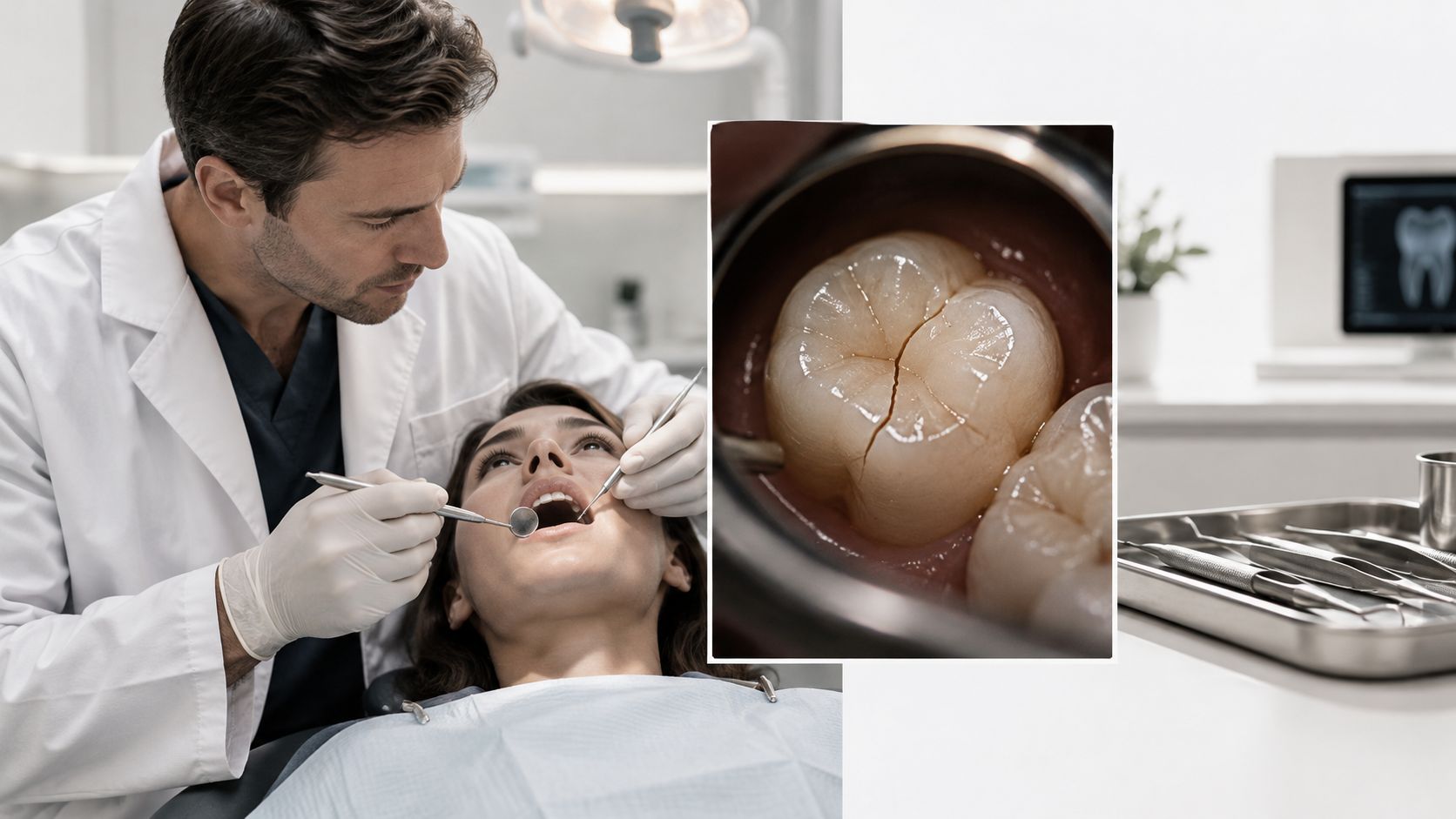
Dental bonding typically costs about $400 to $900 per tooth in national estimates, while local costs in Tennessee depend on whether the work is restorative or cosmetic. Your actual dental bonding cost can be lower or higher after the dentist considers the tooth, treatment complexity, insurance classification, and related care.
You may be searching for a dentist near me after chipping a front tooth on a hard snack, noticing a small gap in a photograph, or seeing a stain that teeth whitening won't correct. The first concern is often financial, especially when online results show very different figures. In Cleveland and Chattanooga, a thoughtful consultation should explain not only the fee per tooth, but also what the treatment includes and whether your dental plan may contribute.
Dental bonding can repair or reshape a tooth with tooth-colored composite resin. It may be appropriate for a small chip, minor gap, discoloration, or limited structural damage, but it isn't the right answer for every crack or weakened tooth. A dentist may recommend restorative dentistry, a veneer, a crown, or another option after examining your bite and the health of the tooth.
What Dental Bonding Actually Costs
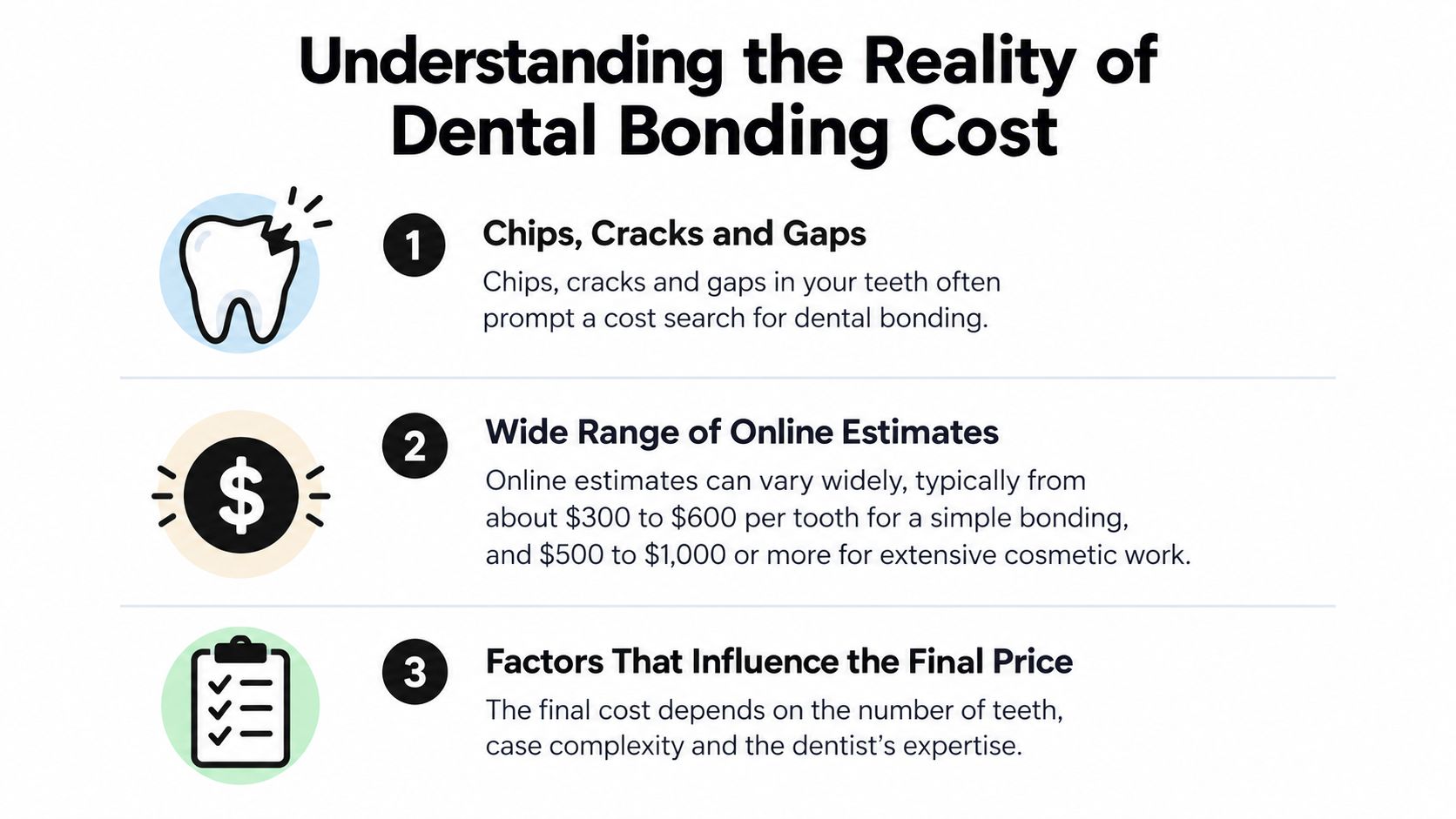
You feel a rough edge with your tongue and notice a small corner missing from a front tooth. It may not hurt, yet the chip becomes difficult to ignore whenever you smile. Searching for dental bonding cost can add to the worry because online estimates vary widely.
One estimate reports an average of approximately $400 per tooth, with a typical range of $200 to $800. Another gives an overall range of $100 to $600 and an average near $350. A separate national estimate reports an average of about $431 per tooth, with a broader range of approximately $288 to $915. These figures are planning benchmarks, not guaranteed fees at a Cleveland or Chattanooga office. (Dental Roundup's national comparison, Dental Cost Finder's bonding estimate)
Why online estimates differ
A per-tooth price does not show how much work your dentist will perform. Composite resin is one part of the fee. Clinical labor, facility overhead, equipment, materials, procedure time, workforce costs, and the treatment setting also affect the total, as described in the World Health Organization review of resin-based composite materials.
A small additive repair may need limited preparation and polishing. A larger cosmetic build-up can require shade layering, more contouring, bite adjustment, and additional appointment time. Treating several teeth also changes the material use and the work involved.
Practical rule: A useful estimate describes the treatment, not just the price.
Ask whether the quote includes the examination, dental X-rays, cleaning or decay treatment, shade selection, bite adjustment, polishing, repairs, and follow-up visits. These details make an online range more useful for judging your own expected cost.
What the local quote should clarify
For patients comparing a cosmetic dentist near me in Cleveland or Chattanooga, the key question is whether the bonding is restorative or cosmetic. That classification can determine whether a dental plan may contribute or whether you should expect to pay the full fee yourself. Repairing a fracture or decay-related defect serves a clinical need. Changing tooth shape or closing a space for appearance alone is generally cosmetic.
A written estimate should identify:
- Teeth and surfaces: Which teeth are included, and how much of each tooth will be treated?
- Preparation: Is decay removal, cleaning, imaging, or another procedure needed first?
- Treatment purpose: Is the bonding repairing damage or improving appearance?
- Maintenance: Are polishing, minor repair, or future replacement billed separately?
A clear quote connects the fee to the work and the reason for treatment. That conversation can replace fear of an arbitrary bill with a practical understanding of your out-of-pocket cost.
How Dental Bonding Transforms Your Smile
Dental bonding is often less complicated than patients expect. It usually doesn't involve extensive drilling or a laboratory-made restoration. Instead, the dentist adds and shapes composite resin directly on the tooth, much like a sculptor restoring a small detail on a carefully finished surface.
The procedure commonly takes about 30 to 60 minutes per tooth, according to Healthline's overview of teeth bonding. Several teeth, additional diagnosis, decay treatment, dental X-rays, or bite adjustment can extend the appointment.
What happens during the appointment
The dentist examines the tooth. The team checks for decay, cracks, weakened structure, bite pressure, and gum health. A painless-looking chip can still need evaluation before cosmetic work begins.
The shade is selected. Composite is matched to the surrounding tooth, or to the planned shade of the smile when other cosmetic services are involved. This step helps the repair blend rather than look like a separate patch.
The surface is prepared. The tooth is cleaned and conditioned so the resin can attach securely. Because bonding is often minimally invasive, many patients don't need anesthesia, although comfort needs vary.
The resin is placed and sculpted. The dentist applies tooth-colored composite in controlled layers, then shapes the edge, contour, and contact with nearby teeth.
A curing light hardens the material. The resin is set with a dental light, allowing the dentist to refine its form.
The surface is finished. The dentist trims, checks the bite, and polishes the restoration so it feels smooth and functions naturally.
The value isn't limited to the material. Precise shade selection, moisture control, anatomy, finishing, and bite evaluation determine whether the result looks natural and remains comfortable.
Bonding works best when the dentist treats the tooth as part of the whole bite, not as an isolated cosmetic surface.
After treatment, you can usually return to normal activities promptly. If the tooth is sensitive, the bite feels uneven, or the edge feels rough, contact the office rather than trying to adjust it yourself.
Factors That Influence Your Total Treatment Cost
The final quote reflects two separate categories. The first includes the clinical work required to repair or improve the tooth. The second includes the diagnostic and administrative parts of safe care, such as an examination or imaging.
Clinical factors
The number of teeth matters. One small repair uses less resin and chair time than several teeth treated for a coordinated smile change. The dentist also has to match proportions and shade across the visible teeth.
The number of surfaces matters. A single-surface repair generally requires less material, contouring, curing, and finishing than a multi-surface build-up. Evidence summarized in the NICE guideline appendices indicates that single-surface composite restorations last significantly longer than multi-surface restorations. The same guideline reports a median survival of approximately 17 years overall, while 56% remained in service at 10 years. These figures describe composite restorations generally, not a promise for every cosmetic bonding case.
The tooth's location changes the work. Front teeth demand careful attention to symmetry, translucency, and visible contours. Back teeth experience different chewing forces and may need a stronger restorative approach.
The condition of the tooth comes first. Decay, a crack, poor moisture control, high caries risk, or a heavy bite may require treatment before or instead of bonding. A night guard may be recommended when grinding threatens the restoration.
Diagnostic and visit-related charges
An examination helps the dentist determine whether bonding is safe and appropriate. Dental X-rays may be needed when a fracture, decay, or deeper problem can't be assessed by looking alone. Professional cleaning or treatment for active disease may also need to happen before elective cosmetic work.
The Humana guide to dental bonding costs cautions that an examination and professional cleaning can add hundreds of dollars to the total. That doesn't mean every patient needs both before bonding, but it does show why a headline price can exclude important care.
For broader planning around local service pricing and marketing context, patients and practice teams can also review Silva Marketing's cost breakdown. Your dental estimate, however, should come directly from the treating office and should identify the proposed procedure and included services.
Bonding Versus Veneers and Crowns
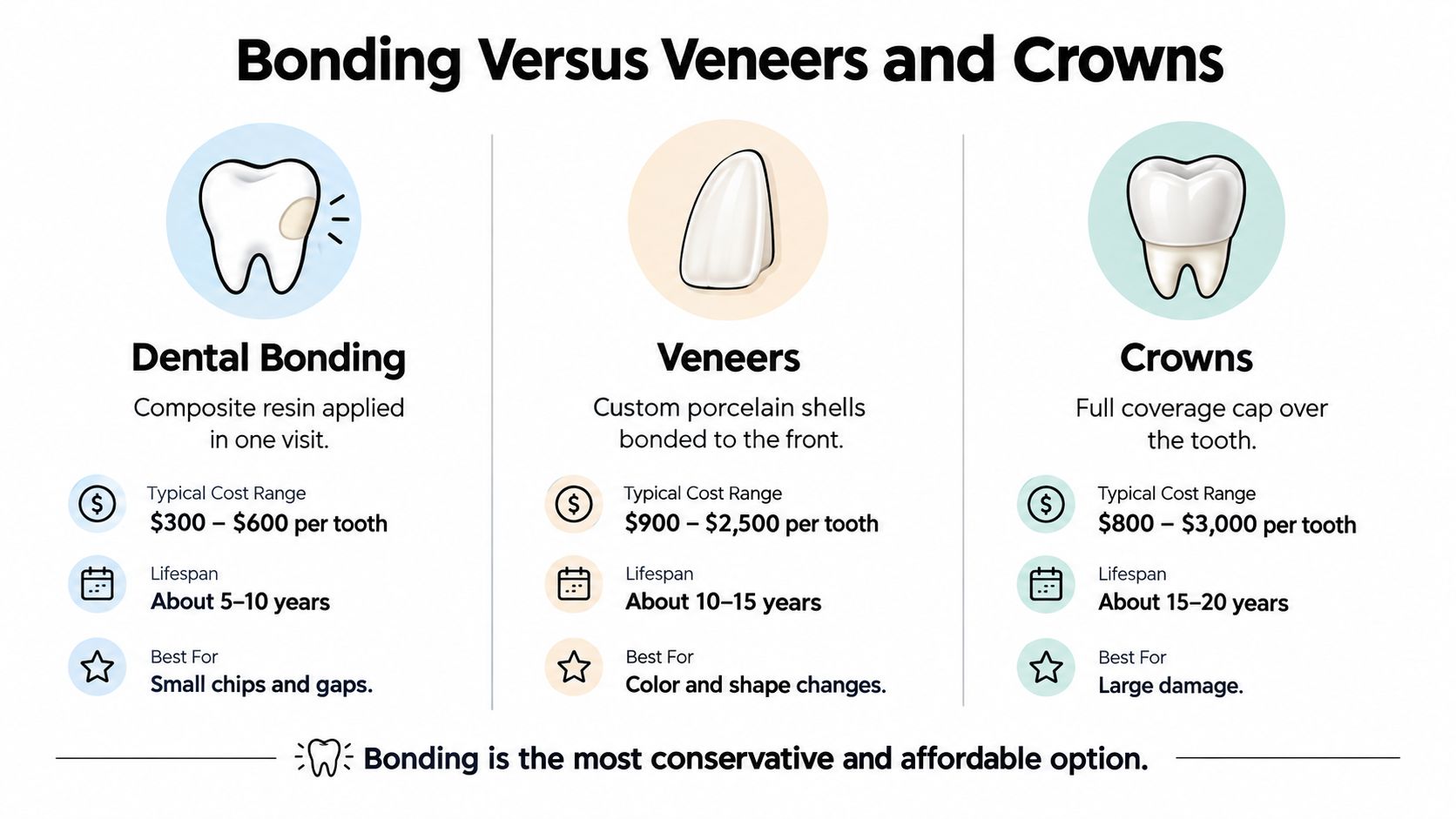
A small chip does not automatically call for a veneer or crown. The suitable treatment depends on the tooth's remaining structure, its health, the forces it handles, and whether your goal is repair or appearance. That classification also affects cost. Cosmetic bonding is usually paid out of pocket, while bonding used to restore damage may be considered restorative under a dental plan.
A practical comparison
| Treatment | Typical planning range | Expected service information | Often considered for |
|---|---|---|---|
| Dental bonding | About $100 to $600 per tooth in one consumer estimate | Composite restorations have a median survival of approximately 17 years overall, but individual results depend on the case and maintenance | Small chips, limited gaps, minor shape changes, and selected repairs |
| Veneers | Fees vary by office and material. Ask for a written, case-specific quote. The $200 to $600 figure applies to bonding, not veneers | Porcelain may have a different durability and staining profile from composite | Broader front-tooth color or shape changes |
| Crowns | No universal patient price applies | Full coverage may protect a structurally weakened tooth when bonding is insufficient | Larger damage or teeth needing substantial protection |
The bonding estimate is a planning reference, not a local fee schedule. A dentist may quote a different amount after examining the tooth, considering whether the treatment is cosmetic or restorative, and reviewing what the fee includes.
Longevity also varies. A critical review reports annual failure rates of roughly 1% to 3% for posterior composite restorations and 1% to 5% for anterior restorations. Outcomes can be affected by location, restoration class, bite loading, fracture risk, and secondary caries. (Critical review of direct composite restoration outcomes)
Bonding generally removes less natural tooth structure. Veneers cover the front surface and can produce a broader cosmetic change. Crowns cover more of the tooth and may suit substantial weakness, though the dentist must assess whether full coverage is appropriate.
Look beyond the first invoice
The lowest initial fee may not be the lowest long-term cost when a restoration faces heavy bite forces, bruxism, extensive missing structure, or poor moisture control. Ask whether prevention, repair, shade changes, edge wear, and possible chipping are included in the treatment discussion.
For a focused explanation of the differences, read this guide to dental veneers versus bonding. The right choice should preserve healthy structure where possible, address the tooth's actual needs, and fit your appearance goals and budget.
Navigating Insurance and Financing Options
Insurance usually focuses on why bonding is being placed, not just what material the dentist uses. A repair for decay, a fracture, an accident, or another documented dental condition may be considered restorative. Bonding performed only to change shape, close a space, or mask discoloration is commonly classified as cosmetic and may be excluded.
One insurance reference reports that medically necessary bonding coverage may range from 50% to 80%, but deductibles, annual maximums, waiting periods, exclusions, network status, and prior approval can change the actual amount. (Aflac's dental bonding insurance guidance)
Verify the classification before treatment
Ask the office to verify benefits and submit a pre-treatment estimate when appropriate. You can also ask your insurer:
- How is this coded: Will the proposed treatment be submitted as restorative or cosmetic?
- What do I owe first: Does a deductible apply before benefits begin?
- What remains available: How much of the annual maximum is unused?
- Are prerequisites required: Does the plan require an examination, X-ray, replacement of an older restoration, or prior approval?
- Does the office participate: Is the treating dentist in network for your specific plan?
Coverage isn't the same as a guaranteed payment. The insurer's response should be compared with the office's written estimate, including any services that insurance won't cover.
Planning for uncovered care
If bonding is elective, the full fee may be your responsibility. That doesn't make the decision impossible, but it makes scope especially important. Treating one clearly defined concern may be different from planning a broader cosmetic dentistry case.
Ask whether the practice offers payment arrangements or third-party financing, and request the terms in writing before accepting them. Confirm the total amount, any interest, the timing of payments, and what happens if the treatment plan changes. Winn Smiles provides transparent cost discussions and may offer consultation or second-opinion pathways for select services, so patients can ask questions before committing to care.
Before scheduling: Request the treatment scope, expected fee, insurance classification, estimated insurance contribution, and projected patient balance in one written conversation.
Patients who need a chipped-tooth repair after an accident should also explain how the injury happened. The responsible insurance pathway can differ, and the dental office can tell you what documentation it needs.
What to Expect During Your Visit to Winn Smiles
A bonding consultation should begin with listening. At Winn Smiles, a patient visiting the Cleveland or Chattanooga area can discuss the chip, gap, stain, or shape concern, along with any sensitivity, grinding, dental anxiety, or budget limit.

The visit in order
First, the dentist examines the tooth and surrounding gums. The team may recommend cleaning and exams, dental X-rays, or other diagnostics when they're needed to rule out decay or deeper damage. If the tooth is healthy and the concern is suitable for bonding, the dentist explains the proposed shape, shade, preparation, and likely maintenance.
Next comes the financial discussion. You should receive a clear estimate that separates the bonding fee from examinations, imaging, cleaning, disease treatment, and any other planned service. The team can also discuss whether the treatment is restorative or cosmetic and help you understand how that classification may affect insurance.
Patients with dental anxiety can ask about Winn Smiles' comfort menu and custom sedation options before treatment begins. Comfort planning may include a slower pace, breaks, a discussion of local anesthesia, or sedation when clinically appropriate.
The actual procedure may be completed in one visit when bonding is suitable. Afterward, the dentist checks your bite and shows you how to protect the restoration from excessive force, staining, or roughness.
For details about the service and appointment process, review dental bonding in Cleveland.
Before your appointment, write down when the damage occurred, whether you felt pain, and whether you grind your teeth. Bring your insurance information and a list of questions. If you're looking for an emergency dentist, severe pain, swelling, bleeding, or a significant fracture should be explained when you call so the office can guide you to the appropriate level of care.
Here is a visual overview of the patient experience and treatment conversation:
Frequently Asked Questions About Bonding Cost
How long does bonding last?
There isn't one guaranteed lifespan. Composite restorations can perform well for many years, but surface area, tooth location, bite pressure, grinding, hygiene, and maintenance all matter. Larger multi-surface restorations generally face more repair exposure than small, simple repairs.
If the bonding chips, must it be replaced completely?
Not always. A 2025 systematic review found that repaired direct-composite restorations had comparable longevity to complete replacement, while preserving more tooth structure and reducing discomfort. The review also reported better marginal adaptation for repaired restorations, with a relative risk of 0.47. (2025 systematic review of repaired composite restorations)
Repair may not be appropriate when there's extensive fracture, recurrent decay, poor isolation, heavy bite force, or significant discoloration. Ask whether polishing, localized repair, or full replacement is recommended, and whether your warranty policy covers any portion.
Is bonding painful?
Most patients tolerate the procedure comfortably, and anesthesia often isn't required because preparation is limited. You may feel pressure or hear the curing light equipment, but tell the dental team if you're uncomfortable.
How do I know whether treatment is cosmetic or restorative?
If bonding repairs damage, decay, or a fracture, it may be considered restorative. If it changes appearance without treating a health problem, it's commonly cosmetic. Your dentist and insurer should confirm the classification before care begins.
Winn Smiles offers bonding consultations, restorative and cosmetic dental care, transparent cost discussions, and comfort-focused visits in Cleveland and Chattanooga. Schedule an appointment with Winn Smiles to discuss your tooth, review treatment choices, and receive a written estimate for your needs.