A chipped front tooth, a dark spot that whitening won't fix, or a smile that looks uneven in every photo can make a routine day feel surprisingly uncomfortable. Patients searching for a cosmetic dentist near me in Cleveland or Chattanooga often arrive with the same question: should they choose dental veneers or bonding?
The honest answer depends on more than today's fee. You need to consider how much healthy enamel can be preserved, how long you want the result to serve you, how often repairs may be needed, and how many visits fit your schedule. At Winn Smiles, patients from Cleveland, Chattanooga, Ooltewah, Hixson, and nearby communities can discuss those trade-offs before committing to treatment.
Choosing Between Veneers and Bonding in Cleveland and Chattanooga
A Cleveland, TN teacher with a small chip on a front tooth may want a same-day repair before returning to work. Another patient in Chattanooga may want to change the shape and shade of several visible teeth for a more complete smile transformation. Both patients may ask about bonding and veneers, but they aren't asking the same clinical question.
The better question is not, “Which costs less today?” It's this: Which treatment preserves the right amount of tooth structure and remains sensible over the years ahead?
Direct composite bonding usually involves sculpting resin onto the tooth in one visit. It's conservative, easy to adjust, and generally less expensive at the start. Porcelain veneers require preparation and laboratory fabrication, but carefully selected enamel-bonded veneers have shown strong long-term survival in clinical research.
Practical rule: Choose bonding when the correction is small and preserving natural tooth structure is your highest priority. Consider veneers when you need broader changes in shape, shade, or symmetry and your enamel and bite support them.
Travel also matters. Patients may drive from Ooltewah, Hixson, or Dalton for cosmetic care, so appointment count can affect value of treatment. A lower initial fee may not feel lower if repeated repairs require extra time away from work, while a larger initial investment may be reasonable when the restoration is designed for long service.
This article takes a candid approach to dental veneers vs bonding. The recommendation should come from an examination, photographs, bite evaluation, and assessment of the tooth itself, not from a one-size-fits-all price list.
What Veneers and Composite Bonding Actually Are
Porcelain veneers are thin ceramic shells bonded to the visible front surfaces of teeth. Porcelain laminate veneers commonly require removal of a thin enamel layer, often about 0.5 millimeters. That preparation makes treatment permanent rather than fully reversible, as explained in this explanation of porcelain veneers and cosmetic bonding.
The dentist plans each veneer's shape, shade, and position before bonding it to the prepared tooth. Materials may include feldspathic porcelain or pressed ceramics, selected for the case's needs and the desired balance of translucency, strength, and design control. Veneers suit broader changes across several visible teeth, including uneven edges, intrinsic discoloration, small spaces, and disproportionate tooth shapes.
Composite bonding adds tooth-colored resin directly to the tooth. The dentist applies it, shapes it by hand, cures it with a dental light, and polishes the surface. Microhybrid or nanofilled composites may be chosen according to the tooth's location, bite, shade, and required reshaping.
Bonding fits a small chip, narrow gap, or localized cosmetic concern. It can usually be completed in one appointment and often requires little or no enamel removal. That makes it a practical choice for patients who want a quick correction or who are not ready for a permanent change.
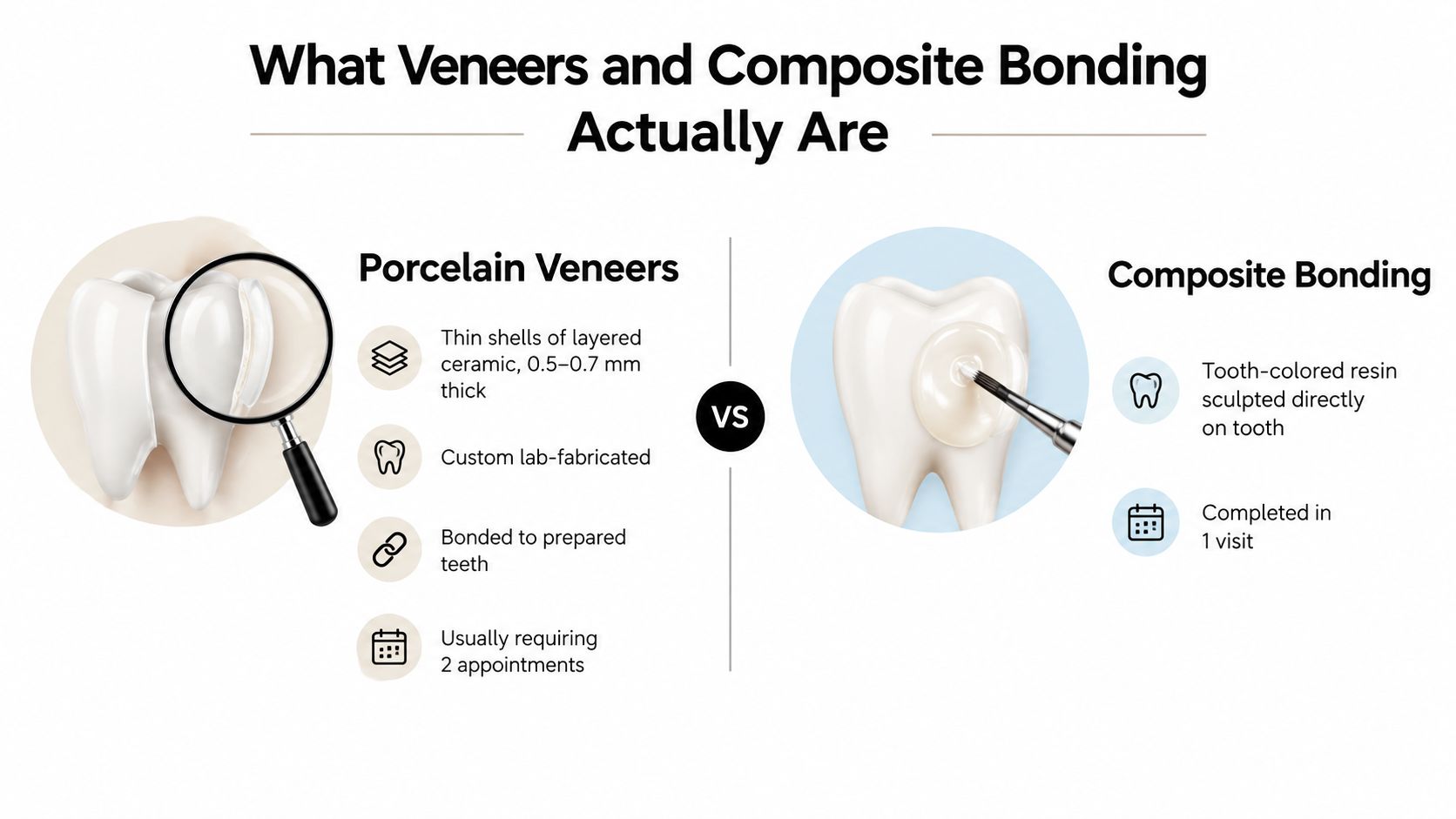
The distinction is straightforward. Veneers cover the visible tooth surface with a custom ceramic restoration after preparation. Bonding adds and shapes resin on the existing tooth. Patients can review how veneers work before scheduling a consultation.
Side-by-Side Comparison of the Key Differences
For a patient in Cleveland or Chattanooga, the right choice depends on more than the first invoice. Compare how much enamel each option preserves, how well it suits the correction, and what maintenance may cost over the next decade or longer.
| Factor | Porcelain Veneers | Composite Bonding |
|---|---|---|
| Material | Custom ceramic, including feldspathic or pressed porcelain | Tooth-colored microhybrid or nanofilled composite resin |
| Typical use | Several teeth needing coordinated changes in shape, shade, or symmetry | Small chips, gaps, worn edges, or localized corrections |
| Procedure | Requires enamel preparation and laboratory fabrication | Sculpted directly on the tooth, commonly in one visit |
| Tooth structure | Usually removes a thin enamel layer | Usually preserves more natural tooth structure |
| Long-term evidence | Enamel-bonded ceramic veneers showed 99% survival and 99% success in a recent PubMed review | A 2018 clinical review reported 80% survival after five years for direct composite veneers in one study |
| Stain resistance | Ceramic generally resists surface staining better | Composite can stain or lose gloss sooner, particularly with frequent coffee or tea exposure |
| Repairability | Repairs may be more involved and can require replacement | Chipped or worn resin is usually easier to add, reshape, or polish |
| Reversibility | Not fully reversible because preparation permanently changes enamel | More conservative and often easier to modify |
| Best fit | A patient seeking coordinated, durable cosmetic change | A patient prioritizing speed, conservation, or a smaller correction |
The preparation trade-off deserves attention. Veneers may require removal of a thin enamel layer, often about 0.5 millimeters, while bonding commonly preserves more of the natural tooth. The clinical preparation reference explains this distinction in its comparison of porcelain veneers and cosmetic bonding.
Published results also show why the decision should extend beyond the appointment. The review above summarized porcelain veneer survival of 96% at 10 years and 91% at 20 years in a randomized trial. Another cohort reported 94.4% survival at five years and 93.5% at 10 years. These figures do not guarantee an identical lifespan for every patient. Bite forces, hygiene, enamel condition, and case selection affect whether the restoration reaches those outcomes.
Bonding wins for speed, conservation, and straightforward repair. Veneers win for broader changes and more stable shade control. Over 10 to 15 years, include likely repairs or replacement in the cost discussion, not only the initial fee. Either option still requires brushing, flossing, examinations, and avoiding habits such as biting ice or hard objects.
Why Enamel Preservation Drives the Outcome
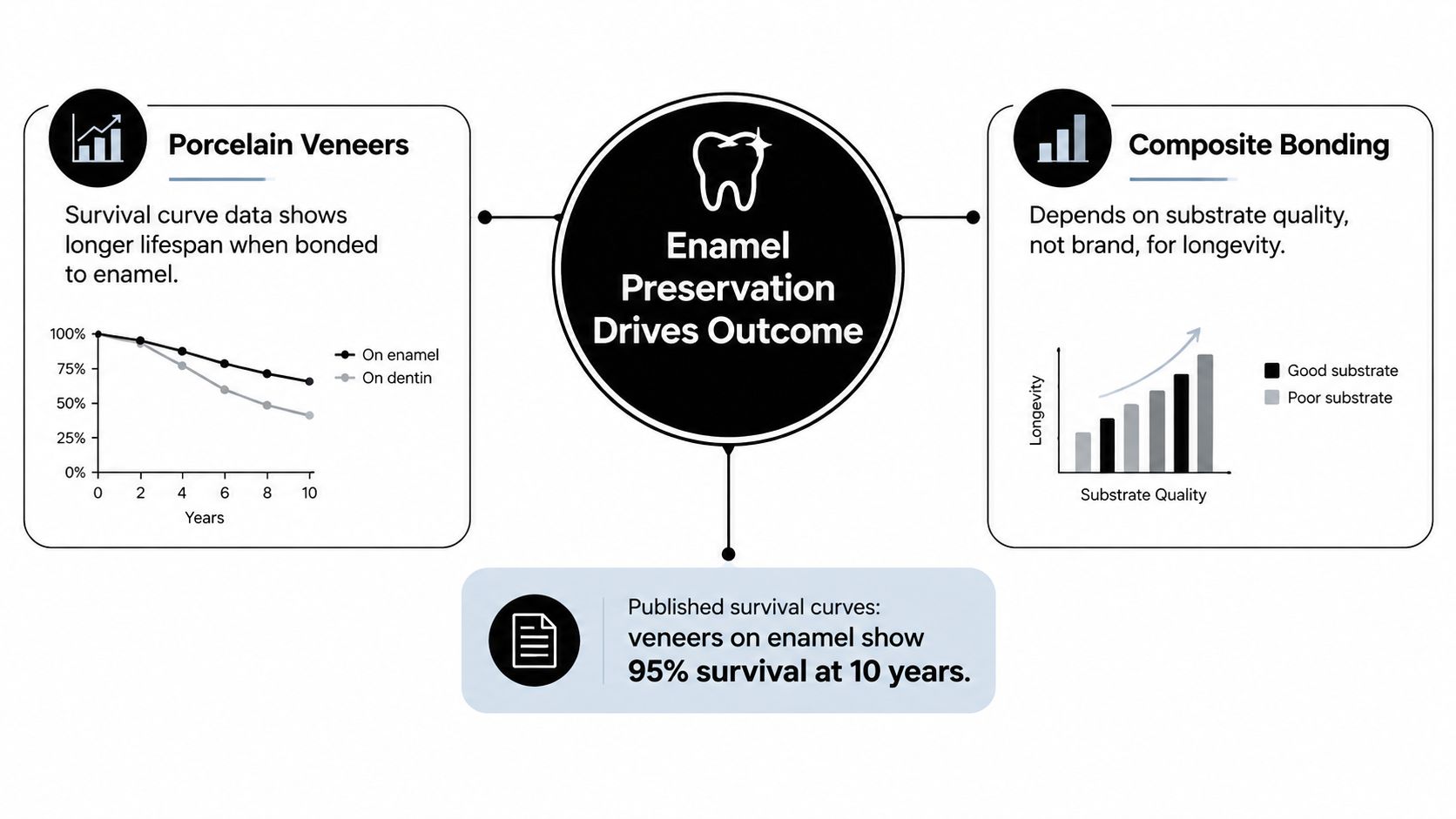
For a patient in Cleveland or Chattanooga, enamel preservation should guide the recommendation before material choice. A veneer bonded mainly to healthy enamel has a stronger foundation than one relying heavily on exposed dentin or an older composite restoration.
A recent systematic review reported 99% survival and 99% success for ceramic veneers bonded to enamel. Veneers bonded to composite resin showed 94% survival and 70% success, while severe dentin exposure was associated with 91% survival and 74% success, according to the PubMed-indexed systematic review.
These findings make conservative preparation a long-term decision, not merely a cosmetic preference. Enamel provides a more predictable bonding surface. Dentin has different moisture, structure, and adhesion challenges. A separate systematic review of laminate veneer failure patterns also found lower failure rates when veneers were bonded to enamel instead of severely exposed dentin or existing composite restorations.
What the preparation means
A thin preparation, often around 0.5 millimeters, may keep a veneer within enamel on the visible front surface of the tooth. The comparison of porcelain veneers and cosmetic bonding explains this preparation distinction. Once preparation enters dentin, the long-term outlook becomes less favorable. The same principle applies to direct bonding, since resin retention is more predictable on sound enamel.
A patient with healthy enamel and a small cosmetic concern may suit conservative bonding. Erosion, abfraction, extensive old fillings, decay, or weakened tooth structure can require a different restorative plan. Veneers are not automatically the answer. Crowns may better protect a tooth that needs structural reinforcement rather than a front-surface cosmetic change.
How candidacy is evaluated
At a Cleveland or Chattanooga consultation, the dentist should assess:
- Enamel availability: How much sound enamel remains on the planned bonding surface?
- Bite pressure: Will the upper and lower teeth place damaging force on the restoration?
- Gum health: Are inflammation or periodontal problems present?
- Tooth condition: Is there decay, a crack, erosion, or a large existing filling?
- Treatment goal: Is the patient correcting one tooth or coordinating a broader smile?
The recommendation should protect the foundation first. If the substrate is unreliable, changing the material will not correct the underlying problem or deliver dependable value over the next 10 to 15 years.
Real-World Treatment Timelines for Each Option
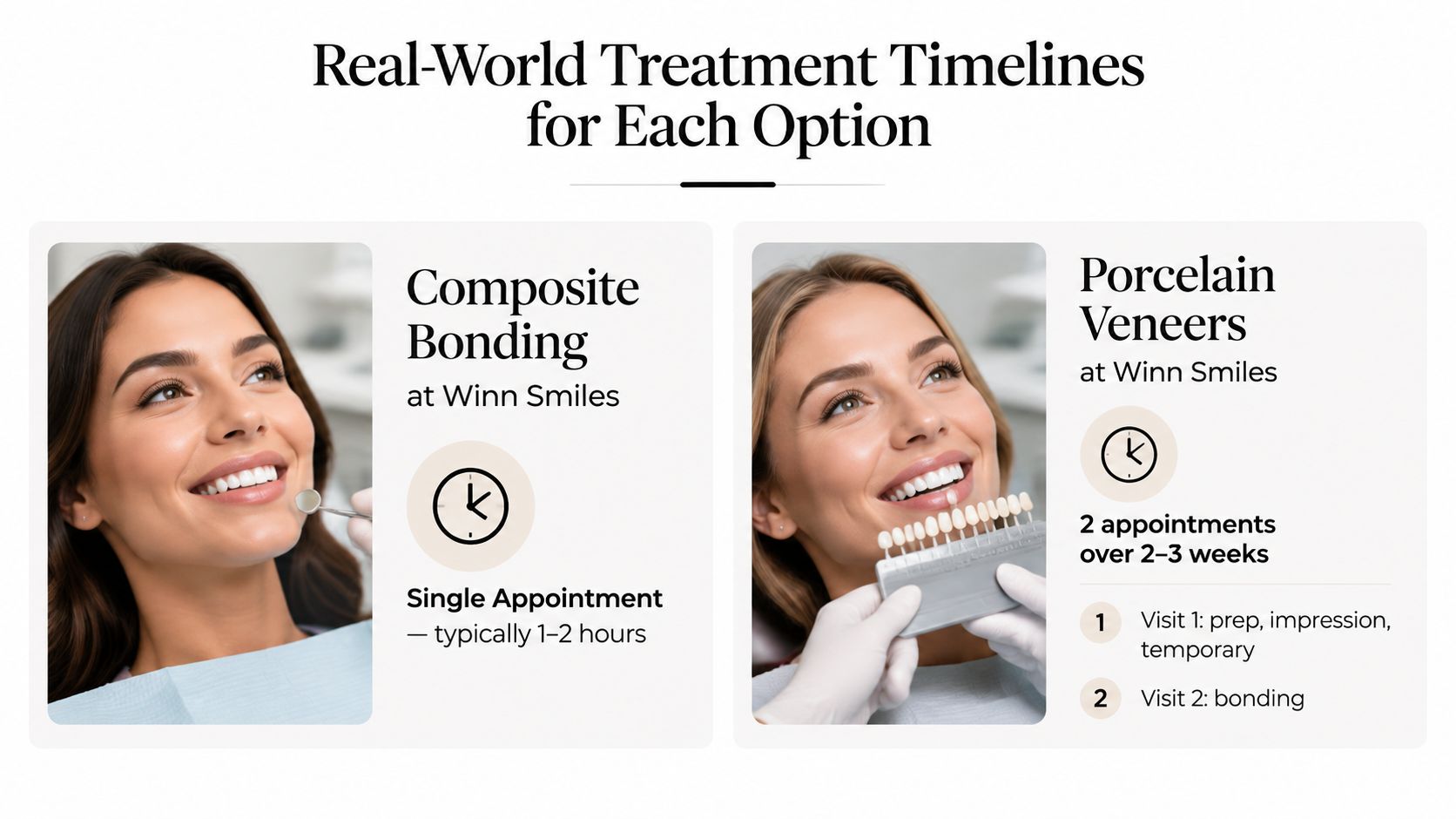
Consider two patients visiting a Cleveland-area cosmetic dentist. One has a small corner chip on a front tooth. The other wants several teeth reshaped and lightened with porcelain veneers. Their treatment timelines should feel very different because their goals and procedures are different.
A bonding appointment
Composite bonding is usually completed chairside. The dentist selects a shade, prepares the surface, applies the resin, shapes the anatomy, hardens the material with a curing light, checks the bite, and polishes the result.
The visit can be completed without the laboratory stage required for ceramic veneers. Many patients don't need numbing for a small cosmetic repair, though anesthesia remains available when sensitivity or preparation makes it appropriate. Once the polish is complete, the patient can generally return to normal activities without temporary restorations.
A veneer treatment sequence
Porcelain veneers require more planning. The dentist evaluates the teeth and bite, takes records, discusses the desired shade and shape, and may create a diagnostic design before preparation.
At the preparation appointment, the dentist removes the planned amount of enamel, takes impressions or digital records, and places temporary restorations when needed. The laboratory fabricates the ceramics, and the patient returns for a try-in, shade and shape review, adjustments, and final bonding. The exact number of appointments depends on the case, the number of teeth, and the laboratory workflow.
A veneer patient should also expect an occlusal check after cementation. The dentist verifies that the teeth meet comfortably and that the new edges aren't taking excessive force. Mild sensitivity can occur after preparation, but the office can discuss comfort options and anxiety support for patients who find longer procedures stressful.
Bonding is the clear choice when time, flexibility, and minimal intervention lead the decision. Veneers make more sense when the patient accepts additional planning in exchange for a coordinated ceramic result that is bonded and stable once treatment is complete.
The True Cost Picture Over 10 to 15 Years
The initial fee is only one part of the decision. Local pricing varies by tooth, material, laboratory, preparation, number of teeth, and the complexity of the bite, so a dentist should provide a written estimate rather than a generic online promise.
For planning purposes, patients often compare composite bonding at roughly $250 to $600 per tooth with porcelain veneers at roughly $1,000 to $2,500 per tooth in the Cleveland and Chattanooga market. Those ranges are local planning anchors, not a quote for an individual case.
The long-term value question is harder. Porcelain veneers bonded to enamel have shown strong survival at the 10-year mark, including a 95.5% cumulative 10-year survival rate for porcelain laminate veneers in a systematic review (long-term veneer review). Composite bonding can be easier to repair, but published lifespan estimates are less consistent, and recurring wear, staining, chipping, and polishing can create a larger maintenance burden. A recent discussion of the evidence also cautions that the popular “five to seven years” bonding claim lacks strong published support as a universal rule (maintenance and longevity review).
Because the evidence doesn't support a single reliable repair schedule or a universal fee, a precise 15-year total would be misleading. The useful comparison is the structure of the spending.
| Cost Component | Porcelain Veneers, 6 teeth | Composite Bonding, 6 teeth |
|---|---|---|
| Initial treatment | Higher initial investment, based on ceramic, laboratory work, preparation, and bonding | Lower initial investment, based on direct chairside resin work |
| Repair pattern | Fracture, debonding, and caries-related issues can lead to repair or replacement | Chipping, wear, staining, and margin changes may lead to polishing, repair, or replacement |
| Replacement exposure | Strong enamel-bonded survival can reduce the likelihood of early replacement, but no restoration is permanent | More uncertain service life means patients should budget for maintenance rather than assume one treatment lasts indefinitely |
| Travel and time | More appointments may mean more travel from Ooltewah, Hixson, or nearby communities | Fewer appointments can reduce time away from work for a small correction |
| 15-year planning question | Ask what replacement or repair would cost if a veneer fails | Ask how often the dentist expects inspection, polishing, or repair based on your bite and habits |
For a six-tooth makeover, the right calculation requires the actual fee, the planned material, the expected maintenance approach, and the patient's risk factors. Bonding isn't automatically cheaper over 10 to 15 years, and veneers aren't automatically cheaper either. The best value comes from matching the restoration to the tooth and avoiding a treatment that fails because it was chosen for price alone.
Which Option Fits Your Smile and Next Steps
For a single small chip, composite bonding usually deserves the first conversation. It can restore the contour without committing the patient to permanent enamel preparation. The same applies to a modest gap or a minor shape irregularity when the bite is favorable and the surrounding teeth already have an acceptable shade.
Veneers become more compelling when the goal involves several visible teeth. Deep internal discoloration, worn incisal edges, uneven proportions, and a desire for coordinated symmetry may justify ceramic treatment, provided the teeth have enough healthy enamel and the gums and bite are stable.
Situations that need a different plan
Neither bonding nor veneers should be used to disguise an untreated foundation problem. Active gum disease, decay, severe crowding, cracks, or a heavy bite can compromise either material. A patient who grinds or clenches may need bite protection or other treatment before cosmetic work.
A tooth with extensive structural damage may need restorative dentistry instead. A crown can protect more of the tooth when a veneer would leave too little support. If a tooth can't be saved, treatment may involve a tooth extraction followed by replacement planning, including dental implants near me for appropriate candidates.
Whitening can be useful when the primary concern is overall shade, while orthodontic treatment may be better when tooth position or crowding is the central problem. Cosmetic dentistry should improve the appearance without ignoring oral health.
A sensible consultation process
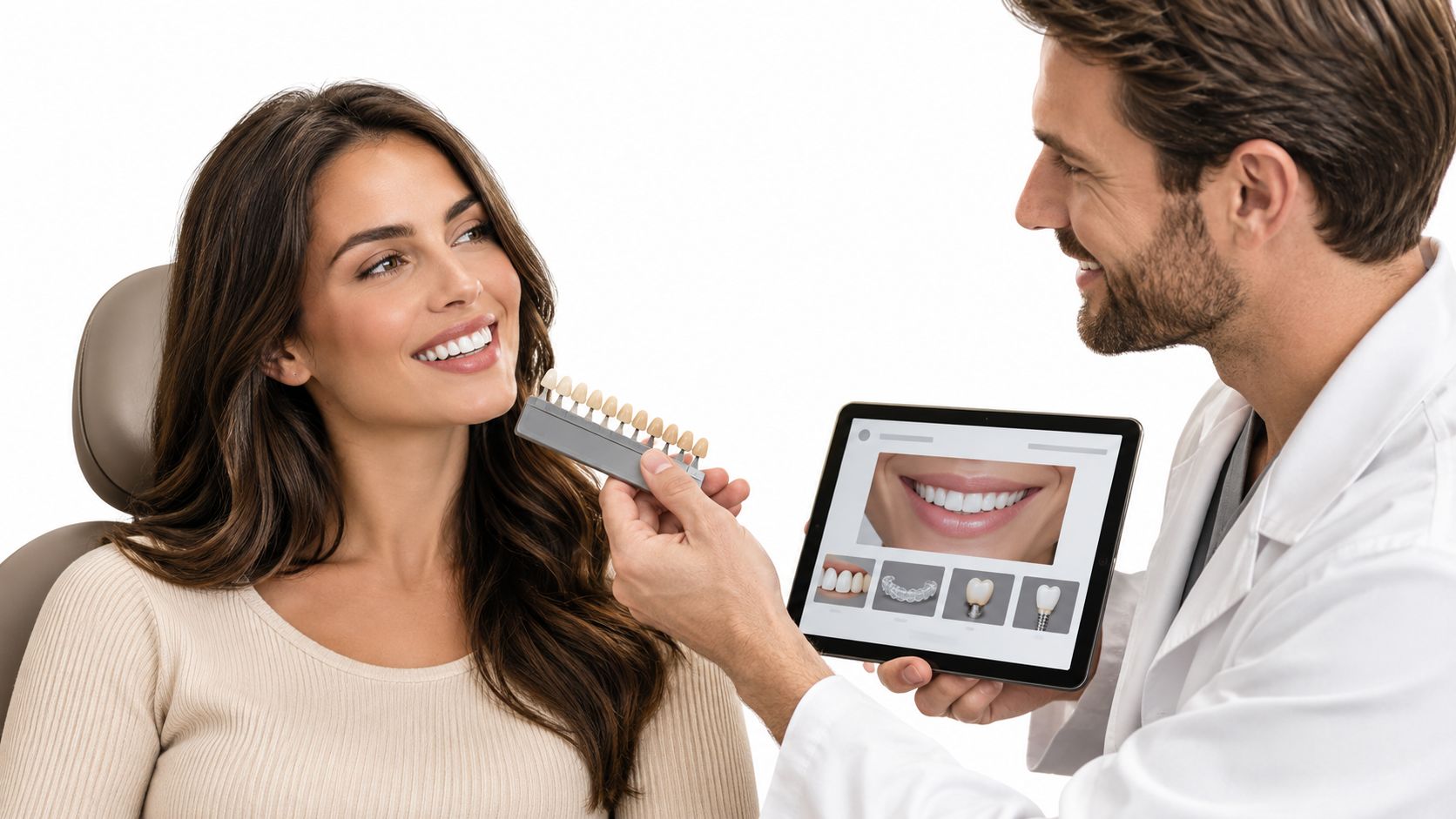
A Winn Smiles consultation can include photographs, a bite assessment, discussion of preparation depth, and a preview or wax-up when appropriate. Patients should ask for a written plan that separates the upfront fee from possible future repair or replacement costs. They should also ask whether the proposed veneer preparation will remain within enamel.
For patients considering direct resin, the practice's dental bonding service in Cleveland can be part of that discussion. The same examination can identify whether preventive care, cleaning and exams, dental X-rays, teeth whitening, Invisalign, crowns, or another restorative option better fits the situation.
Patients who are anxious about treatment should mention it before the appointment. Comfort-focused scheduling and sedation options can make a longer cosmetic visit easier, while patients with urgent pain, swelling, or a broken tooth should ask about emergency dentist availability rather than waiting for a cosmetic consultation.
The direct recommendation is simple. Choose bonding for a small, well-defined correction when conservation and speed matter most. Choose porcelain veneers for a broader cosmetic change when sound enamel, a stable bite, and long-term expectations support the commitment. Book a consultation with Winn Smiles to compare both paths, review the condition of your teeth, and receive a plan built around your smile rather than a generic treatment package.
Winn Smiles offers cosmetic consultations for patients comparing veneers and bonding, along with dental bonding, porcelain veneers, whitening, restorative care, and emergency dental services in Cleveland and Chattanooga. Visit Winn Smiles to request an appointment and discuss the enamel, timeline, maintenance, and long-term cost factors that should guide your decision.