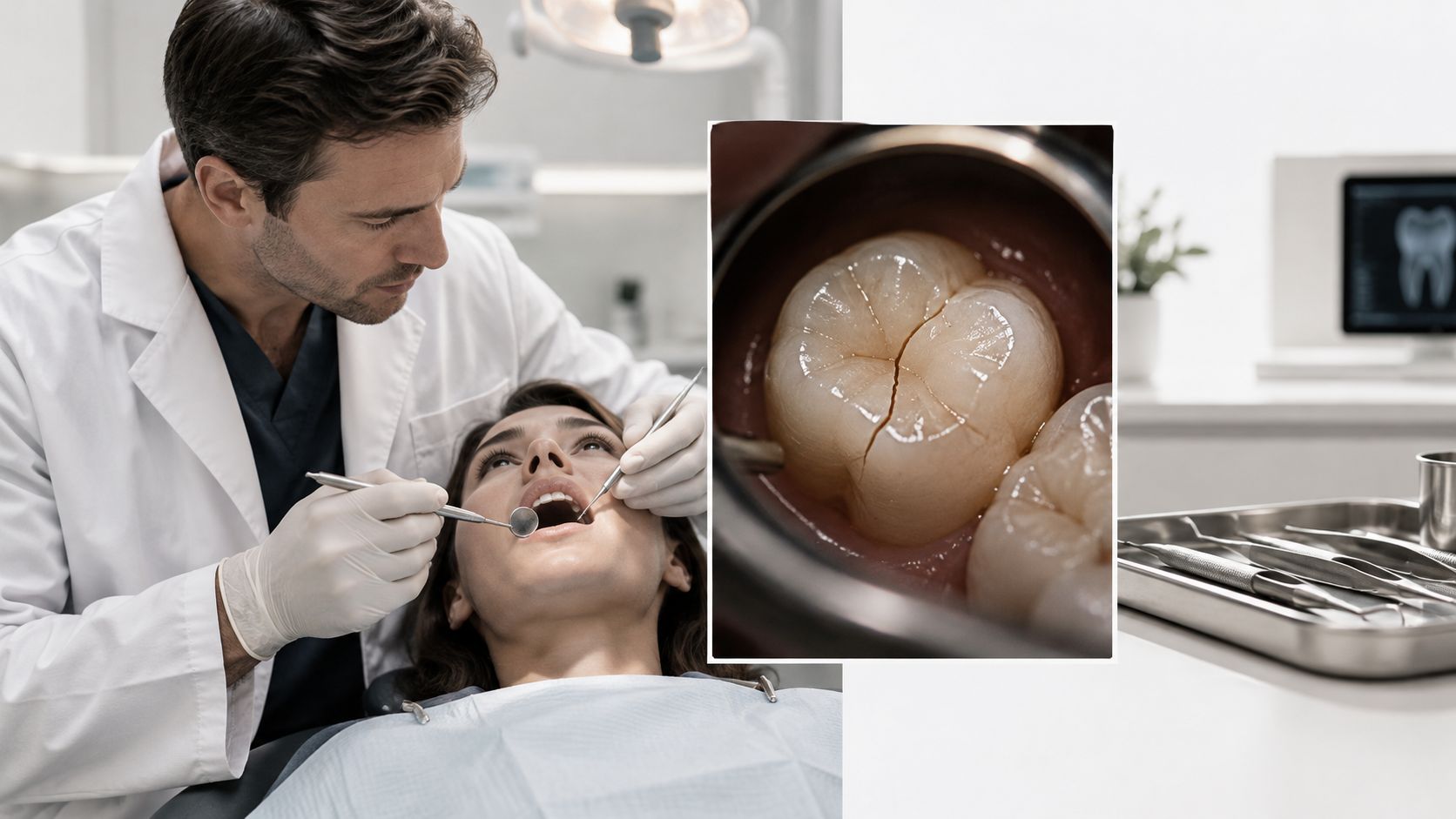
A cracked tooth is not automatically a life-threatening emergency, but it is a dental urgency that deserves prompt evaluation. Severe pain, swelling, bleeding, or a loose segment makes it a same-day emergency.
You may be sitting in your Cleveland, TN kitchen right now, wondering whether the sharp pain you felt biting into a dinner roll means you need an emergency dentist near me or whether you can wait. The answer depends less on the word “crack” and more on what the tooth is doing. A faint, painless line usually isn't a hospital emergency, while intense pain, swelling, bleeding, or trouble swallowing or breathing needs immediate attention.
At Winn Smiles, the first step is a calm conversation about your symptoms. The team can help determine whether you need same-day care, a prompt appointment, or a routine dental exam. The guidance below explains how to triage the problem, protect the tooth during the first hour, and understand what treatment may involve.
A Common Moment of Panic
A patient in Cleveland bites into ice, a hard crust, or even a soft dinner roll and feels a sudden electric jolt. The pain fades quickly, but the tongue finds a rough edge, or a faint line appears in the mirror. The immediate question is familiar: is a cracked tooth a dental emergency, or can it wait?
A stable crack without pain, swelling, temperature sensitivity, or a loose piece may not require a hospital visit. It still deserves a dental assessment because a surface line doesn't show how far the fracture travels. The NHS guidance for chipped, broken, or cracked teeth explains that these injuries are usually treatable by a dentist, with possible care including a filling, crown, reattachment of a fragment, or root-canal treatment when the nerve is exposed.
Practical rule: Mild or intermittent symptoms don't prove that a tooth is safe. Arrange an evaluation promptly, even if the pain disappears before you call.
For Cleveland and Chattanooga adults, the decision becomes clearer when you sort symptoms into three levels. A painless, stable line may fit routine care. Mild chewing pain or temperature sensitivity calls for a prompt appointment. Severe or persistent pain, swelling, significant bleeding, a displaced piece, or exposed tissue can require same-day emergency dentistry.
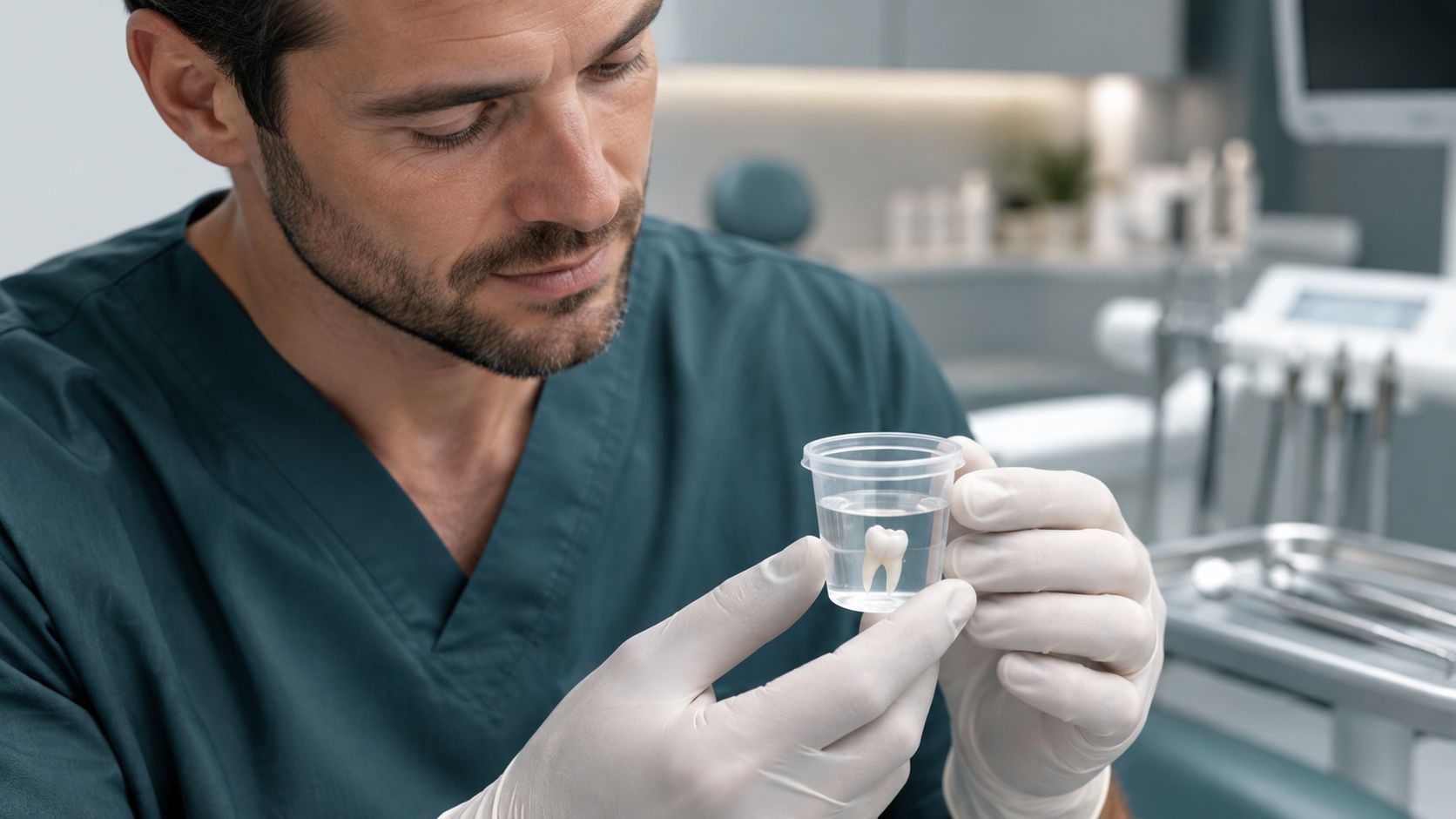
Until you're seen, avoid chewing on that side and don't test the tooth repeatedly by biting hard foods. If a piece has separated, place it in milk or saliva and bring it with you. The right next step isn't panic or watchful waiting. It's a phone call to a dentist who can assess the tooth and explain your options.
What Counts as a Cracked Tooth
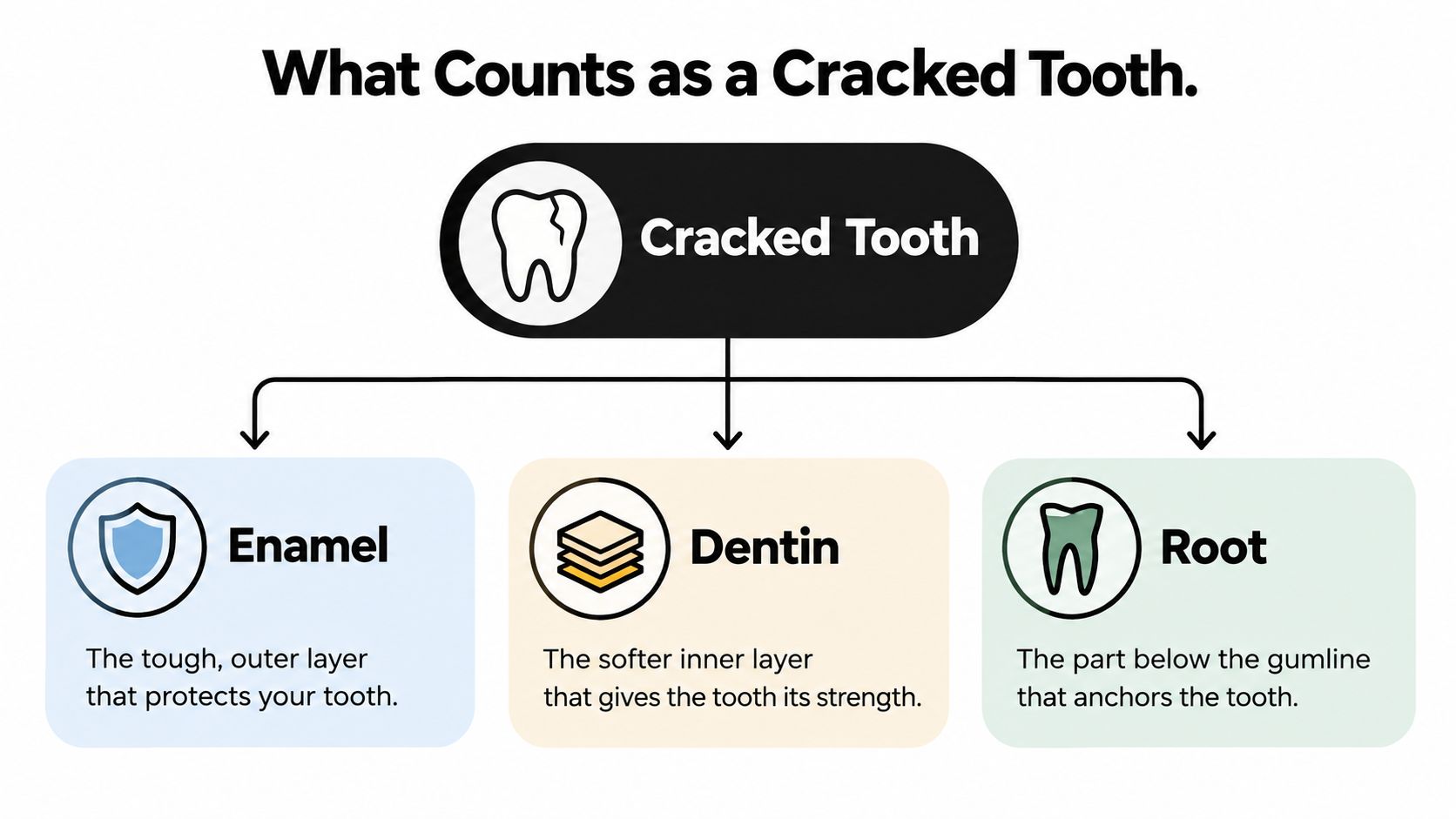
A cracked tooth has a fracture line involving part of the tooth's structure. The line may affect the enamel, the dentin beneath it, or the root below the gumline. These layers behave differently, so two teeth that look similar in the mirror may need very different treatment.
Surface lines and deeper fractures
Craze lines are fine lines limited to enamel. They can resemble a hairline in a windshield and may cause no symptoms. A fractured cusp affects a raised portion of the chewing surface, often around an old filling, and may create pain when you bite or release your bite.
A crack that extends into dentin can allow temperature changes and chewing pressure to reach sensitive inner tissues. A deeper fracture may approach or enter the pulp, the living center containing nerves and blood vessels. If the crack divides the tooth into separate portions, it may be described as a split tooth, which has a less predictable outlook.
The visible line rarely tells the whole story. Some cracks hide beneath a filling, run along a cusp, or continue below the gum. That's why a dentist combines your symptom history with examination and testing rather than deciding treatment from appearance alone.
Why depth matters
A shallow enamel line may need observation, smoothing, or protective restoration. A crack that threatens the pulp may need a crown, root-canal treatment, or, if the tooth can't be saved, extraction. The NHS notes that a badly broken tooth with an exposed nerve may require root-canal treatment, while a fragment may sometimes be reattached or assessed for use in repair. The NHS treatment guidance also advises keeping a separated fragment in milk or saliva.
Chewing places repeated force on a fractured tooth. Prompt evaluation gives the dentist a better opportunity to stabilize the structure before the crack separates it further.
When a Cracked Tooth Becomes Urgent
The most useful way to decide whether you need an emergency dentist near me is to match the symptom pattern to the appropriate level of care. A crack itself doesn't automatically establish the urgency. Pain, swelling, bleeding, pulp symptoms, and tooth stability provide more useful clues.
Three levels of urgency
Routine evaluation may be reasonable when the line is stable, painless, and not sensitive to hot or cold. Even then, schedule a dental exam rather than ignoring it indefinitely. A dentist still needs to determine whether the line is superficial or structurally important.
Prompt evaluation is appropriate for a recent visible crack, mild sensitivity, or pain that comes and goes with chewing. Intermittent pain deserves attention because cracked-tooth symptoms can be unpredictable. The American Association of Endodontists describes severe pain during chewing and hot or cold sensitivity as common cracked-tooth symptoms, and notes that pain may come and go. Their cracked-tooth overview supports immediate professional attention rather than relying on temporary relief.
Same-day emergency care is the right choice for severe or persistent pain, pain that affects sleep or daily activities, marked temperature sensitivity, facial or oral swelling, fever, significant bleeding, a loose or displaced segment, or suspected exposed nerve. The NHS emergency dental guidance explains that severe pain, enlarging swelling, and dental injuries involving a broken or displaced tooth can require urgent care, with timing based on the symptoms. Emergency dental guidance from the NHS provides the relevant triage framework.
A hospital-level emergency is different. Call emergency services or seek immediate medical evaluation if swelling in the mouth, lips, throat, or neck makes breathing difficult. Uncontrolled heavy bleeding or a serious facial or jaw injury also belongs in emergency medical care, not a routine appointment.
| Symptom Pattern | Urgency Level | Recommended Action |
|---|---|---|
| Stable line with no pain or temperature sensitivity | Routine | Arrange a dental examination soon and avoid chewing hard foods on that side |
| Mild or intermittent chewing pain, mild sensitivity, or a newly visible crack | Prompt | Contact a dentist for a rapid evaluation, ideally within the same week |
| Severe or persistent pain, swelling, fever, bleeding, loose segment, or exposed tissue | Same-day emergency | Call an emergency dentist for urgent care |
| Difficulty breathing or swallowing, neck swelling, or bleeding that won't stop | Medical emergency | Seek immediate emergency medical evaluation |
For additional guidance about broken-tooth symptoms and urgent scheduling, see this resource on emergency care for a broken tooth.
What to Do in the First Hour
The first hour should protect the tooth, reduce irritation, and get professional advice. Home care won't repair a fracture, but it can limit additional chewing force while you arrange care in Cleveland or Chattanooga.
Rinse gently. Use warm water to clear food and loose debris. Don't scrub the tooth or swish forcefully around a painful area.
Use a cold compress. If the cheek or gum is swelling, place a cold compress against the outside of the cheek. Use short applications with breaks rather than pressing ice directly against the skin.
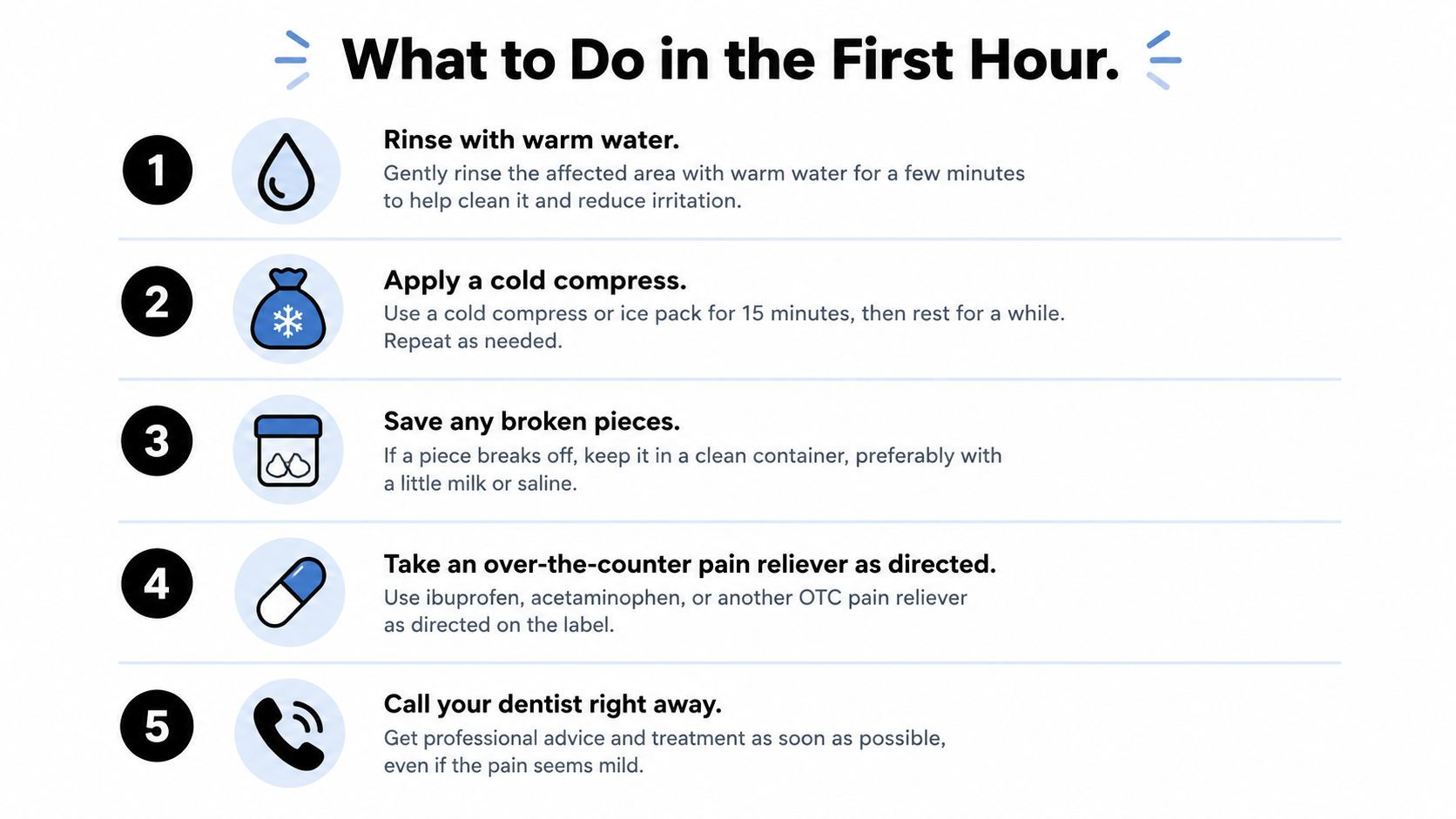
Protect the tooth from pressure. Don't chew on the affected side. Choose soft foods and avoid ice, hard candy, nuts, sticky foods, and anything that makes the tooth hurt.
Take an over-the-counter pain reliever as directed. Follow the product label and consider your own medical restrictions. Don't place aspirin directly on the gum or tooth, and don't use medication as a reason to postpone an examination.
Save any broken fragment. Put it in milk or saliva and bring it to the dentist. Don't glue the piece back, file the tooth, or probe a suspected nerve.
- Small surface damage may be smoothed, bonded, or protected with a conservative restoration.
- A fractured cusp or larger crown crack may need cuspal coverage or a custom same-day crown to hold the tooth together during chewing.
- Pulp involvement may require root-canal treatment followed by a protective restoration or crown.
- A tooth that has split or cannot be predictably restored may require tooth extraction. Winn Smiles can then discuss replacement options, including dental implants, when appropriate.
- “It stopped hurting, so it healed.” Cracked-tooth pain can come and go. Relief doesn't show that the fracture is stable.
- “I can chew on the other side and forget it.” Avoiding pressure helps temporarily, but it doesn't repair the damaged tooth.
- “A clean scan rules out a crack.” Diagnosis may require bite testing, magnification, transillumination, pulp testing, probing, conventional radiographs, and selective advanced imaging together.
- “I'll wait until after the long weekend.” Delay can allow a crack to propagate or the pulp to become compromised.
- “The recommended crown isn't necessary because it feels fine.” A tooth can feel comfortable while remaining structurally vulnerable.
Call Winn Smiles for same-day emergency advice when pain is severe, swelling is increasing, a segment is loose, or the tooth has suffered significant damage. If you have facial or neck swelling that affects breathing or swallowing, or bleeding that won't stop, seek emergency medical care immediately. A general medical clinic may help with a dangerous airway or bleeding problem, but a dentist is needed to treat the tooth itself.
How Winn Smiles Treats a Cracked Tooth
A cracked-tooth visit starts with questions, not assumptions. The dentist will ask what happened, whether pain occurs during biting or release, whether hot or cold triggers it, and whether the tooth feels loose or different in your bite.

Examination before treatment
The clinical examination may include visual inspection under magnification, bite testing on individual cusps, tapping and pressure checks, cold or electric vitality testing, and periodontal probing around the tooth. The American Association of Endodontists recommends combining these methods with the dental history and appropriate imaging. Its clinical guidance for cracked teeth emphasizes that a microscope can reveal subtle cracks that the naked eye may miss.
Dental X-rays can assess the root and surrounding bone, but no single image answers every question. When indicated, the dentist may use more advanced imaging, including three-dimensional imaging such as cone-beam CT, while still interpreting it alongside the clinical findings.
The treatment depends on the crack's location, the condition of the pulp, and how much sound tooth remains.
Restorative dentistry goes beyond just covering a visible line. A filling may suit limited damage, yet teeth facing continuous chewing pressure typically require more robust protection. Care aims to preserve healthy structure when feasible, without guaranteeing that every cracked tooth can be saved.
Patients who feel anxious can ask about the office's comfort menu and sedation options before treatment begins. Clear cost discussions, a plain-language explanation, and a written plan can make decisions easier. Practices also benefit from systems that streamline dental front desk calls, particularly when a patient needs quick guidance after regular appointment hours.
Common Mistakes That Can Cost You the Tooth
A normal X-ray doesn't prove that a crack isn't present. A clinical study found that conventional CBCT detected cracked teeth with 48.4% sensitivity, while contrast-enhanced CBCT reached 67.7% sensitivity in the study described in this clinical imaging research. Even the improved method couldn't accurately measure crack depth.
That limitation matters because crack orientation, restorations, artifacts, and imaging settings can affect what appears on a scan. Persistent chewing pain after “normal” imaging may justify a more complete clinical reassessment, not dismissal.
Assumptions worth leaving behind
A study cited by the American Association of Endodontists reported two-year survival of 94% with a crown after root-canal treatment for a cracked tooth, compared with 20% without a crown. The finding appears in the AAE discussion of whether cracked teeth should be treated. Treatment decisions still depend on examination, but the comparison shows why definitive protection can matter after the nerve has been treated.
The safest habits are simple: don't test the tooth with hard foods, don't attempt a home repair, and don't use temporary pain relief to replace dental care.
Get Same-Day Care at Winn Smiles in Cleveland TN
A cracked tooth isn't automatically a life-threatening emergency, but it deserves a real dental decision. Adults in Cleveland, Chattanooga, and nearby communities can contact Winn Smiles for prompt evaluation when chewing pain, sensitivity, swelling, or a broken segment raises concern.
A visit may include modern diagnostic technology, a comfort menu, sedation options, and a discussion of costs before treatment starts. The practice offers emergency dentistry, restorative care, same-day crowns, root canals, tooth extraction when necessary, and dental implants for suitable tooth-replacement cases. Patients who want a broader plan can also ask about cleaning and exams, teeth whitening, cosmetic dentistry, or dental implants near me after the urgent problem has been stabilized.
You don't need to diagnose the crack before calling. Describe when it hurts, whether the pain is constant, whether swelling or bleeding is present, and whether the tooth feels loose. The team can help determine whether you need same-day care or a prompt new patient exam. For practices looking to improve patient access and call handling, an AI receptionist for practices can also support front-desk communication, but a dental professional must assess and treat the tooth.
For details about urgent appointments, review Winn Smiles' emergency dentistry services. If you need a dentist near me, a cosmetic dentist near me, or a dentist in Cleveland, TN, the easiest next step is to contact the office directly and explain what you're experiencing.
Winn Smiles provides prompt cracked-tooth evaluations, same-day emergency appointments when appropriate, restorative care, root canals, same-day crowns, and tooth extraction when a tooth can't be saved. Visit Winn Smiles to request a consultation or book an appointment in Cleveland or Chattanooga, and take the first practical step toward protecting your tooth and relieving your uncertainty.