You're looking through family photos in Cleveland, TN, and notice your front teeth seem yellower than they used to. You haven't stopped brushing, yet your smile looks different. Before buying a stronger whitening kit, it helps to find out whether you're seeing surface stains, normal aging, or a dental problem that needs attention first.
A Brighter Smile After 60 Near Cleveland
Say you're getting ready for another family gathering. You'd like a brighter smile, but you also remember how cold water sometimes makes a tooth sting. An older front crown adds another question: will whitening make everything match, or make the difference more noticeable?
Teeth whitening for seniors should start with comfort and realistic limits, not a promise of the whitest possible shade. Age-related yellowing isn't necessarily a sign that you've neglected your teeth. Changes beneath the surface, staining drinks, and medication history can all contribute.
A conversation about color should include the teeth and gums around it.
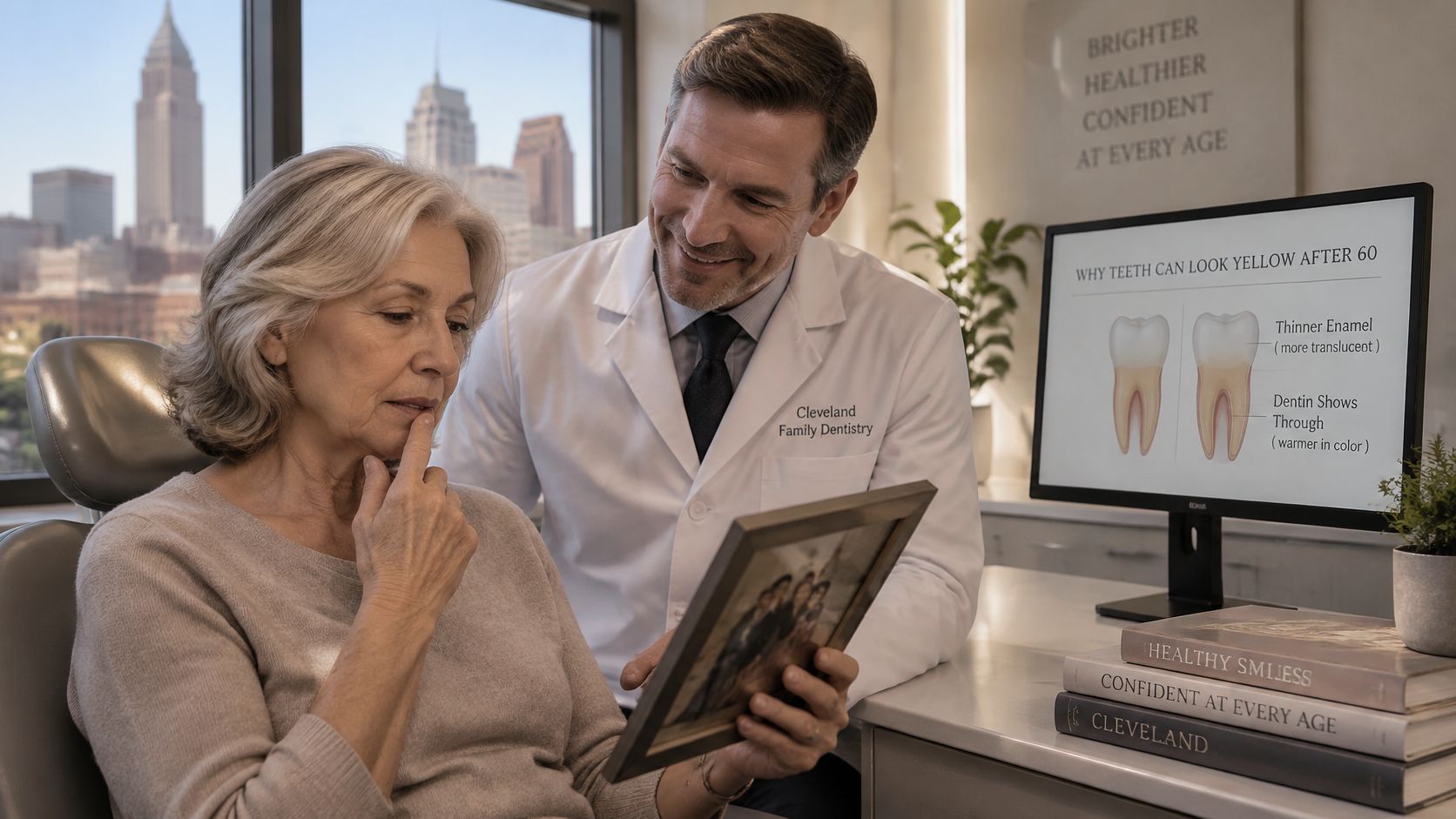
Choose a direction before choosing a gel
The main paths are an in-office whitening visit, custom take-home trays for a gradual change, or a covering treatment such as bonding or veneers when bleaching won't solve the color problem. You don't need to decide which one you want before your examination.
At Winn Smiles, we consider your oral health and daily habits when discussing care with patients from Cleveland and nearby Chattanooga. Tell us about sensitive spots, dry mouth, and dental work that's been in place for years. Those details matter more than the strength printed on a whitening package.
The American Dental Association's whitening overview explains that only natural teeth whiten. Crowns, veneers, and tooth-colored fillings retain their existing color, so whitening neighboring teeth can create an uneven result.
A successful cosmetic change should fit the whole smile, including dental work you already have.
You may decide that a modest improvement is enough. You may also prefer to leave a sound crown alone rather than replace it solely for a lighter color. Use the comparison below to identify a sensible starting point before calling for an appointment.
Whitening Choices Compared for Older Teeth
Whitening paths for older teeth
| Path | Best starting point | How it is used | What may lighten | What stays the same |
|---|---|---|---|---|
| In-office peroxide | Healthy enamel and a preference for supervised treatment | Gel applied during a chair visit with gum protection | Natural tooth shade | Crowns, veneers, fillings, and bonding |
| Custom take-home trays | Gradual change, with caregiver help if needed | Dentist-made trays worn on an individualized schedule | Natural teeth over successive applications | Crowns, veneers, fillings, and bonding |
| Whitening toothpaste | Maintaining a shade after professional care | Brushing with an appropriate toothpaste | Light surface film only | Underlying dentin color and restorations |
| Store whitening strips | A healthy mouth without exposed roots or troublesome dryness | Adhesive strips used according to product directions | Some discoloration in natural teeth | Restorations and potentially resistant internal discoloration |
| Bonding or veneers | Staining that won't respond adequately to bleach | Restorative visits to cover selected natural tooth surfaces | Appearance changes through the covering material, not peroxide | An existing crown's color unless it is replaced |
The ADA's patient guide to teeth whitening cautions that medication-related discoloration and color changes after injury may not respond to bleaching. It also confirms that caps, veneers, crowns, and fillings don't whiten. That distinction separates a useful whitening plan from repeated purchases that can't address the problem.
Which row makes sense for you?
In-office peroxide may appeal if you'd rather have the application supervised than manage treatment at home. Peroxide is the bleaching ingredient that breaks down colored compounds in natural teeth. A supervised visit also allows the dentist to control where gel goes and assess your comfort.
Custom trays offer another kind of control. The dentist can prescribe the amount, wear time, and spacing between applications rather than asking you to improvise. If arthritis or limited hand strength makes trays difficult, a caregiver can help with placement, removal, and rinsing.
For toothpaste, think surface maintenance, not a new underlying tooth color. A toothpaste that polishes away light stain won't rebuild enamel or erase color deep inside a tooth. Ask which product suits your mouth if brushing already causes sensitivity.
When strips or coverings need more thought
Store strips aren't automatically the best starting point for an older mouth. If your gumline is uneven or roots are exposed, a strip may place bleaching material against an area that's already sensitive. Dry mouth is another reason to get an examination before starting a repeated home routine.
Bonding and veneers belong in a different category. They cover a tooth rather than bleach it, and they require a discussion about tooth condition, maintenance, and how much treatment is appropriate. An existing crown usually needs its own matching or replacement decision; placing a veneer over a crown isn't the routine solution.
Don't choose a stronger gel just because the original color is dark. The source of the discoloration and the health of the tooth determine the sensible path.
Why Senior Teeth Look Darker Over Time
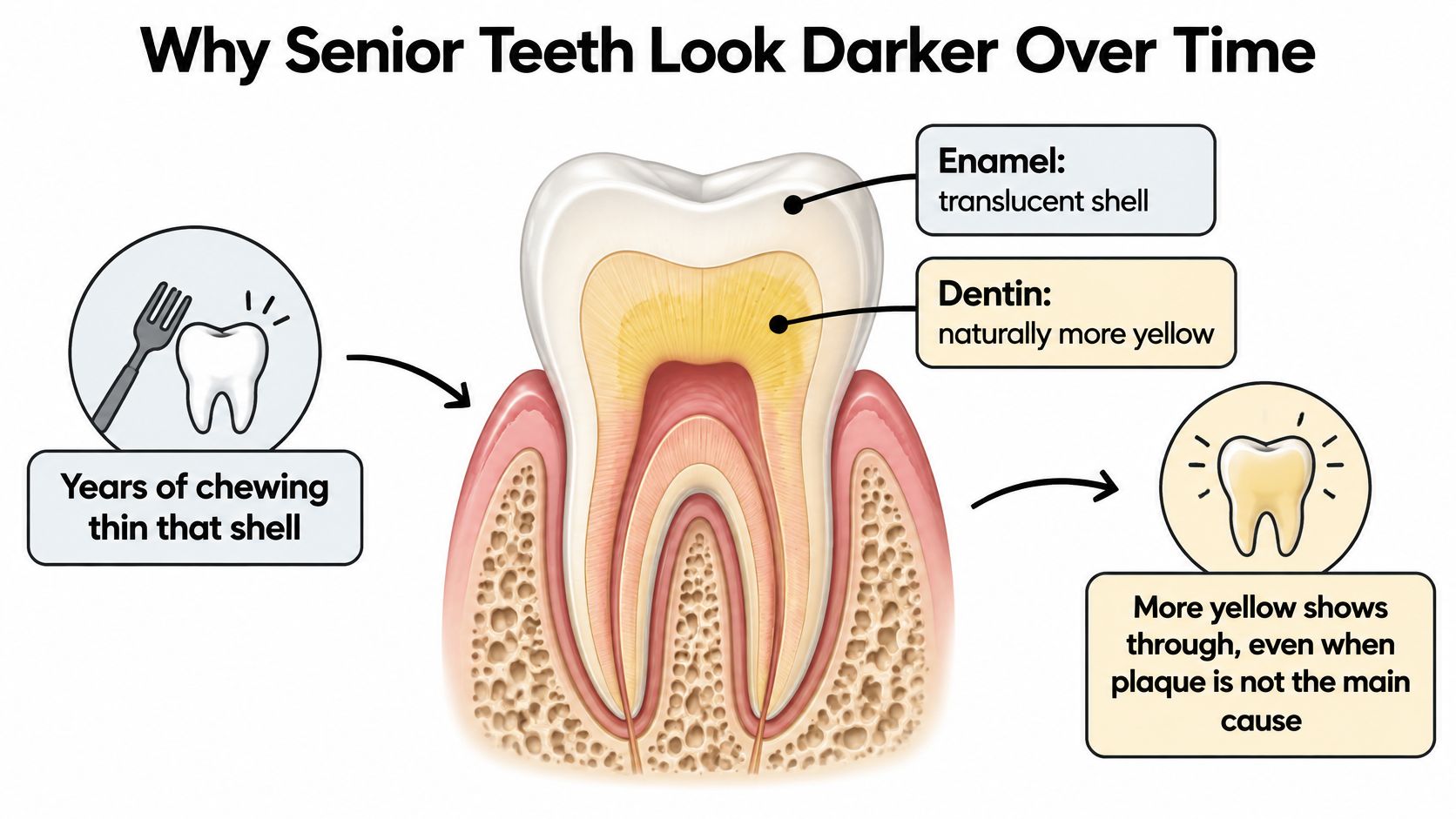
Think of enamel as a translucent outer shell and dentin as the naturally yellower layer beneath it. As that outer shell becomes thinner through years of use, more of the underlying color can show. A clean tooth can therefore look darker without having a heavy coating of plaque.
The clinical review in the Journal of the American Dental Association30811-5/fulltext) describes age-related structural changes alongside external staining, medication-related discoloration, and changes caused by injury or disease. These causes don't all respond to the same treatment.
The tooth's layers help explain why brushing harder isn't the answer.
Surface stains and color inside the tooth
Extrinsic stains sit on the outside. Coffee, tea, red wine, and tobacco are familiar contributors. Cleaning and polishing may remove some external deposits before a dentist decides whether bleaching would add a useful improvement.
Intrinsic discoloration comes from within the tooth. Examples include age-related dentin changes, tetracycline exposure, bleeding inside an injured tooth, or a tooth whose pulp has died. The pulp is the soft tissue inside the tooth that contains nerves and blood vessels.
A smile that gradually yellowed is different from a single tooth that suddenly turned gray. The isolated tooth deserves a diagnosis, even if it doesn't hurt. Covering its color without checking its condition could leave the underlying problem untreated.
Color and structure are separate concerns
A tooth-colored filling may also look increasingly obvious as the surrounding natural tooth changes. That doesn't automatically mean the filling has failed, but its edges and condition still need checking. Likewise, gum recession changes how much of the tooth is visible and can expose a different-looking root surface.
Our explanation of what causes receding gums in adults can help you recognize questions to bring to an examination.
This video offers another way to understand tooth whitening.
Whitening changes color; it doesn't rebuild a tooth. It won't thicken worn enamel, restore a chipped edge, or lengthen a shortened tooth. A dentist in Cleveland or Chattanooga should identify which concern you're trying to solve before recommending cosmetic care.
Health Issues That Mean Wait or Skip
A pre-whitening examination should check for cavities, gum inflammation, cracks, exposed roots, and existing restorations. The ADA's guidance on whitening safety advises addressing decay and gum disease first and warns that bleaching can irritate areas where gums have receded.
When seniors should change the whitening plan
| Finding | Why it matters | Safer next step |
|---|---|---|
| Coffee, tea, or tobacco stain on intact enamel | Surface color may respond | Cleaning and examination before supervised whitening |
| Even yellowing from thinner enamel | Underlying dentin contributes to the color | Set a realistic shade goal |
| Tetracycline or other medicine stain | Internal color may respond incompletely | Examine first, then consider coverage if appropriate |
| One dark tooth after injury or suspected loss of vitality | The cause may require treatment | Check the pulp and treat the tooth as needed |
| Crown, veneer, filling, or bonding | Restorative materials don't bleach | Decide whether the existing shade is acceptable |
| Gum recession and bare roots | Exposed surfaces can be especially sensitive | Protect root areas, address gum concerns, or postpone |
| Cavities or active gum disease | Bleach doesn't treat disease | Complete necessary care before peroxide |
| Medication-related dry mouth | Less saliva means less natural buffering and remineralization | Manage dryness and individualize exposure |
Why exposed roots change the decision
A root doesn't have the same enamel covering as the visible crown of a tooth. Recession can expose dentin and cementum, the thin covering over the root. These tissues are more permeable and less mineralized than enamel, which helps explain why peroxide near the gumline may cause disproportionate discomfort.
A mouth dried by medicines needs additional attention. Saliva helps buffer the mouth and supports the replacement of minerals in tooth surfaces. Reduced saliva also makes root-cavity prevention more important, so cosmetic treatment may need to wait while dryness is managed.
Don't stop a prescribed medicine on your own. Bring your medication list so the dental team can account for its oral effects and coordinate questions with your prescribing clinician when appropriate.
Practical rule: Stabilize the mouth, document the starting shade, and protect exposed surfaces before considering more bleaching.
Health benefits come from necessary care
Whitening itself doesn't cure painful gums or strengthen a cracked tooth. The health benefit of a pre-whitening visit is finding and treating those conditions rather than overlooking them.
Worn enamel and preexisting sensitivity can justify shortening treatment or choosing not to bleach. A caregiver should also know when to pause home treatment: lingering sharp sensations, persistent gum soreness, or a new localized ache deserve a call, not another application.
If you have swelling, significant pain, or a broken tooth, request an assessment rather than booking whitening. An emergency dentist can address an urgent problem; a cosmetic appointment shouldn't delay that care.
Keeping Bleach Gentle on Sensitive Roots
A gentler plan uses controlled exposure, not guesswork about strength. A review of oral health in older adults highlights the importance of periodontal disease, root caries, and barriers to care in this population. Those concerns support making oral health and practical home support part of the whitening decision.
This comfort-first routine gives you and any caregiver clear jobs.

Follow the prescribed routine
- Complete necessary care first. Finish recommended cleaning and treatment for sore gums. Don't place peroxide against inflamed tissue just to keep a cosmetic appointment.
- Record the starting shade with a dated photograph in consistent daylight. Use the same lighting when comparing later, rather than judging against an edited photograph or a different bathroom mirror.
- Ask how exposed roots will be protected. Gel placement, barriers, and tray fit should keep treatment focused on the intended tooth surfaces.
- Choose a supervised approach with an individualized schedule. For home trays, the dentist may recommend shorter wear or more space between applications instead of daily treatment.
- Use a soft toothbrush, lukewarm water, and a sensitivity toothpaste recommended for your mouth. Our guide to tooth sensitivity relief explains related comfort measures.
- Give caregivers a precise demonstration. They should use the prescribed amount of gel, seat the tray, remove overflow from the gums, time the session, and help with removal and rinsing.
- Stop if sharp sensations linger, gum soreness persists, or a tooth hurts when biting. Call before restarting.
Discomfort isn't evidence of progress
Hydrogen peroxide and carbamide peroxide are common bleaching ingredients. The ADA's patient whitening guidance describes temporary sensitivity and gum irritation and warns against excessive use.
Pain isn't a shade target. You don't need to push through it to earn a brighter smile.
A dentist may recommend fluoride varnish as part of care for vulnerable tooth surfaces. Ask whether it fits your needs after bleaching, rather than adding products on your own. More treatment days don't correct an unsuitable diagnosis or make resistant discoloration reliably disappear.
Shade Changes Seniors Can Reasonably Expect
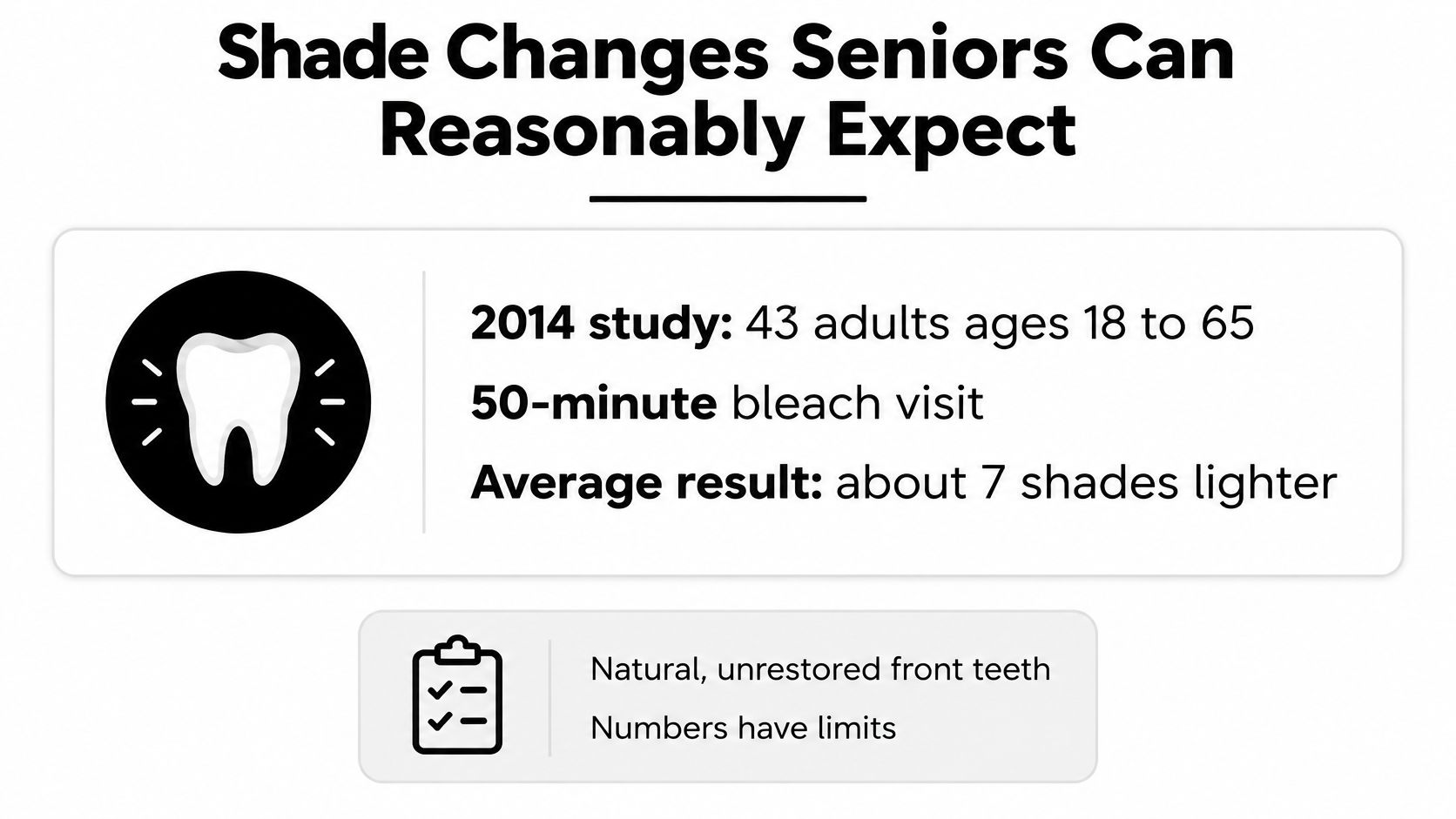
In a published clinical study of healthy adults, 43 participants aged 18 to 65 with natural, unrestored front teeth averaged 7 shades of improvement after a 50-minute bleaching protocol, with individual changes from 2 to 12 shades. At 3 months, the mean improvement remained 5.7 shades; 34 of 43 participants, about 79 percent, reported no pain, while seven reported slight discomfort and two reported mild discomfort.
These findings aren't a senior-only success rate. The study excluded teeth with restorations, decay, or other conditions, and no participant was older than the stated age limit. Its temporary, controllable adverse effects are reassuring, but they don't establish how a mouth with extensive recession or restorative work will respond.
The study's central finding needs to be read alongside those limits.
Whitening study results at a glance
| Measure | Result | What it means for seniors |
|---|---|---|
| Study group | Healthy adults with natural, unrestored front teeth | Older patients with complex dental histories weren't represented |
| Average shade gain after the chair protocol | Substantial improvement, with a broad individual range | An average isn't a promised result |
| Follow-up shade | Some improvement remained after follow-up | Initial color change isn't necessarily permanent |
| Comfort | Most participants reported no pain | Your existing sensitivity still needs assessment |
| Teeth excluded | Restored teeth, decay, and other conditions | Common findings in older mouths limit direct comparison |
Different mouths, different useful outcomes
Consider a Cleveland patient with tea staining and sound enamel. A noticeable lift may be a reasonable goal, provided the examination confirms that bleaching suits the teeth. The patient may be satisfied before reaching the lightest shade available.
A Chattanooga patient with receded gums may choose a softer change achieved with carefully spaced applications. Comfort, not matching someone else's photograph, determines whether continuing makes sense.
For someone with front crowns, the decision may be to brighten neighboring natural teeth modestly and retain the crowns. If the proposed shade would create an unacceptable mismatch, replacement of selected restorations becomes a separate decision, not an automatic part of whitening.
Maintain the result without chasing permanence
Keep staining exposures in mind, especially coffee, tea, red wine, and tobacco, and follow your dentist's aftercare advice. Brush morning and evening, clean between teeth, and attend recommended examinations.
Don't restart treatment whenever the mirror looks different under new lighting. Compare against your baseline and arrange a review before repeated bleaching. A natural-looking improvement that stays comfortable is a better endpoint than continuous applications.
What Whitening Costs and Insurance Questions
A useful estimate starts with an examination, not a price guessed from a photograph. The total can include the whitening method itself and separate care needed to make treatment appropriate. At our office, we recommend examining your mouth so the estimate reflects your actual needs.
Ask for the choices to be itemized rather than combined into an unclear cosmetic package.
Separate the treatment decisions
| Estimate item | What to clarify |
|---|---|
| In-office whitening | What the proposed treatment includes and how follow-up is handled |
| Custom take-home trays | Trays, gel, instructions, and any future supplies |
| Bonding or veneers | Which teeth need coverage and why bleaching isn't sufficient |
| Preliminary dental care | Cleaning, gum treatment, or repair of a worn filling |
| Restoration matching | Whether an existing crown or filling can remain unchanged |
Dental insurance and cosmetic coverage aren't the same thing. Many plans treat whitening as cosmetic, so don't assume that having dental insurance means bleaching will be covered. Ask for benefit confirmation and a written explanation of your expected responsibility before scheduling treatment.
Bring your insurance information and current medication list. If the budget is limited, say so at the beginning; necessary disease care should remain separate from optional shade changes.
Spend first on a diagnosis and a usable plan, not on extra kits you may be unable to use comfortably.
You can also choose to postpone whitening. A healthy, comfortable mouth doesn't need to reach a particular shade to be well cared for, and there's no reason to commit to restorative work because bleaching has limits.
Book a Whitening Consult in Cleveland or Chattanooga
If you've been searching for a cosmetic dentist near me, bring your questions rather than a decision about gel strength. An examination can establish whether you're a whitening candidate, whether another treatment would address the concern better, or whether no cosmetic treatment is necessary.
Winn Smiles professionally whitens teeth at its Cleveland office, offering in-office treatment that can whiten in a session and take-home options for gradual, customized whitening. Our cosmetic services also include bonding and veneers. We develop recommendations around your oral health, lifestyle, and budget rather than assuming everyone needs the same approach.
Make the examination useful
Bring a list of medicines, the names or packaging of whitening products you've tried, and any photograph that shows the color change you're concerned about. Tell us if you have trouble handling trays or would like a caregiver involved.
A useful consultation should address:
- Your health history. Discuss dry mouth, existing sensitivity, and recent changes in symptoms.
- Your teeth and gums. Have existing crowns, fillings, exposed roots, and suspicious dark areas assessed.
- Your starting point. Ask how shade will be documented and what outcome is realistic.
- Your written estimate. Separate whitening from care needed beforehand and clarify comfort precautions.
Keep necessary treatment in perspective
Cleveland and Chattanooga patients can receive preventive, restorative, and gum care within our practice before pursuing whitening. Tooth extraction and dental implants address different problems, such as a tooth that can't be retained or a missing tooth; they aren't treatments for ordinary yellowing.
If an older whitening plan no longer feels comfortable, request another assessment instead of resuming it unchanged. Tell us whether recession, dryness, or a newly placed crown has altered the situation. Book the examination first, then choose a shade goal that fits the teeth and restorations you have.
Winn Smiles offers professional in-office and take-home whitening, with options for patients who need a gradual, comfort-focused approach. Visit Winn Smiles to request a consultation in Cleveland or discuss care from nearby Chattanooga, and bring your medication list and previous whitening products so we can help you choose a sensible next step.