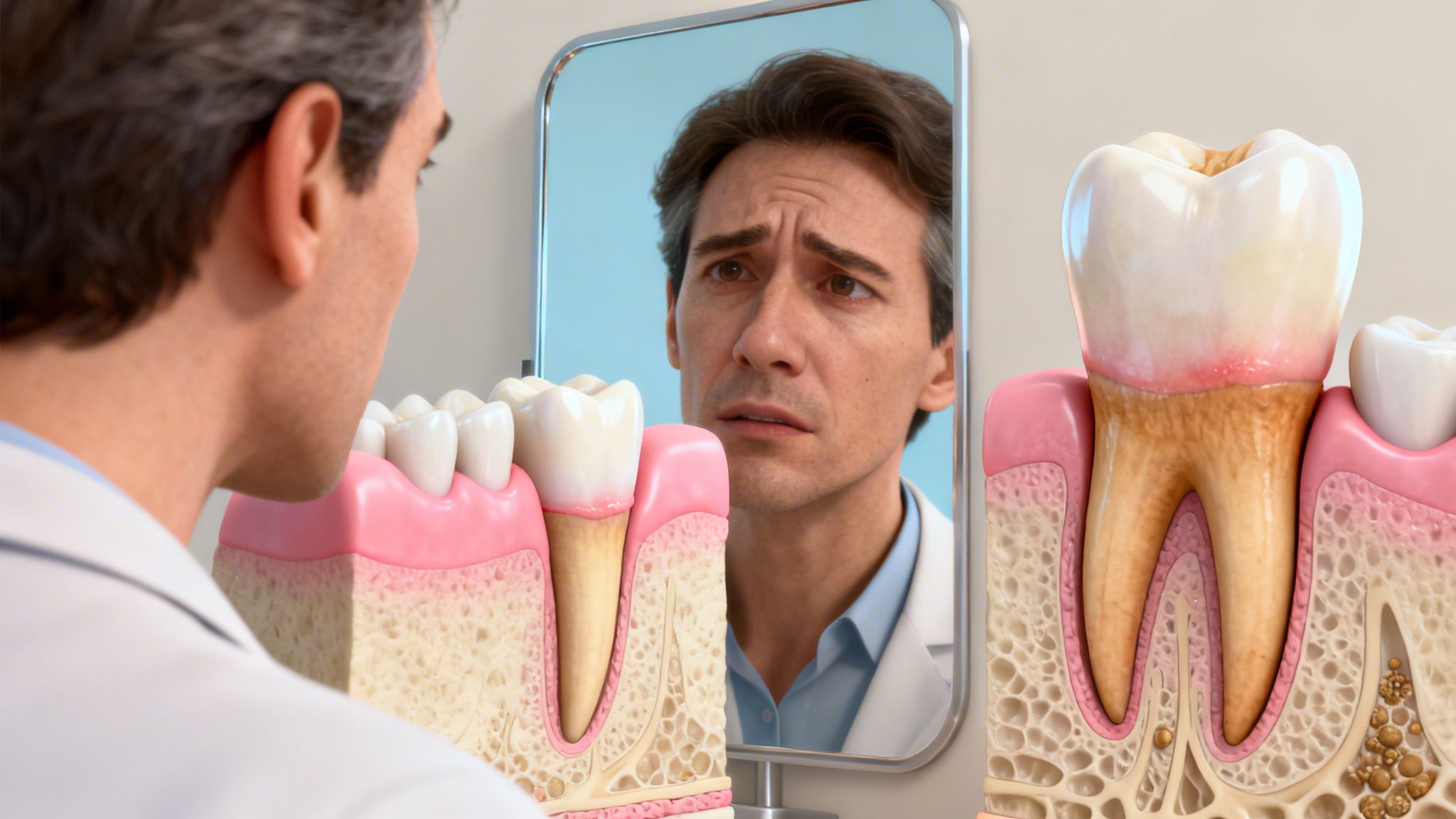
You catch it while brushing one morning. A tooth looks a little longer than it used to. Cold water stings near the gum line. You lean closer to the mirror and wonder if something is changing, or if you are just imagining it.
Most adults who notice receding gums start in that same place. The change is often subtle at first. There may be no sharp pain, no obvious injury, and no dramatic event that points to one clear cause.
That uncertainty can make people put it off. They tell themselves they are brushing fine, that it is just sensitivity, or that gums naturally shift with age. Sometimes they do. But gum recession is still worth taking seriously, because the earlier you catch the cause, the easier it is to protect your teeth and keep the problem from getting worse.
If you have been searching for what causes receding gums in adults, you are not overreacting. You are asking the right question.
Noticing a Change in Your Smile You Are Not Alone
A lot of adults first notice gum recession in everyday moments. It might be while flossing before work. It might be when coffee suddenly feels too hot on one side of the mouth. It might be during a selfie, when one tooth seems longer than the others.
That first reaction is usually worry. People often wonder if they brushed too hard, if they are getting gum disease, or if they are headed toward tooth loss. All of those thoughts are understandable.
What many patients notice first
The earliest clues are often small:
- A longer-looking tooth that did not stand out before
- Sensitivity near the gum line when eating or drinking
- A notch at the base of a tooth you can feel with your tongue
- A gum line that looks uneven in photos or in the mirror
Some people have no discomfort at all. They only notice a cosmetic change.
Others feel embarrassed and assume they caused it. That is not always true. Receding gums can happen for several reasons, and more than one factor may be involved at the same time.
Why it helps to look into it early
Gum recession means the tissue around the tooth has moved away or worn down. When that happens, the root can become more exposed. Roots are more delicate than the visible part of the tooth, so they tend to feel temperature changes more quickly and can be harder to protect.
Key takeaway: Receding gums are common, but they are not something to ignore. A small change today can become a bigger problem if the underlying cause is left untreated.
For adults in Chattanooga and Cleveland, this is one of those concerns that benefits from a timely dental exam. A local visit can usually tell you whether the issue is related to plaque buildup, brushing habits, bite pressure, or another cause that needs attention.
Understanding Gum Recession and Its Symptoms
Gum recession means the gum tissue has pulled away from the tooth or worn down enough to expose more of the tooth surface. In some cases, it also exposes part of the root.
A simple way to think about it is soil around a tree. If the soil slowly washes away, more of the trunk base becomes visible and less support remains around it. Teeth and gums work in a similar way. The gum line protects the root area and helps shield the structures that support the tooth.
What gum recession can feel like
Some adults expect gum recession to hurt all the time. Often, it does not. That is one reason people miss it.
Common signs include:
- Teeth looking longer
- Sensitivity to cold, heat, sweets, or brushing
- Visible root exposure
- Small grooves or notches near the gum line
- Tenderness when brushing
- Gums that seem uneven or pulled back
If sensitivity is one of the main symptoms you are dealing with, this plain-language guide on what causes sensitive teeth can help connect the dots between exposed roots and that sudden zing from cold drinks.
Why gum disease is often involved
In adults, the main disease process behind recession is often periodontal disease, especially chronic periodontitis. The basic chain reaction starts with plaque. Plaque collects around the gum line, the body reacts to the bacteria, and inflammation begins. Over time, that inflammatory process can damage gum tissue and the bone that supports the teeth.
One review of periodontal literature explains that untreated periodontitis can lead to average annual attachment loss of 0.2 to 0.5 mm, and in aggressive forms that loss can accelerate to 1 to 2 mm per year. The same source notes that 30% of the population carries genetic variations linked to greater susceptibility, and that family history can increase the odds by 2 to 3 fold (rejuv-health.com).
That sounds technical, but the practical meaning is simple. Inflammation does not just make gums look puffy or red. In some adults, it slowly breaks down the support around the tooth.
If your gums also bleed when you brush, that symptom deserves attention too. This article on https://www.winnsmiles.com/post/why-do-my-gums-bleed-when-i-brush gives a helpful overview of what that pattern can mean.
Symptoms people often confuse
People commonly mix up recession with a few other problems. This quick comparison helps:
| What you notice | What it may mean |
|---|---|
| Tooth looks longer | Gum recession may be exposing more tooth structure |
| Sharp reaction to cold | The root may be exposed |
| Bleeding when brushing | Gum inflammation may be present |
| A dip near the gum line | Brushing trauma, grinding, or recession may be involved |
Helpful tip: Gum recession is not only a cosmetic issue. Once roots are exposed, teeth can become more sensitive and harder to keep clean.
The Main Causes of Receding Gums in Adults
You glance in the mirror one morning and one tooth looks a little longer than it used to. That can feel unsettling. At Winn Smiles, patients in Chattanooga and Cleveland bring up this concern all the time, and the first thing we want you to know is that gum recession usually has an explainable cause.

In many adults, recession develops the way a shoreline slowly changes. It is often not one dramatic event. It is the result of repeated irritation, pressure, or inflammation over time.
Plaque and gum disease
A very common cause is plaque that stays on the teeth long enough to irritate the gums.
Plaque is a sticky film of bacteria. If it is not removed well at home and during routine dental visits, it can harden into tartar. Tartar gives bacteria more places to collect near the gum line, and the gums may stay inflamed for long periods. Over time, that irritation can damage the attachment around the tooth and the gum tissue may begin to shrink back.
This is one reason a patient can feel fine and still have recession developing without immediate notice. Gums do not always send an early warning that is easy to notice.
Brushing with too much force
This surprises many adults, especially people who are trying hard to keep their teeth clean.
Your toothbrush should sweep plaque away, not scrub the gums raw. A soft-bristled brush works more like a gentle washcloth than a scouring pad. If you brush side to side with heavy pressure, especially along the outer surfaces of the teeth, the gum line can gradually wear down. We often see this pattern on front teeth, where the hand naturally presses harder.
A good rule is simple. Clean thoroughly, but clean gently.
Tobacco use
Smoking and smokeless tobacco can make recession more likely and can also make healing harder once the gums are irritated.
Tobacco affects blood flow, tissue health, and the mouth's ability to recover from inflammation. It can also make gum disease less obvious at home because some smokers do not notice as much bleeding, even when disease is present. That delay matters. Problems that stay hidden longer often become more advanced before treatment starts.
Bite pressure, clenching, and tooth position
Some recession has less to do with bacteria and more to do with force.
If certain teeth hit harder than others, the pressure can concentrate near the gum line. Clenching and grinding can add to that stress, especially at night. Teeth that are crowded, rotated, or positioned outside the natural arch may also have thinner bone and gum support around them, which makes those spots more vulnerable.
Patients sometimes ask why one tooth is receding while the others look fine. Uneven force is often part of that answer.
Thin gums and local anatomy
Some people are born with thinner gum tissue, just like some people naturally have thinner skin. Thin tissue can recede faster when it faces inflammation, brushing trauma, or bite stress.
A tight frenum, which is the small band of tissue connecting the lip or cheek to the gums, can also pull on a specific area. Oral piercings, old habits of nail biting or chewing objects, and a history of orthodontic movement can contribute in certain cases too. These are not causes for everyone, but they are common things we check for in the office.
Why recession becomes more common with age
Age does not create recession by itself. Time allows these other factors longer to affect the gums.
Years of brushing habits, plaque buildup, grinding, tobacco exposure, or thin tissue can add up little by little. That is why many adults first notice recession in their 30s, 40s, or later, even though the process may have started much earlier.
If you want another patient-friendly explanation of this topic, Causes of Gum Recession and What You Can Do About It gives a useful general overview.
Bottom line: Receding gums usually come from a small group of identifiable causes. Once we find the reason, we can build a treatment plan that fits your mouth and make it practical to get care close to home in Chattanooga or Cleveland.
How We Diagnose Gum Recession at Winn Smiles
Many people expect a gum exam to be uncomfortable or complicated. It is usually much simpler than they think.
The appointment starts with a close look at your gums, teeth, and gum line. Your dentist checks whether the tissue has pulled back, whether roots are exposed, and whether the recession seems limited to one area or appears in several places.
Step one is a visual exam
A visual exam tells us a lot. We look for:
- Uneven gum lines
- Exposed root surfaces
- Redness or swelling
- Plaque and tartar buildup
- Wear near the gum line
We also ask what you have noticed. Sensitivity. Bleeding. A change in how your teeth look. Jaw soreness from clenching. Those details help connect the recession to a likely cause.
Step two is measuring the gums
If needed, your dentist or hygienist uses a periodontal probe. This is a small measuring instrument that checks the space between the tooth and the gum.
Patients often worry this part will hurt. In most cases, it is brief and very manageable. The purpose is not to poke at sore tissue. The purpose is to learn whether gum disease has created deeper pockets that need treatment.
Step three is using dental X-rays
Dental X-rays help us see what is happening below the surface. Gum recession is not only about what shows in the mirror. X-rays can reveal whether there has been bone loss around the tooth and whether the problem is mild or more advanced.
That matters because the treatment plan changes depending on what is causing the recession.
What the exam helps us answer
A good diagnostic visit should answer practical questions, such as:
| Question | Why it matters |
|---|---|
| Is this active gum disease or old recession? | Active disease needs prompt treatment |
| Is brushing trauma involved? | Home care may need to change |
| Is grinding or clenching adding pressure? | A nightguard may help |
| Is bone support affected? | Treatment may need to be more involved |
What patients often find reassuring: A gum recession exam is not about judgment. It is about figuring out what is happening and giving you a clear next step.
If you have been putting off a visit because you are worried about hearing bad news, this is worth remembering. Most adults feel better once they know what is causing the problem and what can be done about it.
Modern Treatment Options for Gum Recession in Chattanooga and Cleveland
Treatment works best when it matches the cause. If plaque and gum disease are driving the recession, the first step is different from what you would need for heavy brushing or nighttime grinding.
The good news is that adults today have more comfortable options than many people expect.

Non-surgical care often comes first
For many patients, treatment begins with scaling and root planing, often called a deep cleaning. This removes plaque and tartar from above and below the gum line and smooths the root surface so the gums have a cleaner environment to heal against.
If inflammation is active, this step can make a major difference in stopping progression.
Your dentist may also recommend changes at home, such as:
- A soft-bristled toothbrush
- A less abrasive toothpaste
- A gentler brushing technique
- A prescription rinse when appropriate
- More frequent periodontal maintenance visits
For adults dealing with ongoing gum inflammation, learning about dedicated https://www.winnsmiles.com/services/periodontal-care can help clarify what this type of treatment includes.
Treatment for brushing trauma and bite stress
Some recession is less about infection and more about force.
One source describing traumatic brushing and occlusal overload notes that aggressive brushing with firm bristles can apply shear forces exceeding 2 to 3 N and may erode the gingival margin at 0.2 to 0.5 mm per year. The same source explains that clenching, bruxism, or misaligned teeth can generate tensile stresses above 5 to 10 MPa, with analyses showing 20 to 30% higher recession risk in misaligned dentitions. It also reports that nightguards can reduce clenching forces by 50 to 70% (webmd.com).
That sounds highly technical, but the clinical takeaway is straightforward. If your mouth is dealing with repeated force, the solution may include:
- Technique coaching so brushing stops damaging the gum line
- A custom nightguard if you grind or clench
- Orthodontic evaluation if tooth position is concentrating pressure in one area
- Targeted desensitizing treatment for exposed roots
Laser dentistry and precise tissue care
Some practices also use laser dentistry as part of periodontal treatment or soft tissue management. The advantage is precision. Lasers can help target diseased tissue and bacteria while being gentler on surrounding areas.
That can be appealing for adults who feel anxious about traditional treatment and want a more modern approach.
A short video can help you visualize the general idea of gum-focused care and treatment planning:
When surgical treatment is the right next step
If recession is advanced, non-surgical care may not be enough to cover the exposed root. In those cases, your dentist may refer for or discuss gum grafting.
A gum graft places healthy tissue over the receded area to protect the root and improve the gum line. Patients often seek it for two reasons at once. They want to reduce sensitivity, and they want the area to look healthier.
If damage becomes severe
In advanced periodontal cases, recession can be part of a bigger breakdown of support around the tooth. If a tooth cannot be saved, restorative options may become part of the conversation, including bridges or dental implants near me if replacement is needed.
That is not where most patients start. But it is another reason not to ignore recession. Early treatment is usually simpler than waiting.
Important reassurance: Receding gums do not automatically mean surgery. Many adults start with conservative care that focuses on stopping the cause and protecting the exposed areas.
Simple and Effective Prevention Strategies
Prevention works best when it is practical. Most adults do not need a complicated routine. They need the right technique, the right tools, and consistency.
Brush gently, not aggressively
This is one of the most important changes you can make.
Data from 710 subjects identified faulty toothbrushing in 42.7% of recession cases, nearly matching plaque accumulation at 44.1% as a cause. The same source notes that recession becomes more common with age, with about 38% of adults age 30 to 39 affected, rising to 71% in adults 50 to 59 and 90% in those 80 to 90. It also reports that 88% of people over 65 have recession on at least one tooth, and that men showed higher recession frequency at 60.5% compared with 39.5% in females in the study discussed (sarasotaperiodontal.com).
The lesson is not to brush less. It is to brush smarter.
Use a soft-bristled brush. Keep your grip light. Small circular motions are safer than hard scrubbing across the teeth.
Focus on plaque control every day
Because plaque is a major cause, daily cleaning matters.
A solid routine usually includes:
- Brushing twice a day with a soft brush
- Cleaning between the teeth daily with floss or another tool your dentist recommends
- Replacing worn brushes before frayed bristles start scraping the gums
- Keeping regular cleaning visits so tartar does not sit below the gum line
Pay attention to your habits
Some adults do a good job cleaning their teeth but still put stress on the gums in other ways.
Consider whether any of these apply:
- Grinding or clenching at night
- Tobacco use
- Oral piercings that rub the gum line
- Ignoring sensitivity or bleeding for months
If one of those sounds familiar, your dentist can help you make a targeted change instead of guessing.
A simple home checklist
| Daily habit | Why it helps |
|---|---|
| Soft toothbrush | Reduces brushing trauma |
| Gentle pressure | Protects the gum margin |
| Daily flossing | Lowers plaque between teeth |
| Consistent checkups | Catches change early |
Prevention tip: If your toothbrush bristles flare out quickly, that is often a sign you are brushing too hard.
For many adults in Chattanooga and Cleveland, prevention also means not waiting until something hurts. Gum recession often progresses. Routine cleanings, exams, and dental X-rays can catch early changes before they become more complicated.
Your Comfort-Focused Visit at Winn Smiles
A lot of people who search for a dentist near me or a dentist in Chattanooga, TN are not only looking for treatment. They are looking for a place where they can relax enough to get care.
That matters even more when the issue involves sensitive gums, bleeding, or fear of hearing that something has gotten worse.

What the experience feels like
Patients often say the hardest part is making the first call. After that, things usually feel more manageable.
The offices are designed to feel open and welcoming, not rushed or intimidating. The team explains what they are seeing in plain language. If something needs treatment, you are told why it matters and what your options are.
That kind of communication is important for gum concerns. Recession can sound alarming. Clear explanations make it easier to understand what is urgent, what is manageable, and what you can do next.
Support for anxious patients
Dental anxiety is common. Some patients worry about discomfort. Others worry about being judged for how long they waited.
The care approach is built around reducing that stress. Patients have access to comfort-focused amenities and sedation options designed for individual needs. That can make a big difference for adults who have been avoiding care, whether they need a new patient exam, a cleaning, periodontal treatment, or an emergency dentist visit for a painful flare-up.
Care that fits more than one need
Many adults who come in for gum concerns also ask about other issues during the same visit.
That may include:
- Cleaning and exams
- Dental X-rays
- Restorative dentistry
- Cosmetic dentistry
- Teeth whitening
- Tooth extraction
- Dental implants near me
- Cosmetic dentist near me
For some people, the first goal is stopping sensitivity and protecting the gums. For others, it is also about improving the appearance of the smile once health is stable.
Why local care matters
When you are dealing with a concern that may need follow-up, convenience matters. Being able to see a trusted local dental team in Cleveland or Chattanooga makes it easier to keep appointments, ask questions, and stay on track with maintenance.
Reassurance for new patients: You do not need to know exactly what treatment you need before you come in. A good visit starts with listening, examining, and giving you a plan that makes sense.
Take the First Step Toward Healthier Gums Today
Receding gums can feel unsettling, especially when the change seems to happen slowly and without a clear reason. But the causes are often identifiable, and many cases can be managed successfully when treated early.
The most important thing to remember is this. Gum recession is not something you have to figure out on your own.
If you have noticed longer-looking teeth, sensitivity near the gum line, bleeding when brushing, or a change in the way your smile looks, it is a smart time to schedule an exam. A local dental team can check whether the cause is gum disease, brushing trauma, grinding, bite pressure, or a mix of factors.
For adults in Chattanooga and Cleveland, getting answers early can help you avoid more complex treatment later. It can also give you peace of mind. Even if the recession turns out to be mild, you will know what is happening and how to protect your gums moving forward.
Whether you are looking for a dentist in Cleveland, TN, a dentist near me, help with periodontal care, or guidance on broader restorative or cosmetic needs, the right next step is a professional evaluation.
If you are ready for clear answers and compassionate dental care, schedule a visit with Winn Smiles. Their team serves Chattanooga and Cleveland with comfort-focused exams, modern treatment options, and personalized guidance for healthier gums and a stronger smile.