You want a whiter smile, but you already know what cold water, ice cream, or even a deep breath can feel like on sensitive teeth. That's why so many people put whitening off. They assume brighter teeth automatically mean more pain.
In practice, the first question usually isn't which whitening product is strongest. It's whether your sensitivity is coming from whitening alone, or from something else that needs attention first. A tooth can feel “sensitive” because of gum recession, a small cavity, a crack, or enamel wear. If that's the actual issue, whitening without an exam can make the experience much harder than it needs to be.
For patients looking for a dentist in Chattanooga, TN or nearby Cleveland, a careful cosmetic consultation is essential. The safest path is to start with diagnosis, then choose the gentlest option that still gives you visible improvement. If you've been searching for the best teeth whitening for sensitive teeth, comfort should come first. Shade change comes second.
A Brighter Smile Without the Pain in Chattanooga TN
A common story goes like this. Someone has a wedding, job interview, family photos, or just gets tired of seeing coffee stains in the mirror. They buy a whitening kit, try it once, and the teeth “zing.” After that, they assume whitening isn't for them.
That conclusion is often too broad.
Sensitive teeth don't automatically rule out cosmetic dentistry. They do mean the treatment has to match the reason for your sensitivity. Before starting any whitening treatment, it's important to find out whether the sensitivity points to an underlying problem. Sensodyne advises getting a dental assessment first because pain may reflect a condition such as cavities or gum recession that should be treated before whitening begins, as explained in its guidance on what to know before whitening sensitive teeth.
Why diagnosis comes before product choice
If the tooth itself is healthy, whitening may still be possible with a gentler plan. If the sensitivity is tied to a dental problem, the right answer may be a cleaning and exam, gum treatment, a filling, or another form of restorative dentistry before any cosmetic treatment starts.
That matters for people looking for a cosmetic dentist near me or a new patient exam in Chattanooga. Whitening should never be treated like a one-size-fits-all purchase. It works best when it starts with a clear diagnosis.
Practical rule: If your teeth already hurt before whitening, don't guess your way through it with a stronger kit.
What comfort-focused whitening usually looks like
Patients with sensitive teeth usually do better when care is paced and adjusted. That may mean:
- Starting conservatively with a lower-peroxide approach rather than chasing the fastest result
- Reducing exposure time so the teeth aren't overwhelmed
- Protecting soft tissue so the gums aren't irritated by overflow
- Treating the cause first if recession, decay, or a cracked tooth is contributing to the pain
This is also why whitening often fits into a bigger dental care plan. A patient may come in asking about whitening and also need cleaning and exams, dental x-rays, or help with an unexpected painful tooth. In other cases, the concern is cosmetic only, and a gentle whitening plan is enough.
For many adults in Chattanooga and Cleveland, the most reassuring message is simple. You don't have to choose between a brighter smile and comfort. You just need the right starting point.
Understanding Tooth Sensitivity From Whitening
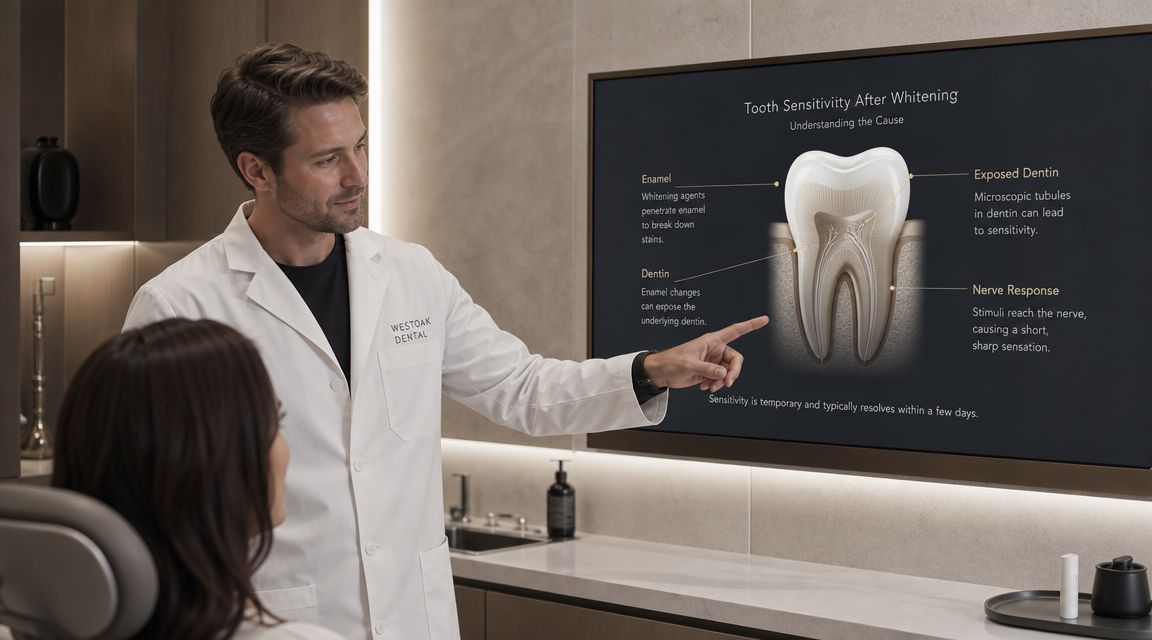
Tooth sensitivity during whitening usually happens because whitening ingredients move through the outer tooth surface and temporarily irritate the inner part of the tooth. If your enamel is already worn down or your gums have receded, the teeth may react faster and more intensely.
Two kinds of sensitivity matter
One kind is pre-existing sensitivity. That can come from exposed root surfaces, a cavity, grinding, a crack, or irritated gums.
The other kind is whitening-related sensitivity. That's the temporary discomfort some people feel after peroxide-based whitening products.
Those two can overlap. If someone already has sensitive teeth, even a mild whitening system may feel stronger than expected. That's one reason professionally guided treatment tends to be a safer choice for nervous patients.
Clinical evidence strongly supports that approach. A review in PMC reported a randomized clinical trial where an in-office product with 35% hydrogen peroxide caused tooth sensitivity in 100% of cases, while supervised home bleaching caused less sensitivity, as summarized in this clinical review of whitening safety and sensitivity.
Why stronger isn't always better
Fast whitening sounds appealing, especially if you have an event coming up. But aggressive treatment often creates the exact problem sensitive patients want to avoid. For many people, the better plan is gradual shade improvement with lower intensity and better supervision.
A helpful outside resource for patients who want to think more broadly about oral conditions before cosmetic treatment is this oral health masterclass. It's useful because it reinforces a bigger point. Symptoms in the mouth should be understood, not ignored.
Here's a quick visual overview that helps explain why sensitive teeth react differently during whitening:
When sensitivity is a warning sign
If the pain is sharp, localized, or lingers in one spot, whitening may not be the first step. A targeted exam may be needed to rule out:
- Decay
- Gum recession
- Cracks or worn enamel
- Old dental work that isn't sealing well
That's one reason a new patient exam can be more valuable than another whitening kit. If you're searching for a dentist near me because your teeth are both stained and sensitive, getting answers first can save time, money, and discomfort.
Comparing Your Whitening Options for Sensitive Teeth
If you have sensitive teeth, comparing products involves more than just price or speed. It's comfort, control, and risk. Here's a quick look at the main options.
| Whitening option | Comfort for sensitive teeth | Control | Typical role |
|---|---|---|---|
| Professional in-office whitening | Mixed. Can be managed carefully, but stronger approaches may trigger sensitivity | Highest | Fast results when carefully customized |
| Custom take-home trays | Usually better tolerated when kept low-dose and gradual | High | Best balance for many sensitive patients |
| Over-the-counter strips | Moderate. Convenient, but fit and irritation can be inconsistent | Limited | Mild to moderate whitening at home |
| Whitening toothpaste | Gentlest | Low | Surface stain maintenance, not deep whitening |
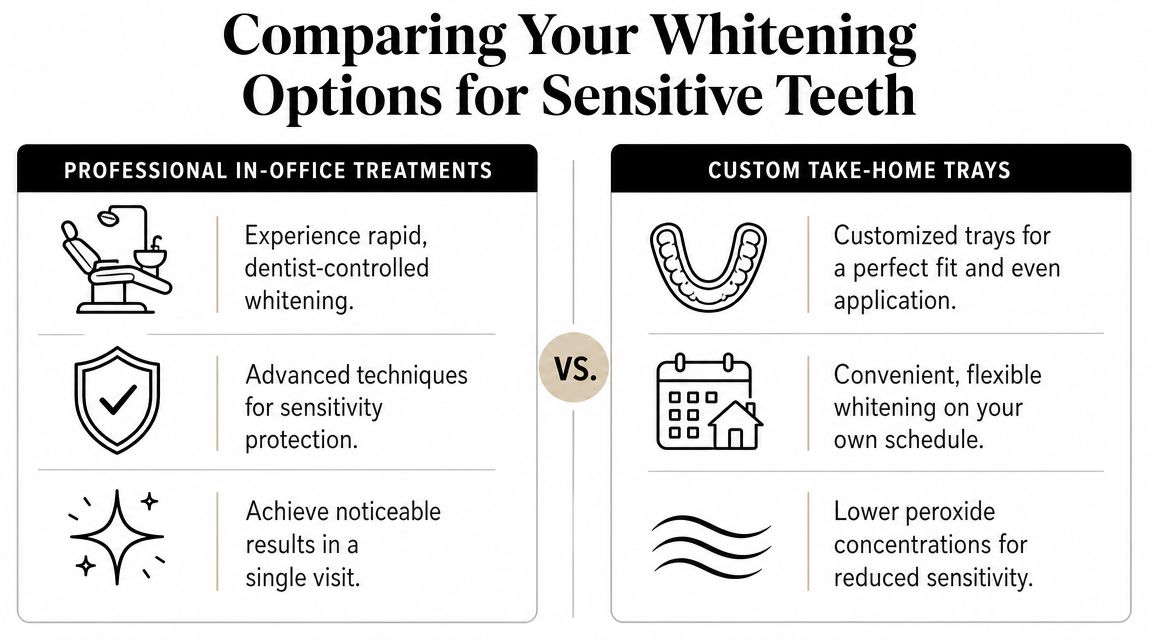
The best whitening option for sensitive teeth usually isn't the most aggressive one. It's the one you can tolerate well enough to finish safely.
Whitening toothpaste
Whitening toothpaste is usually the safest entry point. It works slowly and mainly helps with surface stain. For someone who wants subtle improvement with minimal risk, it's a reasonable place to start.
Its downside is speed. If stains are deeper, toothpaste alone often won't deliver the kind of visible change people expect from cosmetic dentistry.
Whitening strips
Strips sit in the middle. They can produce noticeable whitening, but they still commonly rely on peroxide and can irritate sensitive teeth and gums if the fit isn't ideal.
That's why strips often work better for people with mild sensitivity than for those who already avoid cold drinks. If you're considering at-home approaches, this guide to gentle home whitening methods is a useful companion to help you think through enamel-friendly habits.
Custom take-home trays
For many sensitive patients, this is the most practical middle ground. The tray fits the actual teeth, which helps control gel placement and reduce gum contact. It also allows the treatment to move at a pace your teeth can tolerate.
Many people discover the best teeth whitening for sensitive teeth in real life. It's not instant. It's not harsh. It offers steady improvement with fewer surprises.
If you want a closer look at home-based options from a dental perspective, Winn Smiles also shares guidance on best at-home teeth whitening.
Professional in-office whitening
Professional whitening offers the most control. A dentist can isolate the gums, adjust the strength, and add desensitizing support. According to Spring Haven Dental's overview of teeth whitening for sensitive teeth, the trade-off is clear: whitening toothpaste is safest but slowest, strips give moderate results but can still cause sensitivity, and professionally supervised whitening provides the best control because concentration, tissue protection, and desensitizers can be customized.
For someone who wants noticeable whitening without guessing, this is often the safest route. The key is not assuming every in-office treatment should be aggressive. Sensitive patients usually benefit from a customized approach, not the strongest formula on the shelf.
The Winn Smiles Protocol for Gentle Whitening
The most reliable way to whiten sensitive teeth is to treat whitening like a clinical process, not a product purchase. A comfort-focused protocol starts with diagnosis, then builds the whitening plan around what your teeth can handle.
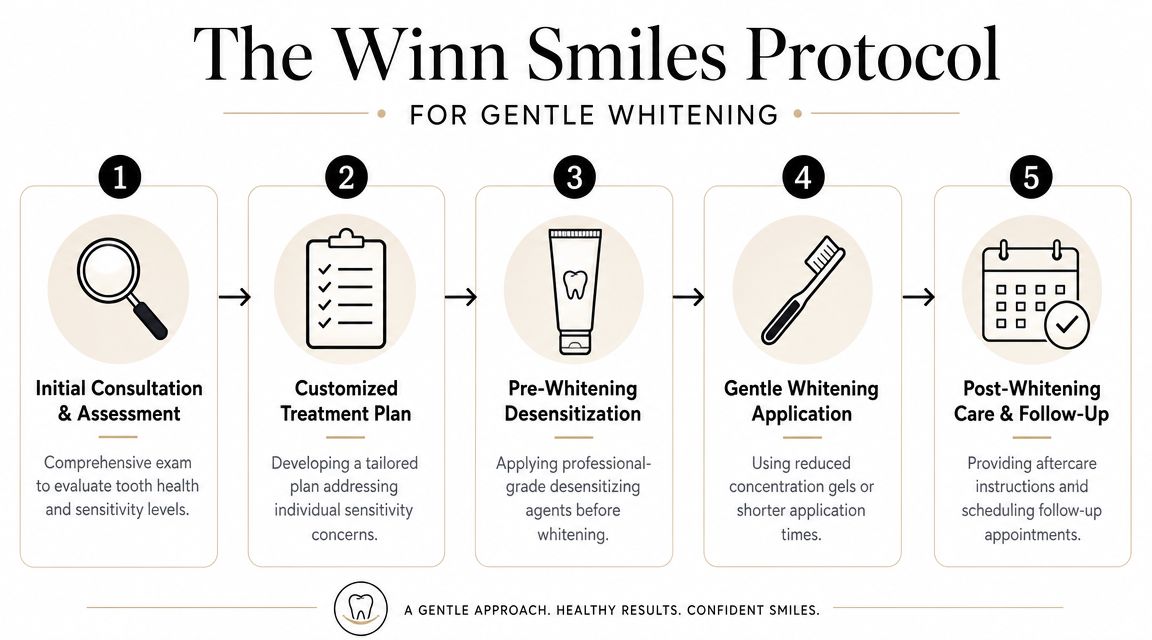
Step one is an exam, not a whitening syringe
If a patient has recession, decay, or a cracked edge, whitening gets postponed. That's not a setback. That's good diagnosis.
For many people, this first visit also overlaps with routine dental care. A cleaning, updated x-rays, and a close look at areas that are reacting to cold can reveal why whitening felt risky in the first place.
The plan should match the patient
A patient with mild surface stain and occasional sensitivity doesn't need the same protocol as someone with exposed root surfaces and a history of painful reactions. The treatment can be adjusted in several ways:
- Lower concentration first so the teeth can respond gradually
- Shorter wear times to reduce irritation
- Custom application that limits gel on the gums
- Desensitizing support before and after whitening
Guidance for sensitivity-prone patients consistently favors lower peroxide and shorter exposure. GoodRx notes that a sensible starting point can be 10% carbamide peroxide or 3% hydrogen peroxide for sensitive users in its review of whether teeth whitening is safe.
Comfort depends on adjustment, not stubbornness
One of the biggest mistakes patients make with store-bought products is assuming they should keep going through discomfort. They wear the strips longer, apply more gel, or use the product on consecutive days even after the teeth start reacting.
A professional protocol should do the opposite. Guidance from a practitioner video on whitening sensitivity emphasizes that patients can skip days, reduce frequency, and stop when sensitivity appears rather than pushing through discomfort, as explained in this discussion of how to adjust whitening when it starts to hurt.
Clinical takeaway: If whitening causes discomfort, the plan should change. The patient shouldn't force it.
That flexibility matters for people who are also managing broader dental needs. Some patients who come in for cosmetic concerns also ask about restorative dentistry, old fillings, a cracked tooth, or even an emergency dentist appointment because something suddenly became painful. Whitening works best when the mouth is stable first.
Used this way, whitening becomes much more predictable. It stops being a gamble and starts being part of a personalized dental care plan.
Which Whitening Method Is Right For You
The right whitening method depends less on trends and more on your pattern of sensitivity, your timeline, and your goals.
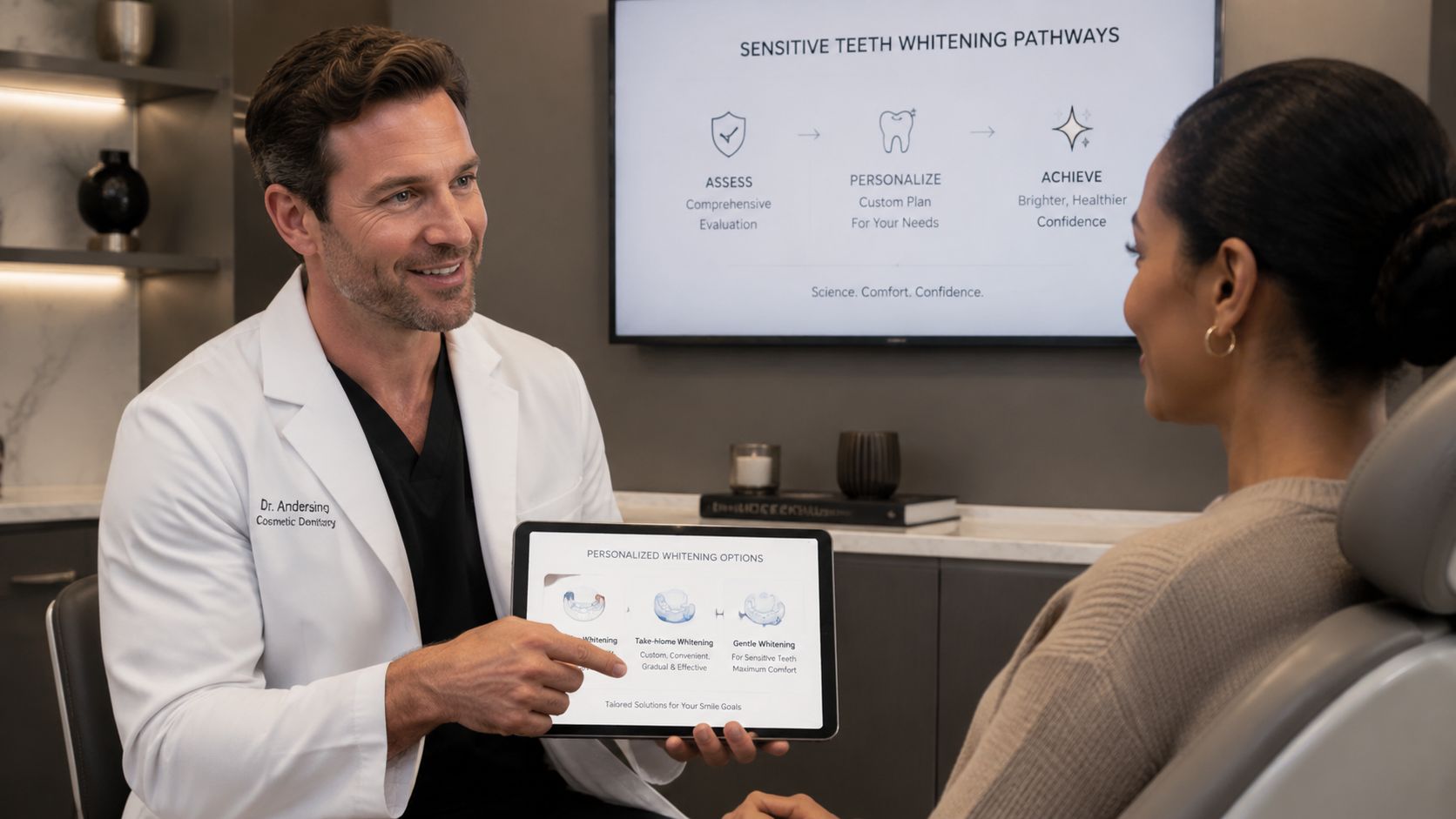
If you want gradual change with the least stress
This patient usually says, “I don't need movie-star white. I just want my teeth to look cleaner and brighter.” A low-intensity, take-home approach often fits well here.
Expert guidance for sensitive teeth points toward low-peroxide products around 5% to 10% and short daily wear times as the best-tolerated way to get visible improvement without triggering significant pain, according to this review of best whitening options for sensitive teeth.
If you need faster results for an event
For a wedding, graduation, interview, or photos, professional whitening may make the most sense, but only if the teeth are first cleared for treatment. The appeal is control. The dentist can manage exposure and comfort more precisely than a generic kit can.
This path is often a good fit for someone searching for a cosmetic dentist near me who wants results on a deadline but doesn't want to guess wrong with an over-the-counter system.
If your teeth are very reactive already
If cold drinks, sweets, or brushing already hurt, don't start with strips. Start with diagnosis.
You may still be a whitening candidate later, but only after the cause of the sensitivity is understood. Sometimes the best next step is preventive or restorative care, not cosmetic treatment that same day.
A healthy mouth can often be whitened gently. An untreated problem usually needs attention before whitening starts.
If you mainly have surface stain
Whitening toothpaste can be a sensible maintenance option. It's slower, but it's simple and easier to tolerate. It can also be useful after professional whitening to help maintain brightness without repeating a stronger treatment too soon.
For many adults in Chattanooga and Cleveland, the most practical answer is this: if you're unsure which category you fit into, schedule an exam first. That removes the guesswork.
Schedule Your Whitening Consultation in Cleveland or Chattanooga
A whiter smile is still possible, even if your teeth are sensitive. The key is choosing a plan that respects comfort, protects your enamel and gums, and starts with the right diagnosis.
That's especially important if you've been bouncing between cosmetic concerns and other dental needs. Some patients come in wanting whitening and also need a cleaning. Others need a cavity treated first. Some are comparing whitening to veneers, asking about dental implants near me, or trying to find a long-term dentist in Chattanooga, TN for both cosmetic and restorative dentistry. A good consultation helps sort those decisions out clearly.
What to expect at your visit
A whitening consultation should feel straightforward, not rushed. Expect a close look at your teeth and gums, a conversation about what triggers your sensitivity, and guidance on whether whitening is appropriate now or should wait until another issue is treated.
That same visit may also help if you've been putting off other care, including a tooth extraction concern, an emergency dentist visit, or overdue cleaning and exams. Cosmetic treatment works better when the foundation is healthy.
A local option for next steps
If you're exploring professional whitening care in this area, Winn Smiles offers information about teeth whitening in Chattanooga. For patients in Chattanooga and Cleveland, having two convenient locations can make it easier to move from questions to an actual treatment plan.
The right next step is simple. Stop guessing which box on the store shelf is safest for your teeth. Let a dentist determine why your teeth are sensitive, what level of whitening they can tolerate, and how to get visible results without unnecessary pain.
If you're ready to find out whether whitening is a safe option for your sensitive teeth, schedule a consultation with Winn Smiles. A careful exam can identify the cause of your sensitivity, outline the gentlest path to a brighter smile, and help you plan any related care you may need in Chattanooga or Cleveland.