You're probably here because you saw a teeth cleaning special while searching for a dentist near me in Chattanooga, TN or dentist in Cleveland, TN, and your reaction was mixed. Part of you thought, “That seems helpful.” Another part thought, “What's the catch?”
That's a smart question.
A lot of adults put off routine dental care for practical reasons. Life gets busy. Insurance can be confusing. Sometimes people just don't know whether a low advertised offer is a real opportunity or the start of a hard sell. If you've been comparing practices for cleaning and exams, dental x-rays, or a new patient exam, you're not overthinking it. You're trying to make a careful decision.
A good teeth cleaning special should make dental care easier to start. It shouldn't leave you guessing about what's included, whether you qualify, or what happens if the dentist finds gum disease, a cavity, or something that needs more attention. Patients deserve plain answers before they book.
That's the lens for this guide. I want to help you read these offers like an informed patient, not just a shopper looking at a price tag.
Is That Teeth Cleaning Special a Good Deal?
A patient sees an ad on their phone during lunch. The offer sounds simple. New patient cleaning special. Low cost. Book today. For a moment, it feels like an easy win.
Then the questions start.
Does this include the exam? Are X-rays extra? Is this only for people with perfectly healthy gums? If I haven't been to the dentist in a while, will I show up and be told I need something completely different?
Those concerns are common, especially for adults who are trying to get back on track with preventive care. They don't want to waste time, feel embarrassed, or walk into a situation where the advertised special turns into a confusing conversation.
A good dental offer should lower stress, not add mystery.
The most useful way to judge a teeth cleaning special is to stop looking at it as a coupon and start looking at it as a first appointment package. Price matters, of course. But price alone doesn't tell you whether the visit will meet your needs.
What makes a special feel fair
A fair offer usually answers the questions patients ask before they ever sit in the chair:
- Who it's for. New patients, uninsured patients, or people due for a routine cleaning.
- What's included. Common items are an exam, X-rays, and a routine cleaning.
- What happens if your needs are different. If signs of gum disease are present, a routine prophylaxis may not be the right treatment.
Why people get confused
Dental ads often use the same word, “cleaning,” to describe very different situations. A healthy patient needing routine maintenance is not in the same category as someone with active periodontal disease who needs more involved treatment. If a page doesn't explain that difference, it can feel like bait-and-switch even when the office is trying to follow proper clinical standards.
That's why the best approach is clarity first. If a practice explains the offer in plain language, that's usually a good sign.
Understanding the Purpose of a New Patient Special
A teeth cleaning special is usually an introductory offer created for people who haven't been to that office before. The practice isn't trying to replace long-term care with a one-time deal. It's trying to make the first step easier.
That matters because many adults delay preventive visits. The CDC reported that dental-care use among adults ages 18 to 64 dropped from 65.5% in 2019 to 62.7% in 2020 in the United States, based on CDC dental care use data. When fewer adults come in for routine care, practices often create accessible introductory offers to help people return.

Why practices offer them
From the patient side, a special reduces the hesitation of booking with an unfamiliar office. From the practice side, it creates a low-friction way to welcome new people into the practice.
That doesn't make it suspicious. In many cases, it's how a dental office introduces its care experience to the community.
What the visit is trying to accomplish
A new patient special usually serves three practical purposes:
Start the relationship
You get to meet the team, see how the office communicates, and decide whether you feel comfortable there.Establish a baseline
The dentist gathers information about your current oral health through an exam and often X-rays.Handle routine preventive care if appropriate
If your gums and teeth fit the criteria for a regular prophylaxis, the office can often complete that cleaning during the visit.
Practical rule: A new patient special is an entry point, not a substitute for ongoing preventive dentistry.
Why that distinction helps patients
Many people in Chattanooga and Cleveland get tripped up. They think the offer is supposed to solve every dental issue in one visit. Usually, that's not the role of the special. Its role is to get you evaluated, complete routine care when appropriate, and identify what comes next.
That could be as simple as scheduling your next recall. It could also mean planning treatment for a filling, discussing cosmetic dentistry, reviewing options for tooth extraction, or talking about dental implants near me if missing teeth are part of the picture. The value is in starting with a clear, informed assessment.
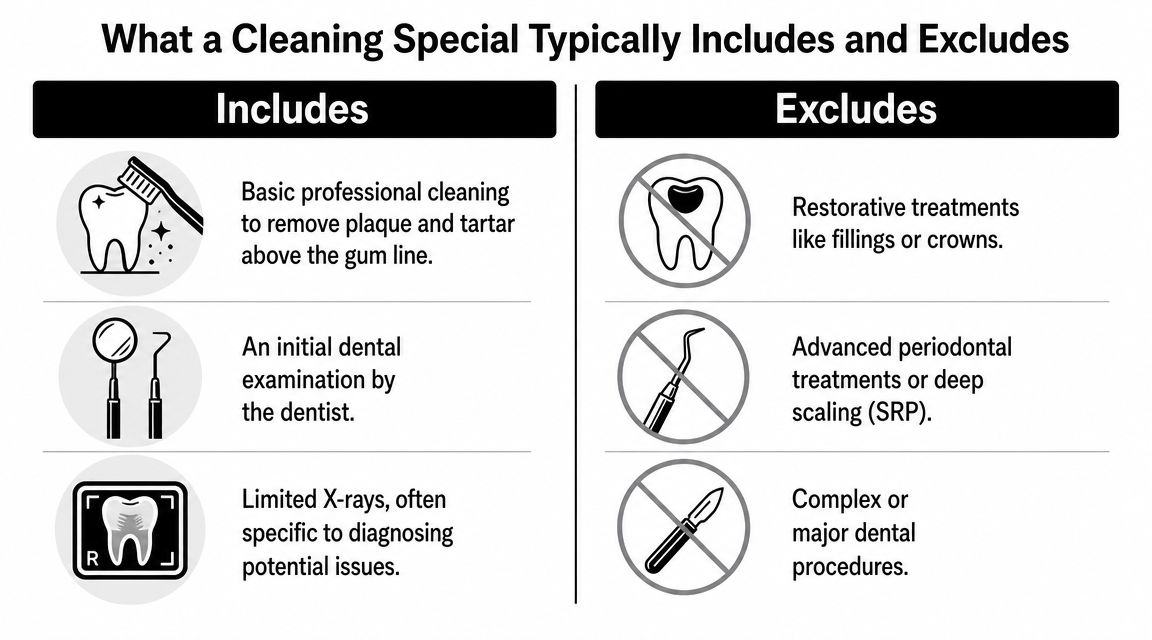
What a Cleaning Special Typically Includes and Excludes
This is the part patients most want spelled out before booking. A proper teeth cleaning special should tell you both what's in the offer and what isn't.
What's usually included
For many dental practices, a new patient cleaning offer commonly includes:
A dental exam
The dentist checks for signs of decay, gum concerns, bite issues, worn restorations, and other findings.X-rays
These help reveal problems you can't see by looking in the mirror.A routine professional cleaning
Standard cleanings generally involve scaling and polishing. If you'd like a plain-language walkthrough, this overview of what happens during teeth cleaning is a helpful reference.
What's usually excluded
Most specials do not include treatment beyond that first preventive visit. Common exclusions are:
- Periodontal therapy
A routine special is for prophylaxis, not deep gum treatment. - Restorative work
Fillings, crowns, and other repairs are separate. - Cosmetic treatment
Teeth whitening and veneers usually aren't part of a cleaning offer. - Complex procedures
Things like surgery, implant placement, or emergency treatment are outside the scope.
The key clinical distinction
A major source of confusion is the difference between a routine cleaning and periodontal treatment. A standard special is for a routine cleaning, or prophylaxis, not gum therapy. Research on interdental cleaning also supports a practical point many patients don't realize: toothbrushing alone does not clean between teeth effectively, and when gum disease is present, more involved care such as scaling and root planing may be needed, as discussed in this review of interdental cleaning and periodontal care.
If you've been trying to stay on top of buildup between visits, it can also help to understand the limits of home care. This guide to professional-grade at-home tartar management explains where home habits may help and where professional treatment is still necessary.
If an office finds gum disease, changing the treatment plan isn't a trick. It may be the clinically correct next step.
The important part is whether they explain that clearly and respectfully.
How Specials Differ From Regular Preventive Care
A teeth cleaning special is a starting point. Regular preventive care is an ongoing system.
That difference is more significant than commonly realized. A one-time offer can introduce you to a practice. It can't replace a care relationship built around your history, your risk factors, and the changes your dentist tracks over time.
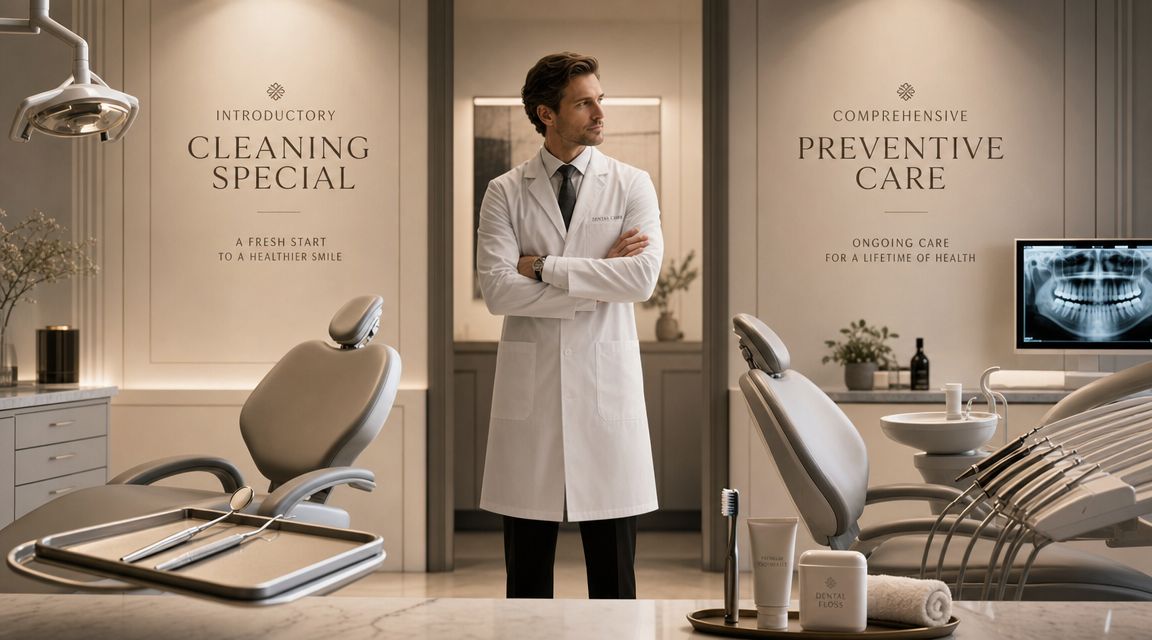
A special is a first step
Think of the special as the first visit that helps answer basic questions:
- What's going on with your teeth and gums right now?
- Are you due for a routine cleaning, or do you need a different kind of care?
- Do you feel comfortable with this office and team?
Those are important questions. But they're only the beginning.
Preventive care is the long game
The long-standing benchmark for preventive dentistry is a professional cleaning every six months, according to Cleveland Clinic guidance on dental checkups. Those visits matter because they remove plaque and tartar that brushing misses and support early detection before small issues become larger ones.
That's where a dental home becomes valuable. Over time, your care team learns whether you tend to build tartar quickly, whether your gums react easily, whether old fillings need monitoring, and whether you may benefit from added support such as fluoride or closer follow-up.
What ongoing care can include
Routine prevention often expands beyond “just a cleaning.” Depending on your needs, it may involve:
- Risk-based recall planning
Some patients do well with standard visits, while others need closer monitoring. - Home-care coaching
Many adults benefit from better techniques between teeth. These daily habits for healthy gums offer a useful at-home complement to in-office care. - Longer-term planning
The dentist can track changes and recommend timely care instead of waiting until discomfort appears.
For a deeper patient-friendly overview, this article on preventive dental care lays out how regular visits fit into long-term oral health.
A good special should lead into that kind of relationship. If it doesn't, you may save money on the first visit and lose value later.
Choosing a Trustworthy Dental Offer in Chattanooga
If you're comparing a dentist in Chattanooga, TN, a dentist in Cleveland, TN, or even looking for a cosmetic dentist near me who also handles routine care, don't focus only on the headline price. Focus on how the office behaves before you book.
That's often where trust shows up first.
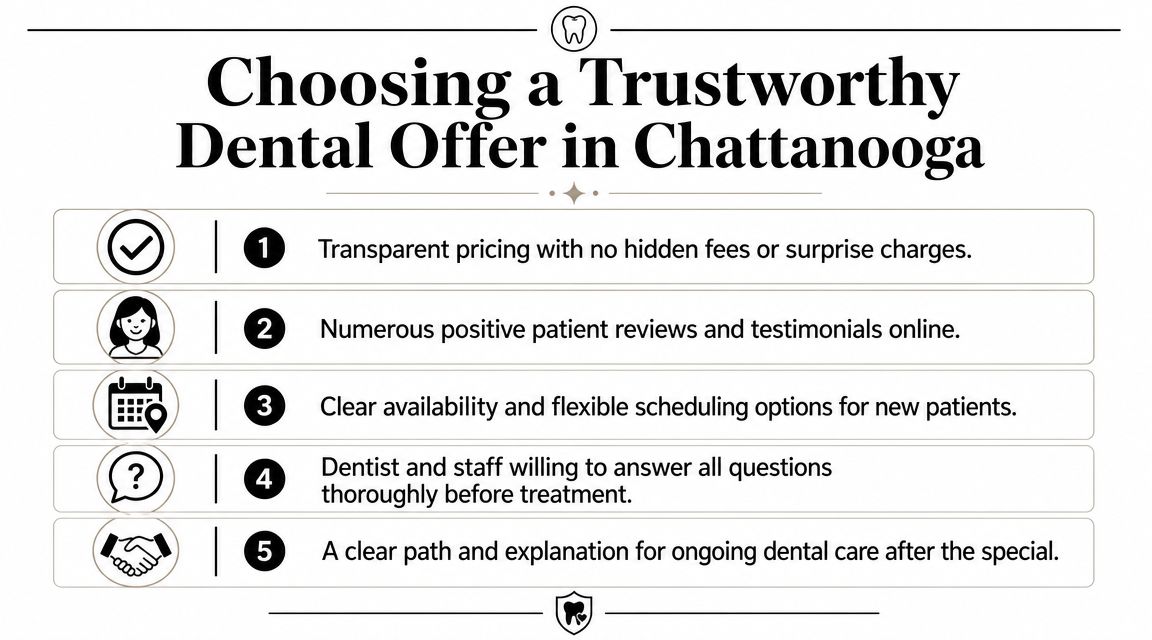
Green flags to look for
A trustworthy offer usually comes with details, not vagueness.
Clear wording online
The page should say who the offer is for and what services are part of it.Straight answers on the phone
If you ask whether the cleaning is routine only, the team should answer plainly.No discomfort around questions
You should be able to ask about X-rays, deep cleaning, insurance, or second opinions without feeling rushed.A path beyond the special
The office should be able to explain what happens if your exam finds gum disease, decay, or restorative needs.
Red flags worth noticing
Some signs suggest caution:
| Concern | Why it matters |
|---|---|
| Vague wording | You may not know what you're actually booking |
| Pressure to commit immediately | Good practices educate first |
| No explanation of exclusions | Patients get surprised when treatment changes |
| Defensive answers | Transparency should be normal, not difficult |
If a practice can't explain a simple offer clearly, that usually won't improve once treatment discussions begin.
Questions you can ask before you schedule
These are reasonable questions, and a good office won't mind them:
- If my gums aren't healthy enough for a routine cleaning, what happens next?
- Are X-rays included, and what kind of exam is part of the visit?
- Will you review findings with me before doing anything beyond the special?
- Can I come in if I also want a second opinion on other dental work?
In this area, some patients also want one office that can handle more than basic prevention. That might include emergency dentist needs, restorative work, same-day crowns, or future implant planning. One option in the Chattanooga and Cleveland area is Winn Smiles, which offers general, cosmetic, restorative, periodontal, and implant-related services along with free consultations and second opinions for select services. That kind of breadth can be useful if your first visit uncovers needs beyond a routine cleaning.
Your First Visit for a Cleaning at Winn Smiles
The first visit tends to go better when you know what to expect. For many patients, the primary stress isn't the cleaning itself. It's the uncertainty.

When you arrive for a new patient appointment, the experience should feel welcoming and organized. You'll check in, review health information, and have time to mention concerns such as sensitivity, bleeding gums, a broken tooth, or anxiety about treatment. That matters whether you came in for preventive care or originally searched for things like emergency dentist, tooth extraction, or dental implants near me and realized you also needed an exam.
What happens in the chair
A professional cleaning typically involves scaling to remove hardened tartar and polishing to smooth tooth surfaces. A typical appointment often lasts 30 to 60 minutes, based on this patient overview of professional teeth cleaning. During a well-run visit, the team keeps you informed instead of leaving you to guess what each step means.
That communication makes a difference. If you're nervous, a comfort-focused office should explain each stage before starting and pause when needed.
A quick visual can help if you want to see the environment and approach patients often ask about:
What happens after the exam
Once the exam and cleaning are complete, the findings should be reviewed in plain language. If your mouth looks healthy for routine prevention, the next step may be simple follow-up. If the dentist spots decay, gum concerns, worn dental work, or signs that point toward restorative or cosmetic care, you should get a clear explanation and a chance to ask questions.
For patients who feel uneasy in dental settings, details like a calm office, comfort options, and sedation availability can matter just as much as the clinical skill. The right appointment doesn't just clean teeth. It helps you feel safe enough to come back.
Frequently Asked Questions About Dental Specials
What if my exam shows I need a deep cleaning instead of a basic one?
Then the office should pause and explain the finding clearly. A routine teeth cleaning special is generally for a prophylaxis, not periodontal therapy. If signs of gum disease are present, the correct treatment may be different from the advertised routine cleaning. The key issue is communication. You should understand why the recommendation changed before anything moves forward.
Can I still use a special if I have dental insurance?
Sometimes yes, sometimes no. It depends on the office and the structure of your plan. In many cases, the team will help you compare whether using insurance benefits or using the special makes more sense. Ask that question before the appointment so you know how the billing will work.
What is a typical price range for a teeth cleaning special?
Prices vary by practice, location, and what the offer includes. Since offers differ, the better question is not “What's the lowest number?” but “What exactly am I paying for?” A lower-priced offer that excludes the exam or X-rays may be less useful than a more complete package.
Is a cleaning special a good option if I haven't been to the dentist in a long time?
Often, yes. It can be a practical way to restart care. Just be open to the possibility that the dentist may find needs beyond routine prevention. That doesn't mean the visit failed. It means you finally got clear information.
Can I use a new patient special if I want a second opinion?
Yes, in many cases. If you've been told elsewhere that you need extensive work, a new patient exam can be a reasonable time to review your situation. Tell the office that upfront so they understand your goal for the visit.
Will a teeth cleaning special help if I'm also interested in cosmetic dentistry?
It can. A cleaning and exam often serve as the first step before treatment such as whitening, veneers, or Invisalign. Healthy gums and a clear diagnosis matter before cosmetic decisions are made.
What should I ask when I call?
Keep it simple:
- What does the special include?
- Is it for routine cleaning only?
- What happens if I need periodontal treatment instead?
- Will the dentist review everything before extra treatment is recommended?
- Do you see patients from Chattanooga and Cleveland for ongoing care too?
If you're looking for a transparent, patient-first dental visit in Chattanooga or Cleveland, Winn Smiles is a practical place to start. You can reach out to ask questions, schedule a new patient appointment, or request a consultation if you want help sorting out whether a teeth cleaning special fits your needs.