

You catch yourself covering a chipped, dark, or uneven front tooth in a photo, then you start counting appointments before you look up a cosmetic dentist near me. If you live in Chattanooga or Cleveland, that pause is useful. A smile change on a front tooth is not a single glue-on visit, and it is not a same-day promise that the tooth will look the same forever.
A dental veneers procedure is a tooth-by-tooth plan for enamel, shade, and the years after bonding. You can still compare whitening, bonding, alignment, or a stronger restoration before anyone touches enamel. Families looking for a dentist in Chattanooga, TN, or a dentist near me in Cleveland, TN, usually want that sequence in plain language first.
Dental Veneers Procedure Visit by Visit
Say your front tooth shows in every work photo. You want the visit count before you book. Most porcelain cases follow a consult, a preparation visit with temporaries, about one to two weeks of lab time, a bonding visit, and a short review. That path usually spans roughly two to three weeks. Same-day milled ceramic can fold fabrication into one day when the tooth, the bite, and the shade already fit.
The American Dental Association describes dental veneers as thin coverings on the front surfaces of teeth. The dentist prepares the tooth by removing a small amount of enamel from the front and sides before bonding the veneer. Because that enamel is removed, conventional treatment is generally irreversible. An exam and an individualized plan come before a yes. Winn Smiles maps this path for patients in Cleveland and Chattanooga.
| Appointment | What happens | Usual timing | Can you still change course |
|---|---|---|---|
| Consult and evaluation | Gums, decay, bite, photos, and shade goals | About 60 to 90 minutes | Yes, no enamel removed yet |
| Mock-up and treatment plan | Wax-up or digital preview of length and speech | Same visit or a short follow-up | Yes |
| Tooth preparation | Limited enamel removal, scan or impression, temporaries | About 1 to 2 hours | No, removed enamel does not grow back |
| Fabrication | Lab porcelain or in-office milled ceramic | About 1 to 2 weeks, or the same day | Color is confirmed again at try-in |
| Bonding visit | Isolation, adhesive cement, and bite adjustment | About 1 to 2 hours | Veneers are fixed in place |
| Short review | Margins, bite, and sensitivity check | About 1 to 2 weeks later | Repairs are discussed only if something is off |
What each visit is for
The consult checks gums, decay, bite, and grinding. Photos and dental x-rays are taken when they change the plan. Shade is set only after any teeth whitening, because porcelain will not lighten later.
A mock-up tests length and speech before enamel is touched. Preparation then removes a thin layer from the front and sides. A scan or impression follows, and temporaries copy the approved shape.
Fabrication happens in a dental lab or on an in-office mill. Bonding fixes the veneer. The review catches a high bite while the tooth is still easy to adjust. If pain, swelling, or a broken tooth shows up before that sequence starts, emergency dentist care comes first so the cosmetic plan is not built on an unstable tooth.
Practical rule: If you can still change your mind, you are still before preparation. After enamel is cut, that spot needs a restoration for life.
How Much Enamel the Plan Should Keep
Patients rarely get a straight answer on how much tooth comes off, or whether a no-prep veneer is safer. The bonding surface decides more than the label on the appointment.
A 2024 systematic review found approximately 99% survival and success for ceramic veneers bonded primarily to enamel, compared with about 91% survival and 74% success when severe dentin exposure was present. Dentin exposure also increased clinical interventions and failures. Enamel holds the bond. Dentin is a weaker, wetter surface, so the same shell has more repairs ahead.
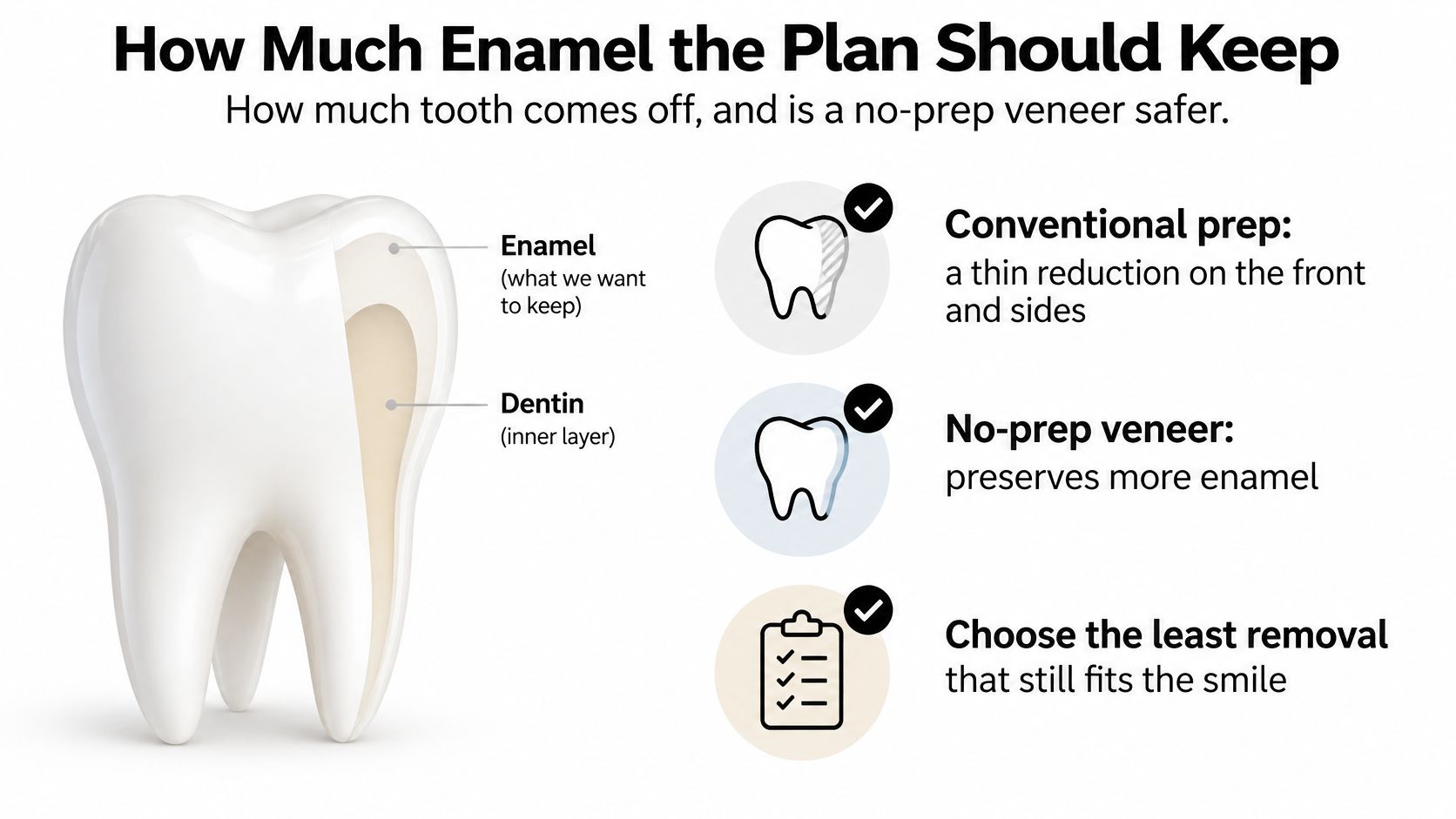
Conventional prep is a thin reduction on the front and sides. When the tooth is already near the desired shape, that cut is often well under a millimeter. Exact depth still follows position, darkness, and the new length. Minimally invasive is not the same as reversible or risk-free. Once enamel is gone, that spot needs a restoration for life.
Screening before a yes
A careful new patient exam looks past the photo.
- Untreated decay: A veneer will not seal an active cavity.
- Gum disease: Inflamed tissue makes margins hard to keep clean.
- Too little tooth: A short or heavily filled tooth may not hold a thin shell.
- Heavy grinding: Night clenching can chip an edge that looked fine at delivery.
- Large existing fillings: The remaining enamel may be too patchy for a reliable bond.
No-prep shells can stay bulky and trap plaque if the tooth already sticks out. Dark teeth and crowded teeth are the edge cases. Masking a deep stain, or lining up a twist, can force more reduction. Whitening, clear-aligner movement, bonding, or a crown on a badly broken tooth may protect more enamel. A tooth that is missing entirely is a dental implants conversation, not a veneer conversation.
In Cleveland or Chattanooga, ask three questions before prep day. How much enamel should remain on each tooth? Can I see photos or a mock-up first? What happens if I wait? Those answers tell you whether the plan is enamel-sparing.
Porcelain or Composite for This Smile
Material is a planning choice, not a single winner for every mouth. A 10-year practice-based evaluation published in 2022 analyzed 1,459 veneer restorations in 341 patients. Of those, 1,043 (71.5%) were direct composite veneers and 416 (28.5%) were ceramic.
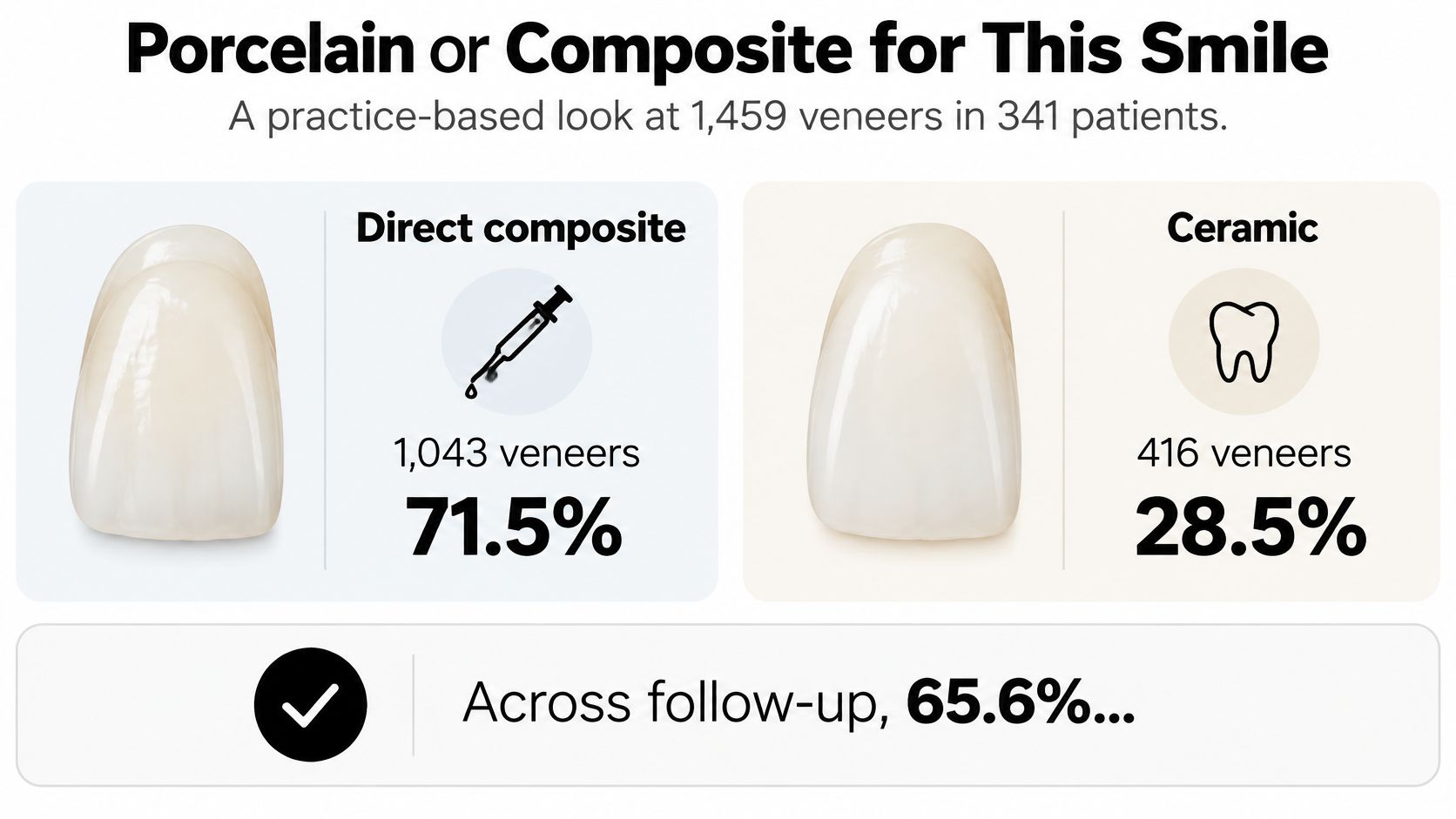
Across follow-up, 957 restorations (65.6%) stayed successful with no repair, 252 (17.3%) were repaired and kept, and 250 (17.1%) failed and needed replacement. Composite carried higher risk, with hazard ratios of 4.00 for survival and 5.16 for success compared with ceramic.
| Material | Share of 1,459 veneers | Annual failure for survival at 10 years | Annual failure for success at 10 years | What that means in the chair |
|---|---|---|---|---|
| Ceramic veneers | 416 (28.5%) | 1.2% | 2.8% | Better long-term record; a chip more often needs a careful repair or a new veneer |
| Direct composite veneers | 1,043 (71.5%) | 4.1% | 10% | Easier to patch the same day; higher chance of stain, repair, or replacement |
How to read the yearly rates
Survival asks only whether the veneer is still there. At 10 years, estimated annual failure on that measure was 4.1% for direct composite and 1.2% for ceramic. Success is stricter. It means the veneer stayed in place without repair. On that measure, annual failure was about 10% for composite and 2.8% for ceramic. The five-year pattern pointed the same way, at 3.9% versus 1.4% for survival and 9.1% versus 2.9% for success.
Ceramic usually means a lab or milled shell, a higher fee, and a stronger record against stain and repeat failure. Composite can be placed more directly, costs less up front, and is easier to patch in the chair. That suits a small chip or a trial of shape. A side-by-side look at composite veneers versus porcelain helps when you are weighing repair against longevity.
Neither material whitens later, and both need a stable bite.
A very dark tooth may need a more opaque ceramic and slightly more thickness. That is a prep decision, not a reason to treat every veneer as the same product. Ask which material is planned on each tooth, and what repair looks like if an edge chips. A small composite patch can often happen the same day. A ceramic chip more often means a careful repair or a new veneer.
From Records and Prep to the Bond
A predictable porcelain path is a numbered sequence you can follow, not a mystery between the chair and the lab. One long-term clinical review reported a 99.3% success rate when veneers were bonded exclusively to enamel, while failure increased significantly once dentin exposure exceeded 30%. Bonding to 100% enamel is the most reliable approach, and enamel should still be preserved when some dentin exposure can't be avoided.
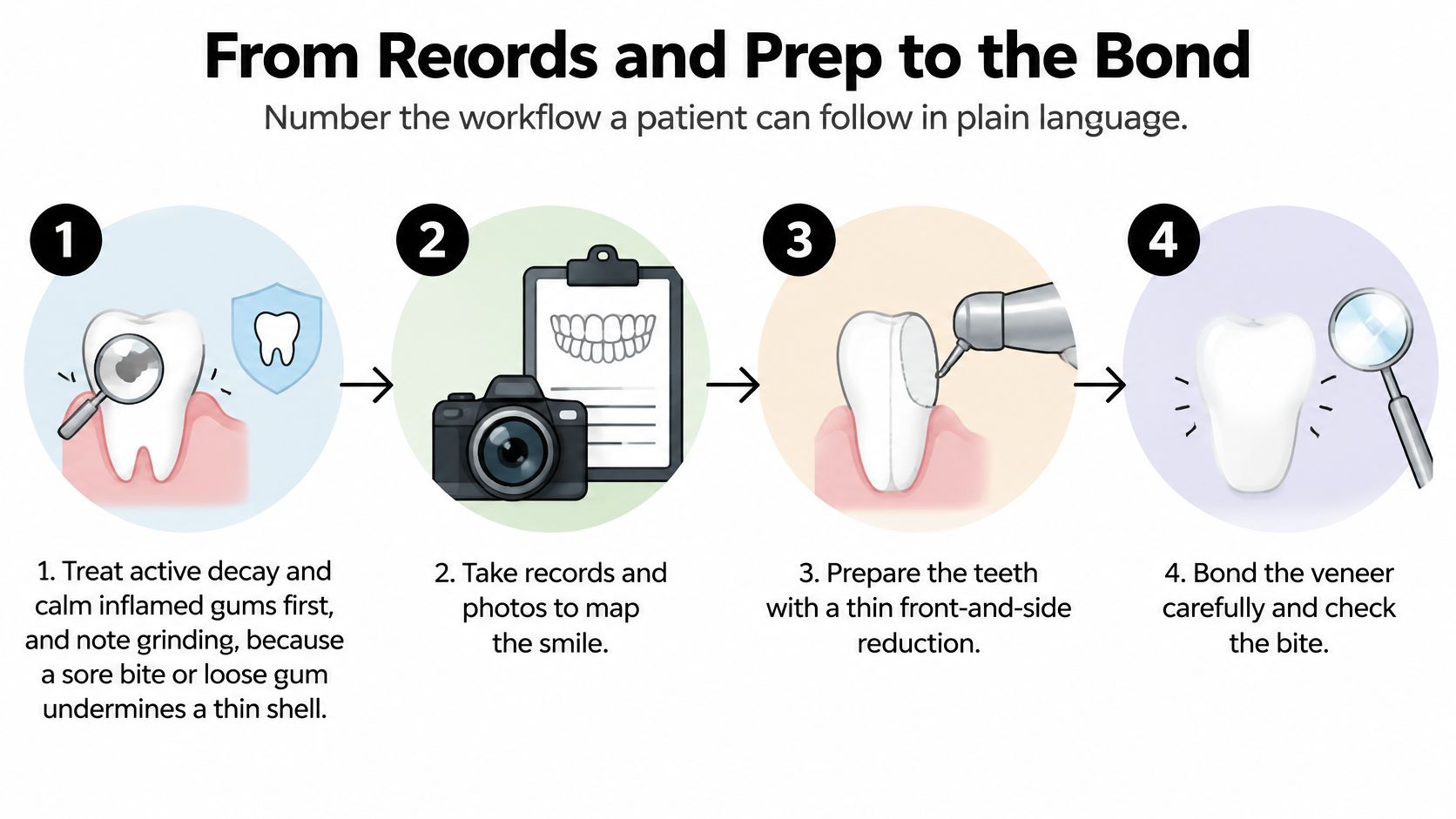
Eight steps you can track
- Treat disease first. Active decay is filled and inflamed gums are calmed. Grinding is noted, because a sore bite or loose gum undermines a thin shell. Skipping this step is the slip that shows up later as a stained edge.
- Take records. Photos compare shade with skin and neighboring teeth. A wax-up or digital design sets length before anyone commits. Don't lock shade on a tooth you still plan to whiten.
- Try the mock-up. Lip support and speech, including f and v sounds, are checked on a reversible preview. If the preview feels long when you talk, say so before preparation.
- Reduce with guides. Depth burs or a silicone index keep the cut controlled, mostly in enamel, with rounded inside corners. The edge sits at or slightly above the gum when looks and old fillings allow. Don't ask for extra grinding just to hide a small twist.
- Scan and place temporaries. The temporary copies the approved shape. It can pop off if you bite hard foods, so stick to softer meals until bonding.
- Fabricate the shell. Porcelain often goes to a lab for about one to two weeks. Ceramic can be milled the same day when the case is simple enough.
- Bond with a checked color. The veneer is tried in with a water-soluble paste so you approve the shade. The tooth is isolated, selectively etched, and primed. The ceramic is treated, and silane is added when the material needs it. Light-cured resin cement seats the veneer, excess is cleared, and the bite is refined.
- Polish and review home care. You leave knowing how to clean the edge and what a normal first week feels like.
Don't grind a tooth heavily just to hide a small rotation or a very dark shade. Whitening, clear-aligner movement, bonding, or a different restoration may fit better. Cleveland Clinic notes that some patients feel more sensitivity to hot or cold afterward, and a veneer can occasionally become loose. Those are warnings to report, not a sign that the plan failed on day one.
If a minor twist or a deep stain would force a deep cut, pause. Alignment, whitening, or another restoration may keep more of your own tooth.
Care That Keeps Veneers Looking Right
After a few years, a veneer may still be attached while its edge, shade, or fit no longer looks or feels right. A systematic review of porcelain laminate veneers estimated survival at 94.4% after 5 years, 93.5% after 10 years, 85.7% after 15 years, and 82.9% after 20 years. Evidence beyond 20 years remains limited. Another long-term review found that the share judged clinically acceptable fell from 92% at 5 years to 64% at 10 years, with fractures and marginal defects among the main problems.
| Years in place | Estimated survival still present | Share still clinically acceptable | What to plan |
|---|---|---|---|
| 5 years | 94.4% | 92% | Keep exams and clean carefully at the edges |
| 10 years | 93.5% | 64% | Expect more edge stain, small chips, or margin repairs even if veneers remain on |
| 15 years | 85.7% | Not reported in the review | Budget for selective replacement of worn or fractured units |
| 20 years | 82.9% | Not reported in the review | Treat reports past 20 years as limited, not a guarantee |
Survival means the veneer is still present and working. Clinical acceptability asks whether it still looks and functions well. A veneer can stay bonded while edge staining, marginal defects, fracture, or wear call for maintenance. Gum changes, a changed bite, and wear or color changes in neighboring teeth can also affect the result.
A separate review of porcelain laminate veneers estimated a 10-year cumulative survival rate of 95.5%. When each cause was counted alone, 10-year survival was 96.3% for fracture, 99.2% for debonding, 99.3% for secondary caries, and 99.0% for a later root-canal treatment. These figures describe veneers that remained clinically functional. They do not mean a veneer never chipped, stained at the edge, or needed maintenance.
Everyday lifespan and home care
Cleveland Clinic reports that veneers commonly last about five to 15 years, and porcelain veneers often last about 10 to 15 years with proper care. Longevity depends on hygiene, bite forces, grinding, diet, and whether a veneer chips or loosens. Short-term results for milled ceramic look favorable, but long follow-up is still thin. Same-day convenience does not establish how a veneer will perform over 20 years.
- Clean the edges: Brush and floss where the veneer meets the tooth so plaque does not collect at a bulky margin.
- Don't use them as tools: Ice, pens, and hard candy can chip an edge.
- Guard a diagnosed grind: A night guard protects ceramic when clenching is confirmed.
- Keep exams: Regular checks help catch margin changes, shade differences, gum changes, and hairline cracks.
- Call for pain or a loose edge: A loose veneer can sometimes be rebonded rather than replaced.
Neighboring untreated teeth can shift in color or wear, so the smile needs to be considered as a set. Plan for selective repair or replacement, not a permanent result. This guide to caring for veneers at home outlines a practical routine. Plaque at bulky edges, a high bite, and unprotected grinding can leave a veneer attached but no longer looking right.
Book a Veneer Consult in Cleveland or Chattanooga
You have the visit path. The next useful step is a consult that decides enamel, material, and maintenance before anyone prepares a tooth. Patients in Cleveland and Chattanooga use that visit to see whether a dental veneers procedure fits this smile, or whether another service protects more tooth.
The appointment covers gum health, decay, bite, and grinding, plus photos. Whitening is discussed before shade is chosen, because porcelain will not lighten later. Tooth position and darkness are reviewed so the plan can stay mostly in enamel. A mock-up of length and speech is shown before any enamel is removed.
Decisions made in that visit
Material is chosen tooth by tooth. Ceramic fits when stain resistance and a lower yearly failure rate matter. Composite fits when a small chip should be patched in the chair at a lower upfront cost.
Related care comes up only when it changes the veneer decision.
- Whitening first: It sets the shade of teeth that will stay uncovered.
- Aligner-style movement: It can straighten a twist that would otherwise force extra reduction.
- A crown: It is the stronger shell when a tooth is too broken for a thin facing.
- Dental implants near me: That search fits a missing tooth, not a chipped one that still has a root.
- Tooth extraction: It is discussed only if a tooth can't be restored and is changing the bite the veneers would have to live with.
You will also hear how temporaries behave, whether the case needs a one-to-two-week lab window or a same-day mill, and how maintenance or replacement is planned over time rather than promised as permanent. Cleaning and exams, including dental x-rays when they change the plan, stay part of that lifecycle. Hours serving Cleveland and Chattanooga are confirmed when you book, so the first visit fits your week.
Bring four questions. How much enamel is left on each tooth? Which material is planned? How do the temporaries behave? How is a chipped edge repaired? Those answers turn a cosmetic search into a plan you can live with.
Winn Smiles plans porcelain and composite veneers for adults in Cleveland and Chattanooga who want a tooth-by-tooth look at enamel, shade, and how long the smile stays looking right. A consult covers gums, bite, photos, and whether whitening, alignment, or another restoration fits better before any enamel is removed. Schedule that visit at Winn Smiles and bring your questions about material, temporaries, and repair.

