Buying the strongest whitening product isn't the best shortcut to a brighter smile. If you're searching for a cosmetic dentist near me in Chattanooga or Cleveland, TN, the more useful question is which treatment fits your stains, sensitivity, existing dental work, and budget. Comparing teeth whitening methods before you buy can help you avoid discomfort, uneven color, and money spent on products that can't address the problem.
Why Whitening Results Differ From Person to Person
The strongest product doesn't automatically produce the best result. A dental review explains that whitening performance involves more than peroxide concentration, and some lower-concentration professional formulations can achieve results comparable to stronger products, with potential advantages for comfort (review of tooth-whitening treatments).
The starting shade matters, but so do the type of discoloration, how long the whitening agent contacts the teeth, and how the teeth respond. Hydrogen peroxide performs the bleaching action; carbamide peroxide releases hydrogen peroxide as it breaks down. That's why comparing percentages across different ingredients without considering the treatment schedule can be misleading.
Surface Stains and Deeper Discoloration
Surface stains come from coffee, tea, red wine, tobacco, and some foods. Cleaning and polishing may remove some of that buildup before bleaching is even necessary. Whitening toothpaste also works mainly at this outer surface.
Intrinsic discoloration sits within the tooth. Aging, certain medications taken during childhood, and tooth trauma can change the underlying color, which may respond less evenly than ordinary surface staining. A darkened tooth needs a diagnosis, not a stronger strip.
Practical rule: Choose the treatment after identifying the stain, not after comparing the brightest smiles on a product box.
The Options Patients Will Encounter
The main choices are in-office professional whitening, dentist-provided take-home trays, over-the-counter strips and gels, whitening toothpaste, and internal bleaching for selected root-canal-treated teeth. These aren't interchangeable treatments.
Patients in Chattanooga and Cleveland often start with a local search because they want someone to check whether whitening is appropriate, not just recommend a product. A useful consultation narrows the decision around these questions:
- Stain severity: Are the teeth mildly stained, heavily discolored, or uneven?
- Comfort: Do cold drinks already cause sensitivity?
- Timing: Is the goal an upcoming event or a gradual improvement?
Teeth Whitening Methods Compared at a Glance
Read this comparison as a guide to treatment design, not a promise about your final shade. Exact prices, appointment lengths, and maintenance intervals require a product-specific treatment plan. A universal price or longevity estimate can hide the cost of additional sessions, replacement restorations, or repeat purchases.
Teeth whitening methods at a glance
| Method | Typical Strength | Time to Visible Results | Expected Longevity |
|---|---|---|---|
| In-office professional whitening | Higher-strength peroxide applied with gum protection | Designed for rapid change during a clinical appointment | Requires maintenance based on shade change and staining habits |
| Take-home professional trays | Lower-concentration peroxide in fitted trays | Gradual improvement through repeated prescribed applications | Touch-ups can be planned when the shade drifts |
| Over-the-counter strips and gels | Consumer peroxide formulations | Builds over the product's treatment course | Repeat treatment may be needed as staining returns |
| Whitening toothpaste | Mainly polishing and stain-removing ingredients | Gradual removal of surface staining, not deep bleaching | Continued stain control requires regular oral care |
| Internal bleaching for a root-canal tooth | Bleaching material placed inside the selected tooth | Assessed between treatment visits | The dentist monitors the treated tooth for recurrent discoloration |
For concentration context, the Australian Dental Association's whitening policy describes home-use products containing approximately 3% to 6% hydrogen peroxide, while some in-office products reach about 35%. Those figures describe product categories, not a reason to choose the strongest available gel.
What You're Paying For
In-office whitening generally has a higher upfront cost because you're paying for clinical time, isolation of the gums, application, and monitoring. It suits patients who value rapid treatment delivery and don't want to manage every application themselves.
Professional take-home trays involve an initial appointment, impressions or scans, fitted trays, gel, and instructions. Ask whether the quote includes review appointments and how future gel supplies are charged. A tray plan can be practical when you want control over a gradual change.
Retail products usually cost less initially, but repeated purchases can narrow that difference. Strips may also be awkward around rotated teeth or an uneven smile line. Toothpaste is a maintenance purchase, not a substitute for bleaching deeper discoloration.
Internal bleaching should be quoted per treated tooth, with clarification about assessment, any necessary imaging, repeat applications, and the final restoration.
- Ask for the complete fee: Include follow-up care and any planned touch-ups.
- Discuss the endpoint: Decide what improvement would make treatment worthwhile.
- Check restoration costs: A darker front crown may require a separate cosmetic plan.
How Fast Each Method Works and How Long Results Last
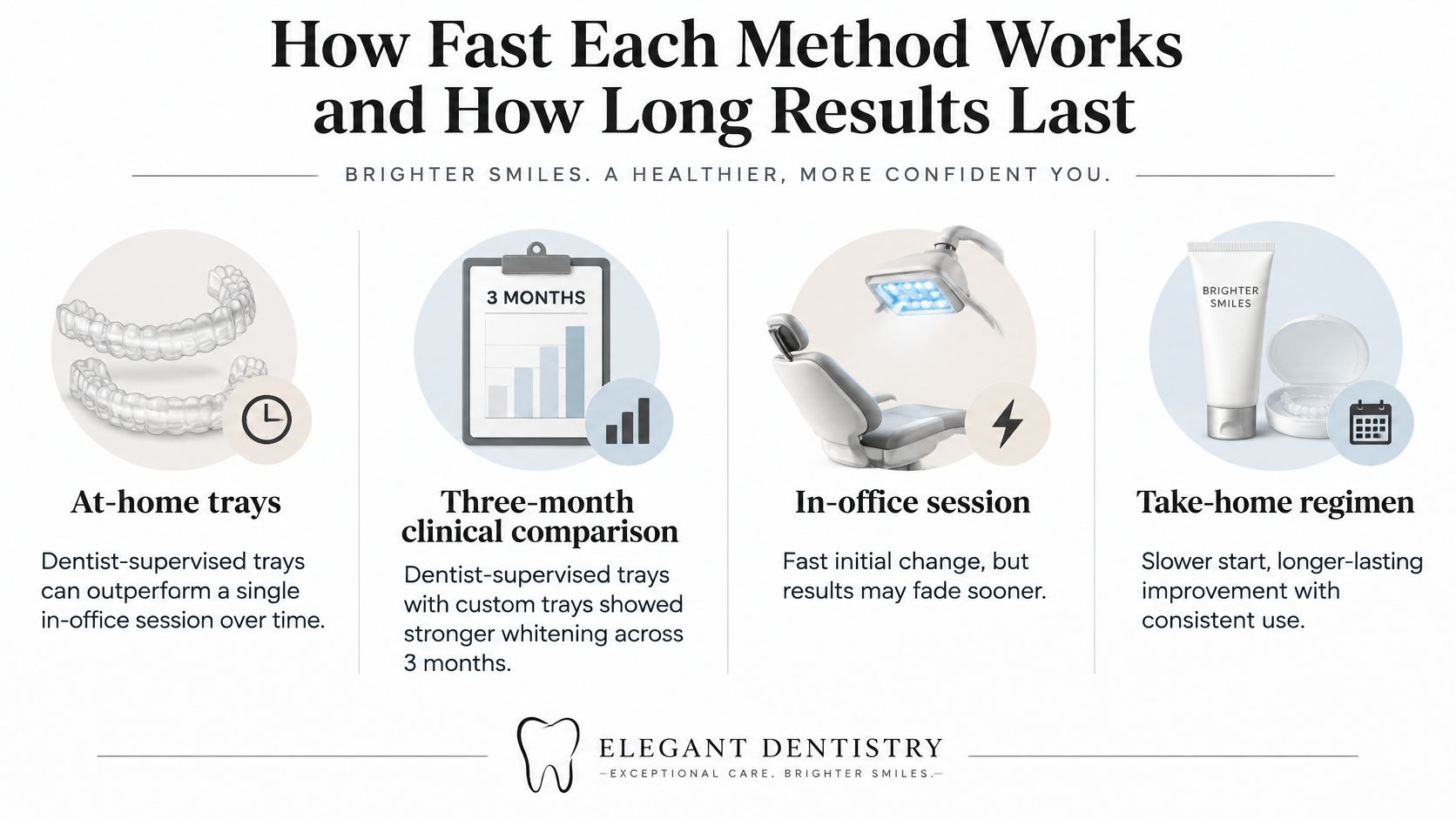
Dentist-supervised home treatment can outperform a single stronger office treatment over time. In a three-month clinical comparison, trays using 10% carbamide peroxide produced significantly greater lightening than a single treatment with 35% hydrogen peroxide, while color relapse in both groups stabilized at approximately six weeks, according to the clinical trial comparing home and office bleaching.
That finding doesn't mean office whitening is ineffective. It means a single concentrated exposure and a repeated home regimen are different treatment schedules. The total planned exposure matters.
The illustration below summarizes the practical timing trade-off, although no method guarantees longer-lasting results for every patient.
Fast Delivery Versus Gradual Adjustment
Office treatment is useful when you want the dentist to manage the application and assess the immediate response. Home trays ask more of your routine, but they allow the team to adjust treatment as the shade develops or sensitivity appears.
Don't start a course immediately before an important event and assume the result will be predictable. Tell the team when the event is, whether photographs are involved, and whether you've whitened before. Leave room for reassessment rather than extending treatment yourself if the first application looks disappointing.
Keeping the Improvement
Bleaching doesn't prevent new staining. Coffee, tea, wine, tobacco, and strongly colored foods can discolor teeth again, while changes in the tooth itself can affect the appearance over time.
- Rinse after staining drinks: Water helps clear the mouth after coffee or tea.
- Avoid tobacco: Continuing to smoke makes maintaining a lighter shade harder.
- Keep brushing and cleaning appointments: Maintenance starts with controlling plaque and surface deposits.
- Request planned touch-ups: Use shade drift, not a recurring urge to go whiter, to start the discussion.
A maintenance plan should preserve an agreed shade, not turn whitening into continuous treatment.
A realistic result is a noticeably lighter version of your natural smile, not necessarily an opaque, pure-white finish. As a hypothetical example, a patient starting at a shade-guide reading of B3 might finish closer to B1 after treatment; that illustrates a possible visible lift, not a predicted outcome.
The dentist can compare shade tabs, photographs, and the appearance in daylight. Use consistent lighting when judging progress, because a bathroom mirror and a brightly lit phone photograph can make the same teeth look different.
Sensitivity and Gum Irritation Across Whitening Options
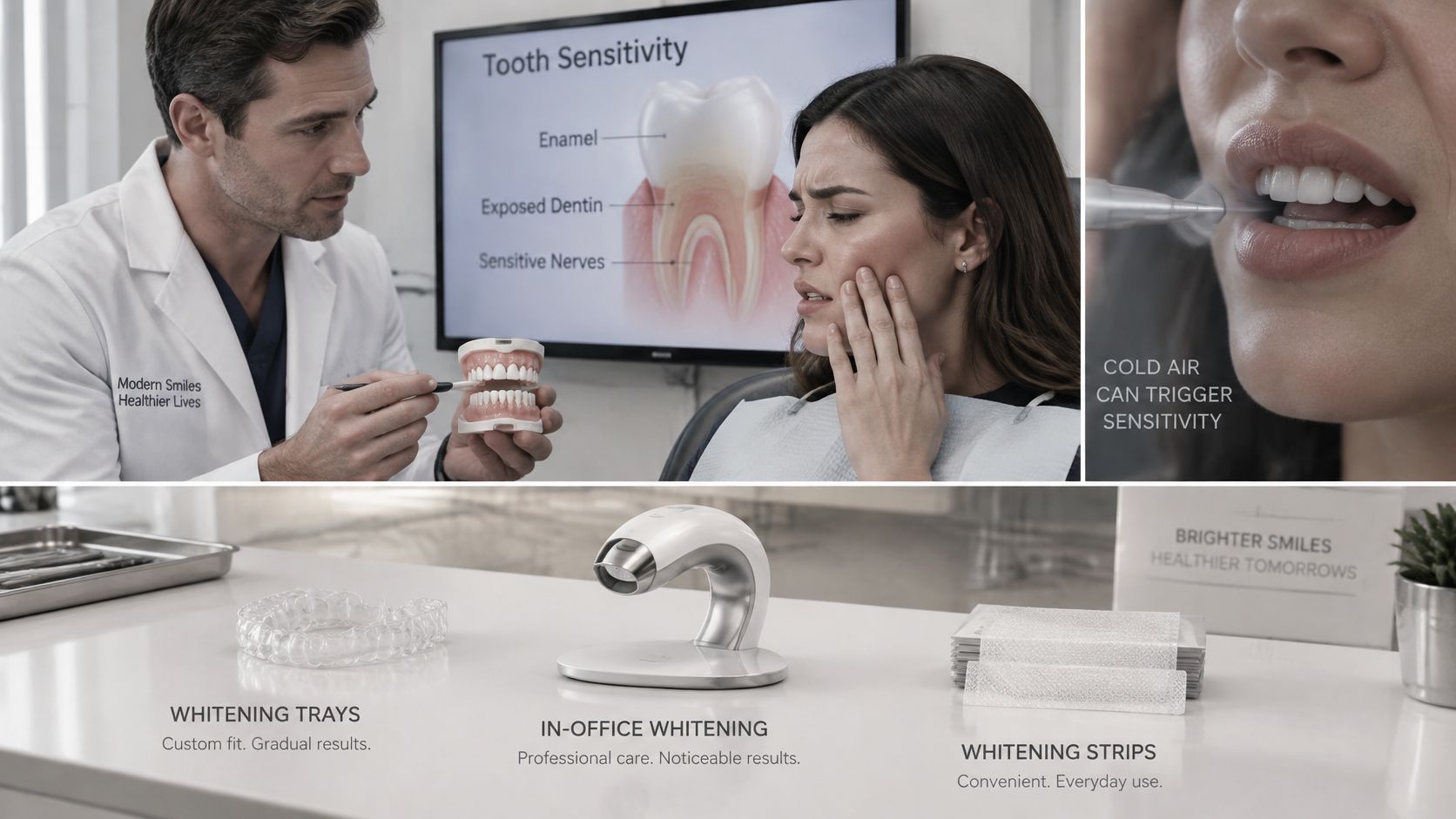
Whitening sensitivity often feels like a quick, sharp twinge when you breathe cold air or drink something chilled. Gum irritation feels different: burning, soreness along the gumline, or discomfort where gel has escaped onto soft tissue. Neither is a reason to add more gel or push through pain.
A discussion of comfort should happen before treatment begins.
How Strength Changes the Trade-Off
A systematic review of bleaching efficacy and sensitivity found that 37% carbamide peroxide used in-office produced similar efficacy to 35% hydrogen peroxide after more than two sessions, with less bleaching sensitivity, although the evidence base was limited. The comparison below also reflects the review's discussion of home-treatment concentrations; certainty was low, and protocols differed.
Sensitivity risk by whitening strength
| Whitening option | Sensitivity risk | What the evidence shows |
|---|---|---|
| Low-strength at-home trays, about 10% carbamide peroxide or 2% to 4% hydrogen peroxide | Lower chance than stronger home regimens | Average sensitivity generally remained mild |
| Higher-strength at-home regimens, 20% to 22% carbamide peroxide or 14% to 16% hydrogen peroxide | Higher chance and intensity | Average sensitivity remained mild; evidence was low certainty |
| In-office 37% carbamide peroxide | Less bleaching sensitivity in the reviewed comparison | Similar efficacy to 35% hydrogen peroxide after more than two sessions; limited evidence |
| In-office 35% hydrogen peroxide | More sensitivity than the compared carbamide-peroxide protocol | Served as the efficacy comparison |
Make a Comfort Plan Before Starting
A fitted tray should hold gel against the teeth without flooding the gumline. More gel doesn't create a better result; excess gel can increase soft-tissue contact.
- Prepare beforehand: Ask whether a desensitizing toothpaste containing potassium nitrate or fluoride suits your symptoms.
- Check the fit: Report sharp tray edges, gel leakage, gum whitening, or burning.
- Adjust with guidance: The dentist may shorten exposure, reduce frequency, or pause treatment.
- Stop for concerning symptoms: Persistent, worsening, or localized pain needs assessment rather than another application.
For a more detailed discussion of gentler protocols, see whitening options for sensitive teeth.
This video provides another way to discuss whitening and comfort with your dental team.
Patients who already have sensitivity often benefit from a lower-strength, longer-duration plan with check-ins. The goal is a tolerable course that achieves an agreed result, not the highest concentration you can endure.
Whitening Around Fillings, Crowns and Veneers
Say you whiten your natural front teeth, but a neighboring crown stays its original color. In daylight and photographs, the crown may suddenly look darker even though nothing is wrong with it. A lighter smile isn't always a more uniform smile.
Bleaching changes natural tooth structure but generally doesn't change the color of fillings, crowns, veneers, bonding, or implant crowns, an important limitation described in the American Dental Association's patient guidance. This makes restoration planning part of the whitening decision, not an afterthought.
Plan the Final Shade Before New Dental Work
If you're considering new visible restorations, start with an exam and shade assessment. When appropriate, whiten the natural teeth first, allow the dentist to reassess the settled shade, and then select the color of the new restoration.
That sequence is particularly helpful for a front crown or veneer. Choosing a restoration to match the current darker teeth and whitening afterward can create a mismatch that bleaching can't correct.
For existing restorations, the options may include accepting a modest difference, replacing a visibly mismatched restoration, or considering bonding or veneers where clinically appropriate. Bonding over an existing surface isn't suitable for every material or situation, so it needs an individual assessment.
Shade-planning advice: Agree on the appearance of the whole smile before paying to lighten individual natural teeth.
Include Implant Crowns and Uneven Stains
If you're searching for dental implants near me while also considering whitening, bring both goals to the same consultation. The visible implant crown keeps its selected shade, so the dentist should coordinate that choice with the intended color of neighboring teeth.
Medication-related staining, including tetracycline discoloration, and trauma-related changes may need a different approach from ordinary food and drink stains. Some teeth need extended supervised treatment; others may be better managed with restorative dentistry rather than more bleaching.
- Bring your priorities: Say whether uniformity or maximum lightening matters more.
- Identify visible dental work: Include fillings and bonding, not just crowns.
- Ask about sequencing: Clarify which treatment comes first and what might need replacement.
For existing veneers, understanding whether porcelain veneers can be whitened can help you prepare useful questions. A good plan starts with an examination, not a product choice.
Internal Bleaching and When to Wait Before Whitening
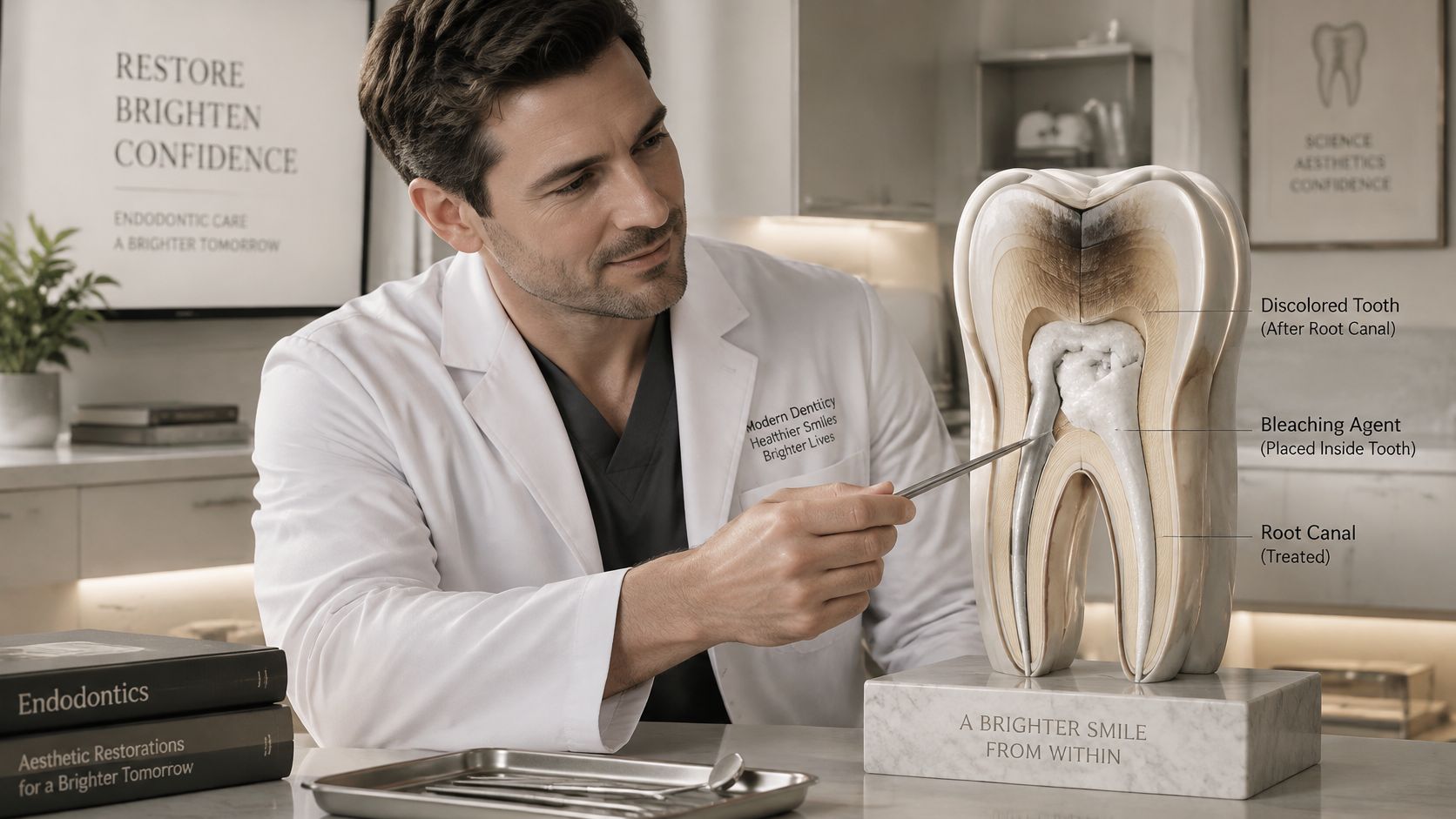
A single dark tooth may need whitening from the inside, not another strip across the entire smile. After root canal treatment, some teeth develop internal discoloration that external bleaching alone may not address evenly.
Internal bleaching places the whitening material within the selected tooth. It isn't a treatment for every dark tooth, and the dentist must first assess the root canal treatment, remaining tooth structure, and cause of discoloration.
This illustration shows why the approach differs from surface whitening.
What Treatment Involves
The dentist accesses the internal part of the tooth through its restoration, checks the protective barrier over the root filling, places the bleaching material, and seals the access. With a walking-bleach approach, the material stays sealed inside between assessments. Further applications may be needed before the final restoration is placed.
A randomized clinical study published in 2024 compared 50 discolored non-vital front teeth, with 25 assigned to each method, and recorded final color-change values of ΔE00 = 10.08 for in-office bleaching and ΔE00 = 8.12 for walking bleach. Both methods changed color, with a larger measured change in the in-office group; these measurements aren't shade-guide steps or a guarantee for an individual tooth.
Internal bleaching deserves careful consent and follow-up. Ask why the tooth darkened, whether the root canal treatment is satisfactory, and whether the tooth needs additional structural protection.
When Whitening Should Wait
The NHS guidance on teeth whitening advises against treatment for people aged 17 or younger, doesn't recommend it during pregnancy or breastfeeding, and says teeth and gums should be healthy before treatment. It also identifies temporary sensitivity, sore gums or throat, and white patches on the gums as possible side effects.
- Untreated decay or gum disease: Address the disease before cosmetic bleaching.
- A suspected crack or painful tooth: Find the cause of the symptoms first.
- New or unexplained darkening: Have the tooth examined rather than covering the change with whitening.
- Persistent gum soreness: Allow an assessment before applying more peroxide.
A whitening consultation can therefore lead to cleaning, periodontal care, a filling, or root canal assessment before cosmetic treatment. That's a useful outcome: whitening doesn't relieve tooth pain or treat infection.
If you need an emergency dentist because of swelling, significant pain, or a broken tooth, prioritize that care. Tooth extraction isn't a whitening treatment, and a discolored tooth shouldn't be assumed to need removal without an examination.
Choose the Right Whitening Method for Your Situation
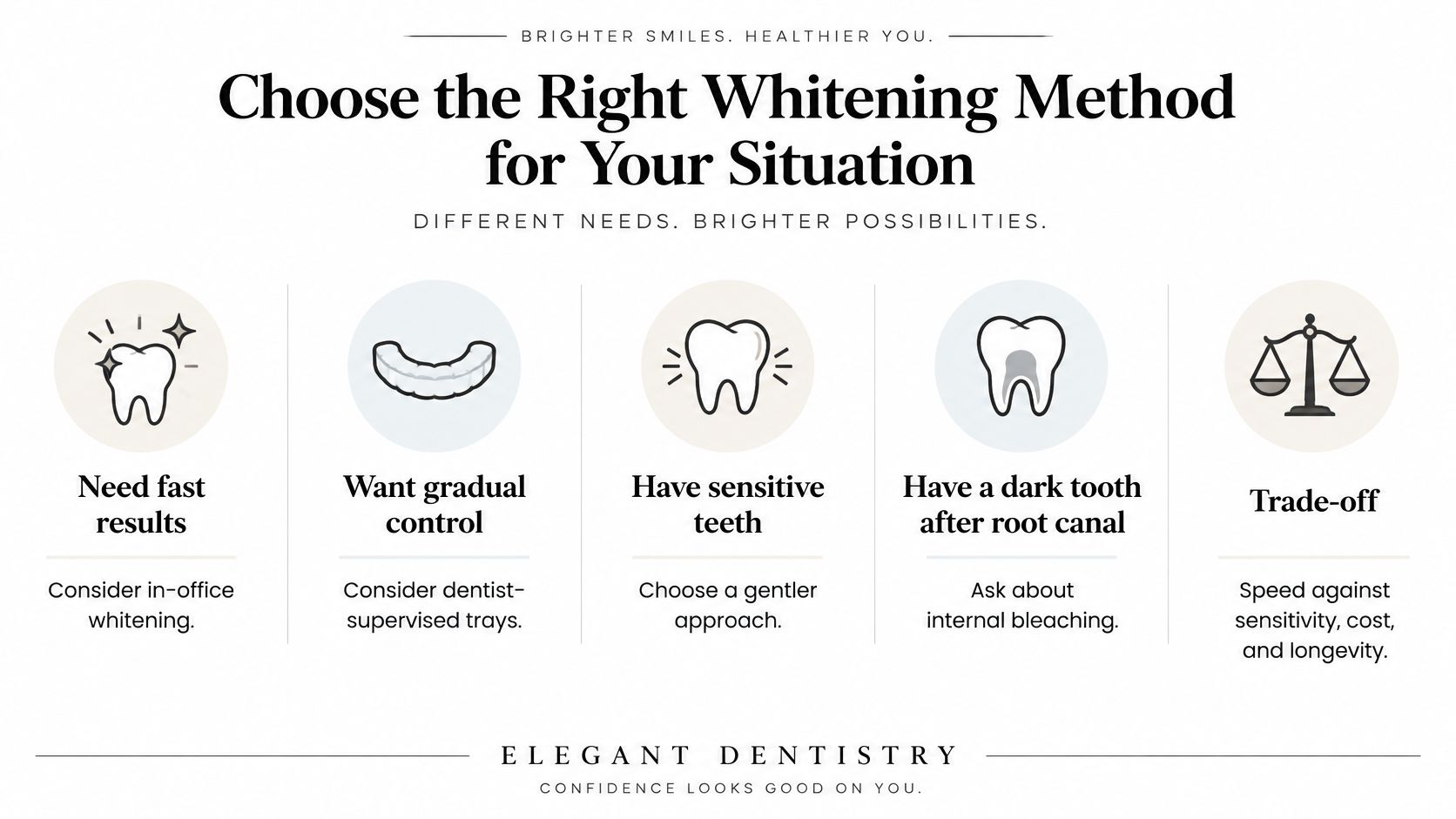
Use this shortlist to prepare for a conversation with your dentist rather than to diagnose your own teeth. If you fit several rows, such as sensitive teeth plus a visible crown, an examination helps the dentist coordinate the priorities.
Whitening starting points by situation
| Your Situation | Usually Best Starting Point | Why It Fits |
|---|---|---|
| An upcoming event | In-office professional whitening | Delivers treatment quickly under clinical supervision |
| Want gradual, controlled results at home | Custom take-home professional trays | Allows fitted delivery and adjustments to the regimen |
| Sensitive teeth or gums | Lower-strength professional treatment after assessment | Supports a gentler, monitored approach |
| Light surface stains and a limited budget | Whitening toothpaste or suitable retail strips | Lower initial cost and a conservative starting point |
| One darkened root-canal tooth | Assessment for internal bleaching | Targets discoloration within the selected tooth |
| Visible fillings, crowns, or veneers | Exam and shade assessment | Allows sequencing and mismatch planning |
| Active decay or gum disease | Treat the condition first | Cosmetic treatment shouldn't replace necessary care |
The core trade-off is speed against sensitivity, gum safety, cost, and maintenance. ADA News guidance on whitening emphasizes screening and supervision and warns that frequent or aggressive bleaching can increase enamel permeability, contribute to erosion, and produce unwanted translucent-looking changes. Repeated self-treatment is no substitute for finding out why you're unhappy with the color in the first place.
What to Expect at a Local Consultation
At a new patient exam in Chattanooga or Cleveland, TN, explain what bothers you: overall yellowing, a dark tooth, uneven front teeth, or an older restoration. Bring the names or photographs of whitening products you've already used and describe any discomfort.
The team can assess the teeth and gums, identify restorations, record the starting shade, and determine whether dental x-rays are clinically needed. Cleaning and exams support mouth health. Whitening addresses appearance. Keeping those goals separate helps you understand what each proposed service will achieve.
Before choosing, confirm:
- The diagnosis: What type of staining are you treating?
- The safety plan: Are decay, gum problems, and sensitivity addressed?
- The cosmetic goal: What shade is realistic for your natural teeth and restorations?
- The full cost: What do treatment, reviews, gel refills, and possible restorative changes include?
Retail whitening may be reasonable for mild staining in a healthy mouth, but stop if irritation develops rather than cycling through stronger products. Ask for an itemized comparison of office treatment and fitted trays so you can weigh the upfront fee against ongoing care. Cost clarity matters as much as shade clarity.
Winn Smiles offers professional teeth whitening, exams, and transparent cost discussions to help patients in Chattanooga and Cleveland, TN choose an approach that fits their teeth, sensitivity, and budget. Visit Winn Smiles to request a whitening consultation, or call the team to discuss appointment availability and ask for a walkthrough of treatment costs.