Smokers have roughly double the dental implant failure risk, about 6.35% versus 3.18% in a large 2015 review, and a common clinical target is to stop smoking at least six weeks before surgery and stay smoke-free for at least eight weeks afterward. Smoking doesn't automatically rule out implants, but it makes preparation and follow-up especially important.
If you want dental implants near me in Chattanooga, TN, or Cleveland, TN, you may be worried that years of smoking have taken this option away. A useful consultation replaces that fear with a personal assessment: what you're using, how much you use, whether you need grafting, and what you can change before treatment.
Failure Rates for Smokers and Nonsmokers at a Glance
Smoking raises the chance of implant failure, but it does not make failure inevitable. The figures below separate early problems with an implant bonding to bone from later inflammation around an implant that is already in place.
That distinction matters if you are weighing treatment. An implant can remain stable while the nearby gum and bone develop problems, so “survival” and “healthy supporting tissues” are not interchangeable outcomes.
Smoking and implant outcomes compared
| Outcome | Nonsmokers | Smokers | What It Means |
|---|---|---|---|
| Implant failure rate, large 2015 review | 3.18% | 6.35% | About 1 in 31 versus 1 in 16 implants, according to the 2015 systematic review and meta-analysis. |
| Early implant failure odds, review of 21 cohort studies | Baseline | 2.59 times the odds | Smoking was associated with higher odds of early failure in the International Journal of Oral and Maxillofacial Surgery review. |
| Implant survival in heavy smokers | 94.4% | 84.6% | In this study, survival was lower for heavy smokers, as reported in the Clinical Implant Dentistry and Related Research study. |
| Peri-implantitis incidence, review | Lower than smokers in the reviewed studies; no pooled figure reported | Reached 36.6% | Peri-implantitis is inflammation of tissues supporting an implant, not implant failure itself, according to the review available through the National Library of Medicine. |
What these numbers can and can't tell you
The first row counts failed implants, not people who lost all their implants. If someone has several, one may fail while the others remain stable.
The early-failure result reports odds, not an absolute failure percentage. It cannot be multiplied by the general failure rate to calculate your personal odds. The heavy-smoker survival figures also describe a particular study group, so they are not a forecast for every person who smokes or every treatment plan.
Keep the comparison honest: These are group outcomes, not a prediction that your implant will fail or succeed.
The amount and pattern of smoking matter when assessing risk. Cigarettes, cutting down, and smoke-free products should not be treated as identical exposures, and reducing smoking is not the same as eliminating risk. Your dentist can consider your use alongside gum health, bone support, medical history, home care, and the proposed procedure. Smoking is a modifiable risk, not an automatic reason to rule out implants.
How Smoke Interferes With Bone Healing Around an Implant
Say you're replacing a missing back tooth. The implant works like a screw anchored into a building's foundation, but living bone must grow onto its surface to make that anchorage dependable.
The process is called osseointegration, meaning that the implant and bone establish a stable connection. Think of roots growing into soil: placement starts the process, but the surrounding support must develop.
Blood flow supplies the repair site
Nicotine narrows blood vessels, while carbon monoxide reduces oxygen availability; a review of smoking and bone healing also describes effects on new blood-vessel formation and the cells responsible for building bone. These changes can leave a healing implant site with less of the circulation and oxygen it needs.
The concept map connects those effects to implant support.
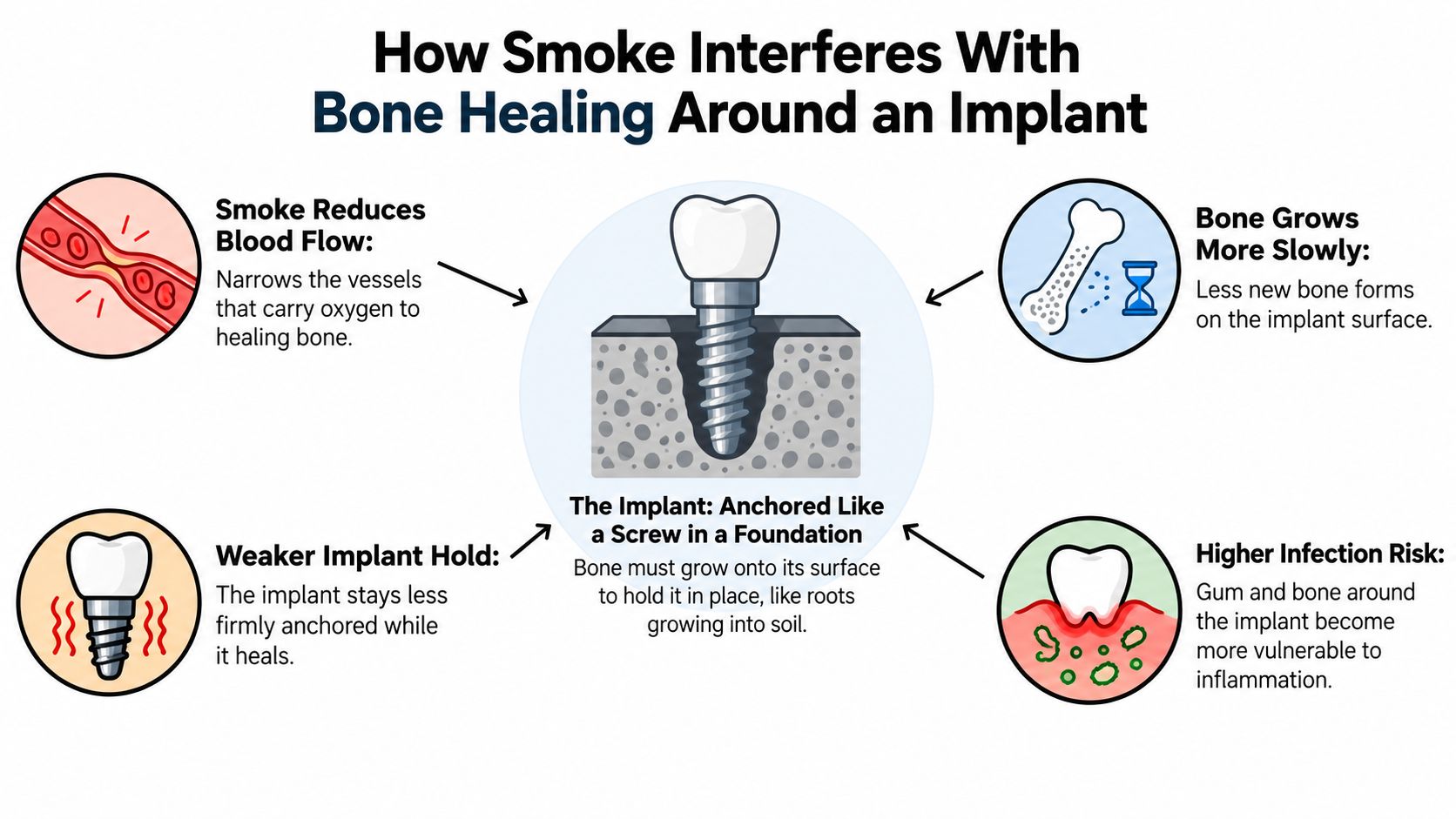
New blood vessels matter because healing bone needs a continuing supply of oxygen and nutrients. When that supply is compromised, the body has a harder job repairing the surgical area.
A gum incision can look closed before the deeper bone has finished healing. That's why a comfortable mouth doesn't necessarily mean the implant is ready for unrestricted chewing or smoke exposure.
Bone-building cells also need to function
Laboratory findings described in that review show fewer osteoblasts, the cells that build bone, and reduced signals associated with bone formation after nicotine exposure. The findings also describe changes favoring pathways involved in bone breakdown.
This doesn't mean every cigarette causes an implant to loosen immediately. It means repeated exposure can interfere with the repair work that should strengthen the implant's connection.
A clean-looking surgical site isn't proof that the bone underneath has finished bonding to the implant.
At your consultation, the dentist should review your smoking history alongside dental X-rays, bone volume, and medical history. If a tooth extraction or graft is needed first, ask how each surgical phase changes the healing plan.
The benefit of this assessment is practical: it helps the dentist choose appropriate timing, identify problems that need treatment, and explain why your instructions may differ from someone else's.
Gum and Bone Problems That Can Appear After Implants Settle
An implant can bond successfully and still develop problems later. Peri-implantitis is inflammation around an implant that involves loss of supporting bone, not just temporary gum irritation.
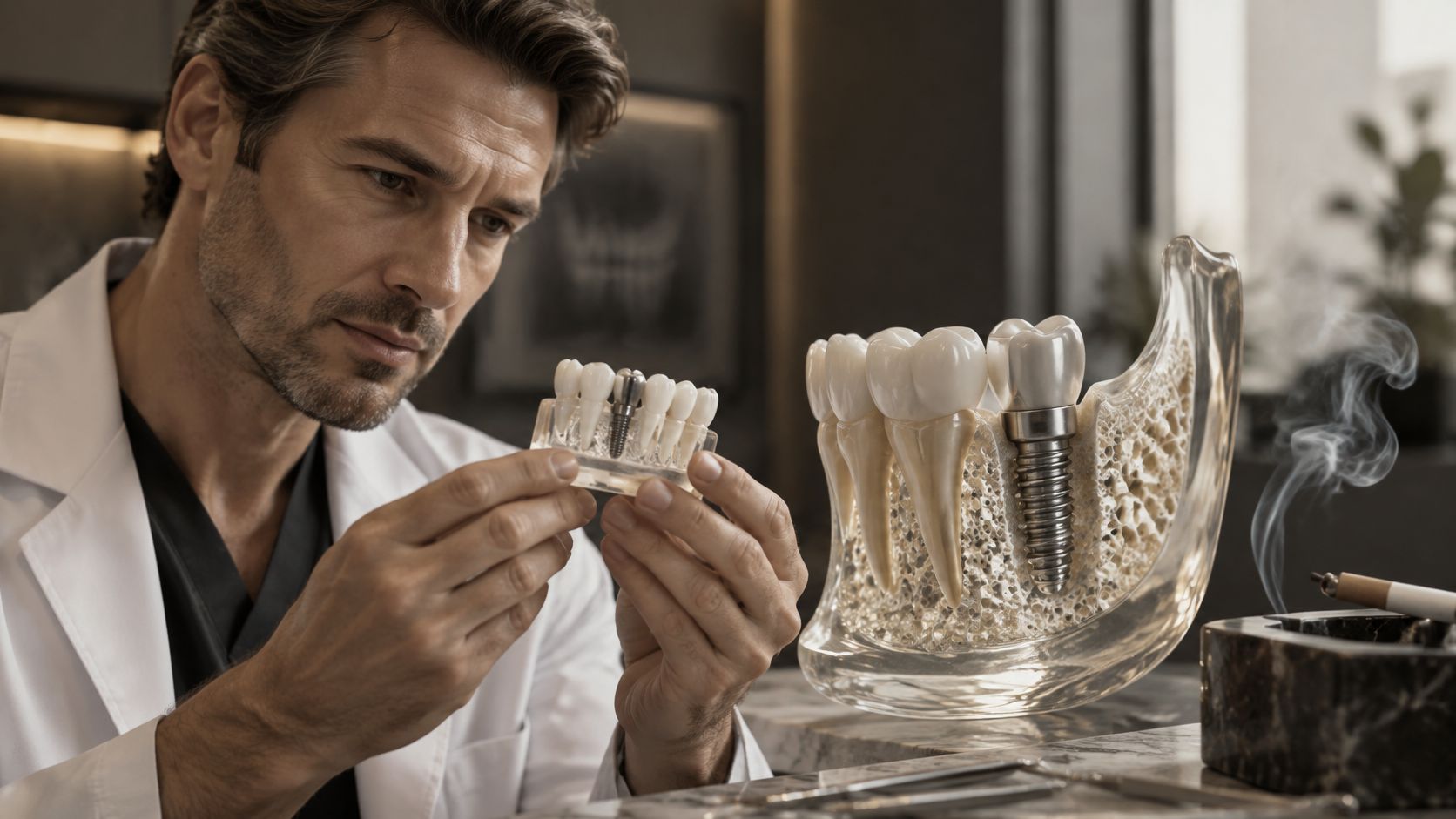
This model illustrates the relationship between the implant and its surrounding support.
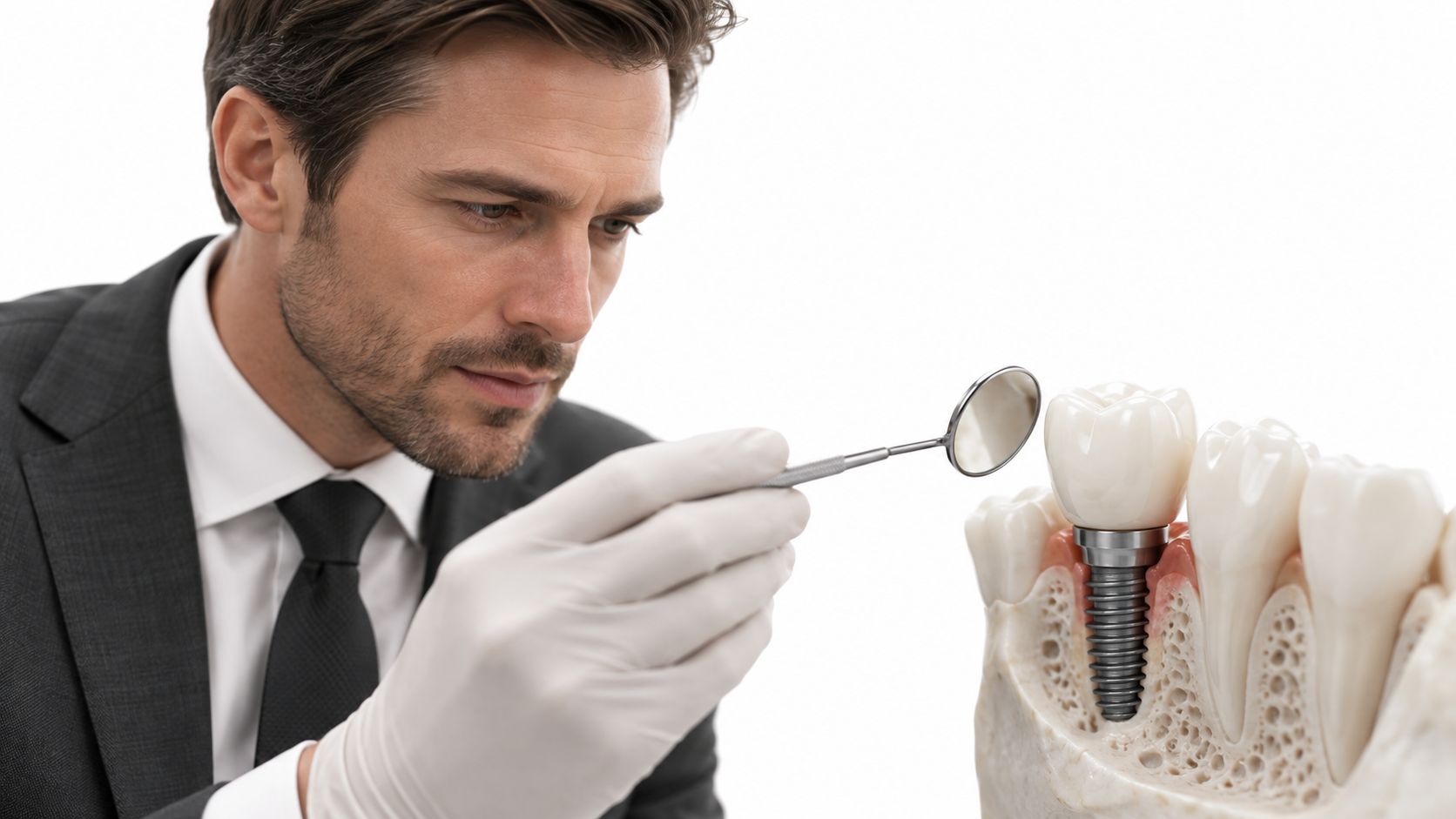
A systematic-review meta-analysis in the Journal of Clinical Periodontology reported peri-implantitis relative risks of 2.04 at the implant level and 2.79 at the patient level among smokers. Those measures answer different questions: whether an individual implant is affected and whether a person has an affected implant.
A 2025 Journal of Oral & Maxillofacial Research meta-analysis associated cigarette smoking with 2.16 mm greater marginal bone loss than nonsmoking. That isn't a forecast for your mouth, but it matters because the bone bordering an implant contributes to its support.
Warning signs that deserve attention
- Bleeding: Gums bleed during brushing or cleaning around the implant.
- Swelling: Tissue looks puffy, irritated, or different from usual.
- Pain or discharge: Tenderness, persistent discomfort, or pus develops.
- Movement: The crown or implant feels loose when you bite.
Don't try to tighten a loose crown yourself or assume movement means the entire implant has failed. A dentist needs to determine whether the problem involves a restoration component, the surrounding tissues, or the implant's support.
This video offers another visual explanation of implant-related care.
Daily cleaning and professional maintenance help manage plaque around the restoration. Your hygienist can demonstrate an interdental brush, floss threader, or other tool suited to the shape of your implant crown.
The practice's explanation of what peri-implantitis is can help you recognize why ongoing cleaning and exams remain necessary. If you develop pain, pus, or movement, request a prompt dental assessment rather than waiting for your next routine visit.
How Heavy Smoking and Bone Grafts Change Your Risk
People smoking more than 20 cigarettes daily had implant-failure relative risks of 2.45 per implant and 4.00 per patient compared with nonsmokers in a systematic review of smoking intensity. Daily exposure matters, so a useful conversation goes beyond asking whether you smoke.
Someone who smokes throughout the day and needs a graft has a different planning problem from someone with lower exposure and adequate existing bone. That doesn't produce a simple pass-or-fail rule, but it changes what needs attention before surgery.
Smoking risk by situation
The comparisons below are between smokers and nonsmokers within the relevant treatment settings.
| Situation | Reported Risk | What It Means |
|---|---|---|
| Smokers, implant level, 2007 review | Odds ratio 2.25 | Roughly double the odds of failure in the 2007 systematic review and meta-analysis. |
| Smokers needing bone augmentation, same review | Odds ratio 3.61 | The augmentation subgroup had higher failure odds than the review's overall implant-level comparison. |
| More than 20 cigarettes a day | Relative risk 2.45 per implant, 4.00 per patient | Heavy smoking carried the highest relative-risk estimates in this comparison set. |
| Sinus-floor augmentation, pooled studies | Relative risk 1.87, 95% confidence interval 1.35–2.58 | Smokers had higher failure risk in the sinus-floor augmentation meta-analysis. |
| Sinus-floor augmentation, three prospective studies | Relative risk 1.55, 95% confidence interval 0.91–2.65 | This smaller subgroup didn't show a statistically significant difference. |
The overall smoking comparison establishes a broader association. The augmentation result describes a more demanding treatment setting, but it doesn't prove that grafting alone caused the difference.
Grafting asks the body to establish or rebuild bone support as part of treatment. Your dentist should explain why it's needed, whether treatment will be staged, and how continued smoking could affect the decision to proceed.
Why the upper jaw needs a closer look
Upper-jaw implant planning can involve less-dense bone and proximity to the sinus. A sinus-floor augmentation adds another surgical consideration, making imaging and an individualized plan especially useful.
The prospective subgroup's uncertainty doesn't prove smoking is harmless in that setting. It means the estimate wasn't precise enough to establish a statistically significant difference.
Bring an accurate daily count: Include workday smoking, weekend changes, and any additional products, not just your lowest-use day.
Ask your dentist which risks can be improved before treatment and which anatomical limitations remain. For patients seeking a dentist in Cleveland, TN, or Chattanooga, TN, that discussion is more useful than accepting a general success percentage without understanding the planned surgery.
Does Cutting Down or Switching Products Help Implants
Many patients hope that fewer cigarettes, a vape, or nicotine pouches will make surgery safe enough. Reducing exposure isn't the same as proving that an alternative is safe for implants.
A systematic review comparing cigarette smoking and smoke-free products supports separating these products rather than assuming identical effects. Cigarettes have established evidence of harm, while newer products have less-established long-term implant safety profiles.
Nicotine products and what implant evidence shows
| Product | What the Evidence Shows | Implant Advice |
|---|---|---|
| Cigarettes | Strongest evidence of harm to implant survival and supporting bone | Aim to stop completely; cutting down isn't equivalent to quitting. |
| Vaping | Limited implant-specific evidence; products may still deliver nicotine despite having no cigarette smoke | Disclose the product, nicotine content, and frequency. |
| Nicotine pouches or smokeless tobacco | Limited long-term implant evidence; nicotine exposure remains | Report use and where oral products are held. |
| Nicotine replacement therapy | A tool used within a medically supervised quit plan, not proof of implant safety | Agree on the product and timing with your physician and dentist. |
| Cannabis smoking | Combustion exposure with limited implant-specific evidence | Disclose it and ask for a smoke-exposure plan. |
Switching away from combustion may reduce some toxic exposure, but smoke-free doesn't mean risk-free. Nicotine content, oral irritation, and continued cigarette use all belong in the discussion.
These are the kinds of details to review alongside your imaging and treatment plan.
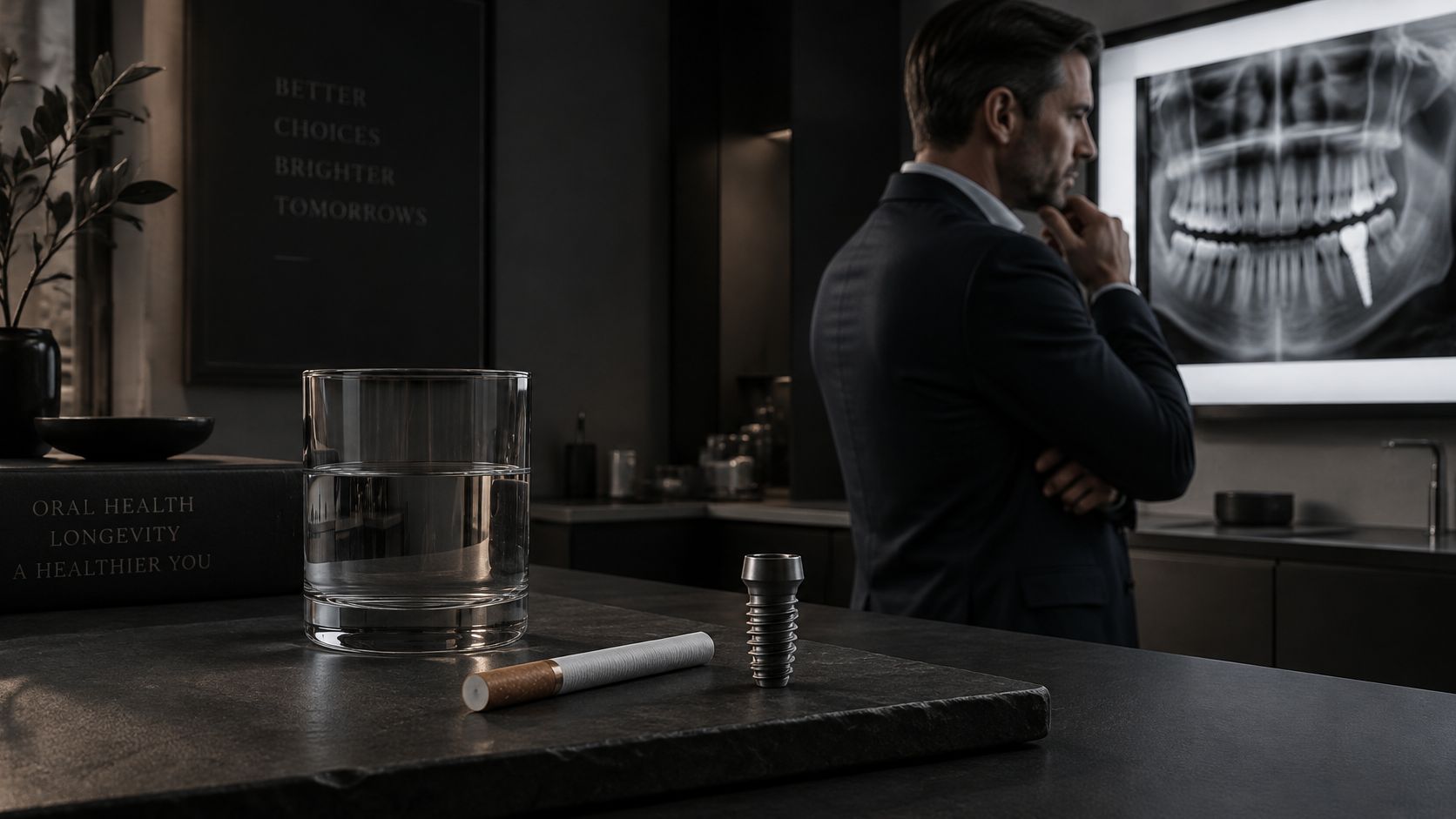
Make a reduction plan specific
If quitting immediately feels out of reach, tell the team rather than avoiding care. Reducing cigarettes can be a step toward cessation, but there isn't an established cigarette allowance that guarantees safe healing.
Dual use also needs a clear description. Replacing some cigarettes with vaping while continuing to smoke isn't the same as eliminating smoke exposure.
Don't stop prescribed cessation treatment on your own because you're worried about nicotine. Ask your physician and implant dentist to coordinate medication choices, including patches, gum, or prescription options when appropriate.
The practical rule is simple: disclose every tobacco, nicotine, and smoked product you use. That includes products you use occasionally, socially, or only when cravings become difficult.
Quit Timeline Before and After Your Implant Surgery
The Foundation for Oral Rehabilitation's smoking risk-assessment guidance recommends stopping at least six weeks before implant surgery and remaining smoke-free for at least eight weeks afterward. These are risk-reduction targets, not guarantees or permission to restart once the minimum interval ends.
Your dentist may adjust the schedule for grafting, additional surgical phases, medications, gum health, or nicotine dependence. Ask for written instructions tied to your actual appointments.
Smoking timeline around implant surgery
| Phase | Smoking Target | Why It Matters |
|---|---|---|
| Six or more weeks before surgery | Stop completely | Allows preparation and recovery before surgery begins. |
| Day of surgery | No cigarettes or nicotine products unless your clinician has specifically approved a cessation medication plan | Avoids unplanned exposure and keeps medication instructions clear. |
| First eight weeks after surgery | Stay smoke-free | Protects the period when bone is bonding to the implant surface. |
| After eight weeks | Remain smoke-free long term | Supporting gums and bone still need protection. |
| Any time after a slip | Tell your dental team promptly | Allows the team to adjust monitoring and care. |
The timeline below shows how those phases fit around placement.
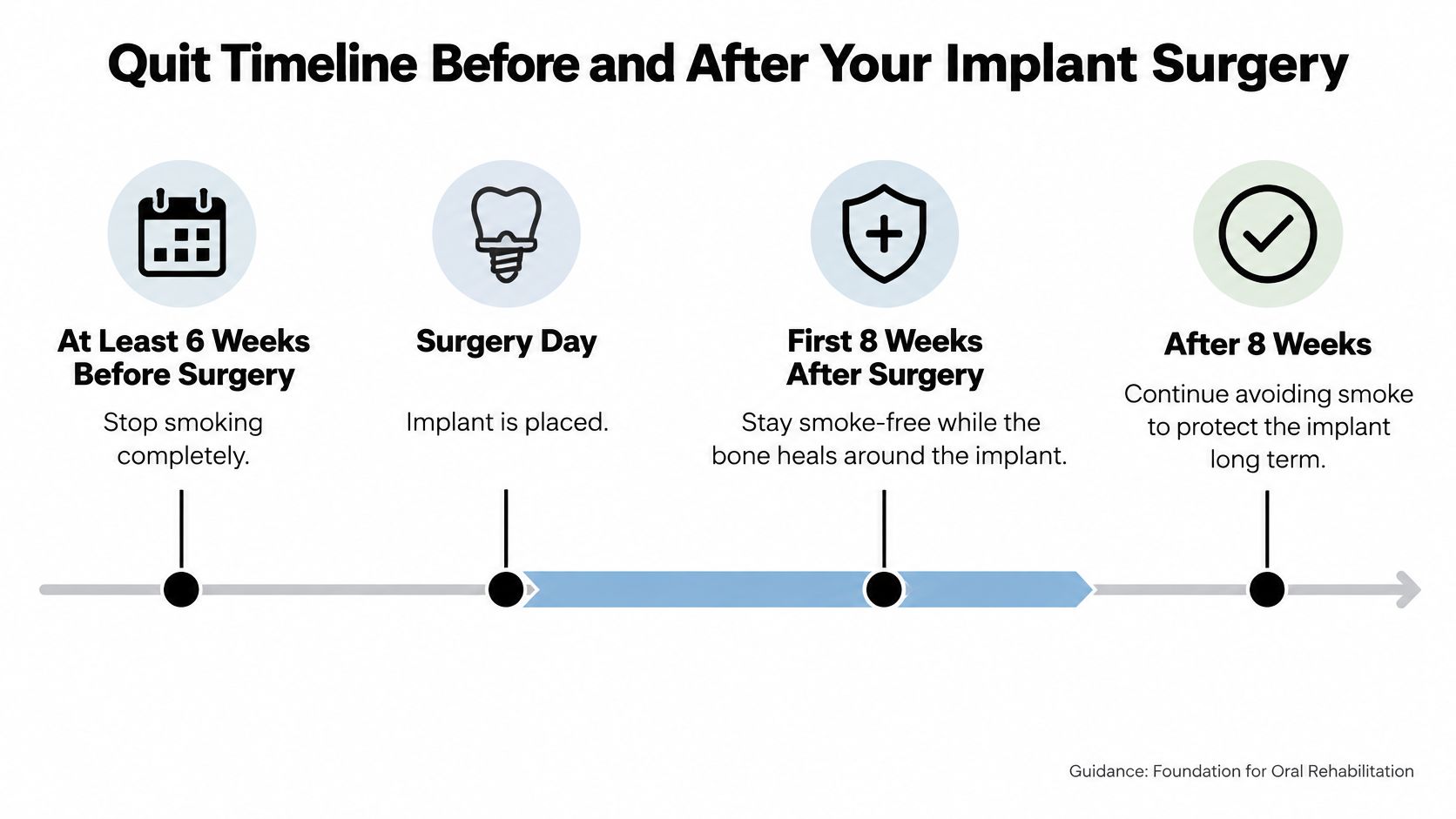
A healing schedule should also explain eating, cleaning, and follow-up visits. Review the practice's guide to dental implant recovery time, then ask which instructions apply to your procedure.
Build a quit plan you can actually follow
- Describe your current use at the first visit. Name each product and your usual daily amount, including changes during stressful days.
- Choose a quit date before scheduling surgery. Allow the recommended preoperative interval, and confirm whether a graft needs its own preparation period.
- Ask your physician about treatment support. Discuss nicotine replacement or prescription options, with the dental team involved in timing decisions.
- Call 1-800-QUIT-NOW. The national quitline connects callers with state cessation programs and support.
- Report a slip early. Tell the dental team what you used and when, rather than waiting until a complication appears.
A quit plan should include what you'll do when a craving happens, not just the date you hope cravings will stop.
For example, remove cigarettes from the car, arrange support for your usual smoking breaks, and keep the quitline number in your phone. If withdrawal makes the plan unmanageable, contact your medical team before changing cessation medication.
Postponing elective implant placement can be a reasonable way to create a more workable preparation period. It isn't a punishment or a permanent refusal of care.
Common Questions About Smoking and Dental Implants
Can I still get implants if I smoke?
Often, yes. Smoking is a modifiable risk rather than an automatic exclusion, and your dentist will consider exposure, implant location, gum health, and grafting needs.
What if I slip during healing?
Tell your dental team promptly. An isolated slip and ongoing daily smoking call for different conversations, but neither is a reason to hide exposure or abandon follow-up care.
Does quitting help an implant that's already placed?
Yes, stopping remains worthwhile. It supports care of the surrounding gums and bone, though it can't restore all previous damage or replace treatment for an existing infection.
Do I need to mention vaping or pouches?
Yes, include every product. Bring the packaging or a phone photo if you're unsure of the nicotine strength, ingredients, or product name.
What if implants aren't right for me?
You still have tooth-replacement options. Your dentist can compare a dental bridge or removable partial denture based on your remaining teeth, gum health, bone support, and preferences.
Honest answers at a new patient exam help the dentist develop a safer, more accurate plan. You don't need to arrive with perfect habits to begin that conversation.
Book a Smoking Risk Consultation in Cleveland or Chattanooga
If you're looking for a dentist in Chattanooga, TN, or Cleveland, TN, request an implant consultation that includes a smoking-risk assessment. Choose the office most convenient for follow-up visits, not just the initial appointment.
Before booking, ask the office to confirm current consultation options and any fees. Bring a medication list, details of every tobacco or nicotine product you use, your daily amounts, and any proposed surgery date.
What to expect at your visit
The dentist reviews your medical and smoking history, examines your mouth, and takes or reviews appropriate dental X-rays. You'll discuss existing gum problems, available bone, and whether tooth extraction or grafting belongs in the plan.
- For fear of failure: Ask which findings affect your candidacy and which can be improved.
- For difficulty quitting: Request coordination with medical cessation support.
- For uncertain timing: Ask for a written quit schedule matched to each surgical appointment.
Comfort concerns belong in this conversation, too. If anxiety has delayed treatment, ask about the comfort menu and whether sedation options suit your health history and procedure.
You can use the practice website to begin planning your visit.
Winn Smiles offers dental implant consultations in Cleveland and Chattanooga that consider smoking habits, bone support, and your treatment needs. Visit Winn Smiles or call the office to request an appointment in your preferred city and ask for a personalized smoking-risk and quit-timing discussion.