You bite down on dinner and feel a sharp twinge in a back tooth. Now your dentist is recommending a crown, and you're wondering how you'll fit treatment around work, school pickup, and everything else. If you're searching for a dentist near me in Cleveland or Chattanooga, TN, same-day CEREC crowns may offer a practical way to restore a damaged tooth without a separate laboratory fitting visit.
The important question isn't just how quickly a crown can be made. It's whether that crown is the right treatment for your tooth, your bite, and your long-term dental health.
What a Same Day CEREC Crown Is and Who It Helps
A cracked molar doesn't always mean you'll need separate appointments to prepare the tooth and receive the final crown. For a suitable tooth, your dentist may be able to complete both during the same visit. A dental crown is a custom cap that covers a damaged tooth to restore its shape and protect the remaining structure.
CEREC stands for Chairside Economical Restoration of Esthetic Ceramics. Developed at the University of Zurich during the early 1980s, the concept brought ceramic restoration manufacturing into the dental office rather than relying entirely on an outside laboratory, as described in this historical review of CEREC technology.
Think of the difference as developing a photo at a nearby shop instead of mailing the film away. The work still requires care, but it happens closer to where you're receiving the service.
What the appointment can accomplish
The dentist designs your restoration on a computer, mills it from a ceramic block in the office, and cements it during that appointment when the clinical checks are satisfactory. Same-day crowns are available at the practice's Cleveland and Chattanooga offices as part of full-scope restorative dentistry.
Adults may need crown treatment because of:
- Decay: A damaged area may be too extensive for a filling alone.
- Fracture: A cracked or broken tooth may need additional coverage.
- A failed large filling: The remaining tooth may need more support.
- Previous root canal treatment: The treated tooth may need a protective restoration.
These situations don't automatically require the same treatment. The dental crown procedure overview provides useful background, but your examination determines whether a crown, a smaller restoration, or another approach makes sense.
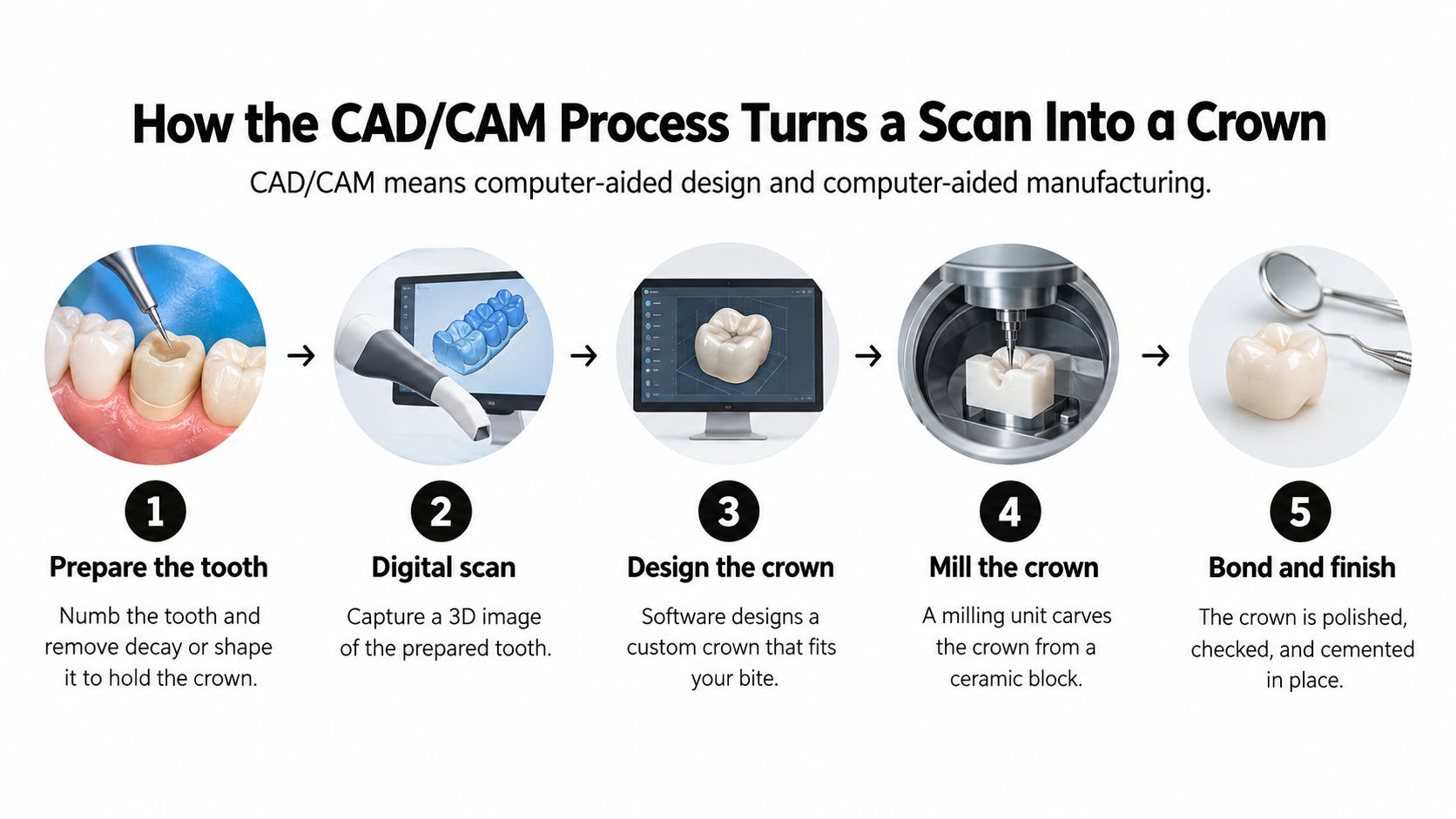
How the CAD/CAM Process Turns a Scan Into a Crown
CAD/CAM means computer-aided design and computer-aided manufacturing. Your dentist uses digital information to plan the crown, then sends that design to an in-office milling unit.
This overview shows how the main stages fit together.
The clinical steps and why they matter
Numb and prepare the tooth. The dentist gives local anesthetic, removes decay, and shapes the tooth to receive the crown. Preparation must leave appropriate space for the ceramic while preserving usable tooth structure.
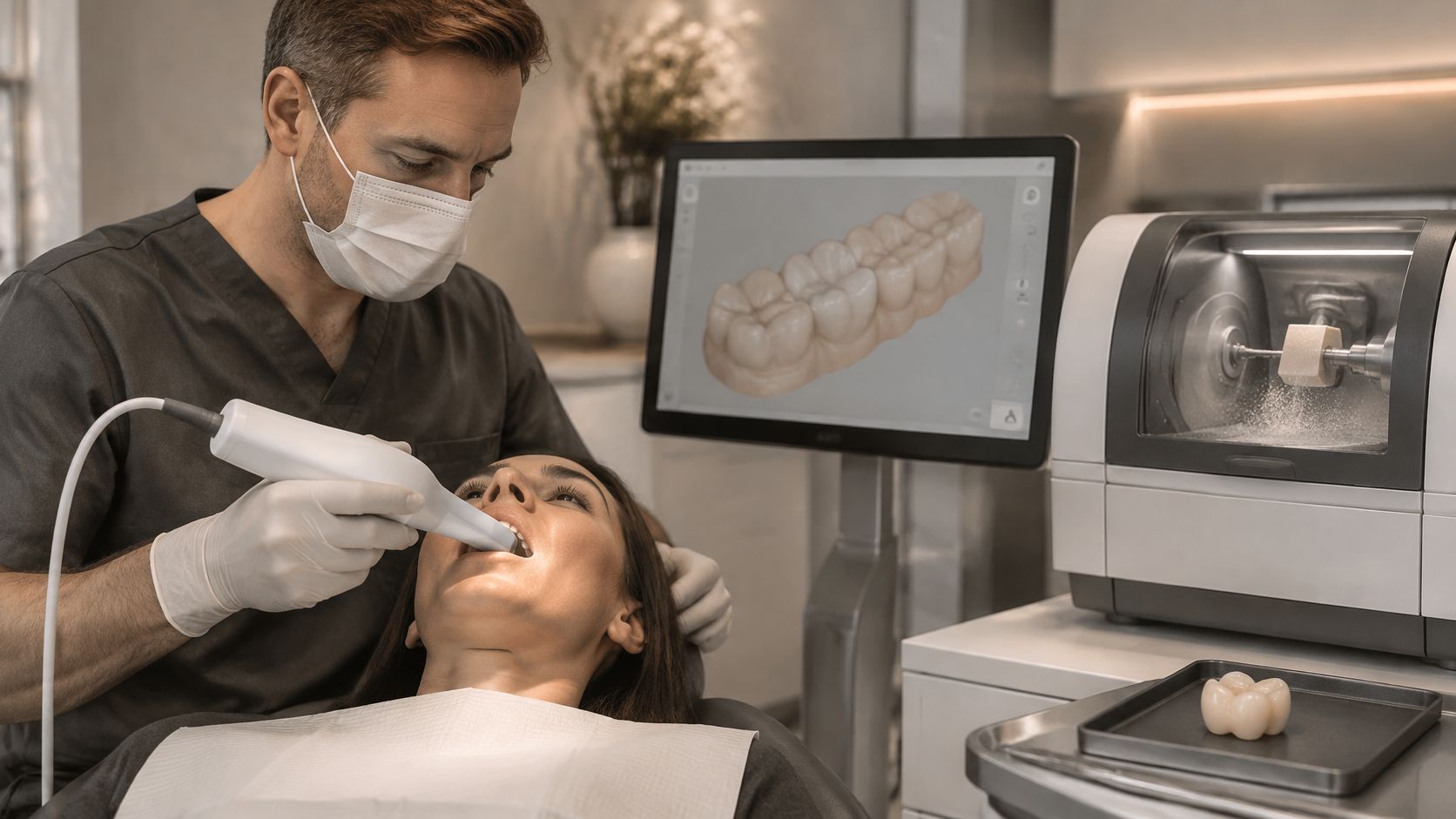
Capture the digital scan. A small handheld scanner records a three-dimensional image of the prepared tooth and nearby teeth. This replaces the soft impression tray in the CEREC workflow and gives the dentist a digital model to inspect.
Review the crown design. Software proposes a shape, but your dentist reviews and adjusts it. The crown needs suitable contact with neighboring teeth and a chewing surface that works with your bite, not merely an attractive outline on a screen.
Mill the ceramic. An in-office milling unit carves the restoration from a solid ceramic block. The chosen material determines whether additional processing, such as crystallization or sintering, is necessary.
Finish and try in the crown. The team completes the appropriate staining, glazing, or polishing, then checks seating, edges, neighboring contacts, and bite. A crown that looks right still needs these hands-on checks before placement.
Bond and reassess. After final adjustments, the dentist secures the crown using the appropriate adhesive cementation process. Moisture control and careful handling remain important even though the design and manufacturing are digital.
What digital precision can and can't promise
A systematic review of digital versus conventional impressions found marginal gaps averaging 9.0 micrometers smaller with digital impressions, but the 95% confidence interval ranged from 18.9 micrometers smaller to 0.9 micrometers larger. Because that interval crosses zero, the finding doesn't establish a definite fit advantage in every case.
The review also found no eligible studies proving superior restoration survival. The practical benefit is control over the digital workflow and opportunities to check the design, not proof that every digitally made crown lasts longer.
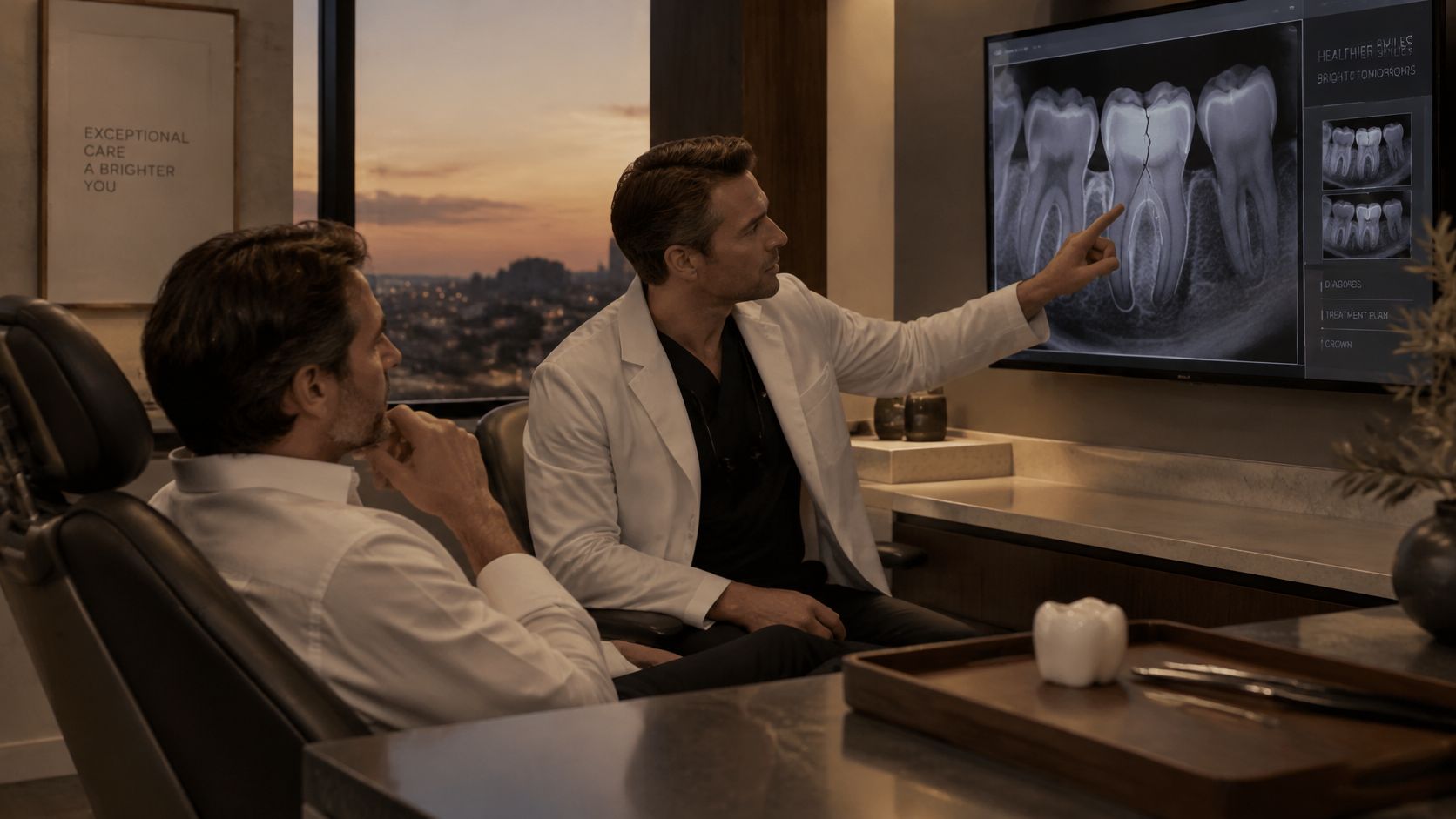
You can ask to see the tooth model and proposed crown on the screen. That can make the treatment easier to understand, especially if you're worried about what's happening while you're numb.
For another view of the process, the following video illustrates the digital crown workflow.
Is a Same Day CEREC Crown Right for Your Tooth
The starting question is whether your tooth has enough healthy structure to support a ceramic crown and whether the surrounding gums and bite are suitable. Your dentist also considers decay depth, root canal status, grinding habits, and how visible the tooth is when you smile.
A systematic review of CAD/CAM restorative treatments describes variation in outcomes across materials, indications, and clinical techniques. That supports an individualized recommendation rather than choosing a crown solely because it can be finished quickly.
Which crown route fits which tooth situation
| Situation | Usually a good fit | When another option may be better |
|---|---|---|
| Single back tooth with solid remaining structure | Often suitable after examination | Heavy structural loss may call for a buildup or consideration of an onlay |
| Front tooth with demanding shade or translucency | Possible in many cases | Complex esthetic cases may suit lab-layered porcelain |
| Tooth that needs root canal treatment first | Crown placement follows appropriate treatment and sealing | A temporary restoration or staged treatment may be needed |
| Heavy grinding or clenching | Possible with careful material selection and a night guard plan | Another material or lab-made crown may be recommended |
| Unusual or tight bite | Considered after a full bite analysis | Staged treatment or a lab-fabricated crown may fit better |
| Multiple crowns needed | Possible for some patients | Visits may be spread out for comfort or complexity |
| Tooth that cannot be saved | Not a crown candidate | Tooth extraction followed by dental implant evaluation |
Why a different recommendation can be reassuring
A lab-made crown may provide more opportunities for detailed color customization. An onlay, which covers only part of the tooth, may be preferable when a full crown would require removing healthy structure unnecessarily.
Sometimes the dentist needs to address another problem before making the final restoration. A temporary restoration or root canal evaluation isn't a failure of same-day technology. It means the treatment sequence is being matched to the tooth.
If you've been searching for a cosmetic dentist near me, explain what matters about the appearance, especially for a visible front tooth. If you're searching for dental implants near me, first establish whether the existing tooth can reasonably be preserved.
Practical rule: Same day describes the manufacturing timeline, not automatic suitability for every tooth.
Before committing, ask whether your tooth has enough structure, whether root canal treatment is needed first, and whether a lab-made crown would better suit your bite. Ask how the alternative would affect the overall cost and treatment schedule, too.
Your One-Visit Timeline From Numbing to Bite Check
A same-day crown appointment works more like a minor kitchen renovation than a takeout order. Several stages happen back to back, and each one has its own pace. For a single, uncomplicated crown, many patients are in the chair and out the door in roughly two to three hours. Complicated cases can take longer, so ask the office to confirm the time your treatment is likely to need.
Here is how a typical visit breaks down. Treat these as rough ranges, not promises, because every tooth and every schedule differs.
| Stage | Typical time | What happens |
|---|---|---|
| Exam and X-rays | Around 15 to 30 minutes | The dentist checks the tooth, gums, and bite and takes an X-ray if needed |
| Numbing and preparation | Around 30 to 60 minutes | Local anesthetic is given, decay is removed, and the tooth is shaped |
| Digital scan | Around 5 to 15 minutes | A handheld wand captures the prepared tooth and its neighbors in three dimensions |
| Design and milling | Around 30 to 60 minutes | The crown is designed on screen and milled from a ceramic block |
| Finishing and fitting | Around 15 to 30 minutes | The crown is finished and checked against the bite and neighboring teeth |
| Cementing and bite check | Around 15 to 30 minutes | The crown is secured, the bite is reassessed, and aftercare is reviewed |
Planning your day around treatment
Don't build a tight deadline around the appointment. Tooth location, the number of restorations, preparation requirements, and material processing can all stretch the schedule past the ranges above.
If your day is busy, ask whether a morning appointment would be practical. Confirm eating instructions beforehand, particularly if you're considering sedation, because those instructions may differ from a local-anesthetic-only visit.
If sedation is selected, follow the office's transportation requirements and arrange an escort when instructed. Don't assume you'll be able to drive yourself home.
What the waiting period means
The longest stretch with nothing happening in your mouth is usually the design and milling stage, which often runs about 30 to 60 minutes. That pause is the appointment's core, not dead time. The ceramic block is being carved into your crown while the design is refined on screen.
The team may use part of that window to explain the next steps, review your care instructions, or let you rest. You shouldn't feel that you have to sit through uncertainty without speaking up. Ask when you can take a break and how to signal if you're uncomfortable.
Leave room in your schedule for careful fitting. A crown shouldn't be cemented simply because the appointment is running late.
When treatment goes as planned, you leave with the final crown in place, a checked bite, and clear aftercare instructions. If the dentist finds a reason to pause or change the plan, protecting the tooth takes priority over finishing that day. Same day describes the manufacturing timeline, not a guarantee that every case wraps up in one sitting.
Same Day Crowns Versus Traditional Lab Crowns
Two patients can sit in the same chair with the same broken molar and leave with different recommendations. One may do well with a crown milled that afternoon. The other may benefit from a laboratory-made restoration, because material options or aesthetic demands can matter more than saving a visit. The deciding factors are the tooth, the material it needs, and your schedule.
| Factor | Same day CEREC crown | Traditional lab crown |
|---|---|---|
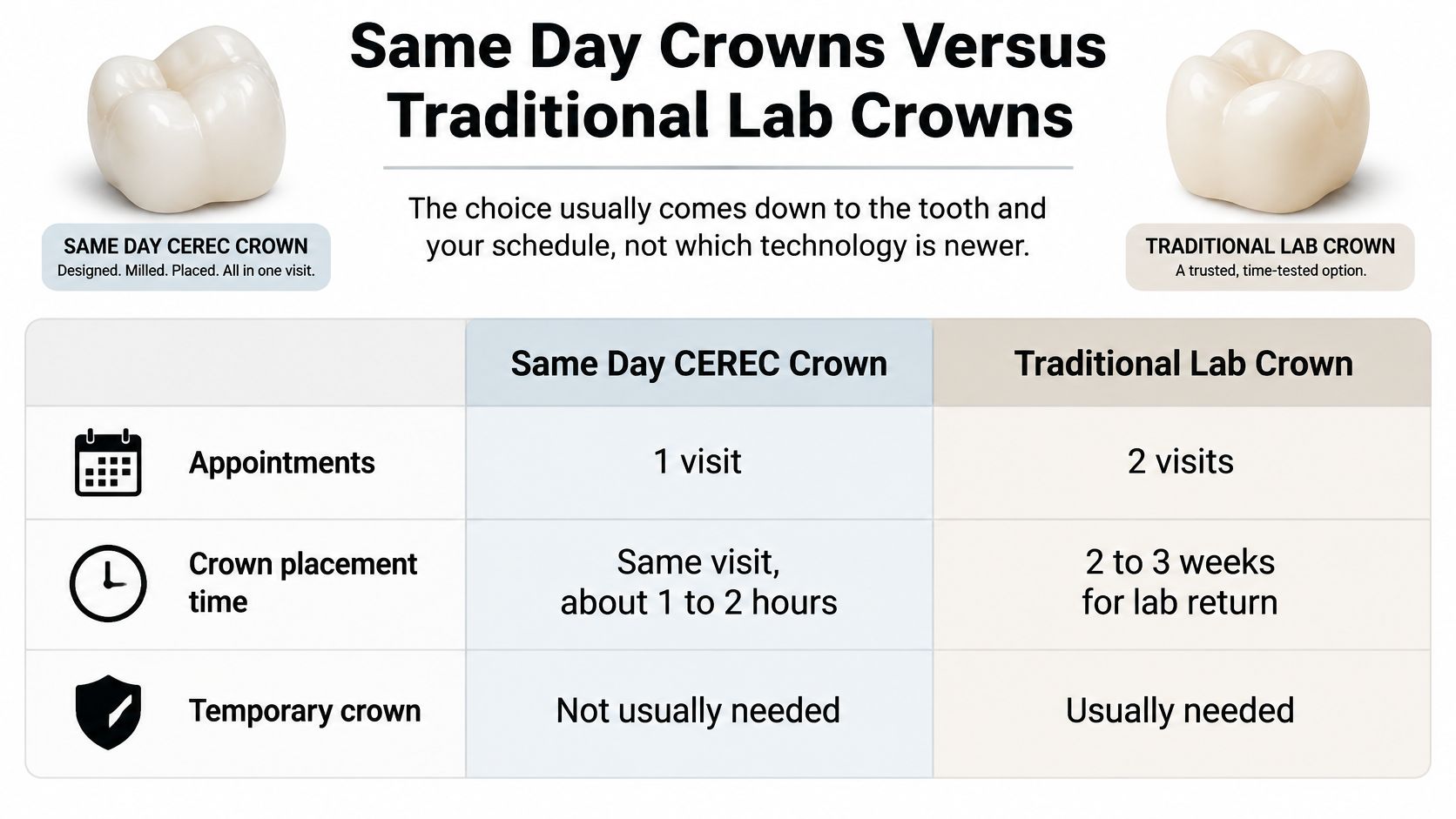
| Appointments | Preparation and placement usually occur together | Preparation and placement usually occur at separate visits |
| Temporary crown | Usually not needed in an uncomplicated completed case | Usually worn while the laboratory makes the crown |
| Impression method | Digital scan | Digital or physical impression sent to a laboratory |
| Material choice | Ceramic blocks suited to milling | Broader options, including layered porcelain and metal-based restorations |
| Fit consistency | Controlled digital workflow, with clinical checks still essential | Depends on impression quality, laboratory work, and clinical technique |
| Long-term evidence | Established evidence for CAD/CAM ceramics, varying by restoration and case | Depends on the material and restoration selected |
| Upfront cost | May be higher, with fewer visits | May be lower, but requires a separate placement visit |
The following visual summarizes the main scheduling differences. The timing shown is an illustration rather than a promise for your treatment.
What the durability evidence actually measures
When researchers report that a crown "survived," they generally mean it remained in place and functioning without needing replacement. Studies follow patients for different lengths of time, count failures differently, and track different kinds of restorations, so percentages quoted from one dataset rarely translate directly to your situation.
That distinction matters here. Much of the long-term follow-up data on CEREC ceramics tracks partial-coverage posterior restorations and earlier generations of feldspathic material, rather than the full-coverage crowns placed today. Those figures describe different restorations under different conditions, and reading them as survival rates for your crown would stretch the evidence further than it goes.
Across the datasets that do exist, reported causes of failure include ceramic fracture, recurrent decay at the restoration's edge, and problems in the underlying tooth itself. Long-term evidence for full-coverage CEREC crowns varies by ceramic material, tooth position, and individual factors such as grinding. The practical lesson: ask your dentist what the evidence looks like for the specific material and tooth being discussed, and remember that both the restoration and the tooth beneath it need ongoing care.
Fit still needs verification
A systematic review comparing CAD/CAM and conventionally fabricated ceramic crowns found generally favorable marginal and internal adaptation for CAD/CAM crowns, but the pooled difference wasn't statistically significant. With either route, the crown's edges, seating, contacts, and bite still need careful inspection before cementation.
For someone who struggles to return for appointments, same-day treatment may offer meaningful convenience when the tooth is suitable. For someone with demanding shade requirements or heavy grinding, additional laboratory customization or a different material may justify the extra visit.
Compare the specific treatment plans your dentist recommends for your tooth. That tells you more than general promises about either method.
What a Same Day Crown Costs and What Insurance Covers
There isn't a single price that describes every same-day crown. The quote depends on the tooth, selected material, supporting preparation, and whether other treatment is needed before the crown can be placed.
Insurance can make the estimate harder to interpret. According to Humana's explanation of dental crown costs and coverage, crowns are commonly treated as major restorative care, and some full-coverage plans may pay up to 50% after applicable deductibles; annual maximums and plan rules can still leave substantial out-of-pocket costs.
That explanation also notes that same-day crowns may cost more than conventional crowns despite reducing visits. Convenience has value, but it shouldn't be mistaken for proven superior durability.
Compare the whole treatment estimate
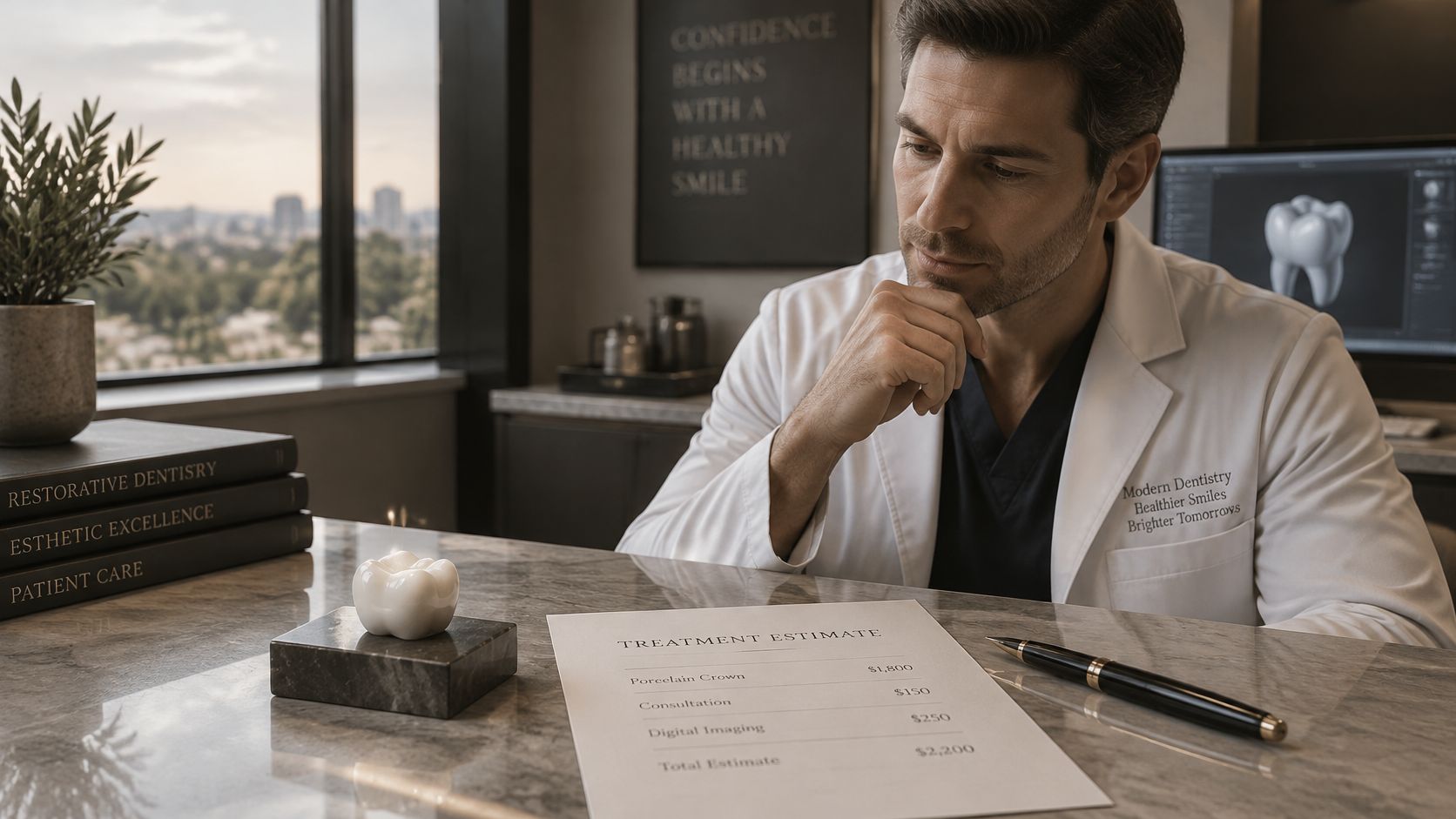
Ask for an itemized plan rather than comparing only the crown line.
- Crown fee: Confirm which material, fitting, and finishing services are included.
- Supporting treatment: Ask whether a buildup, root canal, or periodontal care is separate.
- Insurance review: Request a benefits estimate and ask whether preauthorization is appropriate.
- Annual maximum: Check how much benefit remains and what plan restrictions apply.
- Comfort options: Clarify any additional sedation or comfort-related fees.
- Follow-up and replacement: Ask how bite adjustments, repairs, or later replacement are handled.
- Personal costs: Consider transportation, missed work, and the practical expense of returning.
A lower quote may exclude treatment needed to prepare the tooth. Conversely, a higher quote doesn't automatically mean a restoration is clinically better for you.
Make the financial decision without pressure
The guide to how much a crown costs can help you prepare questions before your visit. Bring your insurance information, but remember that a benefits estimate isn't the same as a payment guarantee.
Before you consent: You should understand what's being treated, what the estimate includes, and what could change the total.
At the Cleveland and Chattanooga offices, transparent cost discussions are part of planning care. Free consultations and second opinions are available for select services, so ask whether your intended visit qualifies and whether diagnostic services carry separate charges.
Caring for Your New CEREC Crown in the First Weeks
Your tooth may feel different after treatment, particularly while the anesthetic wears off and you adjust to the restoration. Some sensitivity can occur, but don't assume persistent or worsening discomfort is something you just have to tolerate.
Follow the treating dentist's instructions, since your care may depend on the ceramic, cement, and condition of the underlying tooth.
Start gently after the appointment
- Wait for sensation: Don't eat while your mouth is numb unless your dentist specifically advises otherwise.
- Choose comfortable foods: Start with softer options and avoid testing the crown with something hard.
- Use the other side initially: Follow the team's guidance about chewing and any bonding-related restrictions.
Brush and floss carefully around the crown, using the technique demonstrated by the dental team. Ask for another demonstration if the contact feels unfamiliar or you're unsure how to clean the edge.
Avoid chewing ice, hard candy, pens, and fingernails. If grinding or clenching was part of your treatment discussion, follow through on the recommended night guard plan.
Know when to call
Contact the office promptly rather than waiting for your next cleaning if you notice:
- Biting discomfort: Pain that doesn't ease or a tooth that meets before the others.
- Movement or damage: A loose-feeling crown, rough edge, or visible chip.
- Swelling: Changes around the gum or face, particularly with increasing pain.
Don't delay urgent assessment for significant facial swelling, and seek emergency medical care if swelling affects breathing or swallowing.
Regular cleaning and exams help the dentist monitor the crown and surrounding tooth. Dental X-rays may be recommended when clinically appropriate, but no maintenance routine can promise a particular lifespan. The aim is to identify concerns while they're manageable and keep the whole mouth healthy.
Common Questions About Same Day CEREC Crowns
Does getting a same-day crown hurt?
The tooth and surrounding gum are numbed with local anesthetic before any preparation begins. You will likely notice pressure, vibration, and cool water spray during the visit, and that is normal. Speak up right away if anything feels sharp, since the dentist can add more anesthetic before continuing.
Once the numbness wears off over the next few hours, expect some tenderness in the gum near the injection site and mild sensitivity to cold or biting for a few days. This usually fades on its own. Call the office if pain throbs, gets worse instead of easing, keeps you up at night, or comes with swelling.
What if the crown feels high or chips?
A crown that feels high usually means it touches the opposing teeth slightly before the others when you bite down. It can feel like your teeth no longer meet the way they used to. Small high spots are adjusted in the office, often in a short visit. A minor rough edge or tiny chip can sometimes be smoothed and polished, while a larger fracture may mean the crown needs to be remade.
Call promptly rather than trying to file or wear the spot down yourself. When you call, describing whether the soreness happens when you bite down, when you release, or all the time helps the team plan the right fix.
How do I know whether I'm a candidate before committing?
Candidacy is decided during the examination. The dentist assesses how much healthy tooth structure remains above the gumline, how deep any crack or decay reaches, the forces that tooth absorbs when you chew, and whether you clench or grind. The tooth's position matters too, since a front tooth that shows when you smile and a back molar doing heavy work have different demands.
A crack extending below the gumline or a tooth with limited structure may suit a different material or a staged plan. Ask the dentist to walk you through the reasoning, including whether a smaller restoration could work, before you agree to proceed.
Can I choose a lab-made crown instead?
Yes, and it is a reasonable conversation to have. A lab-made crown involves a second appointment and a temporary crown worn while the lab fabricates the final one, and that temporary can occasionally loosen before your return visit. In exchange, a dental technician can layer porcelain and fine-tune the shade, which can matter for highly visible front teeth, and certain situations call for materials that chairside milling does not offer.
Weigh the trade-offs against your own priorities rather than defaulting to whichever option sounds fastest.
Book Your Same Day Crown Consultation in Cleveland or Chattanooga
If a tooth is cracked, decayed, or weakened, the next step is an examination to find out what can safely protect it. You don't need to arrive knowing which crown technology you want.
For patients looking for a dentist in Chattanooga, TN, or Cleveland, TN, the local offices combine same-day crown technology with thorough general, cosmetic, and restorative care. Laser dentistry is also available, while a comfort menu and sedation options adapted to each patient help patients discuss anxiety openly.
Make the appointment useful from the start
When you call or request a consultation online, explain which tooth concerns you and whether you're experiencing pain. Mention a broken filling, previous root canal treatment, or grinding if relevant.
Bring the information that can help the team plan:
- Recent records: Available dental X-rays or details of previous treatment.
- Insurance information: Your current plan details for benefits review.
- Medication list: Prescription medicines, supplements, and relevant health updates.
- Your priorities: Questions about comfort, appearance, cost, or scheduling.
Convenient hours and offices in both communities can make arranging care easier. Ask about transparent estimates, second opinions, and free consultations for select services when booking.
If a tooth has broken or is causing severe pain, request an emergency dentist assessment as soon as possible rather than waiting for a routine consultation. Let the office know about swelling or rapidly changing symptoms when you contact them.
Choose the local office that's easiest for you to reach, and schedule a visit to meet the team, examine the tooth, and discuss the treatment that fits.
Winn Smiles offers same-day CEREC crowns in Cleveland and Chattanooga, alongside comfort-focused care and individualized treatment planning. Visit Winn Smiles to request a consultation, describe your tooth concerns, and find out whether a same-day crown or another restorative option is right for you.