Dental veneers are durable rather than permanent: porcelain veneers commonly last 10 years or more, and about 95.5% survived 10 years in a 2021 review of 6,500 porcelain veneers, though repair or replacement may still be needed.
But if a veneer can be replaced, does that mean your original tooth can go back to the way it was? That's the question to ask before choosing a material or shade. How much healthy enamel your dentist preserves affects both the strength of the bond and whether treatment can ever be undone.
For adults searching for a cosmetic dentist near me in Chattanooga or Cleveland, TN, a helpful consultation starts with that distinction, not a promise of a flawless smile forever. Staining, small chips, and uneven edges may have different solutions, and the right plan should protect your teeth while addressing what bothers you.
Are Dental Veneers Permanent? The Honest Answer
Are veneers a one-time decision, or a lifetime arrangement? The honest answer sits in between. Dental veneers are long-lasting restorations, not lifetime guarantees, and the treatment can involve a permanent change to your tooth even though the veneer itself may eventually need replacing.
A veneer is a thin covering bonded to the front of a tooth to change its appearance, working like a slim protective shell over the visible surface. Traditional preparation usually involves removing some enamel to create room for that covering. Enamel doesn't grow back, so a prepared tooth generally needs a veneer or another suitable restoration afterward.
That's where the word permanent earns its real meaning. It describes the commitment to maintaining the prepared tooth, not an indestructible piece of porcelain.
What long-term survival figures mean
The 2021 systematic review of porcelain laminate veneers analyzed 25 clinical studies involving 6,500 veneers, calculated 95.5% cumulative survival at 10 years, and recorded 433 failures across the studies. A pooled estimate like this matters because it smooths out the differences between individual clinics, techniques, and patient groups, giving a steadier picture than any single study can.
Porcelain veneer survival by time in place
| Time in place | Estimated survival | What the figure covers |
|---|---|---|
| 5 years | The large majority still in service | Short-term follow-up consistently shows most veneers intact and functioning |
| 10 years | High survival with small differences between studies | Retrospective and prospective studies tracking individual groups of veneers |
| 10 years, pooled | 95.5% | 2021 systematic review of 25 studies and 6,500 porcelain veneers |
| 20 years | Most veneers still functioning | Long-term follow-up shows a gradual decline rather than a sharp drop-off |
These figures describe groups of restorations, not a prediction for your individual teeth. They also aren't a countdown to replacement. A veneer that's comfortable, intact, and supported by a healthy tooth doesn't need replacing just because it reaches a particular anniversary.
Survival also isn't the same as looking completely unchanged. A restoration can remain in service while needing polishing, monitoring, or attention to its appearance, so a veneer that counts as “surviving” in a study may still benefit from small touch-ups along the way.
Planning perspective: Treat veneers as an ongoing dental care decision, not a purchase you'll never need to think about again.
For patients in Chattanooga and Cleveland, TN, a decade is a useful planning horizon for discussing porcelain, not a promised expiration date. Consider whether you're comfortable with future repairs, replacement expenses, and regular examinations.
Before your consultation, compare your expected time frame with the table. If you want a cosmetic change without committing to future restorations, say that clearly before any tooth preparation begins.
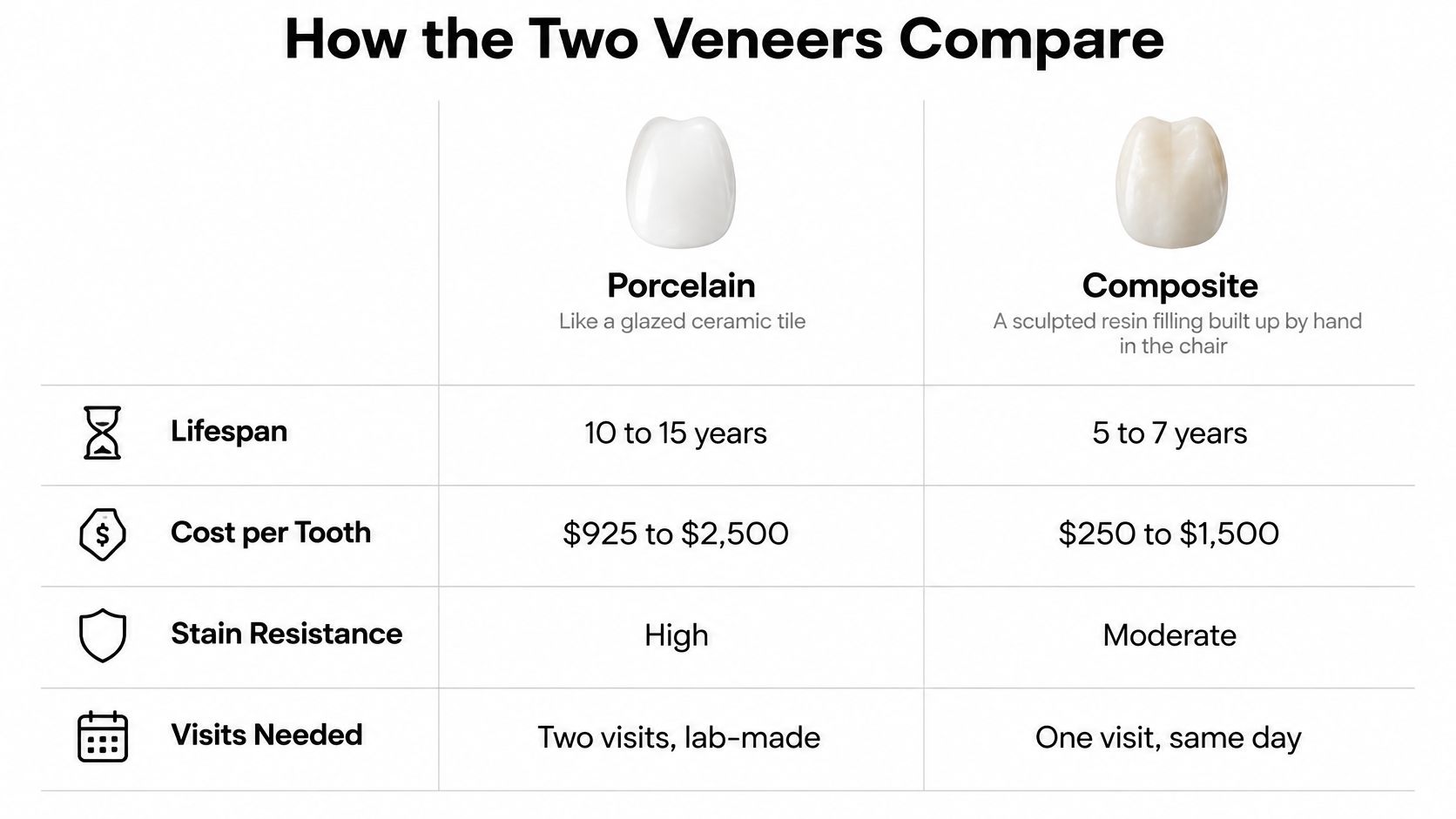
How the Two Veneers Compare
Porcelain behaves somewhat like a glazed ceramic tile, hard, glossy, and resistant to surface discoloration. Composite behaves more like a sculpted resin filling, shaped directly on the tooth and polished by the dentist.
The analogy helps explain their trade-offs, but neither material works independently of the tooth underneath. A beautifully made veneer still needs a sound bonding surface and a bite that doesn't overload it.
This visual introduces the material differences. Treat advertised lifespan and cost figures as discussion points rather than a personal quote or guarantee.
The practical trade-offs
Porcelain veneers are custom ceramic shells made outside the mouth, usually with laboratory involvement. The dentist prepares the teeth, records their shape, and later bonds the finished restorations.
Composite veneers are generally built directly on the teeth using tooth-colored resin. The dentist adds material, shapes it, checks your bite, and polishes the surface. That makes composite useful when a smaller correction or easier future repair is important.
Porcelain versus composite veneers on key criteria
| Criterion | Porcelain veneers | Composite veneers |
|---|---|---|
| Appearance | Glossy and translucent, close to natural enamel | Can look natural, but may lose polish and appear flatter over time |
| Stain resistance | High resistance to surface staining | More likely to pick up color and need polishing |
| Strength | Hard and durable, but thin edges can fracture | Softer and more prone to wear, though chips may be easier to repair |
| Chips and repair | Small defects may be repairable; larger fractures often require replacement | Material can often be added directly to repair a chip |
| Visits needed | Preparation and bonding appointments, with fabrication between them | Direct placement can often be completed in a single treatment appointment |
| Typical service life | A longer-term restoration requiring ongoing monitoring | Usually needs maintenance or replacement sooner than porcelain |
| Best fit | Patients prioritizing stain resistance and sustained shape and appearance | Budget-conscious patients or selected small chips and gaps |
Choose for your situation, not the label
Porcelain may fit someone who wants a consistent appearance across several visible teeth and values stain resistance. Composite may be appropriate for someone correcting a modest edge defect who prefers an additive approach.
Say your main concern is a small gap beside an otherwise healthy tooth. Direct bonding might solve that concern without covering the entire front surface. By contrast, changing both the shade and proportions of several teeth may justify discussing porcelain.
Composite isn't automatically reversible, and porcelain isn't automatically aggressive. Either approach can involve tooth reshaping, depending on the starting position and desired result.
A dentist should examine your teeth, gums, and bite before recommending either option. Bring this question to the appointment: Which material fits my bite, daily habits, and willingness to maintain it?
How Enamel Removal Decides Whether Veneers Can Be Reversed
Enamel is like a clean, hard glass surface that dental adhesive can grip predictably. Dentin underneath is more like damp wood: bonding is possible, but it's a different and more demanding surface.
That's an analogy, not a literal description of tooth structure. The important point is that preserving enamel supports reliable bonding, while unnecessary removal can reduce future treatment options.
The preparation area is easier to understand when you can see the tooth's layers.
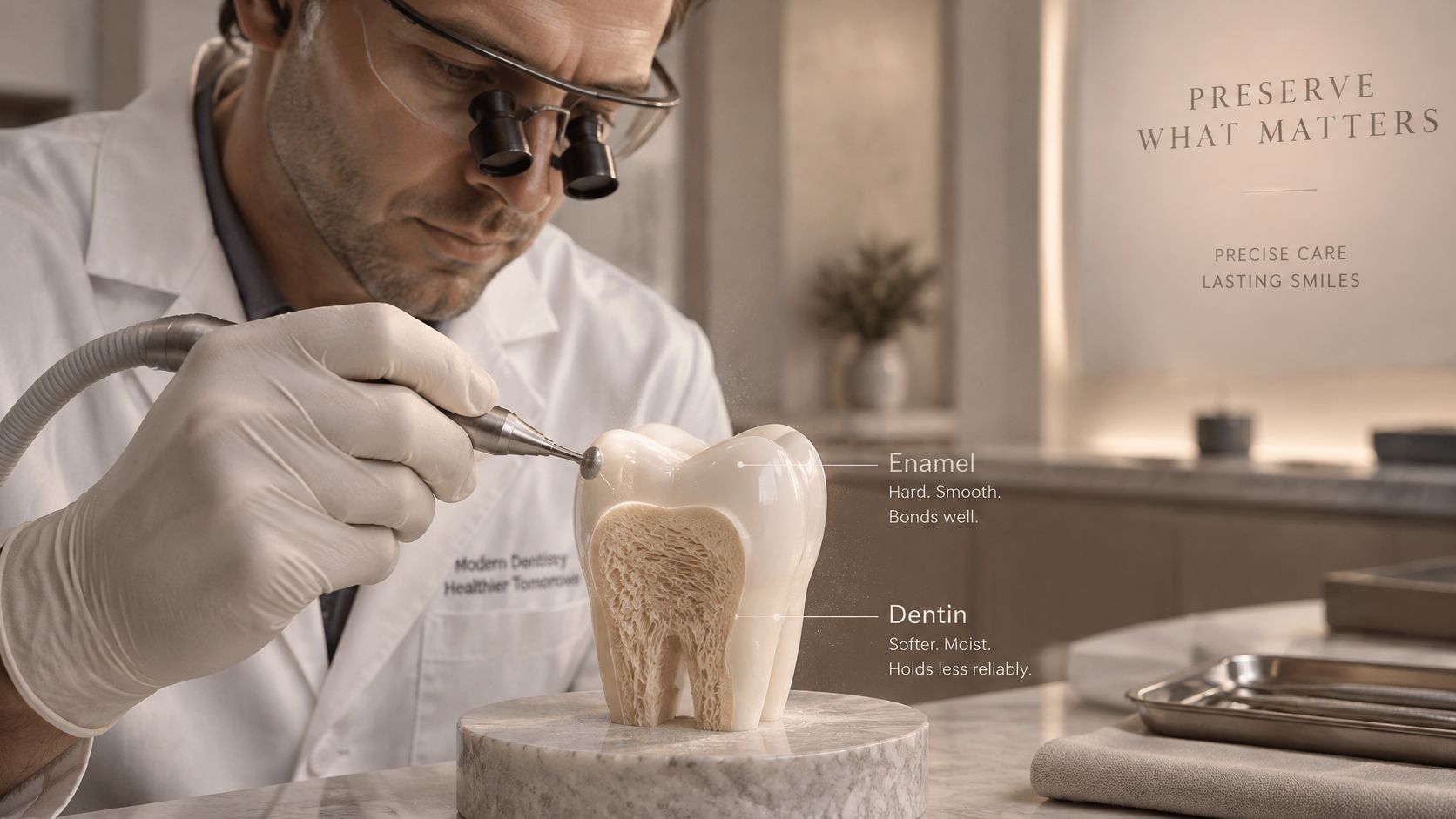
Preparation should create room, not remove tooth unnecessarily
The dentist reduces the tooth where necessary so the veneer sits naturally rather than looking bulky. The appropriate reduction is specific to the tooth, the planned material, and the final shape.
| Approach | Enamel removed | Can it be reversed? | Situations it may suit |
|---|---|---|---|
| No-preparation ceramic veneers | No intentional reduction, although finishing may still be necessary | Sometimes, after an individual assessment | Selected small or set-back teeth with room for added thickness |
| Minimal-preparation ceramic veneers | Limited, targeted enamel reshaping | Removed enamel cannot be restored | Teeth needing modest contour changes |
| Conventional-preparation ceramic veneers | More reduction to accommodate the planned correction | Generally not | Cases needing greater changes in contour or masking |
| Additive composite treatment | None or limited reshaping, according to the defect | Potentially, if enamel remains unaltered; not guaranteed | Selected chips, gaps, or small shape corrections |
A clinical review discussing enamel preservation describes a long-term study of 672 ceramic veneers with 98.4% observed survival over follow-up extending to 15 years, with 99.3% success for veneers bonded exclusively to enamel and a significant increase in failure risk when dentin exposure exceeded 30%.
Those findings support conservative planning. They don't establish a universal safe amount to remove from every tooth.
Why no-prep isn't automatically safer
Adding porcelain without making enough space can leave an overcontoured tooth. A bulky edge near the gum may be difficult to clean, while excessive thickness at the biting edge can change how the teeth meet.
A sound plan uses a diagnostic wax-up or digital design, a bite analysis, and a gum evaluation. The dentist should verify that the planned shape leaves appropriate space and preserves a sound enamel bonding perimeter whenever possible.
A conservative veneer is one that preserves tooth structure while fitting properly, not simply one advertised as no-prep.
Ask these questions before agreeing to preparation:
- Enamel preservation: How much enamel would you remove from each tooth?
- Available space: Is there room for the planned thickness without making my teeth bulky?
- Future treatment: What would you recommend if this veneer chipped or loosened?
Where Veneers Fail and the Warning Signs to Watch
Say a patient in Cleveland, TN, notices a rough corner on an upper front veneer after clenching during a stressful month. The chip may seem minor, but it deserves a dental assessment rather than an attempt to smooth it with a nail file.
Veneers can fail even when the material is strong. The dentist needs to examine the restoration, the underlying tooth, and the forces that may have caused the damage.
The bond and bite matter together
A review of long-term veneer outcomes identifies enamel bonding as an important survival factor and ceramic fracture as a leading reason for failure. A separate systematic review of veneer materials and failure mechanisms reports survival generally above 90% beyond 10 years, with fracture the primary failure mechanism, followed by debonding and color change.
In a study summarized in that latter review, estimated overall cumulative survival was 89% after a median follow-up of 9 years, with 94% for glass-ceramic veneers and 87% for feldspathic porcelain veneers. These are study-specific findings, not proof that changing material alone will produce the same difference for an individual patient.
Grinding and clenching can overload ceramic. Preparation design, bonding technique, trauma, and the condition of the supporting tooth also influence what happens.
Veneer failure modes, warning signs and usual responses
| Failure mode | Warning sign | Usual response |
|---|---|---|
| Fracture, the most common failure | Chip, crack, or rough edge | Repair a small suitable defect or replace a larger damaged veneer |
| Debonding | Veneer feels loose or a gap appears at the gum line | Assess the tooth and veneer; re-bond when suitable or replace |
| Decay at the margin | Sensitivity or a dark line at the edge | Diagnose and treat decay; replacement may be necessary |
| Color change | Dullness or yellowed or darkened edges | Identify the cause, then polish or replace when appropriate |
| Tooth pain needing root treatment | Lingering pain or heat sensitivity | Test the tooth; provide root canal treatment if indicated, then restore it |
| Wear from grinding | Flattened or shortened edges and morning jaw soreness | Assess grinding, consider a custom night guard, and restore damage as needed |
Symptoms need a diagnosis
A dark edge doesn't automatically mean decay, and sensitivity doesn't automatically mean you need a root canal. The table describes reasons to call, not conditions you can diagnose in a mirror.
If a veneer comes off, keep it safe and contact the dental office. Don't use household glue or keep biting on the exposed tooth.
Report chips, looseness, or persistent sensitivity promptly. An emergency dentist should assess severe pain, swelling, or dental trauma rather than postponing care until a routine cleaning.
Daily Habits That Help Veneers Last Longer
The veneer material can't develop a cavity, but the natural tooth beside and beneath it can. Your daily routine should protect that tooth, keep the gum line clean, and limit unnecessary biting forces.
Use this checklist as a reminder, then follow the maintenance schedule your dentist recommends for your mouth.
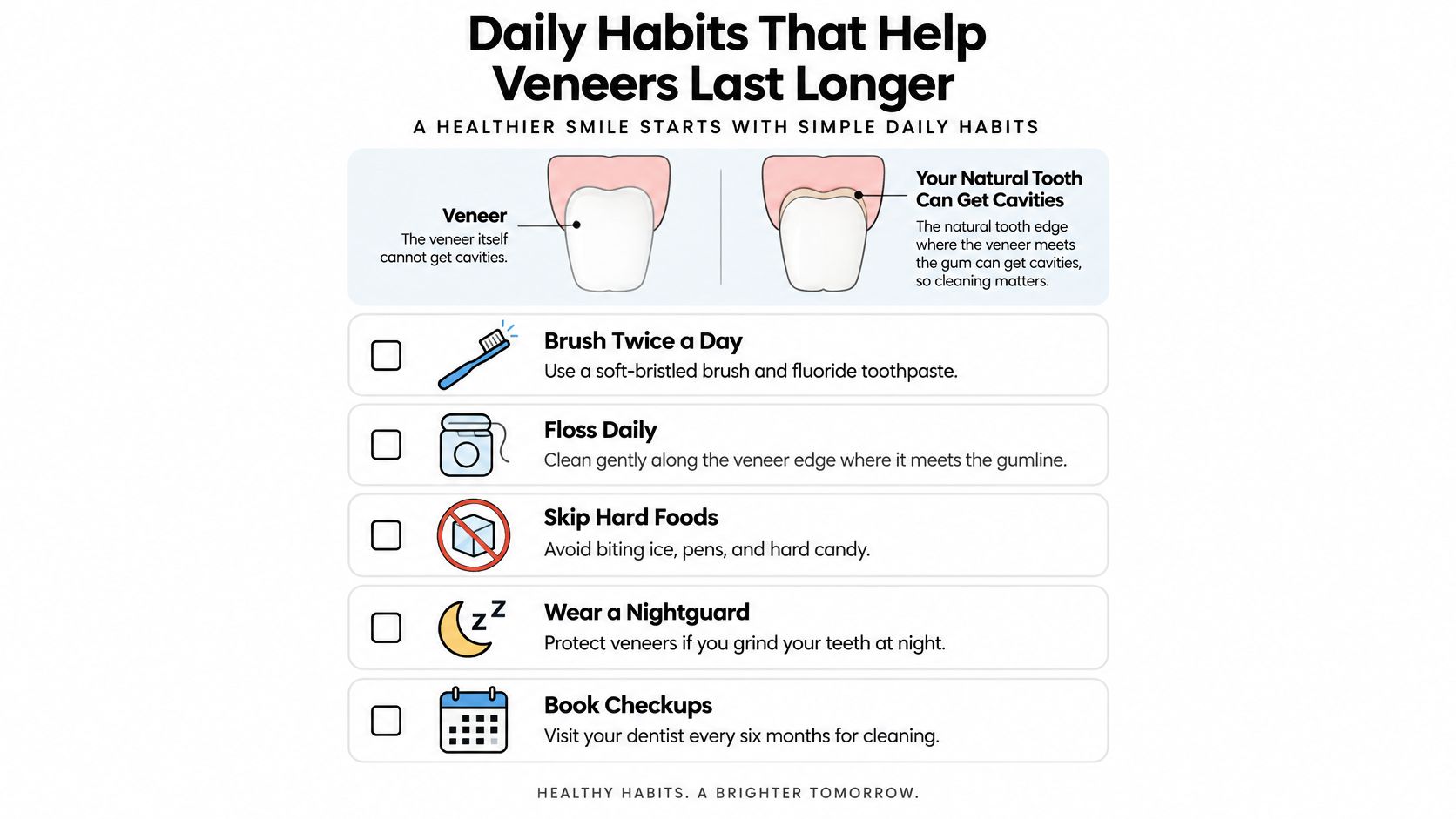
A manageable home routine
- Brush gently: Use a soft-bristled toothbrush and non-abrasive fluoride toothpaste morning and evening. Scrubbing harder doesn't clean the veneer edges more effectively.
- Clean between teeth daily: Guide floss along the tooth rather than snapping it against the gum. Ask which interdental cleaner fits if ordinary floss is difficult to use.
- Limit surface staining: Rinse with water after coffee, tea, or red wine. Avoid smoking, and don't scrub veneers with charcoal or abrasive whitening powders.
- Keep teeth out of tool duty: Don't open packages, bite nails, or chew ice with your front teeth.
- Protect against grinding: Wear a dentist-fitted night guard if prescribed, and bring it to appointments so the fit can be checked.
- Keep professional maintenance appointments: Your dentist should set the interval for cleaning and exams and recommend dental x-rays when clinically appropriate.
For a closer look at cleaning products and routines, use the practice's guide to caring for veneers. DentalHealth.com also explains ways to remove surface stains from veneers, but ask your dentist before trying a whitening product on restorations.
Make the routine fit your habits
Someone who drinks coffee throughout the day and grinds at night needs more than a whitening toothpaste. A water-rinse habit and a properly fitted guard address different risks.
At maintenance visits, the dentist can check the veneer margins, gums, and bite for changes you may not notice. Ask for a written maintenance schedule at your first visit so you know what to do at home and when to return.
This video provides an additional visual reference for veneer care.
Veneer Costs and Benefits Next to Other Options
What does a veneer really cost you per year? The sticker price only tells half the story. Veneer fees reflect the material, laboratory work, number of teeth involved, and complexity of treatment, so a useful estimate explains the proposed work rather than advertising an attractive starting price with unclear exclusions.
A lower initial fee doesn't always mean lower long-term spending. Repairs, polishing, protective appliances, and eventual replacement belong in the conversation too.
Compare ongoing costs, not just the first bill
National price ranges can give you a ballpark, but an examination of your own teeth is what turns a ballpark into a plan. Ask for a written quote and use it to compare equivalent treatment plans line by line.
Estimated veneer cost per tooth and per year
Treat the figures below as a worked example for illustration. Your own written quote will differ.
| Option | Cost per tooth in this example | Estimated cost per year |
|---|---|---|
| Porcelain veneer | $1,000 | $100 per year over a 10-year service life, before maintenance |
| Composite veneer | $500 | $100 per year over a 5-year service life, with maintenance added separately |
Read the table the way you would compare two cars. The option with the higher sticker price can cost the same per year if it stays in service proportionally longer. Dividing a quoted fee by realistic years in service is a budgeting tool, and it tells you nothing about how long either restoration will last in your mouth.
Patients planning retirement expenses may find Prime Journal's practical guidance for later-life finances useful for broader budgeting. Keep the dental estimate separate and ask the practice to clarify payment arrangements directly.
Balance the benefits against the commitment
Cost is only one side of the ledger. The other side is your enamel, because the tooth structure removed during conventional preparation is what makes a veneer permanent in the first place. A tooth that has lost enamel will always need coverage, so the central question is whether the benefits justify that lifelong commitment.
Potential benefits include:
- More uniform appearance: Veneers can coordinate tooth color, shape, and visible proportions.
- Correction of selected defects: Small chips and gaps may be addressed within a suitable plan.
- Stain resistance: Porcelain offers a surface that resists discoloration.
- Targeted coverage: A veneer can be more conservative than a full crown when the tooth doesn't need complete coverage.
Potential risks and obligations include:
- Irreversible preparation: Conventional treatment removes enamel the tooth cannot regrow.
- Sensitivity or gum irritation: These symptoms need assessment if they persist.
- Future restorative treatment: Changes in the supporting tooth may eventually require a crown or root canal treatment.
- Repeat expenses: Maintenance and replacement remain part of ownership.
The clinical patient guide to dental veneers distinguishes traditional permanent veneers from selected no-preparation or minimal-preparation options that may be reversible because they leave enamel largely intact. It also helps clarify why teeth whitening, which changes natural tooth color without adding a shell or removing enamel, may be a more appropriate starting point when color is your only concern.
Compare dental veneers and bonding before committing, since the two differ most in how much enamel they ask you to give up. Ask whether a free consultation applies to your proposed service, and request an estimate that records preparation, included care, and the replacement plan.
Confirm Your Veneer Plan with a Consultation in Chattanooga or Cleveland
Say you live in Chattanooga, TN, feel nervous about dental treatment, and want a brighter smile after years of staining. You don't need to arrive knowing whether veneers are right. You need an examination and a conversation about what you want to change.
If you're searching for a dentist near me, look for a consultation that addresses your health and comfort before discussing cosmetic treatment. A shade choice alone isn't a treatment plan.

What makes someone a suitable candidate?
Your dentist will consider:
- Healthy bonding surfaces: Enough suitable enamel and an assessment of existing fillings.
- Stable oral health: Healthy gums and no untreated decay.
- A manageable bite: Tooth position and biting forces compatible with the proposed restorations.
- Protection when needed: Willingness to address grinding and wear a prescribed guard.
- Realistic expectations: A clear understanding of appearance, maintenance, and potentially irreversible treatment.
Active gum disease and extensive decay need attention before cosmetic coverage. Heavy grinding that a patient won't protect against may make veneers a poor choice.
Veneers also aren't a substitute for missing-tooth treatment. If you're searching for dental implants near me, or you've been told you may need a tooth extraction, ask about tooth preservation and replacement options rather than covering a compromised tooth for appearance alone.
What to expect at the local practice
At the offices serving Chattanooga and Cleveland, TN, the visit sequence should give you opportunities to understand and approve the plan:
- New patient examination: The dentist checks your teeth, gums, and bite, with modern imaging and dental x-rays when needed.
- Treatment planning: You review the expected shape and shade, proposed enamel removal, alternatives, and written costs.
- Preparation and fabrication: For laboratory-made porcelain, the dentist prepares the teeth and provides temporary coverage when indicated while the final veneers are made.
- Bonding and follow-up: The dentist verifies fit and appearance, bonds the veneers, finishes the surfaces, and checks your bite. You receive maintenance instructions and a recall plan.
Comfort-menu options and customized sedation can be discussed if anxiety makes appointments difficult. Free consultations and second opinions are available for select services, so confirm eligibility and any examination or imaging fees when booking.
Your next step is a cosmetic consultation that gives you a personal answer about whether veneers fit your smile, oral health, and long-term plans.
Winn Smiles offers cosmetic dental care in Chattanooga and Cleveland, TN, with individualized planning and comfort options for patients considering veneers. Visit Winn Smiles to request a cosmetic consultation and discuss enamel preservation, treatment costs, and what maintaining your result would involve.