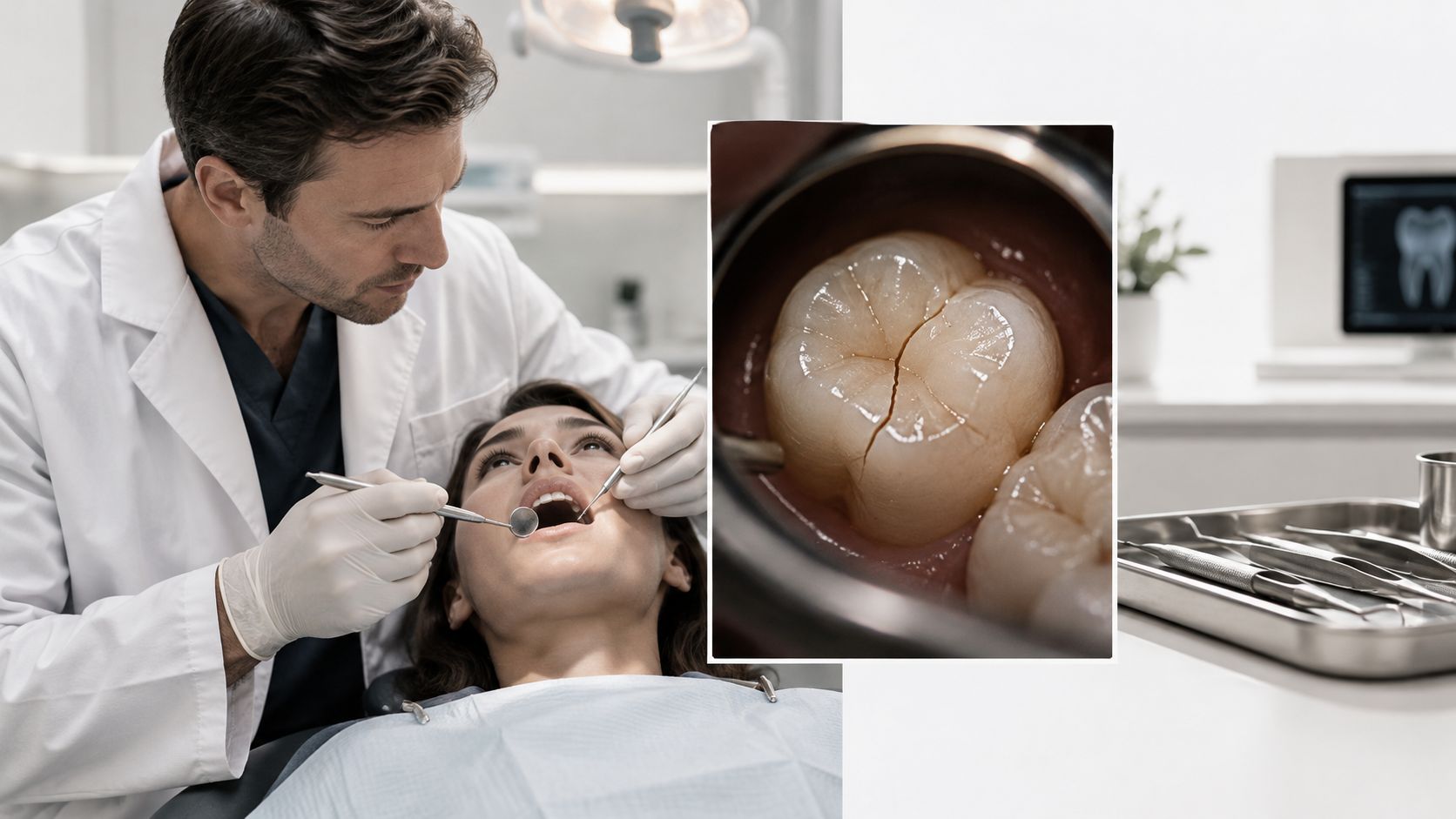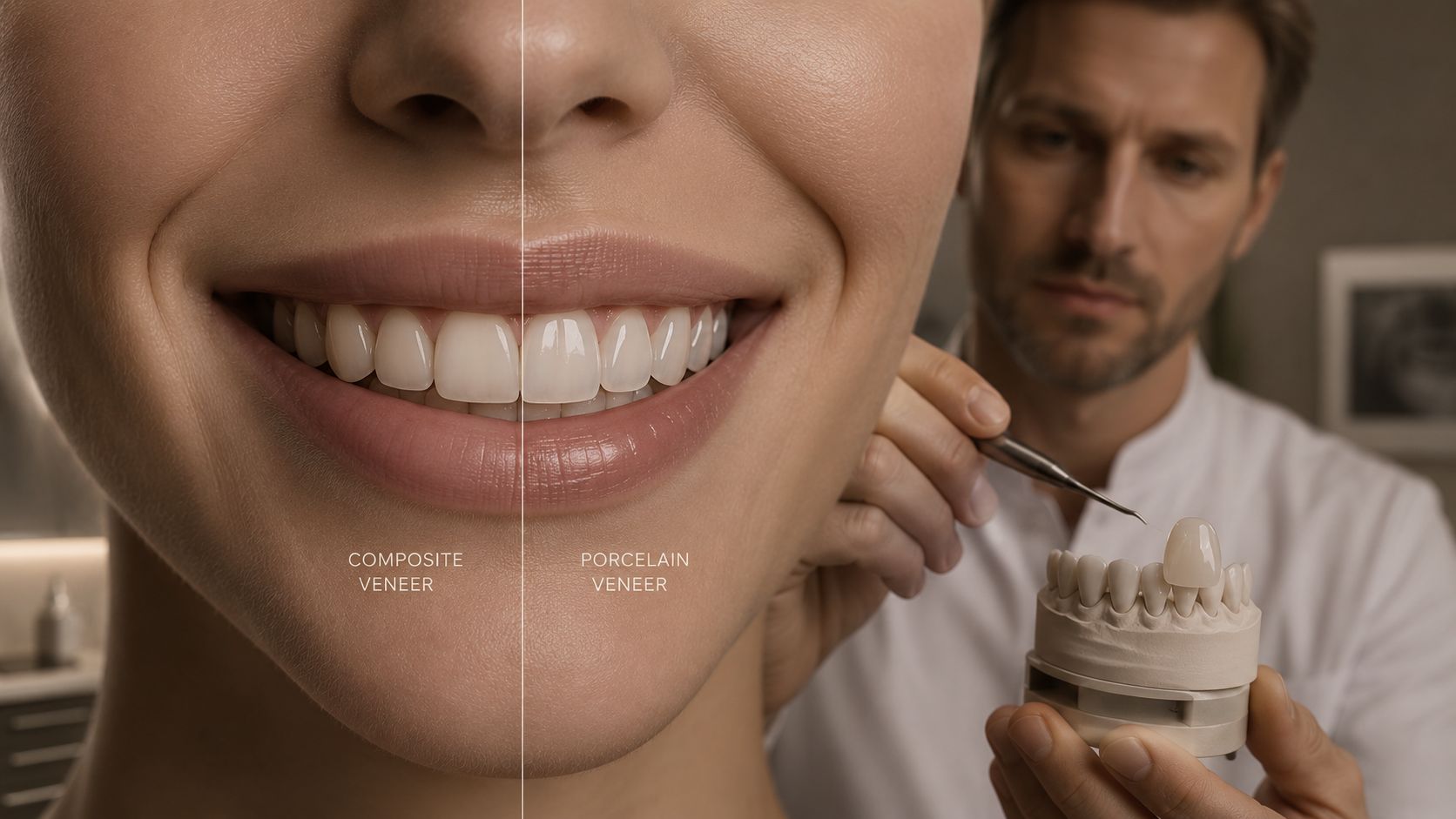
You're at the kitchen table, comparing smile makeover photos on your phone and trying to make sense of conflicting advice about composite bonding, porcelain veneers, no-prep options, and cost. The decision feels personal because it is personal. You're not just choosing a material. You're deciding how you want your smile to look, how long you want the result to last, and how much treatment fits your life.
For patients searching for a cosmetic dentist near me in Chattanooga or Cleveland, TN, the most useful starting point is a careful comparison of composite veneers vs porcelain. At Winn Smiles, this is a common consultation topic, and the right conversation should focus on your teeth, bite, oral health, budget, and expectations rather than an automatic recommendation for the most expensive option.

The practical differences come down to material, appearance, stain resistance, durability, treatment time, maintenance, and long-term value. Composite can provide a conservative and efficient smile refresh, while porcelain has the stronger long-term clinical record and a closer resemblance to natural enamel. Neither is right for every patient, and a healthy foundation matters before cosmetic treatment begins.
Finding the Right Smile Makeover in Chattanooga and Cleveland
A smile makeover consultation often begins with uncertainty. You may have one chipped front tooth, discoloration that whitening hasn't addressed, small gaps, uneven edges, or several concerns at once. Searching for a dentist in Chattanooga, TN, a dentist in Cleveland, TN, or a cosmetic dentist near me can produce plenty of polished before-and-after images, but photographs rarely explain which material was used or why it suited that patient.
The more important question is what you need the veneers to accomplish. A single damaged edge has different planning requirements from a broader cosmetic change. Your dentist also needs to check for decay, gum disease, enamel condition, bite problems, and habits such as clenching or grinding before recommending veneers.
The decision is more than a price comparison
Composite veneers are usually attractive to patients who want a faster and more conservative treatment. Porcelain veneers appeal to patients who place greater weight on stain resistance, refined light reflection, and longer service. The lower initial price of composite doesn't automatically make it the better value, just as porcelain's higher initial investment doesn't make it suitable for every smile.
Veneer treatment also isn't reversible once enamel has been removed. The American Dental Association's patient guidance on veneers explains that composite can be easier to repair when damaged, while porcelain is more resistant to staining and wear. That distinction matters when you're thinking beyond the day your veneers are placed.
Practical rule: Choose the material that fits your ten-year expectations, not only the price you see at the beginning of treatment.
At a local practice serving Chattanooga, Cleveland, and nearby Tennessee communities, the consultation should feel like a conversation rather than a sales presentation. You should be able to ask how much enamel preparation is expected, what happens if a veneer chips, how your bite affects the result, and whether another service, such as whitening, bonding, orthodontic treatment, a crown, or restorative dentistry, may address the concern more appropriately.
This guide focuses on the trade-offs between composite and porcelain, including aesthetics, procedure timelines, durability, lifestyle, and long-term cost. If you're also looking for cleaning and exams, dental x-rays, teeth whitening, an emergency dentist, tooth extraction, or dental implants near me, those needs should be considered separately because veneers only make sense on teeth that are suitable for cosmetic restoration.
Understanding Composite and Porcelain Veneer Materials
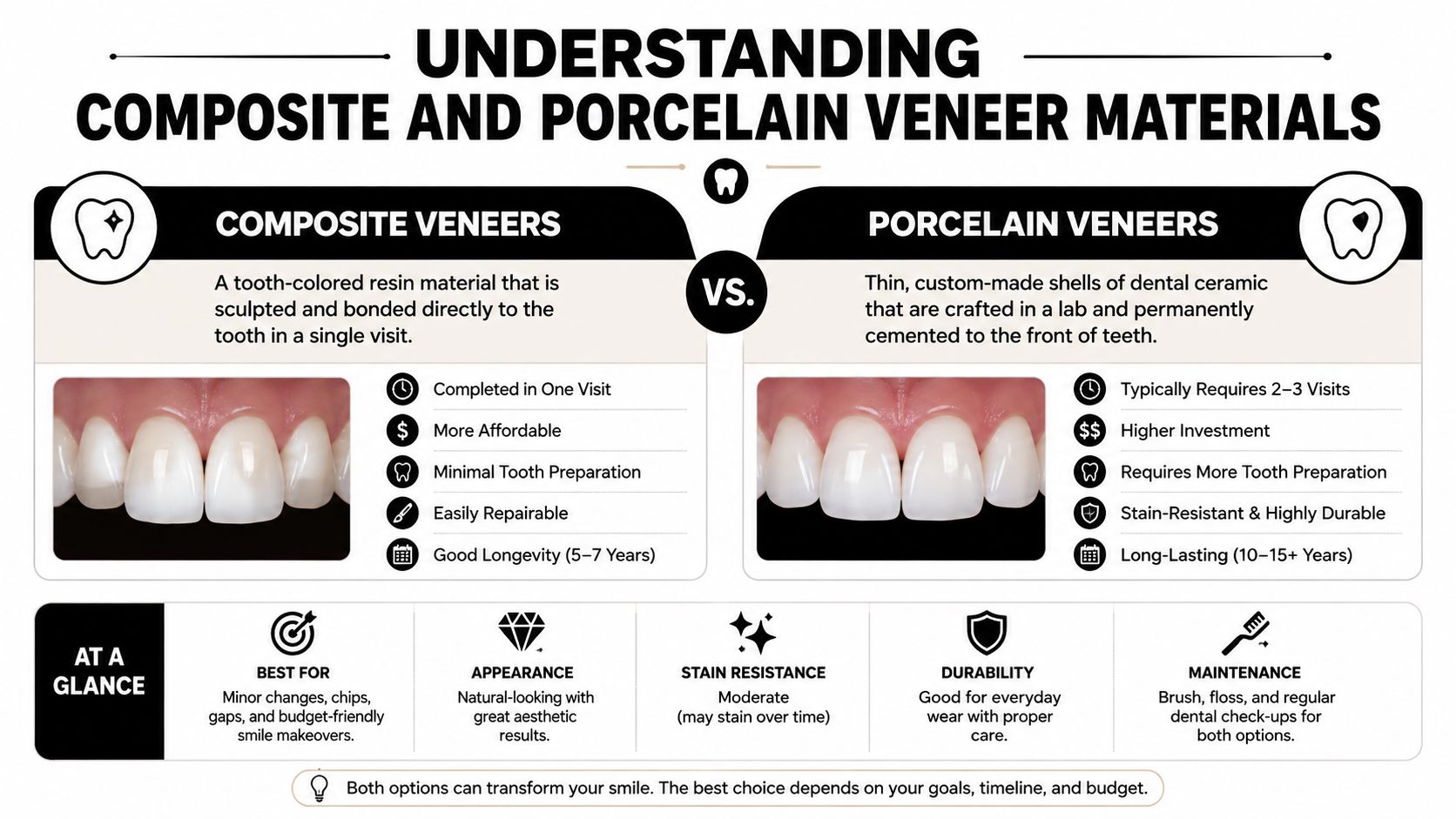
Composite veneers use a tooth-colored resin that a dentist applies directly to the tooth. The dentist builds the shape in layers, adjusts the contours to suit your smile, hardens the material with a specialized curing light, and polishes the surface. Because the work happens chairside, the dentist can make detailed adjustments during the appointment.
Composite generally requires less enamel removal than porcelain. That can make it appealing when a patient wants a conservative approach or needs a limited correction, although the treatment still requires careful planning and isn't automatically reversible if any enamel is altered.
Porcelain veneers are thin ceramic shells made outside the mouth. A dentist uses impressions or digital scans to communicate the shape, shade, and position of each veneer to a dental laboratory. The finished shells are then tried in, refined when necessary, and bonded to the front surfaces of the teeth using a more involved preparation and cementation process.
How the materials handle light
Natural enamel doesn't look flat. It reflects light from the surface while allowing some light to move through its structure. Porcelain can reproduce that combination of translucency, depth, and surface texture particularly well, which is why it often appears highly natural in close-up photographs and bright lighting.
Composite can also produce excellent cosmetic results, especially when the dentist carefully layers, shapes, and polishes the resin. Its optical behavior may not offer the same depth as porcelain, and its surface can be more vulnerable to staining and wear over time. The quality of the result depends on the material, the dentist's technique, your tooth structure, and the design of the smile.
What bonding involves
Composite is etched and bonded directly to the tooth, then shaped and cured. Porcelain requires preparation of both the ceramic and tooth surface, followed by adhesive cementation. That additional laboratory and bonding protocol can provide a precise, durable result, but it also means more planning and less chairside flexibility if the final shade or contour needs a change.
A useful clinical comparison comes from a narrow in vitro study. Researchers found no significant difference in failure loads or microleakage in certain tested situations involving porcelain veneers and composite-supported tooth conditions, and another study reported similar performance for composite resin and porcelain when replacing a fractured incisor edge up to 4 mm. These findings don't mean the materials perform identically in every patient. They show why the indication, remaining tooth structure, and bite must guide the recommendation. See the comparative clinical study on fractured incisor edges for the tested context.
Comparing Aesthetics Cost and Procedure Timelines
Patients usually weigh four issues first: how natural the smile will look, how much treatment costs, how soon the result appears, and how many visits fit their schedule. The table below summarizes the practical differences without treating either option as universally superior.
Composite vs Porcelain Veneers Key Comparison Factors
| Factor | Composite Veneers | Porcelain Veneers |
|---|---|---|
| Aesthetics | Can provide a strong cosmetic result with direct sculpting and polishing, though long-term color stability may be less predictable | Mimics enamel translucency and surface reflection closely, with stronger stain resistance |
| Cost | Often has a lower upfront cost, but exact fees depend on the number of teeth, complexity, and repairs | Usually requires a higher initial investment because of ceramic materials, laboratory fabrication, and additional appointments |
| Procedure time | Often completed directly in the dental chair, sometimes during a single treatment visit | Requires planning, preparation, laboratory fabrication, and a separate bonding appointment |
| Chair visits | Fewer visits may be needed for straightforward cases | Commonly involves preparation and final placement appointments, with temporary coverage when appropriate |
| Repairability | Damaged areas may be easier to repair or reshape directly | Significant damage generally requires replacement rather than adding new porcelain |
| Tooth preparation | May require less enamel removal | Usually involves planned enamel preparation, and removal is permanent |
Specific pricing isn't universal. Fees vary with the condition of the teeth, the number of veneers, laboratory standards, preparation needs, sedation or comfort preferences, and whether other treatment must be completed first. A responsible consultation should provide a written estimate rather than relying on a generic online figure.
Aesthetics and color stability
Porcelain has a nonporous surface that resists many types of discoloration and maintains its polish well. Composite can look natural immediately after placement, but its surface is generally more susceptible to staining and wear. Patients who drink coffee, tea, or red wine regularly may place greater value on porcelain's color stability, while patients with a limited correction may be satisfied with the appearance composite provides.
Whitening should also be planned before veneers when appropriate. Whitening changes natural enamel, not the shade of an existing veneer, so the final shade should be discussed before treatment begins.
Time and convenience
Composite can often be shaped and finished without waiting for a laboratory. That makes it useful for a patient who wants a quick improvement before an important event, provided the teeth and bite are healthy enough for treatment.
Porcelain takes longer because a laboratory fabricates the shells from clinical records. The process may include tooth preparation, digital scans or impressions, temporary veneers when needed, and a final visit to evaluate fit, shade, contacts, and bite before bonding. The extra time supports customization, but it requires more planning around work, family, and travel.
How Long Each Veneer Type Really Lasts
The longevity gap is one of the clearest differences in the composite veneers vs porcelain decision. A widely cited practical estimate places composite veneers at about 5 to 7 years on average and porcelain veneers at about 10 to 15 years or longer with proper care, as summarized in this veneer durability overview. These are planning ranges, not guarantees. A veneer's service life depends on the tooth, bite, bonding, maintenance, and daily habits.
Porcelain also has the stronger long-term clinical record in the evidence gathered. A retrospective study reported 94.4% survival at 5 years and 93.5% at 10 years, while a randomized clinical trial reported 96% survival at 10 years and 91% at 20 years in the cited literature. The same body of evidence noted that porcelain laminate veneers had already become a substantial part of NHS dentistry, with 61,696 placed in 2004/2005 and £6.2 million spent on them in the year ending March 2005. These figures describe specific historical NHS activity, not current Chattanooga or Cleveland treatment volume. The clinical review of porcelain veneer survival provides the study context.
Veneer Longevity and Survival Rates
| Milestone | Composite Veneers | Porcelain Veneers |
|---|---|---|
| Short-term follow-up | Most reviewed studies place survival at 85% to 95% during the first 1 to 3 years | Clinical studies show strong early survival, with results varying by study design and patient selection |
| Around 5 years | A British Dental Journal report summarized 78% overall survival at 2.5 years for direct composite veneers in one clinical evaluation | One retrospective study reported 94.4% survival at 5 years |
| Around 10 years | Reviews describe a decline over longer follow-up, with reported survival varying substantially | Studies reported 93.5% survival at 10 years in one retrospective study and 96% at 10 years in a randomized trial |
| Longer follow-up | Results become increasingly variable, with review findings placing survival around 50% to 75% over 5 to 10 years | A randomized trial reported 91% survival at 20 years, while a systematic review found that a conclusive estimate beyond 20 years remains unavailable |
The composite figures come from the review of composite veneer survival. The porcelain long-term outcome figures come from the prospective trial and systematic review, which reported 93% recall, 92% mean clinically acceptable at 5 years, 64% at 10 years, and 4% replacement at 10 years in the prospective trial. Those measures aren't interchangeable with survival percentages, so they should be read as separate clinical outcomes rather than combined into one promise.
Bruxism, heavy biting forces, poor plaque control, acidic or staining foods, and habits such as chewing hard objects can shorten the life of either material. Composite is generally easier to repair, while porcelain is more resistant to staining and everyday surface wear. If composite needs repeated replacement over the years, its lower starting price may not remain the lower lifetime cost.
For broader planning, patients can review this guide to how long veneers last, then discuss how their own bite and dental history change the estimate.
Choosing the Best Veneer for Your Lifestyle and Goals
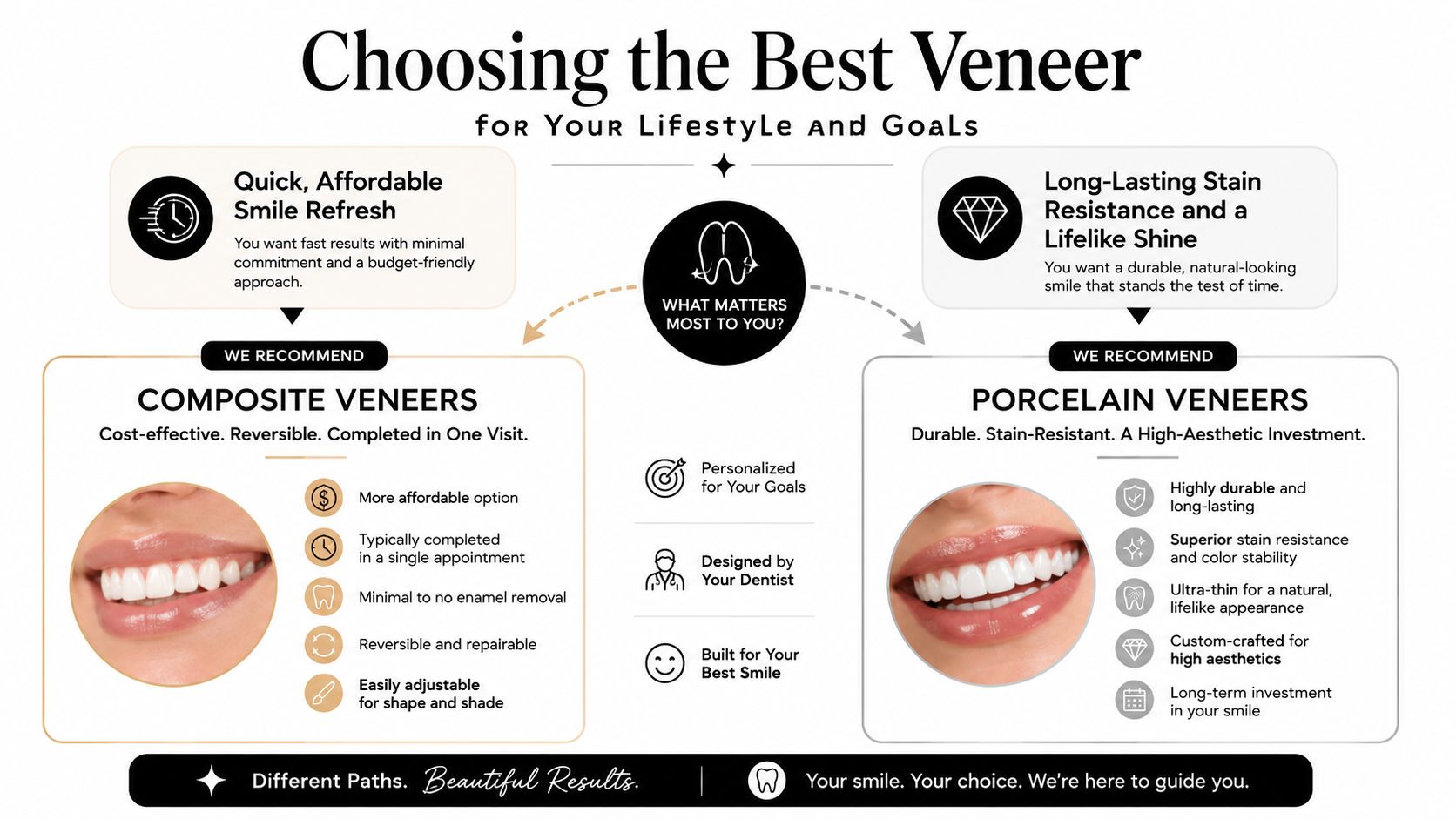
The best choice depends on what you're trying to solve. A patient with one chipped incisor may need a conservative repair, while a patient planning a broad smile redesign may care more about consistent shade, surface texture, and durability across several teeth.
Composite may fit a limited or time-sensitive change
Composite often makes sense when the priority is a quick smile refresh, a smaller correction, or a lower initial commitment. It can be useful for a patient who wants to reshape an edge, close a minor space, or see how a different tooth proportion feels before considering a more involved ceramic treatment.
Younger patients may also need a particularly careful discussion if their teeth or bite are still changing. Composite can offer flexibility, but age alone doesn't determine candidacy. Oral health, enamel, gum position, bite development, and expectations matter more than a simple label.
A professional with a wedding, interview, presentation, or other major event may value a shorter treatment path. The timing still needs to allow for examination, design, treatment, and any refinements, so last-minute cosmetic dentistry isn't appropriate for every case.
Porcelain may make sense for a long-term smile plan
Porcelain is often the stronger fit for patients who prioritize stain resistance, natural translucency, and long-term value. Daily coffee drinkers, patients who want a highly polished appearance in photographs, and people planning a larger cosmetic change may prefer ceramic's optical and surface properties.
Bruxism deserves special attention. Grinding can damage natural teeth, composite, or porcelain, so a nightguard may be recommended regardless of the material. A dentist may first need to manage the bite, evaluate muscle activity, or address worn teeth before placing veneers.
Long-term question: If you're planning to keep the same smile design for many years, ask how repairs, replacements, and maintenance affect the total investment.
The number of teeth changes the calculation. A single chipped tooth may favor composite because direct repair is practical and the treatment is limited. A broader smile makeover involving eight to ten veneers can place more weight on consistent aesthetics and durability, although the final recommendation still depends on your tooth structure and bite.
Neither material protects teeth from decay or replaces daily dental care. Brush and floss consistently, attend cleanings and exams, avoid using your teeth as tools, and ask about a protective appliance if you clench or grind. Patients can also review this practical guide to how to care for veneers before treatment.
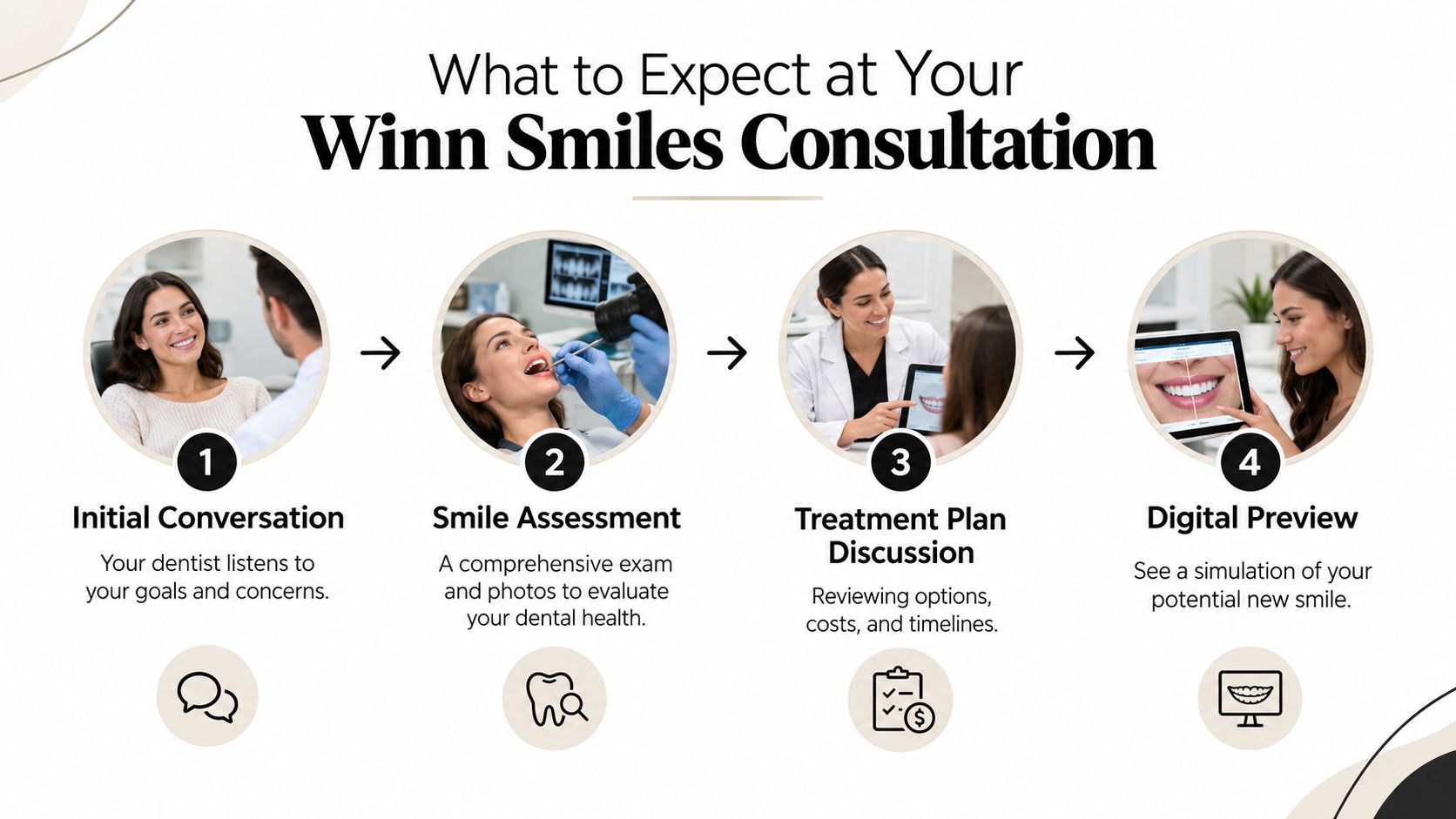
What to Expect at Your Winn Smiles Consultation
A veneer consultation should begin with your goals, not a preset number of veneers. At a Chattanooga or Cleveland visit, the dentist should ask what you'd change about your smile, what you like about it, whether you experience sensitivity, and how quickly you want treatment completed.
The clinical assessment comes next. The team may review your dental history, examine your teeth and gums, evaluate your bite, and use dental photographs, scans, or dental x-rays when they're clinically appropriate. Existing decay, gum inflammation, worn enamel, or an untreated infection may need attention before cosmetic treatment.
The planning conversation
Digital smile design can help you discuss tooth length, width, shape, and shade before treatment begins. A preview isn't a guarantee of the final result, but it gives you and the dentist a shared reference point. You should have time to ask questions and request clarification before agreeing to preparation or bonding.
Material selection should reflect your findings and priorities:
- Health and structure: The dentist confirms that the teeth and surrounding gums can support the proposed treatment.
- Design and shade: You review the intended appearance, including how the veneers relate to your natural teeth and smile line.
- Material choice: Composite or porcelain is considered in light of enamel preservation, durability, stain exposure, bite forces, and repair preferences.
- Written planning: The office explains fees, expected visits, maintenance, and alternatives before treatment starts.
Composite treatment may produce same-day results in a straightforward case. Porcelain generally involves preparation and records first, followed by laboratory fabrication and a later bonding appointment. Temporary veneers may be used during that interval when preparation requires coverage.
Comfort and aftercare
Patients with dental anxiety should tell the team early. Comfort measures, individualized sedation options, and a calm pace can make appointments more manageable, but the appropriate approach depends on your health history and the procedure being performed.
After placement, you'll receive instructions for brushing, flossing, eating, and protecting the veneers. Follow-up lets the dentist check your bite, gum response, comfort, and the polish or margins. Winn Smiles serves patients through two Tennessee locations, with cosmetic dentistry alongside general, restorative, emergency, and implant services. That local continuity can be useful if your needs extend beyond veneers, such as tooth extraction, a crown, periodontal care, or dental implants near me.
Schedule Your Veneer Consultation Today
Choosing between composite veneers and porcelain shouldn't come down to an online price alone. Your best option depends on the condition of your teeth, the appearance you want, how you use your smile, your bite, your maintenance expectations, and the length of time you want the result to serve you.
A consultation gives you the opportunity to discuss those factors without pressure. You can ask about enamel preparation, shade, repair, treatment visits, long-term maintenance, and alternatives such as whitening, bonding, Invisalign, crowns, or restorative care when those services are more appropriate.
Winn Smiles offers cosmetic consultations in Chattanooga and Cleveland, TN, with digital planning, transparent cost discussions, and comfort-focused care for patients who feel anxious about dental treatment. Ask about available scheduling at the location that works best for your family, workday, or upcoming event.
If you're still comparing options, start with a conversation rather than a commitment. A personalized examination can clarify whether composite, porcelain, or another treatment will provide the healthiest and most satisfying path to your smile goals.
Winn Smiles provides personalized cosmetic dentistry, including guidance on composite and porcelain veneers, digital smile planning, and related restorative care in Chattanooga and Cleveland, TN. Visit Winn Smiles to request a consultation and take the next step toward a smile plan built around your goals, budget, and lifestyle.