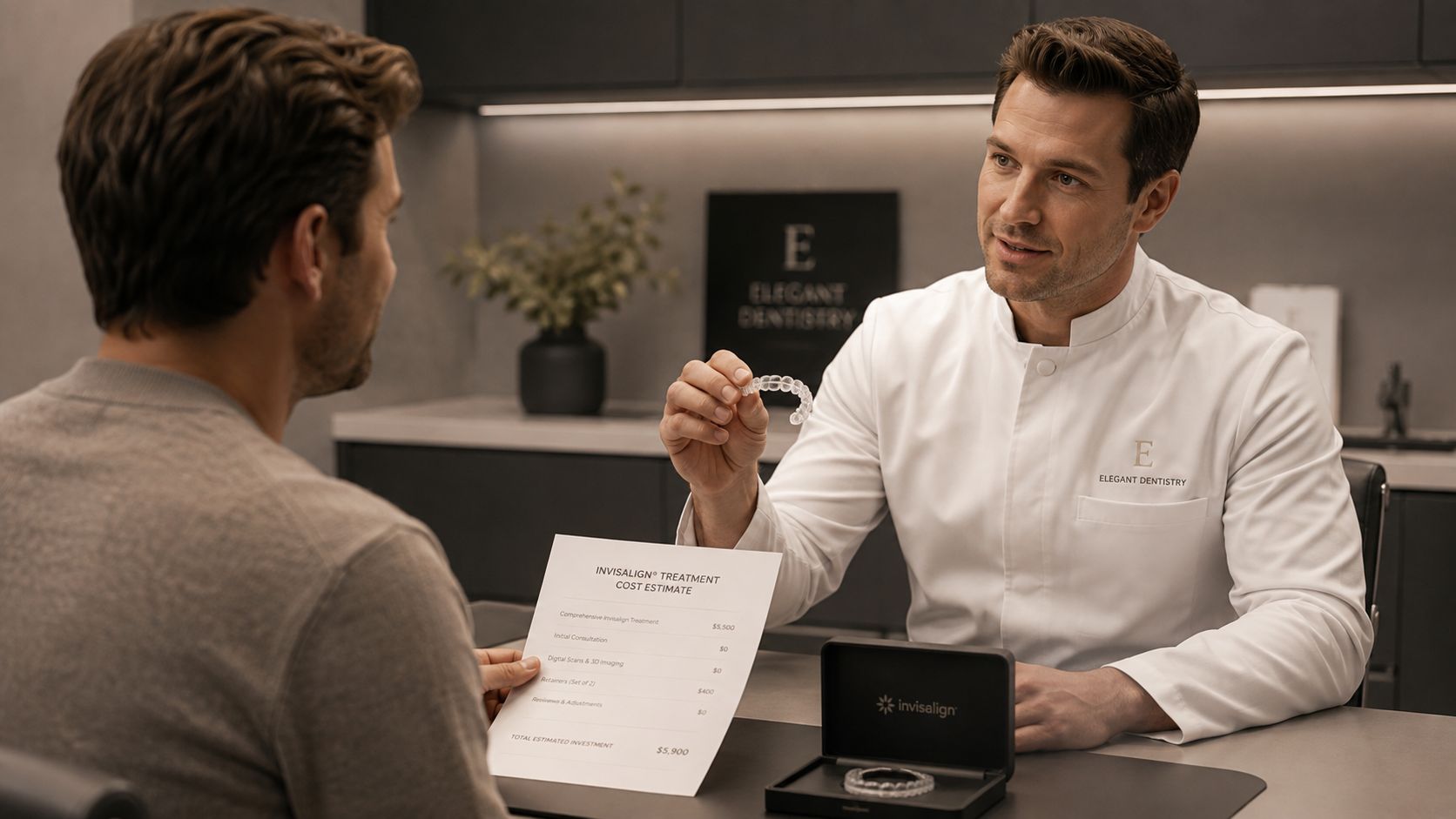
Invisalign cost for adults usually falls between $3,000 and $9,500 before insurance, and a common average is about $5,700. If you're comparing quotes in Cleveland or Chattanooga right now, that's the number to keep in your head before you let a sales pitch or a “starting at” price confuse you.
You may already have one estimate in hand, maybe two, and they probably don't match. That's normal. Adult Invisalign pricing shifts fast once you factor in case complexity, the number of aligners, insurance limits, and the costs most quotes leave out.
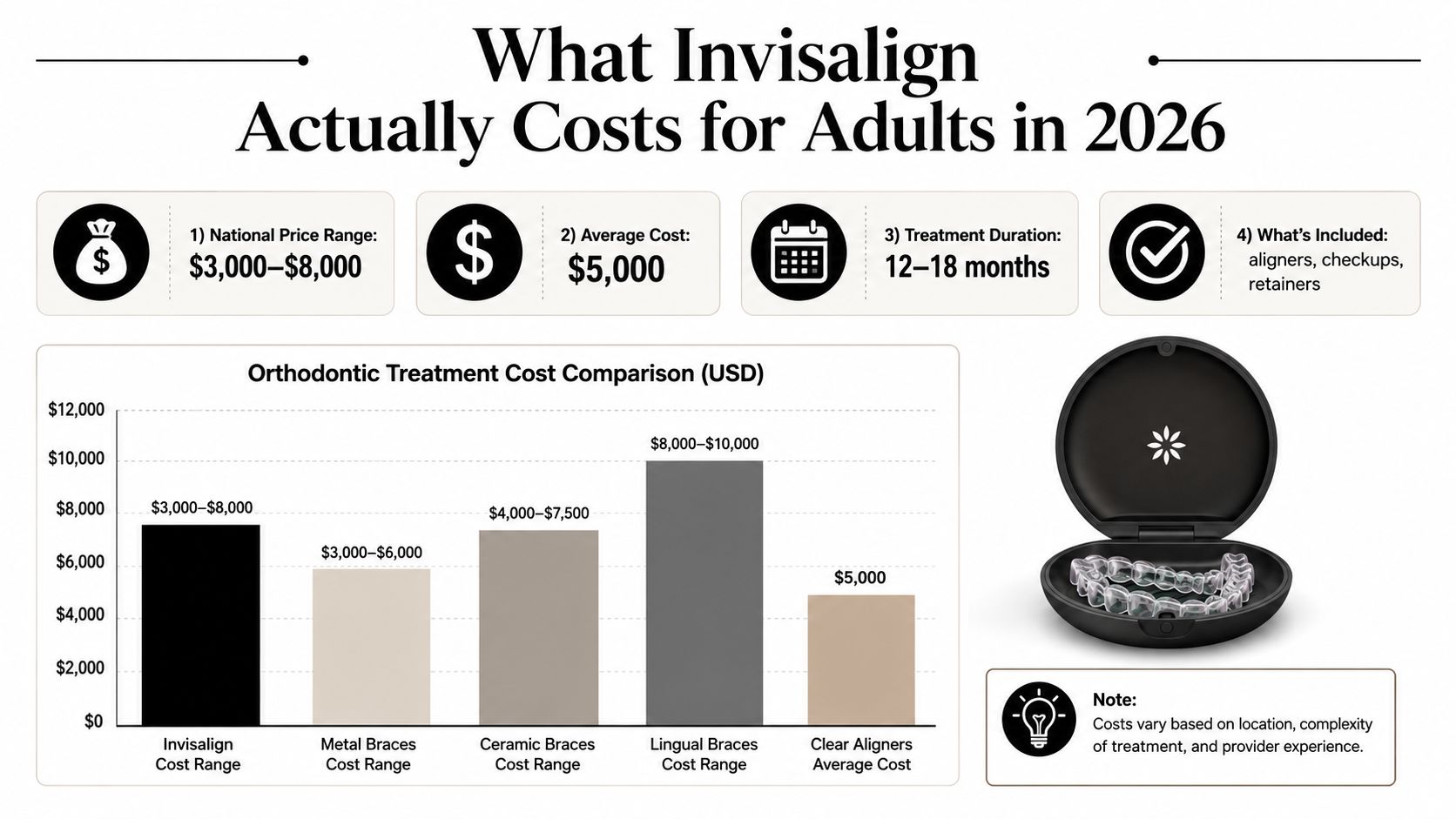
What Invisalign Actually Costs for Adults in 2026
A lot of adults get one quote, then another, and assume someone is inflating the number. Usually, that is not the case. Invisalign cost for adults changes because no two mouths need the same plan, and the pricing bands reflect that reality.
For adults in the U.S., the most commonly cited range is roughly $3,000 to $9,500 before insurance, with a commonly reported average of about $5,700 for full adult treatment (DSM Cosmetic Dentist). Invisalign's own coverage data also showed that among 112,243 U.S. patients in 2021, the average orthodontic coverage was $1,772, and 92% qualified for up to $3,000 in coverage while 77% qualified for up to $2,000. That is why the sticker price matters, but it is not the full bill.
If you are the adult sitting in a consult chair asking whether a quote is fair, the answer depends on more than the number on the paper. A simpler case may sit near the bottom of the range, while a fuller correction can land much higher even when the provider is quoting fairly.
Practical rule: compare the quote against the treatment scope, not just the starting price.
Adults who want a second opinion on clear aligners versus braces can also review Paul L. Gregory, DDS's guide to straighten your teeth in NYC. The city is different, but the decision logic is the same.
How Case Complexity Drives the Final Price
The clearest reason one adult pays a few thousand dollars and another pays much more is straightforward. Case complexity drives the cost. Small crowding and minor spacing issues are one thing. Bite correction and larger tooth movement are another.
Mild, moderate, and more advanced treatment
Independent pricing guides consistently place mild adult cases around $1,800 to $4,500, moderate cases around $3,000 to $6,500, and adult treatment around $5,000 to $9,500 (Real Dental Costs). A current U.S. estimate also puts the average full adult course at about $5,700. That spread is what you should expect when one patient needs a small cosmetic correction and another needs a full working bite plan.
A mild case usually means small gaps, slight crowding, or minor relapse after earlier orthodontics. Moderate treatment usually involves more movement, more aligners, and more check-ins. Higher-complexity treatment handles deeper bite issues, more refinements, and a larger number of aligner sets.
Why the aligner count matters
One current guide lists Invisalign Lite at about $3,000 to $4,500 for 14 aligner sets, while Invisalign Full runs about $7,000 to $8,000+ for 30 to 45 aligner sets (BetterCare). That is not just a pricing difference, it is a treatment difference. More trays usually mean more movement, more time, and more clinical oversight.
If you want a second comparison point, Inspire Dental Group has a useful clear aligner cost breakdown from Inspire Dental. It reinforces the same point, the quote only makes sense when you know what the plan is trying to move.
A dentist should be able to tell you, in plain language, whether your case is simple tooth alignment, moderate correction, or a full bite plan. That is the conversation that determines the bill.
Bottom line: if your dentist says “simple,” expect a very different number than if they say “bite correction.”
What Insurance, HSA, and FSA Cover
Most adults do not pay the sticker price. They pay the amount left after insurance, tax-advantaged funds, and any financing they use to stretch the bill out. That is the number that matters before you decide whether Invisalign fits your budget.
Invisalign says orthodontic coverage may pay up to $3,000 of treatment (Invisalign). That still leaves a real balance for most adults. I see that every week in consultation, and the final out-of-pocket amount usually comes down to the plan details, not the aligner brand.
What usually changes the final out-of-pocket amount
Insurance depends on the fine print. Deductibles, waiting periods, and orthodontic lifetime maximums all change what gets paid and what gets passed back to you. Two adults can both have dental insurance and still leave the office with very different estimates.
HSA and FSA funds help because they let adults use pre-tax dollars for qualifying dental care. That does not lower the treatment fee itself, but it does reduce the amount you are paying with after-tax money. For a lot of adults, that is the difference between a tough bill and one they can manage.
Here is the part I want every adult patient to remember. A quote near the national average can still leave you paying several thousand dollars after coverage.
That is why the published average orthodontic coverage of $1,772 does not erase a full adult Invisalign plan priced near the typical treatment range, as noted earlier with the broader cost breakdown. The provider's fee matters, but your plan's orthodontic limit often matters more.
If you want a direct comparison with another major treatment cost, read how much is full mouth reconstruction in to see how different dental plans can change the final bill. If you are comparing options in Cleveland or Chattanooga, ask for the written estimate after benefits are checked. That is the number worth judging. For a separate look at braces versus aligners, see this Invisalign vs traditional braces cost comparison.
Invisalign Compared to Braces and At-Home Aligners
Adults rarely compare Invisalign to nothing. They compare it with metal braces, ceramic braces, or a lower-cost clear aligner option. The right choice comes down to how visible you want treatment to be, how much tooth movement you need, and how much follow-up you are willing to handle.
| Option | Typical Adult Cost | Average Treatment Length | Best For |
|---|---|---|---|
| Invisalign | About $3,500 to $7,000 for many adult cases | Often 12 to 18 months | Adults who want discreet treatment and good day-to-day convenience |
| Metal braces | About $3,000 to $10,000 | Often 12 to 24 months | More complex tooth movement and cases needing fixed force |
| Ceramic braces | About $4,000 to $7,500 | Often 12 to 24 months | Adults who want a less visible fixed option |
| At-home clear aligners | About $1,000 to $7,000 overall | Varies widely | Mild cosmetic changes when the case is truly simple |
Current summaries place Invisalign in the same broad cost band as adults often expect, and more involved treatment can rise higher depending on the plan and the office handling it (Impressions Dental). Traditional metal braces are also priced in a wide range, which is why the gap between Invisalign and braces is often smaller than people think. The sticker price is only part of the decision.
For a deeper side-by-side pricing discussion, Winn Smiles publishes a helpful Invisalign vs. Traditional Braces Cost guide. If you are comparing orthodontics against broader smile-restoration spending, this how much is full mouth reconstruction in resource from All Stars Dental gives you a useful contrast.
Here is the part adults miss. Treatment length changes the total bill even when the headline fee looks similar. Longer cases usually mean more check-ins, more office time, and a higher chance of refinements or replacement trays, so the cheapest-looking option can become the pricier one once the full course of care is finished.
In my view, Invisalign is the better fit for adults who want a clean look and fewer day-to-day tradeoffs. Braces still make more sense when the case is tougher, especially if the teeth need significant movement that fixed appliances handle more predictably.
The Hidden Costs Most Invisalign Quotes Skip
A quote can look clean on paper and still miss real expenses. That's the trap. Adults get the number, relax for a minute, and then find out the final bill includes things the original quote didn't spell out.
What often gets left out
Replacement aligners matter if one gets lost or damaged. Refinement trays matter if the teeth don't track perfectly the first time. Retainers matter after treatment because teeth don't stay straight on hope alone.
GoodRx points out a gap most adults don't notice, many price guides discuss the treatment range but don't clearly explain the add-ons that can change the total bill (GoodRx). That includes the post-treatment phase, where retainers and occasional refinements can add to the overall cost. The cheapest quote is only the cheapest quote if it includes everything you need.
What to ask before you sign
- Are refinements included? If not, ask how extra trays are priced.
- Are retainers included after treatment? If not, budget for them separately.
- What happens if I lose a tray? Replacement costs can change the final total.
- Is the plan flat-rate or case-by-case? Flat-rate pricing is often easier to compare.
The reason I push this so hard is simple. A lower headline fee can turn into a higher real cost if it excludes the things adults almost always need by the end of treatment.
The smartest adults don't ask, “What's the cheapest quote?” They ask, “What will I actually pay from start to finish?”
For another practical breakdown of patient spending, Winn Smiles has a guide on out-of-pocket dental costs. That's the right mindset for Invisalign too.
Invisalign Pricing in Cleveland and Chattanooga
Local pricing usually tracks the national range, but not perfectly. Cleveland and Chattanooga adults still see the same core forces at work, case complexity, insurance coverage, and treatment length. What changes is how the practice structures the quote and how clearly it explains what's included.

At Winn Smiles, adults in Cleveland and Chattanooga can get a free Invisalign consultation and a second opinion, which matters if they're comparing a quote that looks incomplete or hard to interpret. That kind of visit is useful because it turns a vague estimate into a concrete treatment plan with a real discussion of cost, timing, and alternatives.
Local pricing often reflects three things. First, the amount of movement needed. Second, the practice's technology and workflow. Third, whether the provider is offering a simple cosmetic correction or a more complete orthodontic course.
If you want to compare your own situation, pay attention to the language used in the plan. Mild alignment, moderate correction, and treatment are not interchangeable labels. They point to very different cost buckets.
[iframe width="100%" style="aspect-ratio: 16 / 9;" src="https://www.youtube.com/embed/ZUPq3C5M1bE" frameborder="0" allow="autoplay; encrypted-media" allowfullscreen][/iframe]
Adults in Chattanooga often want one thing above all else, a clear answer without a hard sell. Adults in Cleveland usually want the same thing. A free consult helps both, because it gives you a written estimate, a chance to ask about financing, and a second set of eyes on whether Invisalign is the right fit.
Adult Invisalign Questions Answered Before You Commit
Do monthly payment plans exist? Usually, yes. A quote near the average treatment cost is much easier to handle when the balance is spread out instead of paid all at once. Ask for the monthly payment and the full fee, because a low monthly number can still hide a higher total bill.
Does insurance treat Invisalign like braces? Often, it does. Orthodontic coverage usually applies to treatment, not just the appliance, and the limit is your plan's orthodontic maximum. Adults with dental insurance still need to verify the benefit before they assume most of the fee will disappear.
How long does adult treatment usually take? For many adults, the realistic window sits in the 12 to 18 month range, and some cases finish sooner while others need more time. What shortens treatment is clean tracking, steady wear, and a bite that responds well. What stretches it out is missed wear time, slow tooth movement, and bite corrections that need extra refinement. Your schedule is set more by how your teeth respond than by the aligners themselves.
What if my teeth don't finish on schedule? Refinements usually come into play. That is normal in adult orthodontics when a tooth tracks slowly or the bite needs a final adjustment. Ask whether refinements are included before you start, because that detail changes the cost and keeps the final bill from creeping up later.
Your Next Step Toward a Confident, Straight Smile
If you're in Cleveland or Chattanooga and comparing Invisalign quotes, stop guessing and get a real consultation. Bring your current dental insurance card, your list of medications, and any questions about payment, because a good visit should include a scan or exam, a conversation about your bite, a clear cost estimate, and straight answers about refinements, retainers, and financing.
At Winn Smiles, that conversation starts with a digital scan of your teeth and a review of what your bite needs. You leave with a treatment plan you can compare, not a vague promise and a number that changes later.
Book a free Invisalign consultation with Winn Smiles if you want a clear, local price and a treatment plan you can compare. Adults in Cleveland and Chattanooga deserve a straight answer about cost, timing, what's included, and what the scan shows, and that's what Winn Smiles is set up to provide.