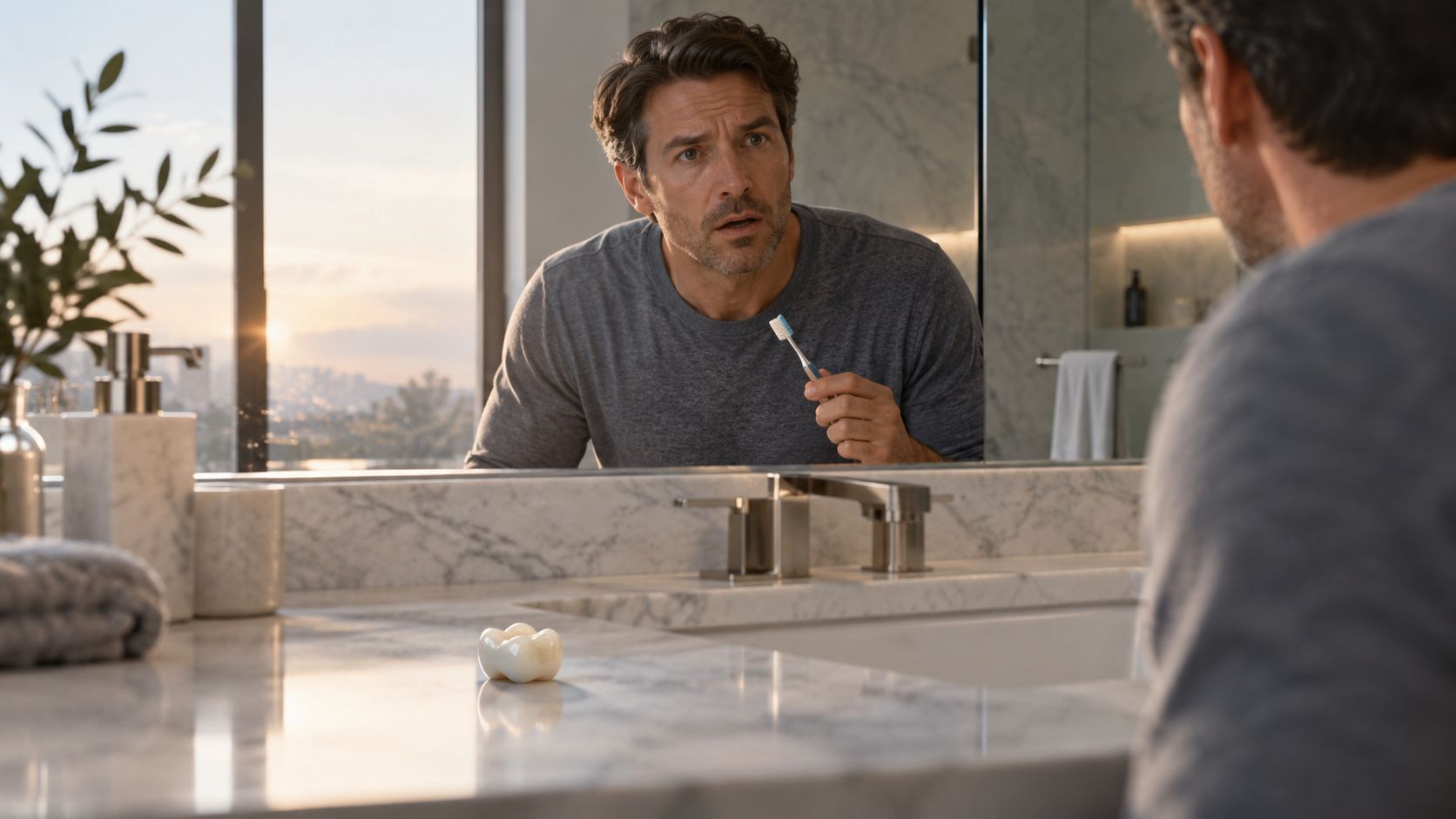
You're brushing your teeth before work in Chattanooga or finishing breakfast in Cleveland when you notice something hard in your mouth that shouldn't be there. You spit into the sink and see your crown. If your root canal cap fell off, the first reaction is usually panic, followed quickly by one big question: Is this an emergency?
In most cases, it's fixable. But it does need prompt attention. A root canal treated tooth can look fine and still be vulnerable once the crown comes off, especially because that tooth may not warn you with normal pain. If you're searching for a dentist near me, an emergency dentist, or a dentist in Chattanooga, TN or dentist in Cleveland, TN, the safest move is to treat this as time-sensitive and protect the tooth until you can be seen.
What to Do When Your Root Canal Cap Falls Out
It often happens in a completely ordinary moment. Someone bites into toast, chews on the side they always use, or notices a strange hollow feeling while flossing. Then the cap is suddenly in their hand, and the exposed tooth underneath feels unfamiliar, rough, or “not right.”
That shock is understandable. People often worry they've ruined the tooth, swallowed something important, or need a major procedure right away. Most of the time, the right next step is much calmer than that. Save the crown, protect the area, and call for care as soon as possible.
What matters in the first few minutes
If the crown came off cleanly and the tooth underneath doesn't look badly broken, that's encouraging. If the crown is still intact, a dentist may be able to recement it after checking the fit and the tooth underneath.
If the exposed tooth feels sharp, looks dark, or seems smaller than you expected, don't assume that means the tooth is lost. It may mean part of the build-up or cement came away with the crown. What matters is avoiding more pressure on that tooth until it's examined.
Practical rule: If a root canal cap fell off, don't test it by chewing “just to see if it's okay.”
The safest first response
Patient instructions from emergency dental guidance are consistent. Retrieve the crown, rinse it, avoid chewing on that side, and arrange same-day or next-day re-cementation when possible, based on emergency crown guidance for a lost dental cap.
That's the mindset to keep. Stay calm, don't force anything back into place, and don't let “it doesn't hurt” talk you into waiting.
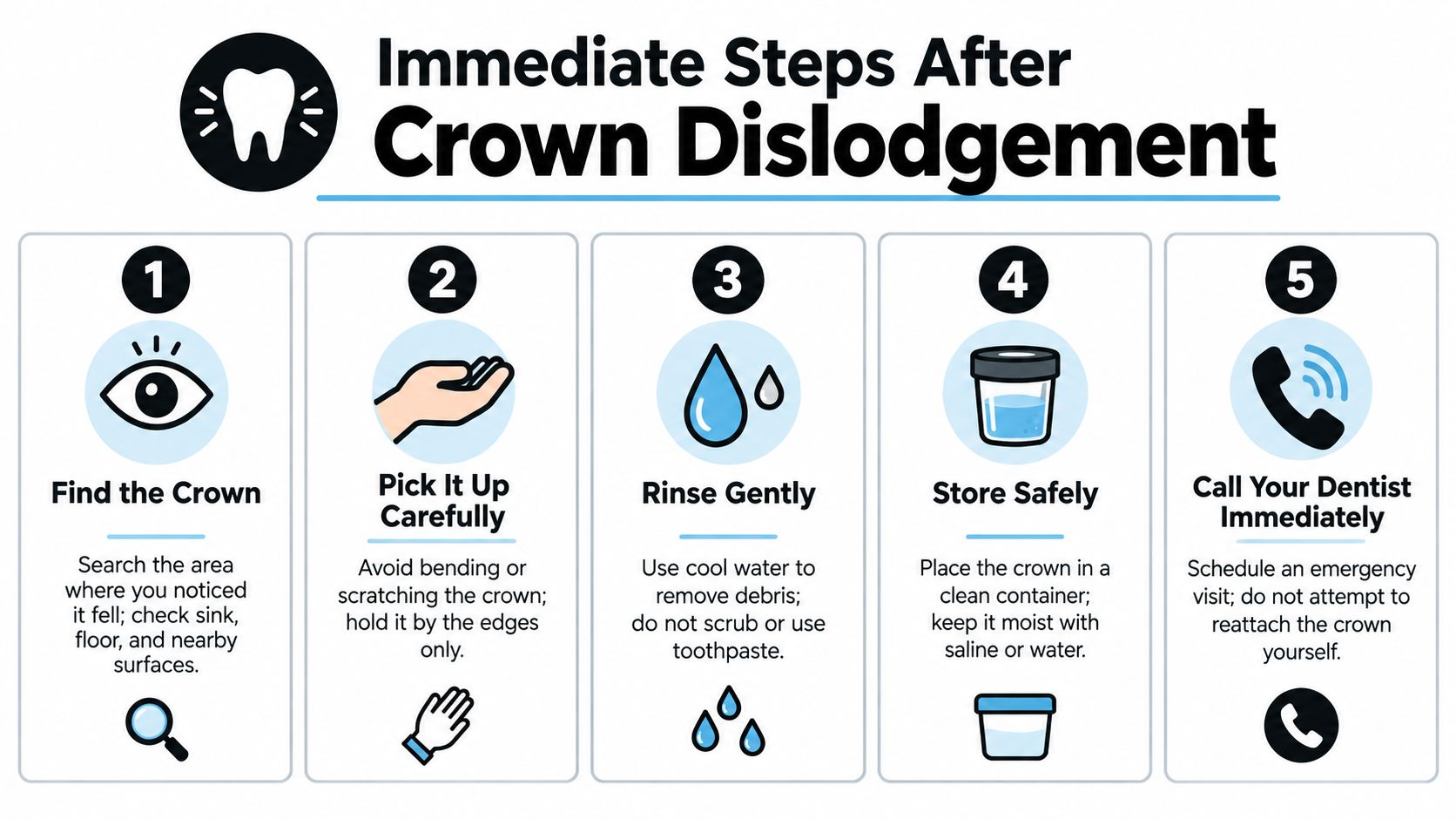
Immediate Steps to Take After Crown Dislodgement
The first few hours matter because this is when patients often make the mistake that turns a manageable repair into a more complicated one. The goal isn't to fix the crown yourself. The goal is to protect the tooth and preserve the crown for professional evaluation.
Do these steps in order
Find the crown.
Check the sink, napkin, plate, floor, or the food you were eating. If you still have it, bring it to your appointment.Rinse it gently.
Use cool water only. Don't scrub the inside, and don't use toothpaste, bleach, or soap.Store it safely.
Put it in a clean container so it doesn't get cracked, lost, or accidentally thrown away.Keep pressure off the tooth.
Chew on the opposite side. Choose softer foods and avoid anything hard, sticky, or crunchy.Call promptly for an emergency visit.
Even if the area isn't painful, the exposed tooth should be checked quickly.
What not to do
A few home fixes create more problems than they solve.
- Don't use super glue or household adhesive. Those products aren't made for oral tissues and can interfere with proper dental bonding.
- Don't force the crown back on. If it doesn't seat easily, pushing it can damage the crown or the tooth.
- Don't keep touching the tooth with your tongue. People do this without realizing it, but repeated pressure can irritate the area.
- Don't delay because you're busy. A root canal tooth can be compromised even when it feels normal.
If the crown fits passively, with no rocking or gap, temporary dental cement may serve only as a short bridge until definitive care, according to patient emergency instructions for a crown that has come off.
A note on temporary crowns
Temporary crowns come off more often than permanent ones. One compiled estimate reports that about 10% to 16% of temporary crowns dislodge before the permanent restoration is delivered, with broader ranges around 6% to 20%, based on compiled reporting on temporary crown loss. That doesn't make it harmless. It means the key mistake is usually waiting too long to have it replaced.
Why Prompt Professional Care Matters Even Without Pain
The hidden danger with a lost crown on a root canal tooth is simple. No pain does not mean no problem. In fact, that lack of pain is one reason patients wait longer than they should.
Why root canal teeth can be misleading
A tooth that's had root canal treatment often won't send the same pain signals a live tooth would. That can create false reassurance. Patient-facing guidance repeatedly warns that when a crown falls off, you should retrieve it, avoid chewing on that side, and contact a dentist promptly because the situation is still treated as a same-day or 24 to 48 hour issue, even when it doesn't hurt, as noted in guidance on a crown falling off a root canal treated tooth.
After root canal treatment, the tooth should also be restored as soon as possible to help prevent coronal leakage into the root canal system and reduce the risk of fracture, according to the American Association of Endodontists clinical guide.
Why the crown matters so much
A crown on a root canal treated tooth isn't cosmetic trim. It is part of how that tooth stays functional over time.
A long-term benchmark is strong but not permanent. A 2009 systematic review found 95% of crowns remain in the mouth for at least 5 years, while longer-term survival at 15 to 20 years ranged from 50% to 80%, and a separate review summarized by NCBI reported survival rates of 94% at 2 to 4 years, 94% at 4 to 6 years, and 97% after more than 6 years for root canal therapy plus restoration, according to PubMed data on restored endodontically treated teeth.
A national dental practice research network analysis found that placing a crown after root canal treatment was associated with 5.3 additional years of median tooth survival compared with no crown placement, based on practice-based research on crowns after root canal therapy.
A root canal tooth can be silently vulnerable. The crown is often what stands between a stable bite and a fracture or leakage problem.
What can happen if you wait
Professional care matters because a dentist has to answer several questions you can't answer at home:
- Is the crown still usable
- Is there decay under the crown
- Did the build-up come out with it
- Is the tooth cracked
- Has the fit changed enough that recementing would fail
That's why a missing crown belongs in the emergency dentistry category, even if you were originally searching for a routine dentist in Chattanooga, TN or dentist in Cleveland, TN rather than an urgent visit.
Temporary Home Fixes and Their Limitations
Home products can help for a very short window, but they have one job only. They protect the exposed area until you get professional care. They do not restore full strength, full seal, or full chewing function.
What can be reasonable at home
If the crown comes off and it appears intact, some emergency instructions allow temporary dental cement when the crown fits passively and doesn't rock. That's a stopgap, not a repair. If the crown doesn't settle easily, leave it out and protect the tooth instead.
If you're dealing with a temporary restoration rather than a permanent one, careful short-term management matters even more. For practical tips on eating, cleaning, and protecting the area, this guide to temporary crown care is useful.
Temporary vs Professional Repair Options
| Option | Duration | Safety | Effectiveness |
|---|---|---|---|
| OTC temporary dental cement | Very short-term bridge until dental visit | Can be reasonable if used exactly as directed and the crown fits passively | Limited |
| Leaving the crown off and protecting the tooth | Short-term only | Safer than forcing a bad fit | Protects but does not restore function |
| Denture adhesive or household glue | Not appropriate | Unsafe or unreliable | Poor |
| Professional recementation | Definitive if crown and tooth are suitable | Highest safety | Strong when the fit and underlying tooth are sound |
| New crown or new build-up | Definitive when old crown can't be reused | Highest safety | Best when underlying structure has changed |
Where people get into trouble
The biggest mistake isn't usually losing the crown. It's acting like a pharmacy product solves the problem. Temporary materials can wash out, trap debris, or hide a deeper issue underneath.
If there's swelling, a bad taste, visible fracture, or the crown no longer fits, skip home experimentation and seek an emergency dentist right away. If the tooth ultimately can't be restored, your dentist may need to discuss tooth extraction, restorative dentistry, or even dental implants near me as the next step.
What to Expect During Your Emergency Visit
Most patients feel better once they know what will happen at the appointment. An emergency crown visit is usually straightforward, and the first goal is to protect the tooth before more damage occurs.
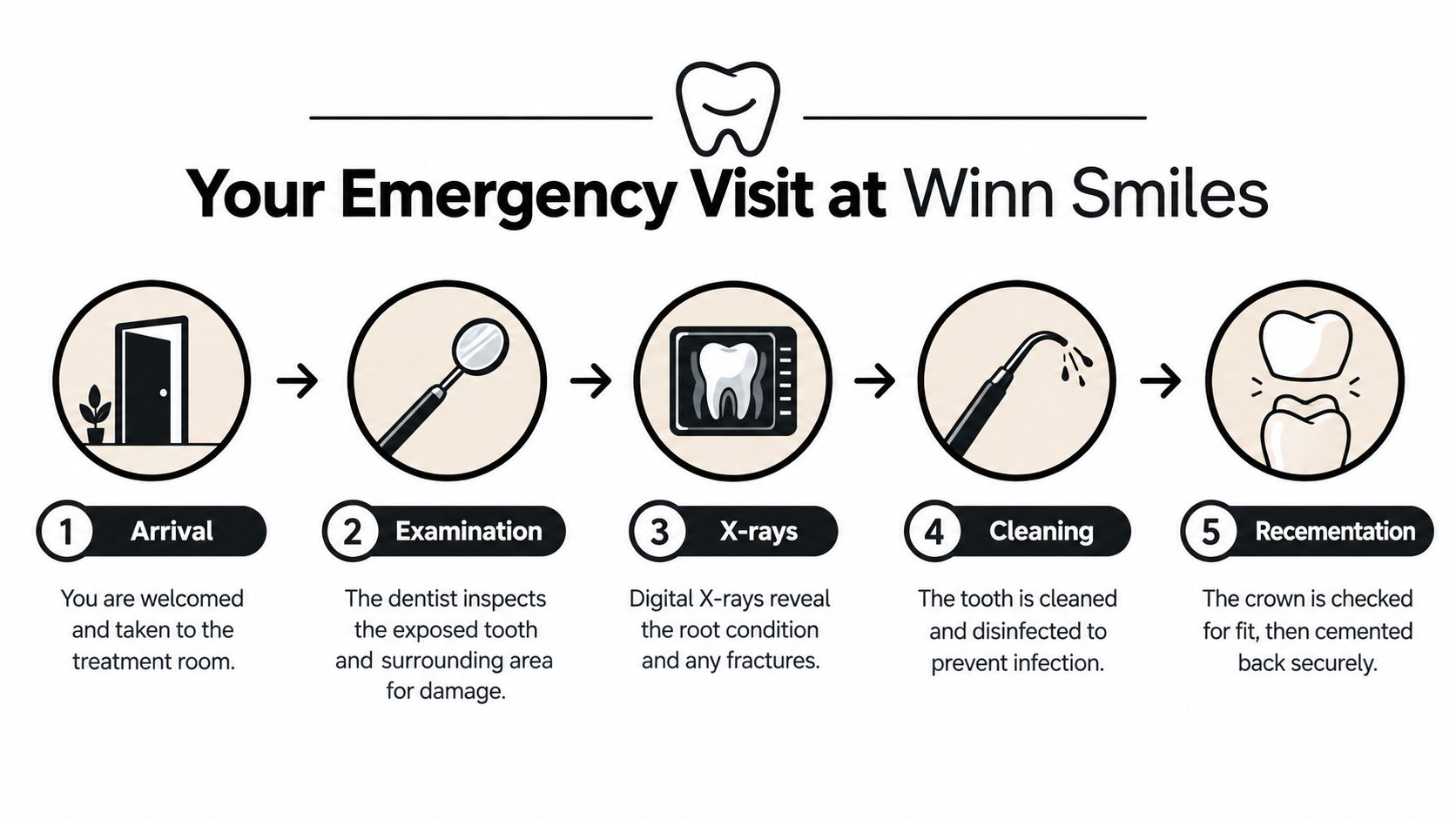
The exam comes first
At the visit, the dentist examines the exposed tooth, the gums around it, and the crown itself. Digital dental x-rays may be taken to check the root, surrounding bone, and whether the tooth has fractured below the visible surface.
The crown is then evaluated for cracks, wear, and fit. Sometimes the crown is fine and the issue is only failed cement. In other cases, the underlying tooth has changed enough that a new restoration is the safer choice.
Here's a visual overview of the process patients often find helpful before they come in.
What treatment may involve
Treatment often includes:
- Cleaning the tooth and crown to remove old cement and debris
- Checking the bite so the crown won't pop off again from excess pressure
- Recementing the crown if the fit is still sound
- Replacing the crown if it's damaged or no longer seals properly
- Planning additional restorative care if the tooth needs a build-up first
The American Association of Endodontists notes that after root canal treatment, patients should return for a final crown to fully restore the tooth, and that appointment should be made as soon as the endodontist completes the work, according to AAE post-treatment care guidance.
Comfort and next steps
If dental visits make you nervous, ask about comfort measures before treatment starts. Some offices, including Winn Smiles, also offer sedation options and same-day crown solutions in appropriate cases, which can make emergency repair more manageable for patients who have anxiety or tight schedules.
If your crown can be saved, prompt recementation is often the simplest path. If it can't, early treatment still gives you more options than waiting does.
This is also the point where your dentist may connect the emergency visit to broader care, such as cleaning and exams, a new patient exam, cosmetic improvements like teeth whitening, or long-term rebuilding with cosmetic dentistry or dental implants if the tooth has become non-restorable.
Preventing Future Crown Loss and Protecting Your Smile
Once a crown has come off, most patients want to know how to keep it from happening again. Prevention is usually a combination of protecting the restoration, reducing stress on it, and catching small problems early.
Habits that help crowns last longer
Start with the basics. Brush carefully along the gumline, floss around the crown margins, and don't ignore a crown that feels slightly loose. A small change in fit is easier to manage before it turns into a full dislodgement.
Be selective with food, especially if the tooth has had major restorative work. Hard foods, sticky candies, and chewing ice place unnecessary force on a crowned tooth.
Protection matters if you grind or clench
If you clench or grind your teeth, ask about a night guard. Bite pressure is one of the most common real-world reasons crowns loosen, crack, or fail early.
Restoration design also matters. A 2025 clinical trial found that for endodontically treated posterior teeth restored with lithium disilicate partial crowns, a fiber post was not necessary in patients without bruxism, according to PubMed research on restoration design after root canal treatment. That reinforces an important point. Durability depends on the restoration design, bite forces, and how much healthy tooth structure remains.
Don't let temporary materials linger
If you've had a temporary filling or temporary crown placed, timing matters. AAE-endorsed guidance states that a minimum of four millimeters of temporary material is needed for an adequate seal, and that seal should be expected to remain effective for no longer than three weeks, based on AAE guidance on temporary endodontic restorations.
That's one reason regular follow-up matters. Preventive visits, cleaning and exams, and timely restorative care help protect not only crowns but also the root canal treated teeth underneath them.
Schedule Your Emergency Appointment Today
If your root canal cap fell off, the safest choice is to act now while the problem is still small enough to manage. Waiting can turn a recementation visit into a larger restorative problem, especially when the tooth isn't giving you pain signals.
Patients in Chattanooga, Cleveland, and nearby communities often start by searching for a dentist near me, emergency dentist, or dentist in Chattanooga, TN when something like this happens unexpectedly. The important part is finding care that can evaluate the crown, check the tooth underneath, and explain whether you need recementation, a replacement, or a different treatment path.
When to call right away
Call as soon as possible if you notice any of these issues:
- Swelling or pressure around the tooth or gum
- A crown that won't seat properly or feels distorted
- Visible breakage in the tooth underneath
- A bad taste or drainage
- Pain when biting, even if the tooth had a prior root canal
One patient instruction source advises that a loose temporary filling or crown should be evaluated within a few days at most, even without discomfort, because the longer the tooth stays unprotected, the greater the risk of decay, sensitivity, and structural damage, according to guidance on what to do when a temporary filling comes loose.
A practical next step
If you think the crown may need replacement rather than simple recementation, it helps to review options for same-day crown treatment before your visit. Fast restoration matters when the goal is to protect a root canal treated tooth before it fractures or leaks.
Whether you need emergency care, restorative dentistry, help after tooth extraction, or long-term options like dental implants near me or a cosmetic dentist near me, the key is getting examined before a painless problem becomes a costly one.
If your crown has come off, Winn Smiles offers emergency dental care, digital imaging, restorative treatment, and same-day crown options for Chattanooga and Cleveland patients who need prompt help. If you want a clear answer and a practical treatment plan, visit Winn Smiles to request an appointment.