Missing a tooth changes small moments first. You notice it when you smile for a photo, when you avoid biting into something crisp, or when you catch yourself chewing on one side. After a while, those small adjustments start to feel bigger. Many people searching for a dentist in Chattanooga, TN or dental implants near me are not only looking for a tooth replacement. They’re looking for relief, confidence, and a plan that finally makes sense.
That’s why a good treatment plan for dental implants matters so much. Dental implants aren’t a one-size-fits-all procedure. They’re a carefully mapped process that starts with understanding your health, your bite, your bone, your goals, and even your comfort level in the dental chair. If you’ve been putting this off because it feels complicated or intimidating, you’re not alone.
At our Chattanooga and Cleveland offices, many new patients come in with the same concern. They want something stable and long-lasting, but they also want to know what the experience will feel like. They want straight answers about healing, timing, and costs. Most of all, they want to know they’ll be treated with patience and respect.
Your First Step Toward a Complete Smile in Chattanooga
A common story goes like this. Someone loses a back tooth and thinks, “I can manage for now.” Then another tooth becomes harder to chew on. Smiling gets more guarded. Social events feel different. Even ordering at a favorite Chattanooga restaurant starts to involve quiet calculations about what’s easy to eat.
Missing teeth can affect more than appearance. They can change how your bite works, how evenly you chew, and how comfortable you feel speaking or laughing. That’s why many adults start searching for dental implants near me, cosmetic dentist near me, or a trusted dentist near me once they’re ready for a more permanent answer.
Dental implants have become a go-to option because they’re reliable and widely used. A projection notes that by 2026, up to 23% of adults with missing teeth may have at least one implant, and reported success rates are 95% to 98% within 5 to 10 years, according to dental implant statistics compiled here. For patients, that means implants aren’t an unusual or experimental choice. They’re a mainstream part of modern restorative dentistry.
Why patients often feel stuck
Some people worry they’ve waited too long. Others assume they’ll need dentures right away. Many are afraid the process will be painful, confusing, or too disruptive to daily life.
Those fears are understandable, but they usually come from not knowing what the process looks like.
Getting an implant isn’t one appointment where everything happens at once. It’s a sequence of decisions and steps, and each one has a purpose.
A thoughtful treatment plan can account for:
- One missing tooth
- Several missing teeth in a row
- Teeth that are failing and need replacement
- Full-arch tooth loss
- Bone loss or a complex bite
- Dental anxiety or a strong gag reflex
What a good plan should feel like
A strong implant plan shouldn’t feel rushed or mysterious. It should feel clear. You should know why imaging is needed, why timing may differ from another person’s case, and what choices affect the final result.
If you’ve also been searching for help with restorative dentistry, tooth extraction, dental x-rays, or even an emergency dentist after a broken or failing tooth, implants may become part of a larger care plan that restores both comfort and function.
For many people in Chattanooga, TN, the first real relief comes when they learn this: you don’t have to figure it all out before you call. You only need to start with an evaluation.
Your Comprehensive Dental Implant Evaluation at Winn Smiles
The first implant visit is less about “getting started on surgery” and more about gathering the right information. A treatment plan only works when it’s based on a full picture of your mouth and health, not a quick glance at the missing space.

What happens at the first visit
Your evaluation usually includes a conversation, an exam, imaging, and planning discussions. That may sound simple, but each part answers a specific question.
- Medical history review helps identify anything that could affect healing.
- Oral exam checks your gums, nearby teeth, bite, and signs of infection or wear.
- Dental x-rays and 3D imaging show bone shape, depth, and nearby anatomy.
- Smile and function goals help shape the final restoration, not just the surgical step.
Patients are often surprised by how much time we spend talking before any procedure is discussed in detail. That’s intentional. If you’ve had prior dental work, gum problems, broken teeth, or a recent tooth extraction, those details matter.
Why 3D imaging matters
Traditional x-rays show useful information, but implants require more precision than a flat image can provide. A prosthetically-driven approach uses 3D CBCT imaging to plan the implant based on the final tooth position, not just the bone that happens to be available. That approach helps distribute biting forces more evenly and is associated with long-term complication rates under 5% in benchmark data, as described in this Decisions in Dentistry discussion of implant planning.
That sounds technical, so here’s the plain-language version. We don’t want to place a titanium post first and hope the crown works out later. We want to know where the final tooth should sit, how it should line up with your bite, and how it should look when you smile. Then we plan the implant to support that result.
What we’re looking for on the scan
A CBCT scan helps map structures that you can’t safely judge by sight alone.
| What we evaluate | Why it matters |
|---|---|
| Bone height and width | The implant needs enough support |
| Nerve location | Important for lower jaw safety |
| Sinus position | Important for upper back teeth |
| Bone shape and angulation | Affects implant size and position |
| Condition of neighboring teeth | Helps decide whether to save, remove, or restore them |
A key point of clarification for patients is that two people can both be missing one molar, but their treatment plans may be very different because their bone, bite, gums, and neighboring teeth are different.
Practical rule: The evaluation is not a formality. It’s where safety, esthetics, comfort, and long-term function start to come together.
Questions we answer early
During the evaluation, many patients want immediate answers to practical concerns. Those questions usually include:
- Will I need a tooth extraction first?
- Am I a candidate for same-day treatment?
- Is bone grafting likely?
- What kind of sedation can I choose?
- Will my implant look natural?
- How many visits should I expect?
Those are all reasonable questions. The right answer comes from diagnosis, not guesswork. Once that evaluation is complete, the treatment plan becomes much easier to understand because it’s built around your anatomy and goals, not around a generic template.
Digitally Designing Your Implant Treatment Plan
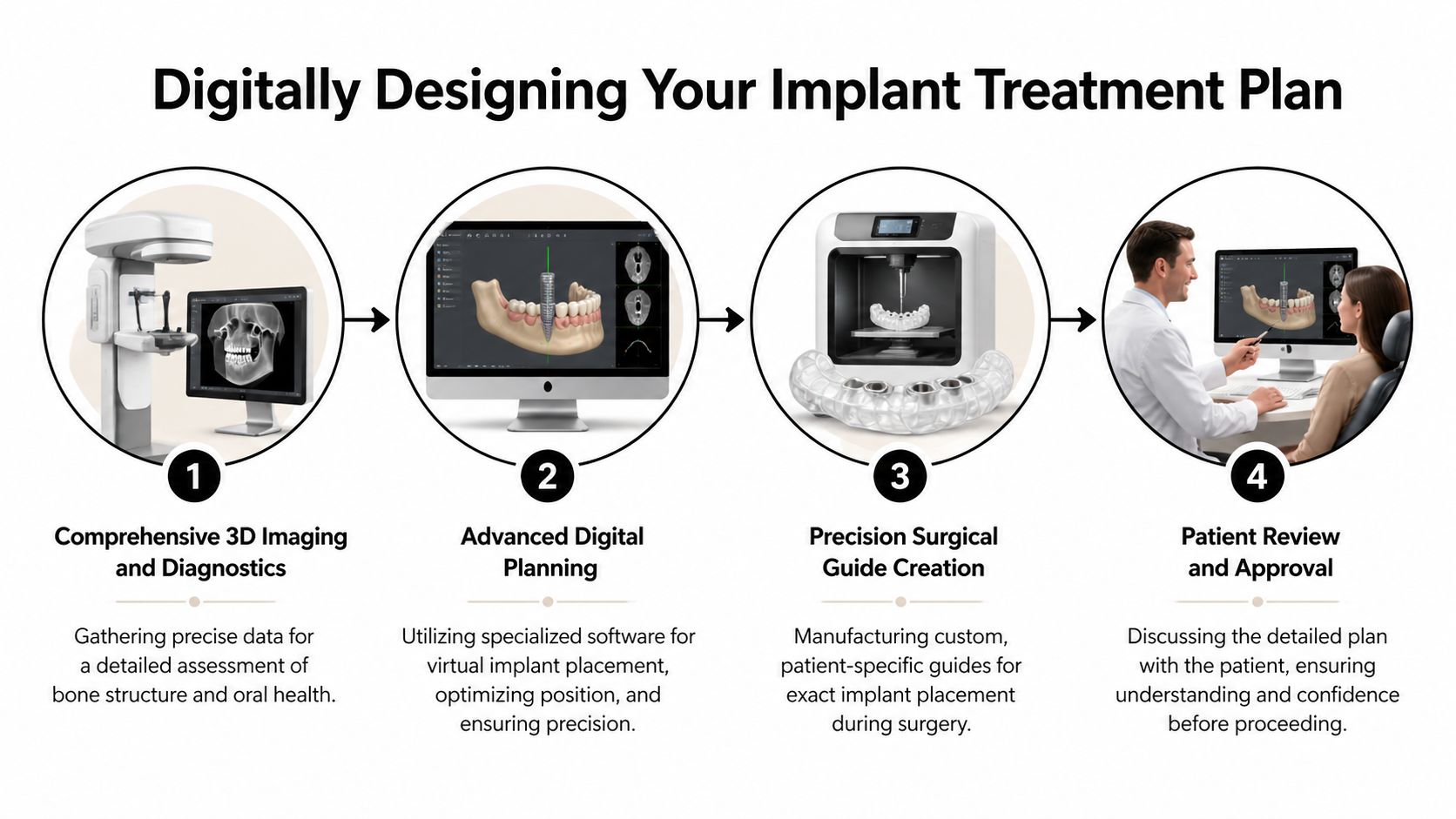
Once the exam and scan are complete, the planning phase moves to the computer. At this stage, modern implant dentistry becomes far more precise than many patients expect. Instead of planning by approximation, we can study your case in three dimensions before treatment begins.
Planning the final tooth first
A strong treatment plan for dental implants starts with the end result. We look at where the crown, bridge, or full-arch restoration should sit when you talk, smile, and chew. Then the implant position is designed to support that result.
That digital workflow helps answer very practical questions:
- What angle should the implant enter the bone?
- How deep should it sit?
- Is there enough room for the future crown?
- Will the final tooth line up naturally with nearby teeth?
- Can the restoration be cleaned easily at home?
This planning stage is especially important because implants aren’t just anchored in bone. They also have to function as part of your bite. A crown that looks good but carries force poorly can create trouble later.
Why healing time is built into the plan
Patients often hear “implant” and think only about the day the implant is placed. The biology is just as important as the procedure. The implant has to bond with the bone in a process called osseointegration.
According to Straumann’s clinical guide on implant healing, treatment plans typically allow 3 to 6 months for healing before the final crown is loaded. In ideal cases, immediate placement can be possible when initial stability is high, measured by an ISQ value over 70.
That’s why some patients leave with a temporary tooth while others heal first and receive the final restoration later. The difference isn’t about preference alone. It’s about whether the bone and implant stability support that timeline safely.
Healing isn’t a delay in the process. Healing is part of the process.
How the surgical guide helps
After virtual planning, a surgical guide may be created to transfer that exact design to the mouth. Think of it as a roadmap that helps the implant go where it was intended to go in the digital plan.
That can improve consistency in areas where a few millimeters matter. For patients, the benefit is simple. The more precise the placement, the easier it is to support a natural-looking tooth and a balanced bite.
What patients usually review before moving forward
Before any procedure is scheduled, patients want to see the plan in plain terms. That review often includes:
- The tooth or teeth being replaced
- Whether grafting or extraction is needed
- What temporary teeth will look like
- How many appointments are likely
- What kind of sedation is available
- When the final restoration is expected
At this point, the case starts to feel real in a reassuring way. Instead of “I need an implant,” you have a mapped-out path with clear decisions and timing.
Implant Solutions for Single Teeth, Multiple Teeth, and Full Arches
Not every implant case looks the same. One person may be replacing a single cracked molar. Another may have several missing teeth in a row. Someone else may be tired of loose dentures and want a more stable full-arch solution. The right treatment plan depends on what’s missing, what’s healthy, and what you want daily life to feel like after treatment.
Replacing one missing tooth
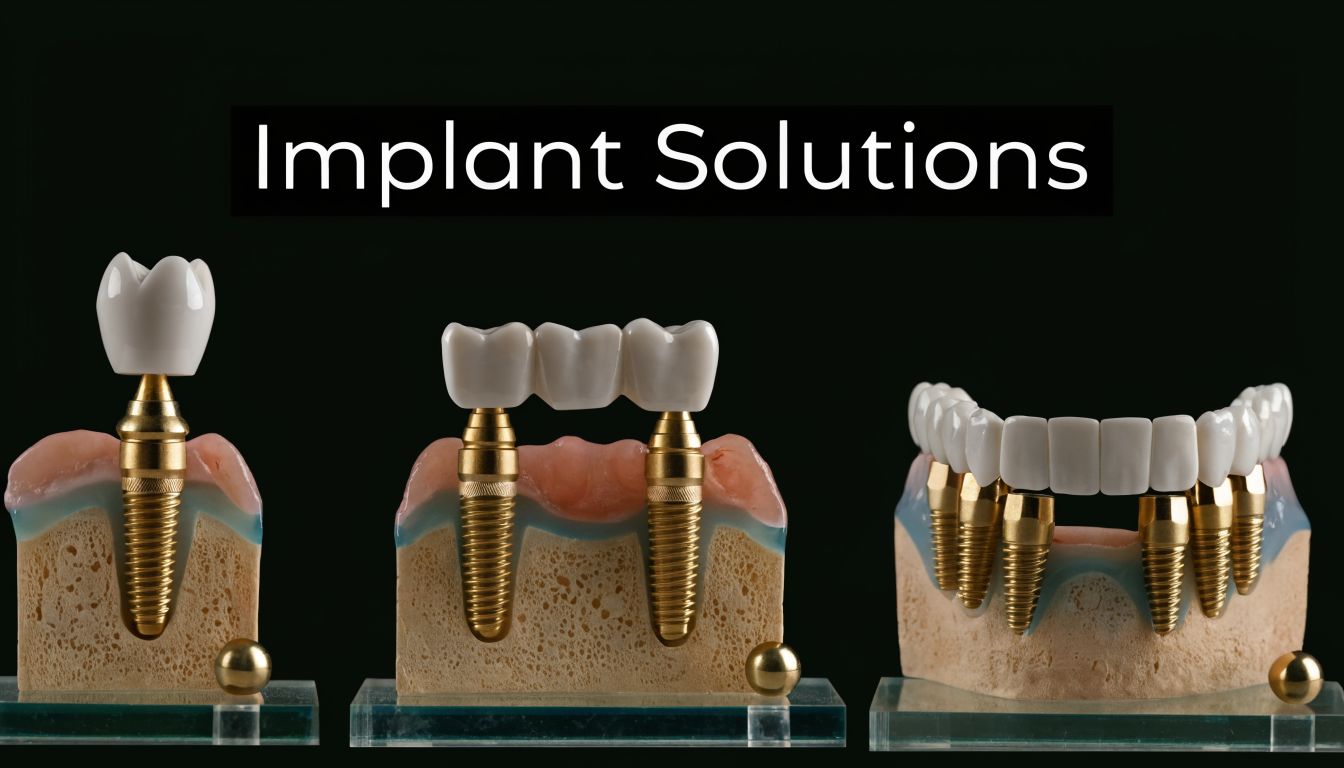
A single-tooth implant replaces the root with an implant and the visible portion with a custom crown. This option is often ideal when the teeth beside the gap are healthy because it avoids cutting them down for a traditional bridge.
For example, if you lost one premolar after a fracture or a failed root canal, the implant can restore chewing on that side without placing extra stress on neighboring teeth. It also helps keep the space from becoming harder to restore later.
Replacing several teeth together
If you’re missing multiple teeth in a row, an implant-supported bridge may make more sense than placing a separate implant for every missing tooth. The bridge spans the area, and the implants support it from underneath.
This can be a useful approach when:
- The gap is long and a removable option feels unstable
- The adjacent teeth are healthy and shouldn’t be prepared for a conventional bridge
- You want stronger chewing support than a removable partial may provide
The decision here isn’t only about how many teeth are missing. It’s also about the health of the surrounding bone and the bite forces in that part of the mouth.
Replacing most or all teeth
For patients missing all or most teeth on an arch, a full-arch implant restoration can provide much more stability than a traditional denture. Some patients choose a fixed option, while others may do well with an implant-supported overdenture that snaps into place more securely than a standard removable denture.
People usually describe the change in simple terms. Food feels easier. Speech feels steadier. They don’t worry as much about movement.
A full-arch plan often involves more diagnosis because we also have to think about smile line, lip support, bite height, and hygiene access.
What about complex cases
Some patients have bone loss, old extractions, or anatomy that makes a straight implant position difficult. Those cases can still be treatable. In more complex situations that may require angled implants, reported success rates remain 92% to 95%, and integrating sedation into care can improve treatment acceptance by up to 40%, according to this PMC-linked discussion of angled implant challenges and patient concerns.
That matters because many people assume complexity means they’re out of options. Often, it means the planning needs to be more individualized.
Same-day possibilities and who qualifies
Some patients qualify for immediate or same-day treatment. Others need a staged plan with extraction, healing, grafting, implant placement, and final restoration over time.
Here’s a simple comparison:
| Situation | What the plan may involve |
|---|---|
| Strong bone and good initial stability | Implant placement with a temporary tooth may be possible |
| Infection or poor stability | Healing first, then implant placement |
| Bone loss | Grafting or modified implant positioning |
| Full-arch tooth failure | Temporary restoration followed by final prosthesis later |
If you’re also wondering about materials, our post on metal used in dental implants gives a helpful overview of what patients receive.
Patients often like to see visual examples before deciding which direction fits them best.
How we choose between options
The “best” option is usually the one that balances health, function, hygiene, appearance, and comfort with your goals and budget. A younger patient replacing one front tooth has different priorities than someone who has worn dentures for years and wants a full-arch upgrade.
A good treatment plan doesn’t push every patient toward the same solution. It matches the solution to the person.
That’s especially important if you’re comparing implants with alternatives such as removable partials, traditional dentures, or fixed bridges. Each has a place. The right recommendation comes from what will serve your mouth well over time.
Ensuring a Comfortable and Anxiety-Free Implant Experience
Many people aren’t afraid of the result. They’re afraid of the experience. That’s an important difference.
Some patients worry about pain. Others worry about sounds, gagging, needles, or feeling out of control in the chair. If you’ve avoided treatment because of past dental experiences, your comfort needs to be part of the treatment plan from the beginning, not added as an afterthought.
Comfort is part of the clinical plan
An implant plan has technical pieces, but it also has human pieces. Your ability to stay relaxed, tolerate longer visits, and recover with less stress can affect how manageable the whole process feels.
That’s why comfort planning may include:
- Local anesthetic so the treatment area is numb
- Sedation options based on anxiety level and procedure complexity
- Shorter, staged appointments when needed
- Clear communication so there are no surprises
- Breaks during treatment for patients who feel overwhelmed easily
This matters for people seeking an emergency dentist, a tooth extraction, or implant treatment after years away from dental care. Anxiety often builds when patients expect judgment or discomfort. A calmer approach changes that.
What sedation changes for patients
Sedation doesn’t replace careful dentistry. It supports it. A patient who feels safe is more likely to move forward with treatment, ask questions, and return for follow-up care.
For some, that means local anesthetic alone is enough. For others, oral conscious sedation may make the visit feel much more manageable. The right choice depends on your medical history, your level of anxiety, and how involved the procedure will be.
What many anxious patients need most
Often, the biggest relief comes before treatment begins. It comes from hearing that you’re allowed to say when you’re nervous. You’re allowed to ask for the plan to be explained more slowly. You’re allowed to want comfort built into the process.
If dental visits have felt difficult before, that doesn’t mean implant care is off the table. It means your care should be adjusted to fit you.
That mindset can make the difference between delaying treatment for another year and finally feeling ready to take the next step.
Navigating Timelines, Costs, and Financing for Your Implants
Most patients ask two practical questions early. How long will this take, and what will it cost me? Both are fair questions, and both deserve direct answers.

Why timelines vary
One implant case may move fairly quickly. Another may unfold in stages. That difference usually comes down to what needs to happen before the final tooth can be placed safely.
A timeline may include:
- Consultation and imaging
- Extraction, if needed
- Bone grafting or site development, if needed
- Implant placement
- Healing period
- Final crown, bridge, or full-arch restoration
Some patients qualify for a temporary tooth right away. Others need more healing time before the final restoration. Neither path is “better.” The right path is the one that respects the biology of your case.
What affects cost
Implant treatment is customized, so costs vary based on the work involved. The biggest drivers are usually the number of implants, whether extractions are needed, whether grafting is required, and what type of restoration sits on top.
A single implant crown and a full-arch case are very different types of care. Even two single-tooth cases can differ if one needs additional site preparation and the other doesn’t.
Here’s a useful way to think about the investment:
| Cost factor | Why it changes the total |
|---|---|
| Number of implants | More implants usually mean more materials and appointments |
| Need for extraction | Adds a surgical step |
| Bone grafting | Adds site preparation and healing |
| Type of restoration | Crown, bridge, overdenture, and full-arch prosthesis differ in complexity |
| Sedation choice | Changes appointment planning and resources |
Why transparency matters
Patients shouldn’t feel like they have to guess their way through treatment planning. A clear financial conversation matters just as much as a clear clinical one.
At our practice, cost discussions are part of the planning process, not hidden until the end. We also talk through what is urgent, what can be phased, and what financing options may help make treatment more manageable. For many people looking for a dentist in Chattanooga, TN, a cosmetic dentist near me, or help with restorative dentistry, that clarity is what turns uncertainty into action.
Looking at value, not just price
Implants are often chosen because they support daily function in a way that many patients find more natural and secure over time. That doesn’t make the decision easy, but it does make it meaningful.
When you evaluate implant treatment, consider:
- How you chew now
- How stable your current replacement feels
- Whether nearby teeth are being compromised
- How important long-term confidence is to you
- Whether you want a removable or fixed solution
For some patients, starting with a consultation is the most useful step because it turns a vague concern into a specific plan with timing and financial details.
Protecting Your Investment with Proper Aftercare and Maintenance
The implant procedure isn’t the end of the story. Long-term success depends on what happens after placement, both at home and in the dental office. A carefully made plan should include those habits from the beginning.
A large multicenter case series reported a 99.9% implant survival rate and found that planning choices influenced long-term tissue health, including lower marginal bone loss with cemented restorations than with screwed prostheses, as described in this PMC study on implant outcomes in routine practice. That matters because success doesn’t come from the implant alone. It comes from the total system of planning, restoration, and maintenance.
The first days after placement
Right after surgery, the focus is protecting the area and keeping healing uncomplicated. You may be asked to eat softer foods, avoid disturbing the site, and clean gently around the area.
Many patients also ask about rinsing. If you want a plain-language explanation of how salt water kills bacteria, that guide can help you understand why a simple rinse is often recommended as part of early healing support.
The habits that keep implants healthy
Implants don’t get cavities, but the surrounding gum tissue and bone still need protection. Daily home care matters. Regular hygiene visits matter. Bite checks matter.
A simple maintenance routine usually includes:
- Brushing carefully every day around the implant and gumline
- Cleaning between teeth or under the restoration with the tools recommended for your case
- Keeping regular professional cleanings and exams
- Reporting soreness, looseness, or bleeding early
For more practical home care tips, our guide on how to care for dental implants walks through the basics in patient-friendly language.
The goal isn’t just to place an implant. The goal is to keep the tissue around it healthy for years to come.
Why follow-up matters
Patients sometimes think a permanent tooth replacement should be “done forever” the day it’s delivered. In reality, long-term implant health is a partnership. We check how the implant is functioning, how the gums are responding, and whether your cleaning routine needs adjusting.
That ongoing relationship protects both your comfort and your investment.
Frequently Asked Questions About Your Implant Treatment Plan
| Question | Answer |
|---|---|
| Will getting a dental implant hurt? | Most patients are surprised that the process feels easier than they expected. The area is numbed, and sedation may be part of the plan if you’re anxious or having more involved treatment. Soreness during healing is normal, but it’s usually manageable with clear aftercare instructions. |
| How long does the whole process take? | It depends on your case. Some people move faster, while others need extraction healing, grafting, or a staged approach before the final tooth is placed. |
| Am I too far gone for implants if I’ve lost bone or space? | Not necessarily. For patients with limited restorative space, treatment plans can include customized overdentures or pre-implant bone regeneration, and emerging AI-driven simulations have been reported to predict these space issues with 95% accuracy and reduce revisions by 25%, according to this video discussion of restorative space challenges. |
| Are implants only for one missing tooth? | No. Implants can support one crown, a bridge for several teeth, or a full-arch restoration. |
| What if I’m nervous about dental treatment? | That should be discussed early. Comfort measures and sedation options can be built into the treatment plan so care feels more manageable. |
If you’re looking for a clear, personalized path forward, Winn Smiles offers implant consultations for patients in Chattanooga, Cleveland, and nearby communities. If you’re missing one tooth, several teeth, or you’re ready to talk about full-arch options, scheduling a visit is the simplest way to get answers that fit your mouth, your comfort level, and your goals.