If you're reading this in Chattanooga or Cleveland, there's a good chance you're tired of working around your teeth. Maybe you smile with your lips closed in photos. Maybe you chew on one side because the other side hurts. Maybe your denture moves when you talk, or you're searching late at night for a dentist near me, dental implants near me, or a dentist in Chattanooga, TN because you want something that feels permanent.
That kind of frustration is personal. Missing teeth don't just affect how you eat. They can change how you speak, how confident you feel in public, and whether you enjoy everyday moments like dinner with family or coffee with friends.
A full-arch implant solution can change that. For many adults who are dealing with major tooth loss, failing dental work, or years of denture problems, All-on-6 implants offer a stable, fixed replacement that can look natural and feel secure. The process is more straightforward than many patients expect, especially when your care team explains it in plain language and plans every step carefully.
Your Guide to All-on-6 Dental Implants Near Chattanooga TN
A lot of people begin this journey with unspoken worries. They stop ordering foods they used to love. They keep conversations short because they're worried their teeth will slip, click, or show damage. Some have already spent years patching broken teeth, getting repeated tooth extraction visits, or replacing old dental work that never seems to last.
If that sounds familiar, you're not overreacting. Extensive tooth loss can affect nutrition, speech, comfort, and self-esteem. It can also make routine dental care feel overwhelming because every appointment seems to lead to one more repair.
All-on-6 implants are designed for people who want to stop managing a problem and start rebuilding their smile on a stronger foundation. Instead of replacing one tooth at a time, this treatment supports a full arch of fixed teeth with six implants. For the right patient, that means a more secure bite and a smile that doesn't come out at night.
You don't have to choose between living with failing teeth and settling for loose dentures. There are fixed options that can restore function and confidence.
Patients in Chattanooga and Cleveland often start with practical questions. Will it hurt? Will I need bone grafting? How long will I be without teeth? What will it really cost over time, not just on surgery day? Those are the right questions, and they deserve direct answers.
This guide is built to help you understand the treatment step by step, in plain language. If you're also looking for ongoing dental care, cleaning and exams, dental x-rays, new patient exams, restorative dentistry, or even an emergency dentist, it's worth knowing how full-arch implant care fits into your overall oral health plan.
What Are All-on-6 Implants
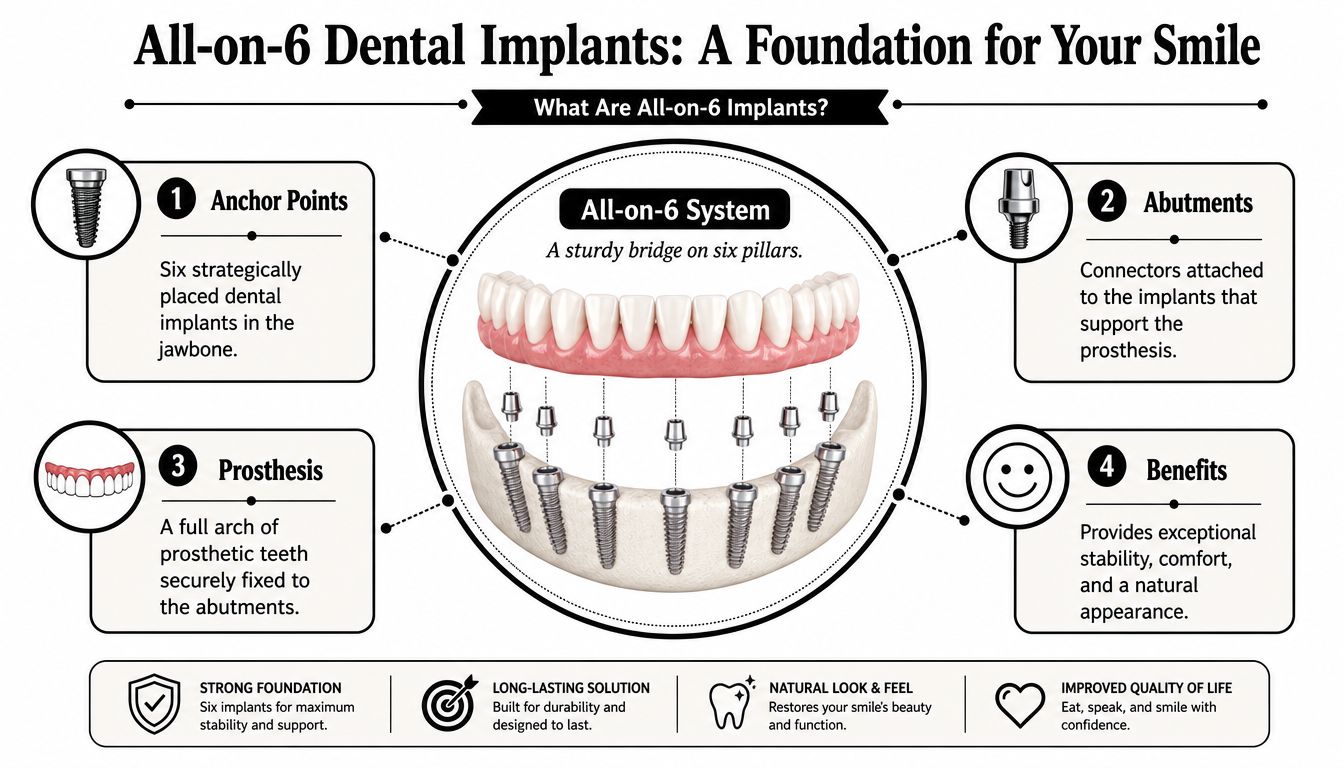
If you are sitting in Chattanooga or Cleveland wondering whether a full set of fixed teeth can really feel stable, All-on-6 is the answer many patients are looking for. It replaces a full upper or lower arch with a fixed bridge that is supported by six titanium implants placed in the jaw.
Those implants work like replacement tooth roots. Instead of resting on the gums the way a removable denture does, the new teeth are connected to anchors in the bone. That difference is what changes how the smile feels day to day.
A simple way to understand it is to focus on support points. With six implants spread across the arch, chewing pressure is shared more evenly. For many patients, that means a restoration that feels steadier during meals, conversation, and normal daily life.
How the implants are positioned
The placement is carefully planned for the shape of your jaw, your bite, and the bone you have available. In many All-on-6 cases, implants are distributed across the front and back of the arch so the final bridge has broad support. That matters because the back teeth handle heavy chewing forces, while the front area often offers strong bone for anchoring implants.
You may also hear the phrase "no bone graft needed." That does not mean bone quality no longer matters. It means your dentist may be able to angle or position implants in a way that uses the bone you already have, which can reduce the need for grafting in some patients. The goal is practical. Shorter treatment planning in some cases, fewer procedures for some people, and a design that supports a fixed full-arch restoration without making promises your anatomy cannot support.
Why a fixed full-arch option feels different
Many patients weighing their options notice the biggest difference is stability. A removable denture sits on top of the gums. An All-on-6 restoration is attached to implants under the gums, so the teeth are not shifting with normal speaking or chewing.
That can change daily life in very concrete ways:
- Eating feels more secure: patients often feel less worried about movement at meals.
- The smile stays in place: there is no need to remove it at night like a traditional denture.
- Cleaning is different, not absent: you still need regular professional maintenance and home care around the bridge and implants.
- Long-term value becomes part of the decision: beyond surgery day, patients in Chattanooga and Cleveland should ask about repair costs, replacement timelines for the prosthetic teeth, and warranty details before treatment begins.
That last point matters more than many people expect. All-on-6 is not just a surgical procedure. It is a long-term tooth replacement system. A well-made plan should explain what future maintenance may look like, what parts may wear over time, and what support you can expect if something needs adjustment years later.
If you have been searching for a cosmetic dentist near me or dental implants near me in Chattanooga or Cleveland, this is usually where the treatment becomes easier to understand. All-on-6 replaces missing teeth, but it also restores daily function with a plan that should make sense both medically and financially.
All-on-6 vs All-on-4 Implants
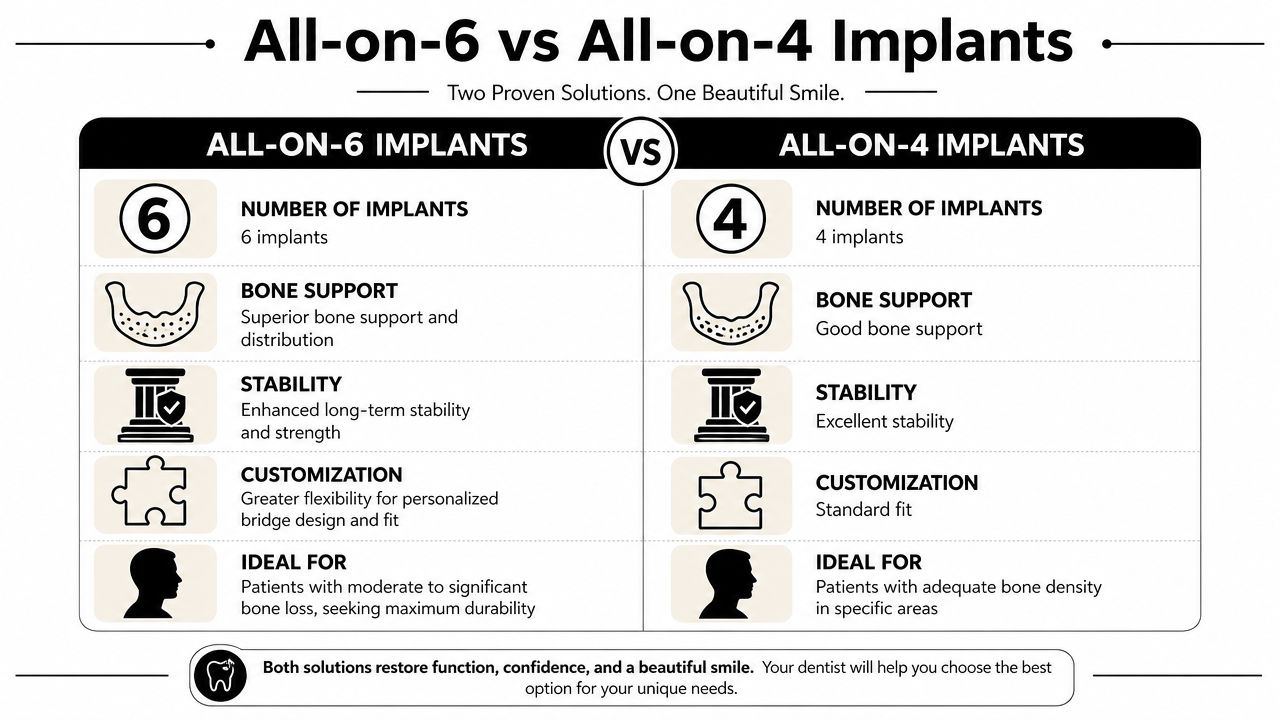
While both All-on-4 and All-on-6 are full-arch solutions, the main difference is simple. All-on-6 uses six implants instead of four, which gives the bridge more points of support across the jaw.
That extra support can matter in real life. A table with six legs usually spreads weight more evenly than one with four. Full-arch implant bridges work in a similar way. With more implants sharing the load, chewing forces are distributed across a wider area, which may help the restoration feel steadier and reduce stress on each individual implant. The Cleveland Clinic overview of dental implants explains the basic role implants play in supporting replacement teeth.
The practical difference patients feel
Patients usually do not ask for a specific implant count. They want to know which option is more likely to fit their mouth, their bite, and their long-term plan. In many cases, All-on-4 can work very well. In other cases, six implants give a dentist more flexibility to support a larger bridge or handle heavier biting forces.
This is also where the phrase "no bone graft needed" needs a careful explanation. It does not mean every patient can skip grafting. It means some full-arch designs can use the bone that is already available more efficiently, especially when implants are placed at planned angles. For patients in Chattanooga and Cleveland, that distinction matters because it affects healing time, cost, and the total number of procedures involved.
All-on-6 vs. All-on-4 at a Glance
| Feature | All-on-6 Implants | All-on-4 Implants |
|---|---|---|
| Number of implants | Six implants support one arch | Four implants support one arch |
| Stability | Greater distribution of chewing force across the jaw | Strong support with fewer anchor points |
| Bone support | Often chosen when added support is important | Often chosen when fewer implants are preferred |
| Grafting considerations | May reduce the need for grafting in some cases, depending on bone shape and volume | Also designed to work efficiently in full-arch care |
| Best fit | Patients needing added biomechanical stability | Patients who are good candidates for a four-implant design |
| Cost direction | Typically higher | Typically lower |
Why a dentist may recommend one over the other
The recommendation starts with anatomy, but it does not end there. Bone volume, bone quality, bite force, clenching habits, and the size of the final bridge all influence the decision. If a patient has a stronger bite, wants more support under a longer arch, or needs force spread across more anchor points, All-on-6 may be the better choice.
The financial side also deserves an honest discussion. Four implants may lower the initial fee. Six implants may provide more support and, in some cases, more confidence over time. Patients should ask what future maintenance may cost, how repairs to the prosthetic are handled, and whether any warranty applies to the implants, the bridge, or both. Those details often shape the true value of treatment more than the starting number alone.
If you are comparing full-arch implant options at Winn Smiles, the clearest question is not, "Which one is better?" The better question is, "Which design fits my bone, bite, and long-term budget most safely?"
The All-on-6 Procedure Timeline at Winn Smiles
You sit down for your consultation knowing you want a full smile again, but the part that feels hardest is the unknown. Patients from Chattanooga and Cleveland often ask the same question first. What happens first, what happens next, and how long until life feels normal again?
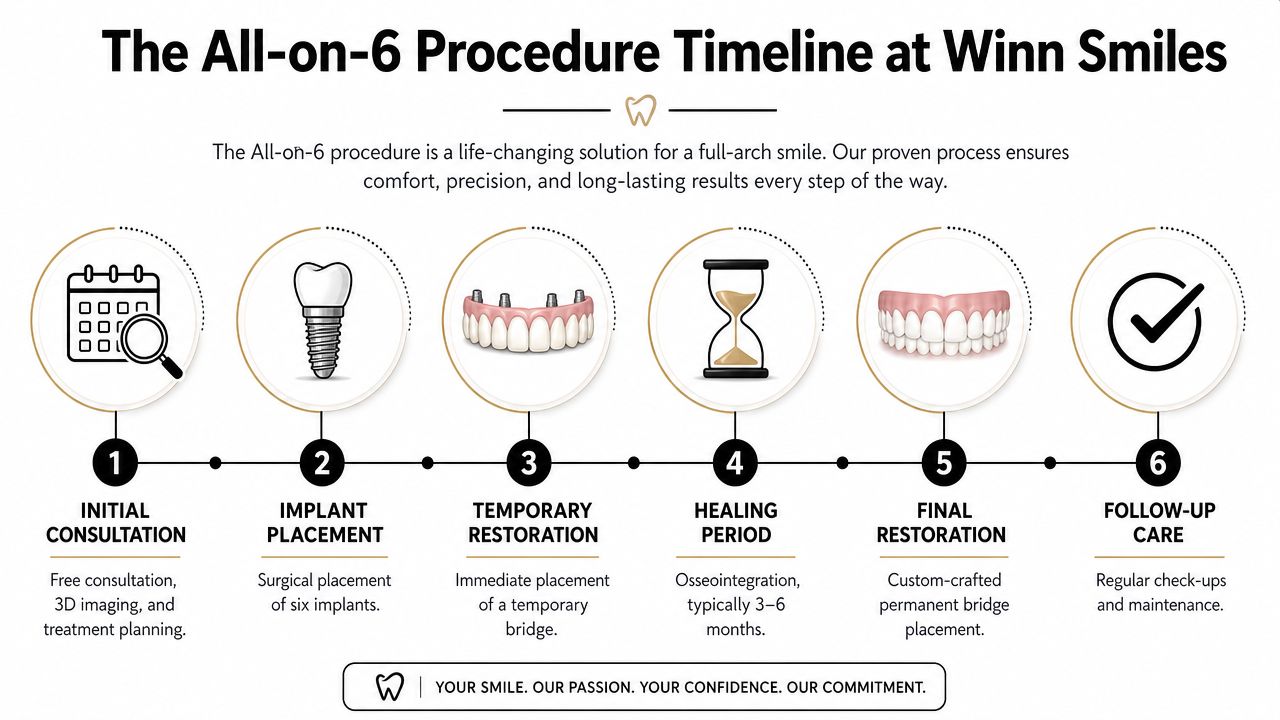
The answer becomes much less intimidating once the process is broken into stages. All-on-6 is not one long appointment. It is a planned sequence, with each step preparing the next and protecting the long-term result.
Step one through step three
The first visit is the planning visit. Your dentist reviews your health history, examines your mouth, takes digital images, and studies your bite, bone shape, and gum health. If you are still comparing options, full-arch implant treatment at Winn Smiles can help you see how the design of the case affects healing time, function, and long-term maintenance.
Next comes the surgical appointment. If damaged or failing teeth need to be removed, those extractions can often be coordinated within the same overall treatment plan. That matters because a full-arch case works best when surgery, temporary teeth, healing, and follow-up care are planned together instead of treated like separate problems.
Then comes the temporary phase. In many cases, patients leave with a fixed temporary set of teeth soon after implant placement. The American Academy of Implant Dentistry explains that immediate-load treatment can be possible for selected patients when the implants achieve strong initial stability and the bite is carefully controlled during healing, as described in its overview of immediate loading in implant dentistry.
What healing actually means
Osseointegration is the period when the implants bond with the jawbone. The term sounds technical, but the idea is simple. The implants need time to become anchored in bone the way a post becomes secure once the surrounding concrete sets.
Healing is not a pause in treatment. It is an active stage of the process, because the strength of that bond affects how well the final bridge handles daily chewing and speaking. During this time, you are usually wearing temporary teeth, adjusting to your new bite, and returning for checks so your dentist can watch the tissues, evaluate comfort, and make sure the temporary is protecting the implants.
This is also where patients sometimes need a clearer explanation of the phrase "no bone graft needed." It does not mean bone quality no longer matters. It usually means the available bone can often be used strategically, so treatment may avoid grafting in some cases. Whether that applies depends on your scan, your anatomy, and where stable implant support can be achieved.
A simple timeline looks like this:
- Consultation and records: exam, digital imaging, treatment planning, and discussion of timing, fees, and expected follow-up.
- Surgery day: implant placement and any needed extractions or preparatory care.
- Temporary teeth: a fixed temporary smile is often provided shortly after surgery.
- Healing visits: bite checks, tissue monitoring, home-care guidance, and time for the implants to integrate with bone.
- Final bridge: your permanent restoration is delivered once healing and stability are confirmed.
What patients in Chattanooga and Cleveland can expect
Patients usually feel more at ease when they know which questions to ask early.
- Will I be comfortable? Your care team should explain anesthesia and sedation options in plain language.
- Will I have teeth during healing? In many cases, yes. A temporary fixed prosthesis is part of the plan.
- How many visits should I expect? Several. Planning, surgery, healing checks, and final delivery all serve a different purpose.
- What costs come after surgery? This is an important question. Maintenance visits, adjustments, repairs, and replacement timelines for temporary or final prosthetic parts should be discussed before treatment begins.
- What does the warranty cover? Ask whether coverage applies to the implants, the bridge, or both, and what kinds of follow-up care are required to keep that coverage in effect.
For patients in Chattanooga and Cleveland, that kind of clarity matters just as much as the surgery itself. A confident smile is built in stages, and the strongest plans account for healing time, future maintenance, and the practical realities of living with your new teeth for years, not just the day they are placed.
Who Is a Candidate for All-on-6 and What Are the Benefits
You may be sitting in Chattanooga or Cleveland wondering whether your mouth is too far gone, or whether implants are more treatment than you really need. That uncertainty is common. Candidacy for All-on-6 is not based on how long you have put off care. It is based on whether rebuilding the full arch would serve you better than continuing to repair one failing tooth at a time.

People who often ask about this treatment
All-on-6 is often considered for adults with extensive tooth loss, severe wear, several failing crowns or bridges, or dentures that slip, rub, or limit what they eat. It also comes up for patients who feel trapped in a cycle of extractions, temporary fixes, and repeated repair bills.
A full-arch plan can make sense when the foundation is the fundamental problem. If the bite is collapsing, the remaining teeth are weak, or gum disease has already changed the long-term outlook, saving every tooth is not always the most predictable path. Rebuilding can offer a clearer starting point.
Patients with a history of periodontal disease need a closer conversation. In this visible source on dental implant failure statistics, implant failure was reported at 14.3% at one year for patients with pre-existing periodontitis, compared with 4.9% for patients with healthy gums. That does not mean All-on-6 is automatically the answer. It means the number of implants, the quality of the bone, and the design of the final bridge should be chosen carefully for the specific mouth in front of the dentist.
Some patients also hear “no bone graft needed” and assume that means bone quality does not matter. It still matters a great deal. In many cases, angled implant placement or using available areas of stronger bone can reduce the need for grafting, but that is different from saying bone loss disappears as a concern. A careful scan is what tells you whether All-on-6 is realistic, whether another design would be safer, and what tradeoffs may affect future maintenance.
Benefits that matter in daily life
The daily benefits are usually more meaningful than the technical description. Patients often want to know whether they will be able to chew comfortably, speak without worrying that teeth will move, and stop planning their day around a removable denture.
Common advantages include:
- More stable chewing: A fixed bridge is anchored to implants, so it generally feels more secure than a removable denture.
- No nightly removal: The prosthesis stays in place and does not depend on adhesive.
- A fuller, more natural-looking smile: The restoration is designed as a complete arch, with attention to tooth shape, support for the lips, and bite balance.
- Fewer patchwork repairs: For the right patient, treatment shifts the focus from constantly fixing individual teeth to creating a more dependable full-arch solution.
There is also a practical benefit patients do not always ask about early enough. A well-planned All-on-6 case should be maintainable. That means your dentist should explain how the bridge will be cleaned, what parts may wear over time, what follow-up visits are expected, and what future costs may come with repairs or replacement of prosthetic components. If cost is one of your biggest concerns, it helps to review dental implant payment plan options before you decide.
Who needs a more detailed conversation
Some mouths need more planning than others. Patients with periodontal history, bone loss, heavy grinding, previous implant problems, or a complicated restorative past should hear not only that they qualify, but why one design is being recommended over another.
That matters because “All-on-6” describes the number of implants, not the whole strategy. A single full-arch bridge and a segmented design such as 3-on-6 do not behave the same way over time. They can differ in how force is distributed, how repairs are handled, and what maintenance is required.
The right candidacy discussion gives you more than a yes or no. It should explain whether All-on-6 is the safest fit for your bone, bite, gum history, budget, and long-term goals, especially if you want care that is realistic to maintain for years in Chattanooga or Cleveland, not just treatment that looks good on surgery day.
Understanding the Cost and Value of All-on-6 Implants
A patient from Chattanooga might sit down for a consultation expecting one simple number, then realize the better question is broader: what will this smile cost to build, maintain, and rely on for years?
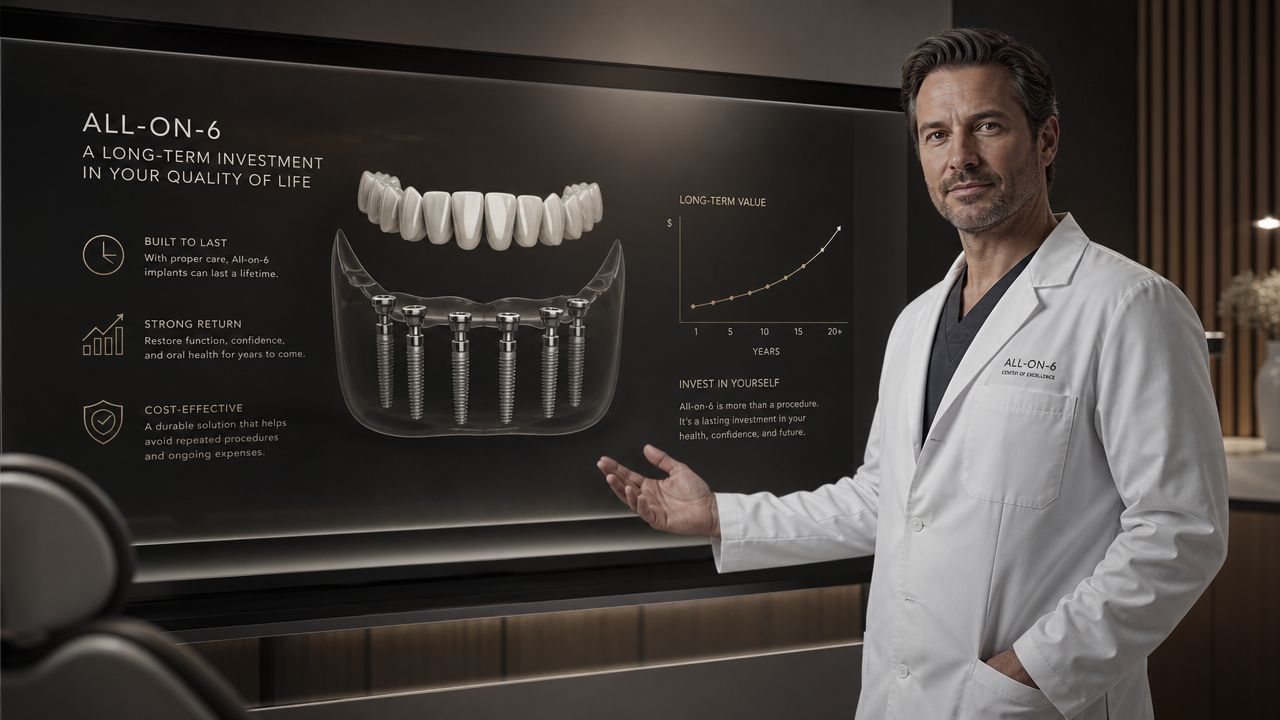
Cost matters because All-on-6 is not a single item. It is a treatment plan made up of surgery, planning, temporary teeth, the final bridge, follow-up care, and future maintenance. The Cleveland Clinic's overview of dental implants explains the basic treatment framework well, but your actual fee depends on your mouth, your goals, and the type of restoration being made.
What influences the price
The final price usually changes based on several practical details:
- Extractions and preparatory care. Teeth that need to be removed, infection control, and gum treatment can add steps before implants are placed.
- Bone shape and density. Some patients hear "no bone graft needed" and assume that means bone quality does not matter. It still does. In many All-on-6 cases, implant angulation and careful planning help use the bone you already have, but that phrase does not mean every patient can skip grafting.
- The type of final bridge. Acrylic, layered ceramic, and zirconia do not wear the same way or cost the same amount.
- Laboratory work and design. A full-arch bridge is custom-made. Bite design, framework strength, esthetics, and fit all affect the fee.
- Whether your quote includes the full journey. Some fees cover surgery alone. Others include imaging, temporaries, delivery of the final prosthesis, and scheduled post-op visits.
The American College of Prosthodontists notes that tooth replacement options differ in long-term maintenance and replacement needs, which is part of why full-arch treatment should be evaluated as a long-term care decision, not only an upfront purchase. Their patient guide on missing teeth replacement options is useful for understanding that bigger picture.
Value means more than the surgery date
Many nervous patients focus on the day of surgery because it feels like the biggest event. Financially, the more important question is often what happens after healing.
A fixed full-arch bridge works like the roof on a house. The day it is installed matters, but so do the materials, the support underneath, and what it takes to keep it in good condition through daily use. If you have spent years repairing broken teeth, replacing partials, relining dentures, or avoiding foods you enjoy, those repeated costs and frustrations are part of the value comparison too.
That is why a careful consultation should cover expected maintenance, not just the placement of six implants.
Long-term costs patients should ask about
Some future expenses are normal and predictable. Others depend on habits like grinding, smoking, missed hygiene visits, or heavy wear.
Ask these questions clearly:
- What cleanings and recall visits will I need each year?
- Will I need a night guard to protect the bridge if I clench or grind?
- What parts can wear out over time? Teeth, screws, and prosthetic components do not all age at the same pace.
- What does the warranty cover, and what would void it?
- If the bridge chips or fractures, who handles the repair and what is the likely process?
- Are future maintenance visits included for a period of time, or billed separately?
Those details matter in Chattanooga and Cleveland alike, because the best financial plan is the one you can realistically maintain close to home.
If monthly budgeting is part of your decision, these implant payment plan options can help you understand how patients often spread out treatment costs before you receive a personalized quote.
What "value" looks like in daily life
Value shows up at dinner. It shows up in photos. It shows up when you stop worrying that your teeth will shift, loosen, or keep breaking.
For many adults, All-on-6 earns its value through steadier chewing, more confidence in social settings, and fewer emergency-style dental decisions. That does not mean it is the lowest-cost option on day one. It means the investment may make more sense over time for patients who want a fixed solution with a clear maintenance plan, realistic warranty expectations, and a treatment design built for years of use in real life.
Why Choose Winn Smiles for Your New Smile
Full-arch implant care asks a lot from a dental team. Planning has to be precise. Communication has to be clear. Patients need to feel informed, not rushed.
That matters even more when you're already anxious, embarrassed about your teeth, or trying to balance major treatment with work and family responsibilities. The office experience should reduce stress, not add to it.
Winn Smiles provides full-mouth dental implant treatment that includes upper and lower All-on-6 implant-supported fixed hybrid zirconia bridges, along with broader services such as general dentistry, cosmetic dentistry, same-day crowns, emergency care, and sedation-focused treatment. For patients in Chattanooga and Cleveland, that means one practice can coordinate full-arch planning alongside routine needs like exams, x-rays, periodontal care, and ongoing maintenance.
What patients often look for in a full-arch provider
Patients searching for a dentist near me or dental implants near me usually aren't just comparing procedures. They're comparing experiences.
A strong full-arch implant visit should include:
- Clear planning: digital imaging and careful case design before surgery.
- Comfort options: especially for patients with dental anxiety.
- Straight answers about recovery: including food restrictions, temporaries, and follow-up.
- Long-term support: because the final bridge is only one part of lifelong oral care.
Why the local setting matters
A local provider in Chattanooga or Cleveland is easier to return to for follow-up, adjustments, maintenance, and routine dental care. That's important because implants aren't a one-day relationship. They work best when they're part of ongoing care with a team that knows your history.
If you're also considering teeth whitening, cosmetic dentistry, or restorative work on the opposite arch, continuity matters even more. A healthy, comfortable smile works best when the whole mouth is planned together.
Frequently Asked Questions About All-on-6
What does “no bone graft needed” really mean
A patient from Chattanooga or Cleveland may hear that phrase and assume grafting is off the table. What it really means is more specific. In some cases, the All-on-6 design lets your dentist place implants in areas where your existing bone can support them well enough, so grafting may not be necessary. The decision comes from your 3D scan, bone volume, bite forces, and overall health.
That wording matters because it affects both treatment time and cost. If grafting is not needed, you may avoid added healing months and added fees. If grafting is still recommended, that is not a failure. It is careful planning.
How successful are dental implants overall
Dental implants have a strong long-term track record, but success is never just about the day of surgery. The bigger picture includes bone quality, gum health, home care, smoking status, and regular maintenance visits. The American Academy of Implant Dentistry explains that implants are a well-established option for replacing missing teeth, and the National Institute of Dental and Craniofacial Research notes that ongoing oral hygiene and follow-up care play a major role in long-term health around implants.
For full-arch cases, that practical point is often the most helpful one. A stable bridge depends on a stable foundation, and that foundation needs checkups, cleanings, and occasional adjustments over the years.
What about immediate-load success if my bone density is borderline
This is a good question, and it deserves a careful answer. If your bone density is borderline, your dentist has to judge whether the implants can hold firmly enough on day one to support a temporary bridge safely. That is similar to setting posts for a fence. If the ground is firm, the structure can handle pressure sooner. If the ground is softer, the plan may need to change.
Some patients can still move forward without grafting. Others are better served by a modified timeline, a lighter temporary, or a different implant strategy. The right answer comes from your scan and exam, not from a standard promise.
What should I ask about long-term cost and warranty
Ask for the full cost of ownership, not just the surgery fee. That includes the temporary teeth, the final bridge, sedation if needed, repairs, replacement of worn components, hygiene visits, and what happens if something chips, loosens, or breaks years later. The American College of Prosthodontists encourages patients to ask detailed questions about maintenance and replacement expectations because restorations, like cars or roofs, can need service over time.
If a consultation explains the procedure but skips maintenance, repair expectations, and prosthetic warranty details, you still do not have the full financial picture. For patients comparing options in Chattanooga and Cleveland, that conversation can be just as important as the surgical plan itself.
Is this only for people with severe tooth loss
All-on-6 is often used for advanced tooth loss, but that is not the only situation. It can also make sense for someone with several failing teeth, repeated infections, severe wear, or older dental work that keeps breaking down. In those cases, the question is less about how many teeth are present and more about whether those teeth are still predictable to keep.
A thoughtful consultation should help you compare both paths clearly. Sometimes saving individual teeth is reasonable. Sometimes replacing a failing arch creates a healthier, more stable long-term result.
If you're ready to talk through your options with a local team, schedule a consultation with Winn Smiles. Whether you're looking for dental implants near Chattanooga or Cleveland, need a second opinion about failing teeth, or want a clear plan that covers treatment, maintenance, and comfort, the next step is a personal evaluation and an honest conversation.