When you're missing a tooth in Chattanooga, TN, or Cleveland, TN, you likely seek more than just a definition of implants. You're trying to answer a more personal question. Will this work for me, and will it last?
That concern is reasonable. A gap in your smile changes more than appearance. People often notice it when they eat on one side, avoid photos, or catch themselves covering their mouth while talking. Others arrive after a tooth extraction, wondering whether a fixed replacement is safer and more predictable than a bridge or removable option.
The phrase dental implant success rate sounds technical, but the underlying issue is simple. You want a tooth replacement that feels stable, looks natural, and lets you get back to normal life with confidence. The details matter, because the average headline number online doesn't tell the whole story.
Considering Dental Implants in Chattanooga or Cleveland TN
A lot of patients start the same way. They lose a back tooth and think they can manage without it. Then chewing becomes awkward. Food gets trapped. The opposite side of the mouth starts doing all the work. Or they lose a front tooth and the emotional impact is immediate. Smiling feels different. Social situations feel harder than they should.
When that happens, people usually type something like dental implants near me, dentist in Chattanooga, TN, or dentist in Cleveland, TN. They want a permanent answer, but they also want honesty. They don't want to be sold on a number without understanding what that number means.
What most patients are really asking
Usually, the question isn't just, "What's the implant success rate?"
It's more like this:
- Will it feel like a real tooth
- Will I be able to chew comfortably again
- What could make an implant fail
- How long does it usually last
- Am I a good candidate after bone loss, gum problems, or a tooth extraction
Those are the right questions.
A healthy dental implant isn't only about getting the post into the bone. It's about how that implant functions in daily life years later.
Why the simple answer can be misleading
You've probably seen a general claim that implants succeed at a very high rate. That's true in broad terms. Modern implant treatment is one of the most predictable forms of restorative dentistry. But averages can hide details that matter to an individual patient, including where the tooth is missing, the quality of the bone, smoking status, healing patterns, and how carefully the case is planned.
That nuance matters in local care. If you're choosing between a cosmetic dentist near me, an emergency dentist after a broken tooth, or a practice that also handles tooth extraction and restoration, you need more than a headline. You need a clear explanation of risk, durability, and what a good treatment plan looks like from the beginning.
Success Versus Survival What a High Success Rate Really Means
The biggest source of confusion is that dentists and researchers often use survival and success as if they mean the same thing. They don't.

Survival means the implant is still there
An implant survives if it remains in the jaw. That's the basic benchmark. It hasn't been lost or removed.
That matters, but it's only part of the picture. An implant can still be present and yet need extra treatment, show tissue problems, or fall short cosmetically.
Success means the implant is doing its job well
An implant is considered a success under stricter standards. It should function properly, support healthy surrounding tissues, and satisfy the patient from both a comfort and appearance standpoint.
A simple way to think about it is a car. If a car is still sitting in your driveway, it has "survived." If it starts reliably, drives smoothly, and doesn't need constant repairs, it's a "success."
According to a clinical-trial protocol, implant survival is about 95% at 5 years and 90% at 10 years, while stricter long-term success rates are 85.2% to 88.7% over follow-up periods up to 20 years in the clinical-trial protocol on implant outcomes.
Implant Survival vs. Implant Success
| Criteria | Implant Survival | Implant Success |
|---|---|---|
| Basic meaning | Implant remains in the mouth | Implant remains in the mouth and performs well |
| Function | May still be present even if problems exist | Stable, comfortable function is expected |
| Gum and bone health | May not fully meet ideal tissue standards | Healthy surrounding hard and soft tissues |
| Appearance | Aesthetic concerns may still exist | Natural-looking result is part of the goal |
| Patient experience | Doesn't fully reflect comfort or satisfaction | Includes patient satisfaction as part of the outcome |
Why patients should care about the difference
If you're comparing treatment options, this distinction helps you ask better questions during a consultation.
Ask things like:
- How do you define a successful implant in my case
- What will the gums and final crown look like
- How will you monitor the area after placement
- If the implant survives but develops a problem, what happens next
Practical rule: Don't judge implant treatment by whether the implant post stays in place alone. Judge it by comfort, gum health, bite function, and how natural it feels in daily life.
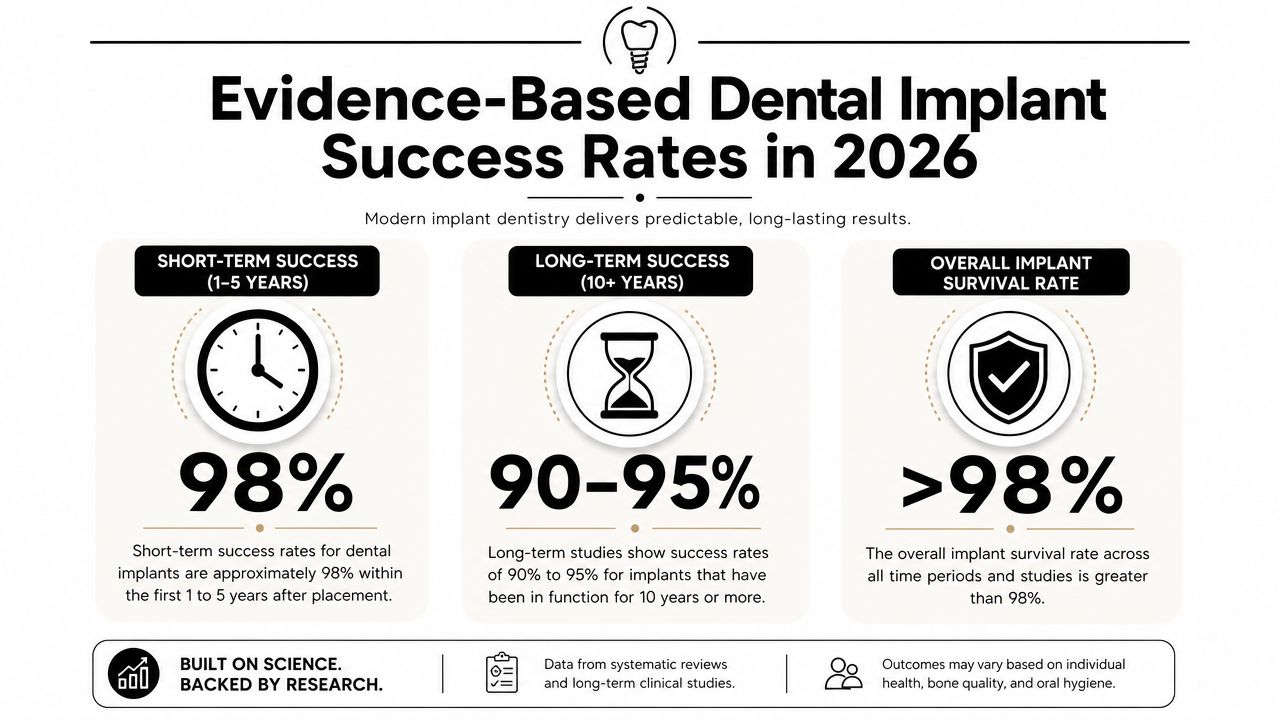
Evidence-Based Dental Implant Success Rates in 2026
It's understandable to seek the number. That's fair. The short answer is that implants perform very well, especially in the first several years after placement.
What the short-term data shows
Dental implants are widely described as one of the most predictable procedures in dentistry. Major summaries commonly report about 95% overall success and 95% to 99% short-term survival in the first few years. A large network study reported 97.8% implant survival at roughly 4 years, and an AAOMS summary is quoted as affirming an overall success rate of around 95% in this summary of implant success data.
For a typical patient, that means implant therapy is not fringe or experimental care. It's a mainstream replacement option with a strong record when the case is planned well and followed closely.
What long-term durability looks like
Implants also hold up well over time, but not every implant keeps that early peak forever. A 2024 meta-analysis found a mean 20-year survival rate of 92% in prospective studies and 88% in retrospective studies. The same body of literature also places 10-year survival around 90% to 95%, and one cited systematic review found about 94.6% 10-year survival in the 20-year implant survival meta-analysis.
That gives patients a more realistic picture. Implants are durable, but long-term success is a partnership between the procedure itself and ongoing care.
What these numbers mean in plain language
Here's the practical takeaway:
- Early outlook is strong for most properly selected cases.
- Long-term outcomes stay favorable, but maintenance matters more as years pass.
- Averages are not personal predictions. Your mouth, health history, bite forces, and hygiene habits shape your own risk.
If you're weighing restorative dentistry options after a failed tooth, these numbers should feel reassuring. They also support an important truth. The best implant outcome doesn't come from statistics alone. It comes from good diagnosis, careful placement, a well-designed restoration, and regular follow-up.
Key Factors That Influence Your Implant's Long-Term Success
The average dental implant success rate is useful, but it doesn't answer the most important question. What affects your implant specifically?
Some factors come from daily habits. Others come from treatment planning and the way the implant is placed. Both matter.

Factors you influence at home
An implant doesn't get a cavity, but the tissues around it can still become inflamed. That's why brushing, cleaning between teeth, and keeping regular cleaning and exams matter so much.
Smoking is another major concern in implant planning because it can interfere with healing and tissue health. Your overall medical history matters too. If you have health conditions that affect healing, your dentist should factor that into the timing and design of treatment.
Some patients also ask about nutrition and bone support. That's a good conversation to have with your healthcare team. If you're interested in the broader connection between nutrients and bone-related health, you can discover vitamin K2's health advantages as a general educational resource.
Later, daily maintenance becomes the part patients control most directly. If you already have implants or want to know what care will look like after treatment, this guide on how to care for dental implants is a practical next step.
Factors your dental team controls
Planning has a direct effect on outcome. A large retrospective study reported an early survival rate of 91.4% overall and found statistical associations with higher early failure risk for immediate implant placement with an OR of 3.742, implant length under 10 mm with an OR of 3.972, and age 30 to 60 years with an OR of 2.542 in the retrospective study on early implant survival.
That doesn't mean those factors automatically make someone a poor candidate. It means details matter. Implant timing, implant geometry, bone volume, and site anatomy are not small technicalities.
Why site-specific planning matters
Success also varies by location in the mouth. One large real-world dataset found the highest failure risk clustered in the first year, and failures were not evenly distributed by site. The maxillary molar region had a 3.0% failure rate and the central incisor region had a 3.37% failure rate in the large real-world implant survival dataset.
That helps explain why two patients can hear the same general success statistic and still have different recommendations. Upper back teeth can be more demanding. Front teeth can be more sensitive from an aesthetic standpoint. Good planning uses dental x-rays, often three-dimensional imaging, bite analysis, and a restoration plan that matches the location.
Good implant treatment is customized. The tooth position, bone shape, bite pressure, and gum line all influence the plan.
Success Rates for Single Implants vs Full-Arch Restorations
A patient who loses one tooth usually asks a different question than someone tired of wearing a full denture. One wants to know, "Will this feel like my own tooth again?" The other is often asking, "Will I be able to eat, smile, and live without worrying that my teeth will move?" Both situations involve implants, but success is measured a little differently.

Single-tooth implants
A single implant replaces one missing root and supports one crown. It is often a very targeted treatment. The goal is to restore that one space without asking the neighboring teeth to do extra work.
For many patients, this is the easier treatment to picture. You want the implant to stay stable, the gum tissue to look natural, and the crown to fit your bite so chewing feels normal again. In everyday terms, success usually means you stop thinking about the missing tooth.
Single implants also tend to have a simpler maintenance pattern. You are caring for one site, one crown, and the gum tissue around it. That does not make it casual treatment. It just means the moving parts are fewer.
Full-arch implant restorations
Full-arch treatment solves a bigger problem. Instead of replacing one tooth, implants support a complete upper or lower set of teeth.
The biology still matters, because each implant must heal well in bone. But the definition of success becomes broader. A full-arch case has to function as a system. The number of implants matters, the way chewing force is shared matters, and the design has to let you clean under and around the prosthesis. A sturdy foundation with a hard-to-clean restoration can create problems later, even if every implant remains in place.
That is why a full-arch result is often judged on two levels. First, are the implants surviving? Second, is the prosthesis comfortable, stable, cleanable, and working well in daily life?
The practical difference in how success is judged
Often, many patients get confused, and it is an understandable point of confusion. "Survival" and "success" are not always the same thing.
An implant can survive in the narrow sense that it is still present years later. Success is a higher bar. Success asks whether the implant is healthy, whether the bone and gum support remain stable, whether the bite is working properly, and whether the restoration is serving the patient well over time.
With a single implant, that evaluation is usually very site-specific. With a full-arch restoration, the dentist also has to judge how the whole set of teeth performs together, much like checking not just one tire on a car, but how the full alignment and suspension are handling the road.
Maintenance reflects that difference:
- Single implants usually focus on one implant site, one crown, and the health of the nearby gum and bone.
- Full-arch restorations require closer attention to bite balance, prosthesis design, home hygiene, and scheduled professional maintenance.
- Treatment sequencing may be more involved for full-arch care, especially when extractions, gum treatment, temporary teeth, or staged healing are part of the plan.
Long-term results remain encouraging, but they need context. Reviews of long-term implant outcomes generally report strong survival over 10 years and beyond, while also showing that maintenance, prosthetic complications, and patient-specific risk factors play a larger role as time passes. For patients exploring dental implant treatment options at Winn Smiles, that distinction matters. A treatment can look successful on paper and still need repairs, relining, bite adjustments, or hygiene support to keep performing well.
Choosing between a single implant and full-arch restoration is less about chasing one headline percentage and more about matching the treatment to your needs, anatomy, goals, and ability to maintain it. The right plan should work in your mouth and in your life.
Your Dental Implant Journey at Winn Smiles
For many patients, the hardest part is not the surgery. It's the uncertainty before they start. They want to know what the process feels like and whether they'll be rushed through it.
A typical implant journey begins with a consultation, imaging, and a close look at the missing tooth area, your gum health, and the way your bite comes together. If you've been searching for a dentist near me because you need both general dental care and implant planning, this visit should also answer whether any preliminary treatment is needed first.

What the first visit should cover
A thorough new patient exam for implants usually includes more than a quick look at the gap. The dentist should evaluate bone support, spacing, gum condition, and whether the final restoration will be a single crown, bridge support, or part of a larger restorative dentistry plan.
Patients also deserve a plain-language discussion of timeline, comfort, and alternatives. If you're anxious, that's part of the treatment plan too. Sedation options, local anesthesia, and step-by-step communication all help make care more manageable.
What treatment usually feels like
Once planning is complete, the implant is placed in the jaw and allowed to heal. During healing, the bone bonds to the implant. After that, the final restoration is attached.
From the patient's perspective, the experience usually feels less mysterious when each stage is clearly explained:
Consultation and imaging
The dentist studies the site, reviews health history, and maps out the restoration.Any needed preparatory care
That might include a tooth extraction, gum treatment, or other foundational work.Implant placement
The implant is positioned carefully so the final tooth can function well.Healing period
This is when the implant integrates with the bone.Final restoration and follow-up
The visible tooth is placed, checked, and monitored over time.
The final crown matters as much as the implant post. A strong implant still needs a well-designed bite and a restoration that's easy to keep clean.
For patients comparing options, Winn Smiles dental implant services include implant-based tooth replacement and full-arch solutions, along with the evaluation needed to determine which approach fits the condition of the mouth.
Why the process should feel personal
Some patients arrive after living with a missing tooth for years. Others come in right after an emergency visit. Some are also thinking about cosmetic dentistry, same-day crowns, or rebuilding their bite after several failing teeth. The process shouldn't feel one-size-fits-all.
A good local implant experience in Chattanooga or Cleveland should leave you understanding three things clearly: whether you're a candidate, what your treatment sequence looks like, and how you'll protect the result for the long term.
Frequently Asked Questions About Implant Success
What are early signs that an implant may be having a problem
A healthy implant usually fades into the background of daily life. You chew, speak, and brush without thinking about it much.
Call your dentist if you notice pain that stays instead of easing, a bite that suddenly feels off, swelling that returns, bleeding around the implant, or any sense that the implant feels loose. An implant should feel steady, much like a natural tooth root anchored in place. Small changes are easier to address early, before irritation turns into bone loss or a problem with the crown.
Can a failed implant be replaced
Often, yes.
The first question is why it failed. Sometimes the issue is infection, sometimes it is poor integration with the bone, and sometimes the implant itself is stable but the visible tooth or surrounding gum tissue needs correction. That difference matters because "failure" can mean very different things.
A replacement plan depends on the condition of the bone and gums, your health history, and whether the area needs time to heal first. Many patients are relieved to learn that one setback does not automatically close the door on implants.
Is it better to place an implant right after extraction or wait
The better choice is the one that fits the condition of the site.
Placing an implant right after extraction can shorten treatment and reduce the number of procedures. Waiting can give the bone and gums time to heal and can be safer in sites with infection, thin bone, or soft tissue concerns. A 2025 review in the Journal of Clinical Medicine found very similar short-term survival for immediate and delayed implant placement, which helps explain why both approaches remain accepted options in the right case (review on implant timing and survival outcomes).
Long-term results are where careful case selection matters most. An immediate implant is not automatically better because it is faster, and a delayed implant is not automatically safer because it takes longer. The site has to be evaluated like a foundation before building a house. If the bone, gum position, bite forces, and infection risk all line up, immediate placement can do very well. If they do not, waiting may protect the final result.
Do implants need maintenance if they feel fine
Yes. Feeling normal is good, but it does not replace follow-up care.
Implants can develop gum inflammation, bite wear, or hard-to-see bone changes before you feel pain. Routine cleanings, exams, and periodic imaging help catch those issues while they are still manageable. The goal is to protect both parts of the investment: the implant under the gum and the restoration you chew on every day.
Are implants worth it compared with other tooth replacement options
For many adults, they are worth serious consideration because they replace the root as well as the visible tooth. That support can help with stability, chewing comfort, and preserving nearby teeth when compared with some bridge options.
The right answer still depends on your goals, budget, health, and the condition of the rest of your mouth. Some patients want the longest-lasting fixed option. Others need the most practical solution for several missing teeth. A careful exam helps sort out value in personal terms, not just price.
If you're looking for clear answers about dental implant success rate, tooth replacement, or whether you're a candidate for treatment in Chattanooga or Cleveland, contact Winn Smiles. A consultation can help you understand your options, your risks, and the path toward a stable, confident smile.