Adults account for 60.2% to more than 64.3% of clear aligner use in major market summaries, so Invisalign isn't a teen-only option, it's a mainstream adult orthodontic choice. In many adult cases, treatment takes about 18 to 22 months, though real-world refinements can make it longer.
If you've caught yourself hiding your smile in photos, covering your mouth when you laugh, or wondering whether it's too late to straighten your teeth, you're in the right place. Adults in Chattanooga and Cleveland ask very practical questions before they start, and they should. Will it fit a work schedule, how long will it really take, what if I already have crowns or gum issues, and is this better than braces for my case?
Why Adults Are Choosing Invisalign Over Traditional Braces
You're standing in line at a store, see your reflection in the glass, and angle your head so your teeth show a little less. That tiny habit is one of the most common reasons adults start looking into orthodontic care, because the concern isn't just appearance, it's how that appearance affects work, photos, and everyday confidence.
Adult Invisalign treatment feels appealing for a simple reason, it's discreet. Since Invisalign has been around commercially since 1999 and Align Technology said it had treated 17 million people worldwide by 2023, including 4.5 million teens, the numbers show it has moved well beyond niche use and into routine adult care, especially in a market that was valued at $6.1 billion in 2023 with a projected 28.5% CAGR through 2030 (ConsumerAffairs summary).
What makes adult treatment different
Adults usually bring a different set of priorities than teens. They're not asking only whether teeth can be moved, they're asking whether the treatment fits a commute, client meetings, dinners out, and existing dental work. That's why invisalign treatment for adults is often discussed alongside questions about discretion, flexibility, and long-term stability.
Adults don't need a perfect marketing story. They need a plan that fits real life, including chewing, cleaning, travel, and the teeth they already have.
A good local dentist should talk through whether you need cosmetic alignment, restorative sequencing, or a different orthodontic path altogether. At Winn Smiles in Chattanooga and Cleveland, that conversation starts with an exam, not a sales pitch.
What this guide covers
You'll get a plain-language look at how aligners work, who's a real candidate, what the timeline looks like in practice, how adults handle the day-to-day routine, and where Invisalign fits compared with braces and other aligner brands. You'll also see why some adults need periodontal care or restorative planning before aligners even begin.
How Invisalign Works for Adults
Invisalign uses a series of custom clear plastic overlays, each about 0.030 inches thick, designed to move teeth in very small increments, about 0.25 to 0.33 mm per upper or lower tray pair (JCO technical description). That step-by-step design is the whole point.
Staircase, not escalator
The easiest way to understand Invisalign is as a staircase. Each tray creates one small change, then the next tray builds on it. By itself, one step looks modest. Over many weeks, those steps add up to a visible change in alignment.
Wear time matters because the trays only work while they are in place. The classic clinical description recommends 20 to 22 hours of daily wear with tray changes every 1 to 2 weeks. If aligners stay out of the mouth too long, the planned movement does not stack the way it should.
Practical rule: if you are wearing aligners only part-time, you are delaying treatment.
Why the removable design matters
Adults usually need to eat, brush, floss, speak clearly, and get through meetings without a lot of hassle. Because aligners come out for meals and cleaning, they fit many adult routines better than fixed wires. The tradeoff is straightforward, convenience only works if the patient keeps up with the schedule.
Digital planning also matters. The aligners are built around a sequence of movements before treatment starts, so the dentist can map out the tooth changes in advance. That planning helps set expectations, but it also means cooperation matters every day, since the trays can only guide the teeth when they are worn as directed.
What patients often misunderstand
A lot of adults hear “clear aligners” and assume the treatment is easy braces. The process is simpler and stricter at the same time. The trays are more discreet, but they still ask for discipline.
Adults who do best usually like structure, because the system depends on many small movements rather than one dramatic adjustment. If the mouth is not healthy, or if existing dental work changes the plan, the sequence has to be adjusted before treatment moves forward. That is also why adult cases often need more careful planning than the glossy before-and-after photos suggest.
Are You a Good Candidate for Adult Invisalign Treatment
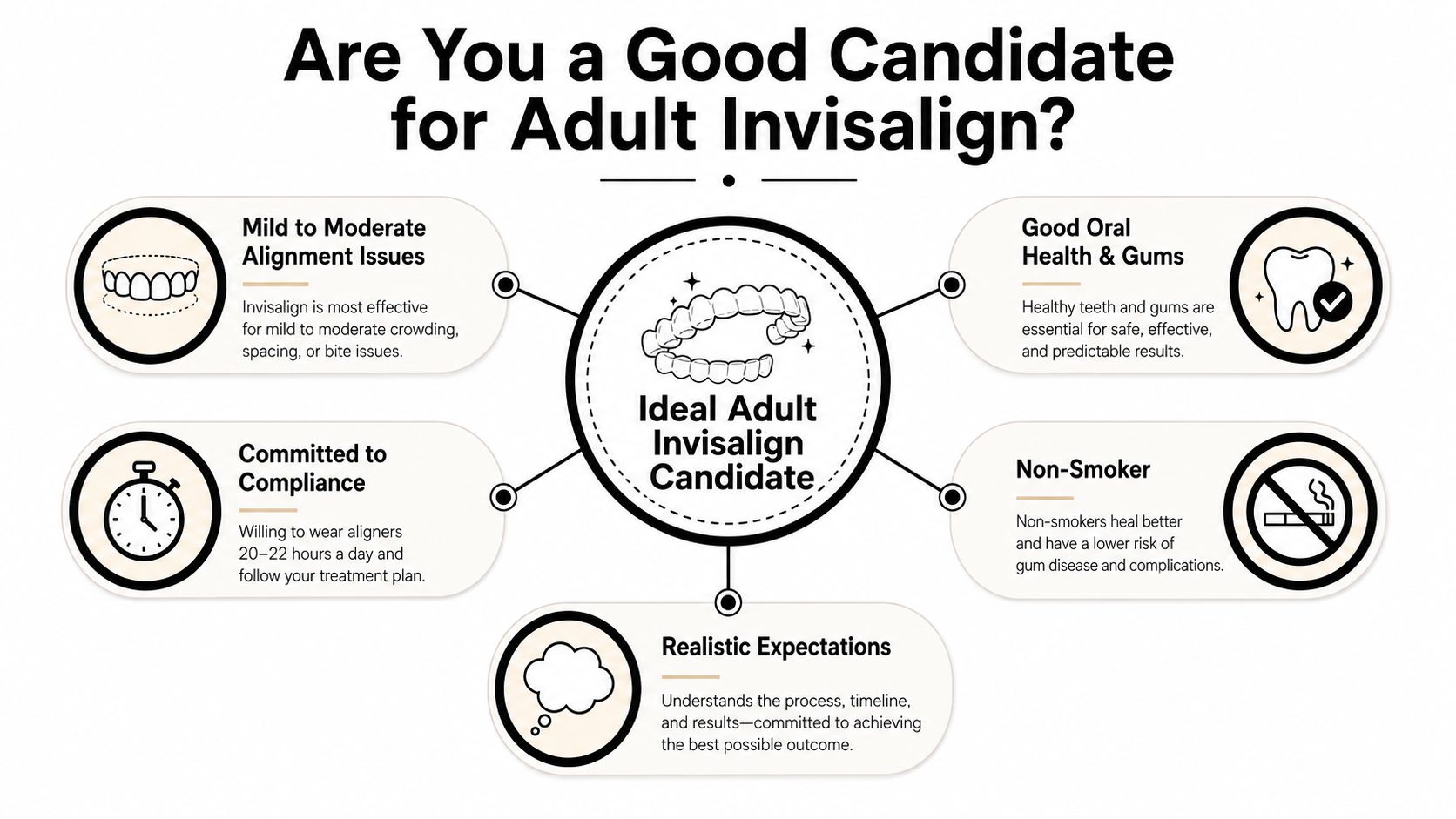
Not every adult with crooked teeth is an automatic candidate, and that's where online marketing often oversimplifies things. The most predictable cases are adults with stable gum and bone health and alignment problems like mild crowding or spacing. When the mouth is healthy, the planning is usually more straightforward.
The straightforward adult candidate
The ideal adult candidate usually wants discreet treatment, can wear aligners consistently, and has no major gum instability. That doesn't mean the case is simple in every detail, but it usually means the teeth can be moved with fewer complications.
The most reliable results tend to come from non-extraction treatment of mild to moderate malocclusions in non-growing patients, which is where clinical evidence is strongest (Invisalign clinical review). That doesn't make other cases impossible, it just means the evidence is clearest in that group.
The more complex adult candidate
A second group of adults needs a more careful plan. These are people with missing teeth, misshapen teeth, receding gums, crowns, implants, or other restorative work. In those cases, aligners may still be part of the solution, but the sequence matters. Sometimes gum treatment comes first, sometimes restorative care does, and sometimes the aligner plan has to be coordinated around both.
Active, compromised periodontal conditions are a real boundary. Stable gum and bone health matters before moving teeth, because aligners depend on a healthy support system. Adults with current periodontal risk need a dentist who can coordinate care instead of forcing the orthodontic plan too early.
Questions worth asking at a consult
A careful exam should answer whether your bite is stable enough for aligners, whether previous dental work changes the plan, and whether anything needs to be treated first. That's the kind of decision-making adults need, especially if they're comparing Invisalign with tooth extraction, restorative dentistry, or other services like dental implants near me searches often bring up.
If you're unsure, that's normal. The right next step is a consultation with digital scans and a bite evaluation, not guessing from a brochure.
The Adult Invisalign Treatment Timeline from Consultation to Retention
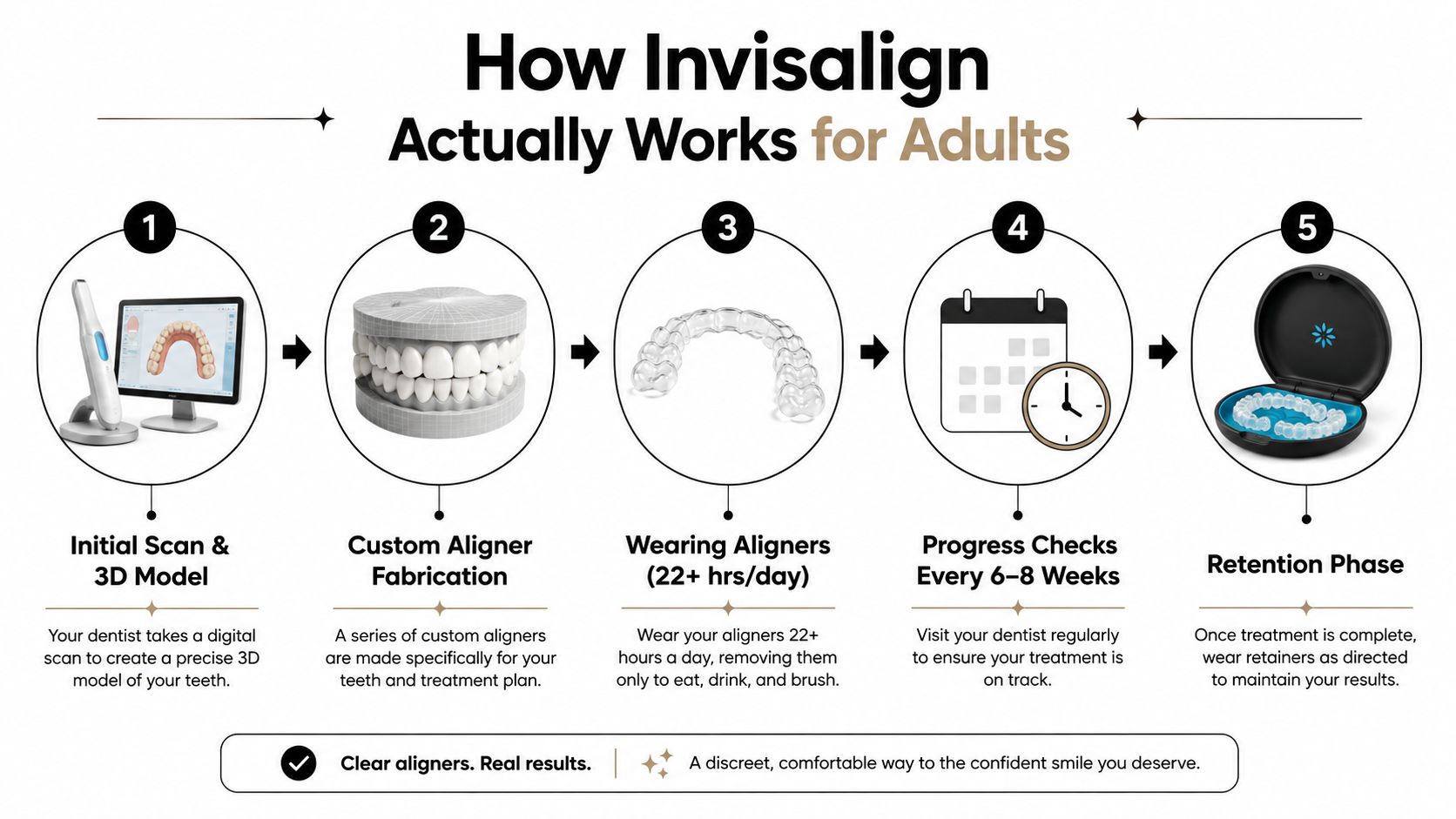
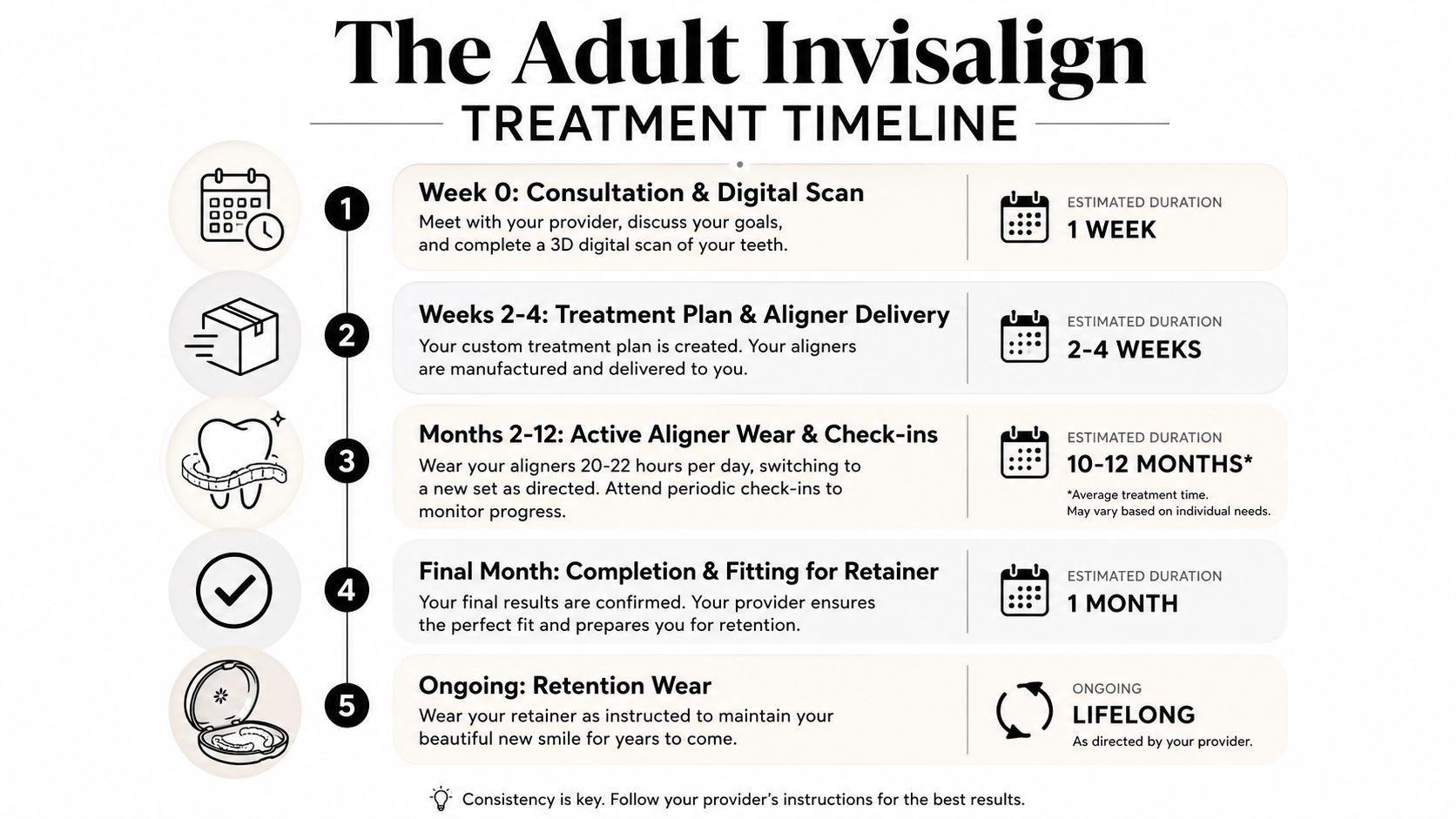
An adult Invisalign case usually starts with a scan, and that first step matters more than many people expect. Digital imaging gives the dentist a 3D view of the teeth, bite, and available space, which helps show whether tooth movement can happen on its own or needs to be coordinated with gum care or existing restorations. At Winn Smiles, the plan is built with that full picture in mind, because adults often have more than straightening to consider.
From scan to first trays
After the scan and digital setup, the first aligners are made. At the delivery visit, the dentist checks how the trays fit, walks through wear instructions, and shows the patient how to insert and remove them without warping the plastic or nicking the edges.
If you want a plain-language overview of treatment length, the practice's guide on how long Invisalign takes is a helpful place to start. Adult timelines often feel less predictable than the examples people see in ads, because work schedules, gum health, and prior dental treatment can all affect the pace.
What the middle of treatment really looks like
A good estimate is only the starting point. Peer-reviewed evidence suggests adult treatment commonly takes about 18 to 22 months, and one comparative analysis found an average of 18 months for Invisalign versus 24 months for conventional braces, with correction rates of 88% for Invisalign and 90% for braces (PMC comparison study). Those numbers help set expectations, but they do not capture every adjustment that often comes up once treatment begins.
That is because refinement is common. A 2023 study found patients averaged 2.5 refinement scans, only 6.0% finished without any refinements, 17.2% switched from Invisalign to braces, and the mean treatment length was 22.8 months, about 5.1 months longer than estimated (PubMed study). In plain terms, the first set of trays is often a roadmap, not the final route.
Real adult treatment is often a process of guided adjustments, not a straight line from tray one to tray twenty.
Retention is not optional
Once the teeth are in the right position, retainers protect the result. Adults sometimes expect the active aligner phase to be the finish line, but teeth can drift if nothing holds them in place, especially while the bite is still settling. Retention is part of keeping the work you already paid for.
That final phase is what helps a result hold up over time instead of slowly slipping back.
Invisalign Costs and Financing Options for Adults in Tennessee
Adult Invisalign pricing varies because no two cases are the same. The price usually reflects the complexity of movement, how long treatment runs, how many refinements are needed, and what kind of retention is included. That's why a single number can be misleading if it isn't tied to a real clinical exam.
What affects the total cost
A straightforward adult case usually costs less than a plan that needs multiple refinements or coordination with restorative care. If a patient also needs crowns, periodontal treatment, or tooth replacement planning, those services affect the total sequence and the overall investment.
Insurance may help, but the details vary by plan. Some adult orthodontic benefits cover part of Invisalign, while others don't include adult aligner care at all. The only safe answer is to check the plan before treatment starts and ask the office to review the estimate line by line.
How adults usually plan for payment
Many adults use financing to spread out the expense, especially when treatment is part of a bigger oral health plan. That's normal, and it's often easier than trying to absorb the full amount at once. If you're comparing options, a finance resource like medical spa financing San Antonio can at least show how structured payment planning is presented in other healthcare settings.
At Winn Smiles, adults can also review treatment details through the practice's Invisalign cost guide, Invisalign treatment cost, before making a decision.
Smart questions to ask before you start
- What's included: Ask whether scans, refinements, retainers, and checkups are part of the estimate.
- How payment works: Ask whether the office offers monthly scheduling or other financing options.
- What insurance covers: Ask how adult orthodontic benefits are applied to your specific plan.
- What happens if the plan changes: Ask how the office handles refinements or unexpected treatment changes.
The clearest cost conversations are honest ones. Adults don't need a vague “starting at” number, they need a plan they can follow.
Invisalign vs Traditional Braces and Other Clear Aligner Brands
Adults often compare Invisalign with braces because both can straighten teeth, but they fit different daily routines. Braces stay on and keep working in the background, while Invisalign depends on consistent wear and good follow-through. In a comparative analysis, the two approaches came out close in overall correction, which is one reason the better choice often depends on the type of tooth movement needed and how a person lives day to day. The comparison chart showing features of Invisalign, traditional braces, and other clear aligners for orthodontic treatment. helps show how those differences play out in practice.
Where Invisalign fits best
Invisalign usually works well for adults who want a removable, low-visibility option and whose bite changes fall into the mild to moderate range. It also appeals to patients who want easier brushing and flossing during treatment, since there are no brackets or wires to work around. For adults with crowns, fillings, or other existing dental work, that planning step matters even more, because aligners need to fit the teeth and the treatment goals at the same time.
The tradeoff is compliance. If the trays are not worn long enough each day, tooth movement can slow down or stall. Adults who want a treatment that keeps working even on busy days often do better with fixed appliances.
Where braces still win
Traditional braces are still the stronger choice for some complex cases, especially when there are severe rotations, large vertical changes, or harder bite corrections. Braces also remove the risk of forgetting to wear the appliance, because they stay on the teeth the whole time.
That added control matters when the case is less straightforward. Adults with gum concerns, limited room for movement, or teeth that need more precise force control may get a more predictable result with braces than with removable trays.
Other clear aligner brands can be a fit too, but supervision matters. A licensed dentist can monitor gum health, bite changes, and refinements in a way remote-only models often cannot. That is one reason adults should compare the provider, not just the plastic tray.
What the comparison really means
No appliance is automatically superior. The right choice depends on the tooth movement you need, your gum health, your existing restorations, and how disciplined you will be with wear time. For many adults in Chattanooga and Cleveland, the choice is between the convenience of aligners and the control of braces, not between “good” and “bad” orthodontics.
Living with Invisalign as an Adult Working Full-Time
The first few days usually feel awkward, then most adults settle in. Speech may sound slightly different at first, especially if you talk a lot for work, but the mouth adapts quickly when the trays are worn consistently. The adjustment is less about appearance and more about routine.
Making work and social life easier
If you eat lunch with coworkers, plan on taking the aligners out, eating, then brushing before they go back in. A travel dental kit makes that easier, especially if your day includes meetings, a long commute, or dinner out after work.
- Pack the basics: toothbrush, paste, floss, and a storage case.
- Remove before meals: don't try to chew through aligners.
- Brush before reinserting: food trapped under trays can become a problem.
- Keep water nearby: it's the safest thing to sip while wearing aligners.
Adults also worry about speaking in meetings or giving presentations. A little practice goes a long way. Read aloud for a few minutes at home, and the tongue usually adjusts faster than people expect.
A small amount of pressure when you switch trays is normal. Sharp pain isn't something to ignore.
What to expect with soreness and compliance
Each new tray can create pressure for a day or two. That's part of how the system works. The goal is controlled movement, not total comfort at every moment, so mild soreness can be a sign that the trays are doing their job.
The biggest mistake adults make is thinking they can “catch up” later. They can't. If the trays aren't worn enough, the treatment slows down and the next aligners may not fit properly. That's why the 20 to 22 hour daily wear target matters so much for adults with busy schedules.
Why supervision still matters
Remote-only convenience sounds appealing, but adult orthodontics isn't just about cosmetics. Gum health, bite changes, and refinements need professional oversight. Adults with more complicated mouths, especially those with existing dental work, do better when the plan is checked in person instead of left to guesswork.
A realistic mindset helps too. Invisalign can be a good fit for many adults, but it's not a six-month magic trick for every case, and it's not pain-free from start to finish. Patients who understand that up front usually feel more satisfied with the process.
How Winn Smiles Supports Adult Invisalign Patients in Chattanooga and Cleveland
Adults usually want three things before they start, clarity, comfort, and a plan that respects their schedule. Winn Smiles is set up around those needs with digital scanning, communication at each step, and office spaces designed to feel less clinical and more comfortable. For patients who deal with dental anxiety, the practice also offers a comfort menu and sedation options.
What a real adult consultation should answer
Adults often ask whether Invisalign can help with relapse after past braces. In many cases, yes, if the teeth and gums are healthy enough for movement and the shift is within a treatable range. They also ask whether aligners are safe with gum disease, and the honest answer is that stable periodontal health comes first, with coordinated care needed when gums or bone aren't stable.
The last big question is what happens after treatment. Retention is still part of the plan, because teeth need a way to hold their corrected position once active movement ends.
Why technology matters in adult care
Digital scanning is easier on the mouth than traditional impressions, and it helps the team plan aligner treatment with more precision. If restorative work is needed, same-day crowns can help keep care moving without unnecessary delays. Laser dentistry can also make some procedures gentler and more precise, which matters for adults who already feel nervous about treatment.
Winn Smiles also offers free consultations and second opinions for select services, which gives adults a chance to understand whether Invisalign is the right route before committing. With two convenient locations in Chattanooga and Cleveland, the practice is structured for people who need care that fits a real schedule, not a perfect one.
A practical way to move forward
If your teeth have shifted after previous braces, if your gums have been giving you trouble, or if you're trying to decide between aligners and braces, a consultation gives you a clearer answer than any online article can. Adults don't need hype. They need a clinician who can look at the whole mouth, explain the tradeoffs, and help them choose the path that makes sense.
If you're thinking about invisalign treatment for adults, schedule a visit with Winn Smiles in Chattanooga or Cleveland. The team can evaluate your teeth, check your gums, review existing dental work, and help you decide whether aligners, braces, or another treatment is the right fit for your smile.