
Roughly 1 in 7 adults worldwide experiences dental fear or anxiety, and sensitive care dentistry offers a practical way to make treatment feel safer, clearer, and more manageable. It isn't an unusual request to want more explanation, better pain control, or the ability to pause during an appointment.
You may be staring at your phone, thinking about calling a dentist near me in Cleveland or Chattanooga, while remembering a painful appointment, a rushed explanation, or years of avoiding care. Sensitive care dentistry begins by treating that hesitation as useful information, not a personal failure. At Winn Smiles, patients can discuss their concerns, understand their choices, and build a treatment plan around communication, pacing, and appropriate comfort measures.
Why Gentle Dental Care Matters for Local Families
A patient who has postponed a cleaning may not be avoiding health. They may be avoiding uncertainty. They may wonder whether an old filling will hurt, whether a sensitive tooth means a root canal, or whether the team will judge them for waiting. Even searching for an emergency dentist can feel difficult when the patient expects pain, pressure, or a lecture.
Dental anxiety is a measurable access issue, not just nervousness before an appointment. A 2021 systematic review and meta-analysis of 31 studies involving 72,577 adults estimated that 15.3% of adults worldwide experienced dental fear or anxiety, with a 95% confidence interval of 10.2% to 21.2%. The same analysis estimated that 12.4% had high dental fear or anxiety and 3.3% had severe anxiety, which can be associated with avoidance or dental phobia.

Comfort is part of complete dental care
For a family in Cleveland or Chattanooga, gentle care should mean more than offering sedation after fear has already taken over. It should include a calm welcome, plain-language explanations, consent before each step, and an agreed stop signal. It should also include time to discuss medical history, medications, costs, transportation, and recovery requirements.
A separate review using the Modified Dental Anxiety Scale examined 19 studies with 9,267 participants and found a pooled prevalence of high dental anxiety of 18%. The difference between overall fear or anxiety and high anxiety shows why screening matters. A dentist shouldn't assume that every patient needs the same approach, and a patient shouldn't have to accept a standard experience that doesn't fit their needs.
A practical rule: The patient should know what will happen, what might be felt, and how to ask the team to pause before treatment begins.
Sensitive care can help someone start with a new patient exam, dental cleaning, and dental X-rays, then move gradually toward restorative dentistry, cosmetic dentistry, dental implants, or tooth extraction when clinically appropriate. That same approach helps children, adults returning after years away, and patients seeking an emergency dentist near me because pain has made delay impossible.
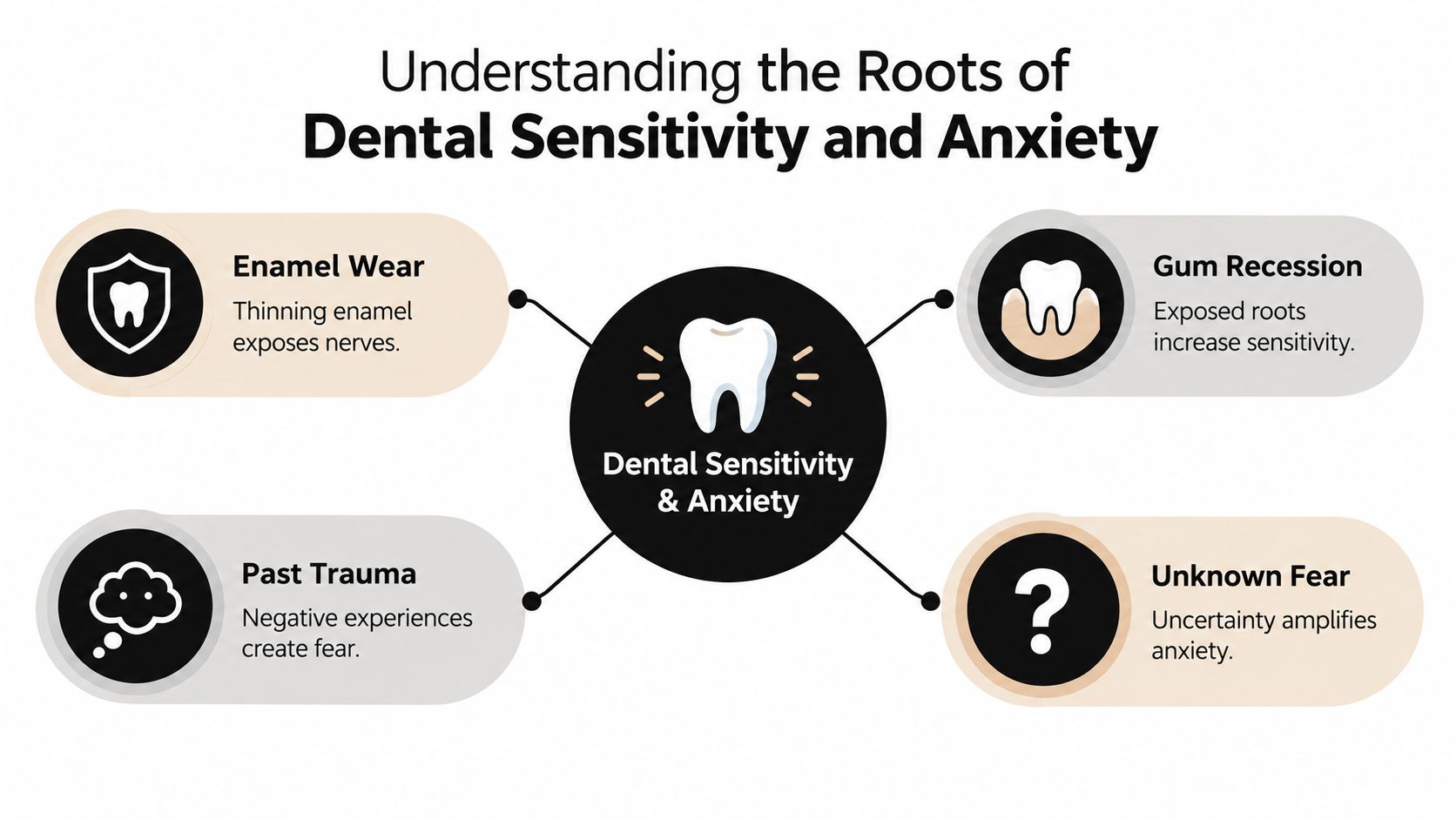
Understanding the Roots of Dental Sensitivity and Anxiety
Dental sensitivity and dental anxiety often overlap, but they aren't the same problem. Sensitivity is a physical symptom, while anxiety is an emotional and physiological response to anticipated treatment, pain, loss of control, or uncertainty. One can intensify the other.
A sensitive tooth may involve exposed dentin, gum recession, acid-related enamel wear, aggressive brushing, a crack, a defective restoration, periodontal disease, or pulp disease. Dentin contains microscopic tubules. When those tubules are exposed, temperature, touch, or pressure can trigger fluid movement and a sharp sensation. A localized symptom, lingering pain, or discomfort that persists after a stimulus deserves examination rather than automatic self-treatment.
Why fear can grow before an appointment
Anxiety often develops through memory and prediction. A past experience involving pain, embarrassment, or a lack of control can make the next visit feel threatening, even when the planned procedure is different. The unknown can amplify that response. A patient may fear the sound of a handpiece, the sensation of numbness, the possibility of bad news, or not knowing how long treatment will take.
Behavioral support has a meaningful role. A systematic review of psychological treatment for dental anxiety identified 10 randomized controlled-trial publications and concluded that cognitive-behavioral and behavioral interventions reduced anxiety while increasing acceptance of dental care. That evidence supports practical measures such as gradual exposure, clear explanations, stop signals, and patient participation.
Patients dealing with broader anxiety may also find it useful to review an anxiety treatment options guide from Be Your Best Self & Thrive Counseling, PLLC. Dental care doesn't replace mental health support, and mental health support doesn't replace a dental diagnosis. The two can complement each other when fear affects daily functioning or access to treatment.
When sensitivity needs a closer look
At-home desensitizing toothpaste may help when symptoms arise from exposed dentin. Products can work by blocking dentinal tubules or reducing nerve excitability. A clinical review of dentinal hypersensitivity supports twice-daily desensitizing toothpaste, reduced acid exposure, gentle brushing with a soft brush, and continued fluoride exposure as initial measures.
Persistent, severe, or one-tooth sensitivity changes the next step. The clinician may investigate recession, wear, a crack, a restoration, periodontal disease, or pulp involvement before recommending in-office desensitization, restorative care, periodontal treatment, or endodontic treatment. Winn Smiles also provides guidance on tooth sensitivity relief, but an online explanation can't determine why a particular tooth hurts.
The Complete Comfort Menu at Winn Smiles
Sensitive care works best as a coordinated plan rather than a single product or procedure. At Winn Smiles, the conversation can include communication, pacing, pain prevention, sensory comfort, technology, and sedation when appropriate. The patient remains involved throughout the process.
The first layer is predictability. Before treatment, the team can explain the sequence in plain language, identify a stop signal, agree on whether the patient wants updates during the procedure, and discuss what sensations may occur. Topical anesthetic can precede local anesthetic, and the clinician can check comfort before starting the next step. These details matter because numbness and sedation solve different problems. Sedation may reduce anxiety or awareness, but it doesn't replace proper local anesthesia.
Sedation as a tailored clinical decision
Oral sedation should be selected according to the patient's needs and medical risk, not offered as an automatic answer. A systematic review of 10 randomized controlled trials involving 327 patients found that oral midazolam 7.5 mg was associated with high treatment satisfaction, while alprazolam at 0.5 to 0.75 mg reduced anxiety. The authors rated the evidence as limited because the studies were small and used varied comparisons.
That finding supports a careful consultation about anxiety severity, procedure length, medical conditions, current medications, airway risk, and the intended depth of sedation. Planning should include informed consent, medical assessment, continuous observation of responsiveness and ventilation, documented recovery criteria, and escort restrictions where applicable. A patient shouldn't drive or make transportation assumptions without receiving specific instructions from the practice.
The comfort menu may also include laser dentistry for selected procedures. Laser treatment can support gentler, precise care in appropriate cases, but it isn't suitable for every diagnosis. Technology should serve the treatment plan, not replace an examination.
Fewer appointments can reduce the emotional burden
Same-day crowns may help some patients restore function and appearance in a single visit, depending on the tooth and clinical situation. This can reduce repeated scheduling and shorten the period spent worrying about an unfinished restoration. Restorative dentistry, root canals, tooth extraction, and dental implants still require individualized diagnosis and planning.
For a fuller explanation of possible comfort measures, patients can review Winn Smiles' comfort menu for dental visits. The central question isn't, “Which sedation option should I choose?” It's, “What combination of communication, pain control, pacing, and treatment methods will allow me to receive safe care?”
Matching Your Comfort Needs to the Right Option
There isn't one correct comfort choice for every patient. Someone with mild worry may need a detailed explanation and a stop signal. Someone with severe avoidance may need a staged plan, behavioral support, and a discussion of sedation. Someone with a painful tooth may need urgent diagnosis before comfort options can be finalized.
Choosing Your Comfort Level
| Comfort Option | Best For | What to Expect |
|---|---|---|
| Communication and stop signals | Patients who fear surprises or loss of control | Agree on a pause signal, review the treatment sequence, and receive explanations before key steps |
| Topical and local anesthesia | Patients concerned about pain or needle sensation | Topical anesthetic may precede local anesthetic, followed by a comfort check before treatment |
| Pacing and staged treatment | Patients returning after avoidance or those facing complex care | The team may divide care into manageable visits and begin with an examination or consultation |
| Sensory adjustments | Patients affected by sound, light, or clinical surroundings | Discuss music, television, visual focus, breaks, and other practical ways to make the environment easier |
| Laser dentistry | Patients whose diagnosis is appropriate for laser-assisted treatment | The clinician explains whether laser treatment fits the procedure and what sensations to expect |
| Oral sedation | Patients with significant anxiety who meet medical and procedural criteria | Review medical history, medications, escort needs, monitoring, recovery, and the limits of sedation |
| Same-day crown planning | Patients who may benefit from a restored tooth in one visit | The clinician assesses the tooth, restoration requirements, and whether same-day treatment is suitable |
This comparison also explains why sedation isn't always the dominant solution. Some patients prioritize additional local anesthetic, control over pauses, or a quieter environment. Others may want light sedation because anxiety makes it difficult to begin. The appropriate choice depends on the procedure, health history, ability to communicate, and recovery needs.
A consultation can also clarify a common concern about treatment urgency. If a patient is searching for dental implants near me, the first step may involve examining a missing-tooth area and discussing bone, gum, function, and timing. If a patient searches for cosmetic dentist near me, active decay or infection must be addressed before whitening, veneers, or other cosmetic services. Comfort planning supports good decisions, but it doesn't replace diagnosis.
Preparing for Your First Gentle Visit
Your first visit doesn't have to begin with extensive treatment. It can begin with a conversation about what makes dental care difficult and what would help you feel more in control.

A simple preparation checklist
Write down your concerns. Note sensitivity, previous difficult experiences, fear of injections, reactions to sedation, or worries about judgment. Specific details help the team adapt the visit.
Bring your medication and health information. Include current medicines, allergies, chronic conditions, prior anesthesia or sedation problems, and relevant cardiac history. Medical screening matters before planned treatment and sedation.
Ask about the visit plan. Find out whether the appointment includes a new patient exam, cleaning and exams, dental X-rays, a consultation, or treatment. Knowing the purpose reduces uncertainty.
Discuss practical access early. Ask about staged treatment, consultation fees, sedation fees, transportation, escort requirements, and payment expectations. Financial clarity can reduce a structural barrier to care.
Agree on a stop signal. Raising a hand can work. The signal should mean pause, not necessarily that treatment must end. You can also request a short explanation before the next step.
An examination may identify a cavity, cracked tooth, infection, gum condition, or a sensitivity cause that needs treatment. The CDC estimates that 21% of U.S. adults ages 20 to 64 have at least one untreated cavity, and 1 in 6 adults age 65 or older has untreated cavities according to its oral health information on cavities and tooth decay. Pain-free patients can still benefit from preventive evaluation.
After treatment, follow the written instructions for eating, brushing, medication, and activity. If sedation is used, follow the practice's escort and recovery directions exactly, and contact the office if symptoms worsen or a concern arises.
The video below offers another way to become familiar with dental care before scheduling.
Finding Your Trusted Local Dental Home
A trusted dental home should make it easier to ask questions before you commit to treatment. For families in Cleveland and Chattanooga, that means finding a practice where general care, emergency dentistry, restorative treatment, cosmetic services, dental implants, and comfort-focused planning can be discussed in one coordinated setting.
Winn Smiles offers light, airy offices, customized sedation options, laser dentistry, same-day crowns, professional teeth whitening, veneers, Invisalign, periodontal care, root canals, emergency dentistry, dental implants, and full-arch implant solutions. The practice also evaluates therapeutic options for sleep apnea and offers free consultations and second opinions for select services. These options don't eliminate the need for diagnosis, but they give patients more ways to discuss care that fits their health, schedule, and comfort needs.
Access matters as much as atmosphere
Patients may face more than fear. Cost, transportation, chronic illness, insurance gaps, competing health priorities, and limited provider availability can all affect whether care begins. A 2025 scoping review of 79 studies described oral healthcare underuse as the result of interacting financial, structural, and psychological barriers, including dental anxiety.
That makes transparent conversations valuable. Ask which problems are urgent, which can be staged, what each option involves, and how medical conditions or medications may affect planning. The same habit of clear communication supports responsible patient education, including the practical principles discussed in these 2026 dental marketing tips, where clarity helps people find and understand relevant care.
Emergency symptoms deserve prompt attention. The CDC reports that tooth disorders generated an average of 1,944,000 emergency-department visits annually in the United States during 2020 to 2022, equal to 59.4 visits per 10,000 people and approximately 1.4% of emergency-department visits, as detailed in its emergency-department visit data. Severe toothache, facial swelling, or suspected infection shouldn't wait for a routine cleaning.
If you have certain high-risk cardiac conditions, tell the dental team before treatment. ADA guidance recommends antibiotic prophylaxis only for specifically identified patients at highest risk of an adverse outcome from infective endocarditis and for procedures involving manipulation of gingival tissue, the periapical region, or perforation of oral mucosa, as outlined in the ADA infective endocarditis guideline.
Winn Smiles offers personalized sensitive care dentistry, including clear communication, pacing, pain-control planning, custom sedation options, laser dentistry, and full-range dental services for patients in Cleveland and Chattanooga. Visit Winn Smiles to request an appointment, consultation, or second opinion and take the first step toward dental care that feels manageable.