
What should “covered” by dental insurance mean for your actual bill? It depends on which treatment stages your plan includes, its payment rules, and how much of your annual maximum remains.
A plan may contribute toward implant treatment without paying most of the total. Ask which parts are covered, what percentage the plan pays, and which benefit year applies. The difference between coverage on paper and your out-of-pocket cost can be substantial.
At Winn Smiles, the first implant visit includes a detailed examination with 3D imaging of the jaw, a discussion of your goals and options, and a personalized treatment plan. Use that plan to ask your insurer for a written estimate before treatment begins.
Which Dental Plans Cover Implants and How Often
The plan type printed on your benefits summary changes the answer before anything else does. In a review of sampled plans, implants were covered during the first year by 22% of PPO plans and 30% of HMO plans, and that review cautions the HMO and indemnity samples were limited and not statistically significant (national implant coverage statistics). A separate review counted about 53% of plans examined as including some form of implant coverage, which shows how much the result depends on which insurers, which policy forms, and which definition of coverage the reviewer used.
| Plan type | Share covering implants in year one | What it means for you |
|---|---|---|
| PPO | 22% | Coverage exists but is limited; check each component |
| HMO | 30% | Small sample; confirm the benefit in writing |
| Indemnity | 100% of sampled plans | Small, not statistically significant sample; still verify |
| All plans examined | About 53% include some implant coverage | Results vary by insurer and policy wording |
Read those rows as a description of the market, not a promise about your card. A plan that lists implants as a covered service can still refuse the surgery, the crown, or the bone graft, or pay for them at different percentages. The word on the summary is a category, and the category is where insurers hide the detail.
Read the definition, not the headline: a plan that lists implants as covered can still exclude the surgery, the crown, or the graft that makes the surgery possible.
Insurance status also tracks who ends up with implants in the first place. An analysis of National Health and Nutrition Examination Survey data from 1999 to 2016, covering 32,758 adults with at least one missing tooth and 618 adults with at least one implant, found that among implant recipients 56.2% had private dental or health insurance and 26.3% had public insurance, compared with 53.9% and 40.8% among all adults with missing teeth (the NHANES analysis of implant recipients). The gap doesn't prove insurance causes treatment, but it tells you which plans say yes more often.
Verification up front is what separates a quote from a bill. The same eligibility-verification discipline hospitals use to reduce claim denials with Clarity works at one-patient scale: confirm the plan is active, confirm what's left of the annual maximum, confirm the exact procedure codes.
Your first move: find your plan type on the benefits summary, then note whether implants appear as a named benefit, sit under major services, or don't appear at all. That one line beats anything a phone representative will summarize for you.
Medicare and Discount Plans Work Differently
Here's where many people's assumptions break. Routine tooth replacement with dental implants is generally excluded from Original Medicare, including implant-supported crowns, bridges, and dentures (Medicare's dental services coverage page). Routine Medicare dental coverage has been excluded since the program began in 1965, and ordinary tooth-replacement implants sit outside Original Medicare benefits. Public insurance has historically been the least likely to pay for implants, while private plans that do pay usually cover only part of the cost.
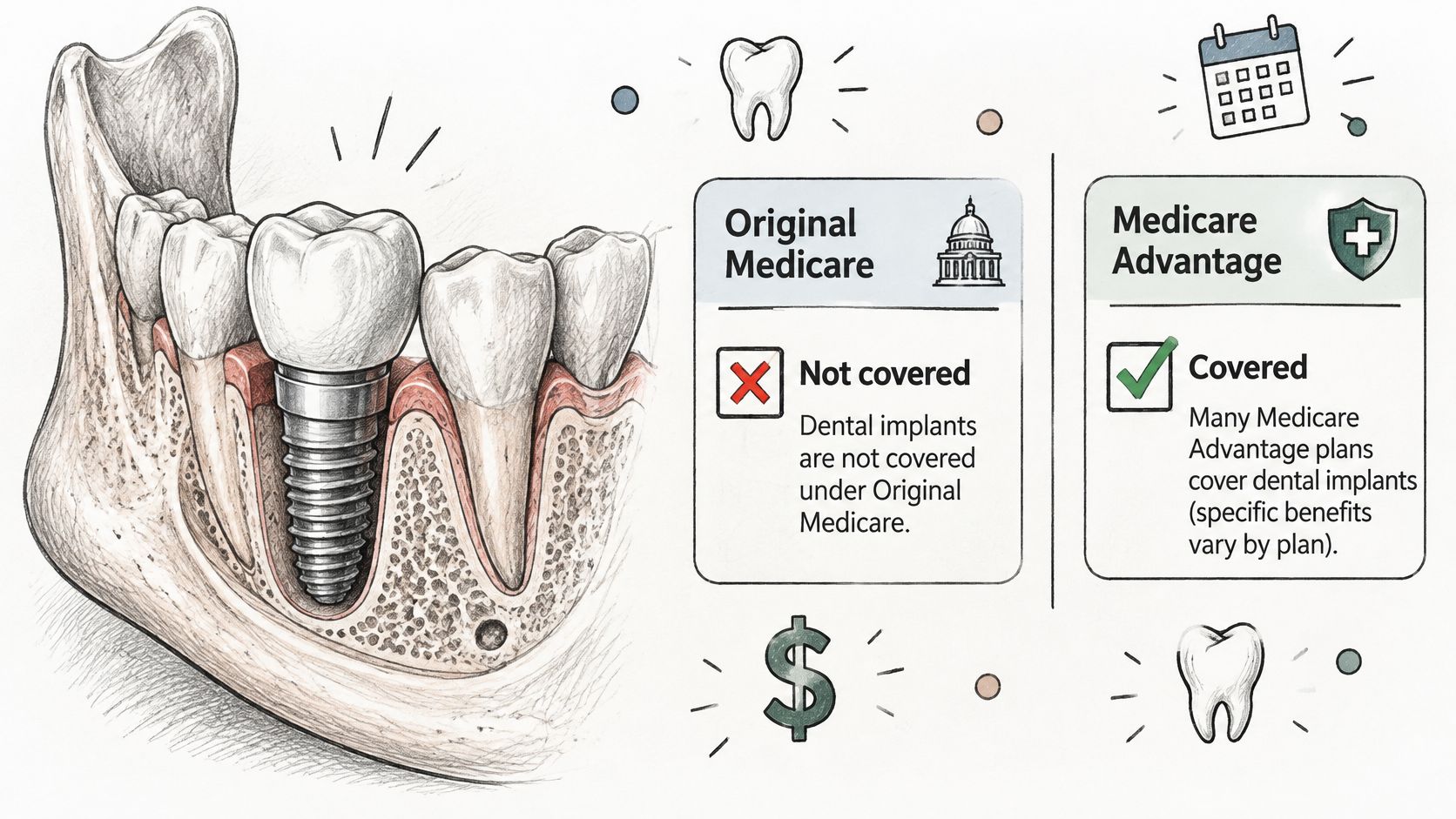
There is one real doorway. Coverage can become possible when the dental service is directly and inseparably connected to a Medicare-covered medical treatment, such as medically necessary oral care before a heart-valve, organ, kidney, or bone-marrow transplant. CMS looks for documentation showing that inextricable link. In practical terms, the claim has to name the underlying medical diagnosis, explain why a removable denture or a conventional bridge won't do, and tie each billed stage to the success of the medical treatment. A single missing tooth, trouble chewing, or a cosmetic preference on its own usually doesn't clear that bar.
If you're in that situation, gather the medical records and ask for a written pre-service determination before anyone schedules surgery. Get the medical policy in hand and coordinate the dental procedure codes with the diagnosis.
Where Discount Plans Fit
Discount plans aren't insurance. They negotiate a lower fee at participating offices and then pay nothing toward the bill. That can still save real money, but compare the discount against the full written fee for each phase, not against a percentage someone quoted you verbally.
The test that settles it: if a benefit isn't printed in your plan documents or in a written estimate, treat it as unconfirmed.
One warning worth repeating: ads using the Winn Smiles name and website to promote "free dental implants" are a scam and are not from us, so verify any offer against the practice directly.
What Insurance Pays for in Each Part of Treatment
A dental implant is a series of services, and the plan may review each one separately. Extraction or site preparation, implant placement, the abutment, and the crown or overdenture can have different exclusions, coinsurance, annual-maximum limits, and frequency rules (how dental plans process implant claims). Ask for a written estimate for every stage before treatment begins.
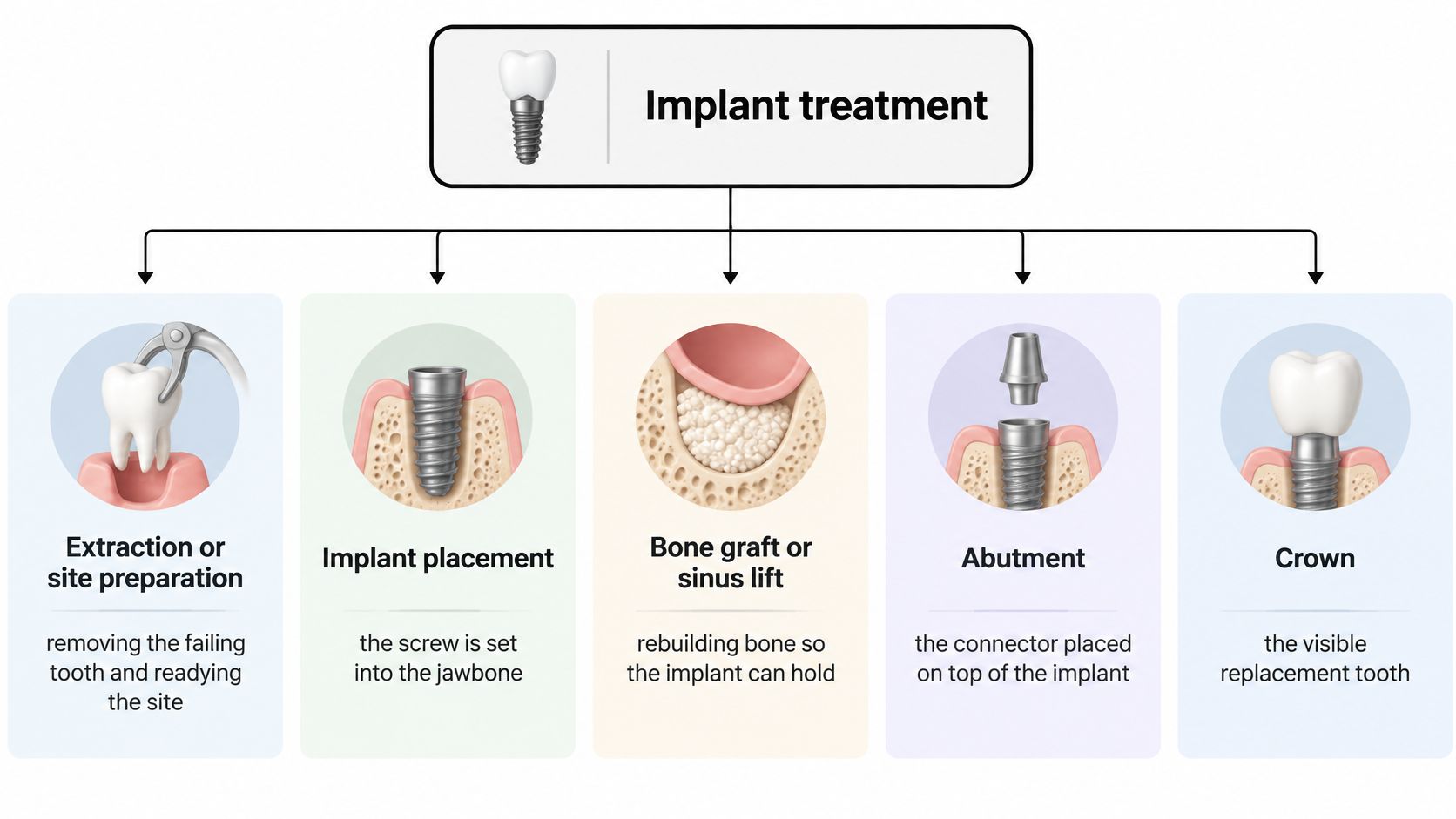
Treatment may begin with removing a failing tooth or preparing the site. The implant is placed in the jawbone, and a bone graft or sinus lift may be recommended if the foundation needs support. Once the implant has integrated with the jawbone, the abutment connects it to the custom restoration. Imaging and sedation may be billed separately, so ask whether your plan covers them.
| Treatment part | How plans often classify it | What to confirm |
|---|---|---|
| Extraction or site preparation | Basic or major service, depending on the plan | Coinsurance and whether it shares the annual maximum |
| Implant placement | Major service; employer dental plans often limit benefits to 50% to 80% of eligible cost (implant benefit limits in dental plans) | Waiting period and missing-tooth clause |
| Bone graft or sinus lift | May be excluded or billed as a separate benefit | Whether the policy covers grafting |
| Abutment | May be processed as a separate benefit | Whether it is handled separately from surgery |
| Crown or overdenture | Major restoration with its own frequency rule | Replacement interval, often every 5 to 7 years |
| Diagnostic imaging and sedation | May be a separate benefit with its own exclusions | Whether 3D imaging and sedation are covered |
Two Clauses That Quietly Cut Your Payout
A missing-tooth clause may exclude a tooth lost before your policy took effect. If you lost a molar before enrolling, check the policy wording before assuming the plan will contribute to replacing it.
An alternate-benefit provision may cap payment at the cost of a covered bridge or removable partial denture. You pay the difference between that allowance and the implant treatment fee.
Waiting periods for major procedures vary by plan. Confirm whether one applies before scheduling treatment. If a plan denies a phase, check that the submitted code matches the documented service. A medical coder performs related code-and-documentation work when reviewing claims.
Request a predetermination before scheduling. It should list the procedure codes, covered percentages, deductible, waiting-period status, missing-tooth limitation, alternate benefit, annual maximum, and whether the crown is processed separately from surgery. For a plain-language explanation of the treatment sequence, read our dental implant procedure walkthrough.
How Annual Maximums Reduce What Your Plan Pays
The percentage on your plan is the number patients remember and the number that matters least. The annual maximum is the ceiling on what the insurer pays in a benefit year, and it decides the bill.
Run the math on a $4,500 implant treatment with 50% coverage for major services. Half is $2,250. If your plan carries a $1,500 annual maximum and none of it is spent, the insurer pays $1,500 and you owe $3,000. Common dental-plan annual maximums sit around $1,000 to $2,000, so a single implant can consume an entire year of benefits (annual maximums and implant costs).
| Scenario | Plan pays |
|---|---|
| $4,000 treatment, 50% coverage, $1,000 maximum | $1,000 (capped; 50% would be $2,000) |
| $4,500 treatment, 50% coverage, $1,500 maximum | $1,500 (capped; 50% would be $2,250) |
| $5,000 treatment, 80% coverage, $2,000 maximum | $2,000 (capped; 80% would be $4,000) |
Notice what happens across all three. The patient lands at $3,000 before deductibles every time, whether the plan pays 50% or 80%. The percentage changes how fast you hit the ceiling, not where you end up. That's the gap this whole conversation is about.
The cap sets the bill, not the percentage. A generous-looking 80% plan and a modest 50% plan can leave you with the identical balance once the maximum runs out.
The maximum also isn't yours alone. Exams, cleanings, fillings, crowns, periodontal treatment, and extractions in the same benefit year all draw from the same pot, so a cracked molar in March shrinks what's available for implant surgery in October. These examples leave out deductibles for clarity, which means your real balance is a little higher, not lower.
Ask the insurer three questions before you commit: how much of the annual maximum remains, when it resets (calendar year or plan year), and which other treatment you'll need this year that draws from it. If the remaining balance is the obstacle, our breakdown of implant payment plans shows how patients spread the uncovered portion.
Staging Treatment to Protect Your Benefits
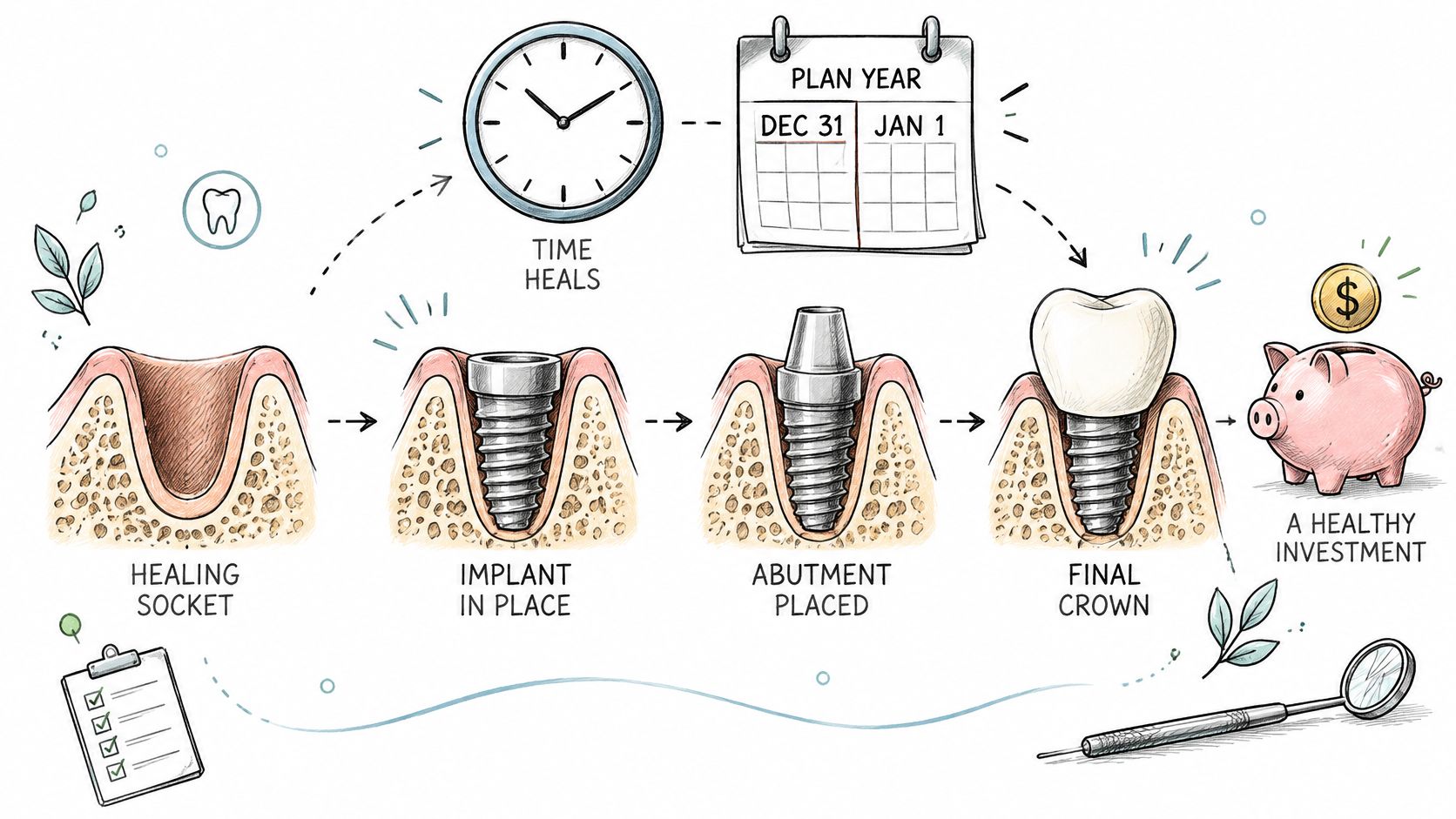
Implant care unfolds over months, not a single appointment, and that timeline is a financial tool if you use it deliberately. After an extraction, the site often needs time to heal before placement. After placement, the implant integrates with the jawbone over the next few months in a process called osseointegration, and our team monitors healing during that window. The custom crown, bridge, or denture goes on only once the implant has fully integrated.
Why the Healing Timeline Can Land in Two Benefit Years
Those healing gaps are exactly where plan years divide. Surgery in November and the restoration in February can fall into two separate benefit years, which means the second phase draws on a fresh annual maximum instead of fighting for what's left of the first.
That only works if the plan covers each service and the timing stays clinically sound. It's not a trick to force. Delaying a needed extraction or placement to chase a benefit invites infection, bone loss, and a bigger reconstruction later, which costs more than the benefit you were protecting. Our position is simple: clinical judgment sets the schedule, and billing gets mapped onto it afterward.
Winn Smiles offers in-house bone grafting and sinus lifts, so a thin ridge doesn't automatically push treatment to another provider or another city. For patients weighing a single tooth against a full arch, the same staging logic applies at a larger scale.
Restorations last years, and your contract's replacement rule governs when a new crown can be billed again. If the crown wears out sooner, that's a conversation with the plan, not a guarantee of a second payment.
Practical rule: ask for a phase schedule with the plan year written next to each date, so you can see which maximum each step draws on before anything is booked.
Get a Written Estimate and Book Your Consultation
Coverage for implants is controlled by the individual contract, not by whether implants are the right treatment for you. Some plans exclude them outright, others treat them as major services and pay a percentage after the deductible and waiting period, and some cover a conventional bridge while excluding the implant-supported version (why the contract controls implant coverage). A verbal "you're covered" won't identify an alternate-benefit clause.
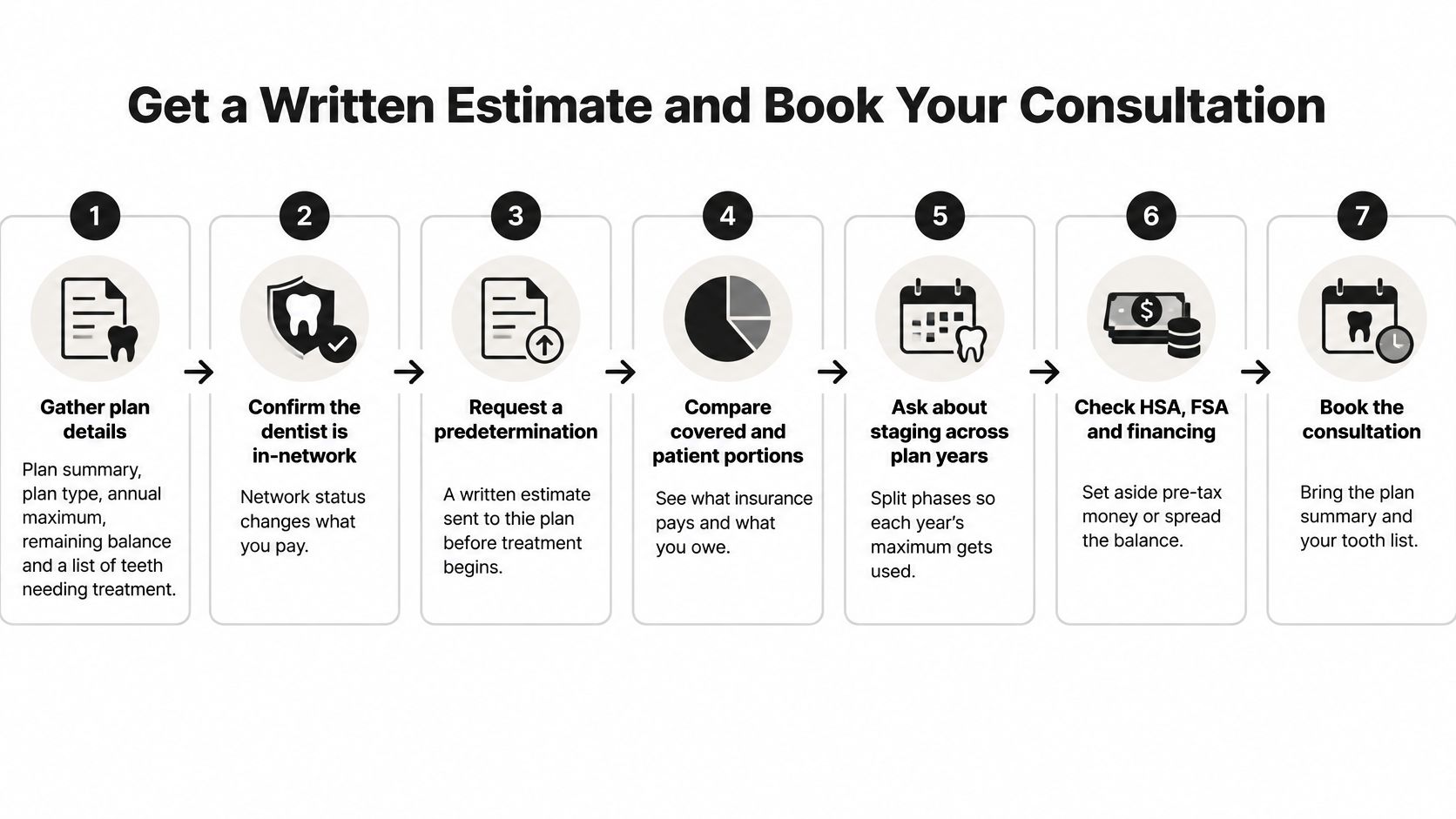
Work through this in order and you'll know more about your coverage than the representatives at your insurer's call center.
- Gather the paperwork. Pull your plan summary, plan type, annual maximum, remaining balance, a list of teeth needing replacement, and any treatment records from the past year. Without the remaining balance, every estimate you get is fiction.
- Confirm network status. In-network and out-of-network rates change your share, so settle this before you discuss numbers.
- Get the procedure codes. Ask the office for the planned codes covering extraction, implant placement, abutment, crown, graft, and imaging. Codes are what the insurer prices.
- Request a predetermination. Have the office send the planned treatment to your insurer for review before anything starts, so the plan commits in writing rather than after the fact.
- Read the reply line by line. Covered percentage, deductible, waiting period, missing-tooth limitation, alternate-benefit rule, and remaining maximum. Each one moves your number.
- Compare against the office fee. Put the insurer's allowed amount next to the practice's written fee for each phase. The difference is your balance, not a surprise.
- Save the approval and reference number. If your plan changes mid-treatment, you'll want the documentation, and a denied or reduced claim deserves a written request for the reason plus an appeal.
That last point deserves emphasis. An estimate is a plan for care, not a guarantee of payment; the insurer's approval is the final word, and plans change formularies, maximums, and clauses between one year and the next.
Here's the version of this that helps. Our first implant visit includes a thorough examination with 3D imaging of the jaw, a discussion of your goals and options, and a personalized treatment plan, so the codes you send to your insurer match the treatment you'd choose. For full-mouth cases, we'd rather see your mouth once and give you a clear, accurate estimate than quote a range over the phone. We also offer free consultations and second opinions for implants, dentures, veneers, Invisalign, and sleep apnea therapy, which means you can get the coverage conversation started without a financial commitment.
Winn Smiles cares for patients across Chattanooga and Cleveland, Tennessee, and we'd rather spend twenty minutes on your insurance contract than have you find out the balance after surgery. Bring your benefits summary and your tooth list to a free implant consultation, and we'll map each phase of treatment to your plan year, your remaining maximum, and the codes your insurer will process. Visit Winn Smiles to schedule your new patient visit or request a benefit review, and let's put a real number on your treatment instead of a guess.