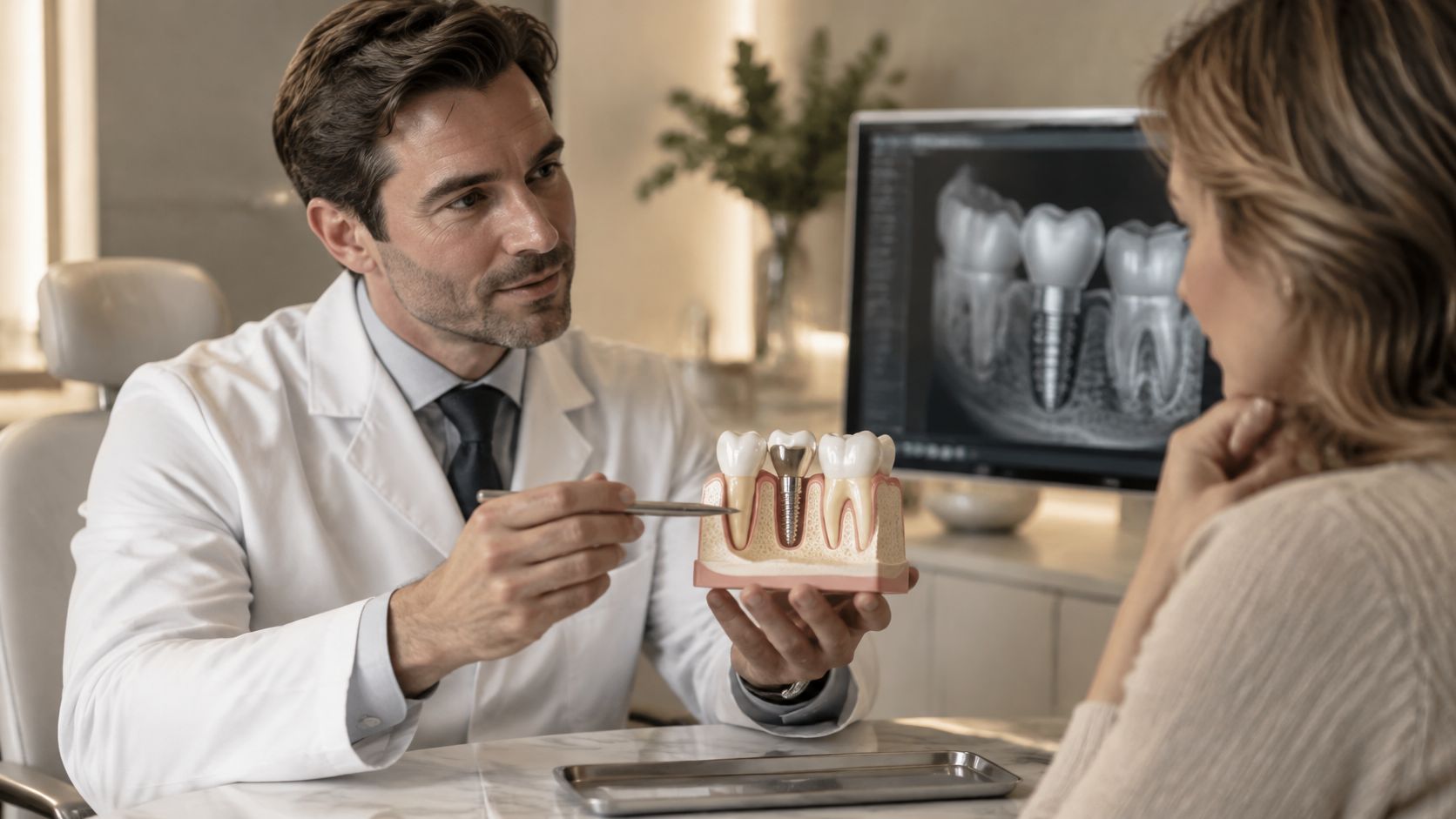
Diabetes doesn't automatically rule out dental implants. When researchers pooled 14 studies covering 1,260 implants in people with diabetes and 11,476 in people without, failure rates came out at 3.89% and 4.84%, a gap small enough that it wasn't statistically significant.
That finding gets repeated as "diabetics can get implants," and the conversation usually stops there. It shouldn't. A diagnosis on its own tells us very little. What changes your treatment plan is your HbA1c trend, the state of your gums, whether you smoke, and how reliably you'll come back for maintenance. Two patients with the same diagnosis can sit at opposite ends of the risk spectrum.
Before placing an implant in someone with diabetes, we consider how healing differs when glucose runs high, along with the coordination and maintenance steps that help keep an implant in place for decades.
Whether Diabetes Rules Out Dental Implants
If you've been told that diabetes closes the door on implants, the published evidence says otherwise. A systematic review of 14 studies compared 1,260 implants placed in patients with diabetes against 11,476 implants in patients without it. The diabetic group recorded 49 failures, or 3.89%, and the non-diabetic group recorded 555 failures, or 4.84%. The risk ratio was 1.07 with a 95% confidence interval of 0.80 to 1.44 and a p value of 0.65, so the difference between the groups wasn't statistically significant.
Survival tracked closely through the first six years in that same review. When follow-up stretched to 20 years, survival among patients with diabetes looked somewhat lower. That pattern is worth sitting with, because it tells you the early years are forgiving and the later years are where control and maintenance start to show.
Why the published numbers don't always agree
Read a different paper and you'll meet a scarier figure. A 2024 systematic review and meta-analysis in the Brazilian Journal of Oral Sciences pooled 37 studies and found the odds of implant failure were 5.31 times higher in patients with diabetes than in patients without. A 2024 review published through European Open Science reported an overall success rate of 93.67% among patients with type 2 diabetes.
Both can be accurate at once. Reviews that pool every diabetic patient mix people whose HbA1c sits at 6.5% with people whose HbA1c sits at 11%, and the average lands somewhere in the middle. Reviews that separate controlled from poorly controlled patients keep finding that the controlled group looks a lot like everyone else.
A diagnosis of diabetes tells you very little about how an implant will behave. Your last three months of blood sugar tell you almost everything.
The distinction that decides the plan
High blood glucose works against an implant in specific ways. It can impair osseointegration, the process where bone grows onto the titanium surface, and it raises the odds of peri-implant inflammation in the tissue around the implant. Think of a young tree: the sapling is healthy, but it only takes root if the ground around it stays that way. An implant placed while glucose swings is a tree planted in poor soil.
Candidacy never rests on the diagnosis alone. Most adults with missing teeth are candidates for dental implants, and overall health, smoking habits and bone density all affect suitability. Gum health belongs on that list too, which is why we spend real time on gum disease and how it interacts with implants before anyone is scheduled for surgery.
What the evidence supports is planning rather than exclusion: medical coordination, an honest look at glycemic control, a periodontal evaluation, a smoking review, and a tighter maintenance schedule once the implant is in.
HbA1c Levels and What They Mean for Implant Planning
HbA1c works like a three-month weather report for blood sugar. A single fasting reading shows one morning, while HbA1c shows the broader pattern that bone and gums have been living with during implant planning.
| HbA1c level | Control category | What it means for implant planning |
|---|---|---|
| Below 6% | Lower range; may be appropriate for some adults without significant low blood sugar | Usually favorable, with standard planning and medical coordination |
| 6% to 8% | Good control | Generally supports healing; planning continues with routine checks |
| Above 8% to 10% | Moderate control | Higher risk of peri-implant mucositis and marginal bone loss; the dentist may discuss improving control first |
| Above 10% | Generally treated as poor control in clinical practice | Timing and healing plan usually need medical coordination before surgery |
A review of the oral-surgery and implantology literature describes HbA1c below 7% as well-controlled diabetes in nonpregnant adults without significant hypoglycemia, values from 6% to 8% as good control, and 8% to 10% as moderate control. That review also linked higher HbA1c levels with more peri-implant mucositis and greater marginal bone loss across two- to five-year follow-up. Values above 10% are generally treated as poor control in clinical practice, so surgery timing and healing plans need medical coordination before implant placement.
Reading the table without turning it into a pass or fail line
Say a patient arrives with an HbA1c of 7.2%, readings that have held steady for a year, and gums that do not bleed when probed. That falls in the good-control band. Planning continues with routine checks and a documented conversation with the doctor.
Now say the next patient arrives at 9.5%, and the number has been climbing for six months. That is moderate control, and the honest recommendation is often to spend a few months improving glucose before surgery.
Same diagnosis, different plans. A single value is only one part of the picture. A falling trend matters more than a snapshot, and daily readings reveal the swings an average can hide. If you track fasting numbers at home, this comparison of normal versus diabetes glucose cut-offs helps you see how one test relates to the three-month average your dentist asks for.
Think of HbA1c as the setting on a thermostat. The number tells you the average temperature, but it does not show every dip and spike. That is why the dentist looks at the average, the direction of travel, and what is happening around the gums and jawbone.
Why the number keeps mattering after surgery
An HbA1c drawn the week before surgery describes a moment. Implants succeed or fail over years, so updated values matter at recall visits and after any medication change. Inflammation and bone loss can threaten an implant many months after the crown went on, and early on they rarely announce themselves with pain.
How Blood Sugar Affects Healing After Implant Surgery
Concrete cures at different speeds depending on the conditions. Pour a slab in cold weather and it sets slowly, unevenly, and sometimes short of full strength. Bone around a new implant behaves in a similar way. After placement, the implant integrates with the jawbone over the next few months in a process called osseointegration, and our team monitors healing throughout that window.

What high glucose slows down
Chronically high blood sugar doesn't attack an implant directly. It degrades the systems the implant depends on: bone-forming cell activity, collagen formation, blood flow through small vessels, and the immune response that keeps bacteria in check, as described in this review of glycemic control and implant prognosis. Slow any one of those and the same surgery produces a weaker bond, a longer healing window, and a gumline that overreacts to plaque.
That's why two patients can have identical surgery and very different recoveries. The procedure is the same. The ground it's placed into isn't.
The healing timeline, stage by stage
The first days and weeks are about swelling and soreness, which usually peaks and then settles. By the second and third week the tissue looks calmer, and the implant is gaining the stability that will hold your future crown.
Research findings become more specific. In a clinical study of people with type 2 diabetes, patients with HbA1c of at least 8.1% saw a larger maximum drop in implant stability and needed more time for stability to return to baseline. Among those at 10.1% or above, only 57.1% of implants had returned to or exceeded baseline stability after 16 weeks, compared with at least 80% in every other HbA1c group.
Here's a short walkthrough of what those monitoring appointments involve.
The next stage arrives once integration is complete, when the custom restoration goes on and takes over the chewing. From there, the timeline stretches into years, and that's the phase where peri-implant disease can begin. Bone loss around an implant is often painless at the start, which is exactly why scheduled checks beat waiting for a symptom.
If you want the practical version of the first week, this guide to dental implant recovery time covers what to expect day by day. The two questions worth asking your own dentist are simple: how will healing be monitored, and which symptoms should make me call the office rather than wait? Persistent swelling, drainage, increasing pain or a loose crown all belong on that call list.
Coordinating Your Dentist and Doctor Before Surgery
Most implant problems in patients with diabetes don't start in the surgical chair. They start in the gap between two clinicians who each hold half the picture. Closing that gap is a sequence, and the order matters.
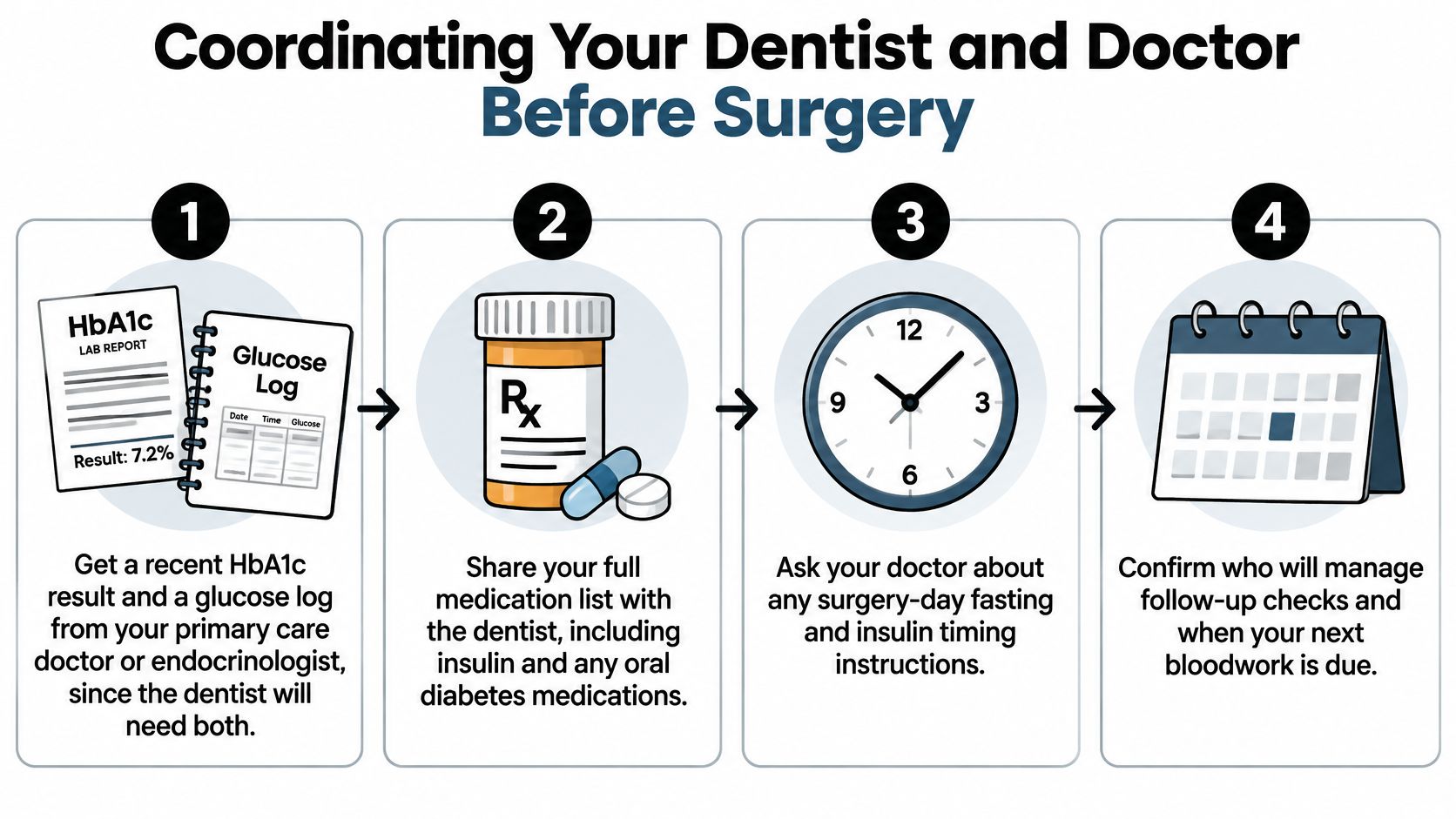
- Get a recent HbA1c result and a glucose log. The average tells us about healing capacity; the log tells us about the swings a breakfast can cause. Ask your primary care doctor or endocrinologist for both.
- Bring every diabetes medication, written down. Include insulin, oral agents, and anything with a low-blood-sugar risk. Mention past hypoglycemic episodes, because a long surgical appointment needs to be timed around them.
- Have your gums evaluated and stabilized first. Untreated periodontal disease gives bacteria a reservoir next to the surgical site. Clearing it before surgery protects the implant rather than delaying the inevitable.
- Say yes to the smoking question. This isn't a lecture. Smoking narrows the same small vessels diabetes already stresses, so it changes the plan and the healing timeline.
- Complete imaging and a bone assessment. Three-dimensional imaging of the jaw shows bone volume, bone quality and the safe position for each implant, which is what turns a general plan into your plan.
- Agree on timing out loud. Two legitimate paths exist: proceed now with a closely monitored healing plan, or wait a few months while glucose improves. Choosing one deliberately is the point.
- Confirm who you call afterward, and which instructions come from your physician. Eating, insulin timing and medication adjustments on surgery day are medical decisions, not dental ones.
On paper, a coordinated plan is short: one shared note between your dentist and your doctor, a glucose range everyone agrees is acceptable, and a follow-up schedule with dates in it.
Ask this directly: "Is HbA1c part of your implant planning, and who on your team contacts my doctor?" A clear, detailed answer shows you how the practice handles whole-health risk.
That question is worth more than any review score when you're comparing a dentist near me search result against a restorative dentistry provider. Whoever answers it with specifics is telling you how they plan.
What to Expect at Your First Implant Visit in Chattanooga or Cleveland, TN
Your first visit is a conversation with imaging attached, not a sales pitch. It starts with an examination that includes 3D imaging of the jaw, a discussion of your goals and options, and a personalized treatment plan you can take home and think about.
Bring the diabetes details you gathered earlier. We'll ask about your most recent blood sugar readings, your medications, and how past dental work healed, because a history of slow healing changes how we schedule the case.

Implant placement itself is a surgical procedure typically done under local anesthesia, with sedation available if you'd prefer it. Patients with dental anxiety often find that option makes the appointment far more manageable than they expected. Post-procedure discomfort is usually minimal and managed with over-the-counter pain medication, though with diabetes you should confirm which reliever and dose suit you with your own doctor.
Many patients ask about leaving with a tooth the same day. In a systematic review and meta-analysis of immediately loaded implants in adults with type 2 diabetes, survival didn't differ from non-diabetic controls overall, with a relative risk of 1.00 and a 95% confidence interval of 0.96 to 1.04. The decision still rests on primary stability, bone quality and quantity, bite forces, infection control, smoking and gum health, not on the diagnosis line in your chart.
Watch the first two weeks closely. Swelling that keeps climbing after day three, bleeding that doesn't ease, or tissue that looks angrier than it did the day before all warrant a phone call rather than a wait-and-see approach.
Protecting Your Implant for Years After Placement
The surgery is one afternoon. The implant is a decades-long project, and diabetes makes the difference in the years that follow rather than the week after.
Start with the routine that protects it. You'll be seen for professional cleanings and exams at the interval your dentist sets, which for many patients with diabetes is more frequent than the standard six-month recall. Dental x-rays when indicated let us track bone levels around the implant rather than guess at them. At home, daily plaque control with a brush and interdental cleaning suited to the implant's design matters more than any single product. If neuropathy or arthritis makes flossing hard, a water flosser or a larger-handled brush does the same job with less dexterity.
Add one habit to the calendar: recheck HbA1c after any major change in glucose control or medication. The American Dental Association's guidance on diabetes recommends considering HbA1c both before placement and throughout the implant's lifespan, because hyperglycemia is tied to peri-implant inflammation.
High survival isn't the same as ordinary maintenance
Look at what control can achieve. A review of controlled diabetic patients identified 2,992 implants, of which 2,890 remained successful over follow-up of 1 to 12 years, an overall survival rate of 97.43% against 97.88% in non-diabetic patients (implant survival and glycemic control).
Those numbers are reassuring, and they're also the reason to stay vigilant. A high survival rate is a population figure. Your implant can survive year one and still lose bone in year eight, because inflammation develops after integration, not before it.
That's the line that matters most in maintenance: implant failure means the implant is lost, while peri-implant disease is inflammation and bone loss that often responds well to professional treatment when it's caught early. One is an ending; the other is a maintenance problem with a solution.
| Sign | Possible cause | Action |
|---|---|---|
| Swelling or drainage around the implant that does not settle | Possible peri-implant infection | Call your dentist promptly |
| Pain or looseness in the implant or crown | Healing problem, bone loss or mechanical issue | Arrange prompt evaluation |
| Bleeding when brushing or probing around the implant | Peri-implant mucositis, an early gum inflammation | Book an early exam and cleaning |
| Crown or bite feels different | Loosening or restoration wear | Schedule an exam with dental x-rays when indicated |
| Blood sugar running consistently high | Higher inflammation and healing risk | Tell your dentist and doctor so the plan can be reviewed |
The rule that keeps implants: call promptly for swelling, drainage, pain or looseness. Waiting a month turns a cleaning into a rebuild.
Book Your Diabetes-Aware Implant Consultation in Cleveland or Chattanooga, TN
One next step is enough. Request a consultation with our team at Winn Smiles in Cleveland or Chattanooga, TN, and bring the diabetes details with you.
Please have ready your most recent HbA1c result and the date it was drawn, your usual blood sugar range and any history of low blood sugar, a current medication list, notes on smoking, a summary of past dental work, and your written questions about healing.
Ask us whether a dental exam and cleaning should come first to check gum health before implant planning. If you're considering full-arch treatment, we offer a free 3D scan to assess whether you're a candidate, which answers the structural questions before anyone talks about cost.
Call the office to book, or request an appointment through our website. We see patients who are new to the area, patients comparing options after a long gap in care, and people looking for a dentist near me who want a straight answer about whether their health is ready for surgery.
Bring your questions about dental implants and diabetes. We'd rather spend a consultation telling you the honest timing than place an implant into a healing environment that isn't ready for it.
Winn Smiles cares for implant patients across Cleveland, Chattanooga and the surrounding communities, and we plan every case around your medical picture rather than your jaw alone. Bring your latest HbA1c result and medication list to a consultation, and we'll tell you plainly whether to move forward now or prepare first. Visit Winn Smiles to request your appointment.