A lot of people start this search the same way. They catch their smile in a photo, notice stains that won't lift, or focus on one or two front teeth that look darker, chipped, uneven, or older than the rest of the smile. Then the key question arises. Should you whiten your teeth, or are veneers the better answer?
That's where the veneers vs teeth whitening decision gets personal. These treatments don't solve the same problem, and choosing the right one depends on what bothers you, how dramatic a change you want, and how much future upkeep you're comfortable with. For adults looking for a cosmetic dentist near me in Chattanooga, TN, or Cleveland, TN, the most useful answer usually isn't the fastest one. It's the one that still makes sense years from now.
Choosing Your Best Smile in Chattanooga and Cleveland TN
A patient may come in saying, “I just want whiter teeth,” and after a closer conversation, color isn't the only issue. Maybe one front tooth has an old injury stain. Maybe the edges are worn. Maybe small gaps show when they smile. In other cases, the concern really is simple staining from coffee, tea, or aging, and whitening is exactly the right first step.
That distinction matters.
People in Chattanooga and Cleveland often search for a cosmetic dentist near me because they want a brighter smile without feeling pushed into treatment they don't need. A good cosmetic plan should feel clear, not sales-driven. It should answer what can be changed, what shouldn't be changed, and what will hold up well over time.
Why this choice feels confusing
Whitening sounds simple because it is. Veneers sound appealing because they can do much more. The confusion starts when both options seem to promise a “better smile,” but in very different ways.
A few common situations lead people into this comparison:
- Stains that keep coming back after over-the-counter products
- One or two teeth that look different from the rest
- Chips, uneven edges, or small gaps that whitening can't fix
- Wedding, job, or family photo goals where appearance matters now and later
Practical rule: If you only want your natural teeth to look brighter, start by evaluating whitening. If you want to change color plus shape, spacing, or symmetry, veneers usually belong in the conversation.
The local decision is about fit, not hype
In Chattanooga and Cleveland, cosmetic dentistry should still start like any other good dental care. Teeth and gums need to be healthy. Bite patterns matter. Existing fillings, crowns, and wear patterns matter. If a patient also needs restorative dentistry, cleaning and exams, or updated dental x-rays, those issues should be addressed before committing to cosmetic work.
That's why this decision works best when you look beyond “which one looks better” and ask a more useful question. Which option fits your smile, your budget, and the amount of maintenance you want to take on?
What Do You Want to Change About Your Smile
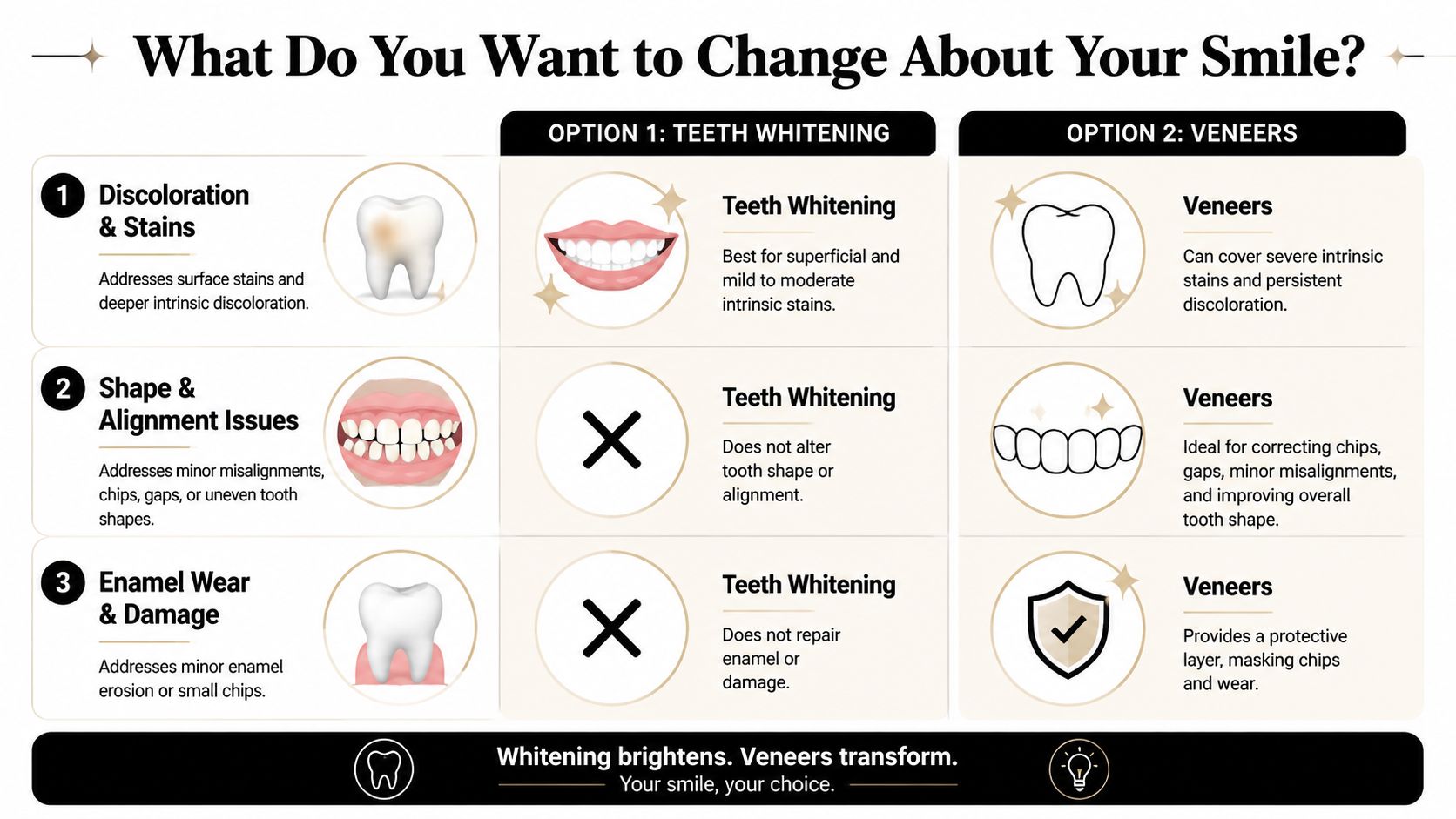
Before choosing a treatment, identify the actual problem. Whitening and veneers overlap in one area, color, but they part ways quickly after that. If you're not clear on what you want to change, it's easy to choose too little treatment or too much.
If your goal is mainly a brighter color
Professional whitening works on natural tooth color. It's often a good fit when the smile looks dull, yellowed, or stained from foods, drinks, or normal aging. If the teeth are otherwise healthy, even in shape, and free of cosmetic damage, whitening is usually the most conservative place to begin.
Whitening won't change the outline of a tooth. It also won't close spaces, smooth a chipped edge, or make a small tooth look larger and more balanced.
If your goal includes shape and design
Veneers are different because they can change multiple features at once. They're often considered when someone wants to improve:
- Deep discoloration that doesn't respond well to whitening
- Chips and worn edges
- Small gaps
- Teeth that look short, narrow, or uneven
- Minor alignment concerns that affect the appearance of the smile
That's why the veneers vs teeth whitening discussion shouldn't be reduced to “which gives whiter teeth.” One treatment brightens. The other can redesign the visible front of the smile.
A simple self-check helps. If you'd still be unhappy after your teeth became lighter, the issue probably isn't color alone.
Three quick ways to sort yourself into the right category
Look at old photos
If your teeth used to look the right shape but have darkened over time, whitening may be enough.Focus on one front tooth at a time
If you notice chips, edge wear, asymmetry, or uneven spacing before you notice color, veneers may solve the concern.Ask whether you want improvement or transformation
Whitening improves the smile you already have. Veneers can change the smile's overall design.
This is also where an exam matters. Some discoloration is surface-based. Some runs deeper. Some “crooked-looking” teeth are a shape problem, while others may call for orthodontic treatment instead. A patient looking for a dentist in Chattanooga, TN or Cleveland, TN often benefits most from hearing which option is appropriate, and which one would be unnecessary.
A Detailed Comparison of Veneers and Teeth Whitening
The biggest difference is scope. Teeth whitening changes shade. Veneers change shade plus form. Both can improve a smile, but they do it through very different paths.
An industry summary reports that about 19% of U.S. adults have had professional whitening, while about 8% of Americans have veneers. The same summary says the global teeth-whitening market was valued at $6.9 billion in 2021 with projections of $10.6 billion by 2030, while the porcelain veneer market was valued at about $2.1 billion in 2021 and is projected to reach $4.3 billion by 2030. That supports what most dentists see in practice. Whitening is the broader, lower-cost cosmetic entry point, and veneers sit in a narrower, more premium category of care according to this cosmetic dentistry market summary.
| Feature | Porcelain Veneers | Professional Teeth Whitening |
|---|---|---|
| Main purpose | Covers color, shape, chips, gaps, and minor alignment concerns | Lightens natural tooth color |
| Type of change | Comprehensive cosmetic redesign of visible front surfaces | Shade enhancement only |
| Procedure | Custom planning, tooth preparation in many cases, fabrication, bonding | In-office treatment or custom take-home system |
| Timeline | Usually more involved, though some workflows can be faster | Often completed quickly |
| Durability pattern | Long-lasting restoration with future replacement needs | Temporary result that fades and needs touch-ups |
| Best fit | Patients who want broader smile changes | Patients whose main concern is staining or dull color |
Visible results
Whitening can make a healthy smile look fresher, cleaner, and brighter. For many adults, that's enough. If the teeth are well-shaped and balanced already, whitening preserves what's natural and improves the shade.
Veneers deliver a more dramatic kind of change. They can mask discoloration, but they also let the dentist adjust visible length, contour, proportion, and symmetry. That's why a patient with chips or uneven front teeth may feel underwhelmed by whitening alone.
Procedure and timeline
Whitening is usually the simpler process. It doesn't require altering tooth shape, and many patients choose it because they want a cosmetic improvement without committing to restorative work.
Veneers require more planning. Shade selection, smile design, and bite evaluation all matter. In some cases, modern CAD/CAM systems can complete veneer workflows in a single visit, but the key point is that veneer treatment is still more involved because it's custom cosmetic reconstruction rather than color lifting alone. If you want a clearer sense of what whitening changes and what it doesn't, this page on teeth whitening results is a useful visual reference.
Durability and upkeep
The result pattern is different, even before you talk about cost. Whitening fades over time, especially if you drink coffee, tea, red wine, or use tobacco. Veneers don't fade in the same way natural teeth do, but they come with a longer-term commitment because they're restorations that will eventually need maintenance or replacement.
Ideal candidates
Whitening fits patients with healthy enamel, healthy gums, and a primary goal of brighter natural teeth. Veneers fit patients who want broader cosmetic correction in the front of the smile.
A lot of disappointment in cosmetic dentistry happens when someone uses whitening to solve a veneer problem, or considers veneers when whitening would have met the goal with less treatment.
Understanding the Costs and Your Financing Options
Cost matters because these treatments ask for different kinds of investment. Whitening is usually the lower entry point. Veneers cost more because the process is more custom, more material-intensive, and more dependent on design and fabrication.
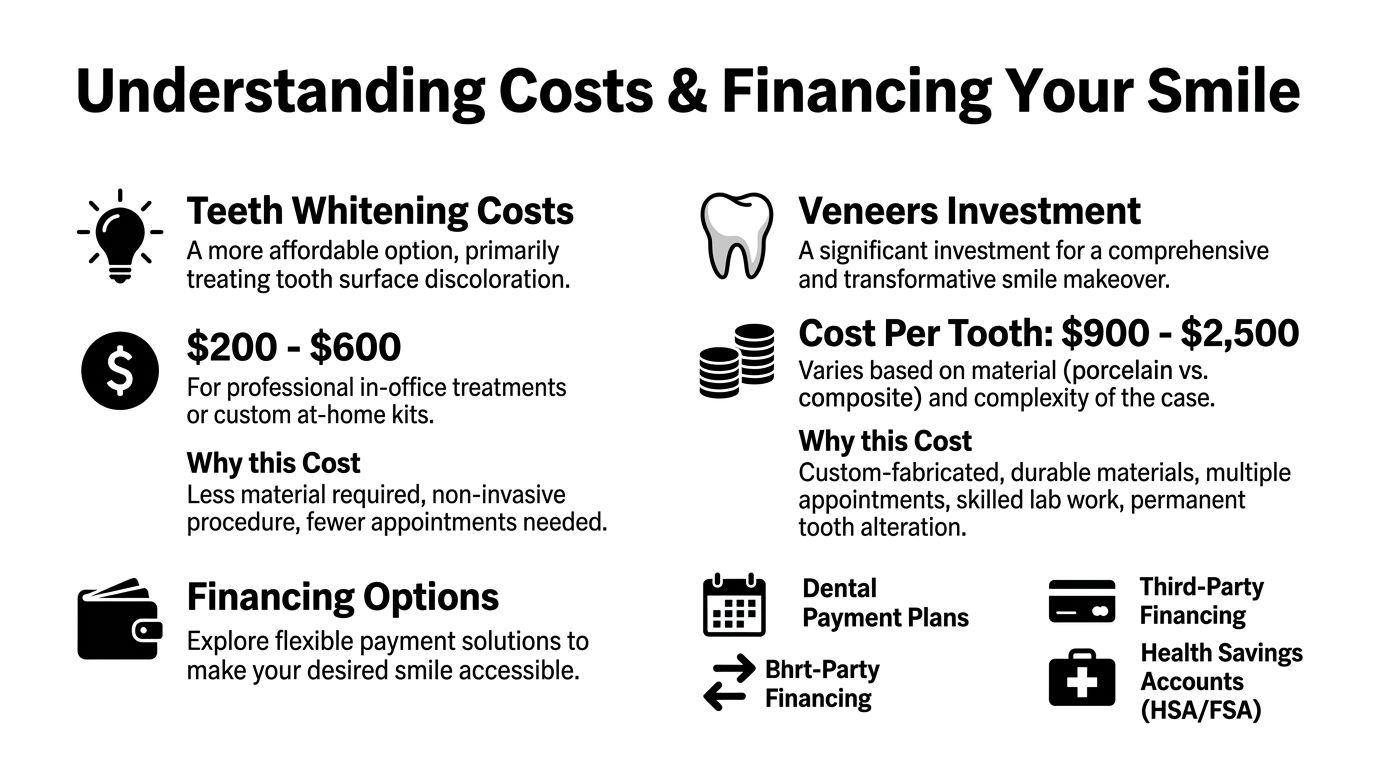
A consumer dentistry guide reports average professional teeth whitening at about $650, while composite veneers typically run $200 to $1,500 per tooth and porcelain veneers $950 to $2,500 per tooth in its whitening versus veneers cost guide. That same guide notes the cost gap helps explain why whitening became the common first-line cosmetic treatment for stain removal, while veneers developed into an option that addresses a wider range of issues, including discoloration, chips, gaps, crowding, wear, and minor alignment concerns.
Why the prices are so different
Whitening is focused treatment. The main goal is lifting shade on natural teeth.
Veneers involve more variables:
- Custom design for shape, contour, and shade
- Material selection such as porcelain or composite
- Detailed planning around bite, symmetry, and smile line
- Fabrication and bonding rather than a simple bleaching process
That doesn't make veneers “better” for everyone. It means they solve a different problem.
Here's a helpful overview of cosmetic treatment considerations:
Think beyond the sticker price
A lower starting price can still lead to ongoing maintenance costs over time. A higher upfront investment can still be the more appropriate choice if whitening won't fix what bothers you.
That's why the practical question isn't only “What can I afford today?” It's also:
- Will whitening solve my concern
- Would I still want veneers later
- Am I paying for color only, or color plus shape correction
- Do I want a conservative first step or a larger cosmetic change
Cost lens: Whitening is often the economical place to start when the problem is staining. Veneers make more sense when color is only one part of the concern.
For patients comparing options in Chattanooga or Cleveland, payment planning can make cosmetic treatment easier to approach. Some offices discuss phased treatment, monthly financing, HSA or FSA use when applicable, and ways to spread out care when a full smile upgrade isn't the right move all at once.
Risks Maintenance and Long-Term Care
Most online comparisons stop too early. They say whitening is cheaper and veneers last longer. That's true, but it misses the part patients live with after treatment.
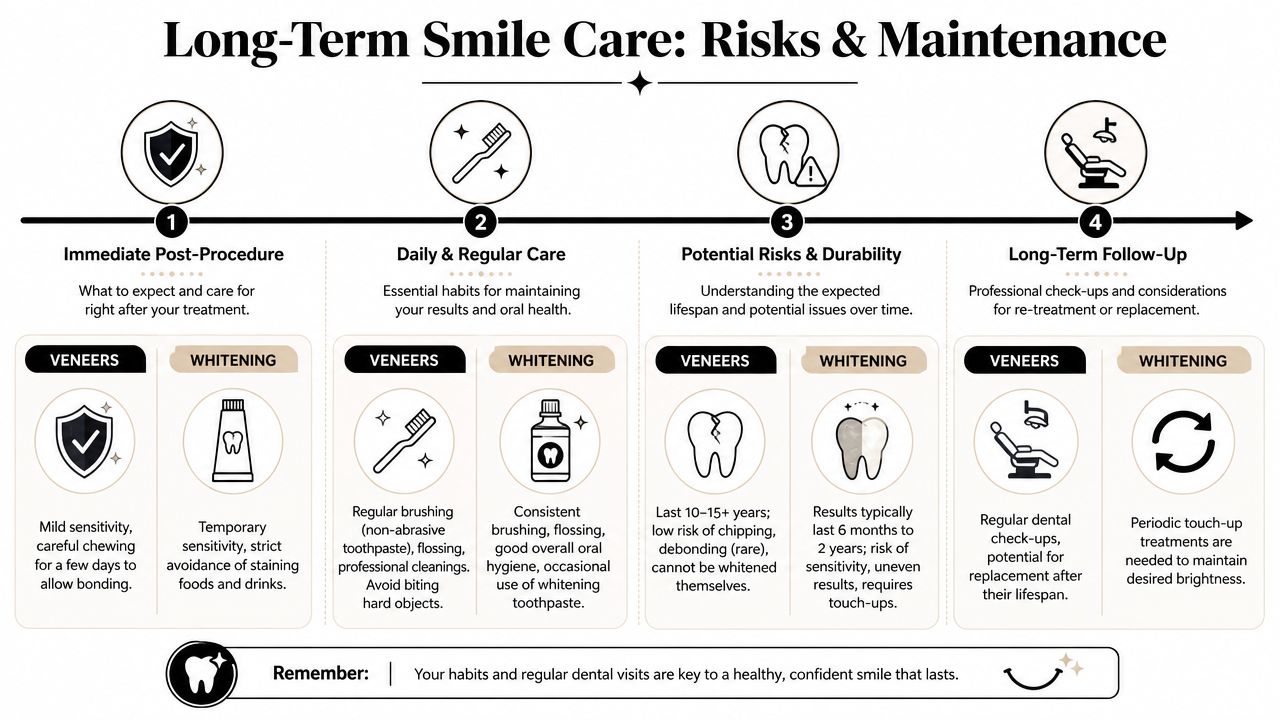
The more useful way to frame it is this. Whitening usually means repeat treatment. Veneers usually mean eventual replacement. According to the Cleveland Clinic overview of dental veneers, veneers typically last about 10 to 15 years, while whitening results commonly last 6 to 12 months. That creates a real trade-off between maintenance cycles and long-term restoration planning.
What to expect with whitening
Whitening is conservative, but it isn't permanent. Results fade, and many patients need touch-ups to keep the shade where they want it. Temporary tooth sensitivity can happen, especially right after treatment.
Whitening also only affects natural teeth. If you already have veneers, crowns, or bonding on front teeth, those restorations won't whiten along with nearby enamel. That can create a mismatch if the natural teeth brighten and the restorations stay the same.
What to expect with veneers
Veneers provide a longer-lasting cosmetic change, but they come with a deeper commitment. In many veneer cases, the teeth require preparation before bonding. That means the decision should be made carefully.
Long-term care usually includes:
- Gentle hygiene habits with regular brushing and flossing
- Avoiding hard-object biting such as ice, pens, or package tearing
- Routine cleanings and exams to monitor gum health and margins
- Awareness that veneers themselves can't be whitened
A veneer can look stable for years while the neighboring natural teeth gradually change shade. That's one reason planning the smile as a whole matters.
Which maintenance pattern fits you better
Some patients prefer whitening because it keeps the natural tooth structure largely unchanged and lets them refresh the result as needed.
Others prefer veneers because they want a more stable cosmetic design and are comfortable with the reality that a restoration has a lifespan. Neither approach is automatically easier. They're different forms of upkeep.
If you're also dealing with cracked teeth, old restorations, or bite wear, cosmetic decisions may overlap with restorative dentistry. In those cases, the right answer may involve more than a whitening tray or a veneer alone.
Your Cosmetic Dentistry Journey at Winn Smiles
A cosmetic consultation should feel less like a pitch and more like problem-solving. A patient comes in thinking they need whiter teeth, and the conversation often becomes more precise once photos, bite patterns, existing dental work, and smile line are reviewed.
One useful question is simple. If the teeth were brighter tomorrow, would you still notice the shape, spacing, edge wear, or one tooth that doesn't match? If the answer is yes, then whitening alone may not get you where you want to go.
How the decision gets made in the chair
A thoughtful consultation usually starts with health first. Teeth and gums need to be stable before cosmetic work. If someone also needs cleaning and exams, restorative treatment, or attention from an emergency dentist because a chipped front tooth is recent, those concerns should be addressed in the right order.
From there, the planning becomes more visual. Shade goals, tooth proportions, facial balance, and how much of the smile shows when talking and smiling all influence the recommendation.
The sequencing question many patients don't ask
One of the most practical issues in veneers vs teeth whitening is order of treatment. A common gap in online advice is what happens if you think you want veneers, but you may also want whitening. The sequencing matters because veneers are bonded cosmetic restorations with long lifespans, while whitening is temporary and can fade over time, as explained in this discussion of teeth whitening vs veneers and treatment order.
In plain terms, many patients benefit from whitening the natural teeth first if veneers are only planned for a few visible teeth. That allows the veneer shade to be matched to the brighter neighboring enamel.
If veneers are placed first and the surrounding natural teeth are whitened later, the veneers won't lighten with them.
That doesn't mean everyone should whiten first. If the plan involves several veneers across the smile, or if the main concern is shape and deep discoloration rather than general staining, the recommendation may be different. Patients exploring porcelain veneers in Chattanooga often need this sequencing explained clearly because it affects how natural the final smile looks over time.
What patients should expect
A cosmetic visit should leave you with a realistic path, not just a list of procedures. That may mean starting with whitening. It may mean planning veneers for selected teeth. It may mean discussing Invisalign, bonding, same-day crowns, or restorative options first if the smile issues are structural rather than purely cosmetic.
For many adults in Chattanooga and Cleveland, the most reassuring part of the consultation is hearing what not to do. That kind of honesty helps patients choose treatment that still feels right after the excitement of the makeover stage has passed.
Your Smile Makeover Questions Answered
Does dental insurance usually cover whitening or veneers
These treatments are often considered cosmetic, so coverage may be limited. Every plan is different, and the details matter. If part of the treatment also serves a restorative purpose, the financial picture can look different than it does for elective cosmetic care alone.
Can I whiten my teeth if I already have crowns or veneers
You can whiten the natural teeth, but existing crowns and veneers won't change color. That's important if those restorations sit near the front of the smile. If the natural teeth lighten and the restorations don't, the mismatch may become more noticeable.
Can one tooth get a veneer, or do I need several
Yes, one tooth can receive a veneer in the right case. This often comes up when a single front tooth is chipped, worn, oddly shaped, or darker than neighboring teeth. The challenge is shade matching, which is why careful planning matters.
Is whitening always the first step
No. Whitening is often the most conservative first option when the problem is overall discoloration on natural teeth. It isn't always the correct first move if the main issue is shape, edge damage, spacing, or a tooth that needs restoration.
Are veneers permanent
They are long-lasting, but they aren't forever. Veneers are restorations, and restorations have a service life. They also require long-term care and periodic evaluation during routine dental visits.
What if I'm not sure which treatment I need
That's normal. It's common for individuals not to walk into a dental office knowing whether they need whitening, veneers, bonding, Invisalign, crowns, or some combination. A good cosmetic exam should narrow the decision based on your actual teeth, your goals, and your comfort with maintenance.
If you've been searching for a dentist near me, cosmetic dentist near me, or a dentist in Chattanooga, TN or Cleveland, TN, and you're stuck between treatments, the next step isn't guessing better. It's getting a clear exam and a practical recommendation.
If you're comparing veneers and teeth whitening and want advice that fits your smile, schedule a consultation with Winn Smiles. A personalized exam can help you decide whether whitening, veneers, or another cosmetic or restorative option makes the most sense for your goals, timeline, and budget.