You've been comparing smile photos, checking reviews, and searching for a cosmetic dentist near me because you want to know whether veneers are worth it before changing healthy teeth. Maybe coffee stains no longer respond to whitening, a chipped front tooth draws your attention in every photograph, or uneven spacing makes you hide your smile. For patients in Cleveland and Chattanooga, TN, the right answer isn't a simple yes or no. It depends on your enamel, bite, gum health, goals, and willingness to maintain a long-term restoration.
Porcelain veneers can create a natural-looking smile, but they're not a temporary beauty treatment. They can involve permanent enamel preparation, future replacement, and careful maintenance. A thoughtful consultation with a dentist in Cleveland, TN, or Chattanooga, TN, should compare veneers with bonding, whitening, Invisalign, crowns, and, when necessary, restorative options such as dental implants or tooth extraction.
Deciding If a Smile Makeover Is Right for You
A common consultation begins with a patient who has spent weeks researching “veneers worth it” online. They bring photos of smiles they like and usually want to correct several concerns at once, such as discoloration, small gaps, short teeth, or minor chips. They often expect a quick recommendation, but the most responsible answer starts with questions about their natural teeth, bite, hygiene, and expectations.
One Cleveland patient may want a brighter smile but have healthy teeth that respond well to professional whitening. Another Chattanooga patient may have a small edge fracture that composite bonding could repair without removing enamel. A third patient may have crowding that would be better addressed with Invisalign before any cosmetic restoration. The visible problem may look similar in a photograph, while the safest treatment differs completely.
That's why a search for a cosmetic dentist near me should lead to more than a gallery of before-and-after images. Your consultation should identify whether you want a limited correction or a full smile makeover, whether the proposed changes fit your facial features, and whether you're comfortable entering a restorative cycle that may require replacement later.
A practical question to ask: “What's the least invasive treatment that can achieve the result I want?”
At Winn Smiles, the discussion should focus on fit rather than pressure. A cosmetic dentistry consultation can help clarify whether porcelain veneers suit your anatomy or whether another service would better protect your natural tooth structure. The purpose isn't to sell you a particular procedure. It's to match the treatment to the problem.
Veneers may be worth considering when you have persistent discoloration, worn or irregular front teeth, minor spacing concerns, or several cosmetic issues that need to be addressed together. They're less appealing when the main issue is active decay, gum disease, severe bite stress, untreated grinding, or a small imperfection that bonding or whitening can handle.
The decision also depends on your priorities. Some patients value a stable color and carefully planned shape more than reversibility. Others prefer to preserve every possible millimeter of enamel, even if the result requires more maintenance or offers a less dramatic change. Both preferences are reasonable. A good dentist should make the trade-offs clear.
The Clinical Reality of Porcelain Veneers
Traditional porcelain veneers aren't placed over untouched teeth. The dentist usually removes about 0.3 to 0.7 mm of enamel, roughly the thickness of a fingernail, to create space for the veneer and a natural transition at the edge. Enamel doesn't grow back, so this preparation is permanent. Clinical guidance on veneer preparation explains why patients should treat traditional veneers as a long-term restorative commitment.
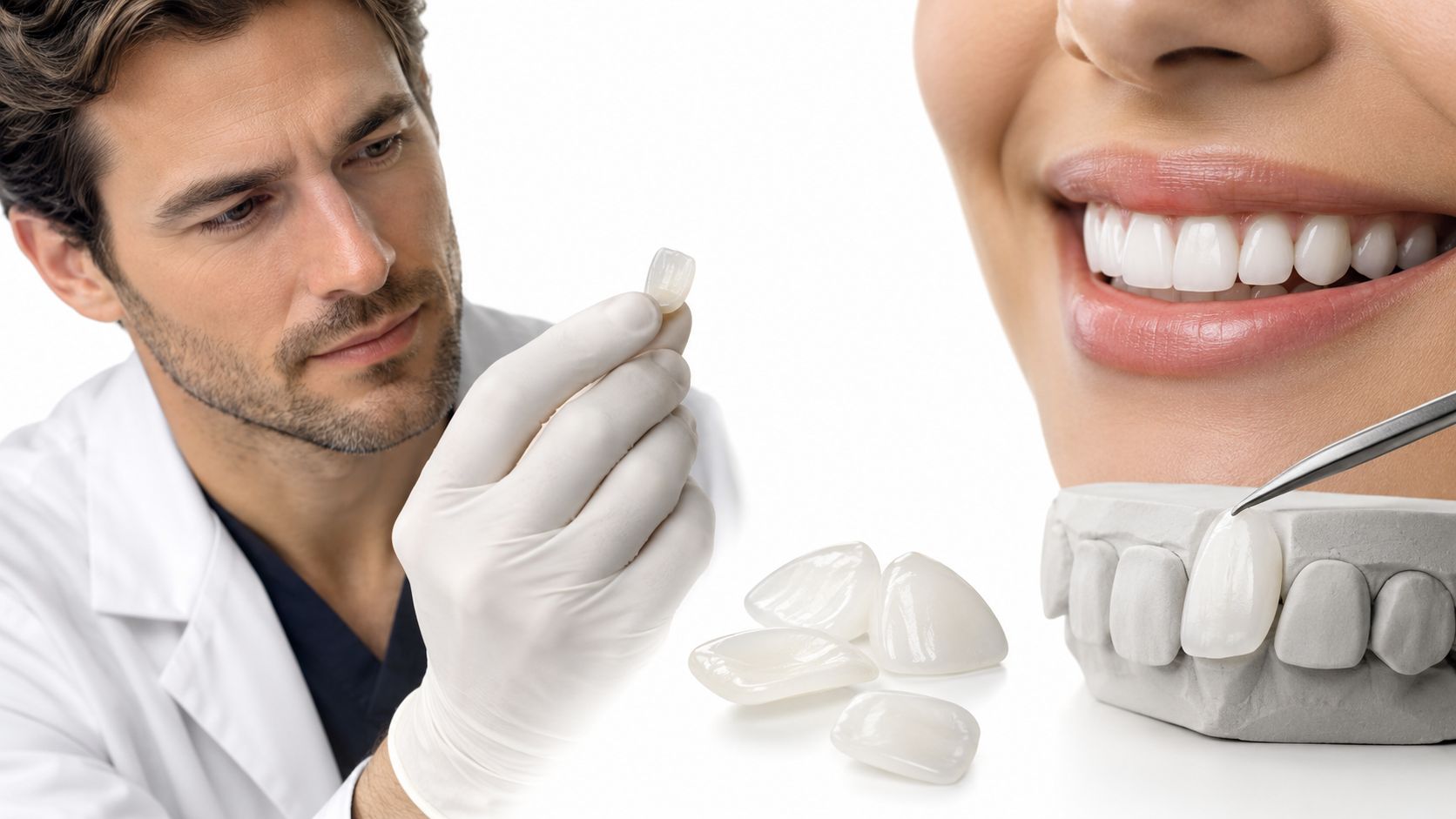
The amount and location of preparation matter. A conservative dentist plans the final thickness, tooth color, bite, gum position, and smile line before touching the tooth. Removing too much structure can increase sensitivity and reduce predictability. Preparation also shouldn't be used to disguise a bite problem that needs orthodontic or functional treatment first.
What the evidence says about durability
Veneers have a long clinical history as a conservative cosmetic treatment, with modern use dating back to the early 1980s. A published review found favorable medium-term outcomes, strong aesthetic maintenance, and high patient satisfaction. Most studies in that review reported failure rates from 0% to 7%, while other trials reported rates from 14% to 33% when factors such as an unfavorable bite, excessive tooth reduction, inappropriate bonding, or large exposed dentin surfaces were present. The clinical review of porcelain laminate veneers shows why technique and case selection matter as much as the material.
A 2024 systematic review found overall survival generally remained above 90% beyond 10 years, with estimated survival around 94% for glass-ceramic veneers and 87% for feldspathic porcelain veneers. Another long-term review reported approximately 95% to 97% survival at 5 years and roughly 90% to 96% at 10 years. A cohort of porcelain laminate veneers reported 94.4% survival at 5 years, 93.5% at 10 years, and 82.93% at 20 years. The 2024 systematic review of ceramic veneers supports a realistic view: veneers can last well, but no restoration lasts forever.
Why preparation and bonding change the outcome
Veneers perform best when the tooth provides a strong bonding surface, the bite distributes force appropriately, and the patient can maintain clean gum margins. They become less predictable when the dentist must work around extensive exposed dentin, heavy grinding, poor hygiene, or unstable gum tissue.
Cleveland Clinic notes that most veneer types are permanent, while some no-prep or minimal-prep options may be reversible in selected situations. Cleveland Clinic's patient guide to dental veneers is useful for understanding why the label “no-prep” doesn't automatically mean every patient qualifies or that the treatment will be reversible.
The clinical promise is substantial, but the commitment is equally real. The question isn't whether porcelain looks attractive immediately. It's whether the planned restoration can remain healthy, functional, and maintainable for your teeth over time.
Comparing Veneers to Alternative Cosmetic Treatments
Veneers are versatile, but they shouldn't be the automatic answer to every cosmetic concern. The right comparison considers how much tooth structure must change, how long the result may serve you, what problem the treatment corrects, and whether the treatment addresses function or only appearance.
| Treatment | Invasiveness | Typical Longevity | Best For |
|---|---|---|---|
| Porcelain veneers | Permanent enamel preparation is common | Often 10 to 15 years, with some sources describing 10 to 20 years depending on care and case selection, as summarized by Franklin Dental's veneer longevity discussion | Persistent discoloration, chips, uneven shapes, minor spacing, and coordinated smile changes |
| Composite bonding | Usually minimally invasive and may preserve enamel | Often requires more upkeep than porcelain | Small chips, minor gaps, and limited reshaping |
| Professional teeth whitening | Noninvasive to the tooth structure | Color changes require maintenance | General surface staining when tooth shape and alignment are already satisfactory |
| Invisalign | No enamel removal for alignment itself | The alignment depends on retention and continued care | Crowding, spacing, and bite-related tooth positioning |
| Dental crowns | More extensive tooth preparation | Designed for damaged or weakened teeth | Teeth with substantial structural loss, decay, or fracture |
| Same-day crowns | Tooth preparation is required, with restoration completed through a streamlined workflow | Depends on the tooth, material, bite, and care | Restoring function and appearance when a tooth needs full coverage |
When bonding makes more sense
Composite bonding can be a sensible first choice for a small chip, a narrow gap, or a slight shape irregularity. The dentist adds tooth-colored resin, shapes it, and polishes it without committing every affected tooth to porcelain. The trade-off is that resin can be more vulnerable to wear, edge damage, and discoloration than porcelain, especially when the patient bites hard objects or grinds.
Whitening is better when color is the only concern. It won't reshape a worn edge, close a structural gap, or correct a tooth that's visibly out of proportion. If staining comes from within the tooth and doesn't respond adequately, veneers may provide a more predictable visual change.
When alignment or full coverage comes first
If crowding or an unfavorable bite creates the main problem, Invisalign or another orthodontic approach may be the appropriate starting point. Veneers can change the visible shape of a tooth, but they don't move the tooth root into a healthier position. Placing cosmetic restorations over an unstable bite can place unnecessary stress on the result.
A crown serves a different purpose from a veneer. It covers more of the tooth and may be appropriate when decay, fracture, or substantial weakening makes a thin facial restoration unsuitable. If a tooth can't be predictably restored, treatment may involve a tooth extraction followed by a dental implant, rather than cosmetic veneers.
Some patients also ask about treating excess gum display. That concern doesn't always require veneers, and a consultation may include discussion of gum-focused care or a resource such as gummy smile injection treatment when appropriate. The best plan depends on whether the issue comes from tooth shape, gum position, lip movement, or a combination.
Understanding Candidacy and Oral Health Prerequisites
Healthy-looking teeth aren't enough to qualify for veneers. The supporting gums, bite, enamel, and daily hygiene must also be suitable. Dentists in a 2026 cross-sectional study most often rejected laminate veneer treatment because of poor dental hygiene, followed by occlusion-related problems and inadequate remaining tooth structure. The study on dentist decision-making and veneer candidacy reinforces an important point: cosmetic treatment begins with health screening.
Problems that need attention first
Active decay should be treated before a veneer covers the front of the tooth. Gum inflammation or periodontal disease should also be controlled because swollen or receding gums can compromise margins, appearance, and long-term support. A patient who can't maintain consistent brushing, flossing, and professional cleanings may not be ready for elective cosmetic dentistry.
Grinding and clenching deserve a careful conversation. Repeated force can contribute to fracture or debonding, especially when a patient's bite concentrates pressure on the veneer edges. A dentist may recommend a protective nightguard or address the bite before considering porcelain.
The same logic applies to a tooth with severe structural damage. A veneer isn't a substitute for restorative dentistry when the tooth needs broader support. Depending on the diagnosis, care may include a filling, root canal, crown, or, when the tooth can't be saved, extraction and dental implant planning.
How a candidacy evaluation works
A thorough evaluation may include a new patient exam, dental X-rays, gum measurements, photographs, digital scans, and a bite assessment. These tools help the dentist see issues that a front-facing smile photo can't reveal, including decay between teeth, bone concerns, hidden cracks, or uneven contact during biting.
Clinical rule: Treat disease, instability, and bite stress before adding elective cosmetic restorations.
Patients sometimes assume a “no-prep” veneer removes all risk. It doesn't. If a veneer adds bulk because the tooth doesn't have enough room, the result may feel unnatural or affect the bite. No-prep and minimal-prep treatments can suit selected cases, but the dentist still needs to evaluate tooth position, enamel, gum contours, and the desired result.
Candidacy is also about expectations. Veneers can improve color, shape, and selected spacing concerns, but they can't guarantee a particular online reference smile. A responsible plan respects your facial proportions, speech, gum display, and natural tooth anatomy instead of forcing every patient into the same design.
Evaluating the Long-Term Investment and Maintenance
The initial fee is only one part of the veneer decision. A realistic ownership plan includes daily hygiene, routine examinations, professional cleanings, protection from grinding, repairs when needed, and eventual replacement. Typical veneer longevity is commonly described as 10 to 15 years, with some sources extending porcelain veneers to 10 to 20 years depending on care and case selection, so future replacement should be part of the conversation from the beginning.

A veneer can remain bonded while the tooth or gum changes around it. Gum recession may expose a margin, natural teeth may darken differently, and the material can develop a chip, crack, or discoloration at an edge. Repairs aren't always possible, and replacement may require additional planning because the tooth has already been prepared.
The hidden cost of ownership
Recent clinical evidence found ceramic veneer survival around 89.3% at 9 to 10 years, while 79.4% of surviving veneers still had complications, including material defects, secondary caries, or gingival problems. The long-term clinical evidence on veneer complications makes the ownership question more nuanced than comparing a price per tooth.
A 2026 study of veneer failures found that most failures occurred after 6 to 7 years, with common causes including dimensional mismatch, discoloration, fracture, and debonding. That doesn't mean every patient will experience failure on that schedule. It means a consultation should cover what happens if one veneer needs repair or replacement before the others.
A useful budget conversation includes:
- Initial treatment: The number of teeth, laboratory materials, diagnostic planning, temporaries, and bonding appointments.
- Preventive care: Dental exams, X-rays when clinically indicated, professional cleanings, and gum monitoring.
- Protection: A nightguard may be appropriate for patients who grind or clench, and a sports mouthguard can reduce injury risk.
- Future treatment: Repairs, replacement, or related care if decay, recession, fracture, or bite changes occur.
For a local discussion of treatment pricing factors, review how much veneers cost, then ask for a personalized estimate rather than relying on a generic per-tooth figure. Pricing can't be separated from candidacy, preparation, materials, and the number of restorations required.
The most sensible maintenance plan remains ordinary but consistent. Brush and floss around the veneers, attend scheduled cleanings, avoid using front teeth to open packages, and report sensitivity, movement, rough edges, or gum bleeding early. Veneers may be durable, but they still depend on the health of the natural teeth underneath.
What to Expect at Winn Smiles in Cleveland and Chattanooga
Choosing a provider matters because veneer treatment involves diagnosis, design, preparation, laboratory communication, bonding, and long-term follow-up. Patients searching for a dentist in Cleveland, TN, a dentist in Chattanooga, TN, or a cosmetic dentist near me should look for a practice that can explain each stage in plain language.
Your first visit
The process begins with your goals. Bring examples of what you like, but also describe what you don't like about your current smile. The dentist will review your medical and dental history, ask about sensitivity or grinding, examine your gums and teeth, and determine whether cleaning, periodontal care, fillings, or other treatment should come first.
Dental X-rays and digital imaging can support the examination by revealing conditions that aren't visible in a mirror. Digital scans and photographs can help evaluate tooth proportions, gum display, bite relationships, and the way your smile appears when you speak and laugh.
Planning the design
A smile design should respect your face rather than copy an artificial template. The team may discuss shade, tooth length, contour, translucency, spacing, and how the proposed veneers will work with teeth that remain untreated. If the plan involves several teeth, the dentist should explain why each tooth is included.
You should also receive clear information about preparation. Ask whether the proposed treatment is traditional, minimal-prep, or no-prep, how much enamel may be removed, and what happens if a veneer needs replacement in the future.
Comfort and communication
Dental anxiety shouldn't prevent you from seeking care. Winn Smiles offers a comfort menu and tailored sedation options, along with modern technology intended to make treatment more manageable. Patients can discuss anxiety, sensitivity, appointment pacing, and the type of support they need before treatment begins.
The practice also provides broader dental services, including preventive cleanings and exams, teeth whitening, Invisalign, restorative dentistry, same-day crowns, periodontal care, emergency dental services, and dental implants. That matters when a cosmetic concern turns out to involve bite alignment, gum health, a broken tooth, or a tooth that needs replacement.
A transparent consultation should leave you with a diagnosis, treatment alternatives, expected appointments, maintenance requirements, and a cost discussion. You shouldn't feel rushed into veneers, and you should be able to request a second opinion if you're uncertain.
Making Your Final Decision and Next Steps
Veneers are worth considering when the problem is mainly cosmetic, your teeth and gums are healthy, your bite can support the restorations, and you want a coordinated change that whitening or bonding can't provide. Porcelain can be particularly useful for persistent discoloration, several uneven front teeth, small gaps, worn edges, and shape differences that need to be corrected as part of one design.
That doesn't make veneers the right choice for every attractive smile. If you have a single minor chip, bonding may preserve more tooth structure. If your teeth are crowded, Invisalign may address the cause before cosmetic finishing. If decay or gum disease is present, health-focused treatment comes first. If a tooth is too damaged for a veneer, a crown or dental implant may be more appropriate.
The strongest decision process compares treatments by problem, not by popularity. Ask yourself:
- Is the concern cosmetic or functional? Aesthetic changes may suit veneers, while pain, fracture, decay, or bite problems require a broader diagnosis.
- Can a conservative option achieve the result? Whitening, bonding, or orthodontics may solve the concern with less permanent alteration.
- Can you maintain the result? Veneers require regular home care, professional dental visits, and protection from damaging habits.
- Do you understand replacement? A veneer is a long-term commitment, not a permanent guarantee that the tooth will never need further care.
You may also be searching for dental implants near me, an emergency dentist, or help with a painful tooth. Those needs shouldn't be folded into a cosmetic plan without a complete examination. Winn Smiles can evaluate whether your priority is cosmetic dentistry, restorative care, tooth extraction, implant treatment, or urgent dental care, then help you sequence treatment responsibly.
For patients in Cleveland, Chattanooga, and nearby communities, the next step is an in-person consultation. Bring your questions about enamel preservation, alternatives, maintenance, bite protection, and the likely replacement pathway. A careful evaluation can tell you whether veneers are a sound investment or whether a different treatment will give you a healthier, more conservative result.
Winn Smiles offers personalized cosmetic consultations, porcelain veneers, teeth whitening, Invisalign, restorative dentistry, same-day crowns, dental implants, and emergency dental care for patients in Cleveland and Chattanooga. Visit Winn Smiles to schedule a consultation and discuss the safest path to the smile you want.