When you're choosing a dentist for yourself or your family, you're usually balancing a few things at once. You want a healthy smile, fewer surprise dental problems, and a practice that feels comfortable from the first phone call. If you've searched for a dentist near me in Cleveland, TN, or Chattanooga, TN, you've probably also noticed how much advice is out there about cavity prevention.
Some of that advice is personal, like brushing, flossing, and scheduling cleanings. Some of it happens at the community level, including public water fluoridation. That's where this topic matters to everyday families. The best oral health plans usually aren't built on one thing alone. They work because small protective habits add up over time.
Your Trusted Dentist in Cleveland and Chattanooga TN
A lot of new patients start in the same place. A parent wants fewer cavities for their child. An adult wants to stop the cycle of fillings, sensitivity, and last-minute emergency visits. Someone moving to the area wants a dentist in Cleveland, TN or dentist in Chattanooga, TN who feels dependable, not rushed.

That search often leads to bigger questions than people expect. Parents ask whether their child is getting enough fluoride. Adults wonder why they still get decay even though they brush every day. Patients looking for an emergency dentist, help with tooth extraction, or even a cosmetic dentist near me often discover that prevention matters just as much as treatment.
Why this topic matters to local families
Community water fluoridation is one of those quiet parts of preventive care that many people benefit from without thinking much about it. It doesn't replace daily hygiene, dental x-rays, or regular cleaning and exams. It supports them.
In practical terms, that matters in family life because not every day is perfect. Kids miss spots when brushing. Adults sip coffee, sports drinks, or soda. Busy schedules delay preventive visits. A community-level measure that helps strengthen teeth in the background can make a real difference over the long run.
Good preventive dentistry works best when home care, community protection, and professional care all point in the same direction.
The local view of prevention
For families in Cleveland and Chattanooga, the most useful way to think about water fluoridation benefits is this. It's part of the environment your teeth live in every day. It doesn't ask you to remember another step. It doesn't depend on insurance approval. It doesn't require perfect routines to provide value.
That's why this subject matters even if you're mostly focused on practical concerns like new patient exams, children's cleanings, restorative dentistry, or keeping your smile bright and healthy. Public health measures may sound broad, but their effects show up in very personal ways. Fewer weak spots. Less decay risk. More support for the teeth your family uses every single day.
What is Community Water Fluoridation
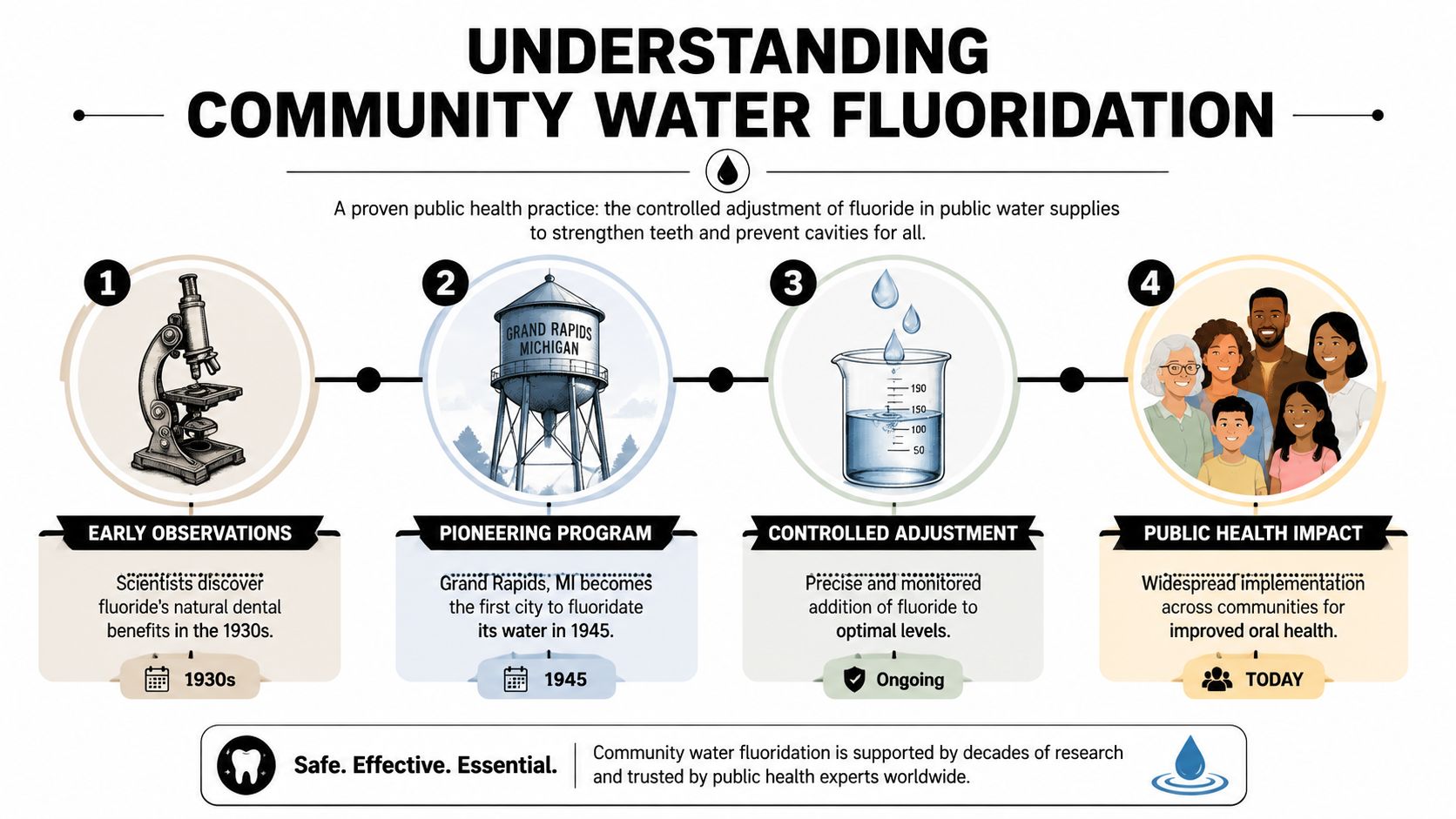
Community water fluoridation means adjusting fluoride in public water to a level that helps prevent tooth decay. It's not about turning water into a medication. It's about maintaining a low level of a mineral that helps protect enamel.
A long public health track record
This isn't a new experiment. Community water fluoridation was first implemented in the United States in 1945, and by 2012 more than 435 million people worldwide had access to either naturally fluoridated water or water adjusted near optimal levels, according to an NIH-supported review of community water fluoridation history and outcomes.
That same review notes just how extensively this topic has been studied. It summarized about 113 studies from 23 countries published before 1990 and found modal cavity reductions of 40% to 50% in primary teeth and 50% to 60% in permanent teeth. Later reviews of studies from 1990 to 2010 reported average reductions of 30% to 59% in primary teeth and 40% to 49% in permanent teeth.
What “adjusted to an optimal level” really means
In plain language, water systems that fluoridate are aiming for a level associated with cavity prevention, not excess. The process is monitored, measured, and designed for broad community use.
That distinction matters because many patients hear the word fluoride and think only of toothpaste or in-office varnish. Community fluoridation is different. It's a public health approach that gives consistent background support to everyone who drinks the water, including children, adults, and people who don't get regular dental care.
A simple way to think about it is that toothbrush habits protect one person at a time. Community water fluoridation protects a whole population at once.
Why dentists still pay attention to it
Dentists care about fluoridation because cavity prevention isn't just about treating problems after they start. It's also about changing the conditions that make decay more or less likely.
That's one reason water fluoridation benefits continue to come up in conversations about family dental care, especially when people are trying to reduce future fillings, avoid dental pain, and keep preventive care affordable. For many families, understanding this basic concept makes it easier to see why prevention starts long before a tooth ever hurts.
How Fluoride Protects Your Family's Teeth
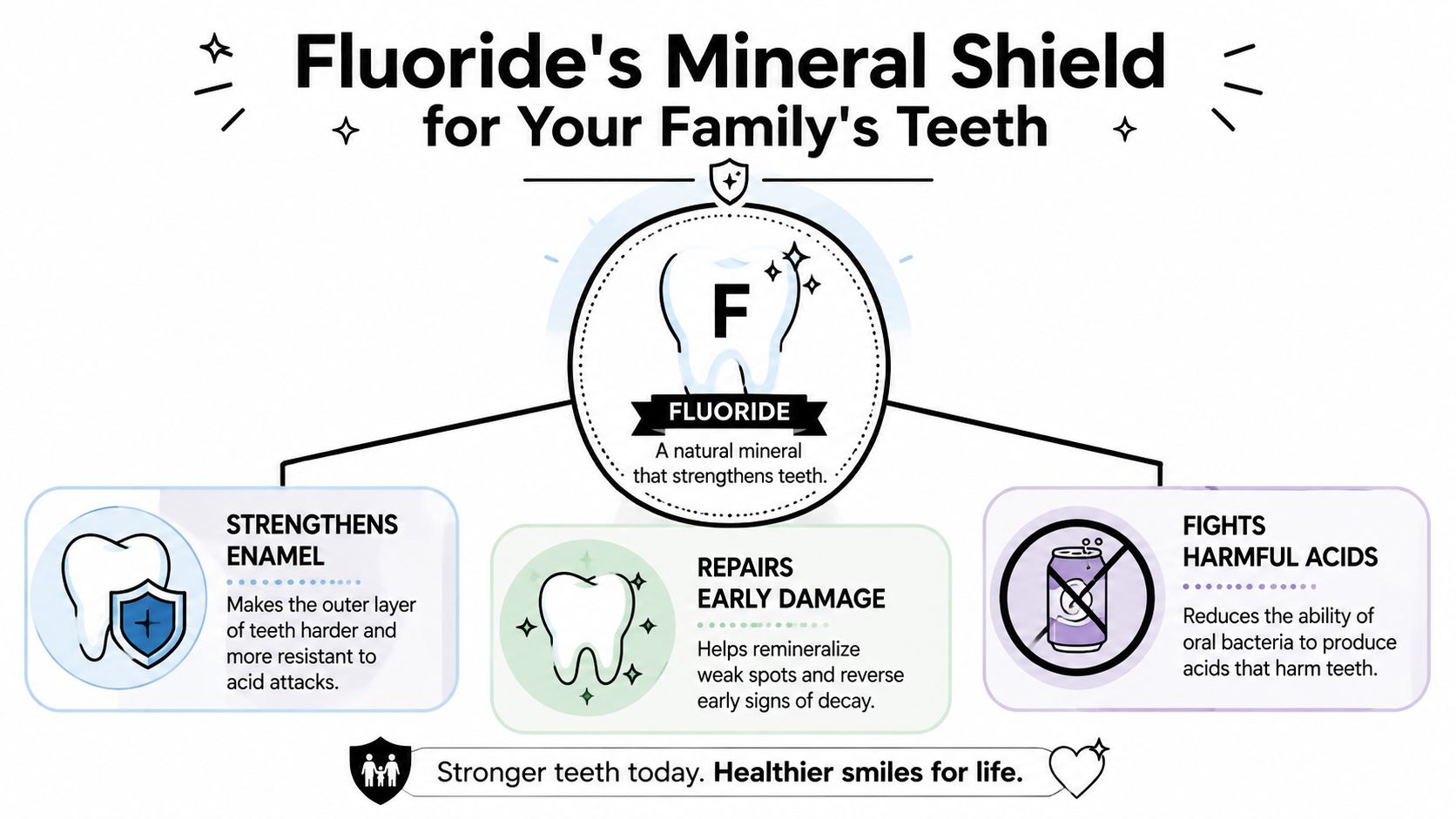
Think of fluoride as a mineral shield for enamel. Teeth spend all day in a tug-of-war. Acids from bacteria and food pull minerals out of enamel. Saliva tries to put minerals back. When that balance tips the wrong way too often, cavities begin.
The daily repair cycle
Fluoride helps by supporting the repair side of that battle. It reduces enamel demineralization during acid attacks, promotes mineral redeposition, and makes teeth more resistant. Community water fluoridation works by maintaining a low, continuous fluoride concentration in drinking water, typically around 0.7 mg/L, and this population-wide exposure reduces tooth decay by about 25% in children and adults, as explained in this public summary on how fluoride in drinking water protects enamel.
That “continuous” part is the key. Teeth don't only need help during a dental appointment. They need support between meals, after snacks, and through the ordinary wear of daily life.
Practical rule: The strongest prevention plans don't wait for damage to become visible. They support enamel before a cavity turns into a filling.
For parents, that often means keeping track of more than brushing alone. Appointment dates, past x-rays, fluoride discussions, and school forms can pile up fast. If you want a simpler way to stay organized, this guide to managing family health documents can help you keep dental and medical records easier to access.
Why some people still get cavities
Fluoride helps, but it doesn't cancel out every risk. Frequent snacking, dry mouth, deep grooves in molars, inconsistent brushing, and existing weak spots can still lead to decay.
Adults are often surprised by that. They assume cavities are mostly a childhood problem, even though adult decay is common for very practical reasons. This overview of what causes tooth decay in adults explains why factors like diet, home care, and previous dental work still matter.
A short visual explanation can make the process even easier to understand.
The Real World Impact on Health in Our Community
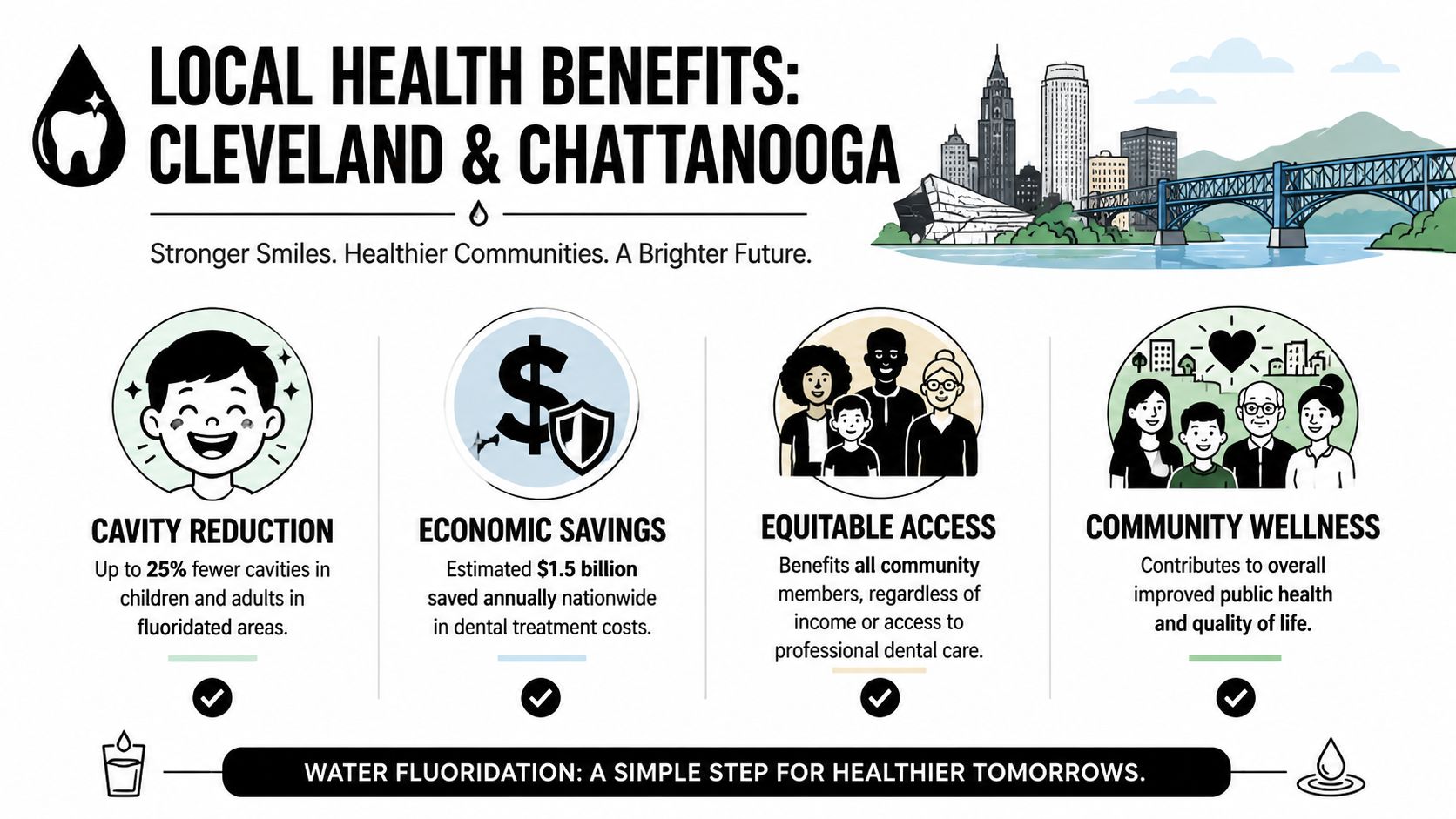
The value of fluoridated water shows up most clearly in ordinary life. It means fewer children starting school with untreated decay. It means adults are less likely to let a small cavity turn into a painful problem. It means families can put less of their time and money into avoidable treatment.
Why community protection matters
Public health measures are easy to overlook because they work in the background. Water fluoridation doesn't depend on someone remembering to book an appointment, refill a prescription, or buy a product. It reaches people where they already are.
That broad reach is one reason many public-health groups continue to support it. Canada's national fact sheet states that drinking fluoridated water reduces tooth decay by approximately 25% to 30% in children and adults, and notes that every $1 invested can yield between $5 and $93 in dental-treatment savings per person, according to this Canadian fluoride fact sheet.
The equity piece matters
One of the most important water fluoridation benefits is that it helps people who don't always have ideal access to care. Families with transportation barriers, limited time off work, financial pressure, or interrupted insurance coverage may not be able to stay perfectly current with preventive visits. A cavity-prevention strategy that reaches everyone through the water supply can reduce some of that gap.
The International Association for Dental, Oral, and Craniofacial Research states that fluoridation benefits deprived communities the most and reduces oral-health inequalities. The CDC estimate cited there says communities of 1,000 or more people see about $20 in return for every $1 spent and save about $32 per person per year by avoiding cavity treatment, as summarized in the IADR position statement on community water fluoridation.
A prevention tool is most powerful when it reaches the people who are least likely to get every other form of preventive care on time.
What that means for Cleveland and Chattanooga families
For local families, this isn't only a policy discussion. It affects school mornings, grocery budgets, missed work, and whether a child needs treatment that could have been avoided. In communities where some households can easily keep up with routine care and others can't, a shared preventive measure helps level the field.
That doesn't mean fluoridation solves every dental problem. It means it gives the community a stronger baseline. From there, personal habits and professional care can do more.
How Winn Smiles Enhances Fluoride's Natural Protection
Water fluoridation is a foundation. It's not the whole house. Teeth still need direct care, professional evaluation, and early treatment when weak spots or disease are already present.
What community protection can't do on its own
Fluoridated water can't remove plaque buildup. It can't spot a cracked filling. It can't tell you whether sensitivity is coming from grinding, gum recession, or decay between teeth. It also can't fix damage that has already moved beyond the earliest stages.
That's why professional prevention still matters so much for people searching for a dentist near me, cleaning and exams, or new patient exams in Cleveland and Chattanooga. Community protection works best when it's paired with regular checkups, dental x-rays when needed, and personalized advice based on real cavity risk.
How modern preventive care adds to that foundation
A complete dental plan usually includes several layers:
- Routine cleanings and exams help remove buildup, check gum health, and identify early signs of decay before they become larger restorative problems.
- Professional fluoride treatments can provide targeted support for patients with higher cavity risk, including children, adults with dry mouth, and people with a history of frequent decay.
- Dental sealants may help protect deep grooves on back teeth where toothbrush bristles often miss.
If you want a clearer picture of what counts as prevention beyond brushing at home, this article on preventive dental care gives a helpful overview.
When treatment becomes the next step
Not every patient arrives with a prevention-only need. Some need restorative dentistry because decay is already present. Others are dealing with a broken tooth, infection, or pain that requires an emergency dentist. Some are exploring dental implants near me, same-day crowns, or tooth extraction after a tooth can't be saved.
Cosmetic goals can also be part of the conversation. Teeth whitening, veneers, and other cosmetic dentistry options don't replace preventive care, but they often work best after the mouth is healthy and stable.
In practice, the strongest results come from combining both sides of dentistry. Public measures help lower risk across the community. Clinical care handles the details that are unique to each person's mouth.
Your Comfortable Dental Visit in Cleveland or Chattanooga
Many people delay care because they're nervous about what the visit will feel like. That's especially common if it's been a while since your last cleaning, if you've had a painful experience elsewhere, or if you're worried the dentist will immediately jump to treatment.
A comfortable visit should feel steady, respectful, and clear. The office atmosphere matters. So does the way the team explains x-rays, answers questions, and gives you time to process what they find. Patients who are anxious often do better when they know what will happen before anything starts.
What a first visit usually includes
A new patient exam or preventive appointment often begins with a conversation, not a lecture. The team asks about sensitivity, bleeding gums, old dental work, pain, and any concerns you've been putting off. From there, they review your oral health with an eye toward both current needs and future risk.
That kind of visit may include:
- A thorough review of your dental history so past fillings, crowns, gum issues, and previous problem areas don't get overlooked
- Dental x-rays when appropriate to check for issues that aren't visible in the mirror alone
- A personalized cavity-risk discussion that considers habits, past decay, and your day-to-day fluoride exposure
- A cleaning plan or treatment plan based on what your teeth and gums need now, not a one-size-fits-all script
Comfort matters as much as clinical skill
For families, comfort isn't a luxury. It's part of getting care consistently. A welcoming front desk, a calm treatment room, and options that help anxious patients relax can make the difference between avoiding care and keeping up with it.
Some patients also appreciate support features like a comfort menu, a team that talks through each step, and sedation options when treatment feels overwhelming. That matters whether someone is coming in for a basic cleaning, restorative dentistry, cosmetic dentistry, or a more involved service such as dental implants.
If a patient feels safe and informed, they're much more likely to return for the routine care that prevents bigger problems.
Personalized care works better than generic advice
Two patients can have the same brushing habit and very different cavity risk. One may have dry mouth. Another may snack frequently through the day. A child may need close monitoring of newly erupted molars, while an adult may need attention to existing restorations.
That's why a good dental visit doesn't stop at “brush and floss more.” It looks at the full picture. In practical care, that includes your symptoms, your home habits, your fluoride exposure, and the treatment options that fit your goals.
Common Questions About Water Fluoridation and Safety
Patients usually don't ask only whether fluoride helps. They also want to know whether it's safe, whether it's still necessary if they use fluoride toothpaste, and how to think about overexposure. Those are reasonable questions.
Is fluoridated water safe at recommended levels
Yes, based on the evidence summary provided here. The U.S. uses 0.7 mg/L as the optimal level for water fluoridation, and expert reviews confirm there is no health risk below the usual permitted concentration of 1.5 mg/L, according to this review on fluoridation risk, benefit, and exposure levels.
The key point is that dose matters. The safety discussion isn't about treating all fluoride exposure as identical. It's about distinguishing optimal community fluoridation from excessive exposure.
If I already use fluoride toothpaste, do I still benefit
Many people do. The current conversation around fluoride is more nuanced because families can be exposed from multiple sources, including toothpaste. But that doesn't make water fluoridation irrelevant.
Instead, it means dentists should look at the full picture. Some patients get solid fluoride exposure and still have high cavity risk because of diet, dry mouth, crowded teeth, or previous decay. Others may have low risk and need only standard preventive guidance. The benefit isn't just the presence of fluoride. It's how that exposure fits with the rest of a person's oral health.
What about fluorosis
Dental fluorosis is the concern most patients hear about first. In general discussion, it refers to changes in tooth appearance linked to overexposure during tooth development. In many cases, it's described as mild and cosmetic rather than a functional problem.
That's one reason parents should talk with a dentist about age-appropriate toothpaste use and total fluoride exposure, especially for young children. Calm, individualized guidance is better than guessing.
What if I want to reduce fluoride from drinking water
Some patients ask this for personal preference, especially when they're trying to manage multiple household health choices at once. If that's your goal, it helps to choose a filtration option designed for that specific purpose rather than assuming any standard filter will do it. This overview of an undersink fluoride filter is an example of the kind of product details worth reviewing before you buy.
What matters most is making that decision with accurate information. If you reduce fluoride in one area of life, you may need to pay closer attention to other forms of prevention.
What doesn't work well
A few approaches tend to create confusion:
- Relying on social media clips alone often leads to broad claims without useful context about dose, age, or total exposure.
- Assuming all filters remove fluoride can leave families with a false sense of control.
- Treating fluoride as the only prevention strategy ignores diet, home care, exams, gum health, and early restorative needs.
The most practical approach is balanced. Understand the community-level benefit. Know your own family's risk factors. Then make preventive decisions with a dental team that can apply general evidence to your specific situation.
If you're looking for clear, personalized guidance on cavity prevention, family dental care, cosmetic options, restorative treatment, or help finding a trusted dentist in Cleveland, TN or dentist in Chattanooga, TN, Winn Smiles is here to help. Schedule an appointment to talk through your concerns, review your fluoride exposure and cavity risk, and build a care plan that fits your smile and your family's needs.