A small chip in a back tooth can seem easy to ignore. Then cold water starts to sting, chewing on one side feels off, and you catch yourself wondering whether this is something that will settle down or get worse.
That uncertainty is common. Many people don't start by searching for “what is restorative dentistry.” They search for a dentist near me, an emergency dentist, or help for a broken filling, a cracked tooth, or a missing tooth that's making meals and conversations harder than they should be. If that sounds familiar, the good news is that these problems usually have clear treatment options.
Restore Your Smile and Health in Chattanooga and Cleveland
A lot of patients arrive with the same story in different forms. One person bites down on something firm and feels a sharp jolt. Another has a tooth that's been dull and achy for weeks. Someone else has lived with a missing tooth for months and is tired of hiding their smile in photos.
In each case, the question isn't only, “How do I fix this tooth?” It's also, “Can I feel normal again when I eat, speak, and smile?”
That's where restorative dentistry comes in. It focuses on repairing damaged teeth and replacing missing teeth so your mouth can work comfortably again. It's not a narrow niche. One industry analysis estimated the worldwide restorative dentistry market at USD 22.4 billion in 2024 and projected USD 34.8 billion by 2030, with a projected 7.7% CAGR from 2025 to 2030 according to Grand View Research's restorative dentistry market analysis. In plain terms, more people are seeking care that helps them restore chewing, comfort, and tooth function.
The problem usually starts small
Dental problems rarely announce themselves all at once. They often begin with signs like these:
- A tooth feels sensitive when you drink something cold or sweet.
- A filling seems rough or loose and food keeps catching around it.
- A crack or fracture appears after an injury or years of grinding.
- A missing tooth changes your bite and makes one side of your mouth do all the work.
When people wait, they often adapt instead of getting relief. They chew differently. They avoid certain foods. They smile less.
Practical rule: If you're changing how you eat or speak because of one tooth, it's worth having it examined.
For people looking for a dentist in Chattanooga, TN or nearby Cleveland, TN, restorative care is often the bridge between discomfort and confidence. It can include a simple filling, a protective crown, a bridge, dental implants, or other treatment based on what your tooth and bite need.
Local care should feel clear and personal
If you're searching locally, you want more than definitions. You want a dental office that can explain your options in a way that makes sense and help you decide what to do next without pressure. That's especially true when you're in pain, worried about cost, or unsure whether the issue is urgent.
Practices that serve local communities also rely on being easy to find and easy to understand online. If you're curious about how local businesses improve that visibility, this overview of top local SEO strategies for 2026 gives helpful context.
For patients in Chattanooga and Cleveland, restorative dentistry is really about getting your daily life back. Food should feel manageable. Your bite should feel stable. Your smile should feel like yours again.
Understanding Restorative Dentistry
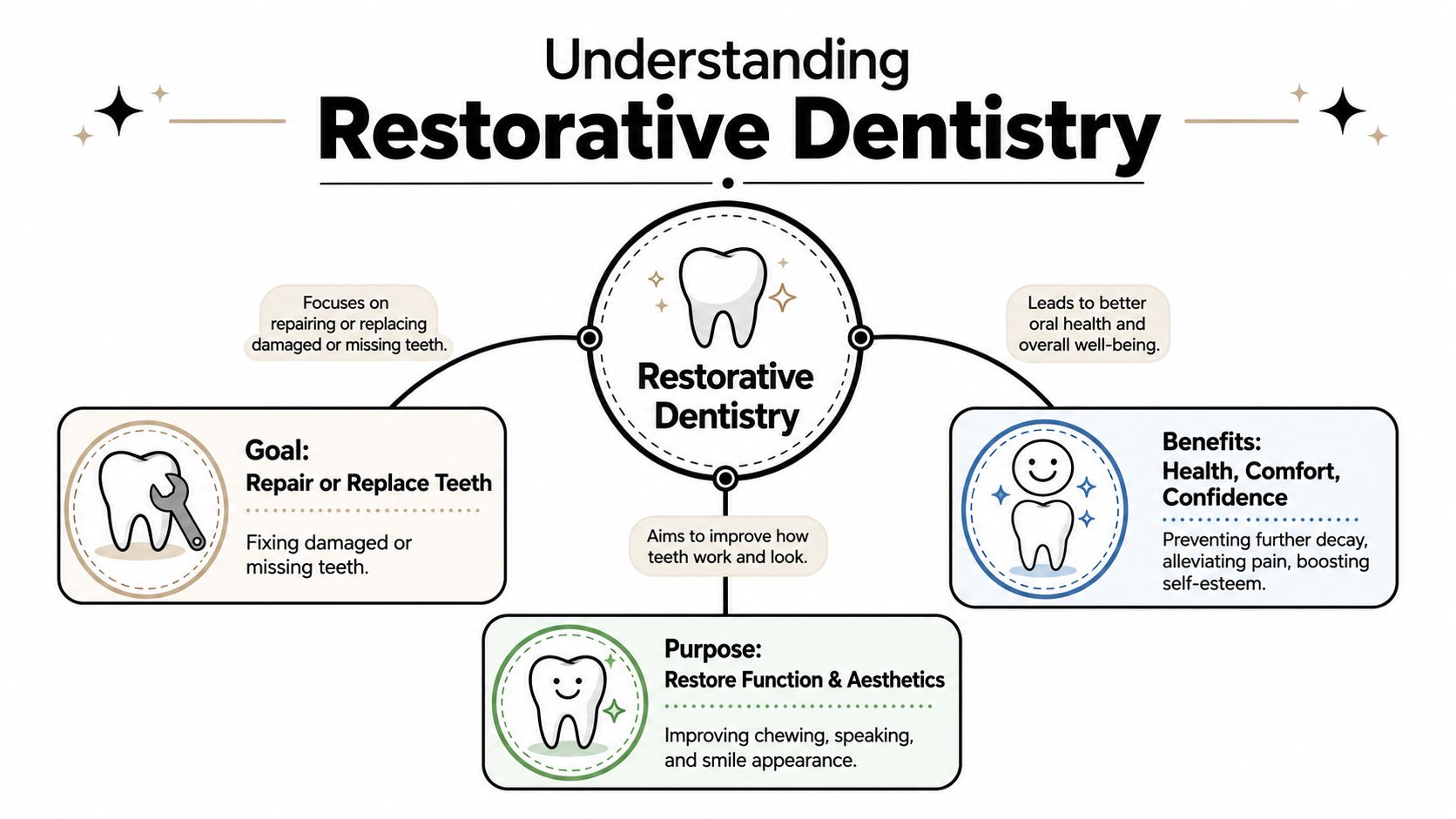
What is restorative dentistry? It's the area of dental care that repairs teeth that are damaged and replaces teeth that are missing. The goal is to bring back strength, function, comfort, and oral health.
A helpful way to think about it is home repair. If a house has a cracked foundation, broken support beam, or missing roof section, paint alone won't solve the problem. You first restore the structure so the home is stable and safe. Restorative dentistry works the same way. It focuses on the parts of your smile that need support before anything else.
It's about function first
Many people assume dental treatment is mainly about appearance. Appearance matters, of course, but restorative dentistry begins with practical questions:
- Can this tooth handle normal chewing pressure?
- Is decay weakening the structure?
- Is there enough healthy tooth left to save it?
- Has a missing tooth changed the way nearby teeth and the bite work?
Teeth aren't merely decorative. They help you chew efficiently, speak clearly, and keep your bite balanced.
Why people need restorative care
Restorative treatment is commonly used when a tooth has:
- Decay that creates a cavity or weakens the tooth
- A fracture or crack from injury, grinding, or wear
- Old dental work that has worn down or failed
- Tooth loss from damage, infection, or other oral health problems
Some problems are obvious. A broken tooth gets attention fast. Others are quieter. A small cavity may not hurt at first, and a cracked tooth can cause symptoms that come and go.
Restorative care often starts with a simple idea. Save what can be saved, replace what can't, and protect the healthy parts of the mouth along the way.
It's common at every age
If you've ever felt like needing a filling or crown means you've somehow failed at caring for your teeth, it helps to know how normal restorative treatment really is. According to the CDC's data brief on dental restorations and caries, nearly 92% of adults ages 45 to 64 had a dental restoration, and restorative care was common across children, adults, and older adults as well.
That tells us something important. Repairing teeth isn't unusual care for a few people. It's a routine part of lifelong dentistry.
What restorative dentistry doesn't mean
It doesn't automatically mean major treatment. Some patients need a small filling. Others need a crown to reinforce a tooth. If a tooth can't be saved, the restorative plan may shift toward a bridge, denture, or implant.
The main point is simple. Restorative dentistry isn't one procedure. It's a category of care built around restoring what disease, injury, or wear has taken away.
Your Options for Restoring Teeth at Winn Smiles
Once people understand the term, the next question is usually practical. “What treatment would I need?”
The answer depends on how much tooth structure remains, whether the tooth is hurting, and whether the problem involves one tooth or several. Modern restorative care can be conservative when the damage is small and more extensive when a tooth is badly weakened or missing.

Fillings for early repair
A filling is often the simplest restorative option. If decay creates a cavity or a small area of damage, a filling closes that space and helps the tooth function normally again.
Fillings are usually used when the tooth is still strong enough to support itself without full coverage. Think of this as patching a problem before it spreads.
Crowns for strength and protection
A dental crown covers a tooth when that tooth is too weak, cracked, or heavily repaired to depend on a filling alone. Crowns are often recommended after large cavities, fractures, or root canal treatment.
If you want a patient-friendly overview of that process, this guide on what a dental crown procedure involves can help.
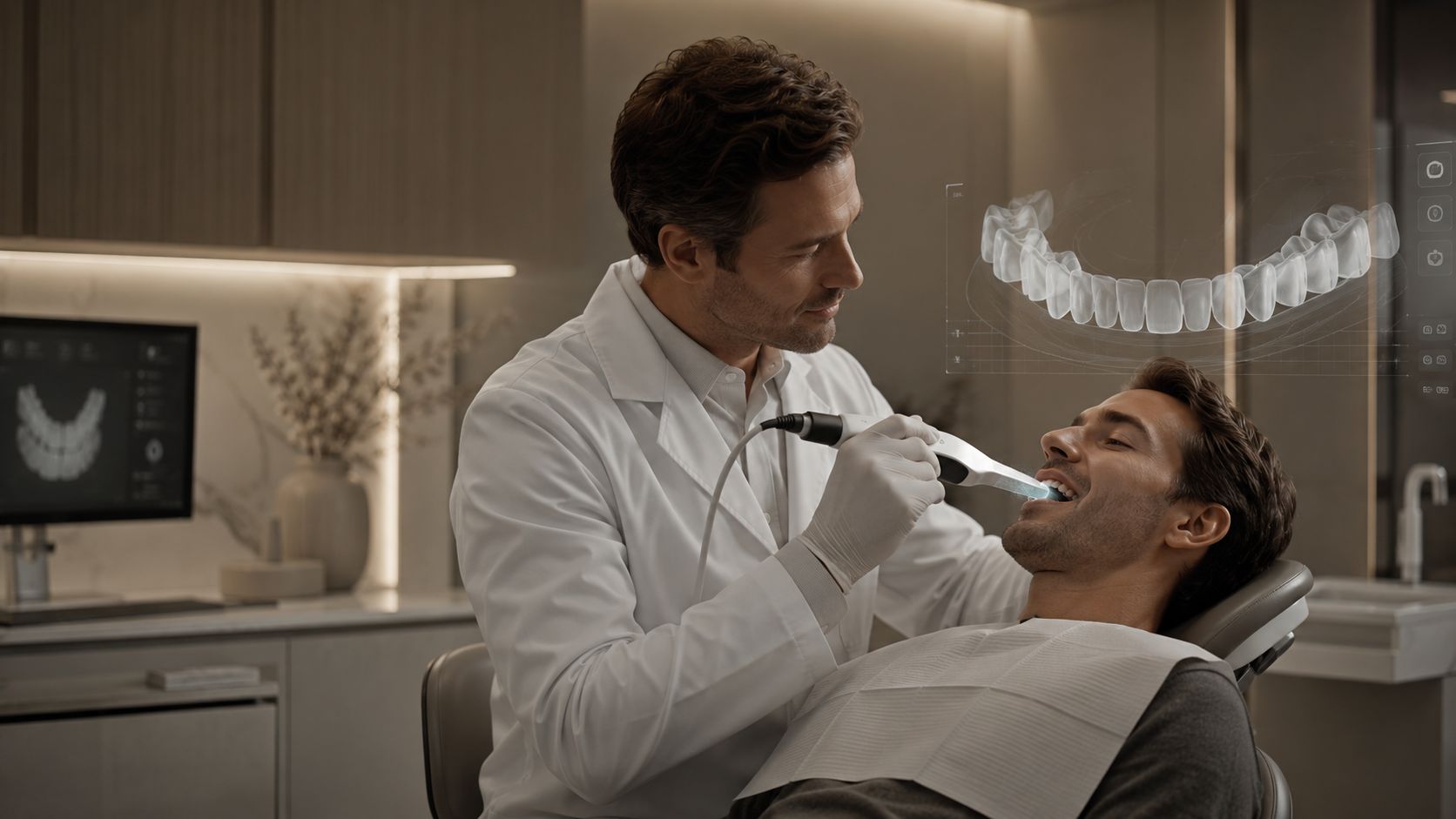
Here's where modern technology makes a real difference. Contemporary restorative workflows increasingly use direct intraoral scanning and CAD/CAM fabrication, which improves the accuracy of the final restoration, as described in this review of digital restorative dentistry workflows. That technology is what makes same-day crowns possible, so some patients can have a tooth prepared and restored in a single visit instead of managing a temporary crown and return appointment.
A crown isn't just a cover. It's a way to help a vulnerable tooth handle pressure again.
Bridges for one or more missing teeth
A bridge replaces a missing tooth by connecting a replacement tooth to support on the surrounding teeth or implants. For some patients, that's a practical way to close a gap and improve chewing.
A bridge can be a good option when the neighboring teeth already need support or when someone wants a fixed replacement but isn't choosing an implant-based solution.
Implants for a stable replacement
Individuals looking for dental implants near me are often seeking a replacement that feels secure and functions more like a natural tooth. An implant replaces the tooth root with a support anchored in bone, then a restoration is attached on top.
That approach can be useful for a single missing tooth, multiple missing teeth, or larger full-arch treatment plans. It also avoids relying on adjacent teeth for support in the way some traditional bridges do.
Dentures for broader tooth replacement needs
Dentures remain an important restorative option, especially when many teeth are missing. They can restore appearance and chewing ability, and in some cases they may be combined with implants for added stability.
A short way to compare common options is this:
| Treatment | Main use | What it restores |
|---|---|---|
| Filling | Small cavity or minor damage | Tooth shape and seal |
| Crown | Weak, cracked, or heavily damaged tooth | Strength and coverage |
| Bridge | One or more missing teeth | Bite continuity |
| Implant | Missing tooth root and crown replacement | Stability and support |
| Denture | Multiple missing teeth | Basic function and smile support |
The right choice depends on your mouth, your goals, and how you want the restoration to fit into everyday life.
Restorative and Cosmetic Dentistry How They Differ
Patients often mix these terms together, and that's understandable. Many treatments improve both health and appearance. Still, the reason for treatment matters.
Restorative dentistry focuses on fixing a problem that affects tooth structure, comfort, or function. Cosmetic dentistry focuses on improving how the smile looks.
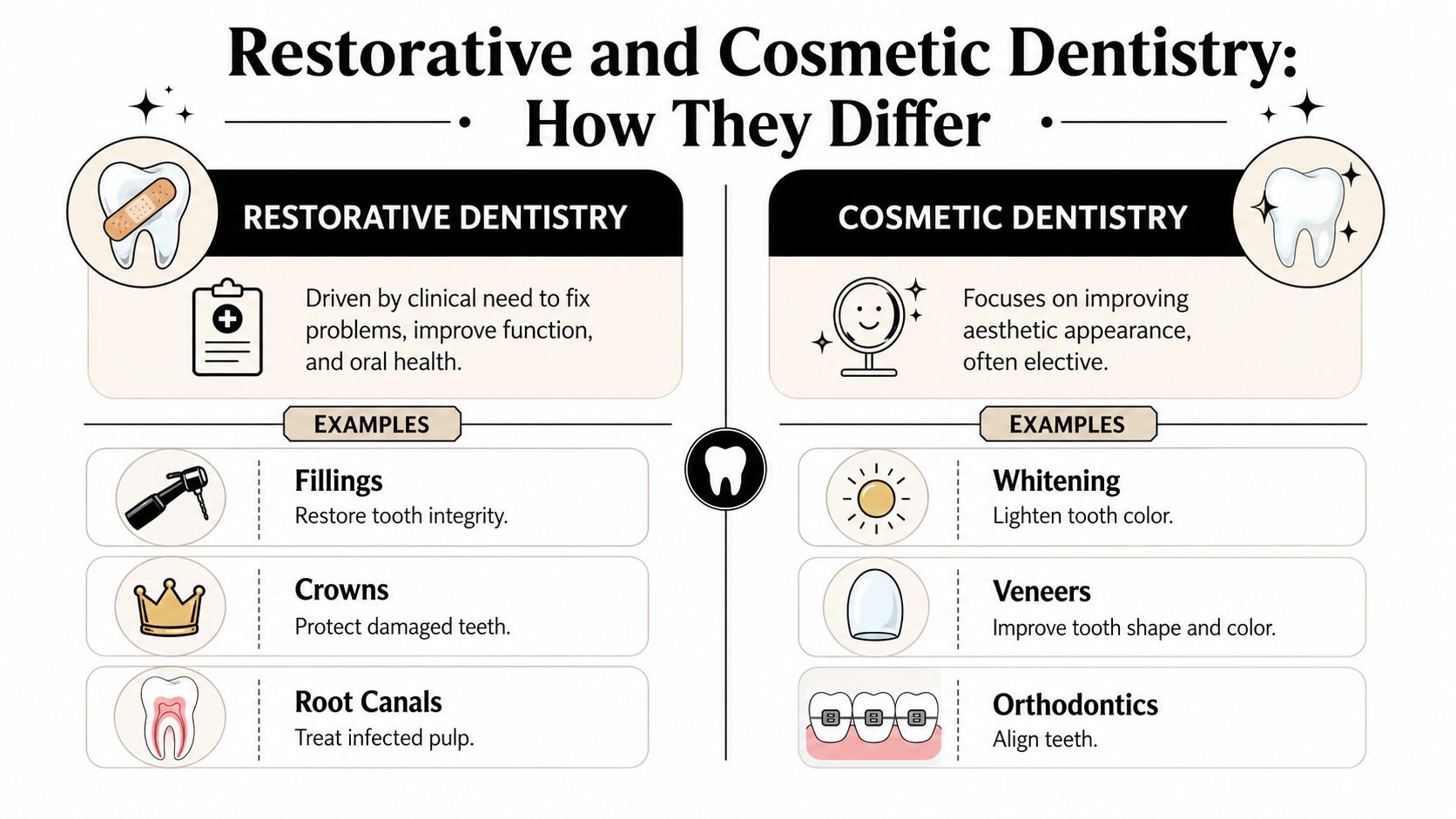
A simple side by side view
| Restorative dentistry | Cosmetic dentistry |
|---|---|
| Repairs damage or replaces missing teeth | Improves smile appearance |
| Driven by oral health and function | Driven mainly by aesthetics |
| Common examples include fillings, crowns, bridges, implants, dentures | Common examples include teeth whitening and veneers |
| Helps chewing, structural support, and bite stability | Helps color, shape, proportion, and symmetry |
According to Cleveland Clinic's overview of dental restorations, restorative dentistry treats decay, fracture, and tooth loss as biomechanical problems. Crowns protect compromised teeth, bridges distribute forces, and implants provide stable support. That's the key difference. The goal is to restore chewing function and structural integrity, not only appearance.
Where they overlap
The line isn't always sharp. A tooth-colored crown can protect a damaged tooth and also look natural. An implant can restore chewing and improve the appearance of your smile at the same time.
That overlap is often where treatment feels most satisfying to patients. You don't want a tooth that only works. You also don't want a result that looks good but doesn't hold up under normal use.
Healthy dentistry and attractive dentistry often meet in the same place. A strong restoration usually looks better, and a well-designed smile should also function well.
When to think cosmetic instead
If your teeth are healthy and your main goal is brightness, shape, or symmetry, cosmetic treatment may be the better fit. That might include teeth whitening, veneers, or other appearance-focused options for someone searching for a cosmetic dentist near me in Chattanooga or Cleveland.
If you have pain, a crack, a cavity, a missing tooth, or trouble chewing, restorative care usually comes first. Once the mouth is stable, cosmetic refinements can be considered if you want them.
What to Expect During Your Restorative Care
For many people, the hardest part is not the treatment itself. It's not knowing what the process will feel like. Clear expectations help.
The first step is a conversation and exam. If you come in with a broken tooth, toothache, or concern about a missing tooth, the dentist evaluates the area, reviews symptoms, and uses imaging when needed to understand what's happening below the surface.
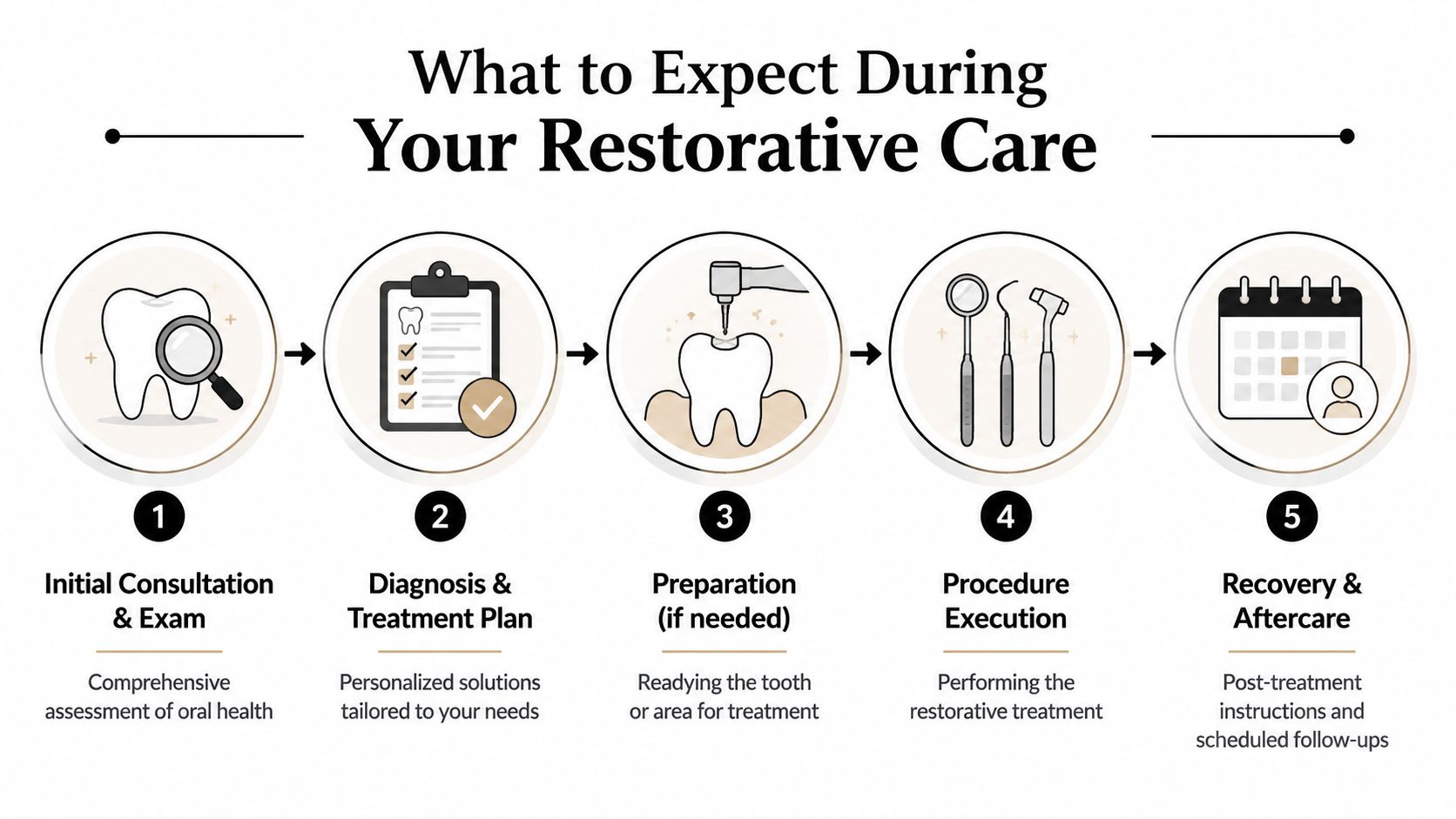
Step one and step two
The visit usually begins with two basic goals:
- Find the source of the problem. Pain can come from decay, a crack, a failing restoration, infection, or bite pressure.
- Build a treatment plan that fits the tooth and the person. Some patients need the most conservative repair possible. Others need something built for long-term durability.
If the issue involves the inner nerve of the tooth, root canal therapy may become part of the restorative plan. This explanation of what a root canal procedure involves can make that process easier to understand.
A quick visual can also help patients understand the general flow of care:
During treatment
The procedure itself depends on the restoration. A filling visit is different from crown preparation, and implant treatment follows a different timeline than either one. What stays consistent is that the dentist prepares the area carefully, places or designs the restoration, and checks how it fits with your bite.
For anxious patients, comfort matters as much as technique. A calm pace, clear communication, and options that help you relax can make restorative care much easier to get through.
After treatment and long term care
Many patients have the biggest questions at this point. What happens after the filling, crown, bridge, or implant is done?
A practical answer is that restorative dentistry isn't a one-time event you never think about again. As explained in CareCredit's patient guide to restorative dentistry, restorative care is part of a long-term maintenance plan, and the best option often minimizes future retreatment. That's why home care, follow-up visits, and knowing how to protect the restoration matter.
Common aftercare guidance often includes:
- Keep the area clean with brushing, flossing, and any special instructions you're given.
- Pay attention to your bite if something feels too high, uneven, or sore when chewing.
- Return for follow-up care so small adjustments can be handled early.
- Ask about habits like grinding, clenching, or chewing ice, since those habits can shorten the life of a restoration.
A well-made restoration does its job best when it's part of an ongoing relationship with your dental team, not the end of the conversation.
Frequently Asked Questions About Restorative Care
Is restorative dentistry painful
Most patients are relieved to learn that treatment is focused on removing pain, not creating it. If you have decay, a crack, or an infected tooth, the problem itself is often more uncomfortable than the procedure that fixes it.
Local anesthesia is used to numb the area, and some patients also benefit from sedation options, especially if dental visits make them nervous.
How do I know if I need restorative care or just a cleaning
A cleaning helps remove buildup and supports prevention. It doesn't repair damage that's already there. If you have pain, a broken tooth, a visible hole, a loose filling, or a missing tooth, you probably need an exam for restorative treatment rather than a cleaning alone.
If you're unsure, that's normal. A new patient exam and dental x-rays can show whether the issue is preventive, restorative, or both.
What's the best treatment for a missing tooth
There isn't one answer for everyone. The best option depends on your bone support, surrounding teeth, bite, budget, and whether you want a removable or fixed solution.
For some people, a bridge makes sense. For others, implants or dentures fit better. The right recommendation should come from an exam, not a guess based on symptoms alone.
Will my restoration look natural
In many cases, yes. Modern materials are designed to restore function while blending naturally with your smile. The exact appearance depends on the type of restoration and where it sits in the mouth, but a natural-looking result is a common goal.
How long will a crown, bridge, filling, or implant last
That depends on the restoration, the condition of the surrounding teeth and gums, and how well it's maintained. No dental work lasts forever under every condition, which is why follow-up care matters.
The better question is often this: what option gives you the healthiest and most stable result with the least chance of needing early retreatment?
What if I've been putting this off
You're not alone. People delay care for all kinds of reasons, including anxiety, schedule issues, uncertainty, and cost concerns. The important thing is not to wait until a manageable problem becomes a painful emergency.
If you've been searching for a dentist near me, an emergency dentist, tooth extraction, or dental implants near me in Chattanooga or Cleveland, a consultation can help you understand what's happening and what your next step should be.
If you're ready to stop guessing and get a clear plan, Winn Smiles offers restorative, cosmetic, and general dental care for patients in Chattanooga, Cleveland, and nearby Tennessee communities. Schedule a visit to talk through your symptoms, review your options, and take the next step toward a healthier, more confident smile.