Loose dentures at dinner. A front tooth that keeps breaking. Teeth that no longer feel reliable when you speak at work or smile in photos. That is usually the point when cost becomes the first real question.
All-on-4 treatment is a significant investment, and the price in Chattanooga and Cleveland is shaped by more than a national average. The final fee depends on the condition of the teeth and bone, the type of final prosthesis, and whether care such as tooth extraction, sedation, or other preparatory treatment is needed before implants can be placed. Cost ranges reported by the Cleveland Clinic's overview of All-on-4 dental implants reflect that same reality. Full-arch implant treatment varies case by case.
In our offices, patients usually want straight answers. They want to know what is included, what can raise the fee, and whether All-on-4 is a better long-term value than continuing to repair failing teeth or struggle with a removable denture.
At Winn Smiles, we see that concern often in patients coming in for new patient exams, dental x-rays, restorative care, or an emergency dentist visit. My job is to make the numbers easier to understand and connect them to the clinical decisions behind them, especially for patients in the Chattanooga and Cleveland area who want realistic local expectations rather than vague national pricing.
Reclaim Your Confidence with All-on-4 Implants in Chattanooga
A lot of people spend years adapting to tooth loss before they finally ask about full-arch implants. They chew on one side. They skip certain foods. They smile with their lips closed. They keep telling themselves they'll deal with it later.
That “later” usually arrives when temporary fixes stop feeling manageable. A denture that rocks during meals, broken teeth that keep needing repair, or a smile that no longer feels like your own can affect far more than appearance. Speech changes. Eating becomes frustrating. Confidence diminishes.

Why full-arch tooth loss feels bigger than a dental problem
Missing most or all of the teeth in an arch changes daily life in practical ways.
- Eating gets limited. Patients often avoid foods that are hard, crunchy, or chewy.
- Social situations become stressful. Dining out, work meetings, and family events can feel uncomfortable.
- Oral health usually worsens over time. Failing teeth, gum issues, and bite problems rarely stay still.
Those challenges are often what bring someone to a dentist in Chattanooga, TN or a dentist in Cleveland, TN to ask about lasting solutions instead of another short-term repair.
Many patients don't ask for “perfect” teeth. They ask for teeth they can trust.
What All-on-4 changes
All-on-4 uses four implants to support a full arch of fixed teeth. For the right patient, that means moving from removable or failing teeth to a stable restoration that stays in place. It's one of the clearest paths from ongoing patchwork treatment to a more complete reset.
This kind of care fits within broader restorative dentistry. Some patients first come in for a painful tooth, infection, or tooth extraction, then realize a larger plan makes more sense. Others are already comparing dentures, bridges, and implant options after years of dental care that never fully solved the problem.
In Chattanooga and Cleveland, patients usually want the same thing. They want straightforward guidance, a plan that respects their budget, and a team that understands this decision affects comfort, confidence, and daily function.
Understanding the Average Cost of All-on-4 Implants
A patient from Chattanooga may get one quote, then call an office in Cleveland and hear a different number for what sounds like the same treatment. That usually comes down to what is included, the condition of the mouth, and the type of final teeth being planned.
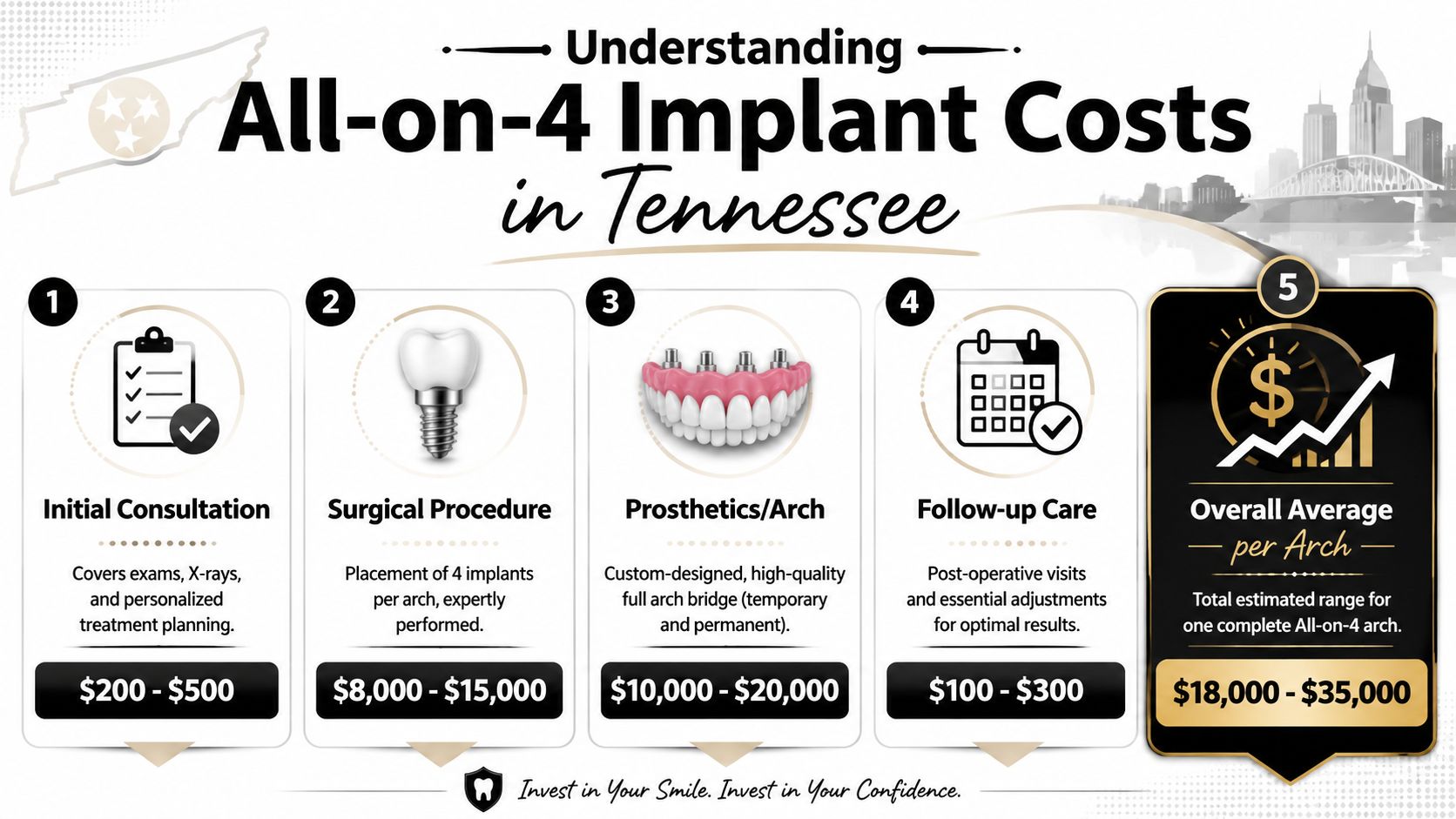
In the Chattanooga and Cleveland, TN area, All-on-4 treatment often starts in the high teens or low twenties per arch for a straightforward case and rises from there when extractions, sedation, temporary teeth, or premium final materials are part of the plan. For full-mouth treatment, many patients locally are looking at a figure that lands well above a single arch because every surgical and restorative step is doubled.
What drives the local price range
The biggest question I hear is simple. “What makes one case cost more than another?”
The short answer is that All-on-4 is a treatment plan, not a single product. Two patients can both need a full arch, but one may still have infected teeth to remove, limited bone in key areas, or a bite that requires more design work. Another may be a cleaner surgical case with fewer steps.
In our part of Tennessee, the fee usually reflects several practical decisions:
- Whether treatment is for one arch or both. Full-mouth care costs more because it includes two sets of implants and prosthetics.
- What must happen before implant placement. Extractions, infection control, and site preparation can add to the total.
- The type of temporary and final teeth. Acrylic options usually cost less upfront than zirconia.
- Sedation and surgical complexity. Longer, more involved cases generally carry higher fees.
- What is included in the quoted price. Some offices bundle imaging, temporaries, and follow-up visits. Others list them separately.
That last point matters more than patients expect. A lower quote is not always the lower total.
Why local estimates matter more than generic averages
National ranges can help with basic orientation, but they do not tell a Chattanooga or Cleveland patient what nearby offices commonly include, how local labs price a final prosthesis, or how often additional procedures show up in real treatment plans.
A better comparison is local and specific. Ask whether the quote covers diagnostics, surgery, a temporary bridge, the final prosthesis, sedation, and follow-up adjustments. Ask what happens if teeth need to be removed first. Ask what material is planned for the final arch. Those answers usually explain the number faster than any national average can.
A short overview can help make the process easier to picture:
Practical rule: Compare All-on-4 quotes by scope, materials, and likely add-on procedures, not by the headline fee alone.
At Winn Smiles, we try to make this part plain. Patients in Chattanooga and Cleveland deserve to know whether they are hearing a starting figure for a simple case or a complete estimate for the care they require. That clarity helps you plan financially and make a decision with fewer surprises.
A Detailed Breakdown of All-on-4 Cost Factors
When patients hear one large price for full-arch implants, it can feel opaque. The better way to look at it is piece by piece. That helps you understand what you're paying for and why one treatment plan may cost more than another.
According to this itemized overview of All-on-4 cost components, common cost factors include 3D imaging at $300 to $600, implant placement surgery per arch at $8,000 to $14,000, a temporary prosthesis at $3,000 to $6,000, the final prosthesis at $5,000 to $9,000 for acrylic, and sedation at $500 to $1,000. That same source notes that additional procedures like extractions can add $1,000 to $3,000 to the total.
The first part of the investment
Before surgery, planning matters. A full-arch case isn't based on a quick look in the mouth.
Diagnostics and planning
This stage may include:
- 3D imaging and records that help map bone levels, implant position, and anatomy.
- Clinical exam findings such as gum health, infection, bite problems, and remaining teeth.
- Treatment design that determines whether you're a good candidate for All-on-4 as planned or need preliminary care.
At this point, a patient often learns whether a damaged arch can be saved with restorative dentistry or whether full-arch replacement is the better path.
The middle part of the investment
The surgery itself is only one part of the fee. The restoration is a major part of the total cost.
| Procedure Component | Typical Cost Range (per arch) |
|---|---|
| 3D imaging | $300 to $600 |
| Implant placement surgery | $8,000 to $14,000 |
| Temporary prosthesis | $3,000 to $6,000 |
| Final prosthesis for acrylic | $5,000 to $9,000 |
| Sedation | $500 to $1,000 |
Where treatment plans start to differ
Two patients can both need All-on-4 and still receive very different estimates.
Prosthesis material
Material is one of the biggest drivers of price. Acrylic options usually keep treatment lower than zirconia. Some of the most expensive restorations use ceramic zirconia, which can add $5,000 to $10,000 to a base acrylic or traditional prosthesis cost, according to this All-on-4 cost review. Patients who want a premium material often choose it for durability, appearance, or personal preference.
Additional procedures
Some mouths need prep work first. That may include removing teeth that can't be saved or handling limited bone support. If you're already dealing with pain, swelling, or broken teeth, the conversation may begin with tooth extraction or urgent restorative care before the implant phase is finalized.
Sedation and comfort choices
Some patients are comfortable with local anesthesia. Others prefer sedation because they've had difficult dental experiences, significant anxiety, or a more involved surgical day. Comfort choices affect the fee, but for many people they also make treatment possible.
The best cost discussion is specific. It should show what's included, what might be added, and what decisions are still open.
For Chattanooga and Cleveland patients, that transparency matters just as much as the number itself.
How All-on-4 Compares to Dentures and Single Implants
A patient from Chattanooga may tell us, “I can still get by with dentures.” A patient from Cleveland may say, “I want fixed teeth, but I need to understand why the fee is higher.” Both concerns are reasonable, and both deserve a clear answer.
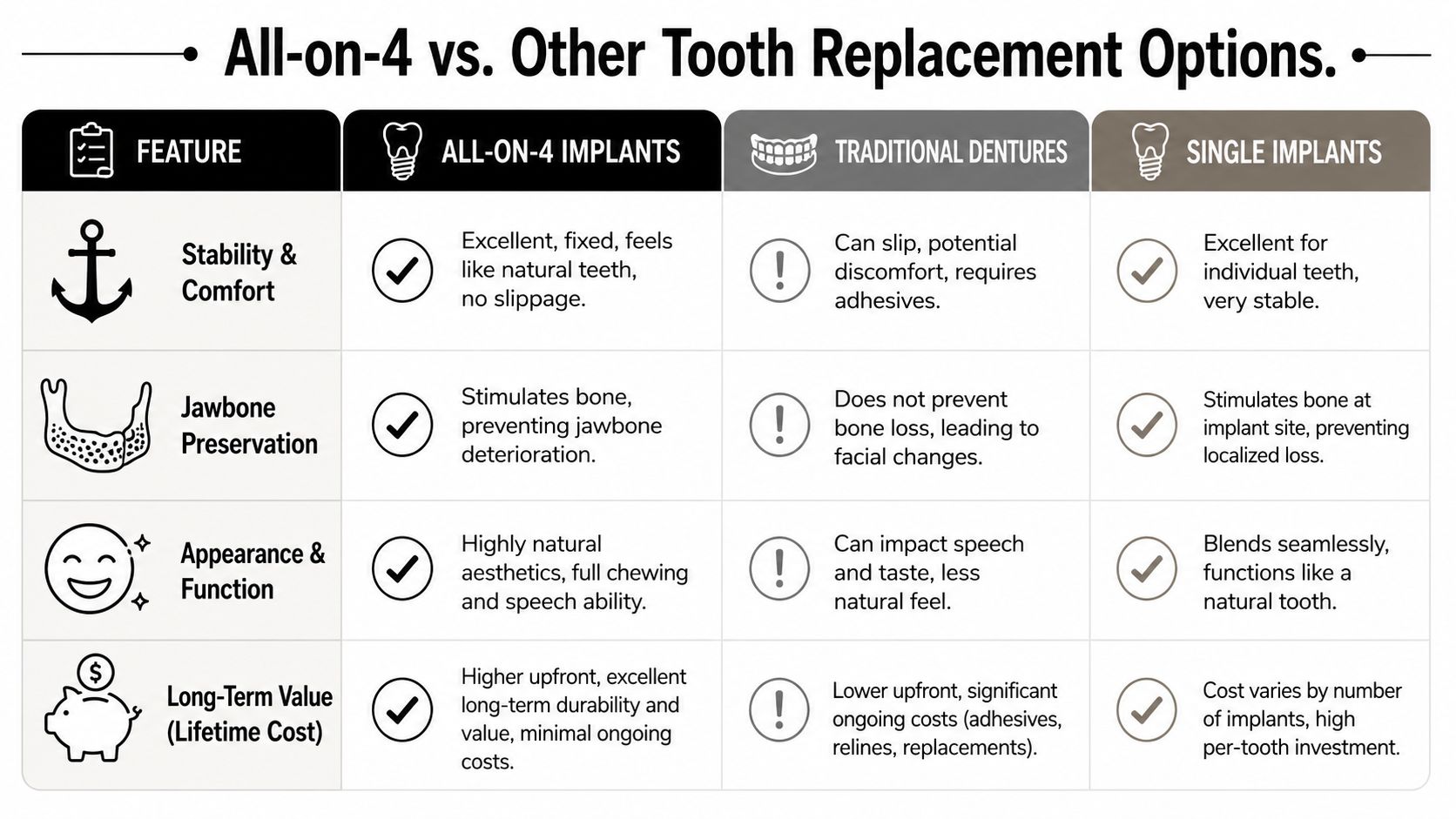
The right choice depends on what you need your teeth to do every day. Cost matters. So do stability, comfort, cleaning, food choices, and how much surgery makes sense for your mouth.
Dentures versus fixed full-arch implants
Dentures usually cost less at the start, which is why some patients choose them first. For the right person, they can be a practical option. But removable teeth come with trade-offs many people in our Chattanooga and Cleveland offices already know well. Slipping while eating, sore spots, adhesive, and the daily routine of taking teeth out can wear people down over time.
All-on-4 solves a different problem. It gives you a fixed arch that stays in place, which often changes how secure patients feel when they speak, smile, and eat in public.
For a closer look at the daily pros and cons, see our guide on dental implants vs dentures pros and cons.
All-on-4 versus replacing many teeth one by one
In a full-arch case, placing an implant for every missing or failing tooth is often not the most efficient plan. It can mean more implant sites, more surgical decisions, and a higher total fee. In some mouths, it also adds treatment steps without improving the final result enough to justify the extra work.
All-on-4 was designed for that middle ground. Instead of rebuilding an entire arch tooth by tooth, four strategically placed implants support a full set of fixed teeth. That approach is often more practical when most or all of the teeth in one arch are already failing.
Here is the day-to-day difference patients usually care about most:
- Stability: Fixed implant arches stay put during meals and conversation.
- Removal: Dentures come out each day. All-on-4 does not.
- Treatment scope: Multiple single implants can be excellent for isolated missing teeth, but full-arch cases often call for a different strategy.
- Maintenance: Both options require care, but the routine is different and should be discussed before treatment starts.
The long-term value question
Patients often focus on the starting fee, which is understandable. I encourage them to look at the years after treatment too. A lower-cost option can become more frustrating if it limits food choices, affects speech, or needs frequent adjustments.
All-on-4 has a strong long-term track record when the case is planned well and the patient keeps up with maintenance. A review in the Journal of Clinical Medicine reported high survival rates for full-arch implant treatment over time, as outlined in this published overview of All-on-4 outcomes.
That does not make All-on-4 the automatic answer for everyone. It does mean the better question is not only “What is the cheapest way to replace teeth?” The better question is “Which option fits my health, my budget, and the way I want to live every day?”
For many full-arch patients, confidence comes from teeth that feel secure, function well, and do not need to come out at night.
In our offices, that conversation is always specific to the patient in front of us. Someone in Chattanooga who wants the lowest entry cost may still choose dentures. Someone in Cleveland who is tired of loose teeth and repeated repairs may decide the higher upfront investment in All-on-4 makes better financial sense over time.
Financing Your New Smile and Navigating Insurance
A common conversation in our Chattanooga and Cleveland offices starts like this: a patient is ready to stop living with failing teeth, but the financial side feels harder to sort out than the treatment itself. That concern is valid. Full-arch implant care is a major investment, and patients deserve clear numbers, realistic expectations, and time to make a sound decision.
Insurance often plays a limited role with All-on-4. Many dental plans place relatively low annual maximums on major treatment, so benefits may reduce a portion of the cost without covering much of a full-arch case. In practice, that means insurance can help, but it rarely determines the whole plan.
What insurance may help cover
Coverage depends on the details of the policy and on how the treatment is coded. Some plans exclude implants outright. Others may contribute to parts of care tied to diagnosis or preparation.
That may include:
- Exams and imaging used to assess the case
- Extractions if damaged teeth need to be removed first
- A portion of the restoration in some plans
- Sedation or surgical services in limited circumstances
Medical insurance may also matter in select cases, especially when tooth loss is connected to trauma or another documented health issue. That is not the norm, but it is worth checking before treatment begins.
At Winn Smiles, part of our job is helping patients understand what benefits may apply and where the larger share of the fee will still be out of pocket.
Why financing matters
Many patients do not pay for All-on-4 in one transaction. Monthly financing can make a fixed, full-arch solution more realistic by turning a large fee into a planned budget item. That approach helps patients compare options calmly instead of making a rushed decision based only on the upfront number.
If you want to compare monthly payment approaches before treatment, Winn Smiles explains payment plan options for dental work.
A few practical steps make this process easier:
- Ask for a written treatment plan. It should show what is included in the quoted fee.
- Review the phases of treatment carefully. Imaging, extractions, temporary teeth, sedation, implant placement, and the final prosthesis should be addressed clearly.
- Check timing, not just totals. A patient in Chattanooga may want treatment completed in a shorter window, while a patient in Cleveland may prefer a phased schedule that spreads costs out.
- Confirm your insurance estimate before surgery day. That gives you time to ask questions and avoid surprises.
I tell patients to judge the financial decision the same way they judge the clinical one. Look at the whole picture. The right plan has to fit your oral health, your daily needs, and your budget without creating avoidable pressure.
Your All-on-4 Journey at Our Cleveland and Chattanooga Offices
Patients often don't arrive for a full-arch implant consultation feeling relaxed. They come in with questions about pain, cost, healing, and whether they've waited too long. That's why the patient experience matters as much as the treatment plan.
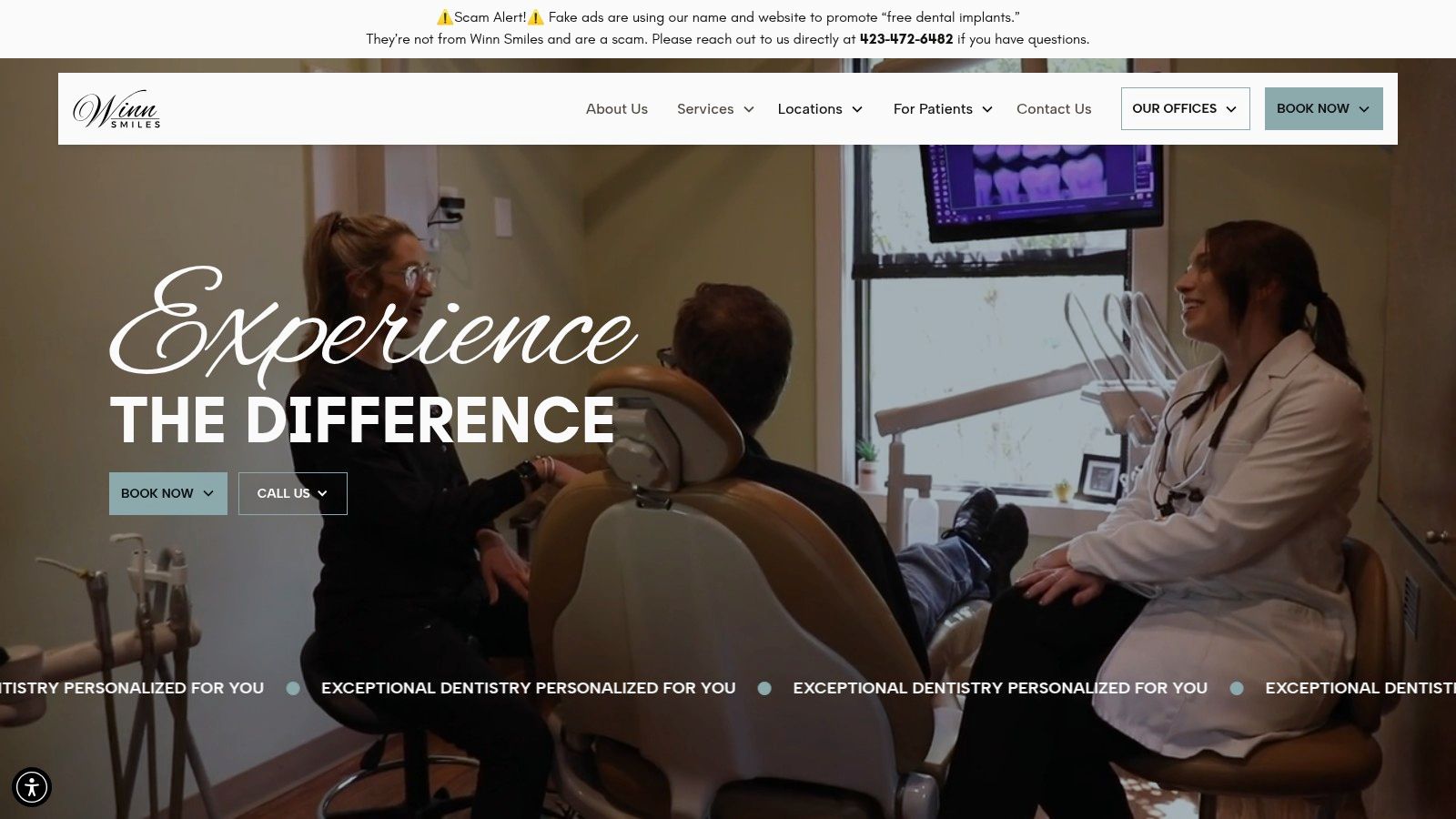
At Winn Smiles, the process begins with a consultation and a clear conversation. Some patients come specifically for implant options. Others first schedule because they need an emergency dentist, have broken teeth, or want a second opinion after hearing they need extensive treatment.
What the first visit is like
The first appointment is about clarity. Patients need to know what's happening in their mouth, whether All-on-4 is appropriate, and what alternatives exist if it isn't.
That usually includes:
- A full exam and digital records to evaluate teeth, gums, bite, and bone support
- A candid discussion of goals such as fixed teeth, comfort, appearance, and timeline
- A review of related services if other needs are present, including restorative care, periodontal treatment, or extractions
For some people, the answer is immediate. Their remaining teeth are failing, and full-arch replacement makes sense. For others, a more conservative option may still be possible.
Comfort matters during complex treatment
Long appointments are easier when the environment is designed for real people, not just procedures. Light, open offices, a comfort menu, and personalized sedation options make a difference for anxious patients and for anyone facing surgery.
Anxiety changes decisions. When patients know comfort options are available, they're often able to move forward with treatment they've postponed for years.
What happens after planning
Once the treatment plan is settled, the next steps are coordinated around surgery, temporary teeth, healing, and the final restoration. Patients also need follow-up visits, home-care guidance, and straightforward communication if questions come up.
Because Winn Smiles also provides broader dental care, cleaning and exams, dental x-rays, cosmetic dentistry, and restorative dentistry, patients can keep routine maintenance and long-term follow-up in the same practice after implant treatment is complete. That continuity helps patients stay on track with the care that protects their investment.
For people in Chattanooga, Cleveland, and nearby service areas, the most reassuring part of the process is usually this: once there's a real plan on paper, the decision feels less overwhelming and much more manageable.
Frequently Asked Questions About All-on-4 Implants
A common conversation in our Chattanooga and Cleveland offices starts the same way. Someone has spent months comparing prices online, reading national averages, and trying to figure out what applies to their mouth, their health, and their budget. These are the questions that usually matter most once the conversation becomes personal.
How long do All-on-4 implants last
All-on-4 is built as a long-term solution, but no dentist can promise the same timeline for every patient. The implants in the bone often last many years with consistent home care, regular maintenance visits, and good control of issues like gum inflammation or teeth grinding. The attached bridge usually wears sooner than the implants themselves because it handles daily chewing forces.
In practice, longevity depends less on a single number and more on habits, bite forces, medical history, and how well the case is planned from the start.
Is the procedure painful
Most patients describe the process as easier than they feared. Treatment is done with local anesthesia, and sedation can be added based on the surgical plan and your comfort level. Soreness after surgery is expected, especially in the first few days, but it is usually manageable with the right post-operative plan.
Comfort should be discussed before the procedure, not after. That matters for patients with dental anxiety and for patients facing extractions and implant surgery in the same visit.
Can I get All-on-4 if I've been told I have bone loss
Sometimes, yes.
Bone loss does not automatically rule out treatment. One advantage of this approach is that it can work for patients who are not good candidates for more traditional implant patterns. The only way to know is to review imaging, gum health, and the quality of the available bone. In some cases, treatment is still possible. In others, a different plan is safer and more predictable.
Do I have to remove all my remaining teeth first
If the remaining teeth are unhealthy, loose, infected, or too weak to support long-term function, they usually need to be removed as part of treatment. If a few teeth still look acceptable, the bigger question is whether keeping them improves the final result or creates problems later.
That decision should be based on prognosis, not emotion alone. Saving a tooth that is likely to fail soon can increase cost and delay a more stable full-arch solution.
How do I clean fixed full-arch implants
Fixed teeth still need daily care. Patients need to clean around the prosthesis, along the gumline, and underneath areas where food and plaque collect. We also recommend maintenance visits so the restoration and surrounding tissues can be checked regularly.
This is one of the biggest financial trade-offs to understand. Fixed implant teeth feel more secure than removable dentures, but they also require consistent maintenance to protect that investment.
Is All-on-4 only for appearance
Appearance is part of it, but function is usually what changes daily life the most. Patients often want to smile without feeling self-conscious, but they also want to chew better, speak with more confidence, and stop dealing with loose dentures or repeated repairs.
That combination is why so many people from Chattanooga, Cleveland, and nearby communities start by asking about cost, then decide based on quality of life.
If you're comparing All-on-4 implants cost in Chattanooga or Cleveland, the most useful next step is a real consultation with a team that can evaluate your teeth, explain your options, and give you a treatment plan that fits your needs. Winn Smiles provides full-arch implant consultations, restorative dentistry, cosmetic care, and ongoing dental support for patients who want clear answers and a practical path forward.