
For a routine single dental implant, the surgical procedure typically takes about 30 to 60 minutes, while the full appointment usually lasts 1 to 3 hours. Complete healing takes several months because the implant must fuse with the jawbone before the final tooth is attached.
If you're looking for dental implants near me in Cleveland, TN, you may be trying to plan around work, family responsibilities, or an upcoming tooth extraction. You might also be wondering whether “implant surgery” means the time spent in the dental chair or the entire journey from consultation to your final crown. Those are different timelines, and understanding the distinction can make treatment feel much more manageable.
At Winn Smiles, patients from Cleveland, Chattanooga, and nearby communities can discuss dental implants, restorative dentistry, sedation options, and other dental care in one treatment plan. The right schedule depends on your jawbone, the number of implants, the condition of your gums, and whether preparatory treatment is needed.
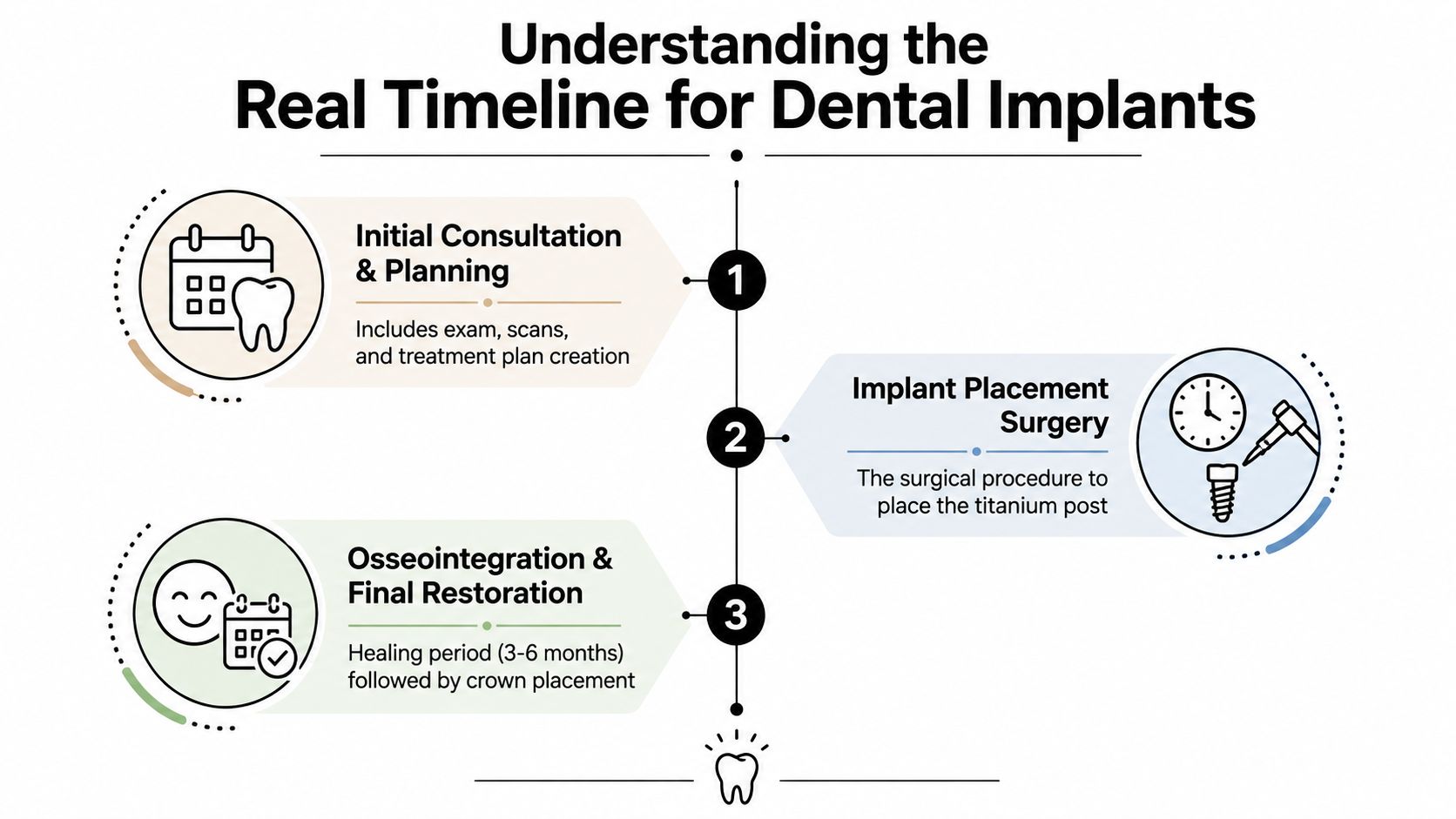
Understanding the Real Timeline for Dental Implants
A Cleveland patient may call the office asking, “How long does implant surgery take?” They may need to arrange transportation, take time away from work, or coordinate care for family members. The most useful answer depends on which part of the process they mean.
There are three separate timelines to keep in mind:
- The active surgical procedure, often about 30 to 60 minutes for a straightforward single implant, according to clinical reference information on dental implant placement.
- The complete office visit, commonly about 1 to 3 hours after preparation, anesthesia, monitoring, and post-operative instructions are included, as described in the same implant surgery clinical overview.
- The biological healing period, which can last several months while the implant integrates with the jawbone. Cleveland Clinic reports that osseointegration typically takes 3 to 9 months before the replacement tooth can be placed, as explained in its dental implant treatment guide.
Why the appointment isn't the whole process
The operation places the implant post into the jaw. It doesn't complete the restoration by itself. Your bone needs time to form a stable connection around the implant, after which the dentist can plan the abutment and crown.
That distinction matters when you're comparing treatment options or searching for a dentist in Cleveland, TN. A short appointment doesn't mean the final result is ready immediately, and a several-month treatment plan doesn't mean you'll spend months in surgery. Most of the time is biological healing, not active dental work.
Scheduling insight: Plan for the full visit, not only the surgical minutes, and ask your dental team to identify each healing milestone before you book.
What Happens During Your Implant Surgery Appointment
Your implant appointment follows a planned sequence. Knowing what happens first, what happens during placement, and what happens before you leave can reduce anxiety and help you prepare for a comfortable visit.

Arrival and preparation
The team reviews your medical history, confirms the treatment plan, and answers last-minute questions. Dental x-rays or digital images may already be part of your planning appointment, allowing the clinical team to evaluate the implant position before surgery begins.
If dental anxiety is a concern, ask about the available comfort and sedation options before the appointment. Local anesthesia numbs the surgical area so you shouldn't feel the incision or implant placement, though you may notice pressure or movement.
Patients who want a clearer understanding of numbing medication can review this resource on how long lidocaine lasts. Your dentist will still give you instructions based on the specific medication and procedure used.
Implant placement
After the area is numb, the clinician prepares the site and places the titanium implant post into the jawbone. For a straightforward single implant, the active surgical portion commonly takes 30 to 60 minutes, although a complex case may require more time.
The team monitors you throughout the visit and works carefully rather than rushing. You can read more about the clinical stages in this guide to the dental implant procedure.
Discharge and instructions
After placement, you'll receive instructions for protecting the surgical site, managing tenderness, choosing foods, and maintaining oral hygiene. Arrange transportation if your sedation plan makes driving unsafe, and keep the rest of the day as calm as possible.
The team should also explain when to call with concerns and when your follow-up visit will occur. Clear instructions give you a practical plan instead of leaving you to guess what is normal.
The Healing Phases After Implant Placement
A patient may feel ready to resume normal routines after several days, while the implant still needs months to become securely anchored. These are separate timelines: initial recovery describes the gums and the body's immediate response, while osseointegration describes jawbone growing around and bonding with the titanium implant.
Soft-tissue healing often begins during the first week. Swelling and tenderness may settle during this period, but the implant is not necessarily ready to support its final crown. The deeper bone-healing stage commonly continues for 3 to 9 months, as reported in this clinical review of dental implant healing.
The early soft-tissue phase
During the first week, protect the surgical area and follow your aftercare instructions. Your gum may remain tender, and your dental team may advise temporary changes to eating, brushing, and physical activity.
Symptoms can improve before the implant has biologically stabilized. Feeling better is a positive sign for early recovery, not proof that osseointegration is complete. A follow-up assessment helps the dentist decide when restorative treatment can proceed.
The bone-fusion phase
The implant must develop a stable connection with the jawbone before it can reliably support the final tooth. Healing commonly takes about 2 to 3 months in the mandible and 3 to 6 months in the maxilla, according to the PubMed-indexed clinical review.
Location, bone condition, and other clinical factors affect the schedule. Once the dentist confirms adequate integration, the restorative team can continue with the abutment and crown.
Winn Smiles also explains practical milestones and aftercare in its guide to dental implant recovery time. Use that information for general orientation, but follow your own dental team's instructions because your treatment plan may differ.
Important distinction: Less soreness means early recovery is progressing. It does not show that the jawbone has finished integrating the implant.
Traditional Implants Versus Same-Day Teeth Options
A patient may leave the dental office with a temporary tooth on the day an implant is placed. That visible result can make the entire treatment seem finished, even though the jawbone still needs time to heal around the implant.
Traditional treatment separates the main stages. The implant is placed first, then allowed to integrate with the jawbone before the final crown is attached. This gives the clinical team time to assess stability before completing the permanent restoration.
Immediate loading changes the timing of what you see, not the underlying biology. A temporary restoration may be fitted soon after surgery for carefully selected patients. The provisional still needs to remain in place during healing, and replacing it generally requires about 4 to 6 months of integration. Primary stability, bone quality, and case selection all affect whether this approach is suitable, as explained in current dental implant technology guidance.
The practical comparison
| Treatment approach | What you may notice | What still happens biologically |
|---|---|---|
| Traditional staged implants | The final crown is placed after the healing phase | The implant must integrate with the jawbone before final restoration |
| Immediate loading | A temporary restoration may be provided soon after placement | The implant still needs months of healing before the provisional is replaced |
The two options therefore involve three separate timelines: the length of the surgery appointment, the early recovery period, and the months required for bone healing. “Same-day teeth” refers mainly to the temporary tooth being provided quickly. It does not mean the implant has finished integrating.
Immediate loading may suit someone with sufficient initial stability and appropriate bone conditions. It is not automatically safer or faster for every patient. If those conditions are absent, conventional loading may offer a more predictable path.
The surgical appointment can be relatively short, while bone fusion continues for months. A consultation helps match the treatment plan to the patient's anatomy and healing needs, rather than relying on the “teeth in a day” label alone.
Factors That Influence Your Individual Surgery Duration
A generic estimate can't account for every implant case. One patient may need a single uncomplicated placement, while another may need multiple implants, a tooth extraction, treatment for bone loss, or a more involved surgical approach.
A recent study reported an overall mean surgical duration of 67.3 minutes. In that study, a checklist intervention was associated with a reduction from 75.4 minutes to 60.3 minutes, and the researchers identified variables including age, gender, unilateral versus bilateral placement, the surgeon combination, incision approach, and technique as factors affecting duration, according to the Frontiers in Surgery study.
What can lengthen the surgical visit
Multiple implants usually require more planning and may require a longer appointment block than a straightforward single-tooth replacement. The condition and location of the bone also matter, as does the surgical access needed to position the implant accurately.
If bone grafting is necessary, the issue may affect the overall treatment schedule rather than only the placement appointment. Mayo Clinic explains that grafted bone may need several months to grow enough new bone to support an implant, as described in its dental implant surgery overview.
Why planning improves predictability
Digital imaging and computer-guided planning help the dental team assess anatomy before surgery. At Winn Smiles, these tools, along with chairside milling, support individualized planning for implant treatment and restorative care. They don't remove the need for healing, but they can help the team prepare the appointment around your specific needs.
Ask for a timeline that separates the consultation, any tooth extraction or grafting, implant placement, follow-up visits, and final restoration. That approach gives you a realistic schedule instead of a single number that may not apply to your case.
Recovery Expectations and Comfort After Surgery
A patient may leave the office surprised that the procedure is over sooner than expected, then become more aware of tenderness once the anesthesia fades. Mild swelling, bruising, or soreness around the implant site can occur during early recovery, and your dental team will explain how to manage those symptoms.
Patient-recovery research found that most immediate symptoms ease within about 4 days, even though complete bone fusion commonly takes 3 to 6 months, according to this clinical recovery study. Those timelines aren't contradictory. Comfort can improve well before the implant is ready for its final crown.
A realistic first-week pattern
On the day of surgery, rest and follow the written instructions you receive. Choose foods and activities that don't place unnecessary pressure on the treated area, and take medication only as directed by your dental professional.
Over the next few days, tenderness and swelling should follow the pattern your team discussed with you. Keep the area clean using the recommended technique, and avoid treating reduced discomfort as permission to test the implant by chewing hard foods on it.
By the end of the first week, many patients are focused less on the surgical site and more on normal routines. The implant is still healing beneath the gum, so continue attending follow-up visits and follow restrictions until your clinician changes them.
Comfort milestone: Feeling more like yourself after the early recovery period is common, but the implant still needs protection during the longer integration phase.
Call the office if symptoms seem unusual, worsen instead of improving, or don't match the instructions you were given. A prompt conversation can help the team determine whether you need an earlier evaluation.
Scheduling Your Consultation at Winn Smiles
For dental implants near me, a dentist near me, or a dentist in Cleveland, TN, the consultation is the best place to turn a general estimate into a personal plan. The team reviews your dental and medical history, examines the treatment area, and uses appropriate imaging to determine whether you need a single implant, multiple restorations, or a full-arch solution.
Patients from Cleveland, Chattanooga, and nearby communities can also discuss related care, including tooth extraction, restorative dentistry, cosmetic dentistry, teeth whitening, cleaning and exams, and emergency dental services. If anxiety is affecting your decision, ask about comfort measures and sedation options before scheduling surgery.
Winn Smiles explains the stages from planning through final restoration and can help you understand which visits are active treatment, which are follow-ups, and which are healing milestones. That clarity helps you plan work, transportation, meals, and family commitments without relying on an oversimplified “same-day” promise.
If you're ready to replace a missing tooth, schedule a dental implant consultation with Winn Smiles. The team can evaluate your needs, explain your expected surgery and healing timeline, and help you choose a comfortable path toward a stable, natural-looking smile.