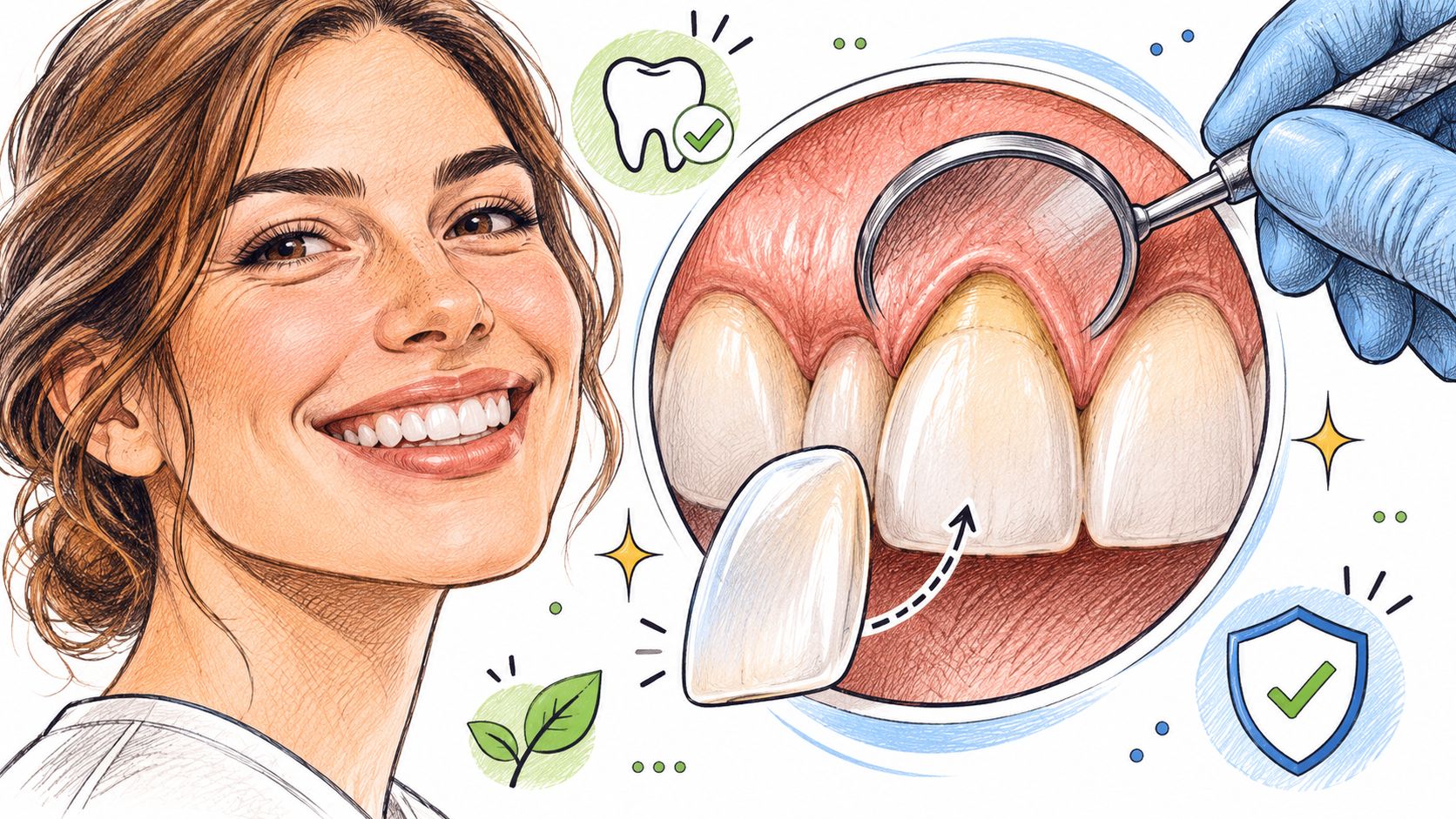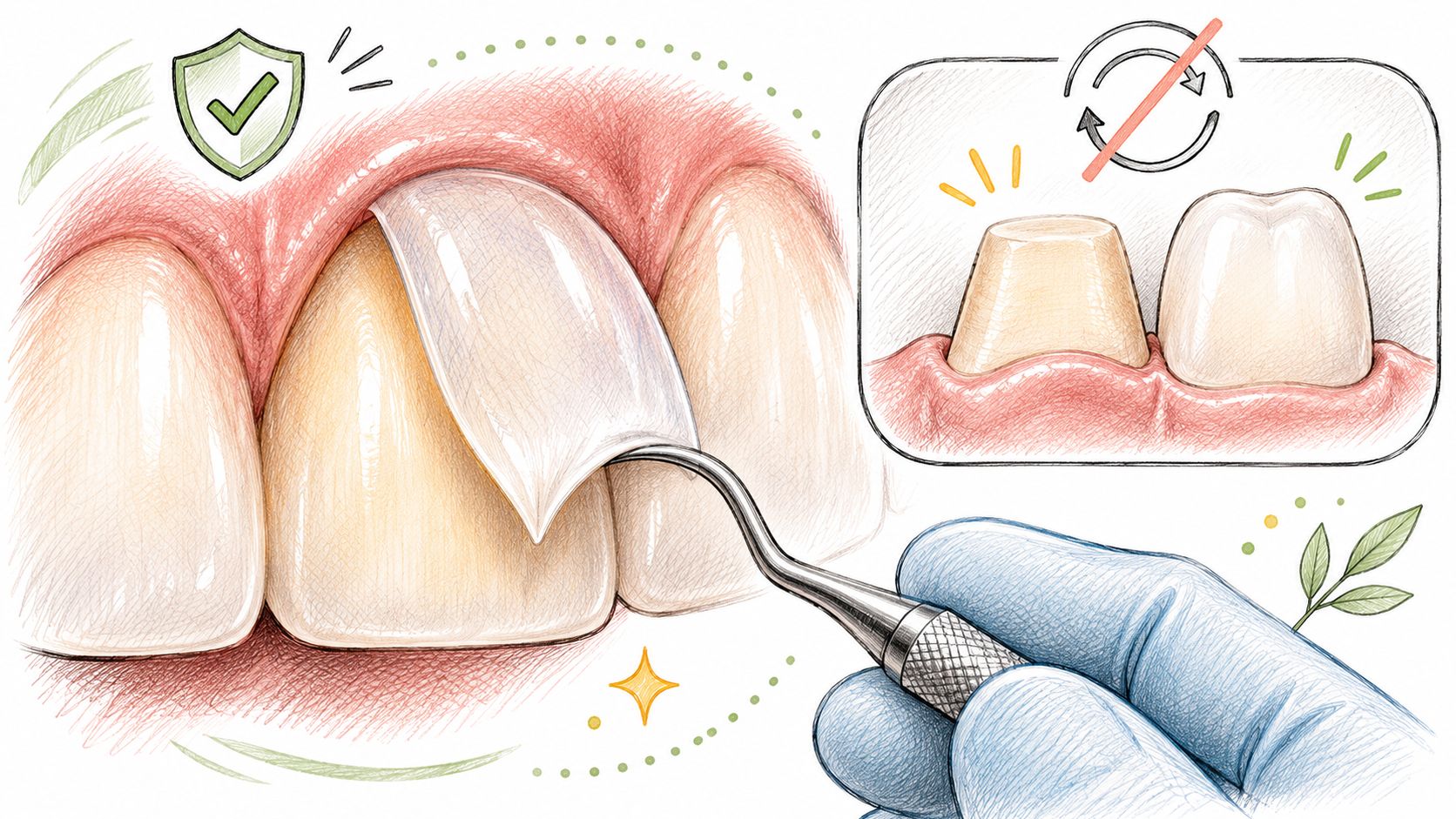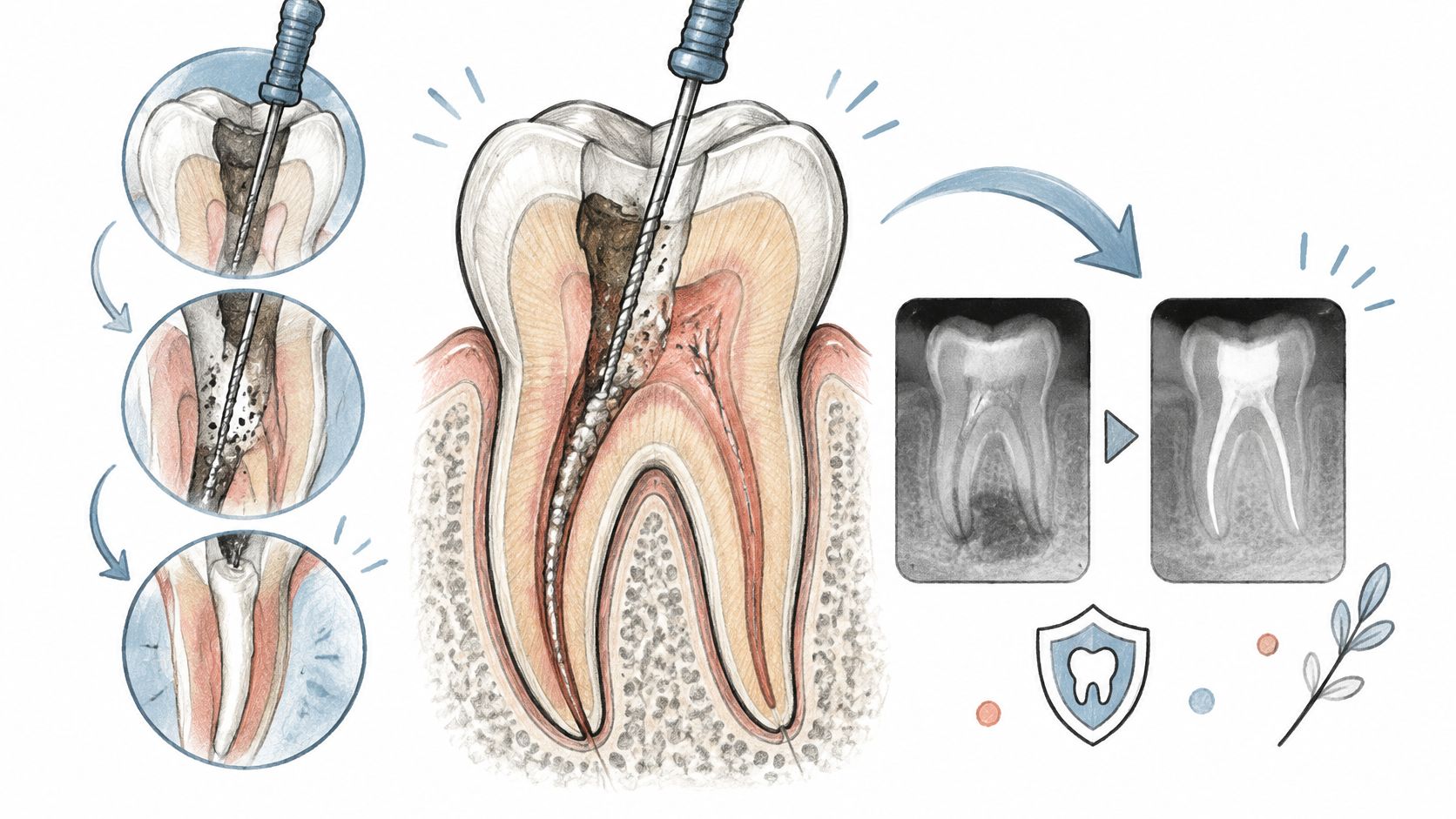
Can a root canal be redone? In many cases, yes, through a procedure called nonsurgical retreatment. Whether it will work for your tooth depends on why the original treatment failed. Some causes, like missed canals or new decay, can often be corrected, while others, like a cracked root, may not be.
Success rates for retreatment vary depending on how researchers define success and how long they follow the tooth, so a single percentage rarely tells the whole story. The sourced figures in the table below show just how much those definitions matter.
That's the question to ask before agreeing to another procedure: what does a successful result mean for your tooth, and how will your dentist measure it?
For adults searching for a dentist near me in Chattanooga or Cleveland, TN, Winn Smiles starts with a thorough examination and X-rays, then discusses the findings with you. A treatment recommendation should explain not just what can be done, but why it makes sense for your tooth.
Success Rates for Redoing a Root Canal
A tooth that aches again after a comfortable period, hurts when you bite, develops a gum bump, or shows a dark area on dental X-rays deserves evaluation. Anyone looking for root canal retreatment near me in Chattanooga or Cleveland, TN should ask a more useful question: not whether another treatment is possible at all, but whether the dentist can identify and correct the reason the tooth hasn't healed.
Nonsurgical endodontic retreatment means treating the inside of a previously root canal-treated tooth again. It can preserve a natural tooth, but published percentages don't all measure the same outcome. Before comparing numbers, you need to know what each study counted as a win.
What the published percentages measure
Under strict criteria, success generally requires no symptoms and complete healing visible on imaging. Loose criteria can accept improvement or partial healing rather than complete resolution.
The table separates these definitions rather than combining them into a single headline rate. Where a cell reads "Not reported," the study did not publish that figure, which says nothing about whether the result was good or bad.
Reported retreatment success rates by criteria and follow-up
| Study or measure | Follow-up | Strict criteria | Loose criteria |
|---|---|---|---|
| Systematic review and meta-analysis | 1-3 years | 71% | 87% |
| Same review, longer follow-up | 4-5 years | 77% | Not reported |
| Retrospective study of large apical lesions | 32 months median | 47% | 79% |
| Australian Endodontic Journal retrospective study, 2024 | Not reported | 78% | 83% |
| Journal of Endodontics retrospective cohort, 120 teeth, 2024 | Not reported | Not reported | 92.5% |
These aren't interchangeable groups. A study focused on large infections around root tips addresses a different clinical situation from a broader review of retreatment cases, so its stricter number isn't evidence that retreatment in general performs poorly.
Improvement isn't always complete healing
Here's a concrete case. Say a tooth no longer hurts and the dark area around its root has become smaller, but hasn't disappeared. A study accepting partial healing might classify that result as successful; a study requiring complete healing might not. Same tooth, same outcome, two different labels. That gap explains why a single headline percentage can mislead you.
Ask about the endpoint: Does the estimate describe symptom relief, complete healing on imaging, or simply keeping the tooth?
Two other questions sharpen the comparison. How long were the teeth followed, since a result checked at one year tells you less than one checked at four or five? And how severe were the cases in the study, because teeth with large infections heal differently from teeth with small ones?
The table's longer follow-up result also shouldn't be read as a promise that an individual tooth will improve by a predictable amount over time. Different follow-up groups and study methods affect the comparison.
For your decision, the most useful estimate is one tied to your tooth's condition, the proposed correction, and a defined follow-up plan. A group average isn't a personal prognosis.
Why a Root Canal Fails and What Can Be Done
Persistent infection can remain in a missed canal, an inadequately cleaned space, or an area that bacteria have reached through a leaking restoration. Retreatment makes sense when the dentist can reach and correct that problem.
Other causes aren't solved by cleaning the same canals again. A root fracture, infection outside the root, or a reaction to material beyond the root tip requires a different assessment.
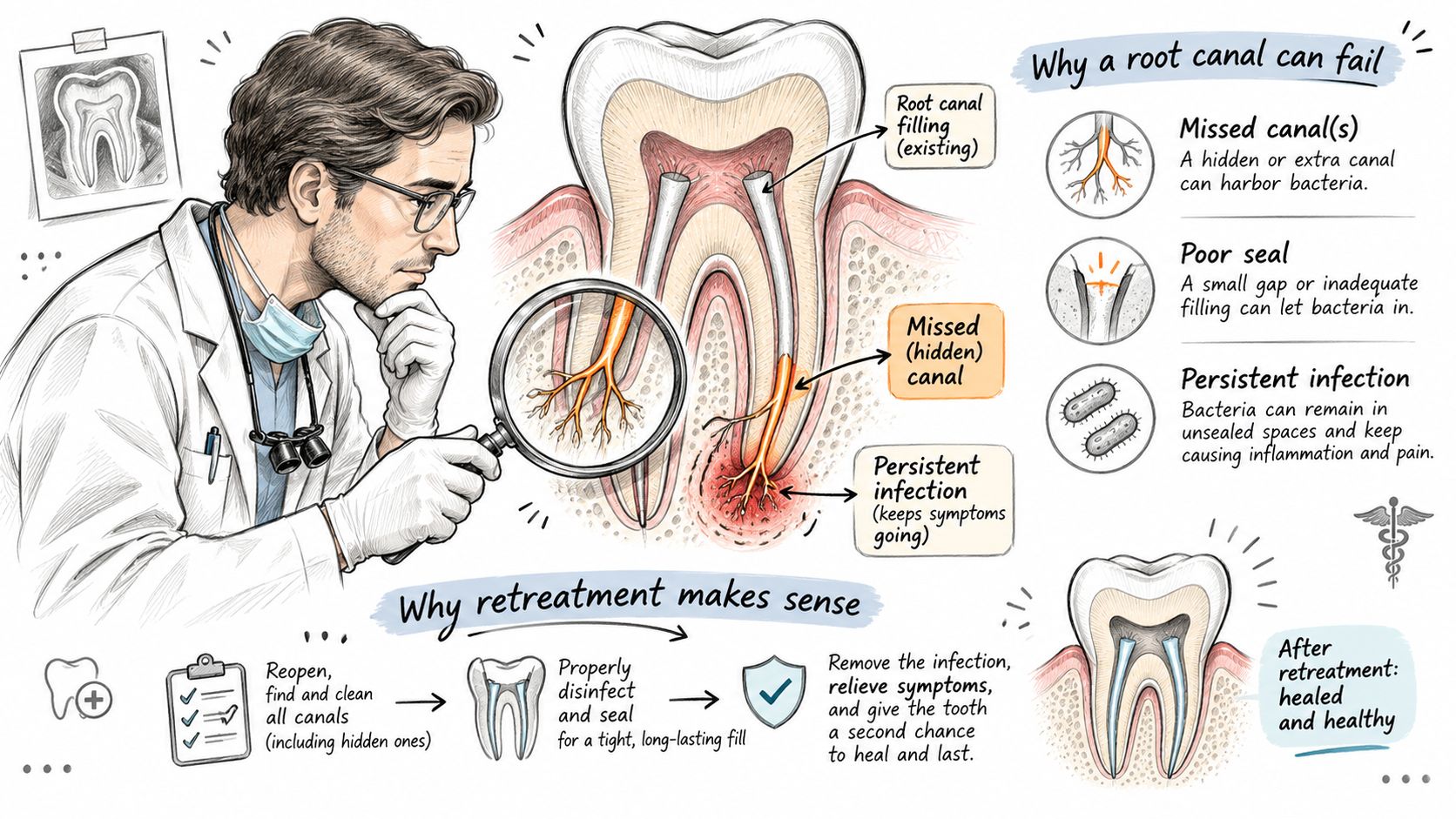
Failure causes, how they are found and retreatment outlook
| Likely cause | How it is found | Retreatment outlook |
|---|---|---|
| Missed or under-cleaned canal | Compare current and older X-rays, then search the canal system | Often treatable with retreatment |
| Leaking crown or filling | Examine restoration margins for gaps, decay, or breakdown | Treatable if enough sound tooth remains |
| Large infection around the root | X-rays or CBCT imaging assess its extent | Lower predictability; surgery may be considered |
| Perforation in the root or canal wall | Imaging and clinical examination | Reduced success; repairability reflects location and size |
| Cracked or vertically fractured root | Clinical testing and imaging | Often not retreatable; extraction may be needed |
| Infection outside the root tip | Persistent symptoms or a lesion after treatment prompt further assessment | Apical surgery may be needed |
Why diagnosis changes the outlook
The American Association of Endodontists outcomes review identifies lesions larger than 5 mm, lower-jaw or molar location, and multiple-visit retreatment as factors associated with lower success, and reports that perforation reduced success by about 31%. These associations aren't reasons to reject treatment automatically, and needing additional visits doesn't itself prove that the visits caused a poorer outcome.
A tooth with apparently adequate existing root filling but persistent disease deserves particular scrutiny. The cause may lie beyond the area that conventional instruments can clean.
When ordinary dental X-rays don't explain the problem, limited-field CBCT, a three-dimensional scan, may help clarify anatomy or complications. Imaging still needs to be interpreted alongside the examination.
For additional background on the approaches available, this patient resource can help you compare endodontic treatment options.
Pain after treatment is a reason to identify the cause, not an automatic reason to repeat the same procedure.
How Retreatment Works Step by Step
Retreatment is considered when symptoms persist, an abscess develops, or imaging shows lasting inflammation around the root. Extraction isn't automatically the next step.
The NHS explanation of root canal treatment describes the central goal as cleaning and filling the tooth to prevent reinfection. Retreatment applies that goal to a canal system that already contains filling material.
This illustration groups the main stages from planning through restoration.
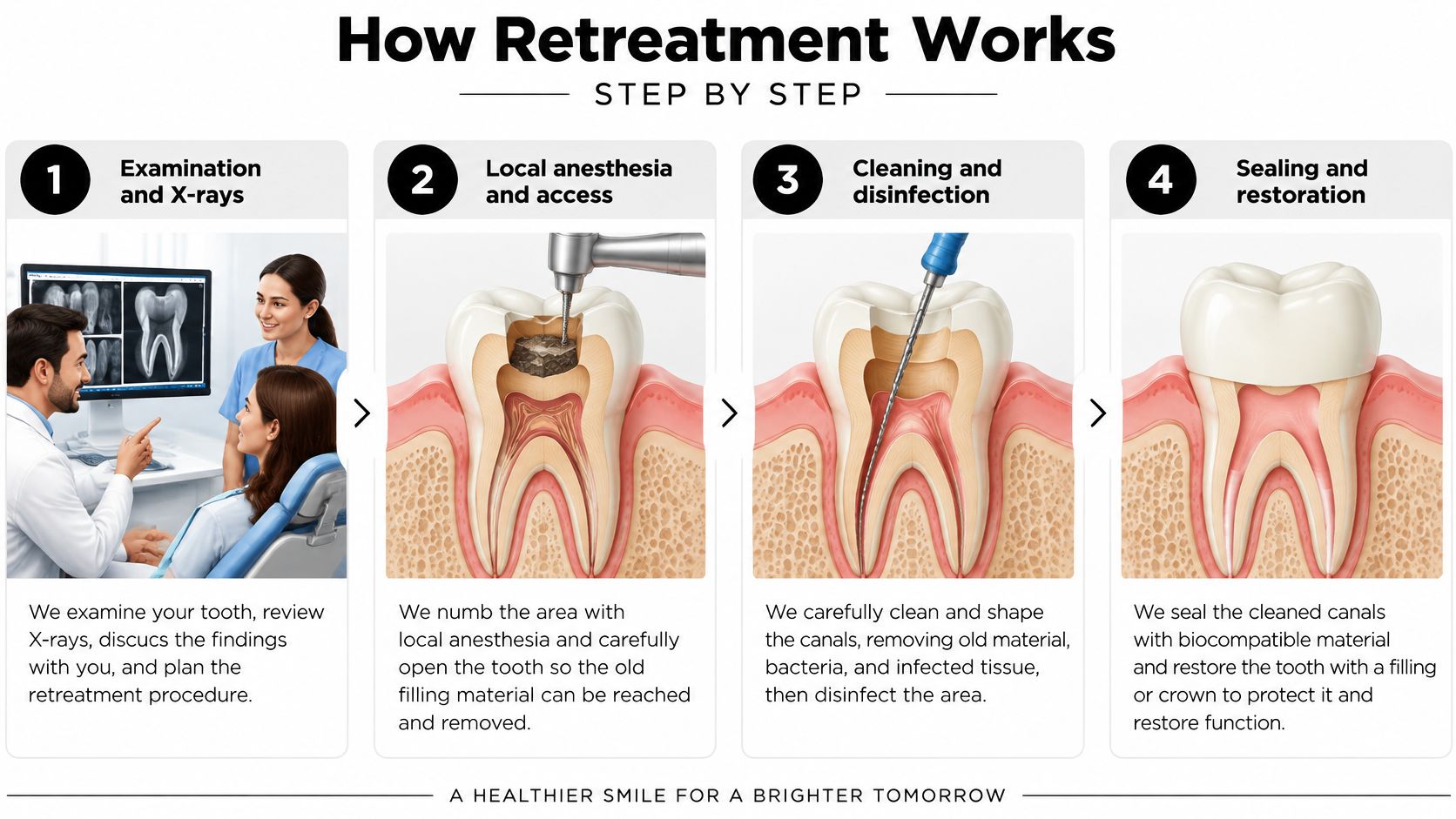
From examination to a protected tooth
Examination and X-rays guide the plan. At Winn Smiles, we begin with a thorough examination and X-rays to assess damage and plan treatment. We discuss the findings with you so you understand the proposed approach.
The area is numbed. Local anesthesia helps keep the tooth and surrounding area comfortable during treatment. Tell the team if you feel discomfort so they can respond.
The dentist reaches the old filling. A small opening provides access through the restoration or tooth, and the previous canal filling and sealer are removed. Clearing that material allows the dentist to inspect and disinfect the underlying spaces.
The canals are cleaned again. The dentist searches for missed, narrow, or inadequately treated anatomy and disinfects the canal system. Magnification and imaging can help with this detailed work.
The canals are refilled and sealed. At Winn Smiles, we fill the inside with a biocompatible material and seal it to prevent future infection. The goal is to close the cleaned spaces against new contamination.
The tooth receives its final restoration. In most cases, we place a crown or another restoration as the final step. A sound restoration helps protect the remaining tooth from fracture and bacterial leakage.
An illustrated explanation can make access, cleaning, and sealing easier to understand. This video provides another way to visualize the procedure.
For a written explanation of the underlying procedure, the resource root canal therapy explained offers additional background.
Follow-up checks healing over time
Your dentist checks symptoms and repeat imaging over the following months rather than judging the outcome immediately. A comfortable tooth is encouraging, but monitoring also assesses the surrounding tissues.
A meta-analysis reporting retreatment survival found tooth survival rates of 90% at 24 months, 86.8% at 48 months, and 85% at 72 months. Survival means the tooth remained present, not necessarily that every tooth was symptom-free or completely healed on imaging.
Retreatment Compared With Surgery and Extraction
Three paths exist for a failing root canal tooth, and each solves the problem from a different direction. Retreatment works from inside the tooth, surgery works from the root tip, and extraction removes the tooth entirely.
| Option | Best fit | Success at 2-4 years | Success at 4-6 years |
|---|---|---|---|
| Nonsurgical retreatment | Reachable canals and a restorable tooth | 70.9% | 83.0% |
| Apical surgery | Root-tip disease that retreatment cannot adequately address | 77.8% | 71.8% |
| Extraction with replacement | Tooth cannot be restored or has poor gum support | Not a tooth-retention outcome; success depends on the implant or bridge placed | Not a tooth-retention outcome; success depends on the implant or bridge placed |
A systematic review comparing retreatment and endodontic surgery found surgery ahead at 2-4 years (77.8% versus 70.9%), yet nonsurgical retreatment ahead at 4-6 years (83.0% versus 71.8%). Read that table again: the same two procedures swap positions depending on when you measure. Surgery tends to look better early because the diseased root tip is physically removed, while retreatment heals gradually from within. This is exactly why asking "how long was follow-up?" matters more than asking "which number is bigger?" No single figure settles which procedure suits your tooth.
Match the approach to the problem
Nonsurgical retreatment is often considered first when the dentist can reach the canals and restore the tooth afterward, since it addresses the problem from inside the tooth.
Apical surgery, also called an apicoectomy, approaches the root tip through the gum. It may be appropriate when the source of persistent disease can't be predictably addressed through the canal; our explanation of apicoectomy evaluation and treatment describes that option.
Tooth extraction becomes more reasonable when the remaining structure or supporting tissues can't sustain a useful restoration. At Winn Smiles, we provide extraction aftercare instructions and can discuss replacement with a dental implant or bridge.
Searching for dental implants near me shouldn't mean assuming an implant is automatically superior to saving the tooth. A review of retreatment outcomes and treatment decisions notes that direct comparisons with implant rehabilitation remain limited, so "implants always win" is a claim the research doesn't support.
Questions that help decide
- Remaining structure: Is enough sound tooth left for a durable restoration?
- Support: Are the bone and gums healthy enough to support the proposed treatment?
- Future choices: If this approach doesn't resolve the problem, what options remain?
That last question is easy to overlook. A retreated tooth that later fails may still be a candidate for apical surgery, while an extracted tooth closes the door on every tooth-saving option. Ask your dentist to walk through the full sequence before committing.
After extraction, follow the specific instructions for protecting the socket, managing bleeding, eating, and cleaning. Replacement planning should also address healing, additional procedures, and the overall treatment sequence.
When a Painful Tooth Needs an Emergency Dentist
A painful previously treated tooth sometimes needs urgent attention rather than a routine consultation. You don't need to determine whether retreatment is necessary before calling.
Contact an emergency dentist promptly for these warning signs:
- Facial, cheek, jaw, or neck swelling: Infection may be extending beyond the immediate tooth area.
- Fever with tooth pain: This combination can indicate a more widespread response to infection.
- Pus or a bitter taste near the gum: Drainage can indicate an active infection, even if pressure and pain temporarily ease.
- Pain that prevents sleep or doesn't ease with over-the-counter medication: Severe or persistent pain needs assessment, not repeated attempts to mask it.
- An open tooth after a crown or filling breaks: Bacteria can enter the exposed space, and the remaining tooth may be vulnerable.
What urgent care can accomplish
An emergency visit usually starts with an examination and X-rays. The dentist may need to relieve pressure or provide initial treatment before planning a full retreatment evaluation.
Our guide to a root canal emergency explains why prompt assessment matters. Contact our Chattanooga or Cleveland, TN office so the team can confirm whether a same-day emergency visit is available.
Mild sensitivity that fades over a few days can usually be discussed at a routine appointment, provided it isn't accompanied by swelling, fever, or worsening pain. If you're unsure, describe your symptoms when you call.
Emergency safety: If swelling makes breathing or swallowing difficult, call emergency services immediately instead of driving to the dental office.
What to Expect at Your Cleveland or Chattanooga Visit
Suppose your previously treated tooth has started hurting when you chew. At your Cleveland or Chattanooga, TN visit, we'll review when the symptoms started, examine the tooth and surrounding tissues, and use X-rays to help understand the cause.
You'll then have a discussion about the findings and proposed plan. A useful consultation leaves you knowing whether the tooth appears restorable, what additional assessment may be needed, and what treatment involves.
This checklist outlines the visit from evaluation through follow-up.
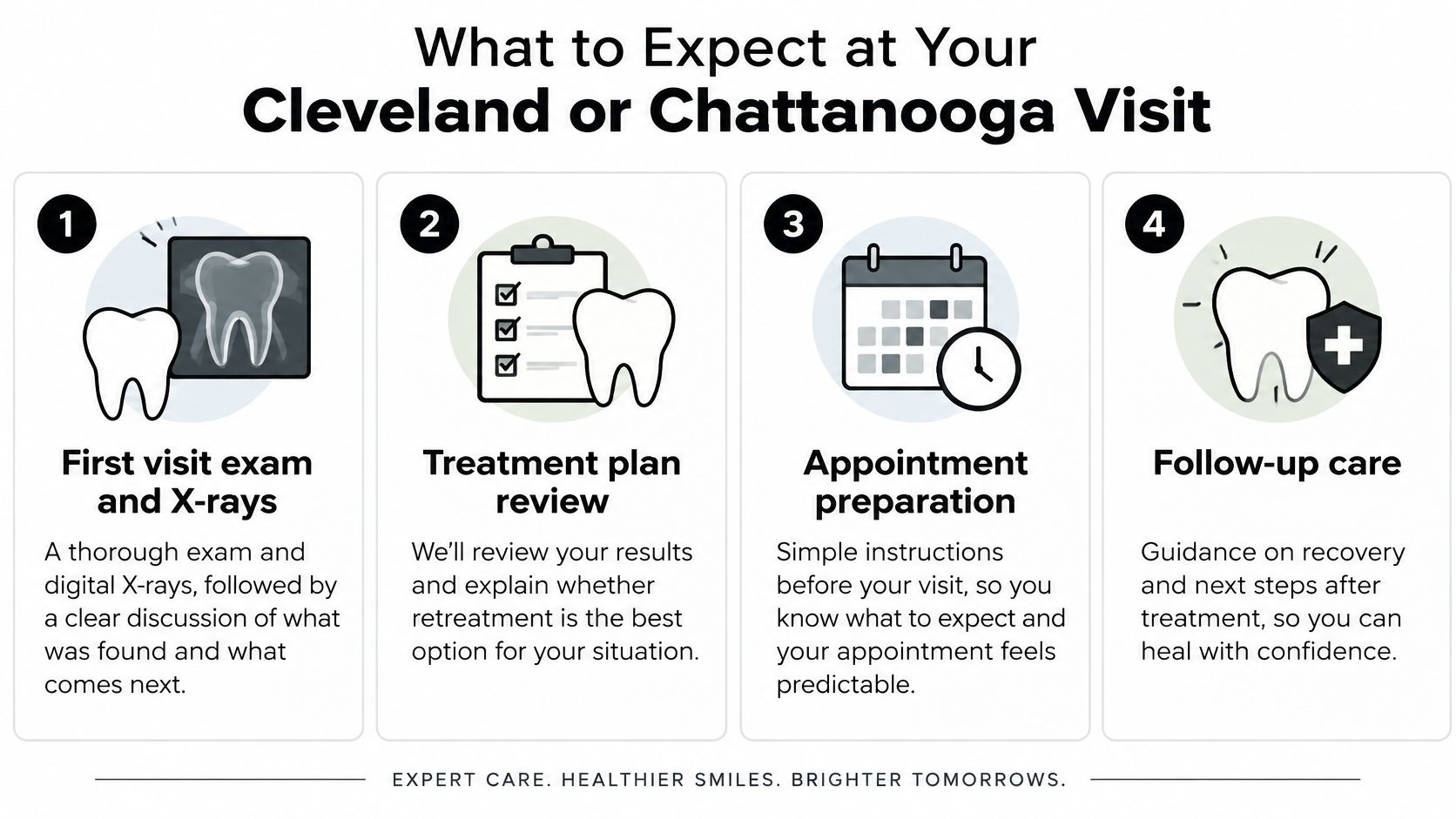
Bring information that helps explain the tooth's history
- Previous records: Bring available dental records and older X-rays, or arrange for their transfer.
- Medication details: Include prescriptions, over-the-counter medicines, and relevant health information.
- A symptom note: Record when the problem began, what triggers it, and whether it's improving or worsening.
Root canal treatment at Winn Smiles typically involves one or two appointments, depending on the case. A retreatment plan may require additional coordination for access, restoration work, or assessment, so we'll discuss the schedule for your specific tooth rather than assume every case is identical.
Plan for a manageable recovery
Patients may have mild discomfort or sensitivity for a few days after a root canal, which can usually be managed with over-the-counter pain relievers. Use only medicines that are safe for you and follow the directions you receive.
Most patients return to normal activities the day after root canal treatment at Winn Smiles. We provide detailed aftercare instructions, including what to watch for and when to contact the office.
If your job involves strenuous activity or makes appointment planning difficult, bring that up during the consultation. Recovery advice should fit both the procedure and your daily responsibilities.
Book Your Retreatment Evaluation in Cleveland or Chattanooga
You don't have to choose between another root canal and extraction based on symptoms alone. The next step is to find out what's causing the problem, assess the tooth with current imaging, and review a recommendation that accounts for its remaining structure and support.
When you're choosing a dentist in Chattanooga, TN, or Cleveland, TN, look for a clear explanation rather than a guaranteed result. A worthwhile evaluation should help you understand both the opportunity to preserve the tooth and the reasons another approach might be more appropriate.
Bring these questions to the consultation
- What are we treating? Ask the dentist to identify the suspected cause and explain how the proposed procedure addresses it.
- How will we judge success? Ask whether the goal includes complete imaging-based healing, symptom resolution, and continued function.
- How will progress be checked? Confirm whether follow-up imaging is planned and what findings would change the recommendation.
- What happens if it doesn't heal? Discuss the next realistic option before committing to treatment.
- What does the full plan include? Clarify restoration needs, appointments, and costs rather than considering the canal procedure in isolation.
Feeling anxious doesn't mean you have to avoid an evaluation. Winn Smiles offers sedation options for root canal patients, and we can discuss comfort concerns before treatment.
We can also discuss work-related activity concerns and tailor recommendations for patients with demanding jobs. An appointment should give you room to explain what matters to you, whether that's keeping a useful natural tooth, understanding alternatives, or making care feel more manageable.
Winn Smiles offers root canal care and individualized treatment planning for patients in Cleveland and Chattanooga, TN. Visit Winn Smiles to request an evaluation of your previously treated tooth and discuss whether retreatment, root-end surgery, or another approach is appropriate.