Some patients with receding gums can still get veneers, but a veneer only covers the front of a tooth and cannot bring back gum tissue that has already been lost. Recession is more widespread than many assume: pooled estimates put it at 78.16% of people at the loosest measuring threshold and 84.92% once at least 1 millimeter is required.
If you've noticed a notch where the tooth meets the gum, felt a sharp twinge from cold water, or seen your teeth look longer in recent photos, you're in very ordinary company. Adults searching for a dentist near me in Cleveland or Chattanooga, TN often arrive with exactly these complaints, and the honest first answer is about the gums rather than the porcelain.
What follows is the order a careful clinician works through: how recession depth changes the options, what a veneer can and cannot change, the gum risks worth knowing, how long the work tends to hold, the alternatives including grafting, and what an evaluation measures. One calm visit with photographs and numbers usually turns a vague worry into a plan you can follow.
Can You Get Veneers With Receding Gums
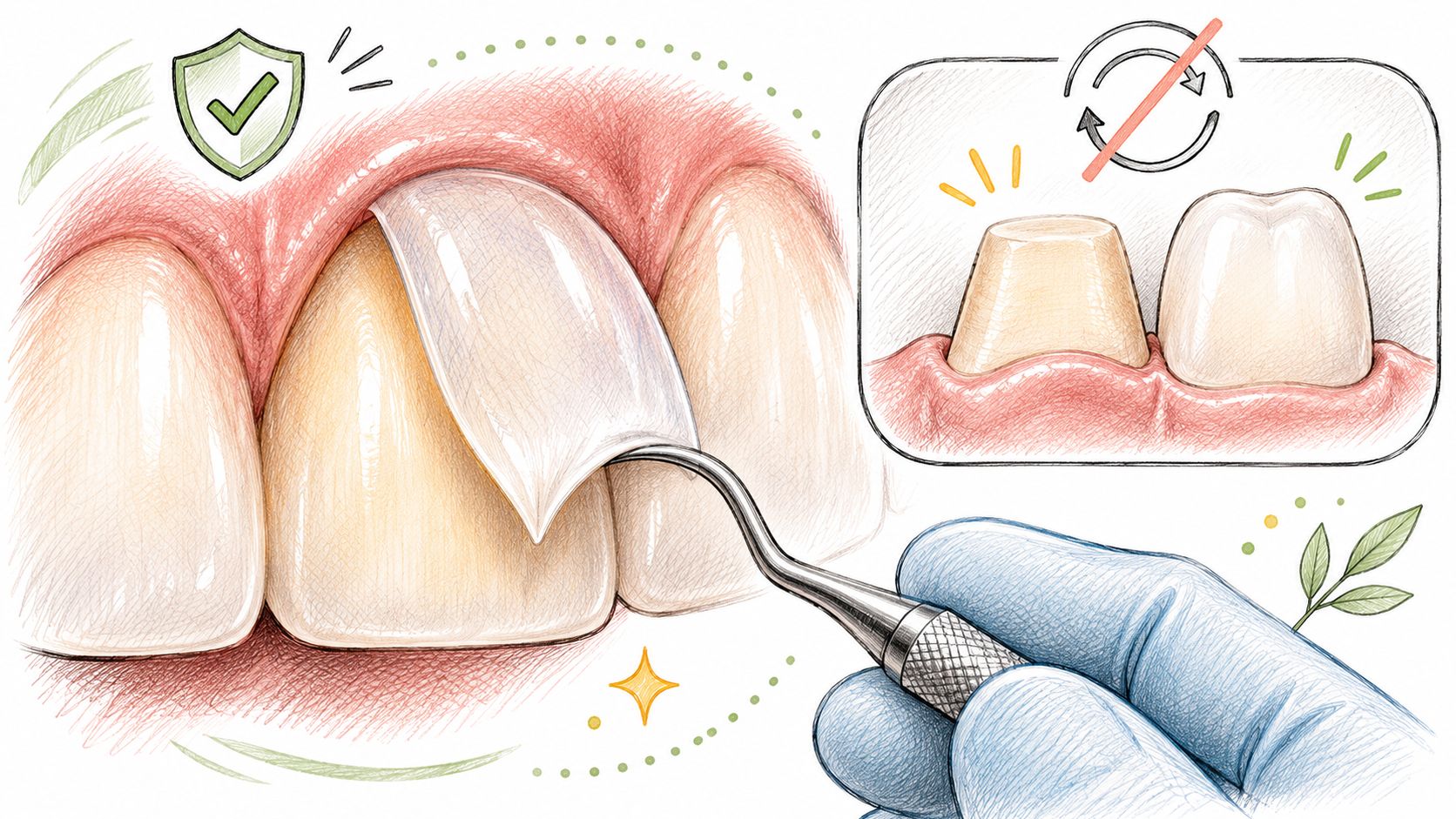
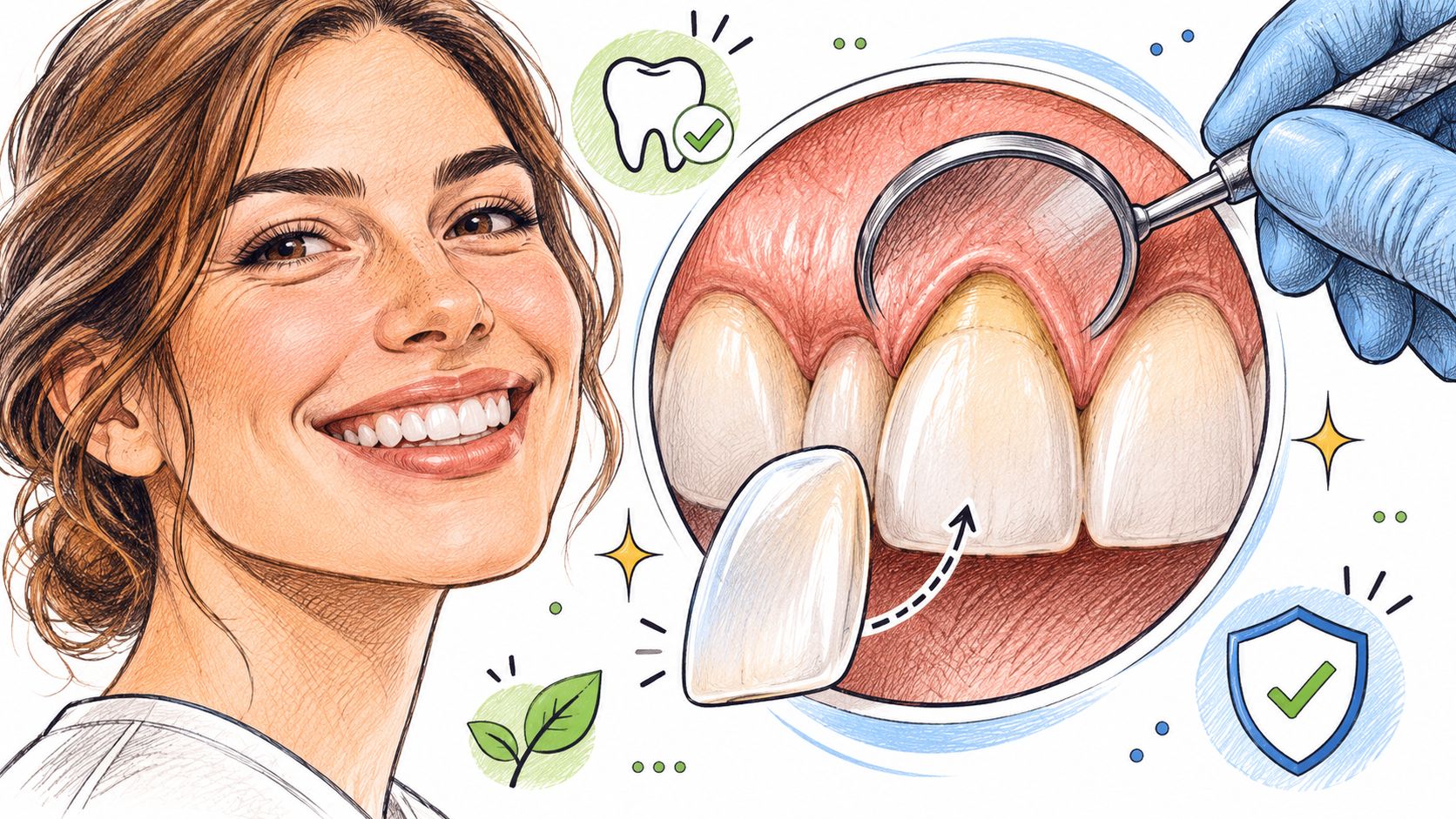
Yes, in many cases. A veneer is a thin, custom shell bonded to the front of a tooth, and it can sit comfortably beside gums that receded some time ago and have since settled. What it cannot do is put gum tissue back. The shell covers the tooth only, so the deciding question is never the porcelain. It is whether the gums underneath are calm, stable, and done moving.
An exposed root surface looks darker than enamel and often feels raw against cold drinks. Teeth appear longer once the gumline drops. A smile starts to read as older than the person wearing it. Those are the reasons the question comes up, and they are reasonable ones.
Recession itself is remarkably common. A 2022 systematic review and meta-analysis in Oral Diseases, pooling 15 studies and 37,460 participants, estimated that recession affected 78.16% of people at the loosest measuring threshold and 84.92% once at least 1 millimeter of recession was required, with cheek-facing surfaces alone at 75.42%. Numbers like these explain why so many veneer consultations begin with a gum conversation rather than a shade guide.
A veneer can camouflage certain visual effects, such as a darker root surface or the length imbalance between neighboring teeth. It cannot replace missing tissue or halt recession that is still progressing. Placing porcelain over active gum disease works like painting over a damp wall: the surface looks better briefly, and the problem keeps spreading underneath. That is why plaque control, scaling and root planing, and root-coverage procedures are common first-line treatments for gum recession, often completed before any cosmetic work begins.
For patients in Cleveland and Chattanooga, TN, this turns a shopping decision into a sequencing decision. Reading about what causes receding gums in adults before you book helps, because brushing trauma, clenching, tooth position, and inflammation each demand a different response. If you want to understand the restoration side first, these cosmetic veneer treatment options cover the material and preparation basics.
The reassurance worth holding onto: a receding gumline is a reason to plan carefully, not a reason you'll be turned away.
Veneer Eligibility by Recession Depth
Depth is the first thing a clinician measures, because it separates a cosmetic case from a periodontal one. A veneer covers the front of the tooth and nothing else, so the deeper the recession, the more exposed root sits outside anything porcelain can reach. Here is how the numbers fall out across the population.
| Recession depth | Share of people with this depth | Typical role of veneers | Usual next step |
|---|---|---|---|
| 1 mm or more | 84.92% | Cosmetic option only after inflammation is controlled | Periodontal check and documented measurements |
| 3 mm or more | 48.4% | Veneers may be combined with gum treatment | Assess tissue thickness, root exposure and wear near the gumline |
| 5 mm or more | 16.2% | Veneers alone rarely solve the problem | Root-coverage surgery, grafting or a combined plan |
A 2025 systematic review and meta-analysis covering 22 studies from 21 sources produced those prevalence figures. Deeper recession is far less common, but it's also a more complicated clinical picture, since more root surface sits exposed and the gum margin may be thinner and less stable.
Notice what the table is really saying. At shallow depths, the gum question and the veneer question can sometimes be answered together, provided the tissue is calm and holding still. By the time recession reaches 3 millimeters or more, the decision tree splits: porcelain can improve how the tooth looks, but something else has to answer for the root. At 5 millimeters and beyond, veneers on their own rarely solve the problem, because most of what bothers the patient is uncovered root surface that no shell on the crown can hide.
Read the table as a description of how often each depth appears, not as your personal odds of a yes. One tooth with 4 millimeters of recession on thick, quiet gums behaves differently from four teeth with 2 millimeters on thin gums that are still moving.
A percentage is not a verdict. Population figures tell you how common a depth is. Your own measurements, tissue thickness and gum stability tell you what to do about it.
What changes the answer beyond depth
Is it still progressing: recession that moved last year and stayed put this year is a different problem from recession that keeps traveling. Stable tissue can often support cosmetic work; moving tissue has to be stopped first, or the margin you pay for today sits exposed again in a few years.
Inflammation and bleeding: active gum disease has to be calmed before elective cosmetic work, because a margin placed on inflamed tissue won't stay clean.
Sensitivity and wear: a notch of worn tooth structure near the gumline changes what the restoration has to do. These worn defects, called non-carious cervical lesions, often appear alongside recession, and when both are present the same spot may need tooth restoration and gum surgery rather than either one alone.
Tissue thickness: thin gum responds differently to handling and to a margin placed near it than thick, keratinized tissue does.
A quick self-check before your visit
Measure from the biting edge of the tooth down to where the gum sits, tooth by tooth, and write the numbers down. Note which teeth sting with cold. Take two photos in daylight, one smiling and one with your lip lifted, so the gumline is visible.
Bring those photos, your list of concerns and one clear statement of your goal: appearance, comfort, or protection against further loss. Those three answers point a clinician toward different plans. A patient who wants a calmer smile line may be a veneer candidate once the gums prove stable. A patient whose main problem is cold sensitivity on an exposed root usually needs the tissue question answered first, with porcelain as the second chapter rather than the first.
What Veneers Can and Cannot Fix and the Gum Risks They Bring
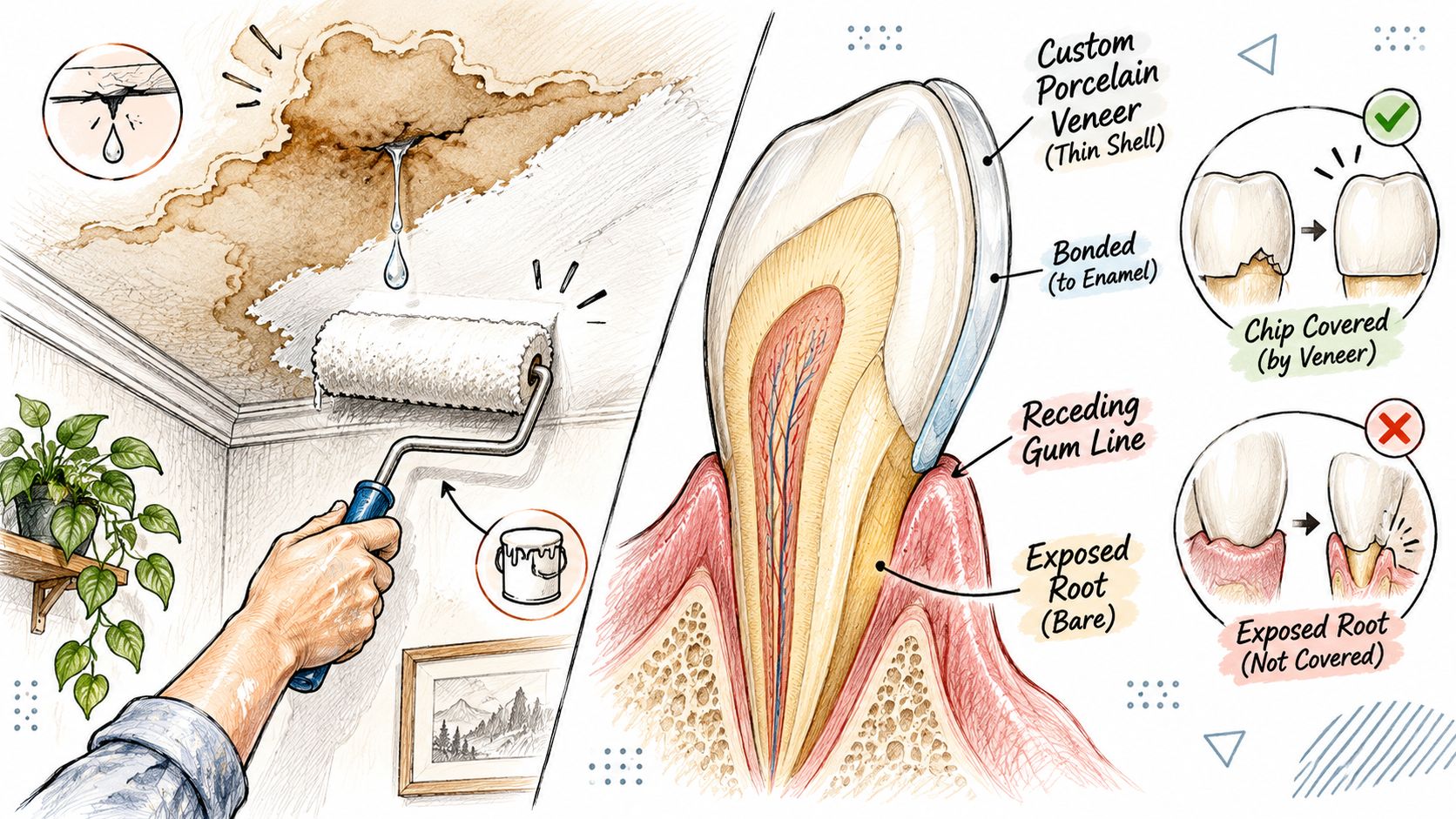
A fresh coat of paint hides a water stain on the ceiling, but the leak above keeps running. Veneers work the same way on a receding gumline. They change the surface you see and leave the tissue underneath exactly where it was.
The distinction in one line: a veneer changes what you see, not the gum tissue underneath it.
What a veneer actually changes
A thin porcelain shell bonded to enamel alters visible surface, color and shape. It can close a small gap, straighten the look of a slightly rotated tooth, cover staining that whitening won't touch, or rebuild a chipped edge. The gumline and the bone supporting the root don't move a fraction of a millimeter because of it.
That gives you two separate goals, and mixing them up is where disappointment starts. Visual masking uses tooth-colored or gum-colored material to hide an exposed area while the gums are stable. True root coverage means moving tissue back over the root, which is a periodontal procedure, not a restorative one.
Current guidance separates these by defect shape as well. For recession with cervical wear, some lesions suit root-coverage surgery alone, while V-shaped or more extensive defects may need both a restoration and root coverage (PubMed). Thin tissue generally responds more predictably to an autogenous graft, because added thickness resists mechanical trauma and helps hold the gum margin in its new position.
Where the margin sits, and why it decides everything
A veneer finishes at or just below the gumline. That edge has to be highly polished, conservatively contoured and placed without crowding the tissue attachment above the bone. When it isn't, plaque collects there, and chronic inflammation gradually breaks the margin down. A gum-colored composite or ceramic mask can camouflage recession in selected cases, but it doesn't restore lost attachment or remove the underlying risk.
If your gums are currently inflamed, read some veneers with gum disease advice before any preparation begins. It explains why the gum work comes first rather than alongside, and why a veneer bonded to inflamed tissue is set up to fail cosmetically even when the porcelain itself is fine.
The risks, in numbers and in plain terms
Gum recession around porcelain laminate veneers is documented, though the reported frequency moves with the study and the follow-up period. A retrospective assessment indexed in the peer-reviewed literature found gingival recession in 27% of evaluated veneered teeth. Other clinical reports have placed the figure considerably lower, which tells you the range depends heavily on case selection, margin placement and how long patients are followed.
Those figures don't prove veneers cause every case. Gum position also shifts with age, periodontal disease, brushing trauma, tooth position and tissue thickness. They do show why the margin deserves measurement and a baseline record before treatment.
There's encouraging evidence on the other side. A prospective one-year study of 73 ultrathin ceramic laminate veneers, measuring 0.2 to 0.39 mm and bonded largely to enamel with cervical margins about 0.5 mm subgingival, found periodontal readings stayed close to baseline in healthy patients who received hygiene instruction. Conservative preparation on quiet gums behaves well. Larger clinical series do still record some marginal recession and bleeding on probing over time, which is why the follow-up matters even when placement goes perfectly.
What can go wrong, concretely:
- Recession keeps traveling beside the veneer, leaving the root and the margin more exposed than they were at placement.
- A dark line appears where porcelain meets natural tooth, which is a color and thickness problem as much as a gum problem.
- Plaque collects at a margin that's over-contoured, rough, or hard to reach with floss.
- Sensitivity arrives or stays, especially where root surface has no enamel covering it.
- Bite stress concentrates on a veneer edge that wasn't designed around your bite.
- Enamel preparation is permanent. Once tooth structure is reduced, it doesn't grow back.
Three questions to ask before you agree to anything
- Is my gum margin stable? Ask for the measurements and a comparison against a previous record, so "stable" is a number rather than an impression.
- Is the goal appearance or protection? Masking an exposed root and covering it with tissue are different procedures with different risks.
- Will this edge stay cleanable in five years? If hygiene access is doubtful now, it won't improve once the porcelain is bonded.
How Long Veneers Last When Your Gums Are Receding
The honest range comes from a 2024 systematic review of nine studies, which reported veneer success rates between 85.08% and 97.5% after five years while also weighing periodontal effects, including gingival recession. Survival and gum response move together, which is why a veneer plan built on unstable gums lands nearer the bottom of that range.
Where you fall inside it depends on a short list: whether recession is still progressing, how thick your tissue is, where the margin sits, how well you clear plaque, how much load your bite puts on the edges, and whether inflammation was treated before the veneers went on. Address those and the odds shift. Skip them and the porcelain gets blamed for a gum problem it never caused.
There's a useful counterweight. A 2024 case report in Case Reports in Dentistry documented no gingival inflammation, recession or plaque at 12 months with no-preparation veneers placed using the BOPT technique. A conservatively planned margin on quiet gums can behave very well.
Write it down: ask for your recession measurements to go into your record, so future change is checked against numbers rather than memory.
At recall, the clinician photographs and measures the gumline, probes the margin, looks for a dark line or exposed edge, and compares the reading to the baseline taken before treatment. Small problems are correctable then: polishing or re-bonding an exposed margin, replacing a single veneer, or referral for root coverage. A margin that recedes early is far easier to manage than one discovered three years later.
Alternatives When Roots Are Exposed
Veneers are one route among several, and for exposed roots they're rarely the first one.
| Option | What it does | Best suited for | Main limit |
|---|---|---|---|
| Bonding over exposed areas | Smooths and covers small exposed areas with tooth-colored resin | Small defects and sensitivity | Less durable than porcelain |
| Gum-colored composite or ceramic mask | Camouflages exposed root visually | Selected cases with stable gums | Does not restore lost attachment |
| Connective-tissue graft | Adds tissue and covers exposed roots | Thin gums and deeper recession | Requires a palate donor site; 95% complete root coverage in reviewed groups |
| Collagen matrix | Covers roots without palate tissue | Patients who want to avoid palate surgery | 85% to 90% complete root coverage in reviewed groups |
| Periodontal care | Controls inflammation, plaque and bleeding | Active gum disease before any cosmetic work | Does not cover exposed roots by itself |
The graft versus matrix trade-off
A 2025 randomized split-mouth trial involving 34 bilateral Miller Class I/II recession cases described subepithelial connective-tissue grafting as the benchmark and a xenogeneic collagen matrix as a potential alternative that avoids harvesting tissue from the palate, cutting donor-site discomfort. The same evidence review reported complete root coverage of 85% to 90% for two collagen matrices against 95% for connective-tissue graft controls in its included groups.
So the answer to "is the no-palate option less painful, and will it look as good?" is a qualified one. It spares your palate. It doesn't yet match graft predictability across every group studied, and small trials with differing materials make head-to-head comparison difficult.
For patients who want to slow things down at home while treatment is planned, this guidance on how to stop gum recession naturally covers the brushing and hygiene habits that keep a margin from getting worse.
When both gum and tooth need work
Some defects don't split neatly into tissue or tooth. A documented case report described favorable results when connective-tissue grafting and a coronally advanced flap were combined with lithium-disilicate partial veneers, rather than veneers used alone. That's the practical answer for a deeper V-shaped defect: rebuild the gum, then restore the surface.
Sequencing holds across all of these. Control inflammation and plaque first. Then choose restorative, surgical, orthodontic or combined treatment based on tissue thickness, lesion depth, esthetic goals and long-term periodontal stability. Veneers come once the gums are settled. If you're weighing a lighter-touch option, this comparison of dental veneers vs bonding sets out where each one fits.
Ask at the consultation: is the goal complete root coverage, less sensitivity, thicker tissue, camouflage before cosmetic work, or simply stopping progression? Each answer leads to a different plan.
What Your Dental Evaluation Will Check
The evaluation comes first, before any decision about porcelain. The American Dental Association guidance on veneers is straightforward: existing dental problems, specifically including gum disease, must be treated before veneers are placed. Veneers may improve the look of tooth shape or color once the gums are stable, but they don't regrow tissue or reverse bone loss.
That's the frame for everything below. A cosmetic question deserves a periodontal answer first.
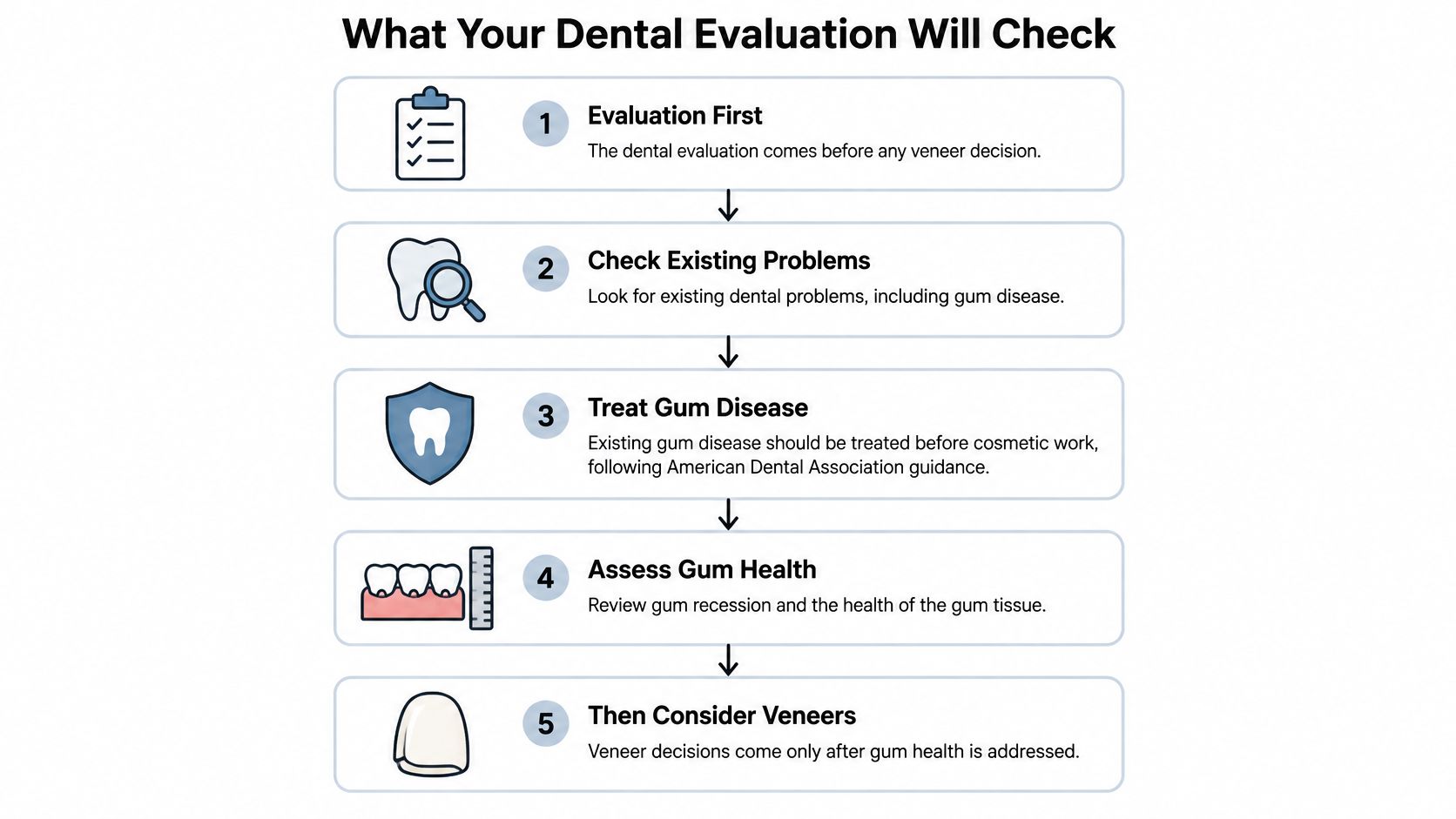
Here is the sequence, with the reason each step exists.
- Review your medical and dental history. Medications, grinding habits and past gum treatment all change what's safe and what's realistic.
- Measure recession and pocket depths around every tooth. Numbers create the baseline that future visits get compared against.
- Check for bleeding, inflammation and plaque. Bleeding shows active inflammation, and active inflammation changes the plan before cosmetics enter it.
- Take dental X-rays and advanced imaging. Bone levels and root anatomy decide whether veneers or gum treatment come first.
- Look for wear near the gumline, decay, cracks and sensitivity. These mixed defects often need a restoration and root coverage together.
- Review your bite, tooth position and brushing habits. A traumatic brushing pattern or a heavy bite will undo good work if nobody addresses it.
- Discuss goals, compare options and receive a written plan. You should leave knowing what happens, in what order, and why.
Periodontal care at Winn Smiles starts with an examination that measures pocket depths, assesses gum recession, checks for bleeding and inflammation, and takes dental X-rays. Our periodontal evaluation also uses advanced imaging to assess recession, inflammation and bone loss, so the conversation about veneers rests on images rather than impressions.
You leave with four things settled: where your gums stand today, whether veneers are appropriate now, what has to happen before they would be, and a timeline you can plan around.
Book a Gum and Veneer Consultation in Cleveland or Chattanooga
Three things now sit clearly in front of you. Recession depth guides which options are open, a veneer covers a tooth but never regrows a gum, and the gum check decides the order of treatment.
Winn Smiles is a dental practice serving Cleveland and Chattanooga, Tennessee and the surrounding communities, with light, airy offices and a team that treats patients like family. Our veneers are custom-made porcelain shells that cover the front of the teeth to correct staining, uneven spacing or minor misalignments, and we offer them alongside periodontal care, dental bonding and teeth whitening. When gum treatment should come first, we say so plainly.
Free consultations and second opinions are available for select services, so you can get a straight answer without pressure. Request an appointment through winnsmiles.com, bring recent photos and your list of concerns, and ask specifically about the gum evaluation. Most patients leave with a plan they understand and a clear next step.
If you've been putting off a question about receding gums because you assumed the answer was no, Winn Smiles can measure what's happening and tell you where veneers fit in the sequence. Our team serves patients across Cleveland and Chattanooga, TN with cosmetic and periodontal care under one roof, including porcelain veneers, bonding and whitening once your gums are ready for them. Visit Winn Smiles to request a consultation and get a plan built around your gumline rather than someone else's.