The national average price for clear aligners is about $5,108 without insurance, with a broad range of roughly $1,800 to $8,100 depending on location, complexity, and provider type. This guide breaks down what patients in Cleveland and Chattanooga, TN, can realistically expect to pay, and what should be included in a transparent quote.
You may be scrolling through aligner ads right now, seeing promises of a straighter smile for a few hundred dollars. Then you call a dental office and hear a price in the thousands. Both numbers can be real, but they may describe completely different levels of treatment, supervision, and follow-up care.
The smartest question isn't “What's the cheapest clear aligners price?” It's “What will complete treatment cost over time, and who will help if my teeth don't move as planned?” That distinction matters whether you're searching for a dentist near me, comparing Invisalign options, or looking for a cosmetic dentist near me in Cleveland or Chattanooga.
What Clear Aligners Cost in Tennessee Today
A patient might see an at-home aligner offer while drinking coffee, then receive an in-office quote that feels several times higher. The natural reaction is to assume one provider is overcharging. Usually, the more important difference is what the fee includes.
The national average gives you a useful starting point, but it isn't a local promise. A widely cited 2023 CareCredit/Synchrony survey reported an average clear aligner cost of $5,108 without insurance, with a range from $1,800 to $8,100 depending on geography. The same survey reported a spread from $3,668 in Utah to $6,516 in Rhode Island, a 78% difference across markets. You can review the underlying pricing context in this clear aligner cost and financing guide.
That spread shows why a national number can mislead a patient in Tennessee. Provider overhead, local operating costs, the complexity of your bite, and the amount of professional care included all affect the final fee. Two people living close to one another can receive different estimates because their teeth, treatment goals, and required monitoring aren't the same.
Why local quotes vary
Think of clear aligner treatment like a home renovation. A small project using standard materials won't cost the same as a larger renovation requiring more design work, more materials, and closer supervision. Your dental team builds an aligner quote in much the same way.
A mild spacing concern may need a simpler plan. Crowding, rotated teeth, bite changes, attachments, refinements, or previous orthodontic treatment can require more planning and monitoring. The brand name on the aligner matters, but it doesn't tell you the whole story.
Practical rule: A low entry price isn't automatically a bargain if scans, progress visits, refinements, retainers, or corrective care are billed separately.
For patients in Cleveland and Chattanooga, a transparent consultation should answer four questions before treatment begins:
- What exactly does the quoted fee include?
- Who monitors the movement of your teeth?
- What happens if your treatment needs refinement?
- What will you pay after the final aligner, including retention?
Winn Smiles provides clear aligner treatment cost information for patients comparing options. The useful goal isn't to guess your fee from a national average. It's to receive a personalized estimate that reflects your smile and makes every included service clear.
What Drives the Clear Aligners Price You Pay
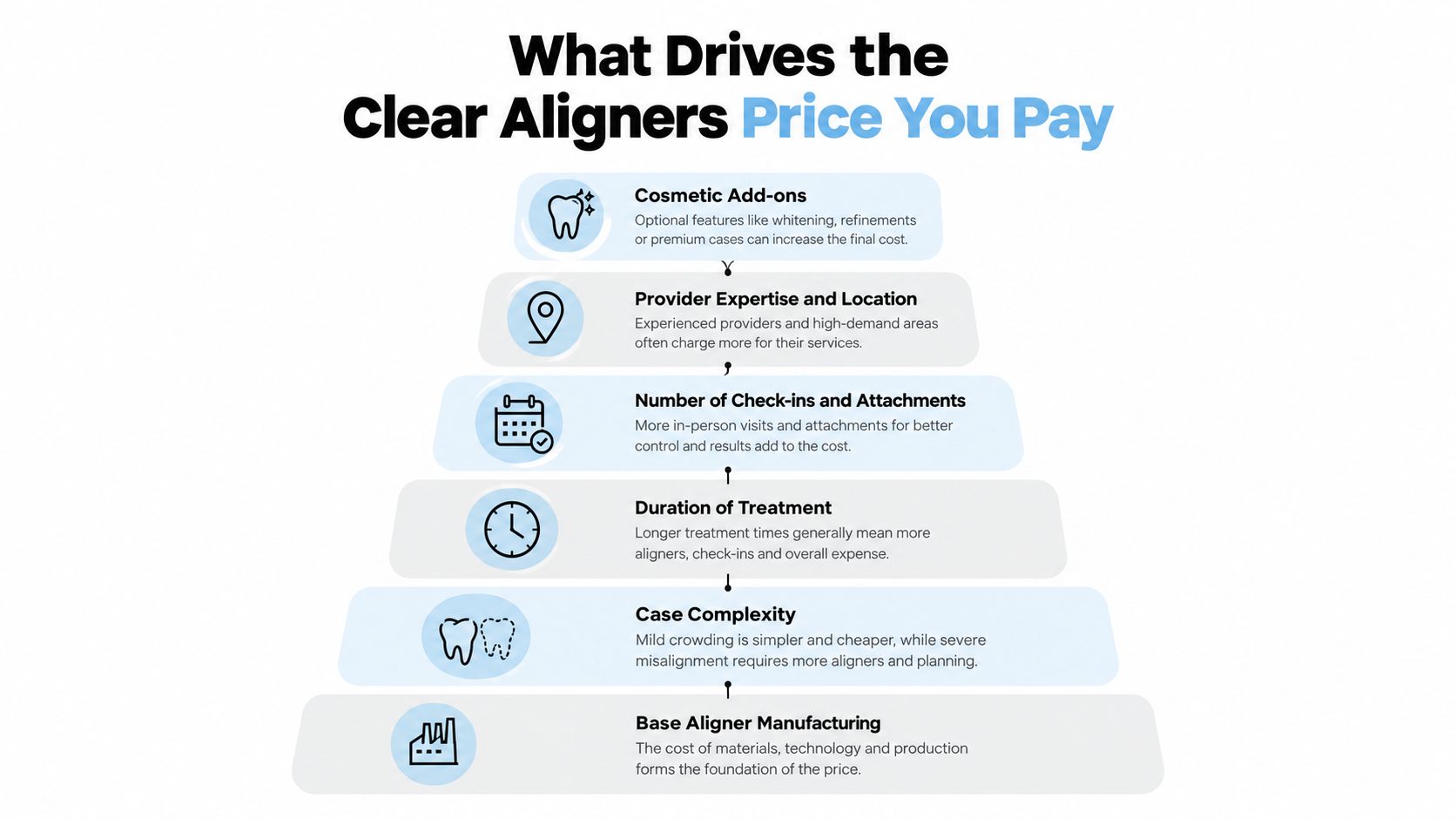
A clear aligner estimate should read like a layered treatment plan, not a single mysterious sticker price. Before you compare two quotes, identify what sits beneath the total.
Start with the movement your teeth need
Case complexity is usually the first major driver. Slight crowding or a small gap may require less planning than significant crowding, rotated teeth, or a bite that needs correction. The more carefully your dentist must sequence tooth movement, the more involved the treatment plan can become.
Treatment length also affects the fee. A longer plan generally involves more aligners, more opportunities to reassess progress, and a greater need for communication between appointments. Your treatment timeline should be based on your teeth, not on a generic promise from an advertisement.
The number of trays matters, but it shouldn't be the only thing you ask about. Some patients need refinements, which are additional aligners made after progress is evaluated. Ask whether refinements are included in the original quote or treated as a new charge.
Understand what professional supervision adds
In-office treatment includes a dental professional evaluating your oral health, planning movement, and checking how your teeth respond. That supervision can identify a problem before it becomes a larger treatment issue. It also gives you a place to ask questions when an aligner feels uncomfortable, doesn't fit, or isn't tracking as expected.
Market pricing data places at-home daytime aligners at roughly $699 to $1,395, while dentist- or orthodontist-supervised in-office treatment averages about $5,100. The broader clear aligner category spans $2,000 to $8,000, with premium in-depth cases reaching $6,000 to $10,000 or more, as described in this clear aligner pricing overview.
The difference isn't just plastic manufacturing. It can reflect examinations, imaging, treatment planning, progress checks, attachments, refinements, and the provider's responsibility for the overall result.
Read the quote line by line
Your location matters, too. Running a dental practice in the Cleveland and Chattanooga area involves local staffing, equipment, facilities, technology, and clinical time. Those costs influence pricing, just as local labor and material costs influence a renovation estimate.
Before signing anything, ask for a written breakdown that identifies:
- Diagnostics: Whether the consultation, examination, scans, or necessary dental x-rays are included.
- Treatment scope: Which aligners, attachments, refinements, and progress visits are covered.
- Retention: Whether the first retainers are included and what replacement retainers cost.
- Support: Who you contact if an aligner is lost, damaged, or no longer fits.
- Additional care: Whether cavities, gum concerns, tooth extraction, or other dental treatment must be completed first.
Two neighbors can receive different quotes for the same aligner brand because the clinical work behind their plans differs. A good estimate makes those differences understandable.
In-Office Aligners vs Mail-Order Options
Mail-order aligners appeal to patients because the upfront price is lower and the process feels simple. That lower price comes from a different service model, not from identical clinical care being delivered at a discount.
Direct-to-consumer systems typically reduce or remove in-person examinations, dental x-rays, regular monitoring, and hands-on mid-course corrections. Independent market analysis estimates that direct-to-consumer aligners represent roughly 15% to 20% of the U.S. aligner market and cost 30% to 50% less than dentist-supervised channels. The same analysis connects the lower price to reduced service intensity, digital intake, and fewer in-person visits rather than identical clinical workflows. You can read the analysis in this market study of aligner pricing and provider economics.
Here's the practical comparison:
| Factor | In-Office Aligners | Mail-Order Aligners |
|---|---|---|
| Typical cost | Often higher because professional treatment and monitoring are included | Often lower because the service model uses fewer in-person visits |
| Supervision level | Dentist-led evaluation, planning, and progress checks | Primarily remote or limited oversight |
| What's included | May include examinations, scans, treatment planning, follow-up visits, refinements, and retention, depending on the quote | Inclusions vary, and exams, refinements, or retainers may be separate |
| If complications arise | You have a local dental team that can examine the problem and adjust the plan | Resolution may require remote communication or a separate in-person dental visit |
| Best fit | Patients who want clinical oversight or need more involved movement | Patients considering limited cosmetic shifting after understanding the trade-offs |
In-office care doesn't guarantee that every case will move exactly as predicted. It does give your dentist an opportunity to see what is happening in your mouth and respond appropriately.
What supervision buys
A dentist can assess more than the appearance of your front teeth. Gum health, cavities, existing restorations, bite relationships, and the condition of supporting tissues all matter before teeth are moved. If a patient needs a tooth extraction, restorative dentistry, or treatment for gum disease first, those concerns should be addressed rather than hidden behind a remote aligner order.
That's why the lowest clear aligners price isn't always the lowest total cost. A plan that excludes evaluation and follow-up may leave you paying for a separate examination or corrective treatment later.
Patients who want a plain-language explanation of the process can review how clear aligners work. For a mild cosmetic adjustment, a mail-order option may seem attractive. For complex movement, bite concerns, previous orthodontic treatment, or uncertainty about oral health, professional supervision is the more responsible choice.
Insurance, Financing, and Monthly Payment Plans
The quoted fee is only one part of the financial conversation. Insurance, tax-advantaged accounts, and payment plans can change how the balance fits your household budget.
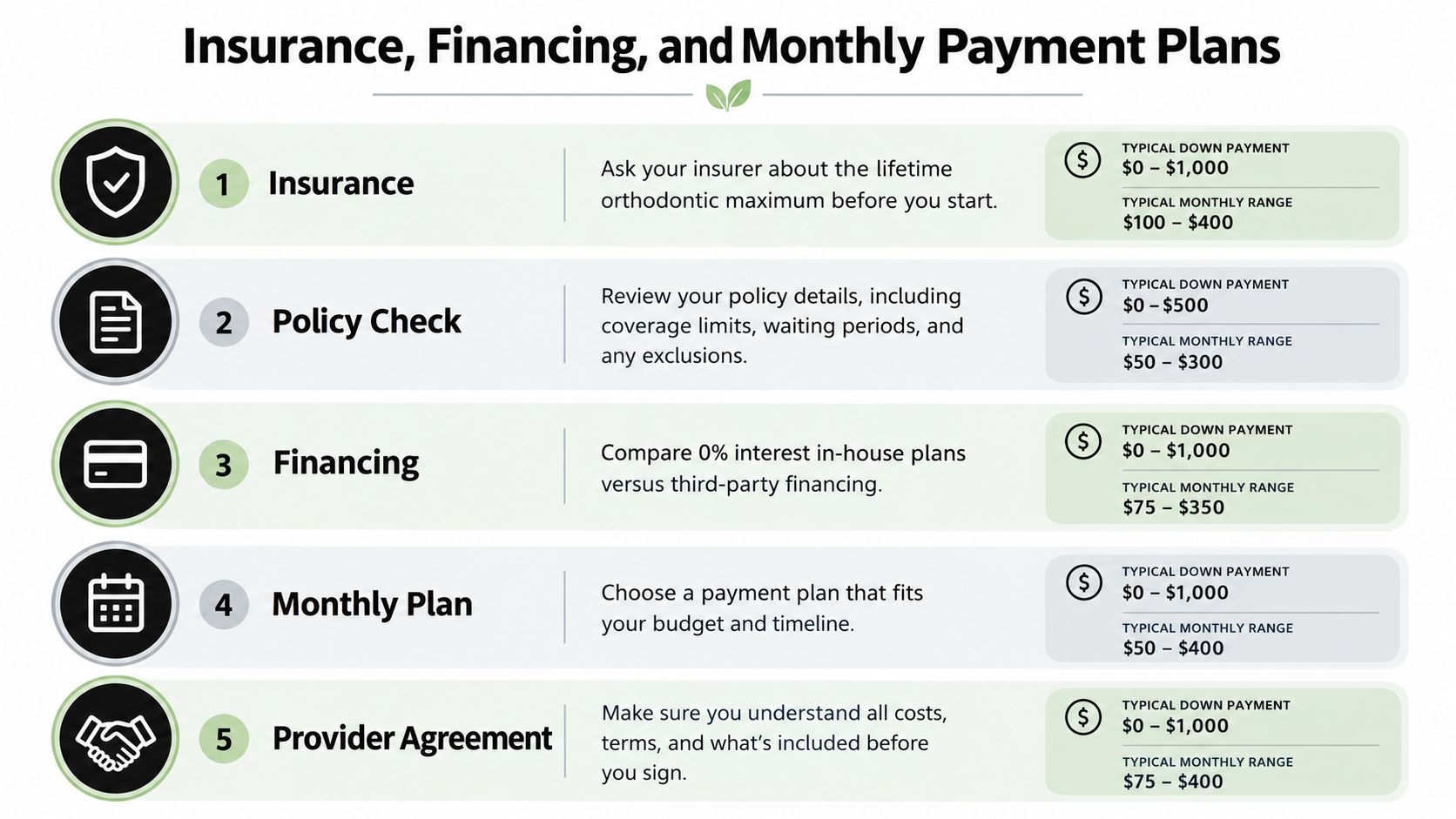
Start by checking whether your dental plan includes orthodontic benefits. Ask the insurer whether clear aligners qualify, whether the benefit has a lifetime orthodontic maximum, whether age limits apply, and whether a waiting period affects eligibility. Don't assume that a plan covering braces will automatically cover every clear aligner service in the same way.
FSA and HSA funds may also help with eligible dental and orthodontic expenses. Confirm the rules for your account and keep your treatment documentation.
Use a real payment example
One sample Invisalign breakdown shows a $7,000 doctor fee reduced by $5,600 in insurance coverage, leaving a $1,400 balance and an estimated $58 monthly payment over 24 months. A second example shows a $5,600 doctor fee with $2,800 in insurance coverage, followed by $233 monthly payments over 12 months. These are examples, not promises of your coverage or payment, and the details are available in this Invisalign cost and payment information.
The lesson is simple. Ask for the full fee before insurance, the estimated insurance contribution, the remaining balance, the payment term, and whether interest or financing charges apply.
Before you commit, request a written financial summary that separates treatment from optional cosmetic services. Teeth whitening, for example, may be planned separately from aligner care. A transparent practice should explain what you need now, what may be recommended later, and what you can decline.
The right monthly plan is one you understand. A lower payment can come with a longer term or financing conditions, so ask about the total amount paid, not only the monthly figure.
Winn Smiles discusses cost before treatment begins, giving patients in Cleveland and Chattanooga an opportunity to review insurance benefits and financing choices without guessing at the final balance.
The Hidden Costs Beyond the Initial Quote
A teaser price answers the easiest question, not the most useful one. The better question is, “What will complete care cost over time?”
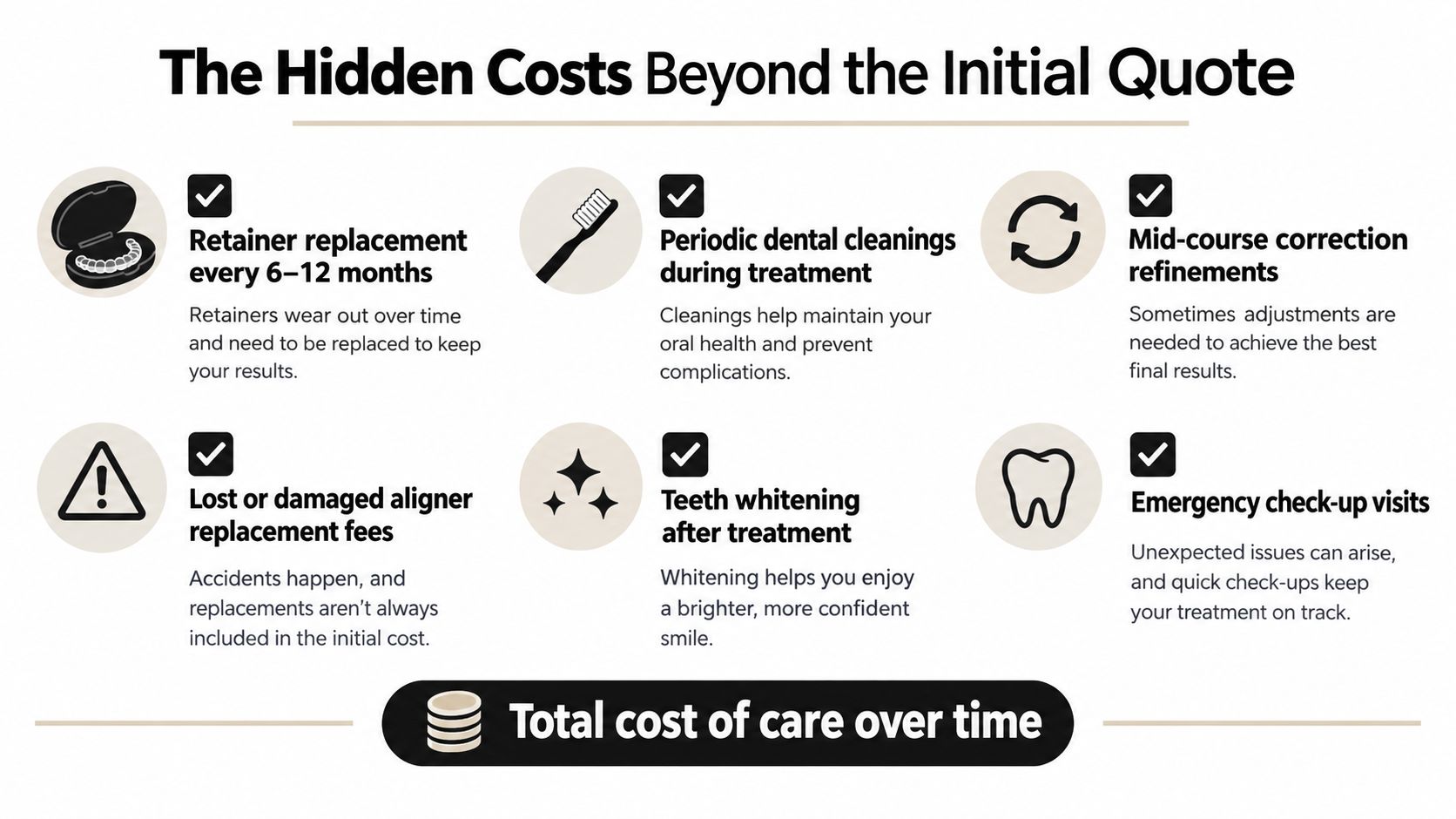
Retainers are a common example. After active tooth movement, retention helps maintain the result. Consumer pricing information places post-treatment retainers at about $99, and retainers may need periodic replacement. Some at-home plans charge separately for retainers or night-only upgrades. Those details can change the long-term value of an apparently inexpensive plan, as explained in this clear aligner cost discussion.
Ask what happens after the last tray
Teeth can shift after treatment if retention isn't followed. If movement occurs, a patient may need an evaluation, new scans, additional aligners, or a separate retreatment plan. A responsible quote should explain whether refinement aligners are included, how long follow-up lasts, and what happens if you lose or damage a tray.
The entry fee may also exclude dental care that must happen before or during orthodontic treatment. A cleaning and exam, dental x-rays, a filling, periodontal care, or another procedure can be clinically important even if it isn't part of the aligner package.
Use this checklist when comparing plans:
- Retainers: Are the first retainers included, and what does replacement cost?
- Refinements: Are additional trays included if your teeth need further movement?
- Lost trays: Is there a replacement fee for a damaged or misplaced aligner?
- Follow-up: How long can you contact the provider after active treatment ends?
- Dental health: Are examinations, cleanings, x-rays, or needed restorative care separate?
- Retention instructions: Who explains how and when to wear the retainer?
Market coverage places the 2026 range from roughly $699 at the low end to about $5,100 for office-based treatment, but the range only becomes useful when you know what each price includes. The cheapest plan at the beginning may not be the cheapest complete plan.
How Clear Aligners Compare to Other Orthodontic Options
Clear aligners aren't automatically the right choice for every smile. They're one tool among several, and the best option depends on tooth movement, bite, appearance, comfort, daily habits, and budget.
Traditional metal braces use brackets and wires that remain attached during treatment. They can provide consistent control for complex movements and don't depend on a patient remembering to put trays back in. The trade-off is a more visible appearance and greater care around brushing, flossing, and certain foods.
Ceramic braces offer a less noticeable bracket appearance while using a fixed system. They can suit patients who want the control of braces with a subtler look, although the brackets and wires still require attention during meals and cleaning.
Clear aligners are removable and discreet. Patients can take them out for meals and oral hygiene, which makes brushing and flossing more straightforward. They also require discipline because the treatment only works when patients follow the wear and care instructions.
Compare the everyday experience
| Option | Appearance | Cleaning and eating | Comfort considerations | When it may fit |
|---|---|---|---|---|
| Clear aligners | Subtle and transparent | Removable for meals and brushing | Smooth trays, with pressure as teeth move | Patients prioritizing discretion and flexibility |
| Metal braces | Highly visible | Food and brushing require extra care | Brackets and wires may irritate soft tissues | Many complex movement patterns |
| Ceramic braces | Less noticeable than metal | Fixed appliances still require careful cleaning | Similar bracket and wire considerations | Patients wanting fixed treatment with a softer appearance |
| Veneers | Changes the visible surface of teeth | Do not move teeth into alignment | Requires a cosmetic evaluation and appropriate tooth preparation | Select cosmetic concerns, not a substitute for orthodontic movement |
Veneers deserve careful discussion because they can create a cosmetic change without correcting the underlying position of every tooth. They may be appropriate for some appearance concerns, but they aren't a universal replacement for orthodontic treatment.
An in-person evaluation is what determines whether aligners can deliver the movement you want. A dentist can assess your bite, gums, existing dental work, and overall oral health before recommending aligners, braces, cosmetic dentistry, or another approach. If your goal also includes dental implants near me, tooth extraction, or restorative treatment, the sequence of care may affect the plan.
Don't choose based on appearance alone. Choose the treatment that can safely accomplish the result you want and that you can realistically follow.
Your Clear Aligner Consultation at Winn Smiles
A consultation should leave you with a decision, not another layer of confusion. At Winn Smiles in Cleveland or Chattanooga, TN, patients are welcomed into light, airy offices by a friendly team that focuses on comfort and clear communication.
The appointment begins with a conversation about what you want to change. Some patients are bothered by front-tooth crowding. Others want to close a gap, improve their bite, or feel more confident before an important event. Your provider can review your dental history, examine your teeth and gums, and determine whether clear aligners fit your goals.
What the visit should answer
A useful consultation gives you a treatment plan built around your smile rather than a generic package. You should understand:
- The clinical goal: Which teeth need movement and whether aligners are appropriate.
- The treatment process: What monitoring, appointments, trays, and possible refinements involve.
- The total fee: What the quote includes and which services remain separate.
- Your alternatives: Whether braces, cosmetic dentistry, restorative care, or no treatment is the better choice.
- Your comfort needs: What options are available if dental visits make you anxious.
The practice offers a comfort menu and personalized sedation options for patients who need additional support during dental care. That same patient-focused approach can help when aligner treatment is part of a broader plan involving teeth whitening, veneers, periodontal care, same-day crowns, dental implants, or emergency dentistry.
Free consultations and second opinions are available for select services, giving eligible patients a way to discuss alignment, treatment options, and pricing before making a commitment. A second opinion can be especially helpful when two quotes differ and you want to understand whether the difference comes from supervision, treatment scope, or included follow-up.
For a dentist in Cleveland, TN, a dentist in Chattanooga, TN, a cosmetic dentist near me, or an emergency dentist who can coordinate your wider dental needs, start with an office that will explain the complete plan. Clear aligners may be the right answer, but the answer should follow an examination and an honest cost discussion.
Schedule a clear aligner consultation at the nearest Winn Smiles location in Cleveland or Chattanooga to replace national averages with a personalized estimate for your smile.
Winn Smiles offers clear aligner consultations, transparent cost discussions, and broader cosmetic, restorative, and preventive dental care for patients in Cleveland and Chattanooga. Visit Winn Smiles to request a consultation and find out what complete treatment could cost for your smile.