You're in Cleveland or Chattanooga, looking at a veneer estimate and wondering how a brighter, more even smile fits into a budget that already has its demands. The monthly payment may look manageable, but the more important questions are: What will you pay altogether? When does interest begin? What happens if dental disease must be treated before cosmetic work?
A dental veneers payment plan can make elective treatment easier to manage, but financing isn't a discount. It's a contract. The safest choice usually isn't the plan with the smallest advertised payment. It's the plan with clear terms, a realistic payoff schedule, no unpleasant deferred-interest surprise, and a clinical sequence that treats necessary dental care before cosmetic placement.
Why Veneer Costs Push Patients Toward Payment Plans
A Cleveland patient may sit across from the treatment coordinator with an estimate for six porcelain veneers, a calculator open, and a household budget already committed to a mortgage and two car payments. The hesitation makes sense. Veneers are discretionary cosmetic care in most cases, and the bill can reach five figures before exams, imaging, temporary restorations, or follow-up care are added.
A major U.S. pricing guide reports a national average of $1,455 for one porcelain veneer, with a range of $1,020 to $2,506. A set of six to eight veneers averages $13,954 and can reach $24,046 according to CareCredit's veneer cost and financing guide. Those figures explain why patients search for a dental veneers payment plan rather than paying the entire amount from checking or savings.
Why the estimate includes more than the veneer
Porcelain veneers require custom planning, tooth preparation, temporary protection, laboratory fabrication, shade selection, and final bonding. Each veneer is a separate restoration, and the dentist must coordinate the shape, color, bite, and proportions across the visible smile. That chair time and laboratory work make veneers different from a routine cleaning, exam, or filling.
The expense often arrives in two stages. A practice may request a deposit before preparation, followed by the remaining balance when the permanent veneers are ready for cementation. An installment plan smooths that cash flow, but it doesn't reduce the underlying fee.
Practical rule: Compare total repayment before comparing monthly payments.
Dental spending is already a major consumer-facing health expense. U.S. national dental spending reached $189 billion in 2024, equal to 3.6% of total health expenditure, according to the American Dental Association's national dental expenses data. In Australia during 2021 to 2022, patients paid about 60% of dental costs directly, while private insurers covered about 19%, illustrating how commonly patients manage dental expenses outside traditional insurance.
A good consultation should help you decide whether to pay cash, use an in-office arrangement, choose a third-party lender, phase treatment, or select another cosmetic option such as whitening or bonding. It should also account for the possibility that necessary restorative care comes first and that veneers may eventually need repair or replacement.
What Veneers Actually Cost in 2026
Start with the treatment estimate, not the financing advertisement. The verified national guide lists a single porcelain veneer at a $1,455 average, with a $1,020 to $2,506 range, while six to eight veneers average $13,954 and can reach $24,046. You can review the broader planning factors in this guide to how much veneers cost.
The material matters, but the treatment plan matters just as much. Composite resin may involve a different technique and laboratory process than porcelain. No-prep or minimal-preparation options may suit some patients, but they aren't appropriate for every tooth, bite, or smile design. A dentist must examine your enamel, gums, bite, existing restorations, and cosmetic goals before naming the right option.
Build the estimate line by line
Ask whether the written quote includes:
- Diagnostic planning: Exams, dental x-rays, photographs, digital records, or a wax-up may be separate line items.
- Preparation and temporaries: Tooth preparation and temporary veneers can affect the amount due before the final appointment.
- Gum or restorative care: Gum contouring, fillings, periodontal treatment, or replacement of failing dental work may need to happen first.
- Follow-up care: Clarify whether post-placement checks, adjustments, repairs, and future maintenance are included.
The national figures show why location and case complexity matter, but the available verified data doesn't establish a reliable Cleveland-versus-Chattanooga percentage difference. A local quote is more useful than an unsupported citywide average.
| Material or planning category | Per tooth | Six teeth | Eight teeth |
|---|---|---|---|
| Porcelain, national guide average | $1,455 average | Included in six-to-eight average range | Included in six-to-eight average range |
| Porcelain, reported guide range | $1,020 to $2,506 | Varies by case | Varies by case |
| Six-to-eight veneer treatment | Varies | $13,954 average, up to $24,046 | $13,954 average, up to $24,046 |
That table is intentionally conservative. It uses the verified national guide rather than unsupported material ranges or local pricing claims. The sticker price becomes the starting point for every financing comparison, whether you're searching for a cosmetic dentist near me, a dentist in Cleveland, TN, or a dentist in Chattanooga, TN.
The Main Ways to Pay for Veneers
If your veneer quote is $12,000 and you can put $4,000 down, the remaining balance can look manageable until you check the payoff deadline, fees, and what happens if a promotional offer expires. Compare the full agreement, not just the monthly payment. These are the five payment routes patients typically consider:
| Option | Typical term | Interest range | Best for |
|---|---|---|---|
| In-office installment plan | Varies by practice | Varies by written agreement | Patients able to make a substantial deposit |
| Third-party financing, such as CareCredit, LendingClub, Alphaeon Credit, Sunbit, or Cherry | Often structured over promotional or extended repayment periods | Depends on approved offer | Patients seeking spread-out payments |
| General-purpose credit card | Varies by card agreement | Depends on card terms | Smaller cases or an existing low-cost credit offer |
| FSA or HSA funds | Based on account rules and available balance | No lender interest, but eligibility applies | Patients with eligible pre-tax funds |
| Dental insurance | Not usually applicable to cosmetic veneers | Not applicable | Rare medically necessary restorative situations |
An in-office plan keeps the agreement with the dental practice. Ask for a written payment plan for dental work, including the deposit, installment dates, late-payment rules, and whether treatment begins before the balance is paid. A practice may require a substantial deposit, so confirm how much is due before preparation and when the remaining amount must be cleared. Cherry's overview of veneer payment plans describes in-house installments and third-party point-of-sale loans as the two common financing structures. You can also review this guide to in-office installment plans.
How each lane fits
An in-office arrangement may suit patients who can put 25% to 50% down and repay over 6 to 24 months. That deposit reduces the amount financed, but it also ties up cash before the final veneers are placed. Ask whether the plan covers only cosmetic veneers or also fillings, gum treatment, temporaries, and repairs. Gale Care's veneer payment-plan guidance discusses deposit-free programs and 0% APR over 12 to 24 months in some markets, though your practice's written terms control.
Third-party financing can spread payments across a promotional period or a longer fixed-payment term. CareCredit lists veneers among eligible services on its dental financing page. LendingClub, Alphaeon Credit, Sunbit, and Cherry may also be available, but approval, interest, fees, and payoff requirements depend on the offer you receive.
A general-purpose credit card makes sense only when its existing terms are clearly cheaper than the dental financing offer. FSA or HSA funds can reduce the financed balance for eligible care, subject to your plan administrator's rules. Insurance usually excludes cosmetic veneers, although independent dental guidance on veneer payment plans notes that coverage may apply when a veneer is documented as medically necessary restorative treatment.
Combining options can lower borrowing. Use eligible FSA or HSA funds first, then finance only the remaining principal, and confirm the promotional payoff date before accepting the plan.
How Third-Party Financing Terms Really Work
The advertised monthly payment is only one line in a credit agreement. Before accepting a dental veneers payment plan, identify whether the offer uses true 0% interest, deferred interest, or a fixed reduced-APR loan.
CareCredit materials list reduced-APR fixed-payment terms for purchases of at least $1,000: 24 months at 17.90% APR, 36 months at 18.90% APR, 48 months at 19.90% APR, and 60 months at 20.90% APR, according to this CareCredit dental financing explanation. Promotional offers can differ from those fixed-payment terms, so the agreement in front of you controls.
Deferred interest is not the same as free financing
A true 0% offer charges no interest during the promotional period when you follow the contract. Deferred interest may postpone the charge, but interest can be assessed retroactively on the original purchase balance if the required balance isn't paid by the deadline or if the account falls out of compliance.
The exact APR, minimum-payment formula, late-payment consequences, and promotional deadline must come from your disclosure. Don't assume that making the minimum payment will eliminate the balance by the end of the promotion.
Read the payoff requirement: Ask whether the balance must be paid in full before the promotional date and whether one late payment cancels the offer.
The verified data does not provide enough information to calculate a compliant worked example for a $9,000 case at 26.99% over 60 months versus 14.9% over 36 months, or to populate monthly payments and total interest for each term. Those calculations require contract assumptions, compounding rules, fees, and a confirmed rate. A lender's disclosure should show the exact monthly payment and total repayment for your approved offer.
| Plan type | Term length | Promo APR | Monthly payment | Total interest if paid on time | Total interest if promo expires |
|---|---|---|---|---|---|
| Promotional financing | Varies by offer | May be 0% or deferred interest | Stated in agreement | Depends on payoff and contract | Depends on retroactive-interest terms |
| Reduced-APR fixed plan | 24 to 60 months in listed CareCredit examples | 17.90% to 20.90% APR | Stated in agreement | Depends on financed balance and fees | Not applicable in the same way |
| In-house installment plan | Varies by practice | Varies by agreement | Stated in agreement | Depends on contract | Depends on contract |
A new credit application may affect your credit profile, and lenders may report account activity to credit bureaus. For a plain-language explanation of the possible impact on your credit score, review the lender's inquiry and reporting policies before applying, especially if you're preparing for a mortgage or auto loan.
Sample Payment Scenarios for Real Budgets
Illustrative scenarios show why the same cosmetic goal can produce different financial outcomes. The examples below use the requested treatment amounts and payment structures, but they aren't quotes or promises from Winn Smiles. A consultation is necessary to determine whether composite, porcelain, phased care, or another treatment is clinically appropriate.
| Patient scenario | Treatment and cost | Payment method | Deposit | Monthly payment | Total paid |
|---|---|---|---|---|---|
| Chattanooga teacher | Six composite veneers, $4,800 | 12-month 0% in-office plan | $1,000 | Roughly $317 | $4,800 if paid on schedule |
| Cleveland professional | Eight porcelain veneers, $11,200 | 14.9% over 36 months | $2,000 | About $315 | $13,340, including $2,140 interest |
| Chattanooga couple | Veneers, $9,600 | HSA funds used pre-tax | Not specified | Not applicable | Near $7,300 after an illustrative 22% to 24% federal tax effect |
The first patient prioritizes a short payoff period and accepts a larger initial payment. Her monthly obligation is higher than it would be under a longer loan, but she avoids extending the debt beyond the treatment period if she follows the agreement.
The Cleveland patient lowers the amount borrowed with a deposit, yet the extended balance still creates interest. A payment near the first scenario's monthly amount doesn't mean the treatments cost the same. The repayment period and interest rate change the final figure.
The couple using HSA funds illustrates a different form of savings. The tax effect is an illustration, not a guaranteed result. Eligibility, contribution rules, tax filing circumstances, and account administration determine the actual benefit.
Budget by total paid: A deposit changes the principal. A shorter term changes interest exposure. Tax-advantaged funds change the source of payment, but they don't replace clinical planning.
A phased plan may also be appropriate if you want to address the most visible teeth first or need restorative dentistry, gum treatment, sedation planning, or other care before veneers. Winn Smiles can provide a personalized quote after a consultation, rather than asking you to rely on a generic online estimate.
Where Veneer Financing Plans Often Fall Short
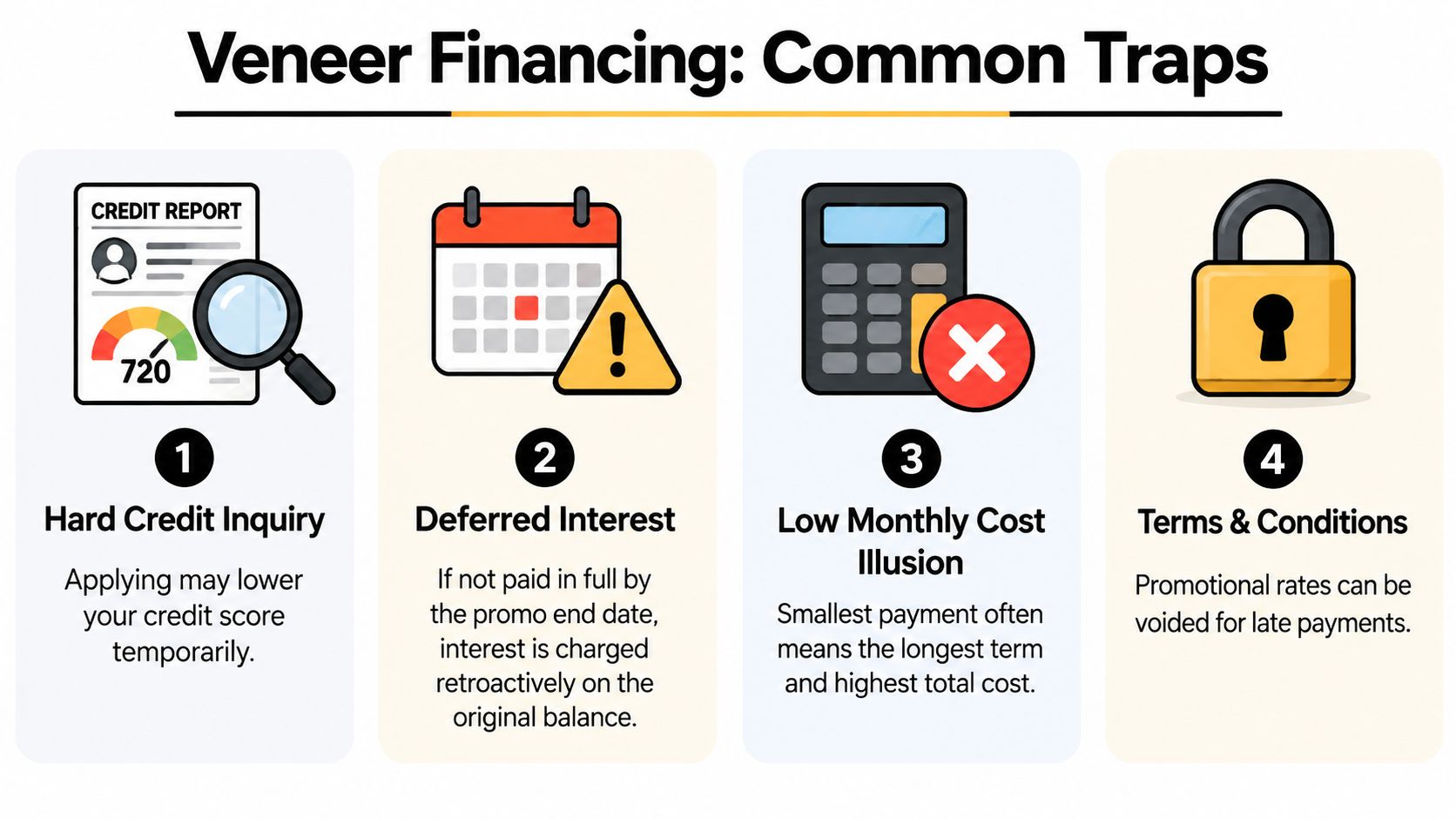
The lowest monthly payment can be the most expensive choice. A longer term may reduce immediate pressure while increasing interest, fees, and the amount of time your budget remains committed to a cosmetic procedure.
Common problems deserve direct questions:
- Deferred-interest exposure: If the promotional balance isn't paid as required, the contract may charge interest retroactively.
- Credit inquiry effects: Applying for financing can create a hard inquiry and may affect a credit profile temporarily.
- Added fees: Origination, processing, account, or other charges may be included in the financed principal.
- Early-payoff restrictions: A prepayment penalty can reduce the benefit of paying the balance early.
- Balloon structures: Some extended arrangements may leave a large final payment rather than a fully amortized balance.
- Limited maintenance coverage: Repairs, retreatment, or replacement may not be included after placement.
The plan also needs to preserve the clinical distinction between cosmetic and medically necessary care. Veneers usually aren't covered when the purpose is appearance alone, while treatment for decay, gum disease, infection, damaged teeth, or an emergency problem may follow different coverage and payment rules. Fee-for-service systems have been associated with higher treatment volumes and lower preventive care delivery, while capitation can encourage prevention but may reduce service delivery without careful adjustment, according to the dental payment-model research indexed by PubMed.
Ask whether the written estimate separates exams, dental x-rays, periodontal care, fillings, root canals, tooth extraction, temporaries, veneers, and follow-up visits. That separation matters if you're also comparing a cosmetic dentist near me with a practice that provides restorative dentistry, emergency dental services, dental implants, or same-day crowns.
A plan with a somewhat higher monthly amount can be cheaper overall when it has clear fees, no deferred-interest surprise, and maintenance terms you understand. Ask who pays if a veneer chips, debonds, or requires replacement, and whether any warranty transfers if you change dentists.
Choosing the Right Plan at Your Consultation
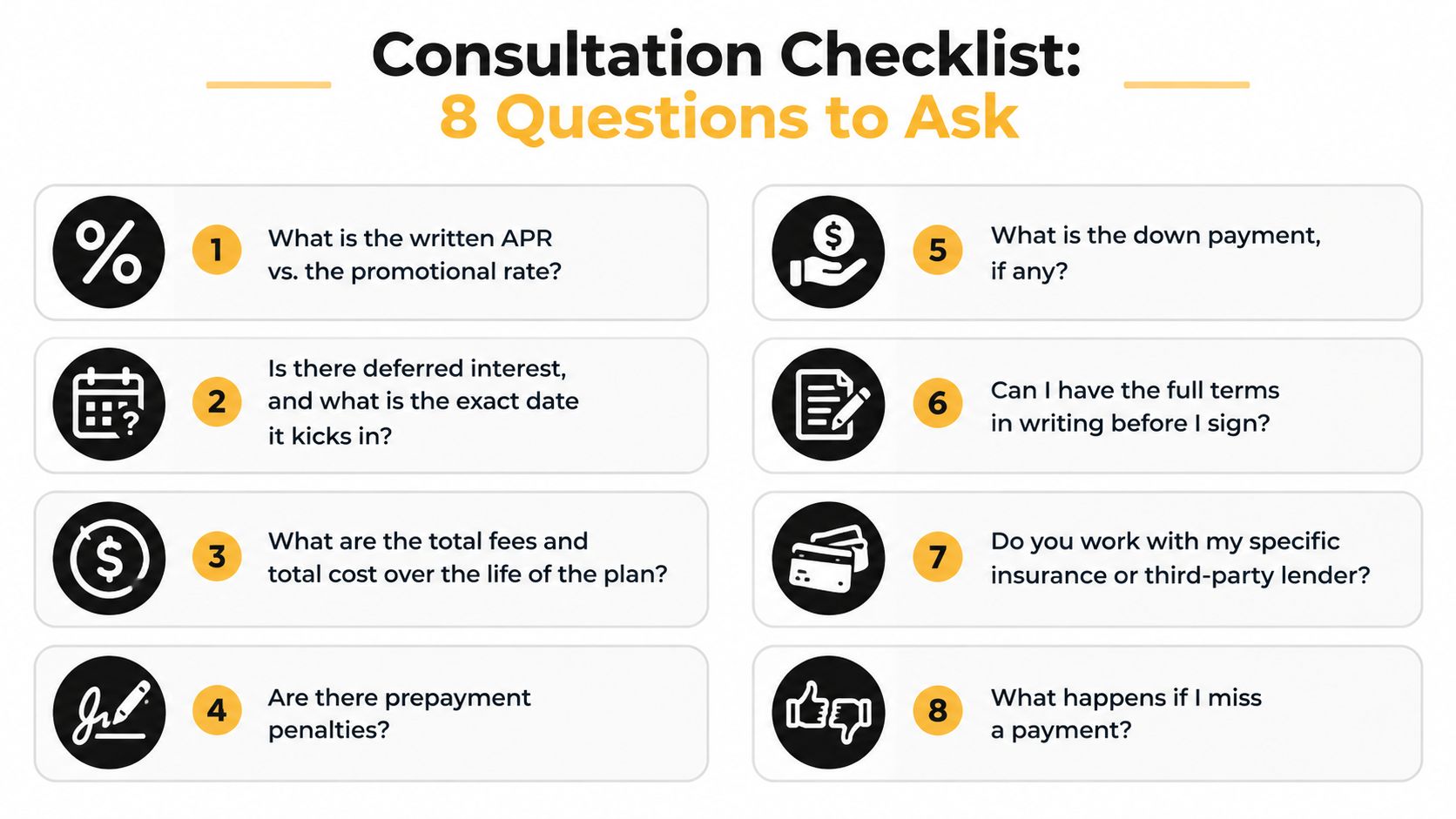
Bring this checklist to your consultation at Winn Smiles in Cleveland or Chattanooga. A strong answer should be written, specific, and easy to compare with another option.
What is the written APR versus the promotional rate?
The promotional figure may apply only during a limited window. The written APR tells you what can happen after that window.Is the offer true 0% interest or deferred interest?
Ask for the exact date the promotion ends and the balance required by that date. Don't rely on a verbal description.What are the deposit, origination, processing, and account fees?
A deposit reduces the financed balance, while fees can increase it. Request the amount due today and the total amount financed.Can I pay early without a penalty?
Prepayment flexibility lets you use a bonus, tax refund, or savings without paying for a longer term you no longer need.What maintenance, repair, retreatment, and replacement coverage is included?
Ask whether the plan covers only placement or also addresses a chipped or debonded veneer. Request the duration and exclusions in writing.Is the warranty transferable?
Transferability matters if you move, change providers, or need follow-up care at another location.What happens after a missed payment?
Confirm late fees, promotional-rate cancellation, credit reporting, and the steps required to restore the account.Can I combine HSA or FSA dollars with this plan?
Confirm eligibility with the account administrator and ask how those funds will reduce the amount financed.
Request documents before committing
Ask for the complete treatment estimate with CDT codes, the clinical sequence, and a separate list of optional cosmetic services. If you need a tooth extraction, dental implants, periodontal care, or an emergency dentist before veneer placement, those services should be visible rather than buried inside one cosmetic total.
Have the coordinator model three repayment terms. Compare the deposit, monthly payment, total repayment, rate after promotion, fees, and maintenance coverage in one place. Winn Smiles describes third-party financing options including CareCredit, Sunbit, and Cherry, and may offer custom arrangements for some treatment plans, but your written approval and treatment agreement determine the actual terms.
Choose the plan that passes every checklist item, not the one with the smallest monthly number. For a dentist near me, a cosmetic dentist near me, or a dentist in Cleveland or Chattanooga, use the consultation to evaluate both the clinical plan and the financial contract.
Schedule a veneer consultation with Winn Smiles in Cleveland or Chattanooga to receive a personalized treatment estimate and review available payment options, including third-party financing and possible custom arrangements. Bring your budget questions, ask for three term comparisons, and let the team help you separate necessary dental care from elective cosmetic treatment before you commit.