You're sitting in a consultation room in Cleveland, TN, holding a mirror and trying to decide whether veneers or a crown will give you the smile you want. Maybe one front tooth is chipped, while the teeth beside it are stained or uneven. Maybe a back tooth has a large old filling and has started to hurt when you bite. The question sounds simple, but the right answer depends on much more than appearance.
At Winn Smiles, patients from Cleveland, Chattanooga, and nearby communities often ask the same thing: Which lasts longer, veneers or crowns? The more useful questions are usually these: How much healthy tooth will be removed? What happens if the restoration chips? Can it be repaired? Will insurance help? Would a same-day crown change the decision?
This guide is the chairside conversation worth having before you commit. It compares dental veneers vs crowns in plain language, with attention to tooth preservation, strength, aesthetics, maintenance, cost, and the condition of the tooth underneath.
A Common Smile Question From Real Patients
A patient may arrive wanting veneers for the two upper front teeth because she wants a balanced, brighter smile. During the examination, one incisor may reveal a deeper fracture or too little remaining enamel for a predictable veneer. The teeth look similar in the mirror, but they don't have the same structural needs.
That distinction matters. A veneer can improve the visible surface of a healthy tooth, while a crown can protect a tooth that has lost substantial structure. Recommending the same treatment for both teeth merely because they sit next to each other may create an attractive result that doesn't hold up well.
The decision starts beneath the smile
The consultation usually includes a clinical examination, dental x-rays when appropriate, and an assessment of the bite. I want to know whether the tooth is vital, whether decay or a crack is present, how much enamel remains, and whether the patient clenches or grinds.
A person looking for a cosmetic dentist near me may focus on color and shape. Those goals matter, but a cosmetic plan still has to respect gum health, enamel, bite forces, and the tooth's history. A person searching for an emergency dentist may need pain relief or stabilization before any cosmetic decision is made.
Practical rule: The restoration should match the tooth's condition, not just the patient's preferred appearance.
Patients in Cleveland and Chattanooga also have practical concerns. A traditional crown may involve a temporary restoration and another visit. A veneer plan may involve several teeth and careful shade coordination. Someone driving a long distance, arranging childcare, or taking time away from work needs those details early.
The answer isn't automatically veneers for a front tooth or a crown for a damaged tooth. The answer comes from combining the tooth's strength, the patient's goals, the bite, and the long-term maintenance plan.
What Veneers and Crowns Actually Are
A veneer is a thin, custom-made shell bonded to the front surface of a tooth. Think of it as a contact lens for enamel. It changes the visible color, shape, length, or contour while leaving most of the tooth surrounded by its natural structure.
A crown is a full-coverage cap that encases the visible portion of a tooth above the gumline. A thimble is a useful everyday comparison. The dentist reshapes the tooth so the crown can fit over it and restore its form, function, and protection.
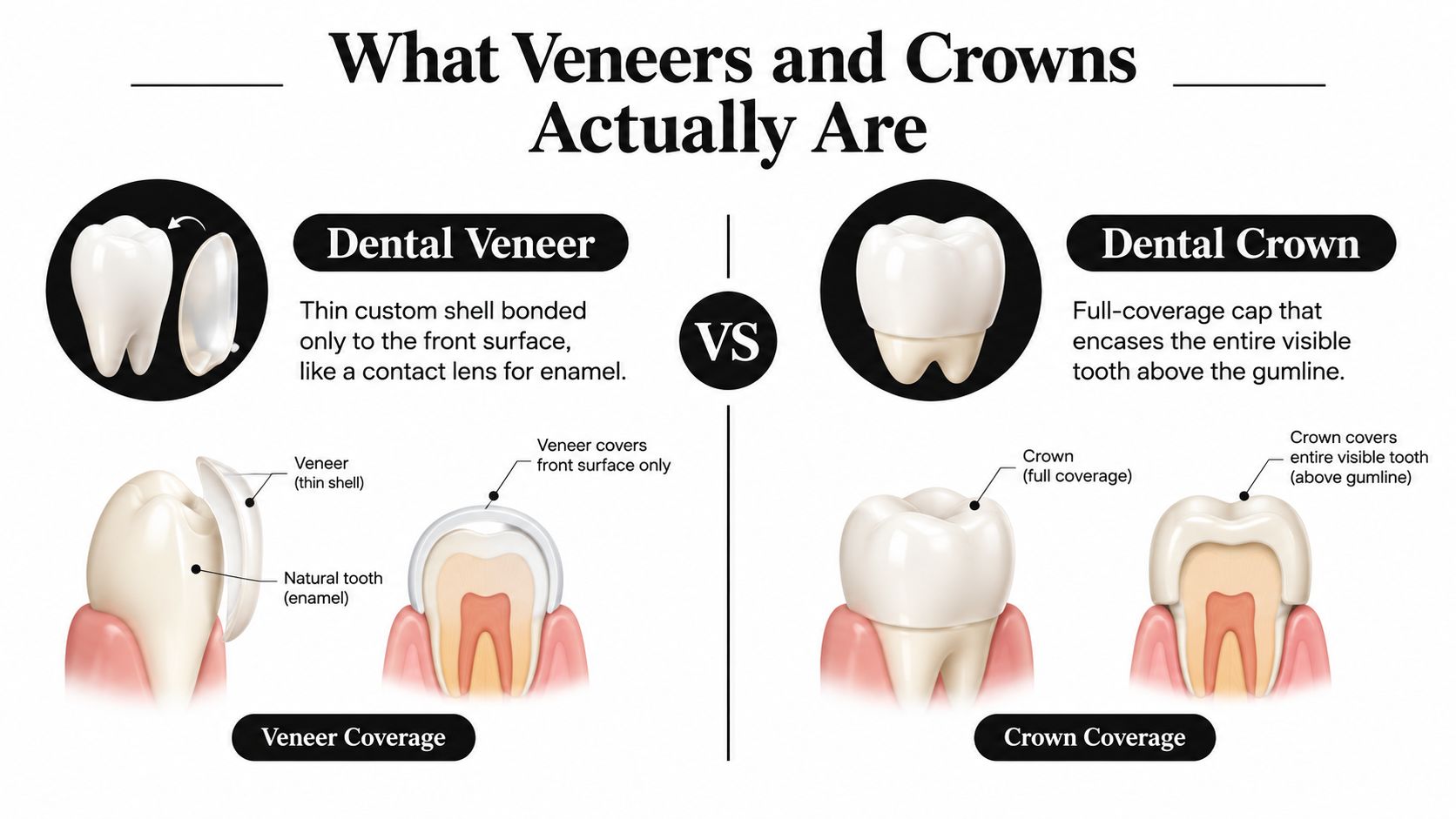
Partial coverage versus full coverage
Veneers are generally used when the tooth is healthy but has a cosmetic concern, such as discoloration, a small chip, or an uneven edge. They don't replace missing tooth structure throughout the tooth, so they aren't a substitute for a restoration designed to reinforce a severely weakened tooth.
Crowns are more commonly used for teeth that are broken, heavily filled, cracked, decayed, or treated with a root canal. They can also be appropriate when a back tooth needs protection from substantial chewing forces.
Inlays and onlays sit between these options. They restore part of a tooth, often when a filling isn't enough but a full crown would remove more structure than necessary. The choice depends on how much sound tooth remains and where the damage is located.
A veneer primarily changes the front appearance. A crown surrounds the tooth to restore strength and function. That difference in coverage drives the preparation, material selection, repair options, and expected performance discussed throughout a treatment consultation.
How They Differ in Preparation and Materials
Preparation is where the structural trade-off becomes easiest to understand. Traditional porcelain veneers typically involve about 0.3 to 0.7 mm of enamel reduction on the front surface, while full-coverage crowns usually require about 1.5 to 2.0 mm around the tooth according to the clinical summaries cited in the guide to veneer preparation.
Research has also measured the broader difference in tooth reduction. One three-dimensional analysis found mean reduction of 28.35% ± 4.37% for porcelain veneers versus 56.93% ± 3.47% for all-ceramic crowns, showing that crowns required about twice the reduction in that study (three-dimensional tooth-structure analysis). A separate review reported that porcelain laminate veneers removed about 3% to 30% of coronal tooth structure by weight, roughly one-quarter to one-half the amount associated with conventional complete-coverage crowns (review of porcelain laminate veneers).
| Criteria | Veneers | Crowns |
|---|---|---|
| Coverage | Front surface only | Entire visible tooth above the gumline |
| Preparation | Usually limited to the visible enamel surface | Circumferential shaping for full coverage |
| Common materials | Feldspathic porcelain, leucite-reinforced ceramic, lithium disilicate, composite | Porcelain-fused-to-metal, all-ceramic, zirconia, gold |
| Main purpose | Cosmetic improvement on a structurally sound tooth | Protection and restoration of a weakened or damaged tooth |
| Fabrication | Composite may be completed chairside; porcelain is often lab-made | Traditional crowns may be lab-made; CEREC can support same-day treatment |
| Patient experience | Often focused on shade, shape, and symmetry | Often focused on rebuilding function, comfort, and strength |
Material selection follows the tooth's location and workload. Porcelain can provide lifelike translucency for visible front teeth. Composite may offer a more conservative or easily modified approach. Crowns may use all-ceramic or zirconia for aesthetics and strength, porcelain-fused-to-metal for a long-established combination, or gold when function and tissue compatibility take priority.
The preparation process and material choice should be discussed together. Patients considering veneers can review the clinical details in how teeth are prepared for veneers, while crown planning may focus more heavily on cracks, existing fillings, bite forces, and the amount of remaining support.
Longevity, Strength, and What Happens When Things Chip
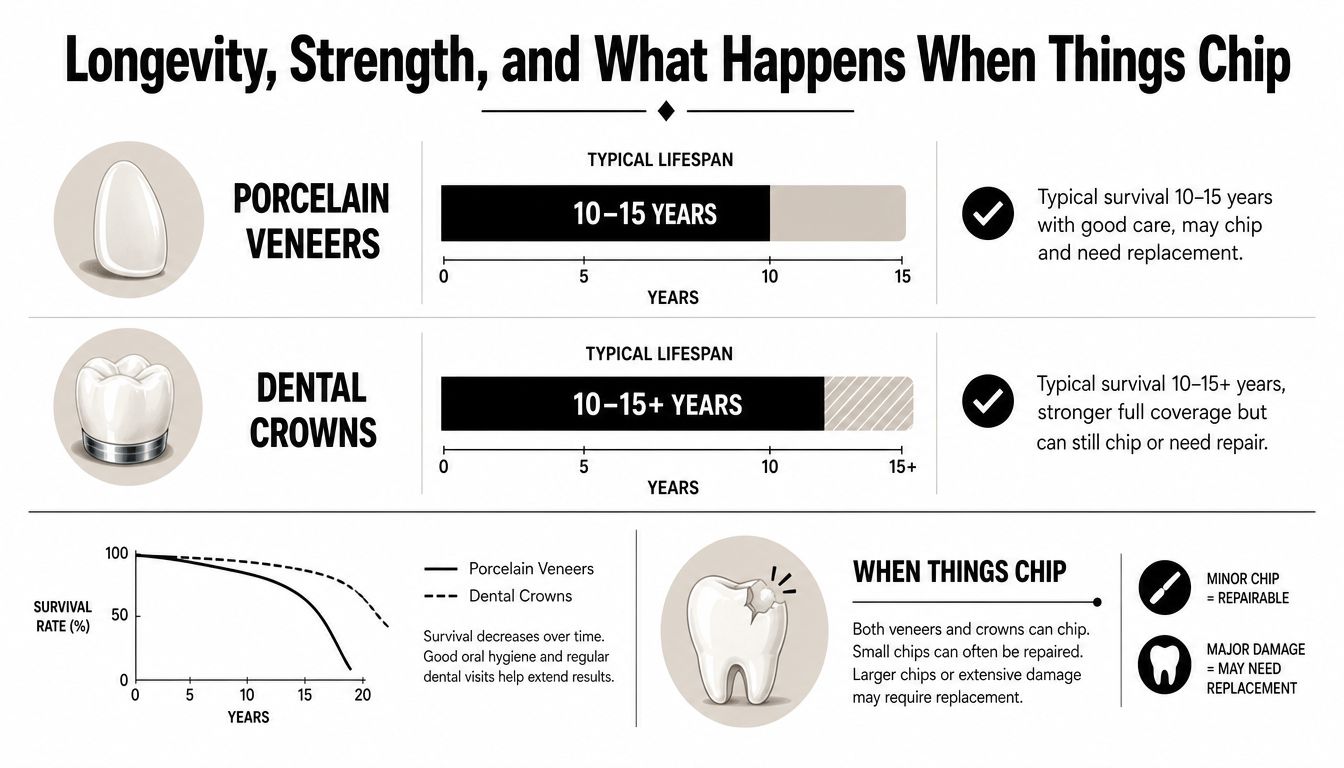
Patients often hear that veneers and crowns last a certain number of years, but survival research provides a more useful picture than a simple promise. A systematic review reported five-year survival of 95.6% for metal-ceramic crowns and 93.3% for all-ceramic crowns (crown-material systematic review). A separate long-term practice-based report estimated a mean survival of 47.53 years for metal-ceramic crowns, with six failures representing 3.9% of that crown group, while the remaining restoration types reached 100% survival at 50 years in that report (long-term crowns and veneers study).
Veneers also show strong medium-term performance. A 2025 systematic review found pooled survival of 97.76% short-term, 97.12% at five years, and 96.05% at 10.4 years. The principal restoration-level failures were bulk fractures at 2.51% and debondings at 2.2% (2025 veneer systematic review).
Survival isn't the same as easy maintenance
The practical difference often appears when something chips. A small veneer edge chip may sometimes be smoothed or repaired with composite, depending on the location, bond, and remaining ceramic. A larger fracture or debonding may require a replacement veneer.
A crown can sometimes be repaired, recemented, or replaced, but access is more complex because the restoration surrounds the tooth. If the underlying tooth has fractured or developed decay, patching the visible material won't solve the problem.
A 2025 review found that veneered implant-supported ceramic crowns had a significantly higher annual ceramic chipping rate than monolithic crowns, 1.65% versus 0.39% (review of veneered and monolithic implant crowns). That comparison involves implant-supported crowns, but it reinforces a broader clinical point: layered ceramics and high-stress situations can create repair concerns that a basic survival percentage doesn't show.
A 2024 meta-analysis estimated 96% cumulative survival for single crowns over 4.6 years versus 90.2% for laminate veneers over 6.5 years, with irreparable failure lower for crowns, 2.7 versus 8.2 in the reported analysis (2024 meta-analysis of single crowns and laminate veneers). In practical terms, crowns often have the advantage on molars, heavily restored teeth, and strong bites. Veneers remain highly effective in carefully selected aesthetic zones where enamel and bond integrity are favorable.
Which Option Fits Which Smile Situation
Two teeth can look similar in a photograph and require completely different treatment. The deciding factors are the tooth's remaining structure, its position, the patient's bite, and whether the goal is cosmetic change or functional protection.
Three chairside examples
A 28-year-old with a small chip on an upper lateral incisor may be a strong candidate for one veneer if the tooth remains healthy and enough enamel supports a reliable bond. Matching the neighboring teeth becomes the aesthetic challenge. If the chip extends significantly, the tooth has a crack, or the bite repeatedly contacts the damaged edge, the plan may shift toward a crown or another restorative option.
A 52-year-old who grinds and has a lower molar with a large old silver filling and a hairline crack faces a different problem. A veneer can't protect the entire chewing surface or distribute forces around a compromised molar. A crown may provide the coverage needed, although the dentist must first assess the crack, pulp health, and whether the tooth can be predictably restored.
A 45-year-old seeking a brighter, more even smile may be better served by a coordinated veneer plan when the front teeth are structurally sound. The dentist still needs to evaluate enamel, gum levels, tooth wear, and bite contacts. If active disease or heavy grinding is present, treating those conditions comes before cosmetic bonding.
| Patient Scenario | Tooth and Bite Reality | Recommended Option | Why It Fits |
|---|---|---|---|
| Small chip on an upper lateral incisor | Healthy front tooth with manageable bite contact | Veneer, or a more conservative repair when appropriate | Preserves more visible tooth structure and coordinates with adjacent teeth |
| Large filling and crack in a lower molar | Reduced support and heavy grinding forces | Crown, after full evaluation | Encases the tooth and protects remaining structure |
| Multiple stained or worn front teeth | Cosmetic goal across a smile, with sound teeth | Coordinated veneers when candidacy is favorable | Changes color and shape without using full-coverage preparation on every tooth |
The recommendation can change during planning. A mock-up may reveal that a tooth needs more length or coverage than first expected. X-rays may uncover decay or a root issue. Bite analysis may show that a seemingly simple veneer would receive damaging contact.
Cost, Insurance, and the Same-Day Crown Factor
At a practice like Winn Smiles, 2025 planning conversations placed fees at roughly $900 to $2,500 per veneer and $1,000 to $1,800 per crown. These are planning ranges, not a promise for every case. The final fee depends on the material, laboratory work, number of teeth, preparation complexity, and whether the tooth needs a buildup or gum reshaping.
Veneer fees can change when a patient chooses a highly customized porcelain design rather than a simpler composite approach. Crown fees may vary with e.max lithium disilicate, zirconia, or porcelain-fused-to-metal, along with the complexity of rebuilding the tooth underneath.
| Cost Factor | Effect on Veneers | Effect on Crowns | Patient Consideration |
|---|---|---|---|
| Material | Porcelain and composite involve different fabrication and aesthetic characteristics | Lithium disilicate, zirconia, porcelain-fused-to-metal, and gold serve different clinical needs | Ask why a material is being recommended for that tooth |
| Number of teeth | A single veneer differs from a coordinated smile plan | Multiple crowns require broader planning and shade matching | Confirm whether the plan is treating one tooth or the entire visible smile |
| Buildup or gum reshaping | May be needed to create a stable, balanced result | May be required when substantial structure is missing | Request an itemized estimate before treatment |
| Laboratory work | Lab-made porcelain requires custom design and fabrication | Traditional crowns involve laboratory fabrication | Ask how many visits and temporary restorations are expected |
| Insurance | Usually considered cosmetic and often paid out-of-pocket | More likely to receive benefits when functional need is documented | Verify coverage and exclusions with your insurer |
When one visit changes the calculation
A traditional crown often involves preparation, an impression or digital scan, a temporary crown, and a later delivery visit. Same-day CEREC technology can design, mill, and place a crown during one visit, which may reduce travel, temporary-crown concerns, and time away from work. Patients comparing options can review the service details for same-day crowns at Winn Smiles.
That convenience doesn't make a crown automatically preferable. A same-day crown still has to be the right clinical restoration, and a veneer may remain the better choice for a healthy front tooth with a cosmetic concern. For patients traveling between Cleveland and Chattanooga, however, appointment logistics can reasonably influence the treatment plan once the clinical options are sound.
Candidacy, Maintenance, and Everyday Care Habits
A strong veneer candidate usually has healthy front teeth, sufficient enamel, stable gums, and cosmetic goals such as changing color, shape, or minor edge wear. The bite should also be manageable. Someone who regularly clenches, grinds, or uses front teeth to bite hard objects may need protection and bite management before considering porcelain.
Crowns become more appropriate when the tooth has a large existing filling, a crack, extensive decay, root-canal treatment, or significant loss of structure. Acid erosion, active gum disease, and uncontrolled bruxism can change the recommendation even when a patient's smile looks ideal in photographs.
Habits that protect either restoration
- Use a gentle daily routine: Brush with non-abrasive toothpaste, clean between the teeth, and pay attention to the gumline around every margin.
- Protect against grinding: A properly designed night guard can reduce damaging contact for patients who clench or grind.
- Avoid concentrated force: Don't chew ice, bite fingernails, open packages with your teeth, or use a veneer as a tool.
- Keep natural teeth healthy: A crown doesn't make the tooth immune to decay. Decay can still begin at the crown margin.
- Attend regular reviews: Professional cleanings and bite checks every six months help the dental team identify inflammation, wear, loose edges, or changes in the supporting tooth.
Veneers don't decay themselves, but the tooth beneath and around them remains part of your mouth. A healthy margin and consistent hygiene support the bond. A crowned molar needs the same discipline as a natural tooth because bacteria can still affect the gumline and exposed tooth structure.
Patients who need broader dental care may also benefit from cleaning and exams, dental x-rays, teeth whitening, periodontal care, tooth extraction, root canal treatment, or dental implants when a tooth can't be saved. Treating active disease first makes a cosmetic or restorative result more predictable.
Making Your Decision With a Trusted Local Dentist
A straightforward framework helps:
- A cosmetic concern on a healthy front tooth often points toward a veneer.
- Structural damage, a major filling, a crack, or root-canal treatment often points toward a crown.
- A back tooth under heavy chewing pressure deserves especially careful evaluation.
- A tooth that sits between categories may need an onlay, bonding, retreatment, or another option rather than either restoration.
Online comparisons can't show how your teeth meet, how much enamel remains, or whether a dark area is surface staining or decay. An in-person consultation can combine a bite analysis, radiographic review, photographs, and a mock-up so you can see the proposed change before treatment begins.
At Winn Smiles, patients in Cleveland and Chattanooga can ask for a consultation or, when appropriate, a second opinion before committing to a veneer or crown. Bring photographs showing the smile you like, a list of previous dental work, and questions about preparation, material, repairability, insurance, and timeline. Patients with anxiety can also ask about comfort measures and sedation options.
If you're evaluating technology or communication before choosing a practice, fonea for dental practices offers useful background on how dental practices can organize patient communication. That kind of clarity matters when you're comparing treatment choices, appointment requirements, and follow-up care.
The right decision is rarely based on longevity alone. It comes from preserving sound tooth structure when possible, providing enough protection when necessary, and choosing a plan you can maintain for years.
Winn Smiles provides cosmetic and restorative consultations for veneers, crowns, and same-day crown care, with treatment planning for patients in Cleveland and Chattanooga, TN. Visit Winn Smiles to schedule an appointment or request a second opinion before you move forward.