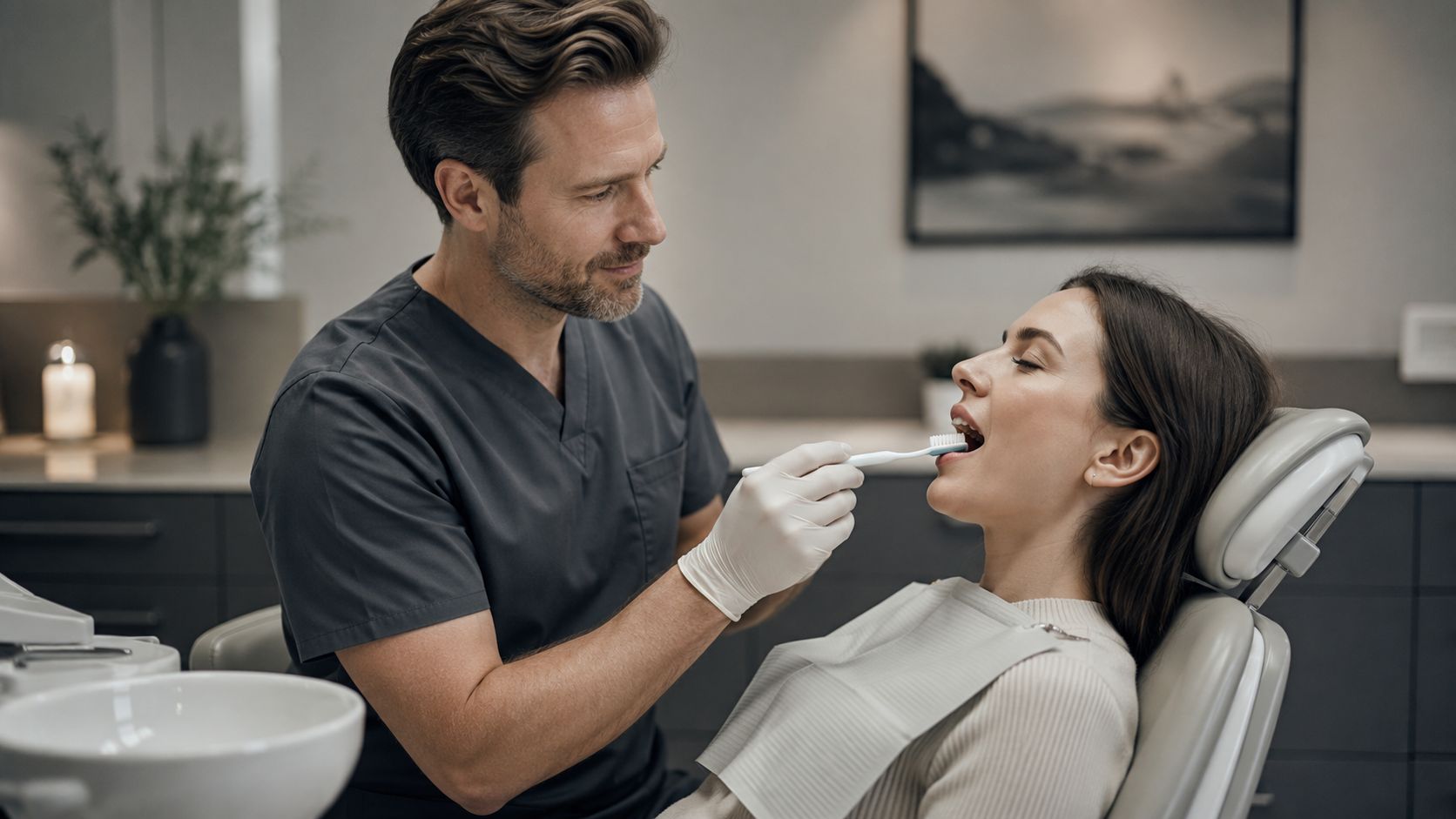
You're trying to get through a cleaning, X-rays, or even brushing your tongue, and your body reacts before you can stop it. Your eyes water. Your throat tightens. You start worrying about the next appointment before this one even begins. For many people in Chattanooga and Cleveland, TN, a sensitive gag reflex turns routine dental care into something stressful enough to postpone.
That delay can snowball. When people avoid cleanings and exams, small problems can turn into larger ones that need restorative dentistry, tooth extraction, emergency dentist visits, or more involved care later. The good news is that a strong gag reflex is manageable. With the right plan, many patients can get through dental X-rays, new patient exams, and treatment more comfortably than they expect.
Your Guide to Comfortable Dental Care in Chattanooga
If you've been searching for a dentist near me or a dentist in Chattanooga, TN because past visits felt impossible, you're not overreacting. Gagging during dental care is frustrating, embarrassing, and exhausting. It can make even simple cleaning and exams feel like a major event.
Some patients avoid the dentist for months or years because they assume nothing will help. That usually isn't true. A sensitive gag reflex often improves when you combine at-home practice with in-office strategies that reduce triggers before they build.

Patients looking for a dentist in Cleveland, TN, a cosmetic dentist near me, or help getting through dental care comfortably usually need more than generic advice. They need practical steps that work before the appointment and a dental team that plans around the problem. Comfort-focused care matters, especially when you need regular dental care, restorative dentistry, teeth whitening, or even more advanced treatment like dental implants near me.
Why comfort planning matters
A gag reflex isn't just a nuisance. It can interfere with:
- Dental X-rays: Intraoral images can trigger the back of the tongue or soft palate.
- Cleaning and exams: Suction, mirrors, and polishing tools may set off the reflex.
- Restorative care: Fillings, crowns, and other treatment can feel harder if anxiety rises first.
- Emergency visits: When you already have pain or swelling, an active gag reflex adds another layer of stress.
Practical rule: The best results usually come when comfort is discussed before treatment begins, not after gagging starts.
A thoughtful office experience can make a real difference. If you want to see what that kind of patient-centered setup looks like, take a look at the comfort menu offered in a modern dental office. Small details often help people feel more in control from the moment they arrive.
What this means for your next visit
You don't have to force your way through dental treatment. There are ways to reduce gagging at home, and there are smarter ways to handle it in the chair. That combination is often what helps patients stop avoiding care and finally move forward with the healthy, bright smile they want.
Why We Gag and What Triggers It
You may be completely willing to get your teeth cleaned and still feel your throat tighten the moment an X-ray sensor or mirror comes near the back of your mouth. I see that in dental patients all the time. It is common, and it does not mean you are difficult to treat.
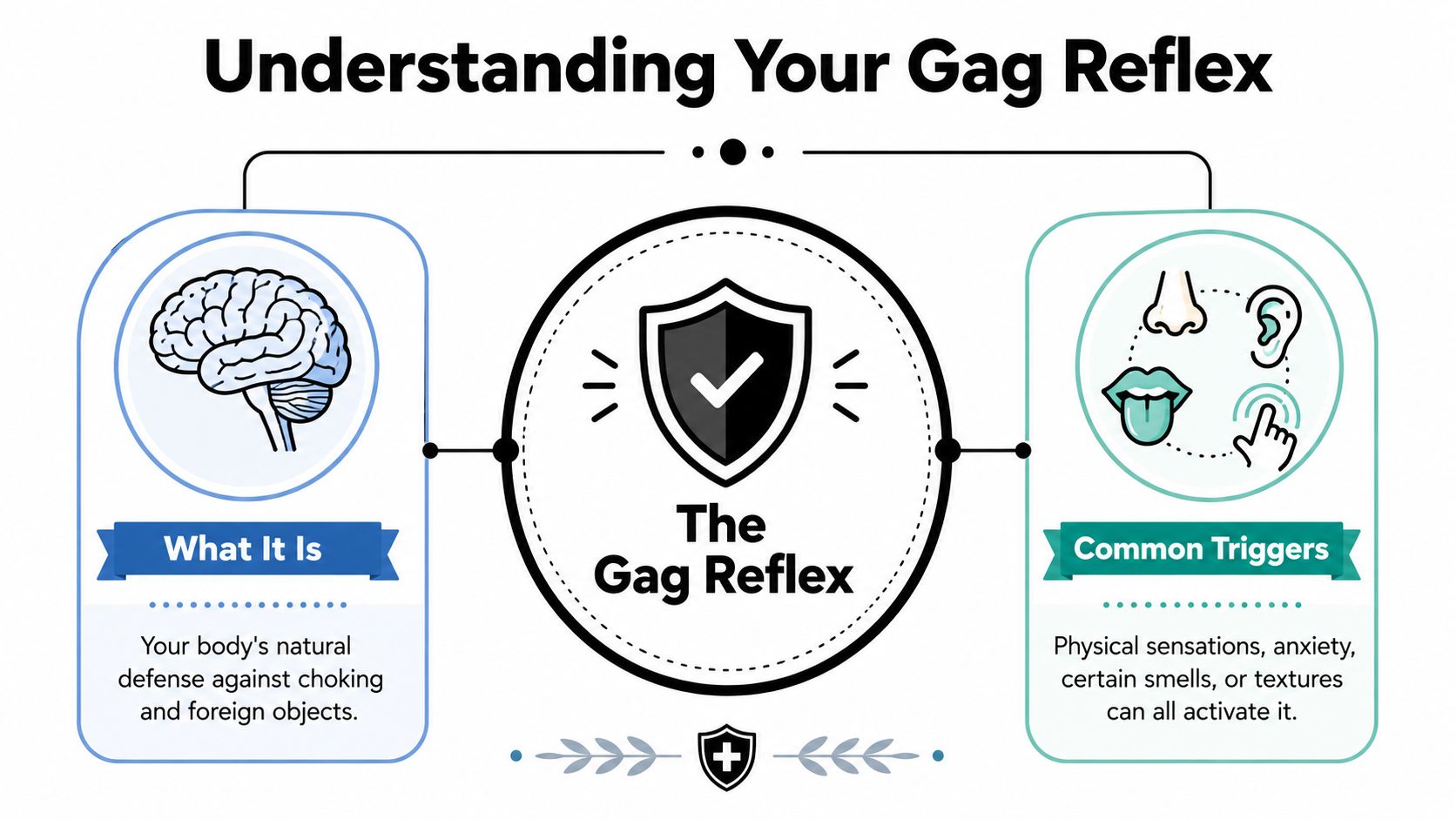
A gag reflex is your body's built-in protection against anything that feels like it could block the throat or airway. In a dental setting, that protection can turn on even when the instrument is small, the procedure is routine, and you know you are safe. The reaction is real anyway.
Physical triggers
For some patients, the trigger is mostly mechanical. A specific spot gets touched, and the reflex starts quickly.
Common physical triggers include:
- The soft palate
- The back of the tongue
- The sides of the tongue
- Thick materials or bulky instruments
- Saliva pooling in the mouth
This pattern matters in dentistry because it often changes how we plan care. A smaller sensor, different positioning, better suction, or avoiding traditional impressions can make a meaningful difference. At Winn Smiles, this is one reason advanced imaging can help. It often reduces the need for the kinds of bulky materials that set sensitive patients off.
Psychological triggers
Other patients gag before we even begin. They may react to the smell of the room, the sound of instruments, a memory of choking during a past visit, or the fear that they will not be able to swallow once treatment starts.
Anxiety makes the throat and mouth more reactive. If that sounds familiar, it may help to read a holistic view of the stress response. The phrase is broad, but the idea is simple. Your body can shift into protection mode very fast, even when your thinking brain knows the situation is controlled.
Patients usually feel less shame once they realize gagging can come from touch, stress, or both.
Why one day feels worse than another
Gag sensitivity is not identical every day. Sleep, congestion, dehydration, stress, and how rushed you feel can all change your threshold. Many patients also tell me mornings are harder, especially if they wake up anxious, stuffy, or with a dry mouth.
That is why timing and preparation matter. In practice, I often recommend choosing an appointment time when you tend to breathe well through your nose and feel less tense. If your reflex is strong enough that routine care still feels overwhelming, we can also discuss in-office strategies such as pacing breaks, topical support, and sedation options in Chattanooga or Cleveland to help you get through treatment more comfortably.
Practical Exercises to Train Your Reflex at Home
A good home plan teaches your mouth to tolerate contact in small, calm doses. Patients do better with steady practice than with one hard session that sets the reflex off over and over.

Start with progressive desensitization
The basic idea is simple. Use a toothbrush to touch an area that feels mildly sensitive, hold there briefly while breathing through your nose, then stop before you spiral into a strong gag response. Repeat daily and move back only as your tolerance improves.
I usually tell patients to keep this boring and predictable. Stand at the mirror when you are calm, not rushed, and practice at the same time each day if possible.
A gentle daily routine
- Start with a clean toothbrush and a relaxed posture.
- Touch a spot on the tongue or palate that feels mildly irritating, not your strongest trigger.
- Hold for about 10 seconds while breathing slowly through your nose.
- Rest for a moment.
- Repeat several times, then stop while you still feel in control.
Progress often comes from staying just below the point where your body panics. If you trigger a full gag every round, you are practicing distress more than tolerance.
What to expect in the first week
Changes are usually subtle at first. You may notice that the reflex starts a little later, feels less forceful, or settles faster after a trigger. That is real progress.
A few habits improve the odds:
- Practice when calm: Late at night, after a hot shower, or any time your body feels settled.
- Keep sessions short: A few focused repetitions work better than pushing until you are frustrated.
- Use your nose: Slow nasal breathing reduces throat tension and gives you something concrete to focus on.
- Track patterns: If mornings are rough or congestion makes practice harder, switch times.
Patients who also deal with panic symptoms sometimes do better when they pair desensitization with grounding. Integrative Psychiatry of America's guide offers a few simple techniques you can practice before brushing or using trays.
Home routine: Calm repetition teaches faster than white-knuckling your way through it.
Try the thumb trick for short-term control
Some patients like a quick physical cue they can use when the reflex starts building. One common method is to tuck the left thumb into the palm and make a gentle fist. It is easy to try during brushing, fluoride trays, or dental X-rays.
It does not fix the underlying sensitivity. It may still give you a brief sense of control, which matters. Short-term tools are useful, especially when you combine them with breathing and a slower pace.
This short video can help you visualize a practical approach:
Use the P-6 pressure point correctly
Another option is P-6 acupressure on the inner forearm. The point sits about three finger-widths below the wrist crease, between the two central tendons. A dental study published by BDJ Team on Nature found that this technique reduced gag reflex severity in dental patients.
How to try it
Press the point firmly but comfortably for a short period before brushing, taking impressions at home, or heading to your appointment. Keep the pressure steady. Sharp or painful pressure is not the goal.
Results vary because hand placement and consistency vary. Try the same method several times before deciding whether it helps you.
Build a plan that matches the kind of care you need
Home practice helps many patients, but it has limits. If you need a crown, X-rays, digital scans, or treatment that keeps instruments in the back of the mouth for longer, training at home may not be enough by itself.
That is where good preparation for the appointment matters. At Winn Smiles, we often combine simple at-home work with imaging choices, pacing, and comfort options in the office. For some patients, nitrous oxide for anxious dental visits can make treatment much more manageable while you continue improving your reflex over time.
| Approach | Best use |
|---|---|
| Desensitization practice | Builds tolerance gradually at home |
| Thumb trick | Short-term support during a trigger |
| P-6 acupressure | Extra non-drug help before brushing or visits |
| Nasal breathing | Keeps the throat and jaw from tightening as quickly |
| In-office support | Helps when home strategies are not enough for real treatment |
If one technique failed once, that does not mean you failed. It usually means the plan needs better timing, better pacing, or more support in the dental chair.
Managing Your Gag Reflex During Dental Procedures
You may do fairly well at home, then sit back in the dental chair and feel your throat tighten the moment treatment starts. That is common. The position of the chair, the sound of suction, and the expectation that something will touch the back of your mouth can all trigger a stronger response.
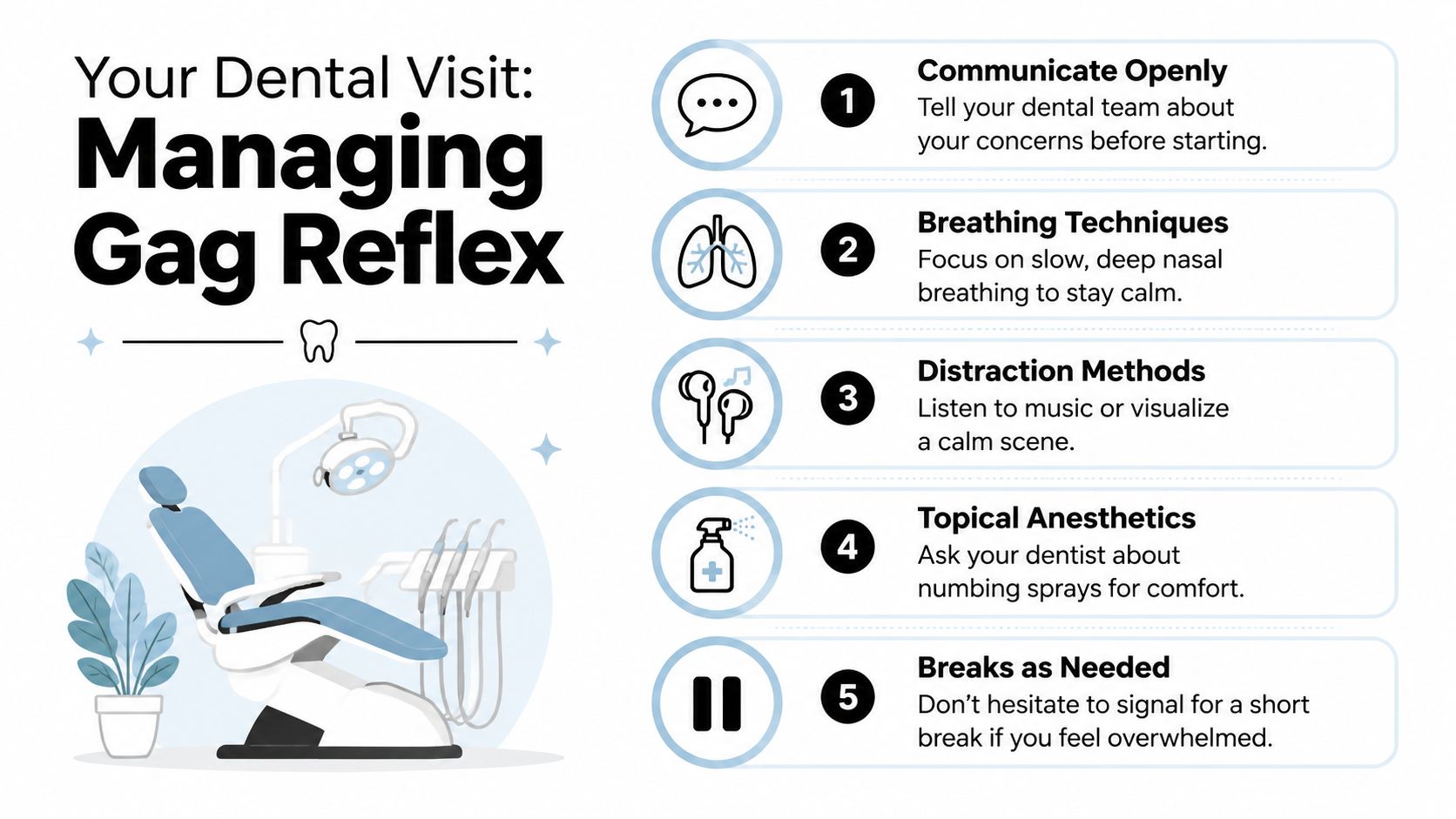
The best appointment starts with a frank conversation before we begin. Tell the team what usually sets you off. For some patients, it is X-rays. For others, it is impression material, a toothbrush during polishing, or feeling out of control once they recline. The more specific you are, the easier it is for your dentist to adjust the pace, choose the right tools, and avoid preventable triggers.
What helps in the chair
In practice, a few chairside adjustments make the biggest difference:
- A stop signal before we start: Raising a hand gives you a predictable way to pause before the reflex spirals.
- Breathing through the nose: This helps keep the soft palate and throat from tightening as quickly.
- Short working intervals: Many patients do better with brief bursts of treatment followed by a reset.
- Active distraction: Music, counting breaths, or squeezing a stress ball gives your brain something concrete to do.
- Topical numbing in selected cases: This can reduce sensitivity in trigger areas during certain steps.
Anxiety often fuels the reflex. If your mind starts scanning for every sensation, grounding techniques can interrupt that cycle. Integrative Psychiatry of America's guide includes simple exercises that adapt well to a dental visit.
X-rays often need a separate plan
A patient may tolerate the exam and still gag during imaging. I see that often, especially with traditional intraoral sensors that sit farther back in the mouth. Good planning matters here.
At Winn Smiles in Chattanooga and Cleveland, we look for ways to reduce back-of-mouth triggers instead of pushing through them. Panoramic imaging and other extraoral options can help in the right case because they avoid placing a sensor deep inside the mouth. The American Dental Association explains that panoramic radiographs are taken with the image receptor and X-ray source outside the mouth, which can make imaging easier for some sensitive patients in dental settings, as described in its overview of dental radiographic examinations.
Some patients do not need less care. They need a different sequence, different imaging, and a team that knows how to slow things down.
When laughing gas is a reasonable option
If anxiety and gagging feed each other, nitrous oxide can help break that loop. It does not erase every trigger, and it is not necessary for every visit, but it often makes cleanings, X-rays, and restorative care much more tolerable. Patients who have avoided treatment for years are sometimes surprised by how manageable a visit feels with the right support in place.
If you want a plain-language explanation, this overview of nitrous oxide for anxious dental visits is helpful.
The goal during treatment is not to force yourself through it. The goal is to create conditions where your body stays calmer and your care can get done safely. That is the difference between a stressful visit and one you can repeat.
How Your Cleveland TN Dentist Can Help
You finally decide to get that problem tooth checked. Then the moment an X-ray sensor, mirror, or impression tray comes near the back of your mouth, your throat tightens and the appointment stalls. I see that pattern often, and it is treatable.
When gagging has delayed care, the best next step is a visit built around tolerance, sequence, and trust. Some patients need a shorter first appointment. Some do better with modified positioning, more frequent pauses, or a different order of steps. Others need help controlling the anxiety that amplifies the reflex.
Patients with a strong gag reflex are often overdue for treatment they already know they need. That may include fillings, crowns, periodontal care, tooth extraction, same-day crowns, cosmetic dentistry, or full tooth replacement. The goal is to make care possible without turning the visit into a struggle.
Professional tools that can help
A Cleveland, TN or Chattanooga dentist should have more than one way to help. At Winn Smiles, that starts with choosing the least triggering path to diagnosis and treatment, then adding comfort options based on how you respond.
Topical numbing support
For certain procedures, topical anesthetics can make a specific area less reactive. This can help with short steps that tend to trigger gagging, although it does not solve every cause. If the reflex is tied closely to anxiety, we usually combine this with slower pacing and clear step-by-step communication.
Nitrous oxide and other comfort options
Nitrous oxide is often useful when anxiety and gagging feed each other. It helps many patients stay calmer and more cooperative during treatment, which can reduce the intensity of the reflex. According to Frontiers in Oral Health, nitrous oxide remains a well-established option for managing exaggerated gag reflexes in dental care. The same source also reports that low-level laser therapy has shown benefit in reducing gag reflex severity and anxiety in some severe cases.
Not every office offers the same comfort tools, and not every patient needs the same level of support. That matters. If your reflex has kept you from finishing treatment in the past, ask what sedation options, pacing changes, and alternative techniques are available before you book.
Advanced imaging and treatment planning
Some patients gag long before treatment starts. Imaging is a common sticking point. In those cases, advanced extraoral imaging can make a major difference because it limits what has to go inside the mouth. That is one reason our team looks for practical workarounds early, especially for patients who have cancelled appointments before or avoided care for years.
Why this matters for bigger treatment plans
A strong gag reflex can interfere with more than cleanings and X-rays. It can block the early steps needed for larger care plans and leave small problems untreated until they hurt.
That includes:
- Restorative dentistry: Crowns, fillings, and repair work are easier to complete when the reflex is under better control.
- Cosmetic dentistry: Veneers and whitening still require exams, planning, and treatment visits you can tolerate.
- Dental implants: Patients searching for dental implants near me often need imaging, planning, and preparatory care before implant treatment begins.
- Emergency dentistry: If you need an emergency dentist, comfort options can help you get urgent care without a distressing experience.
A manageable appointment often changes what is possible.
A practical way to think about your options
The right plan depends on severity, anxiety level, and the type of treatment you need. I usually think about it this way:
| Situation | Best next step |
|---|---|
| Mild gag reflex | Home desensitization, clear communication, and a slower start at the visit |
| Moderate gag reflex | Add distraction, topical support, modified imaging, and more frequent breaks |
| Severe gag reflex | Consider nitrous oxide, sedation options, and a treatment plan built in shorter stages |
If pre-visit nerves make the reflex worse, this guide on how to reduce dental nerves can help you prepare before you come in.
Patients do best when they tell us about gagging before the appointment, not while they are already struggling in the chair. That gives us more room to adjust the plan and give you a calmer first visit.
Schedule Your Anxiety-Free Visit at Winn Smiles
A sensitive gag reflex doesn't mean you're difficult to treat. It means your care should be customized. With the right mix of preparation, communication, imaging choices, and comfort options, many people who once dreaded the dentist can get through visits far more calmly.
If dental care has been delayed because of gagging, anxiety, or both, the most important step is reaching out before the problem becomes bigger. Preventive dental care, cleaning and exams, dental X-rays, restorative work, and cosmetic treatment all become easier when the team knows what you're dealing with from the start.
What a supportive first visit should feel like
A good new patient experience should include:
- A judgment-free conversation: You should be able to explain what triggers your gag reflex.
- A practical comfort plan: That may include breathing guidance, breaks, imaging adjustments, or sedation support.
- Clear expectations: You should know what will happen before anything starts.
- Options for future care: Whether you need routine maintenance, tooth extraction, emergency dental services, cosmetic dentistry, or implants.
If you tend to get nervous before appointments, this article on how to reduce dental nerves from Inspire Dental Group offers a few patient-friendly ideas you can use before you even walk through the door.
You don't have to keep putting this off
Many adults in Chattanooga and Cleveland spend too long assuming their gag reflex will always control the appointment. It doesn't have to. The right support can make routine visits possible again and help you move ahead with the care that protects your health and your smile.
Whether you're looking for a dentist in Chattanooga, TN, a dentist in Cleveland, TN, a cosmetic dentist near me, help with tooth extraction, or answers from an emergency dentist, comfort should be part of the plan from day one.
If you're ready for dental care that takes your comfort seriously, contact Winn Smiles to schedule your visit in Chattanooga or Cleveland, TN. Their team offers modern technology, compassionate communication, and personalized support for patients with anxiety, a sensitive gag reflex, and complex treatment needs.