You notice a pink streak in the sink after brushing, a tender spot near a back tooth, or breath that returns soon after rinsing. If you live in Chattanooga, Cleveland, or a nearby Tennessee community, you may be wondering whether this is ordinary irritation or an early sign of gum disease. Learning how to tell if you have gum disease starts with recognizing the clues, then understanding why only a professional examination can confirm what's happening below the gumline.
Gum changes deserve attention without panic. Winn Smiles provides periodontal examinations, cleanings and exams, dental X-rays when needed, and treatment planning for patients looking for a dentist near me in Chattanooga or Cleveland, TN. A screening can replace guesswork with a clear next step.
Why Your Gums Might Be Trying to Tell You Something
A pink toothbrush, a tender patch near a molar, or breath that stays unpleasant after cleaning can make an ordinary morning feel worrying. Gum disease often starts without notice, though. Early gingivitis may leave gums red, swollen, tender, or prone to bleeding while causing little pain, so busy adults may overlook the change.
One sore spot can follow a sharp piece of food, brushing too firmly, or minor irritation. Repeated changes carry more meaning. Bleeding that returns with brushing or flossing, swelling along the same gumline, or an odor that persists after routine cleaning can point to inflammation. The Centers for Disease Control and Prevention explains gum disease as a condition that may progress from gingivitis to periodontitis, affecting the tissues and bone that support teeth.
Practical rule: Repeated symptoms deserve attention, even when they are mild.
Gum disease is common enough to make regular self-checking useful. National data summarized by the CDC found periodontitis in 42.2% of U.S. adults aged 30 and older, including 34.4% with nonsevere disease and 7.8% with severe disease. These figures do not make every bleeding episode a sign of advanced disease. They do show why a recurring pattern deserves a professional conversation.
For the next 7 to 14 days, note when bleeding, swelling, odor, sensitivity, or other changes appear, and whether they return at the same sites. That record gives your dental team a clearer starting point. Winn Smiles can then use a periodontal screening to decide whether the findings call for preventive care, closer monitoring, or treatment.
Everyday Clues You Can Check at Home
A mirror, good light, and a few minutes can help you notice changes at home. Over 7 to 14 days, record when a symptom returns and whether it affects the same area. This check is like reading a warning light on a dashboard. It can signal that something needs attention, but it cannot identify the cause or show how far a problem has progressed.

Look for patterns, not isolated events
- Bleeding: Repeated bleeding during gentle brushing or flossing, especially from the same sites, can signal inflammation. A single injury from food or brushing too firmly has a different meaning.
- Redness or swelling: Red, puffy, or tender gum tissue may be reacting to plaque and irritation around the teeth.
- Persistent odor or bad taste: Breath or taste that returns after brushing and rinsing deserves attention.
- Recession: If the gumline appears to pull away or teeth look longer, more of the roots may be exposed. Sensitivity may occur, although recession can also develop without pain.
- Loose or sensitive teeth: New movement or sensitivity should be assessed promptly because the tissues supporting the teeth may be affected.
- Painful chewing or bite changes: Discomfort while chewing, a changed bite, or a partial denture that no longer fits properly warrants an examination.
As noted in Risk Factors, absence of bleeding alone does not confirm healthy gums. Symptoms are clues, not confirmation. A person can have deeper spaces around teeth or supporting bone changes without dramatic redness, and a home mirror cannot measure either finding.
The National Institute of Dental and Craniofacial Research discusses gum disease signs and examination, including recession, looseness, pocket measurements, and X-rays. If your notes show recurring swelling, pus, recession, mobility, odor, or chewing changes, arrange a periodontal screening at Winn Smiles in Chattanooga or Cleveland. The screening can separate a visible warning sign from a condition that requires treatment or monitoring.
How Gum Disease Actually Moves Through Stages
Gum disease isn't one single condition. The label describes a process that may begin with surface inflammation and, in some people, progress into damage affecting the tissues and bone that hold teeth in place.
Gingivitis is the early warning stage
Gingivitis is inflammation of the gum tissue. Gums may bleed, swell, look red, or feel tender, but gingivitis doesn't include the attachment and bone destruction that defines periodontitis. With professional care and consistent home cleaning, this early condition may be reversible.
Periodontitis is different. Bacteria and hardened deposits can remain below the gumline, where a toothbrush can't reach. Over time, inflammation may be associated with loss of attachment and supporting bone. That damage can create deeper pockets, recession, mobility, painful chewing, or changes in the bite.
The difference between gingivitis and periodontitis is important because bleeding alone can't tell you which condition is present. Gingivitis can bleed without bone loss, while periodontitis may cause limited discomfort.
Staging requires measurements
A dentist doesn't stage gum disease by appearance alone. The clinical evaluation considers probing measurements, clinical attachment levels, recession, tooth mobility, bleeding on probing, and radiographic bone loss. Periodontitis classification uses stages I through IV and grades A through C to describe severity, complexity, progression risk, and treatment outlook.
That explains why an early problem can feel almost invisible. The tissues beneath the gumline may be changing before a person notices pain or obvious movement. The World Health Organization estimated that severe periodontal disease affected about 19% of people older than 15 worldwide, representing more than 1 billion cases, with case numbers roughly doubling between 1990 and 2019, as reported in its global oral health report.
The practical takeaway is simple. Mild recurring symptoms still deserve evaluation, because identifying inflammation before substantial support is lost can make care more manageable. A dentist near me in Chattanooga or Cleveland, TN can determine whether you need routine preventive care, periodontal cleaning, or a more involved treatment plan.

Risk Factors That Quietly Raise Your Odds
Two adults can have similar brushing habits and very different gum-health risks. Tobacco exposure, diabetes, medications, hormonal changes, family history, crowded teeth, and missed professional cleanings can all affect how inflammation develops or how clearly it shows.
Tobacco is the most significant modifiable risk factor. It can interfere with healing and may make bleeding less obvious, so a smoker shouldn't use “my gums don't bleed” as proof of health. People who use tobacco may need closer monitoring even when the mirror looks reassuring.
Diabetes adds another important layer. Evidence summarized by the National Institute of Diabetes and Digestive and Kidney Diseases indicates that people with diabetes have a 34% higher risk of periodontitis and a 50% to 100% greater risk of tooth loss than people with healthy-range blood glucose. Poor glycemic control can impair healing, while persistent periodontal inflammation may contribute to more difficult glucose control. Gum disease doesn't diagnose diabetes, and dental treatment doesn't replace medical care, but recurring or severe gum problems can justify discussing blood-glucose screening with a clinician.

Build a useful personal risk profile
Tell the dental team if any of these apply:
- Health conditions: Diabetes and immune-related conditions can change inflammation and healing.
- Hormonal shifts: Pregnancy and menopause may alter gum sensitivity and tissue response.
- Medications: Some prescriptions contribute to dry mouth or gum-tissue changes. Bring an up-to-date medication list.
- Family history: A pattern of early tooth loss or periodontal treatment in the family is worth mentioning.
- Hard-to-clean areas: Crowded teeth, bridges, partial dentures, and orthodontic appliances can make plaque control more difficult.
- Irregular appointments: Skipped cleanings allow deposits and inflammation to remain unnoticed below the gumline.
You can change some factors, while others call for closer observation. The Winn Smiles guide to preventing gum disease offers practical prevention information, but a personalized risk profile still requires a dental conversation.
What a Dentist in Chattanooga or Cleveland, TN Actually Checks
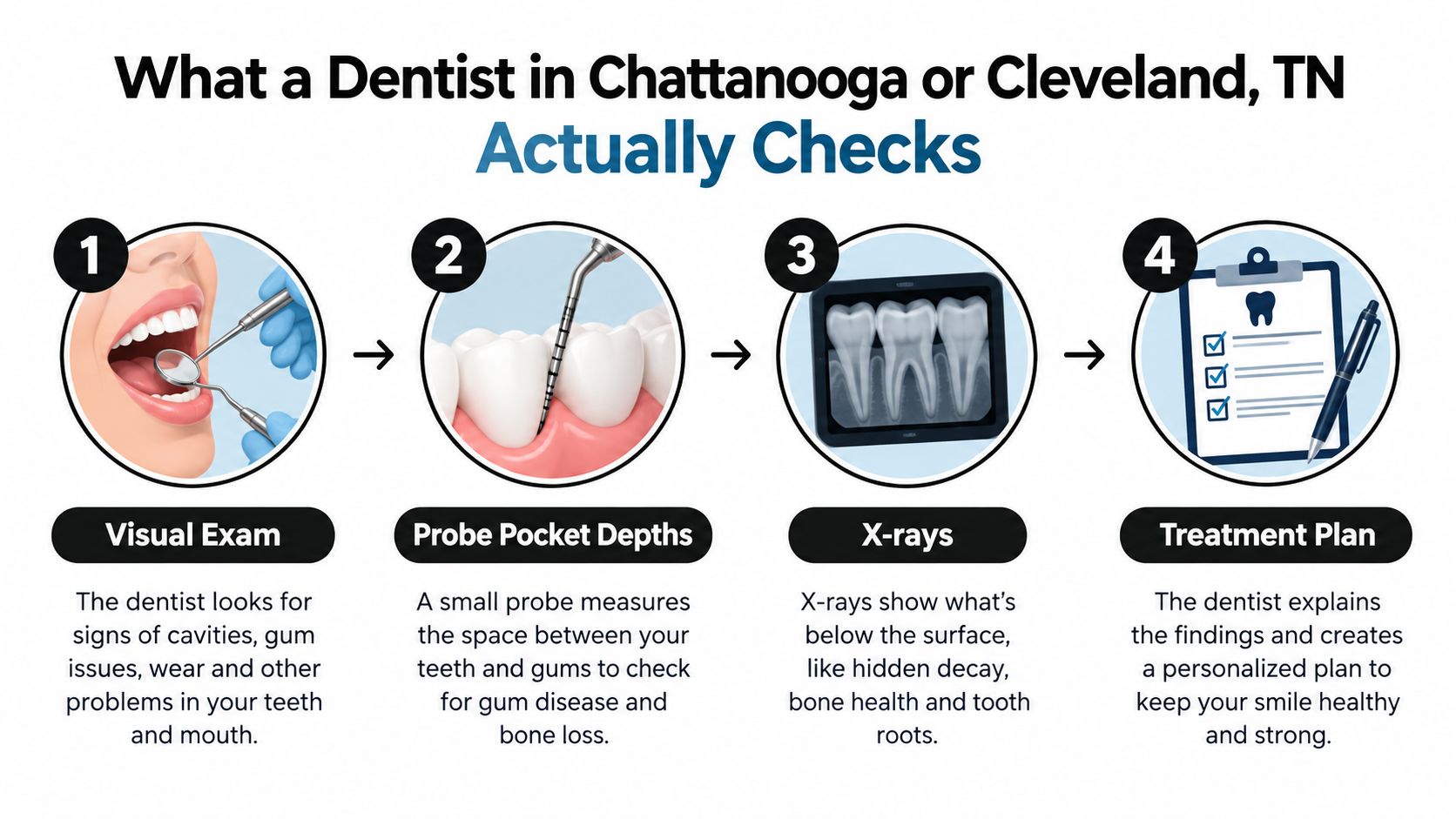
A periodontal screening begins with questions, not equipment. The dentist or hygienist reviews your dental and medical history, symptoms, tobacco use, diabetes, medications, previous gum treatment, and changes since your last visit. This context helps the team interpret what your gums are showing.
The visual exam checks for redness, swelling, recession, plaque, tartar, pus, and changes in how the teeth meet. Next, the clinician guides a periodontal probe, a small measuring instrument, into the space around each tooth. That measurement shows whether the gum has pulled away from the tooth in a way you cannot assess at home.
The probe turns concern into information
Healthy pockets are usually 1 to 3 millimeters deep. The clinician records several sites around each tooth, creating a map rather than relying on one reading. They also document bleeding during probing, recession, attachment loss, tooth mobility, and shifting.
A single deeper measurement does not identify the cause by itself. The team looks for patterns, including whether deeper pockets appear alongside inflammation, recession, attachment loss, or other findings. This is the difference between a warning sign and a clinical assessment.
X-rays show what the mirror can't
Dental X-rays can reveal supporting bone loss that a routine visual check cannot show. Probing, imaging, and your health history work together to help distinguish gingivitis from periodontitis and guide the level of care.
For a broader description of the records and examination steps involved, this comprehensive dental exam explained resource from Bristol Dental and Orthodontics provides useful background.
At Winn Smiles, patients in Chattanooga or Cleveland can review whether the findings support preventive cleaning, periodontal scaling and root planing, or active periodontal treatment. The team can explain what each recommendation involves before care begins.
Why a Healthy-Looking Mouth Can Still Hide Disease
A clean-looking smile and the absence of pain are reassuring, but they don't rule out periodontitis. The disease can progress with limited discomfort while affecting the attachment and bone that support the teeth. Visual inspection may show little, even when probing reveals deeper pockets.
This is especially important for people who smoke or use tobacco. Tobacco can alter inflammatory signs and delay healing, which means less bleeding doesn't necessarily mean less disease. Some people with altered immune responses may also show fewer obvious symptoms.
Home tools have a limited job
Online questionnaires, saliva tests, and consumer screening tools can help a person decide whether to seek care. They can't measure clinical attachment loss or show supporting bone. They may flag people who don't have periodontitis, and they may miss early or localized disease.
Research summarized in a periodontitis screening-tool review illustrates that performance varies widely. Patient-reported tools reached 93.7% sensitivity in one evaluation, while a separate rapid external model had only 49% sensitivity. Those results don't make home tools useless. They show why a positive result needs professional confirmation and why a negative result can't rule out disease.
The better question isn't, “Can I diagnose myself?” It's, “Do I have enough symptoms or risk factors to justify a screening?” Recurring bleeding, recession, mobility, diabetes, tobacco use, or a long gap since your last periodontal exam all make that appointment sensible.
Scheduling a Screening at Winn Smiles
You don't need to solve the diagnosis before you call. Bring the observations you've made at home, including where bleeding occurs, whether swelling returns, and whether you've noticed sensitivity, recession, looseness, bad breath, painful chewing, or a bite change.
When scheduling at Winn Smiles in Chattanooga or Cleveland, mention that you're concerned about gum health and ask for a periodontal screening or new-patient exam. Share relevant risk factors, including tobacco use, diabetes, medication changes, pregnancy or menopause-related changes, and previous periodontal treatment. A current medication list and notes about recent health changes can help the team prepare.
The visit may include a visual exam, periodontal probing, bleeding and mobility checks, and dental X-rays when needed. The findings can support routine cleaning, targeted periodontal care, or a more involved plan. If treatment is recommended, ask what each step is intended to accomplish and how it fits your comfort level.
Winn Smiles also offers a comfort menu and personalized sedation options for anxious patients. Modern technology includes laser dentistry and same-day crowns for related restorative needs. If gum disease has contributed to tooth loss, the practice also provides tooth replacement options, including dental implants and full-arch implant solutions. A tooth extraction, emergency dental services, restorative dentistry, cosmetic dentistry, or a cosmetic dentist near me search may involve different concerns, but a periodontal assessment helps protect the foundation for any future care, including dental implants near me.
For readers comparing nonsurgical approaches, this overview of alternatives to gum surgery from Paul L. Gregory, DDS, offers additional context. Your own treatment plan should be based on probing, imaging, medical history, and the condition of your gums, not on an online checklist alone.
If you're in Chattanooga, Cleveland, or a nearby Tennessee community and recurring gum changes have been on your mind, schedule a new-patient exam or periodontal screening with Winn Smiles. A focused visit can show whether you need preventive care, periodontal treatment, or reassurance, and it gives you a practical plan instead of more guessing.
Winn Smiles provides periodontal examinations, cleanings and exams, X-rays when needed, comfort-focused care, and treatment planning for adults concerned about gum disease. Visit Winn Smiles to request an appointment in Chattanooga or Cleveland, TN, and take the next step toward healthier gums.