Professional in-office whitening can brighten teeth by three to eight shades in just 30 to 60 minutes, while at-home options typically require one to six weeks. The right timeline depends on your whitening method, the type of staining, and the shade you want to achieve.
You may be searching “teeth whitening how long does it take” because a wedding, reunion, job interview, or family celebration is approaching. You want a brighter smile, but you also want to know whether treatment will fit your schedule and whether the result will look natural.
For patients looking for a cosmetic dentist near me in Cleveland or Chattanooga, Tennessee, the practical answer starts with one appointment or several weeks of consistent home treatment. A dental professional can also determine whether whitening is appropriate before you spend time or money on a product that may not address the cause of discoloration.
Understanding Your Teeth Whitening Timeline
A patient may arrive at a consultation hoping to brighten their smile before a special event. They may have coffee stains along the front teeth, mild yellowing from age, or darker areas that have been present for years. Each situation can produce a different treatment plan, even when two people request the same shade.
The method matters first. In-office treatment uses a professional-strength bleaching gel for a concentrated session, while dentist-supervised trays work gradually through repeated applications. Store-bought strips and other over-the-counter products may require still more time because they're designed for lower-intensity use.
The factors that shape your result
Stain type also affects the schedule. Surface discoloration from drinks or tobacco may respond more readily than internal discoloration linked to medication, trauma, or changes within the tooth. Your starting shade, natural tooth chemistry, the condition of your enamel, and your desired level of brightness all influence the final plan.
Some patients want a subtle, refreshed appearance. Others want a more dramatic change. A dentist can help set a realistic target and identify whether existing fillings, crowns, veneers, or bonding may create a shade mismatch, since whitening changes natural teeth rather than dental restorations.
A practical rule: The fastest chair-time option isn't always the fastest path to your best result. The right treatment addresses the reason your teeth look darker in the first place.
Harvard Health describes professional whitening as potentially taking one in-office visit lasting 30 to 90 minutes, while some home protocols take one to two weeks, two to four weeks, or several months for difficult staining. Harvard Health's overview of whitening timelines helps illustrate why a personalized examination is more useful than a single universal estimate.
Comparing Whitening Options and Their Timelines
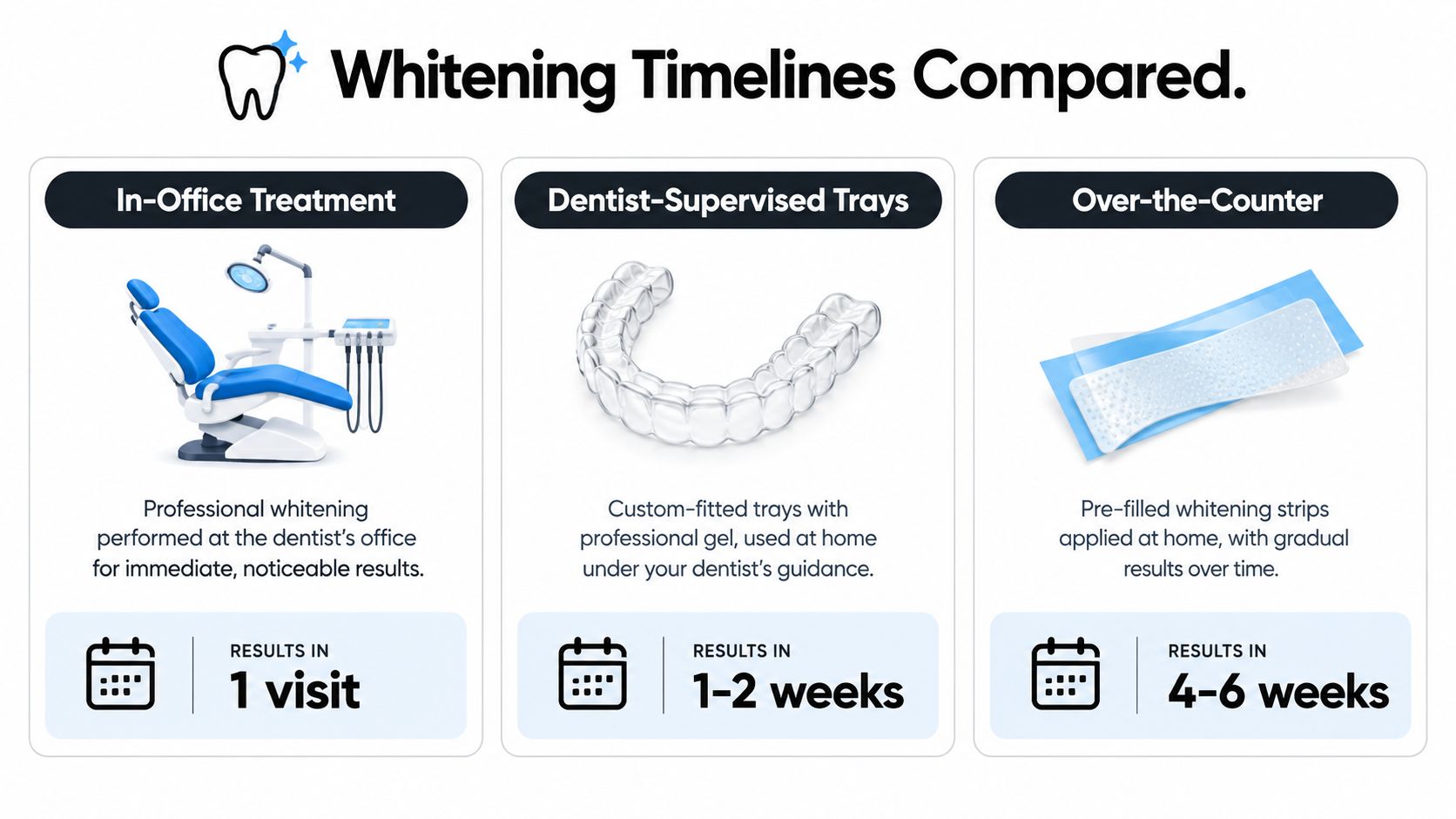
The three common pathways differ in speed, supervision, and convenience. In-office whitening is designed for people who want a visible change during a concentrated visit. Dentist-supervised trays offer more control at home, while over-the-counter products let patients manage treatment independently.
The American Dental Association notes that in-office bleaching can brighten teeth by three to eight shades after 30 to 60 minutes. The ADA also explains that licensed professionals commonly use hydrogen peroxide concentrations of 15% to 43%, which helps shorten treatment time. The ADA's guidance on teeth whitening also describes a comparison in which an over-the-counter technique needed 16 days to reach the whitening level achieved by a seven-day at-home tray system and a one-day in-office procedure.
Teeth Whitening Methods Compared
| Method | Typical Timeline | Shade Change | Best For |
|---|---|---|---|
| In-office professional whitening | One appointment, often 30 to 60 minutes | Visible change may reach three to eight shades | Patients with a short deadline who want professional supervision |
| Dentist-supervised trays | Around one to six weeks, depending on the product and goal | Gradual, controlled brightening | Patients who prefer home treatment and a flexible schedule |
| Over-the-counter strips | Commonly 14 days, with some products taking up to three months | Gradual improvement, sometimes limited to one or two shades | Patients seeking a lower-commitment option |
The NHS says patients may wear whitening trays at home for around two to six weeks, while the European Commission describes wear schedules ranging from two to three hours during the day to eight to ten hours overnight. Total treatment can range from one week to six months, depending on the product and the result desired. NHS guidance on teeth whitening
Some people also investigate cosmetic serums, including Musamam White Intense serum, as part of their personal whitening research. A dentist can help you distinguish between products intended for surface appearance and treatments that have been selected after examining your teeth and gums. For a broader overview of options, see Winn Smiles' guide to the best teeth whitening options.
The best choice depends on your deadline, desired shade, sensitivity history, and oral health. A dental examination should come before whitening if you have untreated decay, gum irritation, cracks, or restorations that may not change color.
Why Whitening Speed Varies by Stain Type
Not all yellowing responds in the same way. A person who drinks coffee regularly may have extrinsic stains, which sit mainly on the outer tooth surface. Coffee, tea, red wine, and tobacco can leave pigments that often respond more readily to cleaning and bleaching.
Intrinsic stains develop within the tooth. Aging, certain medications such as tetracycline, fluorosis, and dental trauma can create deeper discoloration. These stains may require a longer plan, may respond unevenly, or may call for a different cosmetic approach if bleaching doesn't produce the desired result.
Surface stains and internal discoloration
Peroxide works by breaking down the compounds that create darker tooth color. The concentration of the active ingredient, the time it remains in contact with the tooth, and the number of applications all influence the outcome. A stronger professional system can deliver a rapid change, while a lower-concentration product may need repeated use.
The stain's history gives your dentist useful clues. Recent surface staining may improve with professional cleaning followed by whitening. Long-standing discoloration that affects only certain teeth may need closer evaluation, especially if it followed an injury or medication exposure.

A consultation also helps identify whether the color comes from plaque, tartar, enamel, dentin, or a restoration. Whitening natural teeth without considering a crown or veneer can produce an uneven smile. An examination gives you a more dependable estimate than choosing a product based only on its advertised treatment time.
What to Expect During Your Whitening Journey
A professional whitening journey begins with an assessment, not with gel. The dental team asks about your goals, previous sensitivity, dental work, medications, and the date by which you want to see a change. The dentist also checks your teeth and gums for problems that should be treated before cosmetic care.
That examination may include cleaning and exams, dental X-rays when clinically appropriate, and a shade assessment. These steps help the practice determine whether discoloration is on the surface or inside the tooth, and whether whitening can produce an even result.
In-office treatment
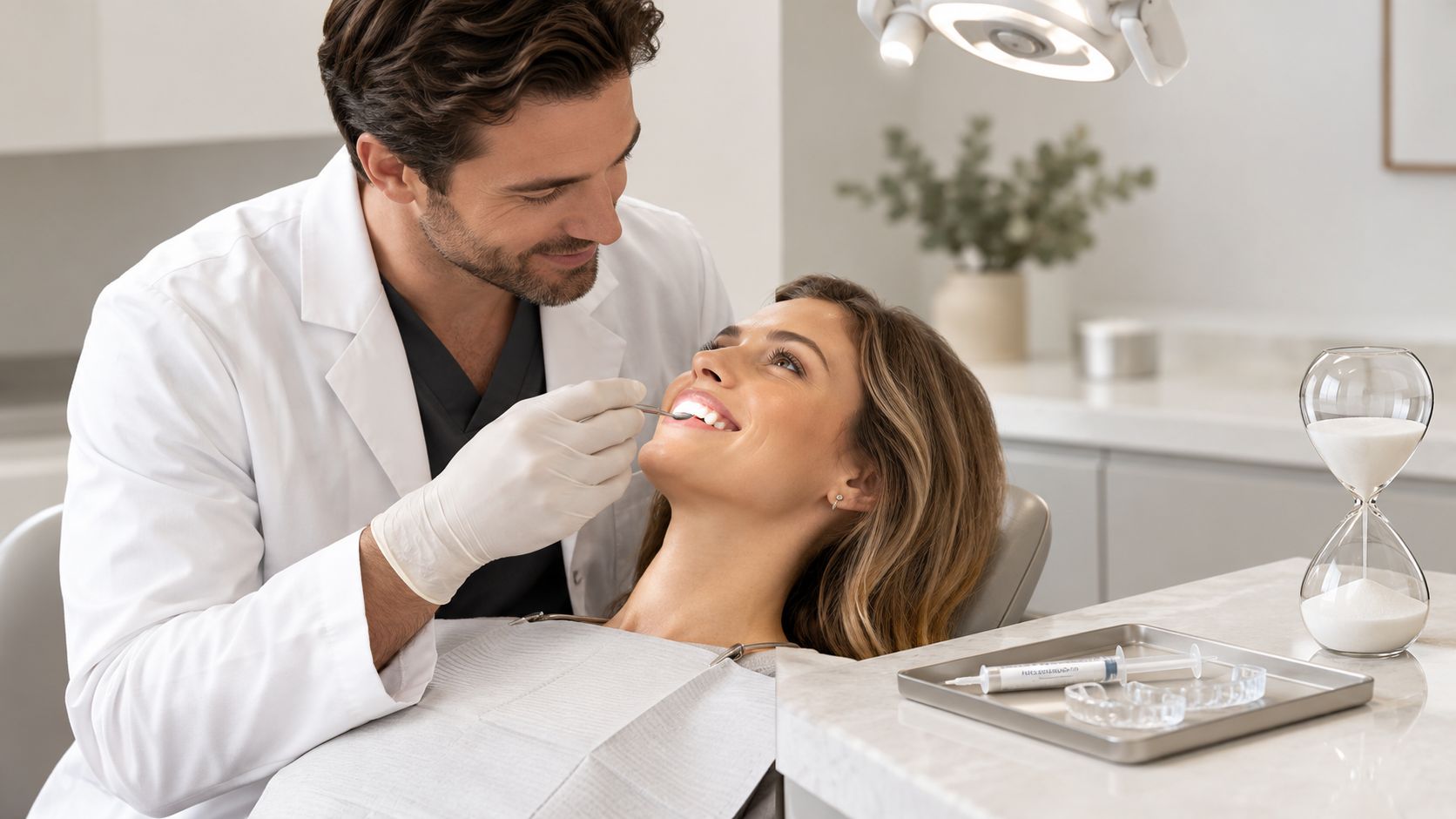
During an in-office appointment, the team protects your gums and other soft tissues before applying professional peroxide gel to the teeth. The gel remains in place for timed intervals, and the dentist or dental professional monitors your comfort and the developing shade.
The treatment itself can produce a visible change during a 30- to 60-minute session, as documented by the ADA. Some patients may need additional treatment because their stains are deeper or their desired shade is more ambitious. ADA News' explanation of professional whitening options describes why the concentration used in a dental office can shorten the route to a noticeable result.
Dentist-supervised home treatment
With trays, the practice creates or provides a fitted system that holds gel against the tooth surfaces more evenly than a poorly fitting generic product. You wear the trays according to the instructions, often for part of the day or overnight, and continue until the planned shade is reached.
The home route takes longer overall, but it can suit patients who prefer gradual change or who want more control over the pace. Your dentist can adjust the schedule if you notice sensitivity or if one area whitens faster than another.
Temporary sensitivity is a common concern. The team can respond by changing wear time, recommending a desensitizing product, or selecting a gentler home protocol. Contact the practice if discomfort is severe, persistent, or focused on one tooth, because that pattern may indicate a dental problem rather than ordinary whitening sensitivity.
Managing Sensitivity and Protecting Your Results
Sensitivity happens because peroxide can pass through enamel and temporarily affect the tooth's inner tissues. You may notice a brief response to cold air, cold drinks, or sweet foods during treatment or shortly afterward. For most patients, the sensation is temporary, but your dentist should know if it interferes with eating, sleeping, or daily activities.
A professional can reduce discomfort without abandoning the whitening goal. The plan may include shorter applications, rest days between treatments, a lower-concentration tray gel, or a desensitizing agent. Patients with a history of sensitivity may prefer gradual home treatment because the dentist can make adjustments as the shade develops.
A personalized comfort plan
Your stain type and your sensitivity history should guide the pace. A patient with surface staining and strong enamel may be comfortable with a concentrated office visit. Someone with exposed roots, enamel wear, or previous sensitivity may need a slower schedule and closer follow-up.
The guide on teeth whitening for sensitive teeth offers additional context for patients who want to discuss comfort before treatment. Don't increase application time or use whitening products more often than directed. More exposure doesn't automatically create a better result and may increase irritation.
Keeping your smile bright
After whitening, protect the result with consistent brushing, flossing, and routine dental cleanings. Dark beverages, tobacco, and heavily pigmented foods can contribute to new surface staining, so moderation and rinsing with water can help reduce pigment contact.
Touch-up treatment may be appropriate when your dentist believes the teeth and gums are healthy. The timing depends on your habits, the type of discoloration, and the whitening system used. A maintenance plan should preserve a natural appearance rather than pursue repeated treatment without a clear benefit.
Why Professional Whitening Delivers Faster Results
Professional whitening offers more than shorter chair time. A dentist selects the gel strength, controls contact time, protects the gums, checks the starting shade, and can change the plan if your teeth respond unevenly. Custom-fitted trays also help place the product against the intended surfaces instead of allowing it to spread unpredictably.
A 2023 systematic review found that products in the same category could show similar whitening efficacy despite very different treatment durations, including comparisons of seven versus 140 hours and 30 versus 60 minutes. The review shows why the clock alone doesn't predict the outcome. Peroxide concentration, delivery method, release profile, contact time, and repetition schedule work together. The systematic review of tooth-whitening protocols explains this relationship in detail.
Value beyond speed
Store-bought products aren't automatically unsuitable, but they may offer less help when staining is deep, uneven, or caused by a dental condition. They also can't evaluate decay, gum disease, cracked enamel, or restorations before treatment.
For adults searching for a dentist in Cleveland, TN, a dentist in Chattanooga, TN, or a cosmetic dentist near me, a consultation creates a safer starting point. The same practice may also help with preventive exams, restorative dentistry, tooth extraction, emergency dental services, veneers, or dental implants when whitening alone can't address the full smile concern.
Schedule Your Whitening Consultation Today
The only reliable way to estimate your personal whitening timeline is to have a dental professional examine your smile. The consultation should identify the stain type, review your sensitivity history, check the health of your teeth and gums, and explain whether in-office whitening or custom trays fit your goals.
Patients in Cleveland and Chattanooga can discuss professional whitening in a comfort-focused setting with a team that explains each step in plain language. Transparent conversations about treatment choices, costs, expected shade changes, and maintenance help you decide without pressure. The practice also provides free consultations and second opinions for select services, giving you another way to compare options before proceeding.

Choosing your next step
If you have an upcoming event, mention the date when you schedule. The dental team can explain whether a single in-office visit is realistic or whether a custom tray plan gives your teeth more time to respond. If you're also considering veneers, restorative dentistry, dental implants near me, or treatment for a dental emergency, raise those concerns during the same conversation so your care plan supports the whole smile.
A professional assessment also protects you from chasing a shade your natural teeth can't safely reach. The goal is a brighter, comfortable smile that looks consistent with your existing teeth and dental work.
Watch this short video for additional guidance before your consultation:
Call or submit an appointment request for a whitening consultation in Cleveland or Chattanooga, Tennessee. Bring your questions about timing, sensitivity, trays, in-office treatment, and the final shade you want to achieve. Clear guidance can make the process more predictable from the first visit through maintenance.
Winn Smiles offers professional in-office whitening and custom take-home options for patients who want a brighter smile with a personalized timeline. Visit Winn Smiles to request a consultation in Cleveland or Chattanooga and take the next step toward comfortable, professionally guided whitening.