A lot of people who search for a dentist near me in Cleveland, TN or dentist in Chattanooga, TN aren't just looking for a cleaning. They're looking for a way to finally get care without the knot in their stomach, the racing heart, or the urge to cancel the appointment the night before.
That fear is more common than most patients realize. Some people have had a difficult dental experience in the past. Others feel embarrassed that they've waited too long. Some need help with a painful tooth, a broken crown, dental implants, or even an emergency dentist in Chattanooga situation, but anxiety keeps getting in the way.
Sedation dentistry exists for exactly that reason. It helps patients move from avoidance to action. Instead of white-knuckling your way through treatment, you can receive care in a calmer, more manageable state. For many adults, that changes everything. It turns a visit they've been dreading into something they can get through.
Your Trusted Dentist for Sedation in Cleveland and Chattanooga
One of the most familiar stories in dental care goes like this. A patient means to schedule a visit. Then life gets busy. Then a little sensitivity becomes a larger problem. Then the idea of sitting in the chair feels so stressful that even making the call feels hard.
By the time they search for a dentist near me or tooth extraction help in Cleveland or Chattanooga, they're not just dealing with a dental issue. They're also carrying months, sometimes years, of worry.
Sedation can help break that cycle. It doesn't replace good dentistry, and it doesn't replace a careful conversation. What it does is make treatment feel possible again. That matters whether you need routine dental care, restorative dentistry, cosmetic dentistry, or something more involved like dental implants near me.
What anxious patients usually want to know
Most patients aren't asking for a technical explanation first. They want practical answers.
- Will I still be aware of what's happening? That depends on the type of sedation chosen.
- Will it hurt? Sedation helps with relaxation, and local anesthetic handles pain control during treatment.
- Can I drive myself home? Sometimes yes, sometimes no. It depends on the sedation method.
- Is sedation only for major procedures? No. It can also help with anxiety, gag reflex issues, and difficulty sitting comfortably for care.
Many patients don't need “stronger” sedation. They need the right level of support for their anxiety, their procedure, and their medical history.
For adults in Cleveland and Chattanooga, that's often the difference between postponing care and finally getting relief. If you've been putting off a filling, same-day crown, implant consultation, or new patient exam because you're nervous, you're not the only one. The good news is, you're not stuck.
Comfort matters in everyday dentistry too
Sedation isn't only for big treatment days. It can also be part of a better experience for patients who feel tense during exams, have a strong gag reflex, or struggle with long visits.
That matters because untreated dental problems rarely stay small. A tooth that starts out needing a simple fix can become an emergency. A missing tooth can affect chewing and confidence. Ongoing inflammation can make daily comfort harder than it should be.
The goal is simple. Help you get the care you need in a way that feels manageable.
What Is Sedation Dentistry and Why Is It Used
Sedation dentistry means using medication to help a patient feel more relaxed during dental care. Depending on the method, you may feel lightly calm, very drowsy, or mostly unaware of the procedure. The purpose is not the same for every patient. For one person, it's about easing fear. For another, it's about staying comfortable during a longer visit.

What sedation actually does
Sedation helps with the emotional side of treatment. It lowers tension, reduces the sense of stress around the appointment, and can make time feel like it passes more easily. It's useful for anxious patients, but that's not the whole story.
Dentists also use sedation when treatment is lengthy, when a patient has trouble getting numb comfortably, or when a strong gag reflex makes care difficult. It can make complex restorative work, extractions, and implant care more manageable.
Sedation and numbing medicine do different jobs. Sedation helps you relax. Local anesthetic prevents pain in the area being treated. If you've ever wondered why both may be discussed, that's why. If you like understanding how numbing medications are regulated and used in healthcare, a useful outside read is understanding Canadian lidocaine rules.
Why patients choose it
Some patients come in after years of avoiding the dentist. Others aren't fearful at all, but they know they don't do well with long procedures. Sedation can help in both situations.
A few common reasons patients ask about it include:
- Dental anxiety that makes appointments hard to schedule or complete
- Extensive treatment such as multiple procedures in one visit
- Physical sensitivity including gag reflex issues or difficulty sitting still
- Urgent care needs when pain is present but fear is also high
Practical rule: Sedation should make care easier, not rushed. The right plan starts with a health review, a conversation, and a clear explanation of what recovery will look like.
When people avoid treatment, the dental problem usually gets more complicated. Cavities deepen. Cracks spread. Infections can worsen. That's why sedation dentistry often plays a larger role than patients expect. It's not just about comfort in the moment. It can be the tool that allows someone to return to regular dental care, keep their mouth healthier, and move forward with less fear.
Exploring the Types of Dental Sedation We Offer
A patient in Chattanooga once told me, “I can handle the dental work. It's the feeling before we start that gets me.” That is exactly why sedation options matter. The right choice changes how the visit feels, how much you remember, and what the rest of your day looks like afterward.
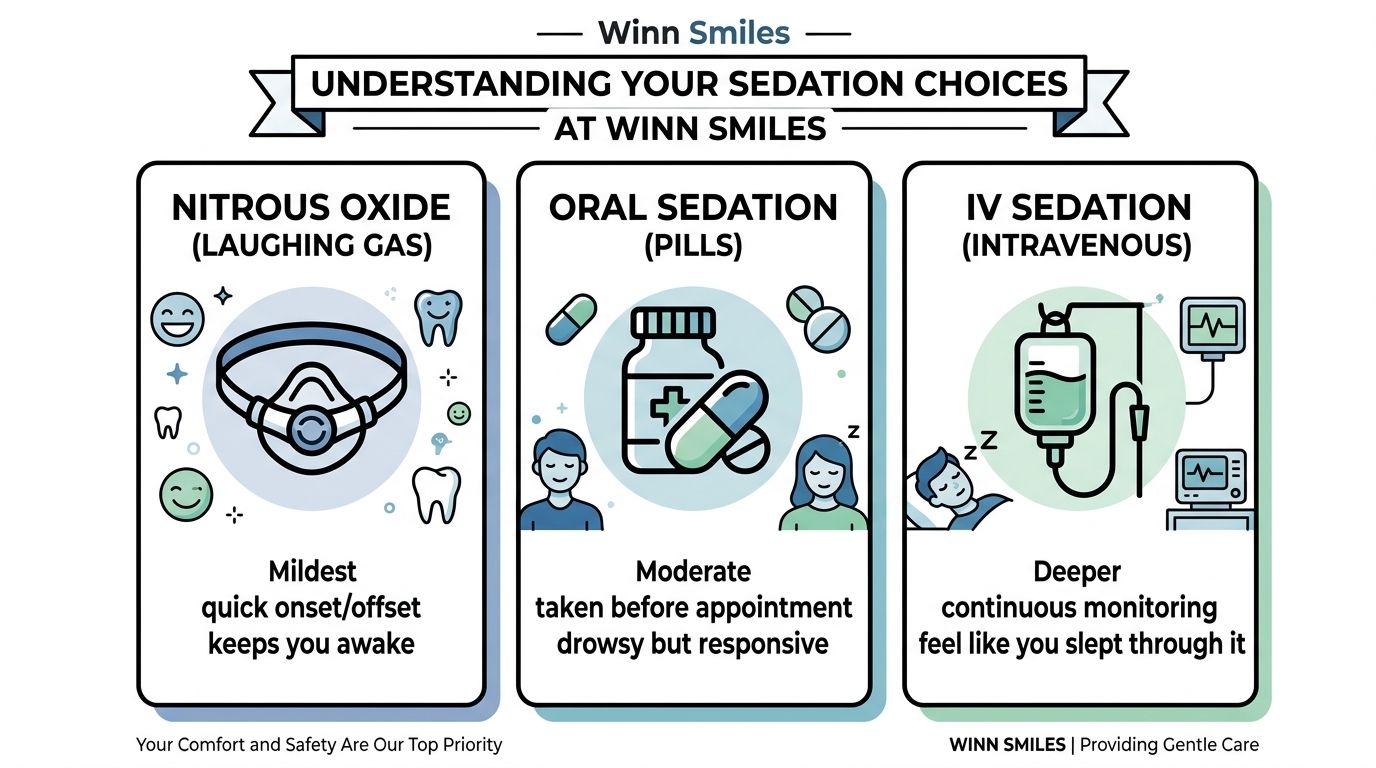
At Winn Smiles, we usually talk through four levels of sedation support: nitrous oxide, oral conscious sedation, IV sedation, and general anesthesia. They are not interchangeable. Each one has a different role, a different recovery pattern, and a different fit depending on your anxiety level, treatment plan, and medical history, as outlined in NCBI guidance on procedural sedation in dentistry.
Nitrous oxide
Nitrous oxide is the lightest option we offer. You breathe it in through a small nose mask, and the calming effect starts quickly.
Most patients do not feel “loopy.” They feel settled. Their shoulders drop, their breathing slows, and the appointment feels more manageable. You stay awake and can respond normally, which is one reason this works well for cleanings, fillings, and other visits where you want help taking the edge off without committing to a longer recovery.
The main advantage is convenience. The effect fades fast, so many patients like it because they can get back to the rest of their day more easily than they could with stronger sedation.
Oral conscious sedation
Oral sedation is stronger than nitrous oxide and usually comes as a pill taken before your visit. By the time you arrive, you often feel drowsy, relaxed, and less focused on what is happening around you.
For the right patient, this can be a very good middle ground. It gives more relief than nitrous oxide, but it does not involve an IV line. The trade-off is less flexibility once the medication is in your system. We cannot adjust it minute by minute the way we can with IV sedation, and you will need someone to drive you to and from the appointment.
Patients often choose oral sedation for moderate anxiety, longer procedures, or past visits that felt hard to get through.
| Sedation type | What it feels like | Recovery burden | Best fit |
|---|---|---|---|
| Nitrous oxide | Light relaxation | Usually lighter | Mild anxiety, shorter visits |
| Oral sedation | Drowsy, calm, less aware | Must arrange a ride | Moderate anxiety, longer visits |
| IV sedation | Deeper relaxation, often little memory | Requires monitoring and escort | Severe anxiety, complex care |
| General anesthesia | Unconscious | Highest level of support | Limited dental settings and select cases |
If you want a closer look at how deeper sedation works, this overview of IV sedation dentistry explains the process in more detail.
Here's a quick visual overview before we go deeper.
IV sedation and general anesthesia
IV sedation allows medication to be given through a vein and adjusted during treatment. That control matters. If a patient is highly anxious or the procedure is lengthy, IV sedation often gives a smoother experience because the level of relaxation can be adjusted during the appointment. Many patients remember very little afterward, even though they may still respond to simple instructions during care.
General anesthesia is a separate category because you are fully unconscious. It is used in more limited situations and specific settings, not as the routine answer for a standard dental visit. In practice, this option is usually reserved for cases where a deeper level of support is appropriate based on the procedure, the patient, and the clinical setting.
The strongest option is not automatically the best one. A better plan is the one that fits your health history, the complexity of treatment, and the kind of recovery you are comfortable managing afterward.
What also matters besides the sedation label
Two patients can choose the same sedation type and still have different experiences. The route of medication, how quickly it starts working, how long the visit is, and how sensitive you are to dental treatment all shape how the appointment feels.
That is part of our comfort-first approach at Winn Smiles in Cleveland and Chattanooga. We do not just name a sedation option and stop there. We explain what you are likely to feel, what support you will need after the visit, and where the trade-offs are, so there are no surprises on treatment day.
Sedation handles anxiety and awareness. Local anesthetic handles pain control in the area we are treating. Patients usually do best when they understand that both work together.
Who Is a Good Candidate for Sedation Dentistry
Not every nervous patient needs sedation, and not every procedure calls for the same approach. The better question is whether sedation would make treatment safer, more comfortable, or more realistic for you to complete.
Patients who often benefit most
Many good candidates fall into one of these groups:
- People with significant dental anxiety who delay care until a problem becomes painful
- Patients planning longer treatment such as implant placement, multiple extractions, or larger restorative visits
- Adults with a strong gag reflex or difficulty sitting comfortably for the length of treatment
- Patients who want to combine care efficiently instead of returning for many stressful appointments
This is especially relevant when someone has been putting off cosmetic dentistry, restorative dentistry, or urgent treatment because the idea of treatment feels overwhelming. Sedation can make it possible to move ahead with the plan instead of continuing to postpone it.
When the conversation needs more nuance
Sedation isn't just about comfort. It's also about fit. The right choice depends heavily on medical history and procedure complexity. Cleveland Clinic's patient guidance notes that IV sedation is often reserved for severe anxiety or lengthy procedures like implant placement, and it also points out that no single sedative is universally superior because different medicines and routes involve different trade-offs, especially for patients with conditions such as sleep apnea or multiple medications. That's why a personalized review matters, as described by Cleveland Clinic's sedation dentistry overview.
Some patients should slow down before assuming sedation is automatically the answer. If you have a complicated medical history, take several medications, or are being evaluated for sleep apnea, the planning conversation becomes more important, not less.
If a patient says, “I want to be completely out no matter what,” that's usually the moment to pause and talk through options carefully. The safest choice is the one that balances comfort with your health profile and the kind of dentistry you actually need.
Sedation can support bigger treatment goals
For many adults, a major benefit is momentum. Sedation can help you follow through on treatment that improves daily life, such as replacing missing teeth, handling a painful tooth extraction, or moving forward with a restorative plan after years of avoiding care.
That's often where patients see the biggest change. They stop organizing life around a dental problem and start getting it solved.
Your Sedation Appointment What to Expect at Winn Smiles
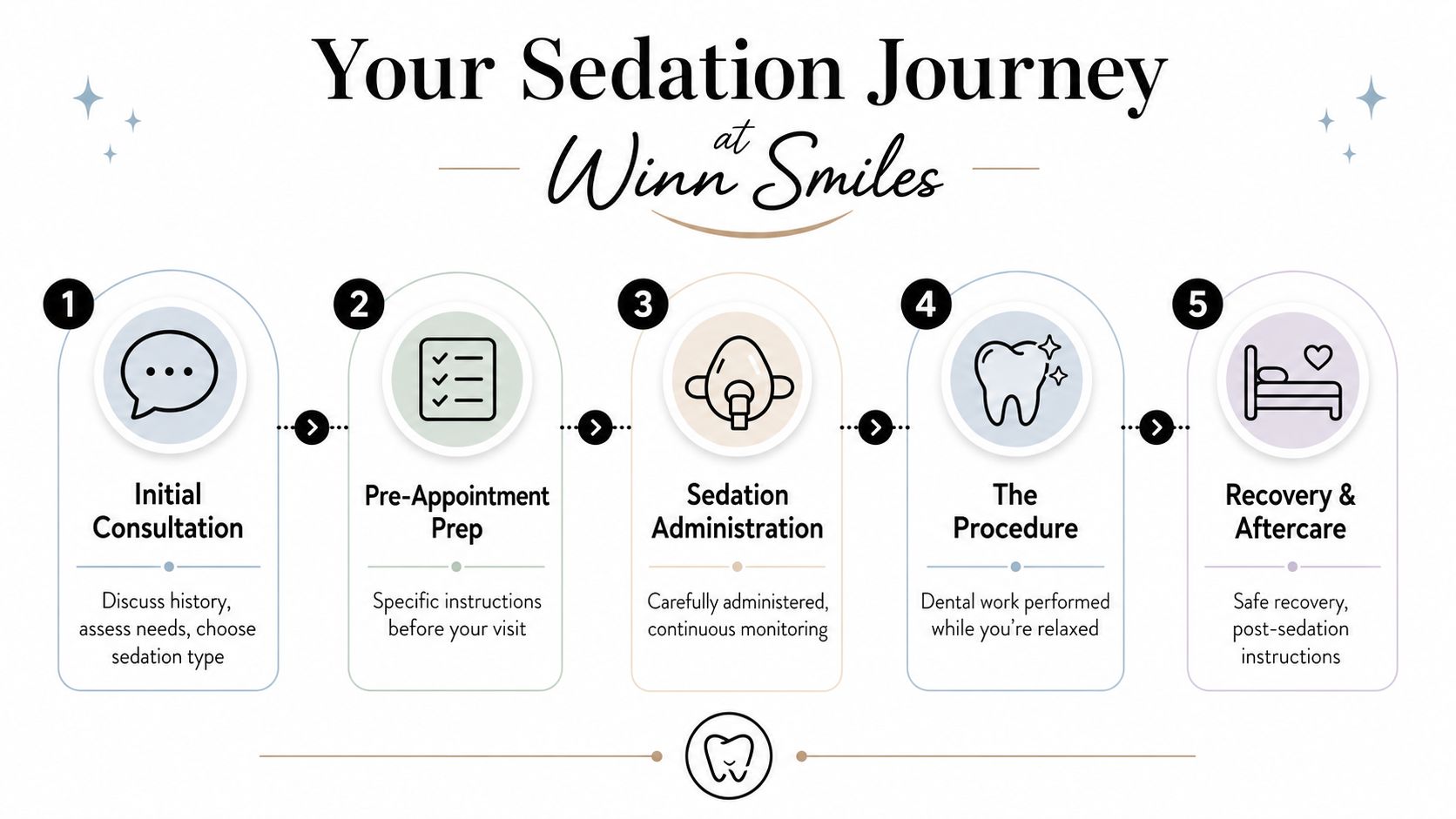
The fear of dental treatment usually gets worse when the process feels mysterious. A clear plan helps. Most sedation visits follow a straightforward sequence, with details adjusted to the type of sedation and the treatment being performed.
Before the appointment
The process starts with a consultation. Your dental team reviews your health history, current medications, anxiety level, and the treatment planned. That's when questions about driving, eating beforehand, recovery time, and escorts get answered clearly.
If oral sedation or IV sedation is part of the plan, you'll receive specific instructions before the visit. Those directions matter. Following them helps your appointment run smoothly and helps your recovery stay predictable.
A typical preparation checklist may include:
- Health review so the sedation plan matches your medical history.
- Transportation planning if you won't be able to drive yourself home.
- Medication instructions based on what you normally take and what's planned for the visit.
- Procedure guidance covering what to expect before, during, and after treatment.
During treatment
On the day of the procedure, the team checks that everything is in place before treatment begins. Once sedation is administered, monitoring continues while the dental work is performed.
The experience differs by method. With nitrous oxide, patients stay awake and usually recover quickly. With oral sedation, patients often feel sleepy and detached from the stress of the visit. With IV sedation, the experience is deeper and often includes limited memory of the procedure.
The calmest appointments usually come from good preparation. When patients know how the day will unfold, they tend to feel more in control before we even begin.
Recovery and aftercare
Recovery depends on the sedation used. Some patients feel ready to move on with their day fairly quickly. Others need a slower transition and support from the person who drove them home.
Aftercare instructions are part of the appointment, not an afterthought. You'll be told what to watch for, when to rest, and how to manage the normal recovery period after both the sedation and the dental treatment itself.
For patients receiving restorative care, tooth extraction, emergency treatment, or implant-related dentistry, this part matters just as much as the procedure. Good aftercare protects the work that was done and makes the whole experience feel less stressful from start to finish.
The Winn Smiles Difference A Focus on Your Comfort
A lot of anxious patients are not only worried about the procedure. They are worried about feeling trapped in the chair, embarrassed to ask questions, or sent home unsure what is normal afterward. Good sedation care has to address all of that.

Personalization matters more than intensity
The best sedation plan is the one that fits the patient, the procedure, and the recovery they can realistically manage. Deeper sedation is not automatically better. Some patients want to stay very aware and recover quickly. Others know that stronger anxiety control is what will let them complete care they have been putting off for years.
Patient comfort also involves practical trade-offs. A fast recovery may matter more than stronger relaxation if someone needs to get back to family or work. Avoiding an IV may matter to a patient with needle anxiety. For another patient, the predictability of IV sedation may feel more reassuring than taking a pill and waiting for it to take effect.
Cost can be part of that discussion too. Patients often ask how sedation affects the overall treatment budget, and that is a fair question. This guide on whether sedation dentistry is covered by insurance can help explain what to ask before treatment is scheduled.
The experience around the procedure
Medication helps, but the setting matters just as much. Patients usually feel calmer when the pace is steady, instructions are clear, and no one treats their fear like an inconvenience.
In a comfort-focused practice, that often includes:
- Time to talk through concerns before treatment starts
- Simple explanations without rushed or overly technical language
- Comfort items such as blankets, pillows, or headphones
- Modern equipment that can make treatment more precise and less physically tiring
Those details change the feel of the visit. A patient who has avoided dentistry for years may still be nervous, but the appointment feels more manageable when the environment stays calm and predictable.
A good sedation experience starts with trust. Patients settle in more easily when they feel heard, respected, and cared for from the first conversation through recovery.
Better dentistry feels more approachable
What patients remember is rarely just the medication itself. They remember whether the visit felt organized, whether someone checked on them, and whether the whole process seemed doable instead of overwhelming.
That is especially important for people coming in for overdue treatment, emergency care, cosmetic work, or a larger restorative plan. Comfort is part of access to care. When the process feels safer and more humane, patients are far more likely to follow through and get the treatment they need.
Schedule Your Anxiety-Free Dental Visit Today
If you've been postponing dental treatment because of fear, you don't have to keep managing the problem alone. Sedation can make care more approachable, whether you need a routine visit, a repair, a tooth extraction, or a larger restorative plan.
For many people, the hardest part is scheduling the first consultation. After that, the process usually feels far more manageable because the unknowns start to disappear. You get answers about your options, your recovery, and what level of sedation fits your situation.
A consultation can answer the practical questions
Patients often want to know:
- What will I feel during treatment?
- Will I need someone to drive me home?
- Can I combine procedures in one visit?
- How do insurance and out-of-pocket costs work?
Those are the right questions to ask. Sedation should be discussed alongside the treatment plan, timing, and financial details so you can make a decision with confidence. If insurance is one of your main concerns, this guide on whether sedation dentistry is covered by insurance is a helpful place to start.
Taking the next step
Whether you're looking for a dentist in Cleveland, TN, a dentist in Chattanooga, TN, help with dental implants near me, cosmetic dentistry, or emergency dental care, comfort should be part of the plan.
You don't need to wait until the pain gets worse. You don't need to force yourself through an appointment in panic mode. And you don't need to guess which of the types of sedation dentistry might fit you best.
The right next move is simple. Schedule a consultation, talk through your health history and goals, and let the dental team build a plan that fits your anxiety level, treatment needs, and recovery preferences.
If you're ready to talk through sedation options, dental implants, cosmetic dentistry, emergency treatment, or routine dental care, contact Winn Smiles to schedule a consultation in Cleveland or Chattanooga.