That first sip of iced tea feels normal until one tooth fires back with a sharp jolt. Or maybe you step outside on a cold Chattanooga morning, breathe in, and feel a quick stab in your mouth that seems to come out of nowhere.
If that sounds familiar, you’re not overreacting. Cold sensitivity is common, but it isn’t something you should ignore or just “put up with.” In many cases, it’s your mouth’s way of telling you that a protective layer has worn down, a root surface has become exposed, or a tooth needs attention before the problem grows.
A lot of patients type in what causes tooth sensitivity to cold when they’re trying to decide whether they need a dentist near me, an emergency dentist, or just better home care. The honest answer is that cold sensitivity can come from several different issues. Some are simple to manage. Others are early warning signs of problems that deserve a closer look.
Experiencing Tooth Pain From Cold in Chattanooga?
Cold sensitivity usually shows up in ordinary moments.
You drink cold water after a walk. You bite into ice cream. You breathe through your mouth on a chilly day in Cleveland, TN. The pain is fast, sharp, and surprisingly strong. Then it may disappear just as quickly.
That pattern makes many people dismiss it. They assume it’s random, or that sensitive teeth are just part of getting older. But tooth pain from cold often has a reason behind it, and that reason can usually be identified with a good dental exam.
What that pain often feels like
Some patients describe it as an electric zing. Others say it feels like a quick pinching sensation deep inside the tooth.
It may affect one tooth, several teeth, or a whole side of the mouth. Sometimes it happens only with cold drinks. Sometimes cold air triggers it too.
Cold sensitivity is common, but “common” doesn’t mean “normal for your teeth.”
Why people get confused
The confusing part is how brief the pain can be.
If a symptom comes and goes, it’s easy to assume nothing serious is happening. But teeth don’t usually become sensitive to cold without a physical change somewhere, such as enamel wear, gum recession, a crack, a cavity, or irritation inside the tooth.
Here’s where patients in Chattanooga and nearby areas often get stuck:
- It only happens sometimes. That can still point to exposed dentin or an early problem.
- It’s not a full toothache. Sensitivity and infection aren’t the same thing.
- It started suddenly. A small change in enamel, gum position, or bite pressure can make a tooth react fast.
A simple way to think about it
Cold sensitivity is less of a diagnosis and more of a clue.
It tells you that cold is reaching part of the tooth that isn’t meant to be exposed. Once you understand how the tooth is built, the pain starts to make a lot more sense. It also becomes easier to see why some people improve with a softer toothbrush and desensitizing toothpaste, while others need restorative dentistry, laser dentistry, or a same-day crown.
Why Your Teeth Hurt When Exposed to Cold
A tooth looks solid from the outside, but it has layers. Each layer has a job, and cold sensitivity starts when the outer protection is no longer doing all the shielding.
The three layers that matter most
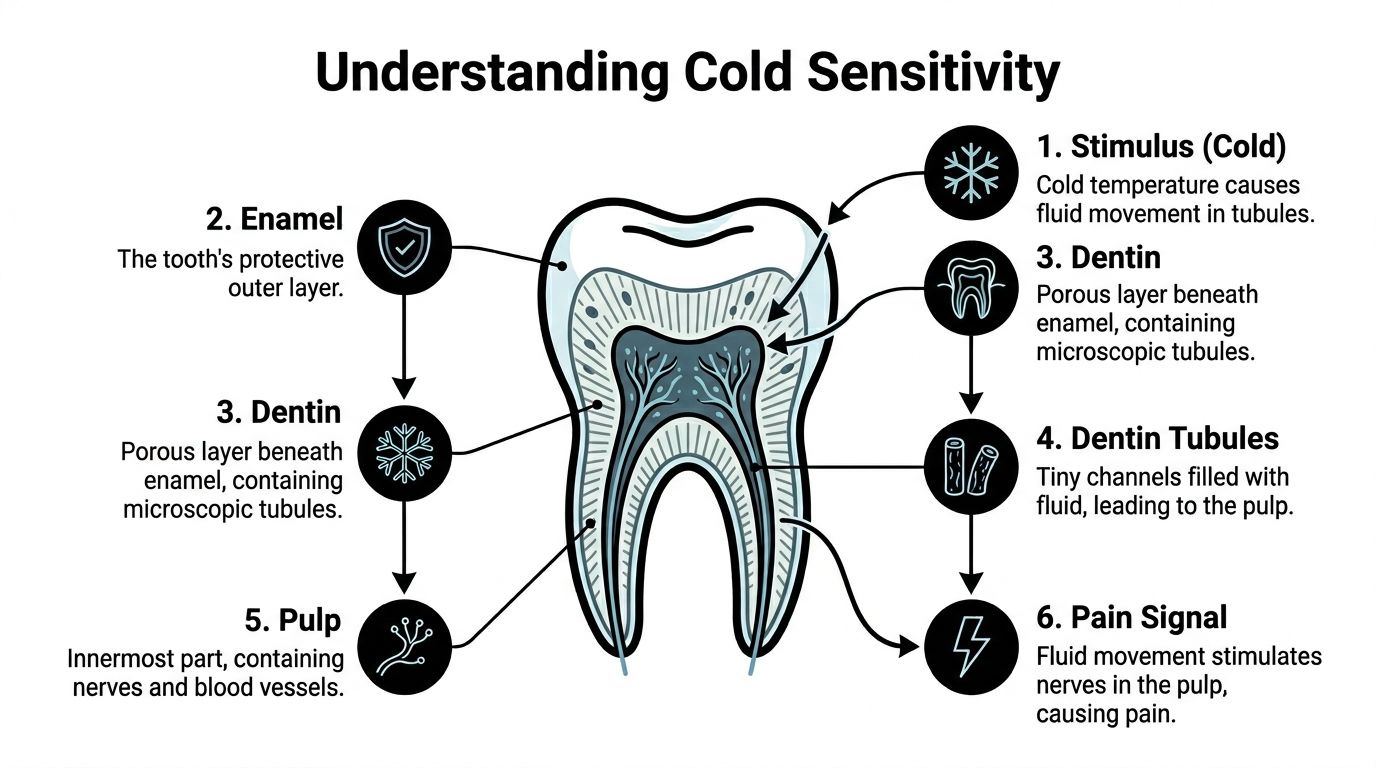
Think of your tooth as having three main parts:
| Layer | What it does | Why it matters for cold sensitivity |
|---|---|---|
| Enamel | The hard outer covering on the crown of the tooth | It protects the tooth from temperature changes |
| Dentin | The layer under enamel | It contains tiny tubules that lead inward |
| Pulp | The center of the tooth | It contains the nerve and blood supply |
Enamel is the armor. It covers the visible part of the tooth crown.
Under that sits dentin, which is much more sensitive. Dentin contains thousands of microscopic tubules. The easiest way to picture them is as tiny straws or channels.
At the center is the pulp, where the tooth’s nerve lives.
How cold creates pain
When enamel wears down, or when the root becomes exposed because the gums have moved back, dentin is no longer protected. Cold can then reach those tiny tubules.
Inside the tubules is fluid. When cold hits exposed dentin, that fluid shifts. That movement stimulates the nerve inside the tooth. This is the basic idea behind the hydrodynamic theory, which is the leading explanation for tooth sensitivity.
In plain language, cold doesn’t need to “touch the nerve” directly. It only needs access to those microscopic channels that carry the signal inward.
Practical rule: If cold causes a short, sharp pain, the tooth often has exposed dentin somewhere, even if you can’t see it.
Why some teeth feel more reactive than others
Not every exposed area hurts the same way.
A tooth with inflammation inside the pulp can react more strongly. That’s one reason some people have mild sensitivity while others feel a dramatic, almost shocking pain from the same cold drink.
There’s also newer science behind this. A Massachusetts General Hospital report on odontoblast cold sensors and TRPC5 channels explains that odontoblasts, which are dentin-forming cells, can act as cold sensors. These channels activate in cold and trigger electrical signals to the brain that are felt as pain. That same report notes that inflammation in the pulp can amplify the signal.
Why this matters for treatment
This is why cold sensitivity isn’t just “in your head,” and it isn’t a mystery symptom.
There’s a real pathway:
- Cold reaches exposed dentin.
- Fluid in the tubules moves.
- The inner tooth reacts.
- Your brain reads that as pain.
Once the source of exposure is found, treatment becomes much more targeted. The goal isn’t only to dull the symptom. It’s to protect the part of the tooth that cold should never have reached in the first place.
Common Causes of Cold-Sensitive Teeth
Most cold sensitivity starts in one of two places. Either the enamel has thinned or worn away, or the gum tissue has receded and exposed the root.
Both situations uncover dentin. Once that happens, cold can travel inward much more easily.
Enamel wear on the chewing surface
Some patients are hard brushers. They scrub instead of brushing.
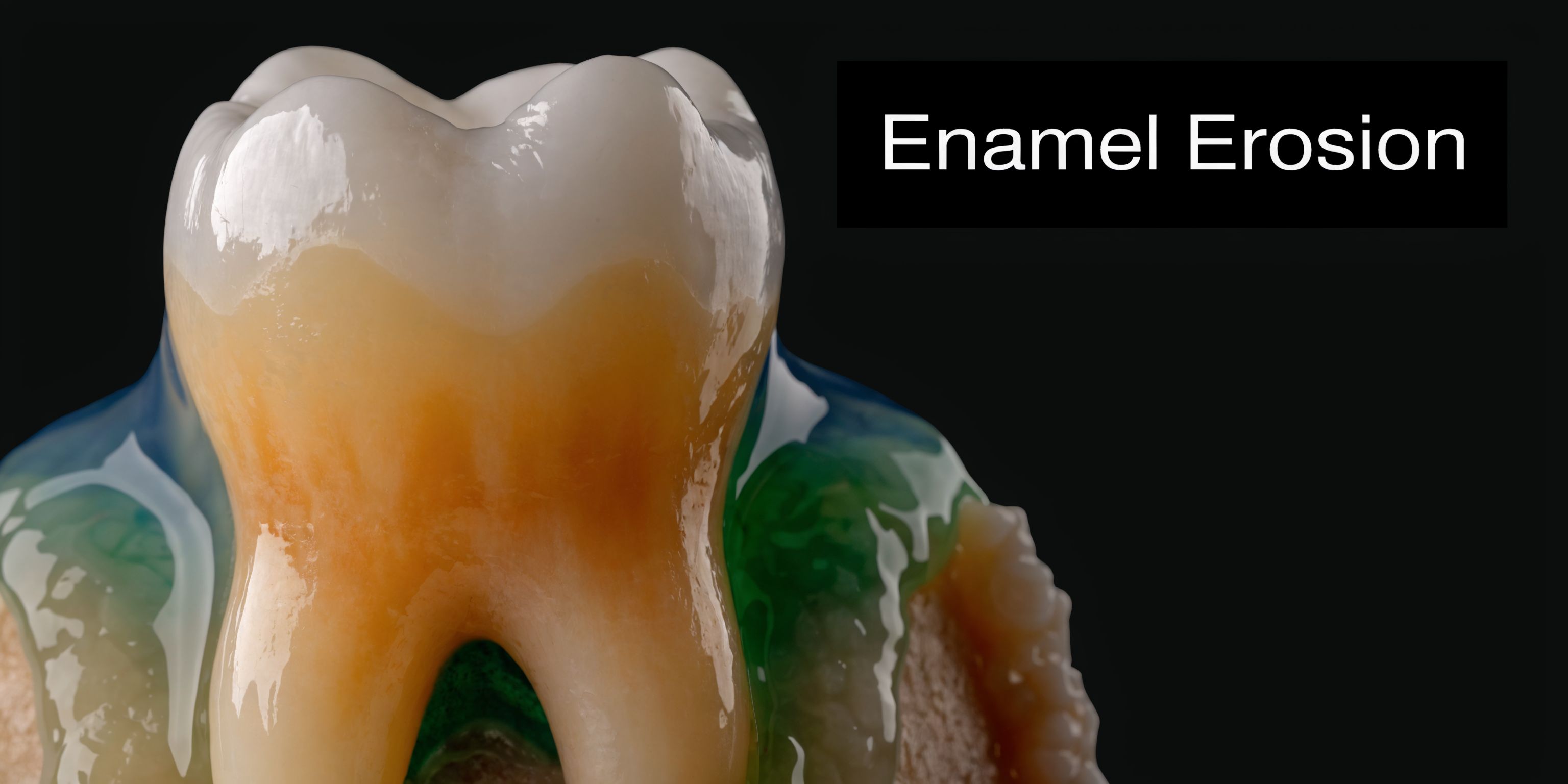
That can wear the protective surface over time, especially near the gumline. Using a hard-bristled brush or abrasive toothpaste can add to the problem.
Other patients notice sensitivity after years of frequent acidic drinks or foods. Soda, citrus, sports drinks, and similar choices can soften and wear enamel. The change is often gradual, so people don’t notice it until cold starts hurting.
A third group grinds or clenches. Grinding places repeated force on teeth and can flatten biting edges, create tiny cracks, and expose more vulnerable areas.
A 2023 report summarized in this discussion of stress-induced bruxism and cold-sensitive teeth states that bruxism affects 31% of adults. The same source notes that post-pandemic anxiety has led to a significant spike in bruxism cases, which helps explain why more adults notice sensitivity even when they don’t see visible damage.
Gum recession and exposed roots
The root of a tooth is not covered by enamel the way the crown is.
That matters because exposed root surfaces are much more sensitive to temperature. If the gumline pulls back, cold can hit the root directly.
Recession can happen for several reasons:
- Periodontal disease can weaken the support around teeth and allow gums to recede.
- Aggressive brushing can wear the gumline down over time.
- Genetics can make gum tissue naturally thinner.
- Aging can make areas of recession more noticeable.
If you want a deeper look at what leads to this, this page on what causes receding gums in adults is a helpful companion.
The single-tooth problem
Sometimes only one tooth reacts to cold.
That can happen when there’s a small cavity, a tiny crack, a worn filling edge, or localized gum recession in one spot. Patients often assume a single sensitive tooth means they’ll need a root canal, but that’s not always the case. A careful exam can separate a surface problem from a nerve problem.
Other situations that can trigger sensitivity
A few causes don’t fit neatly into the “worn enamel” or “receding gums” categories, but they still matter:
- Recent dental work can leave a tooth temporarily more reactive.
- Small cracks can let cold penetrate deeper into the tooth.
- Cavities remove healthy structure and expose sensitive inner layers.
- Whitening products or acidic oral products can irritate already vulnerable teeth.
A sensitive tooth is often less about the cold itself and more about what the cold is able to reach.
A useful self-check
Ask yourself these questions:
- Does it happen with cold air too, or only drinks?
- Is it one tooth or several?
- Did it start after whitening, a filling, or a cleaning?
- Do you wake up with jaw tightness or signs of grinding?
- Have your gums looked lower near one tooth than they used to?
Those details help a dentist in Chattanooga or Cleveland, TN narrow down the cause much faster.
Simple Home Care for Managing Sensitive Teeth
Home care won’t fix every cause of sensitivity, but it can make a real difference. It also helps prevent small problems from becoming bigger ones.
The key is to reduce irritation while protecting the tooth structure you still have.
Start with your toothbrush and technique
If you’re using a medium or hard brush, switch to a soft-bristled one.
Brush with light pressure. Think gentle circles or small strokes, not scrubbing. Many people damage enamel and gum tissue because they believe harder brushing means cleaner teeth. It doesn’t.
If cold sensitivity is tied to gum recession, gentle brushing matters even more. Cleveland Clinic’s overview of teeth sensitivity and gum recession notes that gum recession affects up to 58% of adults globally, and the CDC reports that nearly half of U.S. adults over 30 have periodontal disease, the leading cause of gum recession.
Use the right toothpaste
A desensitizing toothpaste can help calm the tooth’s response over time.
Look for products with potassium nitrate if your dentist has suggested sensitivity toothpaste. These are designed to reduce how strongly the nerve reacts.
Fluoride toothpaste can also help support enamel. If you’re trying to choose one, this guide to the best toothpaste for teeth can help you compare options in a practical way.
Change a few daily habits
Small habits can keep sensitivity from getting worse.
- Cut back on frequent acid exposure by limiting soda, citrus-heavy drinks, and similar items that soften enamel.
- Rinse with water after acidic foods so the mouth returns to a friendlier environment.
- Don’t brush immediately after acidic drinks because enamel may be softer right then.
- Pay attention to clenching if your jaw feels tight, sore, or fatigued.
If you think grinding is part of it
Nighttime grinding often goes unnoticed until a partner hears it, or until the teeth begin to wear.
A custom night guard from a dental office offers better protection than a generic one-size-fits-all option. The goal is to reduce the force on the teeth and prevent more enamel loss.
The best home care for sensitivity is protective, not aggressive. Gentler brushing, targeted toothpaste, and fewer acid exposures usually help more than “deep cleaning” your teeth at home.
When home care isn’t enough
If the pain is getting sharper, lasting longer, or centered on one tooth, home care should not be your only plan.
That usually means the tooth needs more than symptom management. It needs an exam to find out whether the issue is recession, decay, a crack, a filling problem, or irritation inside the tooth.
Modern Dental Treatments for Lasting Sensitivity Relief
When sensitivity keeps coming back, professional treatment usually focuses on one question. What exactly is exposed, irritated, or damaged, and how do we protect it?
That makes treatment much more precise than trial-and-error home remedies.
When the tooth needs sealing
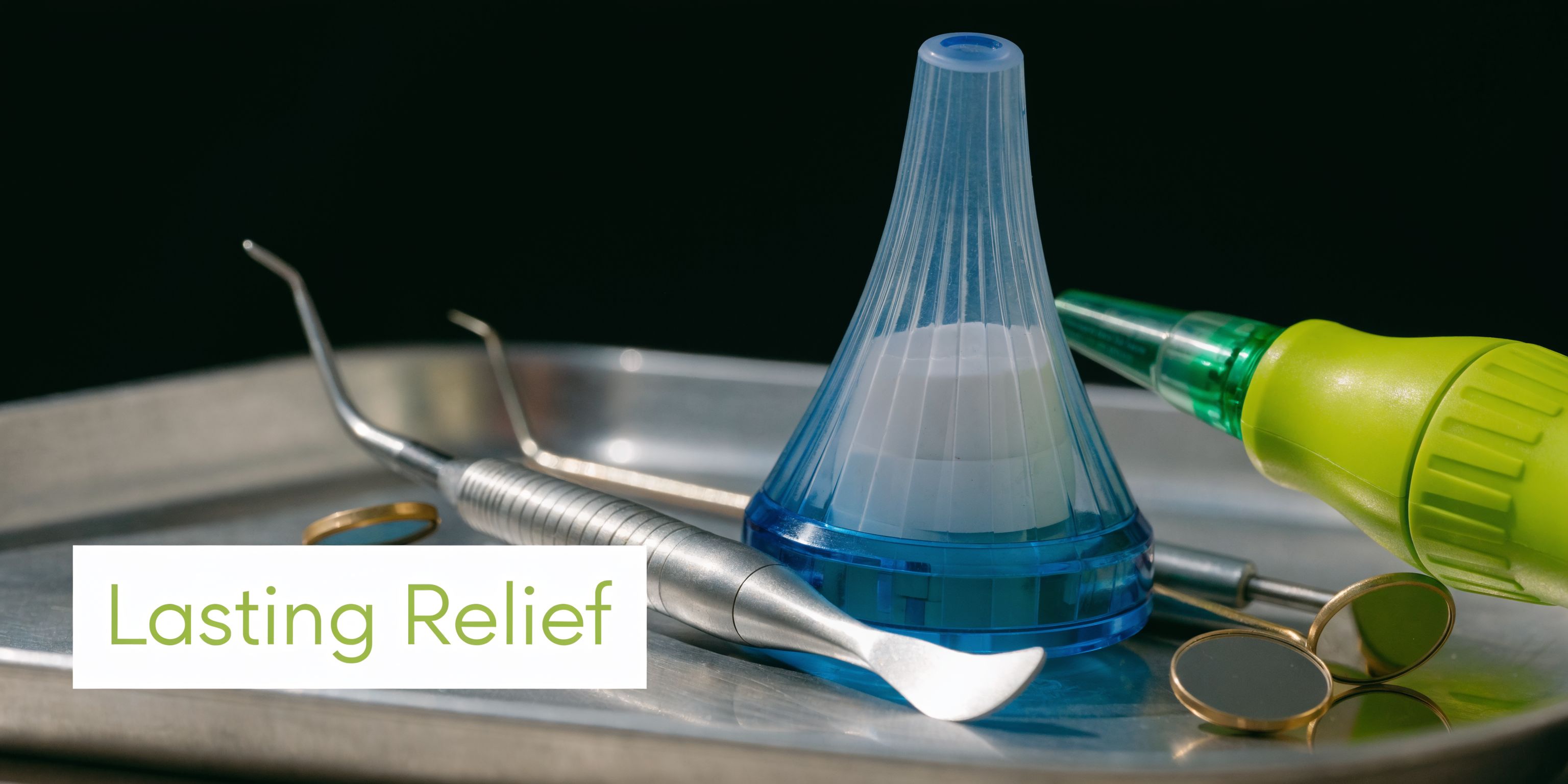
If exposed dentin is the main issue, a dentist may recommend an in-office desensitizing treatment.
These materials help seal open tubules so cold is less able to trigger the tooth. One benchmark often cited for this approach is strong short-term relief. A clinical benchmark for 5% potassium oxalate sealants and sensitivity reduction reports that in-office treatments can reduce post-treatment sensitivity by 70% to 90% within four weeks.
That doesn’t mean every patient needs the same product. It means in-office treatment can work far better than trying random toothpaste after random toothpaste.
If recession is exposing the root
When the root surface is the problem, treatment depends on how advanced the recession is.
A dentist may recommend:
- Professional cleanings and periodontal care if gum inflammation is contributing
- Bonding to cover sensitive exposed root surfaces
- Laser dentistry for gentle gum-focused treatment in appropriate cases
- Gum grafting referral or planning when recession is advanced and the root needs more permanent coverage
Care that considers all aspects matters here. The best treatment isn’t always the one that gives the fastest temporary numbness. It’s the one that protects the tooth and gum support long term.
When the tooth structure itself is damaged
Sensitivity sometimes comes from a cracked edge, a cavity, a leaky filling, or a tooth that has lost too much protective structure.
In those cases, covering the tooth can be the most effective answer.
Same-day crowns
A same-day crown can protect a weakened tooth, seal vulnerable surfaces, and restore strength in one visit. For a tooth that hurts with cold because the outer shell is compromised, a crown often solves both the symptom and the structural problem.
Bonding or fillings
If the issue is smaller, bonding or a new filling may be enough. These treatments close off areas where cold is getting in.
Root canal therapy
If the nerve inside the tooth is inflamed beyond what a surface treatment can handle, a root canal may be the right pain-relieving treatment. Patients often hear that term and assume the worst, but the true point of root canal care is to remove the irritated tissue and allow the tooth to function comfortably again.
Lasting sensitivity relief usually comes from protecting the exposed area, not just masking the pain.
Matching the treatment to the cause
This simple comparison helps:
| Problem found | Likely treatment direction |
|---|---|
| Open dentin tubules | Desensitizing sealant or fluoride-based in-office care |
| Exposed root from recession | Periodontal treatment, bonding, or laser dentistry |
| Cracked or worn tooth | Bonding or same-day crown |
| Cavity or failing filling | Filling replacement or restorative treatment |
| Inflamed pulp | Pulp-protective treatment or root canal care |
Why modern care feels different
Many patients delay treatment because they expect old-fashioned dentistry.
Modern offices often use digital imaging, more conservative restorative techniques, and comfort-focused options that make care much easier than people expect. If dental anxiety has kept you from booking a new patient exam, that’s worth mentioning early. Comfort planning is part of good treatment, not an afterthought.
Is Your Tooth Sensitivity a Dental Emergency?
Not every cold-sensitive tooth is an emergency. Some cases are mild and improve with home care and routine dental treatment.
But some symptoms should move you from “I’ll keep an eye on it” to “I need to call a dentist.”

Signs it can wait for a regular appointment
A routine visit is usually appropriate when:
- The pain is brief and only happens with cold
- Several teeth feel mildly sensitive rather than one tooth standing out
- It started after whitening or recent dental work and seems to be easing
- You can still chew normally without lingering discomfort
Even then, it’s worth mentioning at your next cleaning and exam. Mild sensitivity can become a bigger issue if the cause is active wear, early decay, or recession.
Signs you should call sooner
Cold sensitivity needs quicker attention if the pattern changes.
Call sooner if:
- One tooth is clearly the problem
- The pain lingers after the cold is gone
- Chewing hurts too
- The gum around the area looks swollen or irritated
- The tooth feels cracked, chipped, or suddenly different
- The pain has become stronger or more frequent
A discussion of single-tooth cold sensitivity and early reversible recession notes that if only one tooth is sensitive to cold, it may be an early warning sign of localized gum recession or a small cavity, not aging. The same source notes that 40% of recession cases in adults ages 30 to 50 stem from early, reversible gingivitis, which is one reason early treatment matters.
When it acts more like an emergency
Sensitivity becomes more urgent when it stops behaving like simple sensitivity.
Watch for these changes:
| Symptom | What it may suggest |
|---|---|
| Lingering pain | Deeper irritation inside the tooth |
| Swelling | Infection or gum involvement |
| Pain with pressure | Crack, decay, or bite-related injury |
| Night pain | Inflamed nerve tissue |
| One area suddenly worsening | Localized damage that needs prompt care |
If the pain is sharper, lasts longer, or points to one exact tooth, don’t wait and hope it settles down on its own.
Why early action matters
People often postpone treatment because they’re trying to avoid something major.
Ironically, early care is what most often helps people avoid more complex treatment later. A simple cleaning, a small filling, or a focused gum treatment is much easier than waiting until the tooth needs extensive restorative dentistry, tooth extraction, or replacement options like dental implants.
Your First Visit at Winn Smiles in Chattanooga or Cleveland
If you’ve been putting this off, the first visit is usually much more straightforward than people expect.
You come in, get settled, and talk through what you’ve been noticing. That conversation matters. A tooth that hurts only with cold is different from one that hurts with cold, sweets, and chewing. The timing, the trigger, and whether it’s one tooth or many all help narrow the cause.
What a sensitivity exam usually includes
A new patient exam for cold sensitivity often involves a few simple steps:
- A close visual exam to check for wear, recession, cracks, and decay
- Dental x-rays if needed to see what isn’t visible from the surface
- A gum health check to look for inflammation or areas where roots are exposed
- Bite evaluation if clenching or grinding may be part of the picture
Sometimes the answer is obvious. Other times, it takes a careful process of ruling out a few possibilities.
Comfort matters during diagnosis
If you’re anxious about dental visits, say that at the start.
Good care isn’t only about finding the cause. It’s also about helping you feel comfortable while that happens. Many patients who need a dentist in Cleveland, TN or an emergency dentist near Chattanooga worry they’ll be lectured or rushed. A patient-centered office should feel calm, clear, and respectful from the first conversation forward.
What happens after the exam
Once the cause is identified, the next step is a treatment plan that matches the actual problem.
That may be simple home-care guidance and routine cleanings. It may be a desensitizing in-office treatment, laser dentistry for gum concerns, bonding, restorative dentistry, or a same-day crown. If the tooth is more seriously damaged, the plan may include root canal treatment, tooth extraction, or replacement planning.
The important part is clarity. You should leave knowing what’s causing the pain, what can be done about it, and which option makes the most sense for your goals, comfort, and budget.
If cold drinks, winter air, or ice cream keep setting off sharp tooth pain, it’s time to get a clear answer. Winn Smiles serves patients in Chattanooga, Cleveland, TN, and nearby communities with modern dental care, including new patient exams, dental x-rays, cleanings, emergency dentistry, laser dentistry, same-day crowns, restorative dentistry, cosmetic dentistry, tooth extraction, and dental implants. Schedule a visit to find the cause of your sensitivity and get a practical plan for lasting relief.