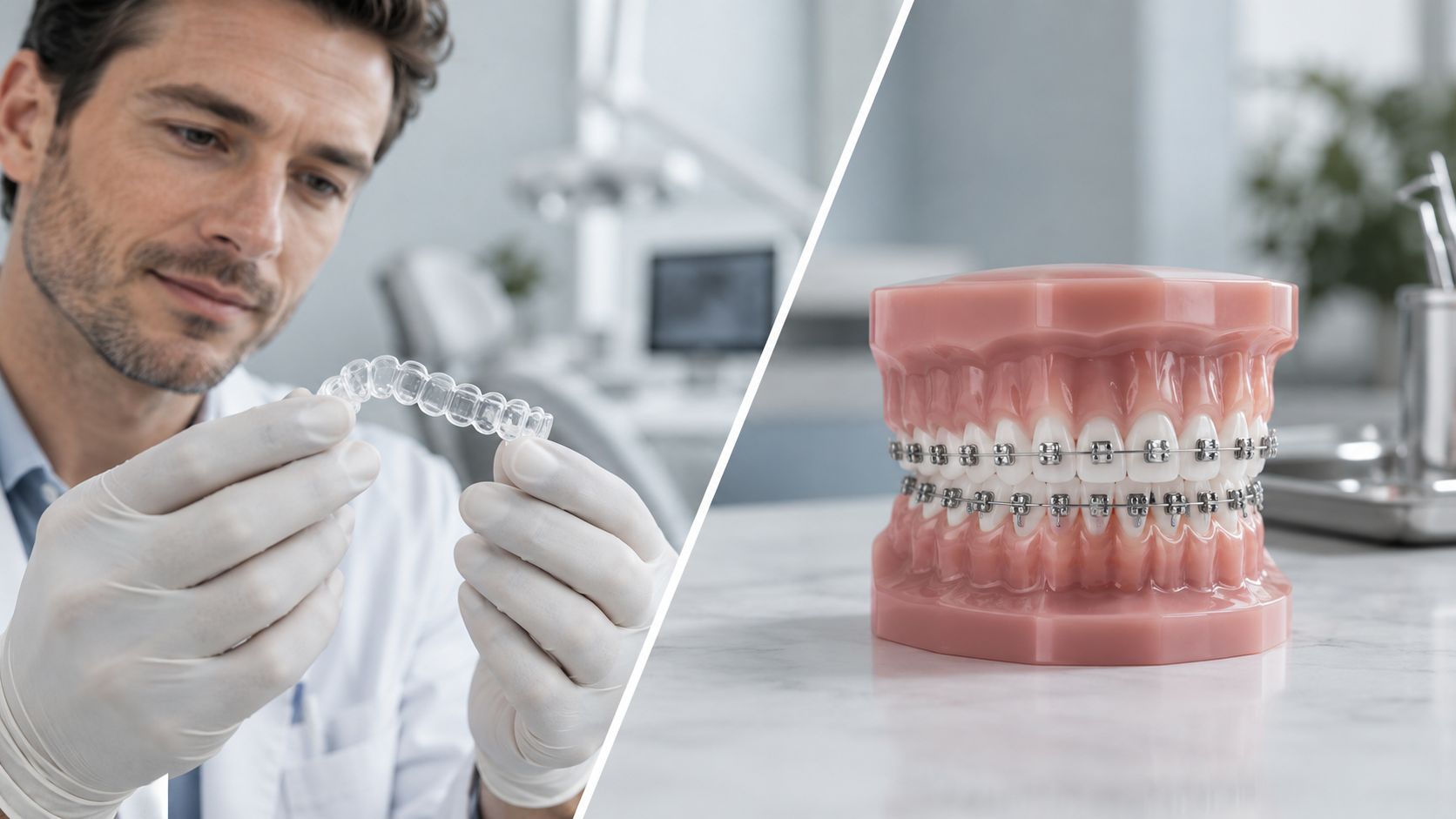
You're sitting in the consultation chair with a crooked front tooth, crowded lower teeth, or a bite that never felt quite right. You've probably searched for a dentist near me, compared clear trays with metal brackets, and wondered whether Invisalign is the more modern choice.
The honest answer is more useful than a universal winner. Clear aligners vs braces is a clinical decision based on your bite, the movements your teeth need, and whether you'll consistently follow the treatment plan. At Winn Smiles, patients in Cleveland, Chattanooga, and nearby communities can discuss those factors during a consultation instead of choosing from an advertisement.
Why Adults and Families in Cleveland and Chattanooga Are Asking About Clear Aligners vs Braces
“Should I do Invisalign or just get braces?” That's the question many patients bring to the front desk. Adults may be thinking about job visibility, photographs, presentations, or a wedding. Parents may be deciding for a teenager whose growth, sports schedule, and ability to manage removable trays all affect the recommendation.
Clear aligners have made orthodontic treatment feel simple. Take a scan, receive a series of trays, and watch the teeth move. Braces can seem like the more old-fashioned option because brackets and wires are visible. Inside the mouth, however, the choice is more complicated than appearance.
Start with the problem, not the appliance
A small amount of front-tooth crowding isn't the same problem as a posterior crossbite, a severe overbite, or a rotated canine. Teeth may need to tip, turn, move vertically, or change how the upper and lower arches meet. Each movement creates different mechanical demands.
Clear aligners emerged as a modern orthodontic option in the late 1990s. Align Technology was founded in 1997, and the first commercial Invisalign system launched in 1999. By 2001, clear aligners were being distributed in Italy and other European countries, marking broader adoption beyond the United States (historical review of clear aligner therapy).
That history explains why aligners are now familiar, but familiarity doesn't make them suitable for every mouth. The right treatment is the one that can produce the required movements predictably while fitting your daily routine.
Three questions matter most
Before comparing colors, attachments, or appointment convenience, ask:
- What must move? Mild spacing and straightforward crowding often differ greatly from bite correction or difficult rotations.
- Can you manage removable treatment? Aligners need consistent wear, cleaning, and safe storage.
- What must remain stable afterward? Retention affects both the appearance and function of your result.
Research comparing aligners with fixed braces supports that nuanced view. Both can improve malocclusion, but braces generally perform better for occlusal contacts, torque control, transverse width changes, posterior buccolingual inclination, and retention stability, while aligners tend to be stronger for segmented tooth movement in suitable cases (comparative review of clear aligners and fixed appliances).
A consultation should therefore answer a practical question: Which appliance gives your particular teeth the control they need?
How Clear Aligners and Braces Actually Compare
The clearest way to compare the options is to match each feature to your priorities. Treatment length, effectiveness, comfort, hygiene, appointments, and cost all matter, but they don't carry equal weight for every patient.
Clear Aligners vs Braces Side-by-Side Comparison
| Criterion | Clear Aligners | Traditional Braces |
|---|---|---|
| Appearance | Nearly invisible trays | Visible brackets and wires |
| Daily responsibility | You must wear and care for the trays consistently | The appliance stays fixed |
| Best fit | Many mild-to-moderate alignment cases | Complex movements and bite corrections |
| Comfort | Smooth plastic edges, with pressure as teeth move | Bracket or wire irritation and adjustment pressure |
| Hygiene | Remove trays to brush and floss normally | Clean around brackets and wires carefully |
| Eating | Remove trays before eating | Avoid foods that can damage brackets or wires |
| Follow-up | Progress checks may be shorter and less frequent | Regular in-office adjustments are needed |
| Predictability | Depends on case selection, attachments, refinements, and wear | Continuous force gives the clinician direct control |
| Cost | Depends on treatment scope and what the plan includes | Depends on appliance type, complexity, and duration |
For a more detailed overview of appearance and treatment differences, review Winn Smiles' comparison of Invisalign and traditional braces.
Treatment time
Research doesn't support treating one timeline as universal. A 2019 meta-analysis found no statistically significant difference in overall objective treatment grading, while clear aligner cases finished about 6.31 months faster on average than braces. The analysis included 353 clear-aligner patients and 353 braces patients, with a 95% confidence interval of -8.37 to -4.24 and p<0.001 (2019 meta-analysis of aligners and fixed braces).
A separate 2026 comparative clinical study reported average treatment duration of 20.77 ± 6.43 months for clear aligners and 27.47 ± 4.81 months for braces, while finding no significant difference in overbite improvement or overjet reduction (comparative clinical study). Those findings describe study groups, not a promise for your case.
Effectiveness and comfort
Aligners can be comfortable because there are no bonded brackets or archwires rubbing against the cheeks. Braces may feel more noticeable after adjustments, but their fixed design means you don't have to remember to put them back in.
For mild-to-moderate, nonextraction cases, aligners can offer an efficiency advantage. For complex bite correction, braces often provide more direct control. Comfort matters, but it shouldn't outrank the appliance's ability to finish the job properly.
Hygiene, follow-up, and cost
Removable trays let you brush and floss without working around brackets. Braces require more deliberate cleaning because food and plaque can collect around wires and brackets. Neither option removes the need for professional cleaning and exams.
Follow-up schedules vary by treatment plan and office. Aligners may require shorter progress visits, while braces need adjustments and wire changes. Cost also depends on the number of movements, length of treatment, refinements, retainers, and insurance. A written estimate is more useful than a general online price.
Chairside rule: If the option looks convenient but asks you to ignore a major bite problem, it isn't convenient. It's the wrong match.
What Each Option Does Inside Your Mouth
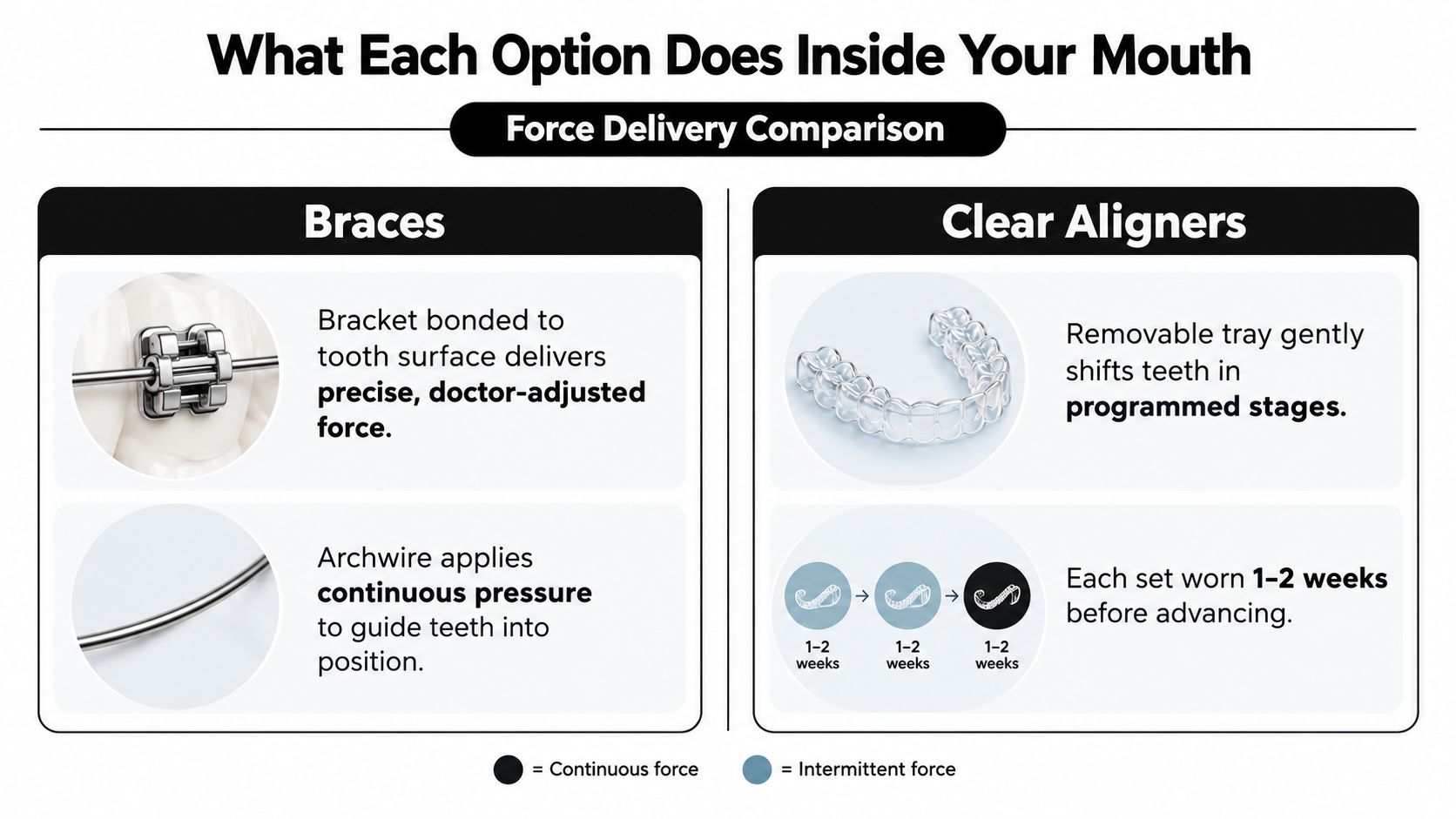
Braces move teeth with bonded brackets and archwires. Each bracket gives the wire a point of contact, and the wire applies continuous, clinician-controlled force. That arrangement helps guide rotations, vertical movements, and bite corrections that require carefully managed force and anchorage.
As teeth move, the surrounding bone remodels. Controlled pressure creates a biological response that allows a tooth to change position, while the clinician adjusts the appliance to control direction. Braces remain attached, so the force delivery doesn't depend on whether you remember to wear the appliance that day.
Clear aligners use a different system. Each custom tray is shaped to apply pressure to selected surfaces, moving teeth through programmed stages. You remove the trays for meals and cleaning, then replace them. The treatment only works as planned when the trays are worn consistently.
Why attachments matter
Clear aligners aren't just transparent plastic. Many cases need tooth-colored attachments, small bonded shapes that give the tray a better grip and help create specific force vectors. Biomechanics reviews describe attachments as active surfaces that contact the aligner, which means their design directly affects how effectively the tray can move a tooth (review of aligner attachments and biomechanics).
Some patients also need elastics for bite correction. Others need interproximal reduction, which carefully creates space between selected teeth. These additions don't mean aligners have failed. They show that aligner treatment depends on planning the mechanics precisely.
The predictability question
A systematic review reported that only 41% of predicted Invisalign tooth movement was achieved in one body of evidence. Another review found low-to-moderate certainty for movement efficiency and noted that many movements aren't predictable enough to complete with a single tray sequence (systematic review of clear aligner predictability).
That's why refinements and case selection matter. A scan can show an attractive projected result, but the clinical plan must account for how your teeth respond, whether attachments can generate the needed force, and whether a fixed appliance would offer better control.
Winn Smiles explains the practical mechanics in its guide to how clear aligners work. During a consultation, the important question isn't whether a computer can display a finished smile. It's whether the planned movements fit aligner physics and your willingness to follow the daily routine.
Which Option Fits Your Situation Best
The best choice changes with the patient. A removable appliance can be excellent for one person and unreliable for another, even when their teeth look similar in a photograph.
A working adult with mild lower crowding
Suppose you have mild crowding in the lower front teeth, want treatment to stay discreet for a wedding, and already maintain a reliable brushing routine. Clear aligners may fit well because you can remove them for meals, photos, and cleaning. They also make it easier to keep normal access to the tooth surfaces and gumline.
That recommendation assumes the bite is suitable and that you'll wear the trays as directed. If you routinely leave them out during long workdays or social events, the aesthetic benefit won't compensate for lost wear time.
A growing teenager
A 13-year-old with a developing bite may need a different approach. If the second molars haven't fully erupted and the jaw is still growing, fixed braces may provide more predictable guidance through the available tooth positions and developing bite.
Parents should also consider responsibility. A teenager who misplaces trays, forgets to replace them after eating, or removes them for sports without a reliable routine may do better with an appliance that stays in place.
A complex bite
Rotated canines, significant overbite, posterior crossbite, and teeth that need vertical intrusion place higher demands on force control. In those situations, bonded brackets and archwires often offer the more dependable route. A hybrid plan may also be appropriate when aligners handle some movements and fixed appliances finish others.
| Situation | Aligners | Braces | Typical Winner |
|---|---|---|---|
| Mild front-tooth crowding | Discreet and removable | Effective but visible | Aligners |
| Reliable adult with image concerns | Convenient for work and events | No daily wear decision | Aligners |
| Growing teen with developing bite | Requires close wear supervision | Fixed guidance | Braces |
| Rotated canine or vertical movement | May need attachments and refinements | Stronger mechanical control | Braces |
| Posterior crossbite or complex overbite | Case-dependent | Often more predictable | Braces |
| Patient who struggles with routines | Risk of missed wear | Works continuously | Braces |
The short version: Cosmetic and mild-to-moderate alignment problems often favor aligners. Skeletal or multi-vector corrections still commonly favor braces.
The final decision belongs in a Cleveland or Chattanooga consultation, where the clinician can evaluate the bite instead of relying on an advertisement.
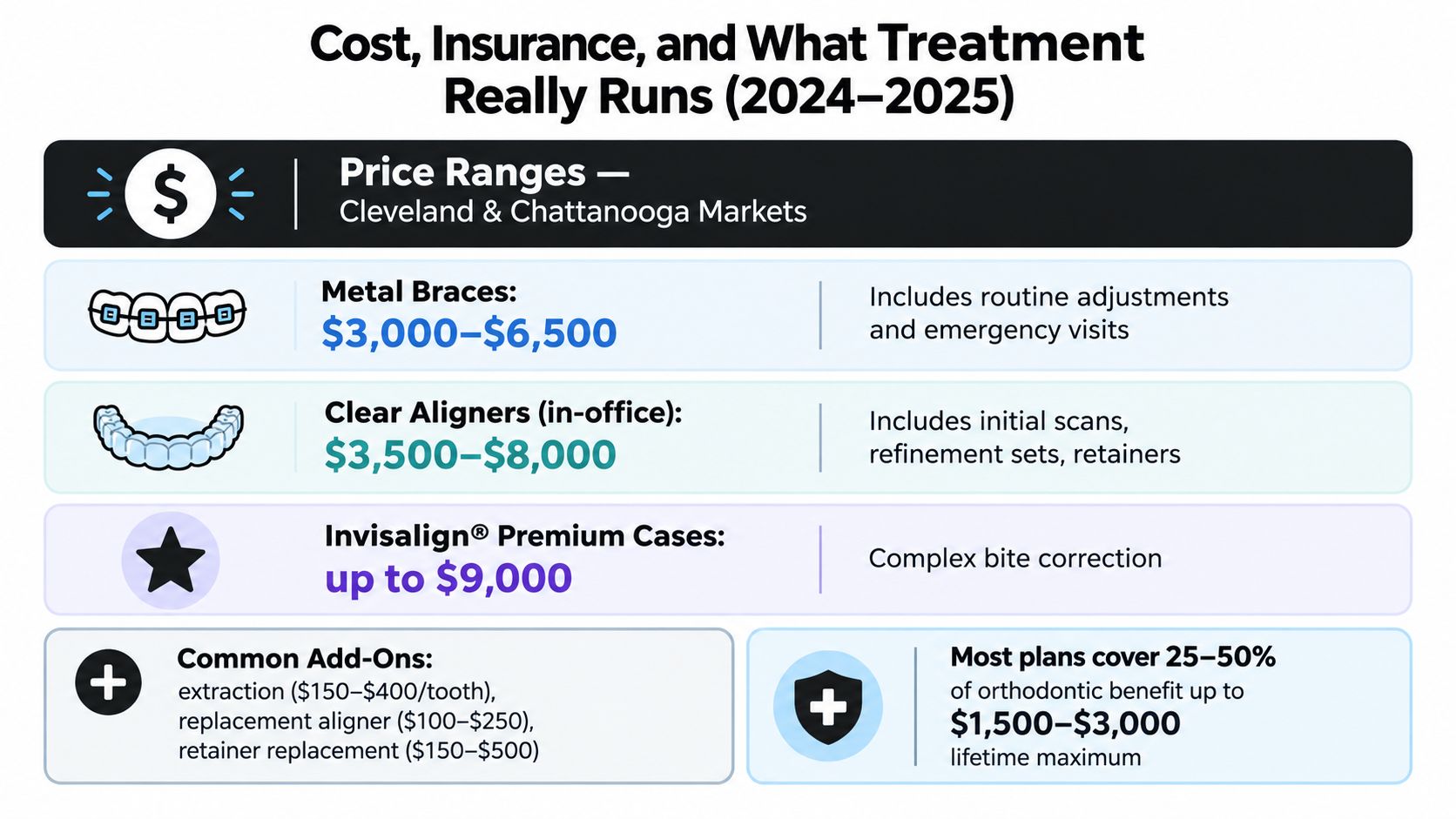
Cost, Insurance, and What Treatment Really Runs
Cost depends on the work your teeth and bite require. Two patients using the same appliance can receive different fees when one plan includes more movements, a longer treatment period, refinements, retention, or bite correction.
A general online price cannot account for those differences. In a Cleveland or Chattanooga consultation, ask for a written estimate that explains what the fee includes and what could create an additional charge. The estimate should also identify whether the quoted amount covers the full planned treatment or only the initial phase.
What belongs in the estimate
A useful treatment estimate should clarify:
- Diagnostic records: Ask whether the consultation includes photographs, digital scanning, and necessary imaging.
- Active treatment: Confirm whether adjustments, tray sequences, attachments, elastics, and planned refinements are included.
- Unexpected events: Ask how the office handles a lost aligner, broken bracket, or visit required because treatment is not tracking.
- Retention: Find out whether retainers are included, how replacements are handled, and what ongoing wear the clinician recommends.
Clear aligner treatment can require refinement trays when teeth do not track as planned. Braces can require repair visits after a bracket or wire breaks. These possibilities should be clear before you sign, along with any fees that may apply.
Insurance and financing
Orthodontic coverage depends on the plan, patient age, contract terms, and treatment details. A policy may cover treatment, exclude it, or limit benefits for dependents, adults, appliances, or lifetime use. Winn Smiles can review the information you provide, but your insurer makes the final coverage determination.
Compare the total treatment fee, deposit, monthly payment, retention costs, and excluded services before choosing a payment plan. The cheapest monthly payment isn't automatically the lowest total cost.
Retention is part of treatment
Teeth can shift after aligners or braces. Retainers may be fixed, removable, or combined, depending on your result and risk of movement. Include long-term retention in your original budget instead of treating it as an optional afterthought.
Ask who checks the retainers, when replacements may be needed, and what to do if one breaks or stops fitting. Protecting the finished result is part of the treatment plan.
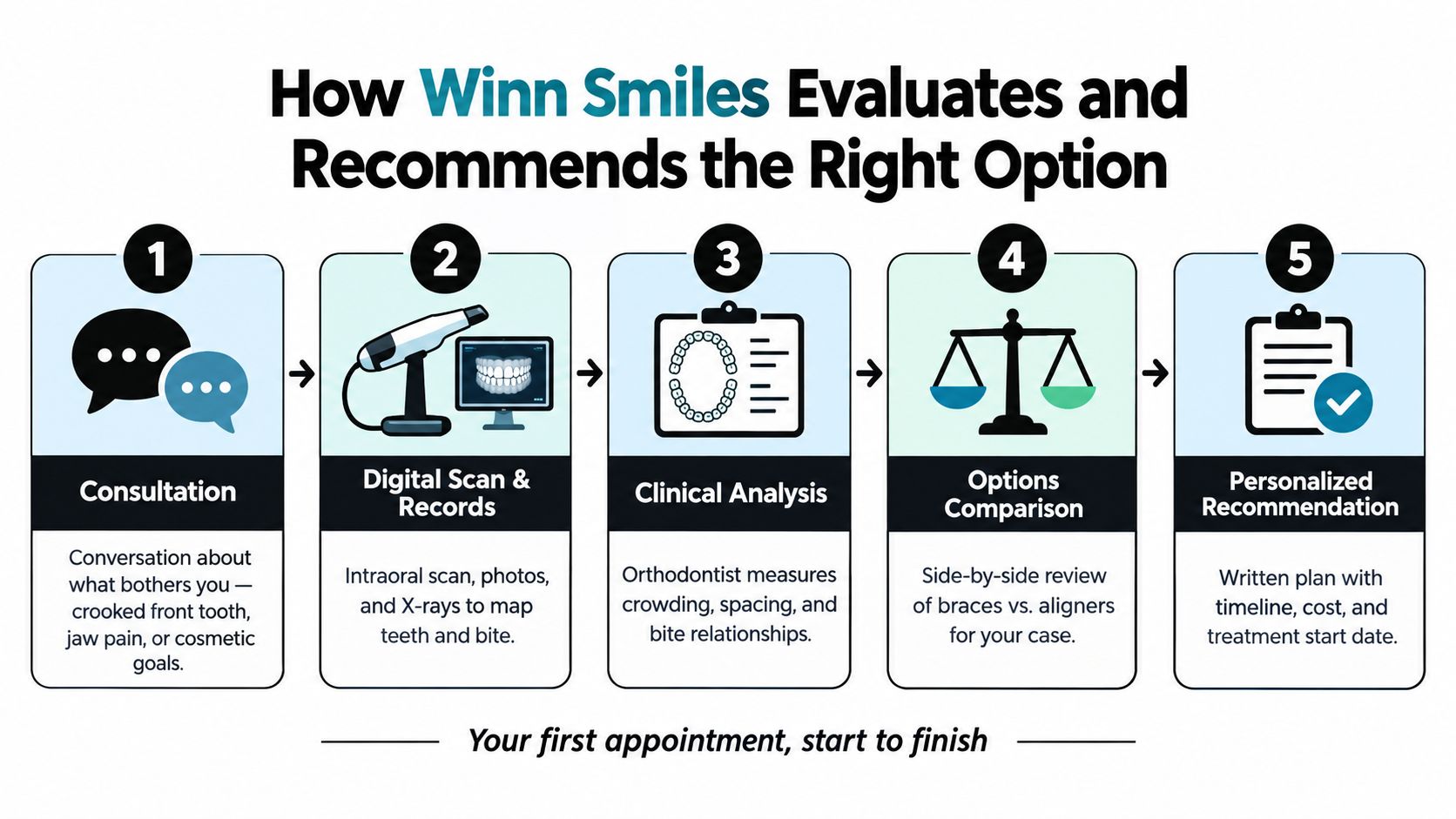
How Winn Smiles Evaluates and Recommends the Right Option
The first appointment should feel like a clinical conversation, not a sales presentation. You might begin by explaining a crooked front tooth, jaw soreness, relapse after stopping an old retainer, or a goal tied to an upcoming event.
The team then gathers records that show more than a front-facing smile. Intraoral and facial photographs document the teeth and soft tissues. A digital iTero scan replaces gooey impressions and captures the arches in three dimensions. A panoramic radiograph helps assess root position and supporting bone.
The recommendation process
Once the records are available, the doctor maps planned tooth movement in three dimensions. The discussion can compare aligner staging with bracket placement, including predicted movements, attachments, interproximal reduction, elastics, and the likely treatment sequence.
The conversation should also include your daily life. Be honest about whether you can manage removable trays. Mention your profession, contact sports, musical activities, upcoming restorative work, and any concern about dental anxiety. Those details can affect which appliance is practical.
A written estimate and insurance verification help you make the decision without pressure. If you want outside help understanding the broader digital and marketing services that support healthcare practices, you can see what the team offers.
The media below provides another visual explanation of the treatment decision and consultation experience.
Winn Smiles offers Invisalign as one treatment option, but the recommendation should follow the examination. If your needs extend beyond alignment, the same dental practice can also discuss cleanings and exams, dental x-rays, teeth whitening, cosmetic dentistry, restorative dentistry, tooth extraction, dental implants, and emergency dental services when appropriate.
Book Your Clear Aligner or Braces Consultation in Cleveland or Chattanooga
If you're searching for a cosmetic dentist near me, an emergency dentist, or a practice that can coordinate orthodontic and restorative care, start with a consultation focused on your actual bite. Winn Smiles serves patients in Cleveland and Chattanooga, Tennessee, with offices designed around comfortable, clear communication and modern records.
Before you arrive, bring your insurance card, any recent dental x-rays you have, a list of current medications, and a short note describing what you want to change. Include concerns such as crowding, a crooked front tooth, chewing difficulty, jaw soreness, or a previous orthodontic relapse.
What to expect at the first visit
Your appointment can include:
- Conversation: Explain your concerns, priorities, schedule, and treatment preferences.
- Records: Complete photographs, a digital scan, and bite assessment, with imaging when clinically appropriate.
- Recommendation: Review whether aligners, braces, or a combined approach better fits the required movements.
- Planning: Discuss anticipated treatment stages, attachments or other additions, retention, fees, insurance, and financing.
Ask the scheduling team about current evening or weekend availability if you work regular daytime hours or coordinate appointments for children. You can also ask about financing pre-approval before treatment begins, so the financial plan is clear.
For patients researching how practices build accessible local care information, this resource on partnering with Transactional LLC offers additional context. Your treatment decision, however, should come from your examination and conversation with the dental team.
You don't need to decide between clear aligners and braces before the appointment. You need enough information to understand your bite, your responsibilities, the expected plan, and the full cost. Contact Winn Smiles through its website or the office scheduling team to arrange a consultation in Cleveland or Chattanooga, and ask about the current hours, appointment availability, and any consultation offer that applies to your service.
Winn Smiles provides Invisalign consultations and braces evaluations for patients in Cleveland and Chattanooga who want treatment matched to their bite, habits, and goals. Visit Winn Smiles to request an appointment, discuss your options, and take the next step toward a healthier, more confident smile.