You notice it in small moments. A front tooth looks a little more crowded in the rearview mirror after work in Chattanooga, or your teenager in Cleveland keeps turning away from photos because smiling feels uncomfortable. Maybe your bite feels uneven, food catches between overlapping teeth, or you're searching for a dentist near me because an old orthodontic result has started to shift.
Misaligned teeth can affect appearance, cleaning, chewing, speech, and bite comfort. The right answer to how to fix misaligned teeth isn't always clear aligners, and it isn't always braces. Treatment depends on the relationship between your teeth and jaws, the health of your gums and bone, the movement required, and the result you want to maintain.
Why Misaligned Teeth Deserve Your Attention
A crooked smile is often the concern that brings a patient into the office, but it's rarely the only issue. Overlapping teeth can create narrow spaces where a toothbrush and floss don't clean effectively. Plaque then remains around the gumline and between teeth, increasing the challenge of preventing decay and gum inflammation. Regular cleaning and exams, along with a proper evaluation, can show whether alignment is contributing to those problems.
A patient may also notice that one side does more of the chewing. When upper and lower teeth meet unevenly, biting forces can concentrate on particular teeth instead of spreading comfortably across the dental arch. That can contribute to premature wear, sensitivity, or damage in a tooth that already has a large filling. Jaw muscles and the temporomandibular joints can also feel strained when the bite doesn't close evenly.

The mouth and airway connection
A narrow dental arch or a bite that doesn't allow comfortable lip closure may occur alongside mouth breathing. Mouth breathing has several possible causes, so straightening teeth alone isn't a guaranteed solution, but a conversation about breathing, snoring, daytime fatigue, and sleep quality belongs in a complete assessment. Winn Smiles also evaluates patients seeking care for sleep apnea and can discuss appropriate therapeutic options when indicated.
Misalignment is common worldwide. The Cleveland Clinic reports that malocclusion affects about 56% of people globally and describes it as a problem involving how the teeth fit together, not merely whether individual teeth look straight (Cleveland Clinic's overview of malocclusion). That distinction matters because an attractive row of teeth doesn't automatically mean the bite is stable or functional.
Practical rule: Don't choose an appliance from a photograph alone. A dentist or orthodontist needs to assess the bite, roots, supporting bone, and gum health before recommending movement.
A dental examination may include dental X-rays, photographs, and digital scans. If a tooth is painful, loose, badly broken, or infected, restorative care or a tooth extraction may need to come before alignment. A patient looking for an emergency dentist should address urgent pain or swelling first, rather than beginning elective cosmetic treatment.
Understanding Your Bite and Malocclusion Types
Dentists use malocclusion to describe an imperfect fit between the upper and lower teeth. The classification organizes the diagnosis, but it does not decide treatment. Two patients with the same class may need different plans because crowding, jaw growth, gum support, tooth shape, and bite function can vary.
Class I is the most common pattern, followed by Class II and Class III (Cleveland Clinic's malocclusion reference). These categories describe bite relationships, not whether a particular treatment will succeed.
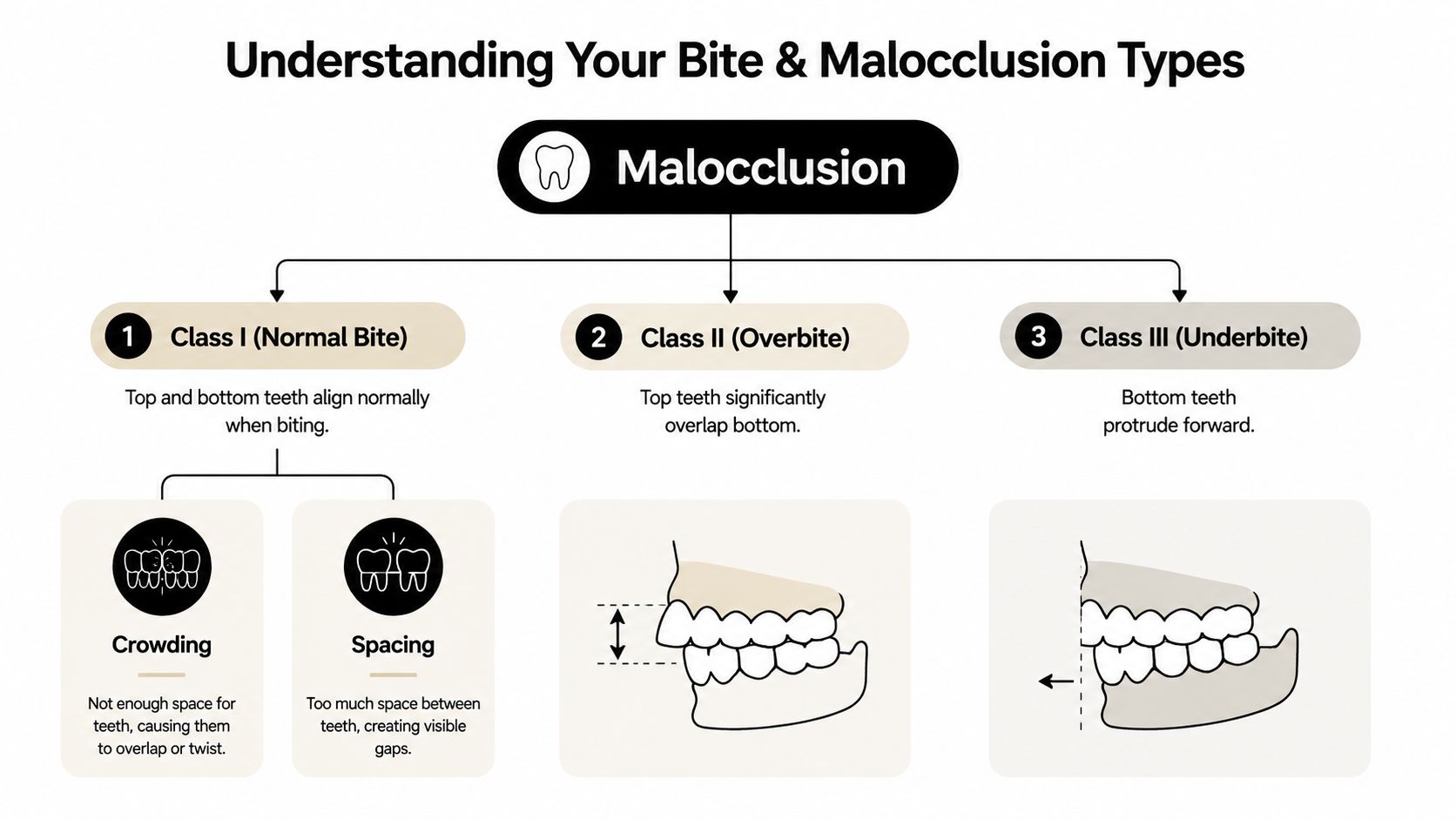
Class I
In Class I, the back teeth have a generally ordinary relationship, while the front teeth may be crowded, rotated, tilted, or spaced. This is the pattern many patients mean when they describe crooked teeth. Clear aligners may handle mild or moderate alignment concerns, but significant rotations, limited space, or complex bite goals can make fixed braces more predictable.
Black triangles can also appear after crowded teeth are straightened. These small spaces near the gumline may reflect tooth shape, gum position, or the way the teeth were overlapping before treatment. They should be discussed during planning rather than treated as an unexpected cosmetic issue afterward.
A crossbite may occur within this broader presentation. One or more upper teeth sit inside the lower teeth when the patient closes. In a growing child, an untreated crossbite can affect closure and contribute to an uneven growth pattern. Early evaluation helps determine whether tooth movement is enough or whether broader orthopedic and orthodontic care is needed.
Class II
Class II commonly presents as an overjet, with the upper front teeth positioned noticeably ahead of the lower front teeth, or as a pronounced overbite, with the upper incisors covering too much of the lower incisors. Tooth position, jaw growth, or both may contribute. Clear aligners can address selected Class II cases, but planning must account for anchorage and the way the bite is corrected, not only the visible front teeth.
Class III
Class III is commonly called an underbite. The lower front teeth sit ahead of the upper front teeth, sometimes because of tooth position and sometimes because the jaws have a skeletal discrepancy. Orthodontics may improve dental compensation, while a pronounced skeletal problem may require coordination with an oral and maxillofacial surgeon.
Open bites add another layer. Front teeth do not touch on closure, and tongue thrusting, airway concerns, skeletal growth, or other factors may contribute. Severe crowding, impacted teeth, major jaw discrepancies, and complex vertical corrections require careful treatment selection. A clinical examination should establish whether clear aligners, fixed braces, restorative dentistry, or an oral surgery referral fits the diagnosis. It should also clarify the retention demands, because teeth need long-term support after active movement ends.
Professional Treatment Options for Straighter Teeth
A patient with mild crowding may do well with removable trays, while another with rotated teeth, extraction spaces, or a jaw discrepancy may need fixed braces or surgical coordination. Treatment selection should match the diagnosis, not only the appearance of the front teeth. An orthodontist may use fixed or removable appliances to move teeth and improve the fit between the upper and lower jaws. Some patients also use a removable appliance before progressing to fixed braces (NCBI Bookshelf overview of malocclusion treatment).
Clear aligners
Clear aligners suit many mild-to-moderate malocclusions, particularly cases involving limited crowding, spacing, or selected bite adjustments. They can be removed for meals and brushing, which may make daily hygiene more manageable. The trade-off is discipline. Trays must be worn consistently, and frequent removal can disrupt the planned sequence of movement.
Aligners have limitations with severe rotations, difficult root movement, vertical corrections, extraction spaces, and major skeletal discrepancies. Round teeth can resist controlled rotation, so attachments may be placed to help the trays grip specific teeth. Aligner treatment can also require refinement trays if teeth do not track as planned. Winn Smiles provides Invisalign as an option when examination findings support that approach. Patients can review what Invisalign is and how it works before a consultation.
Traditional and ceramic braces
Metal braces remain useful when treatment requires detailed control of torque, root position, vertical relationships, or several teeth at once. Ceramic braces use tooth-colored components and may be less noticeable, but they use the same fixed-appliance method. Braces may suit complex crowding, extraction-based movement, severe rotations, or patients who may struggle to wear removable trays as directed.
Fixed appliances still require careful brushing around brackets, attention to food choices, and adjustment visits. Their advantage is continuous control, which can matter more than appearance when the goal is a stable bite and controlled root position. Ceramic brackets also require care because some components can be more prone to damage or staining depending on the appliance and habits.
Veneers and crowns
Porcelain veneers can mask minor shape or alignment concerns for an adult seeking a cosmetic change without orthodontically moving the roots. They do not correct the underlying bite, and placement generally requires irreversible enamel reduction. Significant crowding or an improper jaw relationship calls for tooth movement or other diagnosis-based care rather than veneers alone.
A crown may be appropriate when one tooth is both damaged and poorly positioned. It restores that tooth's structure and appearance, but it does not correct a wider alignment problem. Examination should establish whether the main need is cosmetic dentistry, restorative dentistry, orthodontic movement, or a combination.
Orthognathic surgery
Orthognathic surgery may be required when a skeletal jaw discrepancy cannot be corrected with orthodontic mechanics alone. The treatment plan typically coordinates an orthodontic provider with an oral and maxillofacial surgeon. The objective includes the relationship between the jaws, teeth, facial balance, and chewing function, not just a straighter smile.
Comparing treatment paths
Fees depend on the diagnosis, records, appliance selection, treatment duration, and any restorative or surgical care. Winn Smiles can provide a personalized estimate for Chattanooga and Cleveland patients after evaluation. The table offers a planning framework, while an examination determines the actual sequence, duration, and fee.
| Treatment Option | Best For | Typical Timeline | Estimated Cost Range |
|---|---|---|---|
| Clear aligners | Selected mild-to-moderate crowding, spacing, and bite concerns | Limited cases may take about 6 months; full treatment may take 24 months or longer | Case-dependent; discussed after records and treatment design |
| Metal braces | Complex alignment, rotations, torque, and extraction-related movement | Extensive care may take 24 months or longer | Case-dependent; discussed after records and treatment design |
| Ceramic braces | Patients seeking fixed treatment with a less noticeable appearance | Longer-term treatment may take 24 months or longer | Case-dependent; discussed after records and treatment design |
| Porcelain veneers | Minor cosmetic shape or alignment concerns | Cosmetic treatment can be completed more quickly than orthodontic movement | Case-dependent; quoted after restorative evaluation |
| Crowns | A damaged individual tooth needing structural restoration | May be completed through a restorative sequence | Case-dependent; quoted after examination |
| Orthognathic surgery with orthodontics | Significant skeletal jaw discrepancies | Requires a coordinated, multi-stage plan | Case-dependent; surgical and orthodontic fees are reviewed separately |
For patients comparing braces vs aligners costs timeline, the Mouthology treatment comparison outlines broad planning differences. The same appliance can involve a different fee and duration depending on the correction required, so local diagnosis remains necessary. The consultation should also address what happens after active treatment, including the retainer plan and the possibility that alignment may shift without long-term support.
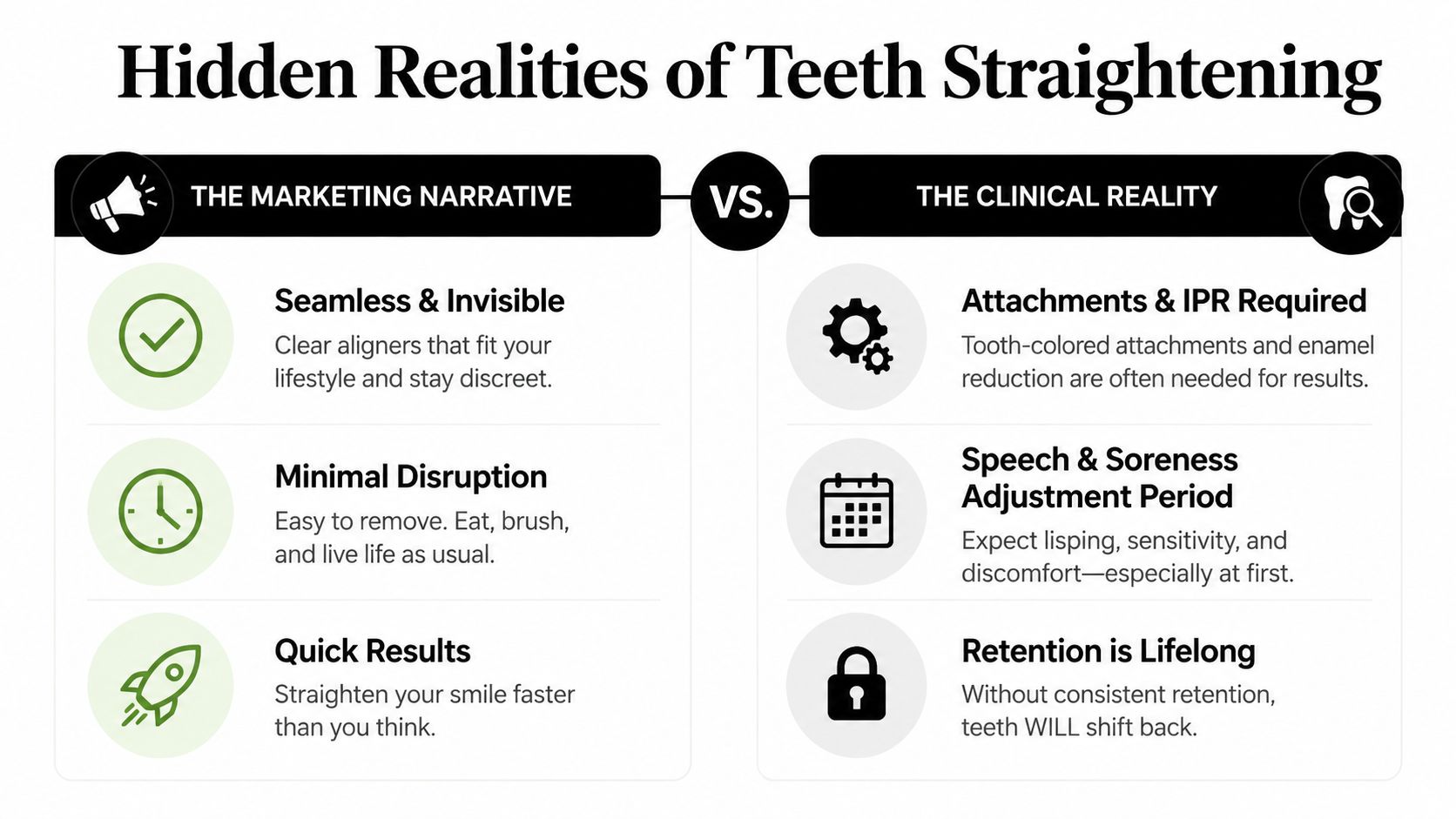
Hidden Realities of Teeth Straightening Most Guides Skip
Straightening teeth can improve function and appearance, but the final smile photo leaves out important clinical decisions. Before choosing treatment, ask what may change during alignment and what care will continue afterward.
Black triangles can appear
An open gingival embrasure, often called a black triangle, is a dark space between teeth where gum tissue does not completely fill the area. It may become more noticeable after alignment, especially when teeth have triangular crowns, the incisors angle forward, or gum and bone support has changed with age.
A 2025 retrospective study reported black triangles in 48.75% of clear-aligner patients, most often between the upper central incisors. It associated the finding with incisor proclination and no interproximal reduction (the study on open gingival embrasures after clear-aligner treatment). This does not predict the result for every patient. It does support discussing tooth shape, gum health, possible enamel reshaping, and realistic aesthetic expectations before treatment.
Retainers are part of treatment
Teeth can shift after braces or aligners, so retention is part of the treatment plan rather than a brief administrative step afterward. Your provider may recommend a removable retainer, a bonded retainer, or both, based on the teeth moved and the likelihood of relapse. Wearing the retainer as directed helps protect the correction.
Periodontal health also affects stability. Winn Smiles provides information about braces and bone loss, but an individualized assessment matters when there is gum recession, bone loss, bleeding, or tooth mobility.
Aligners have boundaries
Clear aligners can work well for selected cases, but they are not a universal answer for crooked teeth. Evidence supports their use most clearly in mild-to-moderate cases. Severe skeletal discrepancies and impacted teeth are generally poor candidates. Reviews also describe limits involving root control, anchorage loss, and differences between planned and achieved movement in extraction cases (recent evidence on clear-aligner indications and limitations).
Treatment staging affects how complex movements are managed. A review describes staged movements, phase-specific attachment changes, and three-dimensional planning as ways to improve accuracy compared with combining several difficult movements in one phase (review of aligner staging and attachment sequencing). Attachments may feel unfamiliar, speech can require an adjustment period, and refinements or mid-course corrections may be appropriate parts of treatment.
Patients may also have questions about aligner materials. A 2026 scoping review documented microplastic release from aligners but concluded that the health risk remains unknown. Raise those concerns during your consultation and ask which materials and cleaning instructions apply to your plan.
What to Expect at Your Winn Smiles Consultation
A first visit should feel like a conversation, not a sales presentation. At Winn Smiles in Chattanooga or Cleveland, you can begin by explaining what bothers you, whether that's crowding, a changing bite, gum concerns, appearance, or anxiety about dental treatment. Your goals help shape the questions the clinical team asks.
The evaluation
The team may collect photographs, digital scans, and dental X-rays to assess tooth positions, root angles, bite relationships, bone support, and existing dental work. Digital records can be more comfortable than traditional impression material, and they give the dentist a detailed basis for discussing aligners, braces, veneers, crowns, or a referral.
The examination also screens for problems that should be managed before elective alignment. Cavities, gum disease, infection, worn enamel, cracked teeth, or an unstable restoration can change the sequence of care. If you're also considering dental implants near me, tooth replacement, or cosmetic dentistry, the plan should account for those goals rather than treating each tooth in isolation.
The treatment discussion
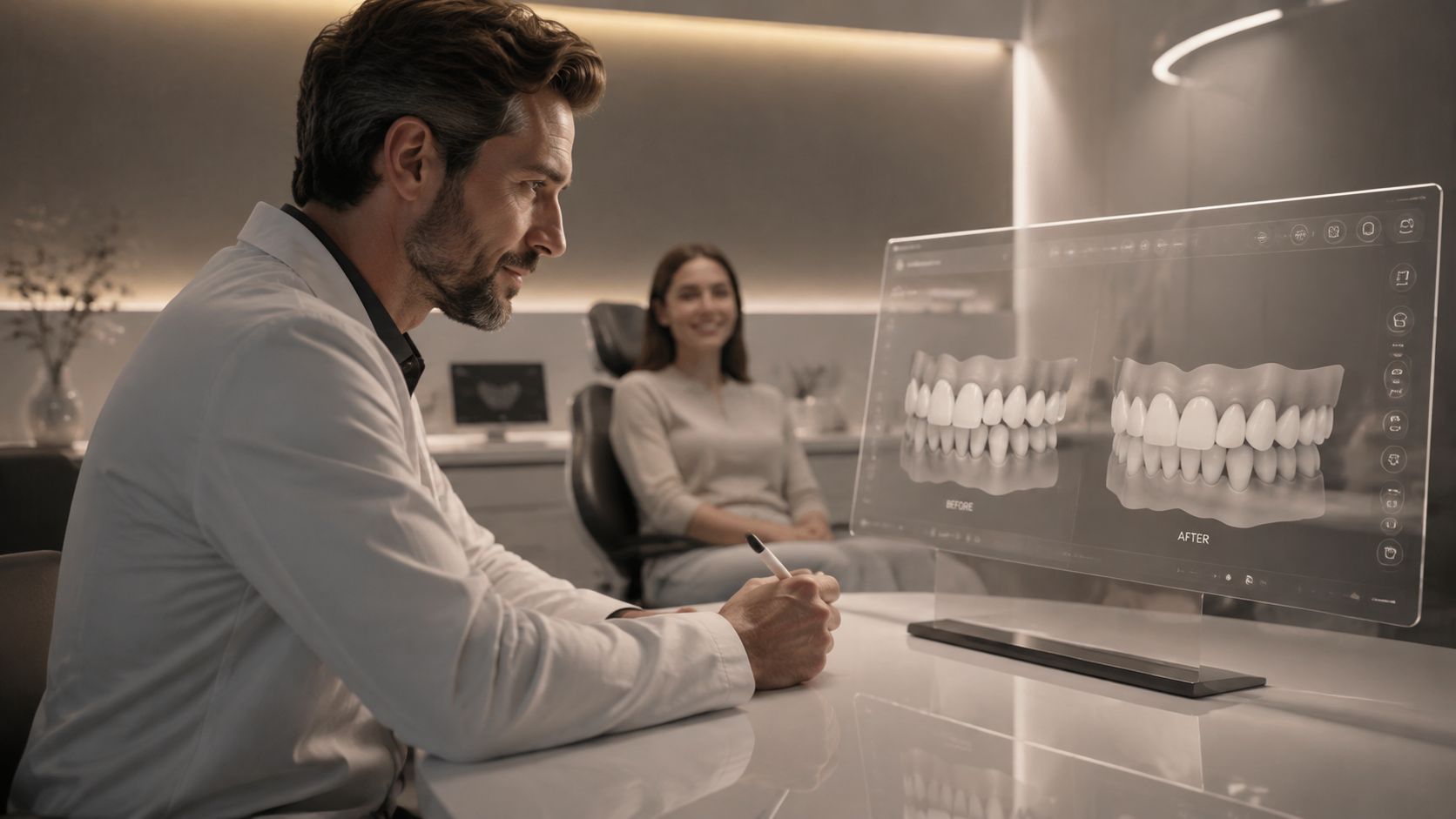
Once the records are reviewed, the team can explain the recommended approach, alternatives, expected sequence, and factors that could change the plan. Digital treatment simulations may help you understand potential tooth movement, although a simulation is a planning tool, not a guarantee of the final result.
A clear financial conversation matters. Ask what the estimate includes, whether refinements or retainers are included, what payment and financing options are available, and whether restorative or periodontal treatment is separate. Transparent planning lets you compare the full scope of care instead of comparing appliance names alone.
Comfort and decision-making
Patients with dental anxiety can ask about comfort measures such as nitrous oxide or oral sedation when clinically appropriate. Winn Smiles also offers a comfort-focused environment and customized sedation options, but sedation decisions require a review of your health history, medications, and treatment needs.
Bring your questions. You shouldn't feel rushed into accepting treatment during the appointment. A good consultation ends with a diagnosis, a practical roadmap, and enough information to decide whether you're ready to proceed.
Take the First Step Toward a Confident Smile
Deciding to fix misaligned teeth can feel more personal than choosing a dental procedure. You may have postponed care because you're embarrassed by your smile, worried about discomfort, or unsure whether aligners, braces, veneers, or another option will suit your bite. Those concerns are common, and they're best addressed with a careful evaluation rather than a generic online recommendation.
The right plan may involve Invisalign for selected alignment concerns, traditional or ceramic braces for more complex movement, restorative dentistry for a damaged tooth, or a combination of services. A professional examination can also identify gum, bone, airway, or bite issues that aren't visible in a selfie. That information helps you choose treatment for function and long-term stability, not just a temporary cosmetic change.
Schedule a free consultation at Winn Smiles in Chattanooga or Cleveland to discuss your goals without obligation or pressure. The practice offers flexible scheduling, transparent cost discussions, modern diagnostic technology, and comfort options for patients who feel nervous about dental care. You'll leave with honest answers about what can be corrected, what trade-offs to expect, and which next step makes sense for your smile.
If you're ready to stop wondering how to fix misaligned teeth, call or book online and begin with the evaluation that makes the decision clearer.
Winn Smiles offers Invisalign evaluations, braces-related guidance, cosmetic dentistry, restorative care, and comfort-focused dental services for patients in Chattanooga and Cleveland. Visit Winn Smiles to request a consultation and discuss a personalized plan for straighter teeth and a healthier bite.